Buyer Fit Snapshot
| Best fit | Custom Handle Boxes for Retail projects where brand print, material claims, artwork control, MOQ, and repeat-order consistency need to be specified before quoting. |
|---|---|
| Quote inputs | Share finished size, material target, print colors, finish, packing count, annual reorder estimate, ship-to region, and any compliance wording. |
| Proofing check | Approve dieline scale, logo placement, barcode or warning zones, color tolerance, closure strength, and carton packing before bulk production. |
| Main risk | Vague material claims, crowded artwork, missing packing details, or unclear freight terms can make a low unit price expensive after revisions. |
Fast answer: Custom Handle Boxes for Retail: Design, Cost & Strategy should be specified like a repeatable production item. The safest quote records material, print method, finish, artwork proof, packing count, and reorder notes in one written spec.
Production checks before approval
Compare the actual filled-product size with the drawing, then confirm tolerance on folds, seals, hang holes, label areas, and retail display edges. Reserve space for logos, QR codes, warning copy, and material claims before decorative graphics fill the panel.
Quote comparison points
Review material grade, print process, finish, sampling route, tooling charges, carton quantity, and freight assumptions side by side. A quote is only useful when the supplier can repeat the same color, closure quality, and packing count on the next order.
Custom Handle Boxes for Retail: Design, Cost & Strategy
Custom handle Boxes for Retail do more than make a product easier to carry. They turn the trip from shelf to checkout into part of the brand experience, which is exactly why smart retailers treat the box like selling space, not throwaway filler. A handled carton can lift perceived value fast. Only if the structure, finish, and load support are built for real use. Otherwise it is just a pretty hole in a weak box, and that is a bad trade.
From a packaging buyer's point of view, custom handle Boxes for Retail sit at the intersection of convenience, branding, and product protection. The right spec can cut down on awkward carry complaints, improve shelf presence, and make a gift-ready item feel finished without padding the cost with nonsense. The wrong spec does the opposite. That is why the details matter: board grade, handle design, insert fit, and the way the box folds under pressure all change the result.
Custom Handle Boxes for Retail: What They Are and Why They Sell
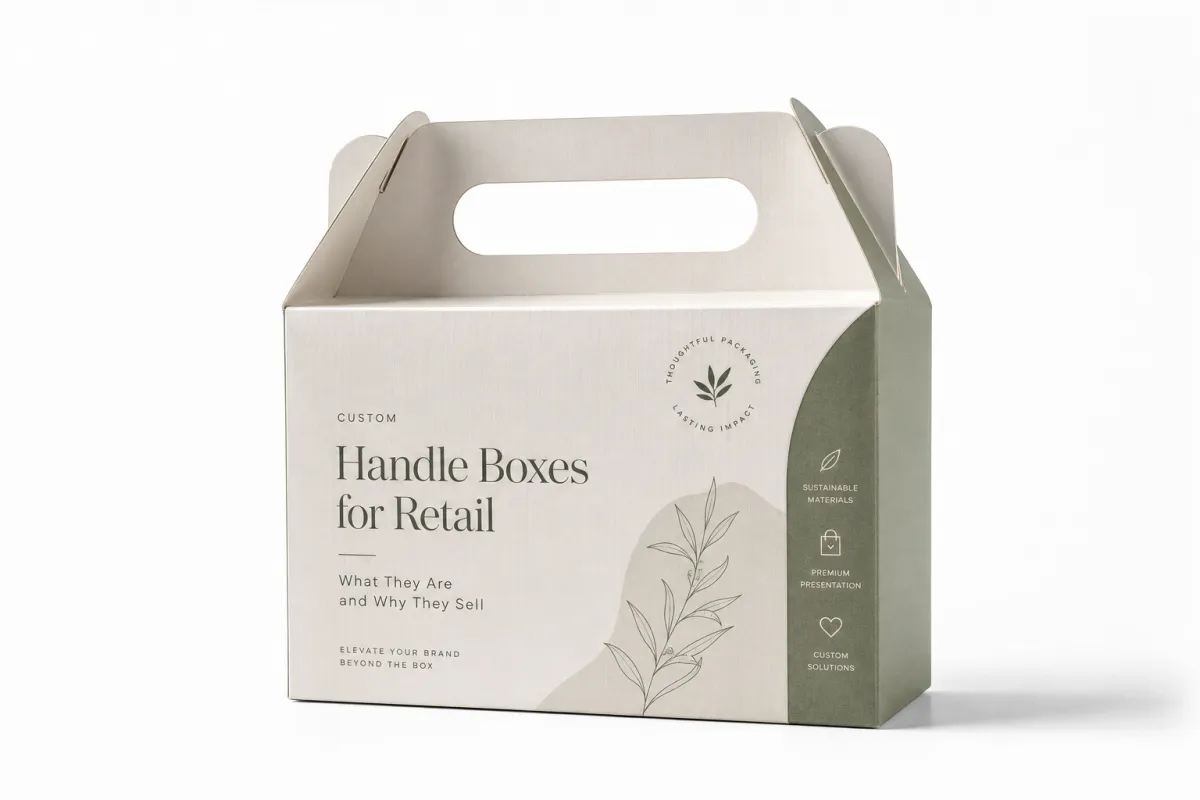
Custom handle boxes for retail are packaging formats built with a carrying feature integrated into the carton structure. In plain language, they are retail boxes with a die-cut handle, attached handle, or reinforced carry point so shoppers can move the product without juggling a bag, a loose sleeve, and a small miracle. You will see them used as folding cartons, corrugated retail cartons, and rigid presentation boxes, depending on weight and brand position.
These boxes sell because they solve a real behavior problem. Shoppers do not want to hold an awkward box with two fingers while also carrying a phone, keys, and another purchase. A handle gives them a cleaner path from checkout to home, and that convenience makes the box feel more premium. That matters for gift sets, beauty kits, gourmet assortments, apparel bundles, and promotional packs where packaging is part of the decision, not an afterthought.
The branding effect is easy to miss, which is odd because it is staring at you. A handled box gives your logo another touchpoint every time the customer picks it up, carries it, or sets it down. With custom handle boxes for retail, the package becomes a moving billboard for a few important minutes, and those minutes matter in a store. Good package branding does not need to shout; it needs to be seen, remembered, and easy to trust.
There is one thing buyers often get wrong: a handle is not decoration. Custom handle boxes for retail need the right wall thickness, handle geometry, and closure behavior or the box will fail exactly where people touch it most. A clean printed surface is nice. A box that rips at the carry point is expensive theater.
I have watched teams approve a box because the render looked polished, then act surprised when the first filled sample sagged like a bad paper grocery bag. That is not a design surprise. That is a missing test.
- Convenience: easier carrying at checkout and on the way home.
- Shelf presence: a handle changes the silhouette and helps the box stand out.
- Perceived value: customers often read handled packaging as more premium.
- Brand recall: the logo gets seen in motion, not just on a shelf.
For brands comparing custom handle boxes for retail with standard cartons, the choice usually comes down to whether transport is part of the product experience. If it is, the handled format earns its keep quickly. If not, you may be paying for a feature the customer barely uses. That is a design decision, not a moral one.
How Custom Handle Boxes for Retail Work
Custom handle boxes for retail work because the structure spreads stress across the board instead of dumping all the load into one weak point. A typical build includes a base panel, side walls, a top closure, and a handle that may be cut from the board, folded from the same sheet, or attached as a separate element. Reinforcement can come from doubled layers, glued patches, tabs, or inserts that keep the product from shifting and pulling the handle off balance.
The handle style matters more than most mockups suggest. A cut-out handle is efficient for lighter products and lower price points. A folded paper handle is often used for midweight retail items where the customer wants a softer grip. Rope or ribbon handles can read more premium, though they are not automatically stronger. Reinforced board handles are usually the safer choice for heavier or more valuable products because they spread the load better across the top panel. With custom handle boxes for retail, the best handle is the one that survives the actual filled weight, not the one that looks nicest in a rendering.
The customer journey also deserves a reality check. These boxes have to survive shipping or pallet movement, sit cleanly on the shelf, get picked up at checkout, and then carry well at home. That means custom handle boxes for retail should be tested in the same sequence the customer will experience: transport, display, pickup, and carry. A box that looks good in a static photo can still fail when a cashier lifts it from one edge or when a product shifts inside during a turn.
Load distribution is where many brands get burned. If the handle is too close to the front panel, the box tips. If it is too close to the edge, the board tears. If the insert does not lock the product in place, the entire weight can slap against one side of the box and stress the carry point. The right packaging design balances grip comfort, center of gravity, and tear resistance. That sounds technical because it is. Packaging is physics wearing branding clothes.
For standards-minded teams, it helps to look at real testing guidance instead of guessing. General performance checks often follow transport and vibration principles used in package testing; resources from ISTA are useful for understanding the abuse a box may face in transit. If your program uses fiber-based board, FSC sourcing claims can support your sustainability story, but only when the paper chain is actually documented. Otherwise it is just a label with good PR.
"The customer should feel the box helping them, not fighting them."
That line comes up a lot in packaging reviews, and it applies directly to custom handle boxes for retail. If the grip digs into the hand, if the lid opens under weight, or if the box bends in the middle, the handle has failed its job. The smart move is to prototype early and test with a filled sample, not a paper model and optimism. Paper optimism is cheap. Returns are not.
Key Factors That Change Performance and Price
Material choice is the biggest price and performance lever in custom handle boxes for retail. SBS paperboard gives you a smooth print surface and a clean retail feel, often in the 300-400gsm range for folding formats. Kraft board reads more natural and works well for brands that want a straightforward, earthy look, though heavy coverage printing can be less vivid on uncoated stock. Corrugated board brings more strength and is common for larger or heavier items. Rigid board, usually around 1.5-3 mm thick depending on the build, delivers the most premium feel but also raises both material and freight costs.
Size changes the math quickly. A larger custom handle boxes for retail program consumes more board per unit, needs a stronger handle, and may require more complex inserts to keep the product from rattling. That means a box that is only slightly bigger on paper can cost noticeably more once the dieline is optimized and the reinforcement is added. Most buyers underestimate how quickly dimensions affect both board usage and shipping volume.
Print complexity is another obvious driver. A one-color logo on kraft is a different animal from full-coverage custom printed boxes with foil, spot UV, embossing, or fine-line artwork. Decorative finishes can raise the bill, but they also change how the product reads on shelf. Matte lamination looks quieter and more modern. Gloss boosts color intensity. Soft-touch feels expensive but can show scuffs if the box is handled a lot. For custom handle boxes for retail, choose finishes that match the product category, not just the mood board.
Order volume matters because setup costs are fixed. Dielines, plates, cutting dies, and machine setup are spread across the run, so lower quantities usually carry a higher per-unit price. A small order of custom handle boxes for retail might look expensive next to a larger run, but that is normal. Setup does not care about your spreadsheet.
Here is the practical way to think about it: spend money where the customer touches the box, and save money where the structure can be simplified without losing strength. That usually means a stronger handle, a cleaner closure, and efficient internal support before you add decorative extras. Good packaging strategy is rarely about maxing out every feature. It is about choosing the features that actually matter.
One more thing from the production floor: if a spec sheet does not mention product weight, it is incomplete. Weight drives the structure more than a pretty mockup ever will, and ignoring it is how brands end up paying for a "premium" build that still feels flimsy in the hand.
Custom Handle Boxes for Retail Cost and Pricing Basics
Pricing for custom handle boxes for retail usually moves with six variables: size, board grade, print coverage, handle construction, finish, and quantity. If one of those changes, the quote changes. If three of them change, the quote can change a lot. That is why apples-to-apples comparison is so important when you request estimates.
For realistic budgeting, simple folding handle boxes in moderate quantities can land around $0.35-$0.90 per unit depending on size and print coverage. Heavier corrugated retail cartons often move into the $0.80-$1.80 per unit range. Rigid or highly finished custom handle boxes for retail can run $1.50-$4.00+ per unit when you include specialty coating, inserts, or premium handle construction. Those are not universal numbers, because they depend on specifications, but they are useful enough to keep a budget from drifting into fantasy.
Shipping can wreck a cheap quote if you ignore it. A low unit price on bulky custom handle boxes for retail may look great until freight, pallet counts, and damage risk are added. A slightly more expensive but flatter structure can win on total landed cost. Buyers who only compare unit price often learn this the expensive way, usually after a warehouse receives crushed corners and everyone suddenly discovers "savings" has a very short half-life.
If you want a cleaner quote comparison, ask for the same dimensions, the same material, the same finish, the same handle type, and the same packing method. Even the best custom packaging products can be mispriced if one supplier quotes a folded board style and another quotes a rigid, fully assembled format. The words sound close. The cost structure is not close at all.
| Format | Typical Board | Strength | Print/Finish Feel | Common Budget Range |
|---|---|---|---|---|
| Folding handle carton | 300-400gsm SBS or kraft | Light to medium | Good for crisp graphics | $0.35-$0.90 |
| Corrugated retail box with handle | E-flute or B-flute | Medium to heavy | Good with simpler artwork | $0.80-$1.80 |
| Rigid handled presentation box | 1.5-3 mm rigid board | Heavy | Best premium perception | $1.50-$4.00+ |
| Reinforced specialty build | Mixed board + insert system | Heavy or awkward items | Highly customized | $2.00-$5.00+ |
That table is not a quote sheet. It is a decision guide. The point is to show how custom handle boxes for retail scale with complexity. If your product is light and the brand wants a sharp shelf look, a folding format may be enough. If the item is heavy, high-value, or awkwardly shaped, paying more for reinforcement is usually the smarter spend because it reduces failures and protects the customer experience.
For supply teams, a clean rule helps: compare total landed cost, not just the factory price. Include freight, damage allowance, and the number of units that actually make it to shelf in sellable condition. The cheapest custom handle boxes for retail are not cheap if 8% of the run arrives damaged or performs badly in store. That is not savings. That is invoice cosmetics.
Step-by-Step Process and Timeline
A clean project for custom handle boxes for retail starts with the product, not the artwork. Measure the item, note the weight, decide whether it will ship flat or pre-filled, and define how the box will be used in store. Is it a one-time purchase, a gift item, or a reusable carry package? That answer shapes the structure before design even begins. A box for a 300g beauty kit does not need the same engineering as a 1.2 kg gourmet set.
Next comes dieline selection. This is where the packaging design gets real. The die-cut pattern controls the fold sequence, handle position, closure type, and insert behavior. If the structure is wrong, the print does not matter much. You can dress up a weak carton all day, but custom handle boxes for retail are judged by how they hold weight and move in a hand. Structure first. Decoration second. That order saves money and headaches.
Prototype review is the point where buyers learn the truth. A plain sample checks fit, fold logic, and strength. A printed proof checks color, legibility, and shelf impression. A filled sample checks balance, grip comfort, and whether the handle tears when the box is lifted from one corner. For custom handle boxes for retail, all three samples serve a different purpose, and skipping one is how a brand ends up approving a box that looks fine but feels wrong.
Typical timing breaks into a few chunks: artwork approval, sample approval, manufacturing, finishing, packing, and freight. A straightforward run may take 12-18 business days after approval, while a more complex custom handle boxes for retail project with foil, inserts, or revised tooling can take longer. The exact schedule depends on plant capacity, seasonality, and how fast feedback moves through your team. Slow approvals are usually the real delay, not the machine.
If you want to keep the schedule honest, build in one round for samples and one round for corrections. Teams that pretend everything will be approved on the first pass tend to schedule themselves into a corner. The better move is to set a realistic timeline, keep version control tight, and make sure the final spec is frozen before production starts. Changes made after approval are where budgets go to die.
For teams with broader packaging programs, it can help to review the rest of your lineup in the Custom Packaging Products catalog so the handle box does not feel disconnected from the rest of the shelf system. Matching structure and graphic language across product families usually improves brand consistency without forcing every item into the same mold.
Common Mistakes Brands Make with Handle Packaging
The most common mistake in custom handle boxes for retail is choosing a handle that looks elegant but cannot survive the filled weight. That usually happens when the mockup is approved empty and nobody tests the box with the real product inside. Then the first sample tears, the handle distorts, and the pretty concept turns into a production problem. A handle should be comfortable, yes, but comfort without strength is just a faster failure.
Another problem is ignoring product balance. If the contents sit too low, too high, or too far forward, the box will swing, tilt, or dig into the hand. Custom handle boxes for retail need the product centered so the carry point and the load point cooperate. This is basic physics, which means it gets skipped with shocking regularity.
Overdesign is a quieter issue. Brands sometimes load the box with metallic inks, multiple spot colors, textured finishes, and a complex window layout, then leave the structure thin and underbuilt. The result is a package that looks expensive until someone picks it up. Good branded packaging should not need to apologize when it leaves the shelf. Strong presentation and strong structure should move together.
Retail handling is another place where assumptions fail. Boxes are stacked in back rooms, nudged by shelf lips, lifted quickly by cashiers, and loaded into bags or cars. If the closure pops open or the corner crushes, the box is not retail-ready. Custom handle boxes for retail should be tested for the boring realities: warehouse movement, checkout speed, and whether the customer can carry the box without holding their breath.
Not testing samples is the final classic mistake. Buyers approve a render, skip the filled prototype, and then discover the handle rubs, the insert shifts, or the board cracks at the fold. That is avoidable. With custom handle boxes for retail, a sample in hand is cheaper than a return, cheaper than a complaint, and definitely cheaper than reworking a printed run after the fact.
If you need a better testing baseline, look at package performance guidance from industry groups and build a simple pass/fail checklist around drop, grip, and closure integrity. A lot of teams make this more dramatic than it needs to be. It is not drama. It is a box. It either carries well or it does not.
Expert Tips and Next Steps for Retail Brands
Match the structure to the product category before you chase the finish. Beauty packaging usually wants a clean, refined feel with a modest load. Gourmet food and gift sets often need stronger board and a handle that feels secure in one hand. Apparel and accessory bundles can use lighter structures if the contents are soft and well-contained. Electronics and heavier kits usually need reinforcement and a more disciplined insert system. Custom handle boxes for retail work best when the engineering matches the item, not the mood board.
Keep the design system simple enough to read quickly. A strong logo, a clear product name, and one memorable finish are usually better than cramming every branding idea onto one panel. Retail shelves are crowded. People glance, compare, and move on. Custom handle boxes for retail should communicate value in a second or two, not require a meditation break. That is where package branding earns its keep.
Sample testing should stay practical. Put the actual product inside. Check the carry feel. Lift from the handle. Tilt it. Set it on the shelf. Open and close it a few times. If the box is for gift retail, ask whether it feels ready to hand to someone without explanation. If it is for daily retail traffic, ask whether the handle still feels comfortable after a few minutes. That is better than judging by CAD files and good intentions.
Before you request quotes, prepare a short spec sheet: dimensions, product weight, quantity, print areas, finish, shipping destination, and lead-time target. That one page can save days of back-and-forth. If you are comparing vendors, ask each one to quote the exact same custom handle boxes for retail build, then compare unit price, freight, sampling cost, and expected damage rate. The supplier who looks cheapest on paper is not always the cheapest in practice.
Two more practical moves help a lot. First, request a physical prototype before locking the run. Second, compare two or three structural options instead of one fixed concept. Small changes in board thickness or handle reinforcement can move cost and performance in meaningful ways. If you are already reviewing Custom Packaging Products, use that process to line up your handle box with the rest of your product packaging so the shelf story feels consistent.
For teams who want a cleaner decision rule, here it is: spend more where the customer touches the box, spend less where the structure can be simplified, and never approve custom handle boxes for retail without a filled sample. That sounds simple because it is. The hard part is resisting the urge to guess. And yes, guessing is usually what causes the repair bill.
Custom handle boxes for retail are worth the investment when they improve carrying comfort, strengthen shelf appeal, and support the product value you want the customer to feel. If the box does that well, it pays back through better presentation and fewer practical headaches. If it does not, it becomes a cost center with a nice logo. Nobody needs that.
The most useful next step is not a mood board. It is a filled sample, a clear weight target, and a spec sheet that names the exact board, handle, and finish you plan to use. Start there, test it in the hand, and only then decide whether the fancy version is actually worth the money.
What are custom handle boxes for retail best used for?
They work best for items customers carry immediately after purchase, such as gifts, cosmetics, apparel sets, food assortments, and premium promotional kits. They also help when the box itself needs to reinforce brand value at checkout or on the sales floor, which is why custom handle boxes for retail show up so often in branded packaging programs.
How do I choose the right handle style for retail packaging?
Pick the handle based on weight, comfort, and presentation. Cut-out handles suit lighter items, while reinforced or attached handles are better for heavier loads. Test the carry feel with a filled sample before approving production, because custom handle boxes for retail can look fine in a mockup and still feel terrible in the hand.
What affects the cost of custom handle boxes for retail the most?
Material grade, box size, print coverage, finish, handle construction, and order quantity drive most of the price difference. Freight can also change the total cost a lot, especially for bulky rigid styles. If two quotes use different specs, they are not really comparable, even if both are labeled custom handle boxes for retail.
How long does it take to produce custom handle boxes for retail?
Timing depends on whether you need samples, revised artwork, or specialty finishing. A straightforward order can move faster than a custom structural project with multiple approval rounds, and custom handle boxes for retail often take longer when inserts, foil, or reinforcement changes are part of the build.
Can custom handle boxes for retail be used for heavier products?
Yes, but the structure needs reinforcement, stronger board, and a handle designed for the actual product weight. If the product is heavy or awkwardly shaped, prototype testing is non-negotiable. That is the difference between a retail package that helps and custom handle boxes for retail that become a liability.

