A custom wooden keepsake box does more than hold an item. It changes the way the item is perceived, handled, and remembered. A gift in a plain carton is still a gift. A gift in a well-made wooden box becomes an object with a second life, one that often stays on a shelf, desk, or dresser long after the first unboxing.
That matters because packaging is not just protection. It is part of the product's value signal. Wood carries weight, grain, and permanence in a way paperboard cannot quite match. Plastic can be durable, but it rarely feels ceremonial. A wooden box sits in a different category altogether: half packaging, half keepsake, and, in many cases, part of the product itself.
In premium packaging, the container is often judged before the product is touched. If the box feels generic, the brand starts at a disadvantage.
Buyers usually reach for a custom wooden keepsake box when the item inside has emotional or commercial value that deserves more than disposable packaging. Jewelry, awards, wedding favors, heirloom storage, collector pieces, and corporate gifts all fit that pattern. The use cases vary, but the buying logic is similar. The packaging has to protect, present, and remain credible after the moment of purchase.
What a custom wooden keepsake box is and why it stands out
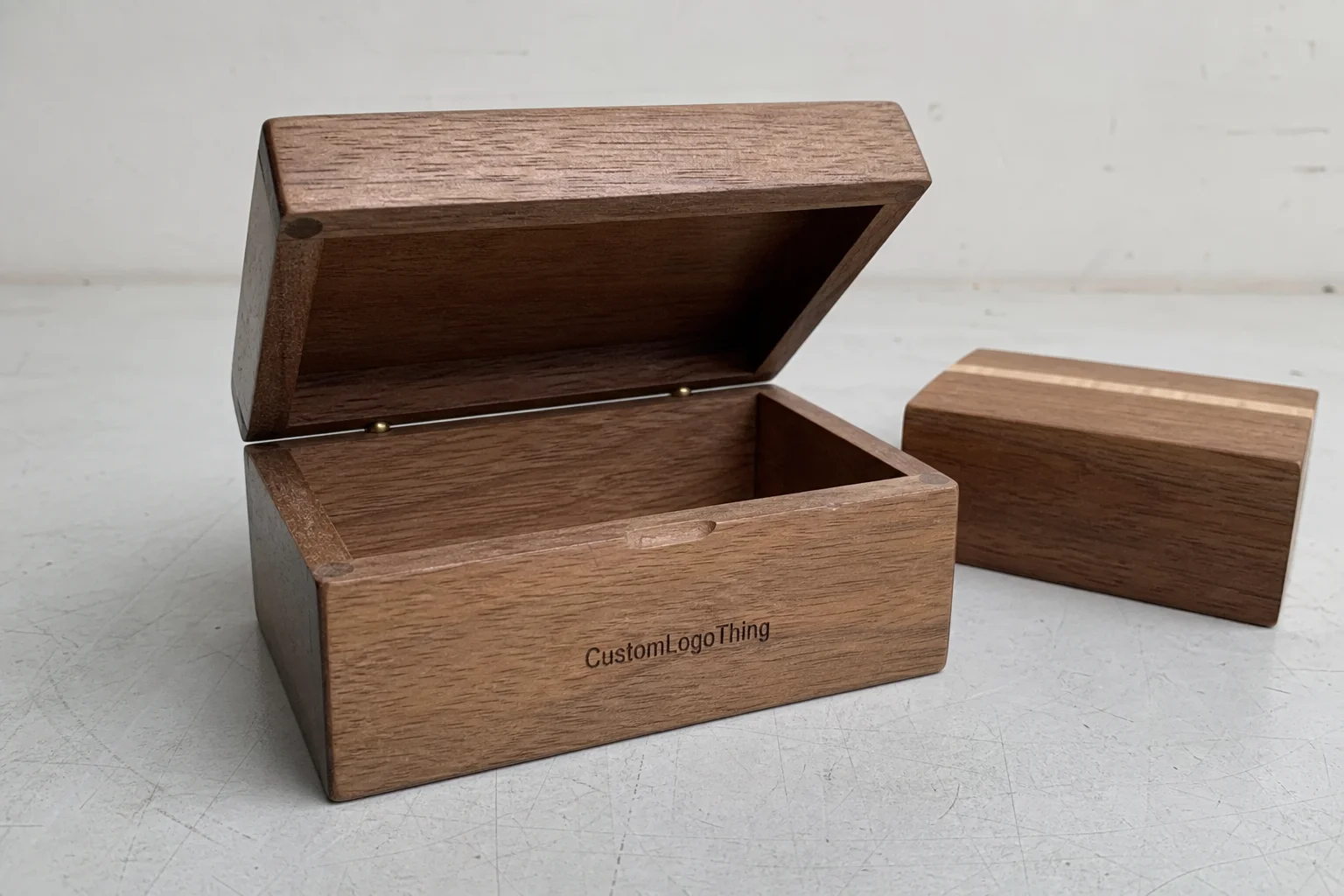
At its simplest, a custom wooden keepsake box is a reusable presentation box built from wood or wood-based materials and tailored to a specific item, brand, or occasion. Some are designed for one object. Others use dividers, foam, or fabric-lined cavities to hold a set in place. The better versions are engineered around fit, because a loose interior creates movement, noise, and avoidable wear.
Wood stands out because it signals something paperboard usually does not: permanence. A premium folding carton can look polished, especially with strong print and good finishing, but it still reads as temporary. Wood has texture, depth, and enough structural presence to make the opening feel deliberate. That is why it shows up so often in branded packaging for premium goods, anniversary gifts, and presentation pieces.
There is also a practical advantage that gets overlooked. If the box is worth keeping, the brand stays visible longer. That matters in retail packaging, collector items, and corporate gifting, where the container may remain in circulation for months or years. A good box becomes a small, durable brand asset.
Most orders fall into a few broad categories:
- Jewelry and watches, where closure feel, lining, and interior fit matter.
- Awards and recognition pieces, where the box becomes part of the presentation.
- Wedding and event favors, where the packaging itself may be kept.
- Corporate gifts, where package branding needs to look controlled and polished.
- Heirloom storage, where protection matters as much as display.
That overlap between packaging design and product design is what makes this category different. The box is not just wrapping. It influences how the recipient reads the item before the item is even seen.
How the box works: materials, closures, and inserts
The substrate drives a surprising amount of the final result. Solid wood gives the strongest natural character and often the highest price point. Veneer over MDF is more common in commercial programs because it gives a wood face with better dimensional stability and more predictable costs. Bamboo has a cleaner, lighter look and fits brands that want a more modern or environmentally conscious visual language. Hybrid constructions, where an engineered core is paired with a wood surface, often offer the best balance of appearance, consistency, and cost control.
Closures shape the unboxing experience more than many buyers expect. Magnetic lids feel clean and contemporary. Hinged tops carry a more traditional, presentation-box feel and usually communicate sturdiness. Sliding lids work well for flatter items and can create a more refined reveal. Hidden magnets keep the exterior uncluttered while still giving a secure close. Clasps and latches can look attractive, but they add hardware complexity and, in many cases, more labor.
The interior is where many projects either come together or start drifting. Foam inserts are common for fragile items because they hold shape and prevent movement. Velvet or fabric-lined inserts add softness and usually read as more premium for jewelry and gift sets. EVA foam works well when the item needs a precise cavity. Cardboard dividers are economical for multi-item sets, though they usually feel less luxurious than wrapped or lined solutions. Laser-cut inserts can be extremely accurate, but they depend on tighter tolerance control than many buyers realize.
Decoration should match the material, not fight it. Laser engraving usually works best on natural wood or veneer. UV print is useful when the artwork includes color or fine detail. Foil stamping can look strong on darker finishes, but it needs a flat, well-prepared surface to avoid visual inconsistency. Routed lids create depth and can elevate a logo without adding ink. Branded hardware is another option, though the extra detail only makes sense if it genuinely improves the box rather than merely adding cost.
Two practical realities sit behind all of this. First, wooden packaging ships differently from paperboard, so carton design and freight planning matter more than they do with lighter packaging formats. Second, the weight often increases the perceived value of the box. That is not a cosmetic detail. A heavier presentation piece signals structure before the lid is opened.
For brands comparing wood against other Custom Packaging Products, the real question is not whether wood looks better. It is whether the item justifies a longer-lived, more substantial presentation format.
Key factors that affect cost, pricing, and MOQ
Cost usually comes down to a short list of variables: wood species, size, lid style, insert complexity, finish level, and decoration method. When two quotes are far apart, the difference is usually sitting in one of those details. It is rarely a mystery. It is usually a spec difference.
For planning purposes, unit price behaves in a predictable way. Small runs carry more setup cost per box, while larger orders spread sampling, tooling, and labor across more units. A simple veneer-over-MDF box with a single-color logo might sit around $6 to $12 per unit at mid-volume. A more complex solid-wood build with a fitted insert and premium finish can move into the $14 to $30 range or higher. Those are working ranges, not promises. Dimensional complexity, surface area, and finish method can push the number quickly in either direction.
MOQ usually climbs as the box becomes more custom. Standard sizes, one finish, and one decoration method are easier to run in smaller batches. Special stains, multiple inserts, fabric linings, or mixed hardware typically raise the minimum order. That is not a supplier tactic. It is the cost of setup and changeover.
There are also hidden costs that tend to show up late if nobody asks for them early:
- Sampling and revision rounds.
- Artwork proofing and color matching.
- Custom cartons or outer protection.
- Freight surcharges for bulky or heavy goods.
- Breakage allowance and transit testing.
If the box supports a launch, the landed cost matters more than the unit cost. A quote that looks attractive at first glance can become expensive once freight, cartons, and rework are added. For teams comparing vendors, the supplier should be able to break out the box, insert, decoration, and shipping separately. If they cannot, the quote is not ready for a decision.
| Build option | Typical look and use | Approx. unit cost at mid-volume | Best for | Watch-outs |
|---|---|---|---|---|
| Solid wood | Heavy, tactile, natural grain | $14-$30+ | Heirlooms, awards, premium gifting | Higher shipping weight, more variation |
| Veneer over MDF | Controlled finish, consistent face | $6-$12 | Jewelry, corporate gifts, retail packaging | Edge finish and moisture control matter |
| Bamboo or hybrid build | Modern, clean, lighter feel | $7-$16 | Eco-forward product packaging, smaller gift sets | Surface prep affects print and engraving |
That table is a reference point, not a quote sheet. The real number depends on quantity, cavity complexity, and whether the decoration is a single operation or a layered one. A supplier who gives a precise answer before seeing dimensions is usually estimating.
Process and lead time: from concept to delivery
The production path is simple in theory and unforgiving in practice. It usually starts with a brief, then moves through spec review, prototype, revision, mass production, finishing, packing, and shipment. If the buyer provides clear dimensions and artwork up front, the process is cleaner and the final box is more likely to match the original intent.
Sampling deserves more attention than it often gets. The first sample is not only about appearance. It is for fit, closure feel, insert depth, grain consistency, print placement, and edge finish. A lid that looks excellent in a photo can still feel weak if the closure snaps too hard or the hinge line sits unevenly. That is why sample review should happen under normal lighting and with the actual item inside the box.
Lead time depends on three variables more than any others: sample approval speed, material availability, and decoration complexity. Straightforward structures can move relatively quickly once the spec is fixed. If the build includes multiple finishes, fabric lining, or detailed engraving, the schedule expands. In practice, a simple custom wooden keepsake box may move through production in roughly 2 to 4 weeks after approval, while more complex programs can take longer. Freight adds another variable, especially for international shipments or peak-season routing.
That is why approval calendars matter. If the box supports a launch, seasonal campaign, or event, buffer time is not optional. Miss the buffer and the rush premium starts looking less like a fee and more like a penalty for delayed decisions.
For buyers who want a reference point on packaging testing and transit protection, the standards pages at ISTA are useful. For material sourcing and fiber-based packaging claims, the FSC framework is worth reviewing before final approval.
Step-by-step guide to ordering the right size and style
Step 1: define the object first. Measure the item's length, width, height, and weight. Add room for lining and removal, but do not guess. If the item is fragile, note the points that need support. If it will be displayed, decide which face should be visible when the lid opens.
Step 2: choose the structural job. A gift box, a storage box, and a retail display box are not the same thing. A gift presentation box can prioritize reveal and tactile feel. A storage-oriented box may need a stronger closure and a tougher interior. A retail packaging box may need shelf presence and repeatability across many units.
Step 3: decide on the interior layout. A single cavity is fine for one item. A set usually needs a divider, foam cutout, or wrapped insert so nothing shifts. If the item can rattle, the spec is not finished. That sound may seem minor, but it changes how expensive the box feels the moment it is picked up.
Step 4: place the branding deliberately. One strong logo location is usually better than several competing marks. On a custom wooden keepsake box, the lid is usually the primary surface. Side branding can work, but only when it supports the opening sequence instead of interrupting it. This is a packaging design decision, not just an artwork choice.
Step 5: sample before production. Compare the sample against the approved spec, not against memory. Check hinge feel, insert depth, finish uniformity, grain variation, and logo clarity. If something is off, fix it before mass production starts. A small revision at sample stage is much cheaper than rework after a full run.
When these steps are followed in order, the quote becomes easier to compare and the final box usually feels more intentional. That is the difference between a decent box and one that quietly increases the perceived value of the item inside it.
Common mistakes buyers make before ordering
The first mistake is confusing outer size with usable interior space. Wall thickness, lining, hinge clearance, and insert depth all reduce the room inside the box. A buyer who orders from the outside dimensions alone can end up with a product that fits too tightly or slides around because the internal cavity was never calculated properly.
The second mistake is treating finish and decoration as interchangeable. They are not. A high-gloss finish can look elegant, but it also shows fingerprints and surface marks more easily than satin or matte. Laser engraving, foil, and UV print each behave differently on bare wood, veneer, and coated surfaces. If the decoration method is chosen before the material, the final result often feels compromised.
Third, many teams underestimate shipping. A wooden box weighs more than a folded carton, and weight multiplies once protective cartons and pallets are added. That matters for e-commerce fulfillment, multi-location distribution, and direct-to-consumer campaigns. Freight is part of the packaging system, not an afterthought.
Fourth, skipping samples is expensive more often than it should be. The closure may feel weak. The grain may vary more than expected. The insert may sit too shallow. The logo may read smaller in real light than it did in the proof. These are common issues, not rare failures.
Finally, late artwork changes create avoidable pressure. If a team keeps adjusting logo size, stain color, or insert layout after production is underway, lead time stretches and the supplier usually has to protect itself with change fees. That is not a quality problem. It is a process problem.
Expert tips for a premium result and a cleaner quote
Keep the design restrained. A strong logo, one finish direction, and a clean interior often look more expensive than a box trying to prove itself with too many features. In branded packaging, restraint can read as confidence. Too many embellishments usually read as uncertainty.
Match finish to function. Matte and satin finishes hide handling marks better than gloss. Gloss can look dramatic, but it is less forgiving. If the box will be opened often, handled in retail, or moved through fulfillment channels, fingerprint resistance matters more than a mockup suggests.
Ask for a production drawing early. That one document reduces a long list of avoidable errors: wrong tolerances, inconsistent insert depth, unclear lid clearance, and artwork placed in the wrong zone. It also makes supplier comparison easier because you are quoting the same spec across vendors instead of three slightly different interpretations.
If budget pressure is real, simplify the lid or insert before cutting the exterior quality. A clean outer box with a straightforward internal fit usually feels better than an ornate interior trapped inside a weak shell. Buyers often do the reverse, and the result is backward.
When comparing suppliers, judge three things together: sample consistency, communication speed, and packaging protection. The lowest unit cost does not matter much if the box arrives damaged or the approval process drags for weeks. That is especially true for a custom wooden keepsake box, where surface defects and fit issues are visible immediately.
One more practical point: if responsible sourcing matters, ask whether the wood or veneer can be supported by FSC documentation. For transit-heavy programs, check whether the supplier understands basic ISTA-related drop and vibration concerns. Neither point guarantees quality on its own, but both reduce the chance of a later surprise.
Next steps: request specs, compare samples, and finalize the order
Start with a one-page spec sheet. Include target dimensions, quantity, finish, branding method, insert type, shipping destination, and delivery deadline. The clearer the brief, the easier it is to compare quotes without guessing what was actually included. If the project is large, add a reference image and a short note on what must not change.
For gifting, retail, or collector storage, ask for at least two sample options if the supplier can support them. One can test the visual direction. The other can test a more economical structure or finish. Side-by-side comparison often reveals where the real value sits, and where the extra spend is only cosmetic.
Before approval, compare fit, hinge feel, grain consistency, and print clarity under normal lighting. A sample that looks polished in a controlled photo may not hold up in a showroom, office, or shop floor. If the box is going to represent your brand, it should be tested where your buyer will actually encounter it.
Then lock the commercial terms together: MOQ, unit Cost, Lead Time, cartons, freight, and payment milestones. A quote is only meaningful when the landed cost is visible. Once the approved sample is on file, use it as the production reference for repeat orders and seasonal reruns.
That is the practical way to buy a custom wooden keepsake box: start with the item, choose the structure for the job, price the real landed cost, and approve the sample before scale-up. Do that, and the box becomes more than packaging. It becomes part of the product's value story.
What size custom wooden keepsake box should I order for small gifts?
Measure the item first, then add clearance for the insert and easy removal. Leave room for lining and lid thickness so the fit does not feel cramped. If the box is meant for retail or gifting, a slightly larger size often creates a better opening experience.
How much does a custom wooden keepsake box usually cost?
Pricing depends on wood type, size, finish, insert complexity, and decoration method. Lower quantities usually cost more per unit because setup and sampling costs are spread across fewer boxes. Freight, cartons, and special protection can change the landed cost significantly.
How long is the lead time for custom wooden keepsake box production?
Lead time depends on sample approval, material sourcing, and decoration complexity. Simple builds usually move faster than multi-finish or highly detailed branded designs. Fast approvals and clear specs are the best way to reduce delays.
What's the best interior insert for a custom wooden keepsake box?
Foam works well for fragile items and precise fits. Velvet or fabric-lined inserts feel more luxurious for jewelry and premium gifts. The right insert depends on whether the item needs display appeal, protection, or both.
Can I order a custom wooden keepsake box in a low MOQ?
Yes, but the minimum order usually depends on the box structure and branding method. Standard sizes and simpler finishes are easier to produce in smaller quantities. Custom dimensions or complex decoration may require a higher MOQ, so it helps to simplify the spec before asking for the lowest possible run.