Buyer Fit Snapshot
| Best fit | Die Cut Corrugated Packaging Supplier projects where brand print, material claims, artwork control, MOQ, and repeat-order consistency need to be specified before quoting. |
|---|---|
| Quote inputs | Share finished size, material target, print colors, finish, packing count, annual reorder estimate, ship-to region, and any compliance wording. |
| Proofing check | Approve dieline scale, logo placement, barcode or warning zones, color tolerance, closure strength, and carton packing before bulk production. |
| Main risk | Vague material claims, crowded artwork, missing packing details, or unclear freight terms can make a low unit price expensive after revisions. |
Fast answer: Die Cut Corrugated Packaging Supplier: Material, Print, Proofing, and Reorder Risk should be specified like a repeatable production item. The safest quote records material, print method, finish, artwork proof, packing count, and reorder notes in one written spec.
Production checks before approval
Compare the actual filled-product size with the drawing, then confirm tolerance on folds, seals, hang holes, label areas, and retail display edges. Reserve space for logos, QR codes, warning copy, and material claims before decorative graphics fill the panel.
Quote comparison points
Review material grade, print process, finish, sampling route, tooling charges, carton quantity, and freight assumptions side by side. A quote is only useful when the supplier can repeat the same color, closure quality, and packing count on the next order.
Die Cut Corrugated Packaging Supplier: What to Know
The box is rarely the real problem. The real problem is finding a die cut corrugated packaging supplier that can make the thing fit, print cleanly, ship without drama, and not waste money on extra air. That is where packaging projects start to wobble, because a carton that looks perfect on a screen can fail the minute it hits freight, stacking pressure, or a packing line moving too fast.
From a buyer's side, a good die cut corrugated packaging supplier does a lot more than spit out a quote and disappear. The better ones think like engineers, production planners, and problem-solvers all at once. They ask annoying questions early about product weight, stack strength, print coverage, assembly method, and shipping conditions. Good. That is how you avoid expensive surprises later.
I have watched plenty of teams approve a gorgeous render and then get blindsided by the actual carton. The drawing fit. The sample did not. That gap is where a decent packaging program turns into a mess, and it usually starts with someone assuming "close enough" is a real spec.
That matters whether you are ordering Custom Printed Boxes for ecommerce, retail packaging for a shelf display, or protective shippers for fragile goods. The right structure can cut freight volume, reduce damage claims, and make package branding look deliberate instead of patched together. If you are comparing broader options too, it helps to review Custom Packaging Products and Custom Shipping Boxes while you build your spec.
What a die cut corrugated packaging supplier actually does
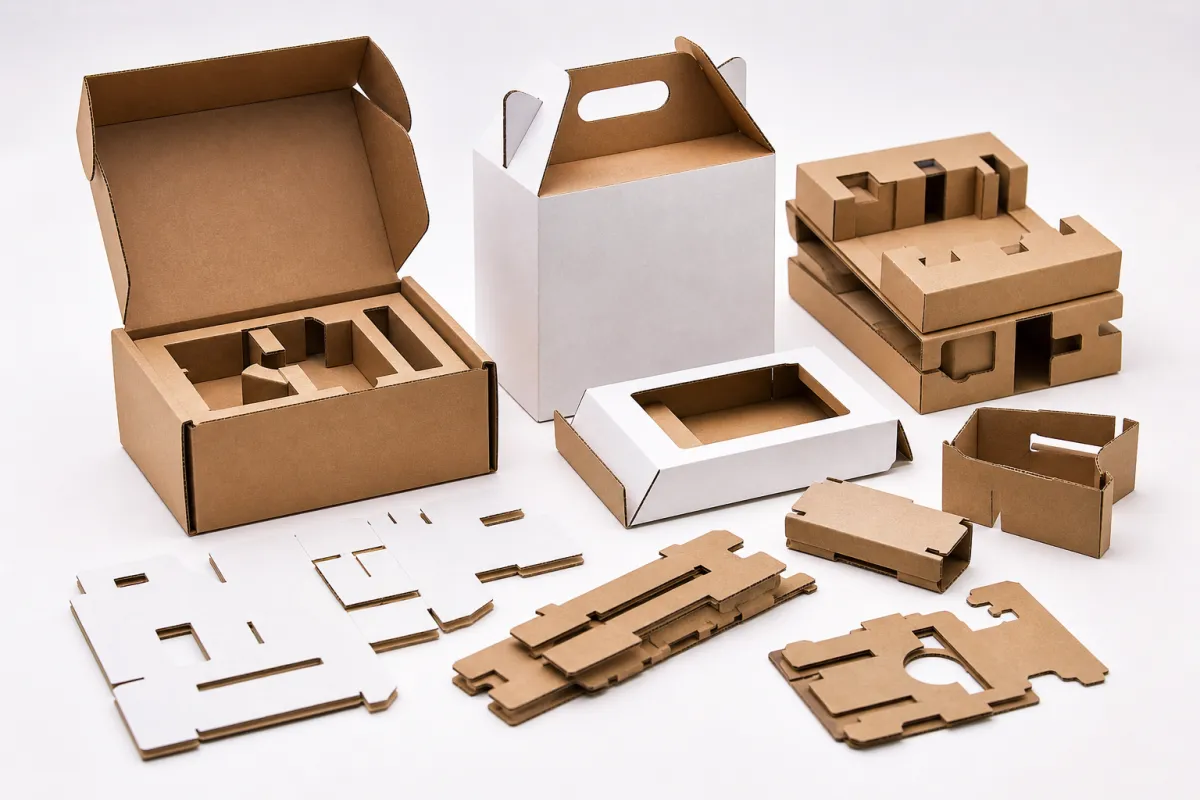
A die cut corrugated packaging supplier builds custom-cut corrugated structures using a steel rule die instead of pulling a stock carton off a shelf. That means the box is designed around your product, your packout, and your shipping reality. Your product does not get forced into some generic size that almost fits. Almost is expensive. Almost also tends to arrive dented.
Corrugated packaging should work like a tool, not just a container. A capable die cut corrugated packaging supplier handles dieline setup, board selection, cut-and-score tooling, print coordination, prototyping, and repeat production. The supplier may also recommend inserts, partitions, locking tabs, hand holes, or glue points so the finished pack performs the way it should in storage and transit. That is why the right supplier feels more like a technical partner than a plain vendor.
Most buyers are surprised by how little the shape matters compared with the real mechanics. The challenge is making the box fit properly, print cleanly, and survive the abuse of actual handling. A good die cut corrugated packaging supplier will talk about flute direction, board caliper, glue allowance, pallet pattern, and assembly speed. If those topics never show up, the quote may be cheap for a reason.
For businesses focused on product packaging and retail packaging, the supplier's role goes beyond protection. Better fit means less void fill, lower freight costs, cleaner shelves, and less wasted material. Better print means the carton supports brand recognition instead of looking like an afterthought. That is the practical side of branded packaging: the box has a job, and it still needs to look like it belongs to the brand.
The operational side matters too. A reliable die cut corrugated packaging supplier helps you avoid line stoppages by checking whether the pack folds by hand, loads automatically, or nests flat for storage. Some suppliers spot assembly issues from a single drawing and a product sample. Others just repeat your dimensions back to you. You already know which group saves money.
In plain terms, the supplier does more than make a blank box. The job includes structural judgment, print control, and production consistency. A solid die cut corrugated packaging supplier helps you make fewer decisions later by making better ones earlier.
How die cut corrugated packaging is made, step by step
The process usually starts with the product, not the carton. A competent die cut corrugated packaging supplier wants exact dimensions, product weight, surface fragility, shipping method, and the end use of the box. Is it for ecommerce? Retail display? Transit protection? Subscription fulfillment? Those answers change the structure, board grade, and print method. Guess here and you end up with a beautiful box that cannot do its job.
Next comes the structural concept and dieline. The supplier or packaging designer lays out a flat pattern showing where the cuts, scores, glue areas, and locking features sit. A die cut corrugated packaging supplier will usually create or refine that dieline before any tooling is made. This is the stage where fixes are still cheap. Once the die is approved, changes cost more and slow everything down.
Sampling comes after that. A blank mockup, a printed prototype, or a more production-like proof can all make sense depending on the job. Smart buyers test the sample with the actual product, not a stand-in that is close enough in theory and wrong in practice. A tight sample round catches problems like a lid that rubs, an insert that compresses too much, or a product that shifts when the carton is shaken.
If a sample looks perfect flat on the table but fails when packed, stacked, or dropped, the sample was not finished. It was just optimistic.
After sample approval, tooling gets built. The steel rule die includes knives for cutting and creasing rules for folding. Extra features such as hand holes, tear strips, vents, or inserts are built into that tooling. A seasoned die cut corrugated packaging supplier will explain what each feature does to production speed and carton strength. Every extra detail has a cost, and not just on paper.
The print stage follows, if the box needs print. Depending on the design, the supplier may use flexographic print, litho lamination, or a printed label applied to the board. A die cut corrugated packaging supplier that understands print production will ask for artwork in the correct format, check bleed and safe zones, and confirm whether the board surface can hold the detail you want. Forcing fine text onto the wrong board is a classic way to make premium branding look cheap.
Production then moves into conversion, where sheets are cut, scored, folded, glued, and packed for shipment. This is where consistency matters most. A strong die cut corrugated packaging supplier monitors register, crush, score depth, and glue performance so the first carton and the last carton behave the same way. Repeatability is not glamorous, but buyers notice it fast when a run is 500 pieces or 50,000 pieces.
For more technical packaging projects, testing should not be treated like decorative theater. ISTA drop and transit methods, plus ASTM compression or transit-related tests, can help confirm that the structure matches the shipping risk. The International Safe Transit Association has useful references at ISTA, and the EPA sustainable materials guidance is helpful when recyclability or recycled content matters to your buyer. A serious die cut corrugated packaging supplier should be comfortable talking about that kind of validation.
That is the real workflow: brief, concept, dieline, sample, tooling, print, convert, and packout. It sounds orderly on paper. In the real world, the quality of the die cut corrugated packaging supplier shows up in how few loops it takes to get from the first brief to a box you would actually ship.
Key factors that change performance, print, and fit
Board choice is usually the first big decision. A good die cut corrugated packaging supplier will talk about flute profile, liner weight, and board grade instead of tossing around vague words like "strong" or "premium." E-flute is common when print detail matters and the package needs a tighter, cleaner finish. B-flute and C-flute add more cushioning and stiffness. Double-wall board enters the picture when the package needs more stacking strength or better protection in transit.
Here is the useful part. E-flute is often around 1/16 inch thick, B-flute around 1/8 inch, and C-flute around 5/32 inch, though caliper varies by mill and board construction. A capable die cut corrugated packaging supplier starts with those numbers, then adjusts for product weight, compression load, and shipping conditions. A lightweight cosmetics carton and a 20-pound hardware shipper do not need the same structure. That sounds obvious. People still get it wrong.
Print method matters just as much. Flexographic print can be efficient for simple graphics and larger runs. Litho labels usually deliver sharper image quality and smoother branding, especially when the carton needs to sell on shelf. Uncoated kraft gives a natural look, while white-top corrugated improves color brightness and contrast. A skilled die cut corrugated packaging supplier will tell you when a nice render is going to disappoint on brown board and when a white top sheet is the smarter move.
Structural details can make or break the finished box. Score depth affects how neatly the carton folds. Glue joints affect strength and assembly time. Tab length affects closure security. Insert design affects how the product sits in the pack. A die cut corrugated packaging supplier that understands packaging design will not treat these as tiny details. They are the reasons a box feels intentional instead of floppy.
Tolerances deserve more respect than they usually get. A product that is 1.5 mm wider than the prototype can turn a snug fit into a jammed fit. A product with a slightly taller cap can press into a lid panel and deform the box. That is why a reliable die cut corrugated packaging supplier pushes for fit testing before production. One sample with the actual product is worth more than three rounds of "close enough" opinions from people staring at a screen.
Sustainability belongs in the decision, just not as theater. Recycled content, curbside recyclability, and FSC-certified paper can matter for both brand story and retailer requirements. The FSC system helps when chain-of-custody or responsible sourcing is part of your requirements. A good die cut corrugated packaging supplier will tell you what is actually available in your board spec instead of promising every green claim under the sun.
Assembly method is another real-world factor. Some die cut cartons are built for quick hand assembly. Others are designed for automated packing or semi-automatic folding. If your team is loading 10,000 packs a week, a few extra seconds per carton add up fast. The right die cut corrugated packaging supplier should be able to estimate how the carton behaves on the line, not just how it looks in a presentation deck.
Branding still matters too. A plain shipping carton can still be printed well, but if the package is going to a customer, shelf, or influencer unboxing moment, the carton becomes part of the product experience. That is where package branding and product packaging overlap. Better fit and print quality make the brand feel credible rather than forced, and a good die cut corrugated packaging supplier helps get you there.
One thing I see a lot: teams overfocus on the front panel and ignore the inside surfaces. Then the carton opens and the product is rattling around like it missed the memo. That is exactly why a supplier who understands structure is worth more than one who only talks graphics.
Die cut corrugated packaging supplier pricing and what drives it
Pricing is where a lot of conversations get fuzzy. A trustworthy die cut corrugated packaging supplier should explain the cost stack clearly: tooling, board, print, finishing, quantity, and setup labor. If the quote only shows one neat number and nothing else, something is usually hiding in the shadows. Not always. Often enough to be annoying.
Tooling is one of the first cost drivers. A new die has an upfront charge because the cutting and scoring rules have to be built to your exact shape. More complex cartons cost more to tool than simple RSC-style boxes. A die cut corrugated packaging supplier may also charge extra for multi-up layouts, specialty inserts, or multiple versions of the same structure. That is normal. Complexity does not become free just because the PDF looked simple.
Quantity has a huge effect on unit price. A small run spreads setup and tooling across fewer pieces, so the per-unit cost goes up. Larger runs usually cut the cost sharply because the supplier can amortize setup over more cartons. When comparing quotes, ask for tiers at 500, 1,000, 5,000, and 10,000 units. A good die cut corrugated packaging supplier will not mind showing where the economics actually change.
| Order type | Typical unit range | Common tooling/setup | Best use case |
|---|---|---|---|
| Short run prototype | $2.50-$6.00 per unit | $150-$500 | Fit checks, investor samples, early launches |
| Small production run | $1.10-$2.40 per unit | $200-$800 | Limited ecommerce runs, seasonal packs |
| Mid-volume production | $0.55-$1.20 per unit | $300-$1,000 | Steady replenishment, branded packaging programs |
| Higher-volume production | $0.18-$0.55 per unit | $500-$1,500+ | Repeat orders, retail packaging, ongoing fulfillment |
Those ranges are directional, not promises. Board grade, print coverage, inserts, coating, and assembly requirements can move the number quickly. A die cut corrugated packaging supplier quoting white-top litho-laminated packaging for a premium launch will land in a different range than a plain kraft shipper. Cheap board can shave cost on paper and then hand that money back through damage claims. That is not savings. That is a delayed bill.
Print complexity is another major driver. One-color flexo on kraft is different from a full-coverage, high-detail image on white-top board. Every extra ink station, coating pass, or finishing step adds cost. A smart die cut corrugated packaging supplier will help you decide where the money actually matters. Sometimes the better move is simplifying the inside of the carton and spending more where the customer actually sees it.
Revision policy matters too. If the dieline changes after approval, or if artwork arrives late and triggers another proof, the supplier may charge for the extra work. That is fair. A good die cut corrugated packaging supplier invests real time into tooling and proofing, and repeated changes create real cost. Ask about revision charges before you commit. It is a boring question that saves real money.
One more practical tip: compare apples to apples, not apples to a hopeful drawing of an apple. If one quote includes tooling, samples, delivery, and revision support while another excludes all four, the cheaper number is fake comfort. A dependable die cut corrugated packaging supplier will let you compare total landed cost, not just unit price. That is the number that matters when the boxes land on your dock.
Process and timeline: from brief to boxes on the dock
Lead time depends on how ready your project is when it reaches the supplier. A repeat order with an approved die and locked artwork can move quickly. A brand-new structure with inserts, print development, and fit testing will take longer. A practical die cut corrugated packaging supplier should explain that up front instead of pretending every job is a five-minute miracle.
A typical flow starts with discovery and specs, then quotation, dieline draft, sample approval, artwork lock, tooling, press prep, conversion, and shipment. Each stage can move fast if decisions are clear. Each stage can also stall if the product dimensions are fuzzy or the internal approvals keep bouncing around like a pinball. That is not a supplier problem, even if people love blaming the box plant for everything.
Delays usually come from the same places: late artwork changes, missing product samples, unclear dimensions, slow sample approvals, and new product revisions after the die has already been made. A strong die cut corrugated packaging supplier will flag those risks early, because the schedule often gets lost in the handoff between departments, not in the machine room.
If you want to shorten lead time, come prepared. Send exact dimensions, a real product sample if possible, weight data, the shipping method, and the deadline that truly cannot move. Tell the die cut corrugated packaging supplier whether the box is for retail packaging, ecommerce, or transit protection. The more specific the use case, the less back-and-forth you will need.
Rush orders are possible in many cases, but they carry tradeoffs. Faster turnaround usually means fewer sample rounds, higher setup fees, and less room to refine the structure. A die cut corrugated packaging supplier can sometimes compress the schedule, but a rushed sample approval is a bad place to make permanent mistakes. Speed is useful. Careless speed is expensive.
For packaging buyers who like hard standards, this is where testing and documentation earn their keep. A carton destined for shipment should line up with the rough expectations of transit testing, compression resistance, and material sourcing. The supplier may reference ISTA-style distribution testing or paper certification requirements, and that is a good sign. A die cut corrugated packaging supplier who can speak plainly about these standards is usually easier to work with than one hiding behind buzzwords.
Here is the simple truth: the best timelines are built, not wished into existence. A prepared buyer and a responsive die cut corrugated packaging supplier can often keep a project moving in a predictable rhythm. A vague buyer and a passive supplier will turn a straightforward carton into a month of avoidable emails.
Common mistakes when choosing a supplier
The biggest mistake is shopping on unit price alone. A low quote from a die cut corrugated packaging supplier can hide weak board, under-scored folds, poor print resolution, or charges that show up later as setup, sample, or revision fees. Cheap is only cheap if the box arrives usable. If it crushes, misprints, or slows the packing line, the cost moved somewhere else.
Vague specs cause the next mess. If the supplier does not know product weight, dimensions, shipping lane, storage conditions, and assembly method, they are guessing. A good die cut corrugated packaging supplier can estimate a workable structure from partial information, but they should not be asked to invent the whole use case. That is how you end up with a box that technically matches the drawing and still fails in the real world.
Skipping samples is a classic expensive shortcut. A carton can look perfect in a PDF mockup and still fail when the product is packed, stacked, or dropped. A serious die cut corrugated packaging supplier will encourage test samples because the sample stage is where fit issues, print problems, and closure failures are cheapest to fix. If a supplier pushes you straight to mass production without checking the fit, that is not efficiency. That is gambling with your freight budget.
Artwork mistakes are another easy way to burn cash. Files built for digital ads often miss bleed, safe zones, resolution requirements, and print color limits. A capable die cut corrugated packaging supplier will review the artwork basics, but they are not there to rescue a badly prepared design file every time. If the packaging design is not built for press reality, the final carton will show it.
Communication quality matters more than most buyers admit. Slow replies and fuzzy answers before the order usually become expensive problems after the order. The first few emails from a die cut corrugated packaging supplier tell you a lot. Do they ask practical questions? Do they explain tradeoffs in plain language? Do they give specific lead times and cost drivers? If not, expect the same confusion later when the clock is running and the boxes are due.
One more mistake: assuming a good-looking box is automatically a good packaging solution. It is not. A package can be visually strong and operationally awkward. A supplier who understands branded packaging will balance appearance, protection, and packing speed instead of obsessing over one and ignoring the other. That balance is the difference between a nice render and a carton that actually earns its keep.
If you want a quick way to screen a die cut corrugated packaging supplier, ask for three things: a sample, a line-item quote, and a plain-English explanation of the board choice. A good supplier will give you all three without drama. A weak one will give you confidence and very little else. Confidence does not ship products.
Expert tips and next steps before you request quotes
Start with a spec sheet. It does not need to be fancy, just complete. Include product dimensions, product weight, quantity, shipping method, target ship date, print goals, assembly method, and any retailer or marketplace requirements. A well-prepared brief makes a die cut corrugated packaging supplier faster and more accurate. Vague briefs produce vague quotes. That is not mystery. That is math.
Ask for a physical sample or a mockup before you commit to production, especially if the product is fragile, premium, or expensive to replace. A good die cut corrugated packaging supplier should be willing to prove fit before full production. If the product is heavy or has an awkward shape, sample testing becomes even more valuable. A few extra days there can prevent a few ugly months later.
When you compare suppliers, ask each one to explain board choice, die complexity, and lead time in plain language. If the explanation sounds like it was written by committee, keep moving. A reliable die cut corrugated packaging supplier should be able to tell you why one board is better than another, why one structure needs more setup, and where the schedule pressure sits. You are buying judgment as much as cardboard.
Build a simple comparison grid. Tooling cost. Unit price. Sample cost. Lead time. Revision policy. Delivery terms. That is usually enough to see the real winner. A strong die cut corrugated packaging supplier might not be the cheapest line item, but they often cost less in the total picture because the box fits, prints correctly, and does not create waste.
There is also value in matching the carton to the channel. Ecommerce packaging needs different abuse resistance than shelf-facing retail packaging. Transit packaging needs more compression strength than a display carton. If your program includes both, ask the die cut corrugated packaging supplier whether one structure can serve both roles or whether separate versions will actually save money in the long run. Sometimes one box does two jobs. Sometimes that just means doing both jobs badly.
For brands building a larger packaging program, it helps to think in systems. The corrugated shipper, inserts, printed messaging, and outer branding should work together. That is where custom printed boxes and package branding become part of the customer experience rather than separate line items. A competent die cut corrugated packaging supplier can support that system if you bring a clear brief and real priorities.
My blunt advice: choose the die cut corrugated packaging supplier that balances fit, durability, print quality, and repeatability, then lock the specs before artwork goes final. If you keep changing the shape after the print files are built, the box gets more expensive and the schedule gets uglier. A disciplined die cut corrugated packaging supplier will help you avoid that trap, but only if you let them do the job properly.
The cleanest packaging programs come from clear specs, honest samples, and a die cut corrugated packaging supplier who treats the job like a real production system instead of a quick quote. If you need one practical rule to carry forward, use this: lock the product dimensions, confirm the board choice, and test the sample with the actual contents before approving print. Do that, and you cut out most of the expensive nonsense before it starts.
Frequently asked questions
What should I send a die cut corrugated packaging supplier for an accurate quote?
Send exact product dimensions, weight, quantity, shipping method, and whether the box is for retail display, ecommerce, or transit protection. Include artwork expectations, board preference if you have one, and any deadline that is truly non-negotiable. If you already have a sample or prototype, send that too; it removes guesswork and usually tightens the quote.
How long does a die cut corrugated packaging supplier usually need for samples and production?
Simple repeat jobs can move quickly, but new structures need time for dielines, sample approval, tooling, and press scheduling. Expect sample rounds to add days or weeks if the fit is tricky, especially when inserts or special folds are involved. Rush jobs are possible, but they usually cost more and leave less room for design fixes.
Why do die cut corrugated packaging supplier quotes vary so much?
The biggest differences come from board grade, print method, tooling, and order quantity. Some quotes look cheaper because they exclude setup, sample costs, or revision charges. A lower unit price is not a win if the box arrives weak, misprinted, or late.
What board style should I ask a die cut corrugated packaging supplier about?
Ask about flute profile and liner combination first, because that determines strength, print surface, and overall feel. Use tighter flutes when print detail matters and stronger constructions when stacking or shipping abuse is the bigger risk. Let the product, not ego, decide the board.
How do I compare two die cut corrugated packaging suppliers fairly?
Compare tooling, unit pricing, sample policy, lead time, and revision support on the same specification. Ask both suppliers to quote the exact same dieline and board target so the numbers mean something. Check whether they can explain tradeoffs clearly; vague answers are expensive later.
The cleanest packaging programs usually come from clear specs, honest samples, and a die cut corrugated packaging supplier who treats the job like a real production system instead of a quick quote. If you keep the fit tight, the board appropriate, and the artwork realistic, the box will do its job without drama. That is the point, and a good die cut corrugated packaging supplier helps you get there without paying for the same mistake twice.


