Buyer Fit Snapshot
| Best fit | Die Cut Hang Tags with Logo projects where brand print, material claims, artwork control, MOQ, and repeat-order consistency need to be specified before quoting. |
|---|---|
| Quote inputs | Share finished size, material target, print colors, finish, packing count, annual reorder estimate, ship-to region, and any compliance wording. |
| Proofing check | Approve dieline scale, logo placement, barcode or warning zones, color tolerance, closure strength, and carton packing before bulk production. |
| Main risk | Vague material claims, crowded artwork, missing packing details, or unclear freight terms can make a low unit price expensive after revisions. |
Fast answer: Die Cut Hang Tags with Logo: Material, Adhesive, Artwork, and MOQ should be specified like a repeatable production item. The safest quote records material, print method, finish, artwork proof, packing count, and reorder notes in one written spec.
Production checks before approval
Compare the actual filled-product size with the drawing, then confirm tolerance on folds, seals, hang holes, label areas, and retail display edges. Reserve space for logos, QR codes, warning copy, and material claims before decorative graphics fill the panel.
Quote comparison points
Review material grade, print process, finish, sampling route, tooling charges, carton quantity, and freight assumptions side by side. A quote is only useful when the supplier can repeat the same color, closure quality, and packing count on the next order.
Die Cut Hang Tags with Logo: Sustainable Packaging Tips
Die cut hang tags with logo tend to get noticed before a shopper has fully processed the product itself. That happens fast on a crowded rack or shelf, where the outline of the tag, not the copy, is what catches the eye first. A rounded edge, a custom notch, a bottle shape, or a contour that echoes the logo can all create that quick pause. And that pause matters. It is often the difference between a product that blends in and one that feels considered.
These tags are not just a fancier rectangle with a hole in it. Die cut hang tags with logo use a custom cut line, a logo-forward layout, and enough space to carry pricing, care instructions, barcodes, material details, or a short brand note without turning the card into a cluttered mess. For brands trying to keep packaging lighter and more responsible, they also make practical sense. They use a relatively small amount of material, pair well with recycled or FSC-certified paper, and avoid the bulk that comes with boxes or layered inserts that do not always earn their keep.
The honest version is this: a good tag can look premium, feel efficient, and support a real sustainability story all at once. A careless one can look expensive for all the wrong reasons. So it helps to look at how die cut hang tags with logo are made, what changes the price, how turnaround usually works, and where brands most often trip over design choices that seemed minor on a screen but turn into headaches in production.
Die Cut Hang Tags with Logo: Why They Stand Out
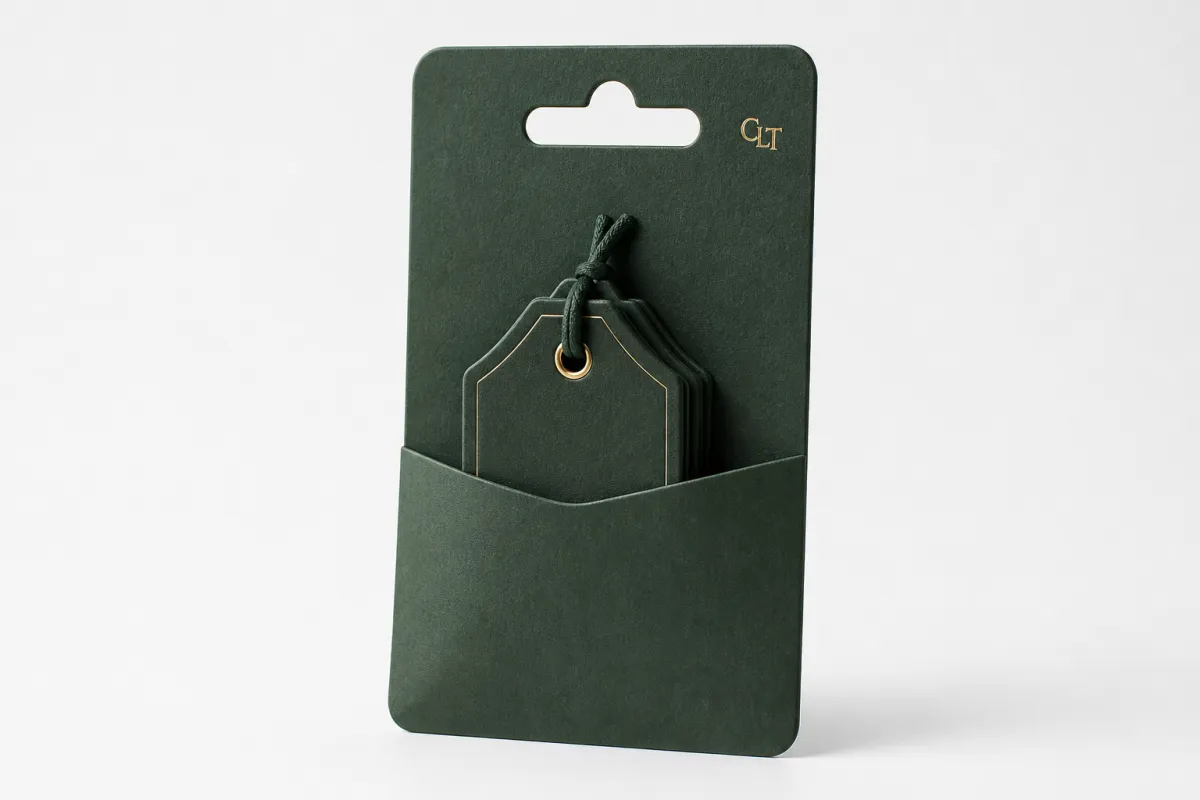
Standard tags disappear quickly into visual noise. Die cut hang tags with logo do the opposite. The shape creates a stop-and-look moment. A scalloped edge, a subtle corner cut, a product silhouette, or a custom contour can make someone look twice, and that extra second matters in retail. People scan quickly. They are not reading every detail. The outline of die cut hang tags with logo gives the product a cleaner identity before the shopper even gets to the copy.
That matters because hang tags do more than hang. They frame the product, and a small piece of paper or board can change how the item feels on the rack and in the hand. A cotton shirt can feel more deliberate, a skincare bottle can feel less generic, and a home goods line can look more finished with the right tag. Die cut hang tags with logo work especially well when the logo has a distinct silhouette or when the brand wants the tag itself to become part of the identity. Think of it as packaging with memory built in. A standard rectangle can still do the job, but it rarely leaves the same impression.
From a sustainability angle, die cut hang tags with logo are a sensible middle ground. They use less material than folded inserts, display boxes, or heavier wrap systems, yet they still carry brand presence. Choose recycled paper, an FSC-certified stock, or a responsibly sourced uncoated sheet, and the tag can support a credible eco message without pretending to be more than it is. That honesty matters. Buyers can spot the difference between a real material choice and a polished claim that sounds nice but does not hold up once the package is in hand.
A tag should earn its space. If the outline, print, and attachment help the product sell, the tag is doing real work. If it only looks busy, it is decoration with a price attached.
Die cut hang tags with logo also help when practical information needs to live in a compact space. Apparel tags often need size, fiber content, country of origin, and care notes. Beauty and wellness tags may need ingredient callouts, batch information, or recycling guidance. Gift and lifestyle brands may want a short brand statement or a QR code. A custom shape helps organize that information so the tag feels intentional instead of crammed.
Another advantage comes from designing around the logo instead of forcing the logo into a generic frame. The mark can sit in a cutout, tuck into a corner, or echo the silhouette of the tag itself. With die cut hang tags with logo, the logo is not a late addition. It becomes part of the structure.
- Better shelf impact: The outline creates a pause in a crowded display.
- Cleaner storytelling: More room for brand copy, care notes, or material claims.
- Lower packaging burden: Small format, low material use, and easy paper-based sourcing.
- More brand control: The shape can reflect the logo instead of fighting it.
For brands comparing packaging pieces, it often helps to look at the tag alongside related print items. Our Custom Labels & Tags page is useful if you want to match stock, finish, and visual language across the whole product line. Consistency is boring in a spreadsheet and powerful in a store.
How Die Cut Hang Tags with Logo Are Made
The production path for die cut hang tags with logo is straightforward, but the details matter. A project usually begins with a concept sketch or a reference shape, then moves into a dieline. The dieline is the cut template that tells production where the edges, hole, perforation, and any internal cutouts should go. Once the dieline is approved, artwork is placed on top of it, proofed, adjusted, and sent into cutting and print production.
That sequence sounds simple because it is simple. The trouble starts when design and production stop talking to each other too soon. I have sat through enough proof reviews to know the usual trouble spots: a logo that sits too close to the trim, a hole that clips copy, or a shape that leaves no room for a readable QR code. Die cut hang tags with logo need the artwork and the cut line to work together, not compete for attention. If one side wins, the tag usually loses.
Two cutting paths come up most often. Digital cutting is useful for small runs, prototypes, and very complex shapes. It avoids the upfront cost of a steel rule die, which is why brands use it for samples or short launches. Steel rule dies make more sense for larger quantities because the setup cost gets spread across more pieces, and once the die is made, the per-unit cut cost is usually lower. For die cut hang tags with logo, the right choice depends on quantity, shape complexity, and how often the design will be reused.
A typical production flow usually looks like this:
- Quote and specification review: Size, stock, finish, quantity, attachment method, and delivery location are confirmed.
- Dieline creation: The custom cut shape, hole, and any cutouts are mapped.
- Artwork placement: The logo, copy, barcode, and compliance text are positioned safely inside the trim area.
- Proofing: A digital proof checks layout, spacing, and color expectations.
- Sampling or soft approval: For complex die cut hang tags with logo, a sample can save a lot of trouble later.
- Cutting and print production: The stock is printed and cut according to the approved dieline.
- Finishing and packing: Hole reinforcement, lamination, foil, or string may be added before shipment.
Hole placement matters more than most people expect. A tag can look perfect in a proof and still hang badly on a product. If the hole is too close to the edge, the tag may tear. Too far toward the center, and it can swing awkwardly or cover product details. Heavier stock sometimes benefits from an eyelet or reinforcement ring, though that does add another material to the mix. That is useful when the tag needs it. It is not useful when it is there just because someone thought shiny metal looked premium.
String choice matters too. Cotton string, paper twine, and recycled fiber ties usually fit sustainable packaging goals better than plastic cords or glossy synthetic ties. The right choice depends on product weight, hanging behavior, and the way the brand wants the tag to feel in hand. A lightweight tee needs something very different from a ceramic piece or thick knitwear. Die cut hang tags with logo should hang cleanly, not twist into a stubborn little sail.
A practical rule helps here: the more unusual the shape, the more disciplined the layout needs to be. Clean spacing around the logo, enough margin from the edge, and a logical hole position make die cut hang tags with logo feel deliberate. Without those basics, the tag starts looking like an overdesigned school project. Nobody wants that.
Key Factors That Change the Look and Performance
Material selection changes almost everything first. Die cut hang tags with logo are commonly printed on 14pt to 18pt stock, though brands sometimes go lighter for delicate products or heavier for a more substantial feel. Recycled uncoated board gives a softer, more natural look and usually recycles more easily. Coated stock sharpens color and image detail, but it can reduce the handmade feel some brands are chasing. If sustainability is part of the message, the paper choice should support that story instead of fighting it.
Recycled content, FSC certification, and coating type should be discussed together rather than as separate afterthoughts. An FSC-certified paper source helps with responsible fiber sourcing, and you can verify the certification language through the Forest Stewardship Council. If a supplier says the tag is eco-friendly, ask what that means in plain language. Post-consumer content? FSC? Soy or water-based ink? No plastic lamination? If the answer is fuzzy, the claim is doing more work than the material.
Shape complexity is the second major factor. Simple rounded corners are easy. Deep scallops, tiny cutouts, narrow points, or thin extended tabs are harder. They cost more because they slow production and raise the chance of weak edges or rough cuts. Die cut hang tags with logo can absolutely handle unusual silhouettes, but a shape should serve the branding, not just show off the fact that a die cutter is available. If the outline makes the tag fragile or hard to stack, it is not a smart shape. It is a headache with good typography.
Finishes change the look fast. Matte lamination, soft-touch coating, foil stamping, embossing, and spot UV each create a different result, and each one brings a sustainability tradeoff. A soft-touch finish feels upscale but can complicate recycling. Foil and heavy spot coating can look sharp, yet they add cost and can make the tag less paper-pure. If the tag's main job is to signal natural materials or low-impact branding, plain print on a good stock often beats a pile of finishes. Die cut hang tags with logo do not need every effect available. They need the right one.
A simple comparison helps keep the choices grounded:
| Option | Look and Feel | Typical Tradeoff | Best Use |
|---|---|---|---|
| Recycled uncoated paper | Natural, tactile, understated | Softer color saturation | Eco-led brands, apparel, handmade goods |
| FSC-certified coated stock | Sharper print, cleaner edges | Less organic feel | Retail products needing crisp graphics |
| Soft-touch finish | Velvety, premium, quiet luxury | Harder to recycle than plain paper | Higher-end launches, gift sets |
| Foil accent | Bright metallic detail | Higher cost and extra process step | Small logo highlight or limited edition runs |
Ink choice matters as well. Water-based or vegetable-based inks are often better aligned with sustainable packaging stories than heavy solvent systems, especially on paper tags. That does not mean every green claim is equal, because printing chemistry is only one piece of the picture. Still, it is a sensible place to begin. The same logic applies to attachment choices. A paper tag with a plastic tie and metal eyelet is still a paper tag, but it is no longer a simple one-material item. Die cut hang tags with logo are strongest when they stay material-smart.
For packaging teams trying to reduce waste, the U.S. EPA has a useful public reference on reducing waste and recycling basics at EPA recycling guidance. It is not a hang tag playbook, obviously, but the material logic still applies: fewer mixed materials, clearer disposal paths, and more attention to what the item actually needs to do.
One more performance issue deserves attention: stacking and shipping. A highly irregular tag shape may look beautiful individually, but if it nests poorly, it can slow packing and increase waste. Die cut hang tags with logo should be beautiful on the product and efficient in a carton. That balance is the whole point.
Process, Timeline, and Turnaround for Production
A clean order process saves more time than a rushed one ever will. For die cut hang tags with logo, the best path starts with a complete quote request: size, quantity, stock, finish, hole style, string or eyelet choice, and shipping destination. When those details are missing, the first round of quotes tends to wander. When they are clear, the whole job moves faster and with fewer surprises.
The timeline usually depends on three things: how custom the shape is, whether a steel rule die is needed, and how many approval rounds the artwork takes. Simple die cut hang tags with logo can move through production fairly quickly after proof approval. More complex tags, specialty coatings, or layered finishing steps add days. Revisions add even more because every correction resets part of the schedule. That is not a punishment. It is just how physical production works. Paper does not care about your launch calendar.
As a rough planning range, a straightforward run may take around 7 to 12 business days after proof approval, while a more detailed order can land closer to 12 to 18 business days. If the job needs a custom die, specialty finish, or sampling first, build in extra time. For seasonal launches, I would not cut it close. I would rather see die cut hang tags with logo land early and sit in inventory than arrive the afternoon before a sales meeting and force everyone into panic mode. That kind of rush has a way of making a small issue feel twice as expensive.
The most important checkpoints are usually these:
- Dieline accuracy: The shape, edge distance, and hole placement must be correct before print.
- Logo safe area: Keep the logo far enough from the trim that it never feels cramped.
- Barcode readability: If the tag includes scanning data, test contrast and quiet space.
- Color expectation: Confirm whether the proof is digital only or should match a Pantone reference.
- Attachment method: String, eyelet, or reinforcement should fit the product weight and finish.
If you are ordering die cut hang tags with logo for a product launch, work backward from the sell date rather than the artwork deadline. Give yourself room for proof review, production, delivery, and a small margin for the unexpected. That margin is the difference between calm inventory and a very awkward email chain.
For larger programs, it helps to connect the hang tags to your broader packaging plan early. If a brand is also updating labels, product stickers, or carton markings, matching those pieces through the same product family keeps the print language aligned. Our Custom Labels & Tags category is a useful starting point for that kind of coordinated order.
Cost, Pricing, and MOQ for Die Cut Hang Tags with Logo
Pricing for die cut hang tags with logo is driven by a handful of predictable variables. Quantity is the biggest one. Shape complexity comes next. Then paper stock, print colors, finishing, and whether the order includes attachment components like string or eyelets all start to move the number. A simple tag on standard stock will almost always cost less than a fully finished tag with foil, soft-touch coating, and a custom cutout. That sounds obvious because it is obvious. Yet people still expect a six-step premium tag to cost like a blank card. It does not.
MOQ, or minimum order quantity, matters too. Small runs are not a problem by themselves, but the unit cost rises because setup work gets spread across fewer pieces. If you order 250 die cut hang tags with logo, the die or digital setup, print setup, and finishing time are all carried by that small number. At 5,000 pieces, the economics usually improve. That is why brands often test with a small run, then move to a larger production order after the shape proves itself in the market.
As a practical benchmark, a plain short run may land in the higher per-piece range, while larger quantities can bring the unit price down sharply. A simple stock tag might range around $0.60 to $1.20 each for very small quantities, around $0.22 to $0.45 for mid-range orders, and around $0.08 to $0.22 for larger runs, depending on print coverage and finishing. Add specialty decoration and the number climbs. Add a unique shape with multiple cut points and it climbs again. That is not a scare tactic. It is print math.
A pricing comparison helps make the pattern easier to read:
| Run Size | Typical Unit Cost Range | Setup Pressure | Best Fit |
|---|---|---|---|
| 250-500 pieces | $0.60-$1.20 | High | Samples, small launches, internal testing |
| 1,000-2,500 pieces | $0.22-$0.45 | Moderate | Seasonal drops, pilot programs |
| 5,000-10,000 pieces | $0.08-$0.22 | Lower per unit | Established SKUs, repeat production |
| 10,000+ pieces | Quote-dependent | Lowest per unit | High-volume retail programs |
That table is a benchmark, not a promise. A complex die cut hang tag with logo, a premium stock, or a two-sided print with specialty finish will sit at the higher end. A simpler shape with one-color print and no extras will sit lower. If you want a cleaner quote, send the exact size, artwork format, paper preference, finish preference, hole style, and whether string or eyelets are needed. The less guessing a supplier has to do, the better the number usually gets.
A smart way to control cost without cheapening the tag is to simplify the shape before you strip away the paper quality. In other words, keep the good stock and good print, but remove the tiny cutout that adds risk and slows production. Another sensible move is to limit special finishes to one focal area instead of covering the whole tag. Die cut hang tags with logo do not need to shout through every possible effect. They need one clear design decision and enough restraint to let it work.
If you are comparing packaging parts for a launch, it also helps to group the order by purpose. A tag for a clothing line might need one design standard, while a tag for a gift product might need another. Die cut hang tags with logo can stay premium without becoming expensive theater. The buyer only cares whether the tag helps the product sell and whether the numbers make sense.
Common Mistakes to Avoid with Die Cut Hang Tags
The first mistake is overdesigning the outline. A shape that looks clever in a mockup can become expensive, weak, or messy in production. Thin points tear. Tiny internal cutouts snag. Odd silhouettes may not stack well or may create awkward hanging behavior. Die cut hang tags with logo should have a reason for the shape. If the reason is, "it looked cool once," keep looking.
The second mistake is crowding the logo and copy too close to the edge. A tag with beautiful print but no breathing room feels less premium, not more. That is especially true with die cut hang tags with logo because the shape already draws attention. You do not need to cram everything into the first inch of space. Leave room for the eye to rest. It makes the whole piece feel more expensive and more deliberate.
The third mistake is ignoring how the tag behaves once it is attached. Some tags look fine flat on a screen and fail the moment they hang from a product. They curl, flip, cover the care label, or point in the wrong direction. If the tag is attached to a soft garment, a bottle neck, or a flexible bag, the weight of the stock and the hole position matter. Die cut hang tags with logo should complement the product's movement, not fight it.
The fourth mistake is using a sustainability message that the material system does not support. A recycled-content claim on a tag with heavy laminate, foil, plastic cord, and a metal eyelet can feel weak if the rest of the package is pretending to be simple. Sustainable packaging is not a magic phrase. It is a material decision. If you want die cut hang tags with logo to support an eco story, the paper, ink, attachment, and finish all need to cooperate.
A sustainable claim is strongest when the physical materials look like they belong together. Mixed signals are expensive, and customers notice.
There is also a very practical mistake I see often: skipping the sample. If the tag has a complex silhouette or an unusual attachment, a sample can save you from wasting a full run. That matters even more for die cut hang tags with logo because the cut line is part of the design. A tag that works on a PDF and fails in hand is not a design. It is a correction order waiting to happen.
Another avoidable problem is underestimating print contrast. Light gray text on kraft paper may look charming in a brand deck, but on a real shelf it can be hard to read. Tiny care text, narrow line weights, and pale logo marks all become riskier on custom shapes because the eye is already processing the outline. With die cut hang tags with logo, clarity beats cleverness more often than designers like to admit.
Expert Tips and Next Steps for a Smarter Order
Start with one clear goal. Do you want stronger shelf impact, a cleaner sustainability story, better logo recognition, or some mix of those? Die cut hang tags with logo can support all of them, but the design should favor one main job. If everything is equally important, nothing is. That is not dramatic language. It is how buyer attention works.
Ask for the dieline early. Ask for the digital proof after that. If the shape is unusual, ask for a sample before full production. Those three checkpoints catch most of the expensive problems while they are still cheap. Die cut hang tags with logo are easy to approve too quickly because they look small and harmless. Then the print arrives, the hole is wrong, and suddenly a small tag is eating time across the whole launch calendar.
Build a small buffer into the order. That is especially useful for seasonal programs, influencer kits, retail launches, and apparel drops where damaged inventory or last-minute reorders happen. A buffer of 5% to 10% is usually enough to cover spoilage, hand-applied damage, or a surprise need for more units. Die cut hang tags with logo are not usually the place to shave inventory down to the bone unless you enjoy paying rush fees later.
A quick pre-flight checklist keeps the order steady:
- Confirm the exact size and cut shape.
- Review the artwork on the final dieline.
- Check logo clearance from the trim edge.
- Choose stock that matches the sustainability claim.
- Decide whether the finish helps the brand or just adds cost.
- Verify the attachment method on the actual product.
- Approve the quantity based on launch needs and buffer.
If you are matching multiple packaging elements, keep the paper tone, color palette, and finish family consistent. That is where die cut hang tags with logo do more than decorate. They connect the product to the rest of the packaging system. A clothing line that uses the same design language on tags, labels, and inserts feels more stable and more intentional. A brand that changes styles on every piece tends to look like it bought each element from a different conversation.
For buyers comparing options across a product line, the easiest next move is to gather one clean quote, one accurate dieline, and one proof that reflects real production specs. Then review the tag on the product, not just on the screen. That small step saves a lot of second-guessing. And yes, it is worth doing even if everybody is in a hurry.
Die cut hang tags with logo are a smart packaging choice when they are treated like part of the product strategy, not a late-stage decoration. Keep the shape useful, the materials sensible, and the layout clean, and they will do exactly what they should: elevate the product, support a credible sustainable packaging story, and stay cost-conscious enough to survive the buying meeting. Before you place the order, confirm the dieline, the stock, and the attachment on the actual product; that one habit catches most of the avoidable mistakes and keeps the final tag doing the work it was meant to do.
FAQ
What makes die cut hang tags with logo different from standard hang tags?
The shape is custom instead of a basic rectangle, so the tag becomes part of the branding instead of just a label. Die cut hang tags with logo also tend to create stronger shelf impact and can support a premium or sustainable packaging story more effectively.
Are die cut hang tags with logo a good sustainable packaging choice?
Yes, if you choose recycled or FSC-certified paper, avoid unnecessary coatings, and keep the attachment simple. Die cut hang tags with logo use a small amount of material but can still carry a strong brand message, which is the point.
How much do die cut hang tags with logo cost per piece?
Unit cost depends on quantity, size, cut complexity, stock, print colors, finish, and whether accessories like string or eyelets are included. Lower quantities usually cost more per tag because setup and die work are spread across fewer pieces.
What is the typical turnaround for die cut hang tags with logo?
Simple orders can move quickly after artwork approval, but custom shapes, specialty finishes, and revisions add time. The fastest path is clean artwork, a confirmed dieline, and no last-minute changes.
Do I need a custom dieline for die cut hang tags with logo?
Yes, if you want a unique outline or any non-standard cut, the dieline is what tells production exactly where to cut. A correct dieline prevents wasted material, strange proportions, and expensive rework.


