Trade Show Pom Pom Beanies Unit Cost: Buy With Confidence
Trade show pom pom Beanies Unit Cost looks simple on a quote sheet. It is not. The number only makes sense once you compare it with how long the beanie stays in circulation, how visible the logo remains after the event, and whether the item feels worth wearing when the booth lights are gone.
A $4.25 beanie that gets worn on a commuter train, at a jobsite, and on a weekend walk can outwork a cheaper handout that never leaves the venue. The cheapest item on the spreadsheet is not always the lowest-cost choice in practice. That gap matters more with winter apparel than with nearly any other promo category.
A buyer focused only on Trade Show Pom Pom Beanies unit cost misses the wear curve. The better question is whether the piece will hold shape, keep the decoration readable, and stay desirable long enough to keep the logo working after the show badge scanner stops buzzing. That is where the math changes.
Why pom pom beanies earn more wear than one-day handouts
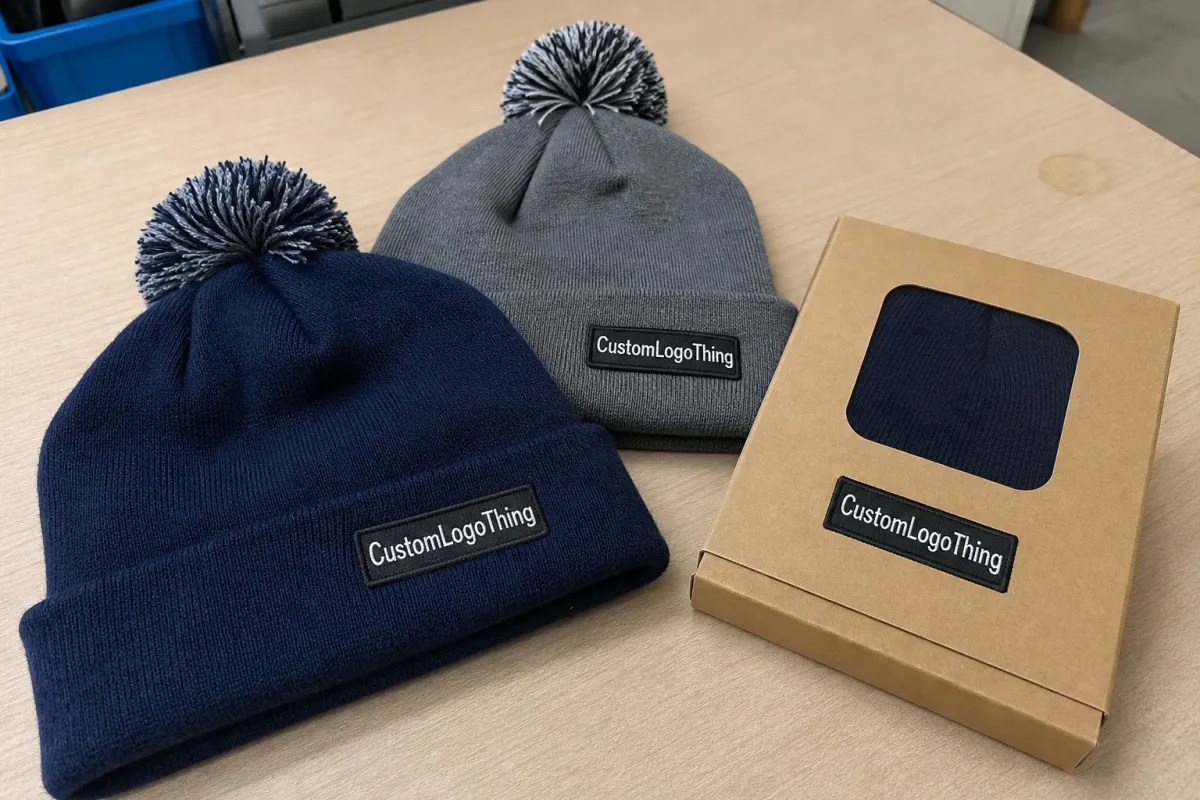
From a packaging or promotions buyer's point of view, the strongest event item is the one people keep reaching for after the event. Pom Pom Beanies do that in a way flyers, pens, and low-grade totes rarely can. They are practical in cold weather, they feel seasonal without feeling disposable, and they photograph well because the pom adds height and motion to the silhouette.
That visual lift matters at winter expos, outdoor registration lines, regional roadshows, ski-adjacent events, and sponsor kits built around cold-weather comfort. A beanie gets worn on the commute home, on the next client visit, and sometimes for months afterward. A brochure is lucky to survive the ride in the seat pocket.
There is also a visibility effect that gets underestimated. The pom creates a larger shape in photos and on the show floor, so the item reads more clearly from a distance. That helps when the goal is social sharing, booth photography, or a quick glance across a crowded aisle. A plain knit cap can disappear into a dark coat. A pom pom beanie usually does not.
For that reason, I tend to think in terms of impressions per dollar, not only piece price. A slightly higher unit cost is easy to justify if the item keeps getting worn after the event. The same logic applies to sponsor bundles, employee onboarding kits, and field teams that need something useful rather than novelty-driven.
There is one more practical point. The product works across more than one audience. Staff, VIP guests, and customer prospects can all wear the same style without it looking too promotional. That flexibility gives trade show pom pom beanies a longer life span than many one-day handouts.
Product details that separate a good beanie from a giveaway
The difference between a useful beanie and a throwaway usually starts with the knit body. A cuffed acrylic or acrylic-blend beanie gives a cleaner decoration zone, keeps the logo readable, and holds shape better than a thin fashion knit. A tighter knit also helps embroidery sit flatter, which matters when the logo is small and the order is tied to a fixed event date.
Material matters more than buyers expect. Standard acrylic remains common because it is consistent, predictable in production, and cost-effective at scale. Recycled polyester blends can be a good fit when the brief calls for a lower-waste story, but they should still be judged on hand feel, stitch clarity, and how well the cuff springs back after packing. A recycled story does not help if the hat feels flimsy.
Decoration method changes the item's finish more than the headline price usually suggests. Embroidery is the most durable and usually the safest choice for long wear. A woven patch handles small text and sharper artwork. A woven label gives a clean branded touch without pushing the look too close to premium retail. Private label tags can make sense when the beanies are going into VIP kits or resale channels.
- Embroidery: best for durability and simple logos.
- Woven patch: better for fine detail and crisp edges.
- Woven label: a tidy, lower-cost branding option.
- Private label tag: useful when the presentation needs to feel retail-ready.
Color strategy deserves the same attention. One neutral body color with one bright accent usually broadens appeal without making production messy. Navy, black, charcoal, and heather gray are safe anchors. A red, orange, or safety-lime pom can add energy without forcing the buyer into a complicated multi-color knit.
Packaging belongs in the product discussion, not in a separate cleanup step. Individual polybags keep the beanies clean for distribution. Size stickers matter if the order includes youth or oversized options. Insert cards help when the item needs sponsor messaging or event instructions, and they can be printed on FSC-certified stock when the paper needs to carry the same story as the apparel.
The other detail that gets missed is how the beanie looks in motion. A good cuffed knit keeps the logo upright when the hat is worn, not just when it lies flat on a table. That is a small thing, but small things decide whether an item feels premium or forgettable.
Specs that control fit, decoration, and buyer satisfaction
Material blend and knit gauge do most of the heavy lifting. A 7-gauge knit usually feels warmer and more substantial, while a tighter 12-gauge knit gives a smoother face for logo placement. Acrylic remains the most common base because it scales well, keeps pricing stable, and is easier to match across production lots. If the order needs a softer hand, a blend can help, but only if the decoration still sits cleanly on the fabric.
Fit is another small detail with large consequences. Unisex stretch sizing keeps ordering simple, especially when hats are going to a mixed audience. That said, premium runs sometimes split into youth and adult options, or offer an oversized cut for teams that want a roomier look. If comfort matters, a sample on actual heads tells more than a flat spec sheet ever will.
Decoration placement changes how the logo reads in photos and across a booth. Front cuff placement is the most visible. A side-panel badge can feel more modern, but it may disappear in crowd shots. A woven patch on the cuff usually gives the best balance between readability and low risk, especially if the logo has small text or thin outlines.
Pom size is not just a style choice. A 3-inch pom usually looks balanced on a standard cuffed beanie. A larger pom creates more energy, but too much volume makes the logo feel smaller by comparison. That can be a useful trade when the design needs personality. It can also make the branding look secondary if the decoration area is already tight.
Approval details prevent a lot of headaches later. Ask for stitch count, PMS color references, pom diameter, logo placement, and whether the pom is yarn, faux fur, or a mixed construction. If the beanie uses custom yarn colors, confirm whether the match is being made to Pantone chips or to a digital mockup. Those are not the same thing, and they diverge quickly under bright trade show lighting.
For buyers shipping into strict distribution channels, carton labeling and transit handling matter too. If the order is going directly to a venue or fulfillment center, it is worth asking whether the packing plan aligns with a transport profile such as ISTA-style drop and vibration testing. That sounds technical because it is. It also prevents the annoying version of cheap: cartons that arrive crushed, shifted, or short-counted.
One more practical check: confirm how the logo behaves on the knit after stretching. Some placements look sharp on a proof but distort once the cuff is pulled over a head. That risk rises on looser knits and on designs with small lettering. The proof should show the logo at wear position, not only in a perfect flat lay.
Trade show pom pom beanies unit cost, MOQ, and pricing tiers
Trade show pom pom Beanies Unit Cost is easiest to understand when it is broken into four buckets: blank body, decoration, setup, and freight. If a supplier gives only a headline number, the buyer cannot see where the margin is hiding. If the quote separates those pieces, the comparison becomes much cleaner.
MOQ matters because knitwear setup costs are real. Yarn sourcing, decoration digitizing, label creation, packing labor, and quality checks all get spread across the run. When the order is small, those fixed costs sit on fewer units, so the cost per piece climbs fast. A 100-piece run can look expensive beside a 500-piece run even when the raw materials are similar.
Typical pricing tiers for a decorated cuffed pom pom beanie often look like this, assuming one logo location and standard packaging:
| Order size | Typical unit cost | What usually changes | Best fit |
|---|---|---|---|
| 100 units | $6.25-$9.00 | High setup burden, fewer decoration choices, less freight efficiency | VIP gifts, speaker kits, internal teams |
| 250 units | $4.60-$6.80 | Better spread on digitizing, labels, and packaging setup | Small trade shows, regional roadshows |
| 500 units | $3.40-$5.20 | Stronger bulk pricing and more color flexibility | Typical booth programs |
| 1,000+ units | $2.70-$4.10 | Lower cost per piece, better packing and freight efficiency | Multi-show rollouts, staff uniforms |
Those ranges are not universal, and they should not be treated like a quote. A thicker knit, a larger embroidery area, a custom woven patch, or a specialty tag will move the number. Freight can also change the landed cost more than buyers expect, especially if the order moves by air instead of ground. A cheap factory price can disappear once the cartons are moving.
It also helps to understand what usually gets added after the first quote. Setup charges, rush fees, split shipment fees, and sample shipping can all show up later if the brief was vague. Tooling fees are less common on standard beanies than on molded items, but they can appear when the order includes custom trims, specialty badges, or unusual packaging hardware. The number that matters is the landed number.
Decoration cost deserves a closer look. Embroidery often stays the least complicated route, but the price can rise if the logo has a high stitch count, multiple thread colors, or a large coverage area. Woven patches usually cost more than plain embroidery because they add a separate production step. A private label tag can be economical on larger runs, yet still expensive if it is applied by hand to a small order. The best quote explains those differences instead of hiding them behind a single line.
A low headline price is useful only if the beanie arrives with the right knit, the right logo, and the right ship date.
There is one more useful comparison. Ask for a plain version and a more polished version. The plain version shows the base economics. The polished version shows the cost of better finishing, cleaner packaging, or a slightly upgraded decoration method. That side-by-side view often makes the actual decision obvious.
Common cost traps buyers miss before approving the order
The first trap is assuming the sample price reflects the bulk price. It often does not. Samples absorb extra labor, extra communication, and sometimes faster shipping. They are useful for approval, not for budgeting. If a supplier makes the sample look cheap, ask which costs are being left out of the quote.
The second trap is underestimating shipping weight. Pom pom beanies are light individually, but they still take up volume. Volumetric freight can hurt on air shipments and on tight direct-to-show deadlines. A buyer looking only at unit cost can miss the fact that the carton footprint is driving the landed number.
The third trap is changing artwork after approval. Even a small logo adjustment can trigger another digitizing round or a new sample. That is especially true with woven patches and complex embroidery. The safest approach is to approve the proof only after the logo, placement, and size are final.
The fourth trap is ignoring color consistency. With knitwear, shade variation can happen between dye lots. A black beanie might stay black, but navy, heather tones, and accent yarns can drift. Good suppliers will warn about that before the order starts. Better ones will match the most visible pieces first and tell you where the risk sits.
The last trap is thinking all packaging is equal. A bulk carton can be perfectly fine for warehouse distribution and completely wrong for a venue that wants clean, countable units. Polybags increase handling time, but they protect the item and make receiving easier. If the order is going to a show floor, that tradeoff usually pays for itself.
Production steps and timeline: from mockup to delivery
A clean production plan starts with a quote and ends with a receiving check, and each step can create delay if the details are sloppy. The sequence is usually simple: quote, digital mockup, sample or pre-production proof, bulk production, quality check, packing, freight. The trouble is rarely the sequence itself. The trouble is late changes.
- Quote and mockup: confirm logo file type, decoration method, color palette, quantity, and in-hand date.
- Proof stage: approve placement, stitch count, PMS match, pom style, and packaging details.
- Bulk production: knit, decorate, trim, finish, and prepare the order for packing.
- Quality check: verify count, alignment, color consistency, and visible defects.
- Packing and freight: carton label, ship, and track to the final destination.
Most delays come from the same three places: slow art approval, missing Pantone references, and quantity changes after the order is already in motion. If the show date is fixed, those delays become expensive quickly. A one-week slip can force air freight, and air freight can erase the savings from a lower base quote.
For standard production, stock yarn and a simple logo can move faster than custom yarn and layered decoration. A realistic schedule is usually measured after proof approval, not after the first conversation. That distinction matters because buyers often count the days before artwork is even signed off. In practice, a few extra days at the start can save a much larger delay at the end.
Timeline expectations are usually clearer when they are stated in ranges. For stock beanies with embroidery, production may run around 2-4 weeks after proof approval if inventory is available and the order is straightforward. Custom yarn colors, woven patches, specialty tags, or split shipments can push that closer to 4-6 weeks. Rush work is possible in some cases, but the price usually moves fast once the freight method changes.
If the order has to reach multiple show sites, ask about carton splits early. Split shipments and staging at more than one destination add handling cost, but that cost is easier to manage when it is planned rather than discovered after packing. The same logic applies to direct-to-show delivery. The shipping label needs to match the event receiving rules, not just the office address.
That is also where distribution discipline matters. A supplier who understands carton count, carton labeling, and transit risk usually gives a better result than a seller who only talks about the knit itself. The industry standard conversation around package durability and shipping tests is worth checking against references such as Packaging resources when the order has to survive multiple handoffs.
My practical rule is simple: if the event date is fixed, build a buffer before the freight window, not after it. The cost of waiting is almost always higher than the cost of being a little early.
What a reliable supplier proves before you place the order
A reliable supplier does more than quote a number. It proves the knit is consistent, the decoration lands in the right place, and the packaging plan will not create a surprise at receiving. That proof can come from clear photos, a pre-production sample, or a documented first-article check. If the supplier cannot show those basics, the risk climbs fast.
Support level is a useful differentiator. Some vendors only send a price. Better partners help clean up artwork, advise on quantity splits, suggest the right decoration method, and explain how the beanies will pack for the final destination. That kind of help matters because trade show orders are usually time-sensitive and hard to fix once production begins.
Communication is not a soft issue here. A responsive project owner can prevent the kind of error that turns into a chargeback, a reprint, or a late-night shipping rescue. I would rather work with a supplier who answers quickly and flags a problem early than one who promises a low number and disappears for three days.
The buyer should also ask how the supplier handles quality checks. Are they inspecting every piece, or sampling by lot? Are they checking logo placement against a signed proof? Are they confirming the count before the cartons leave? Those are practical questions, not administrative trivia.
There is a useful test that reveals a lot: ask for the exact carton plan before production starts. If the supplier can explain pack counts, outer carton dimensions, and any insert card or hang tag options, the order is in better hands. If they cannot, the risk of a messy receiving process goes up. So does the chance that someone on your team has to fix a problem that should have been solved upstream.
Reliable suppliers also talk plainly about tolerances. Slight variance in knit tension, embroidery placement, or pom position is normal in apparel production. What matters is whether the variance stays inside a range you can live with. If the samples look perfect but the factory cannot explain acceptable variation, the quote is better than the process.
Honestly, the cheapest quote is often the most expensive one when the order is tied to a live event. The real savings come from fewer corrections, fewer freight surprises, and fewer hours spent fixing something that should have been right the first time.
Next steps for a quote that gets the right numbers fast
If the goal is a clean quote, send the supplier the information they need in one shot. The better the brief, the more useful the pricing. It also reduces revisions, which keeps the order moving while the event calendar keeps getting closer.
- Send the logo file: vector artwork is best, and a clean PDF can help if vector is not available.
- State the quantity: include the target run plus any backup quantity if the buyer may expand later.
- Choose the decoration method: embroidery, woven patch, woven label, or private label tag.
- Share the in-hand date: not the order date, the date the beanies need to arrive.
- Add the shipping zip code: freight is part of the landed cost, not a footnote.
- Confirm packaging needs: polybag, insert card, bulk carton, or split ship to multiple shows.
Ask for two versions of the quote if the budget is tight: one option optimized for lower unit cost, and one option with a more polished finish. That comparison usually exposes the real tradeoffs between speed, presentation, and bulk pricing. It also helps the buyer decide whether to save on decoration or upgrade packaging.
If the event is important, it is worth asking one more question: what would change the number after approval? A good supplier should be able to list the likely triggers clearly. A bad one leaves the buyer guessing, and guessing is expensive in apparel buying.
Trade show pom pom beanies unit cost is only one line in the spreadsheet, but it is usually the first line people compare. The best quote is the one that matches budget, MOQ, decoration method, freight, and the way the beanies will actually be used after the event. If the numbers fit the brief, the order is ready to move.
What drives trade show pom pom beanies unit cost the most?
Quantity, decoration method, yarn blend, and freight usually drive the biggest swings. Ask for landed cost, not just factory price, so the comparison stays accurate.
What is a realistic MOQ for custom pom pom beanies at trade shows?
Small runs are possible, but the cost per piece is usually higher because setup is spread across fewer units. If you need multiple colorways, confirm whether the MOQ applies per color or across the full order.
Which decoration method lasts best on trade show pom pom beanies?
Embroidery and woven patches usually hold up best because they stay visible and resist everyday wear. Choose a decoration that works on curved knit fabric and remains readable from booth distance.
How long does production usually take for custom pom pom beanies?
Timeline depends on proof approval, yarn availability, decoration complexity, and factory workload. Stock materials and final artwork can shorten the schedule; custom colors and late changes extend it.
What should I send to get an accurate quote fast?
Send vector artwork, quantity, color targets, in-hand date, shipping zip code, and packaging requirements. Including those details up front reduces revisions and helps the supplier quote the real trade show pom pom beanies unit cost.


