Buyer Fit Snapshot
| Best fit | Die Cut Kraft Boxes Wholesale for Shipping Logistics projects where brand print, material claims, artwork control, MOQ, and repeat-order consistency need to be specified before quoting. |
|---|---|
| Quote inputs | Share finished size, material target, print colors, finish, packing count, annual reorder estimate, ship-to region, and any compliance wording. |
| Proofing check | Approve dieline scale, logo placement, barcode or warning zones, color tolerance, closure strength, and carton packing before bulk production. |
| Main risk | Vague material claims, crowded artwork, missing packing details, or unclear freight terms can make a low unit price expensive after revisions. |
Fast answer: Die Cut Kraft Boxes Wholesale for Shipping Logistics should be specified like a repeatable production item. The safest quote records material, print method, finish, artwork proof, packing count, and reorder notes in one written spec.
Production checks before approval
Compare the actual filled-product size with the drawing, then confirm tolerance on folds, seals, hang holes, label areas, and retail display edges. Reserve space for logos, QR codes, warning copy, and material claims before decorative graphics fill the panel.
Quote comparison points
Review material grade, print process, finish, sampling route, tooling charges, carton quantity, and freight assumptions side by side. A quote is only useful when the supplier can repeat the same color, closure quality, and packing count on the next order.
Custom Logo Things
Die Cut Kraft Boxes Wholesale for Shipping Logistics
Need packaging that keeps moving through a warehouse without turning every order into a tiny obstacle course? die cut kraft boxes wholesale are built for that exact problem. A carton cut to the product instead of around it can reduce pack-out time, limit product movement, and cut the kind of damage that starts with a sloppy fit and ends with a customer service ticket. I once watched a mid-volume apparel shipper shave just under 20 seconds off each order by changing nothing except the box style; the team thought the number was too small to matter until the weekly labor report told a different story. Multiply that kind of improvement across thousands of shipments, and the math stops being theoretical pretty quickly.
At Custom Logo Things, the useful question is never whether the mockup looks nice on screen. It is whether die cut kraft boxes wholesale help a fulfillment team standardize dimensions, keep inventory easier to forecast, and stop spending money on extra filler, tape, and rework. A box can look plain and still outperform a more decorative structure if it folds faster, stacks cleaner, and survives shipping without drama. That is the kind of boring win operations teams actually like. Accounting does too.
Why Die Cut Kraft Boxes Wholesale Reduce Shipping Friction
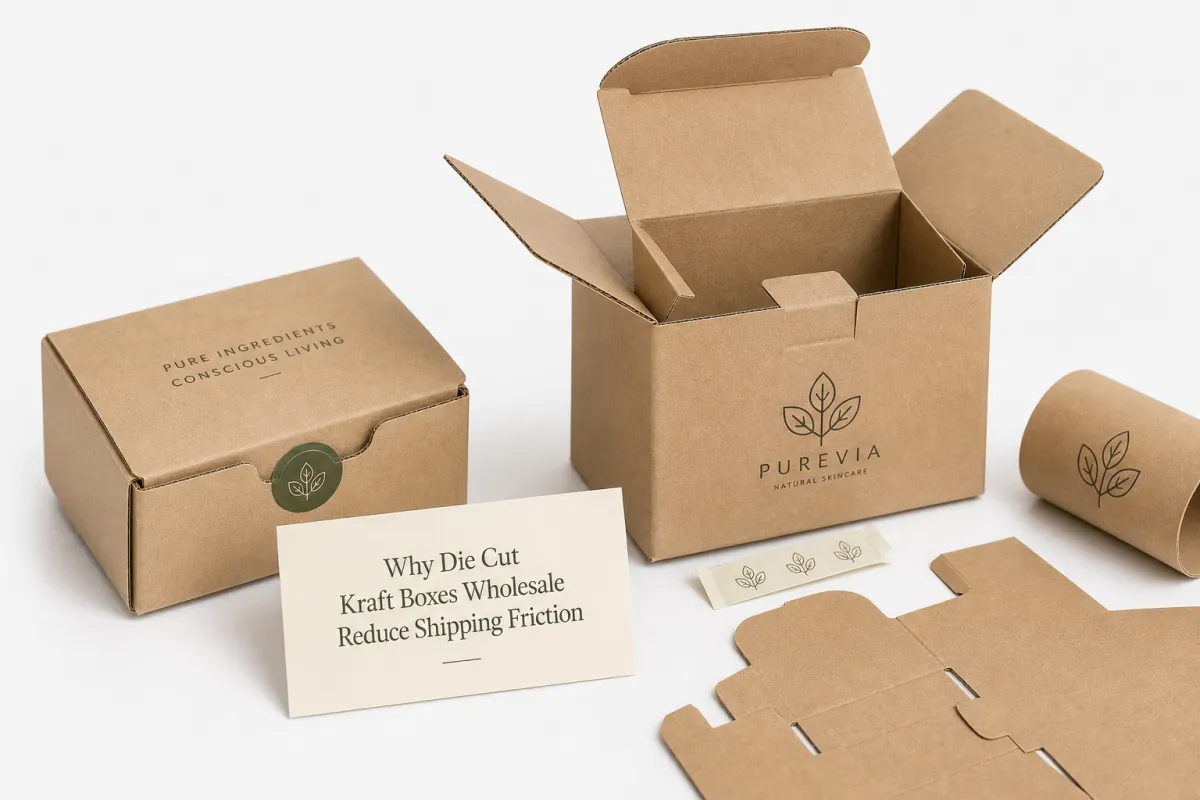
die cut kraft boxes wholesale reduce friction because the shape is engineered around a specific product profile. The carton starts with a dieline, not a guess, and that difference changes the entire pack-out rhythm. When the fold sequence is consistent, the tabs lock the same way every time, and the closure lands where it should, packers stop improvising. The box becomes a repeatable motion instead of a little puzzle that needs solving a few hundred times before lunch.
A common mistake is to assume a heavier board fixes a poor structure. It usually does not. In many shipping operations, die cut kraft boxes wholesale lower labor more effectively than a thicker board because the geometry removes uncertainty. Workers do not need to force a lid into position, trim loose void fill, or add tape just to make up for a carton that never closed correctly in the first place. A better cut can eliminate those extra movements, and extra movements are expensive in a high-volume environment.
Kraft carries its own practical advantages. The brown surface hides scuffs better than many coated white packages, nests neatly in storage, and handles pallet movement and line staging with less visual wear. die cut kraft boxes wholesale also suit direct-to-consumer shipments because the finish tends to read as sturdy without trying too hard. That visual honesty matters. A box does not need to shout to signal quality. Sometimes the most convincing packaging is the one that looks like it was built to work first and photograph second.
Wholesale buying adds another layer of value. When the same die cut kraft boxes wholesale spec returns in recurring runs, buyers can forecast usage more accurately, set reorder points with less guesswork, and keep packing instructions stable across multiple SKUs. That helps subscription programs, apparel brands, cosmetic kits, and accessory shipments that depend on repeatable output. It also reduces the hidden cost of training new staff, since one proven carton is easier to teach than a family of almost-identical boxes that each behave a little differently. That part is kinda underrated.
In logistics, the smallest details are often the most stubborn. A closure that takes two extra seconds can become a staffing issue. A carton that bulges by half an inch can alter pallet counts. A die line that folds cleanly can prevent a cascade of little delays. die cut kraft boxes wholesale work because they turn those small details into fixed behavior.
- Less movement: a snug fit keeps the product from bouncing inside the carton.
- Less filler: fewer voids mean fewer loose materials at the packing bench.
- Faster training: one repeatable fold sequence is easier to teach than a loose carton style.
- Cleaner storage: flat-packed die cut blanks stack efficiently and use less shelf space.
- Better replenishment: repeatable specs make reordering simpler for logistics teams.
A carton that saves 15 seconds on every pack-out can matter more than a slightly thicker board, especially when the same order profile repeats all week.
How Do Die Cut Kraft Boxes Wholesale Help Fulfillment Teams?
die cut kraft boxes wholesale help fulfillment teams by removing decisions that slow down the packing bench. A well-built carton folds the same way every time, closes the same way every time, and stacks with fewer surprises. That predictability is not a small benefit. In a busy warehouse, repeatability is a form of speed, and speed without confusion is what keeps labor costs from drifting upward.
The structure also helps teams handle different product categories without switching to a new process for every order. One style may work as a mailer, another as a tray, and another as a reinforced shipper, but the assembly logic stays familiar. That makes die cut kraft boxes wholesale useful for brands that ship apparel one day and kits or accessories the next. Fewer packaging variables mean fewer training gaps, fewer packing errors, and fewer damaged cartons moving through the floor.
There is also a physical advantage that is easy to miss. Because the carton is cut to a specific dieline, it can reduce excess motion at the bench and reduce excess bulk in storage. For many teams, that is the difference between a box that merely holds a product and a box that improves throughput. die cut kraft boxes wholesale are not just packaging; they are a workflow decision that affects labor, storage, and shipping efficiency at the same time.
I have seen that play out in real packing rooms. The team usually starts by focusing on one visible problem, like tape usage or crushed corners, but the root cause turns out to be a carton that asks for too many small corrections. Once the structure gets cleaned up, the floor calms down. The line stops feeling like it is fighting the box every shift.
Die Cut Kraft Boxes Wholesale Materials and Construction Details
die cut kraft boxes wholesale can be built from several board families, and the right choice depends on product weight, print requirements, and how rough the shipping route will be before the customer opens the box. Lightweight retail items often do well with kraft folding carton board because it scores cleanly and keeps folds crisp. Shipment-first packaging usually leans toward paperboard or corrugated kraft because those structures add stiffness and improve crush resistance.
Paperboard grades that show up most often
Most buyers compare natural kraft paperboard, coated kraft board, and corrugated kraft board. Natural kraft has the fibrous, earthy look many brands want when the goal is a plainspoken presentation. Coated kraft sharpens print detail and keeps logos from sinking into the fibers, which matters if the design uses bold color blocks or fine type. Corrugated kraft, especially single-wall builds in the 32 ECT to 44 ECT range, gives heavier products more support and better protection when the route includes repeated handling. die cut kraft boxes wholesale are not a single material choice. They are a decision tree, and the right branch depends on how the product actually ships.
What the die cut tool changes on the line
Die cutting is what makes the carton repeatable. A steel rule die cuts the outline and presses in the score lines, so every fold happens the same way. That is how the final box gets locking tabs, thumb notches, display openings, or tuck-in closures that behave predictably during assembly. With die cut kraft boxes wholesale, the real value lies in workflow control. A good dieline can eliminate extra tape, simplify closure steps, and keep stack shape stable on shelves and pallets. Packaging teams feel that difference almost immediately.
Finish changes the read of the box. Natural kraft carries a warmer, more rustic tone, while coated kraft supports tighter print and a more retail-polished appearance. For shipping logistics, the best finish depends on how visible the package will be before it is opened. A box that spends most of its life in a fulfillment center can prioritize durability and cost. A carton that lands directly in the customer’s hands may justify better print treatment or scuff resistance. die cut kraft boxes wholesale should be specified around the full use case, not just the marketing image.
Board weight, fiber density, score quality, and fold memory all affect performance. A 18pt or 24pt kraft board may suit lighter items and presentation-focused packaging, while heavier goods often need reinforced corrugated walls, tighter tolerances, or stronger closures. If the design includes hinges that open repeatedly or corners that carry real stress, testing should happen early. That is one reason die cut kraft boxes wholesale remain popular with practical buyers: they can be tuned to the product instead of forcing the product to fit a generic carton.
For validation, many teams reference ISTA methods to simulate vibration, compression, and shock. Sustainability-minded programs may also ask for FSC chain-of-custody documentation. Those details do not change the look of the box, but they do matter when procurement, operations, and brand teams want proof that the structure can survive the lane and satisfy sourcing standards. That is the difference between a pretty sample and a box the warehouse can trust.
Specifications for Die Cut Kraft Boxes Wholesale Orders
Good quoting starts with precise measurements. For die cut kraft boxes wholesale, buyers should define inside length, width, and depth rather than relying on an outside measurement that leaves too much room for interpretation. A product that measures 8.25 x 5.5 x 2.1 inches may need a very different carton from one that only looks similar on paper but includes fragile corners, a hanging tab, or a closure that needs extra headroom. Tolerance matters too. A snug fit can improve presentation, yet a box that is too tight can slow the packing line or damage edges during insertion.
Define the fit first
The first decision is whether the box should hold the product tightly, allow room for inserts, or leave space for a separate protective layer. Apparel mailers can often run with tighter sidewalls and a simple closure. Accessory kits may need a die cut insert or a locking tray. die cut kraft boxes wholesale work well in all three cases, but the dieline has to be built around the real packing method, not the version that looks best in a presentation deck.
Define the packing workflow next
Structure options include tuck ends, auto-lock bottoms, sleeve formats, mailer styles, display cutouts, and insert-ready trays. Auto-lock bottoms are useful when the box needs quick assembly and a stronger base. Mailer styles are common in e-commerce because they fold flat, ship efficiently, and stay neat on a fulfillment line. Sleeves can create a more premium presentation, but they also add steps, so the buyer should compare labor cost with the visual upside. For die cut kraft boxes wholesale, the smartest structure is the one that protects the product without slowing the operation.
Printing belongs in the specification sheet too. Some brands want a single-color logo on natural kraft because it feels direct and keeps costs under control. Others need full-coverage graphics, inside printing, barcodes, or a more retail-forward finish with spot treatment on the exterior. If the artwork sits near folds or closures, it should be placed on a proper dieline so nothing lands on a score, seam, or cut edge. That one decision prevents a surprising amount of friction later. die cut kraft boxes wholesale can look understated or premium; careful structure and print alignment make the difference.
Operational details matter just as much as graphics. Buyers should confirm closure strength, stackability, and crush resistance, along with master case counts, pallet build height, and any barcode or label placement required by the warehouse. If the packaging will sit in cold storage, travel through humid lanes, or move through carriers with repeated compression, board and adhesive choices may need adjustment. A supplier who asks those questions early is doing the buyer a favor. die cut kraft boxes wholesale perform best when the shipping environment is known before production starts.
A useful habit is to send a simple spec sheet before asking for a quote:
- Exact product dimensions and weight.
- Target quantity and reorder frequency.
- Print coverage, logo size, and color count.
- Insert, label, or barcode requirements.
- Shipping method, pallet preference, and storage conditions.
Pricing, MOQ, and Cost Drivers for Wholesale Orders
Pricing for die cut kraft boxes wholesale depends on a narrow set of variables that become obvious once the spec is clear: board grade, box size, print coverage, coating, die complexity, and total quantity. A plain unprinted kraft mailer can stay economical because the setup is simple. A multi-panel carton with inside printing, specialty scoring, or a custom insert costs more because the line has more steps to manage. Comparing two products by product-page appearance alone can be misleading. Two boxes may look close and behave very differently in production.
Minimum order quantity usually exists for a reason. A custom die, press setup, cutting pass, and finishing stage all carry fixed labor, so very small runs spread that cost too thin. For die cut kraft boxes wholesale, MOQ often reflects the setup required to keep the line efficient. A larger quantity typically lowers unit cost because tooling and labor are spread across more pieces. That does not mean the buyer should overbuy. It means the run should match real usage, storage capacity, and the expected reorder cycle.
Unit price versus landed cost
It helps to look beyond unit price. A carton that costs a few cents more but reduces void fill, taping, labor, or dimensional shipping expense can lower the true landed cost of the order. If a tighter box cuts cubic volume enough to reduce freight charges, the packaging premium may vanish almost immediately. That is why die cut kraft boxes wholesale should be evaluated as part of the entire fulfillment system rather than as an isolated purchase. Packaging sits inside operations, not outside it.
The table below gives comparison points buyers often use during early quoting. These are planning ranges, not fixed promises, because print coverage, freight distance, and tooling choices affect the final number. Still, the ranges help a logistics team see where the money goes and what features move the price the most.
| Box Style | Typical Build | Best Use | Rough Unit Range at 5,000 pcs |
|---|---|---|---|
| Simple kraft mailer | Unprinted or single-color, light to medium board | Apparel, small accessories, subscription kits | $0.28-$0.48 |
| Printed die cut mailer | Single-color or limited full-coverage print | Branded e-commerce shipments | $0.42-$0.78 |
| Reinforced corrugated die cut box | 32 ECT to 44 ECT, stronger corners or tabs | Heavier goods, fragile items, longer lanes | $0.65-$1.25 |
| Mailer with insert | Box plus custom insert or tray | Kits, cosmetics, electronics, sample sets | $0.70-$1.40 |
These ranges show how features stack. An insert can improve protection and presentation, but it adds tooling and assembly time. A coating can help with scuff resistance, but it adds finish cost. A more complex die can make the box easier to use, yet increase setup. die cut kraft boxes wholesale reward precise decisions. If a team knows product weight, print priorities, and pack-out target, the quote gets clearer and the production plan gets easier to manage.
Buyers can still save money without weakening the packout. Standardizing dimensions across several SKUs helps. Reducing nonessential print coverage helps. Choosing a simpler closure instead of a decorative one helps. Selecting one board grade that covers multiple product families can help more than creating a custom spec for every single item. In a warehouse with real volume, those choices compound quickly. That is why die cut kraft boxes wholesale are best planned as a packaging system, not as a stack of unrelated cartons.
Process and Timeline From Quote to Delivery
The order process for die cut kraft boxes wholesale usually begins with a quote request that includes dimensions, product weight, artwork, quantity, and shipping destination. The more exact the input, the better the quote. If the supplier has to guess at insert size, print coverage, or closure style, the estimate becomes fuzzy and the back-and-forth takes longer. Better quotes come from buyers who send a clean spec sheet and a clear explanation of how the box will live inside the warehouse or retail channel.
After quoting, the proof stage usually comes next. That is where the dieline gets reviewed, fold points are checked, and artwork placement is confirmed before production begins. For die cut kraft boxes wholesale, this step is not ceremonial. A tiny shift in logo placement can land a mark on a score line, and a small change in fold geometry can affect how the closure behaves. The proof is the place to catch that, not after the first run has been cut and packed.
Typical production flow
A standard production sequence includes tooling, printing, die cutting, finishing, quality checks, packing, and shipment prep. Simple kraft styles move faster because there are fewer finishing stages, while higher-coverage print, specialty coatings, or custom inserts add time. For many programs, straightforward die cut kraft boxes wholesale orders can land in roughly 10 to 15 business days after proof approval, while more detailed builds may need 15 to 25 business days depending on complexity and capacity. Freight transit time sits on top of that and should be planned separately.
Late artwork revisions, unclear measurements, missing product samples, and extra approval rounds all slow a run down. So does specifying a structure around appearance instead of actual handling. A buyer can save a noticeable amount of time by sending the real product, not only the dimensions on a spreadsheet. In practice, die cut kraft boxes wholesale move more smoothly when the supplier sees the packing scenario early.
The strongest production files are boring in the best way: complete dimensions, clean artwork, a confirmed dieline, and no uncertainty about the closure or insert.
If the shipment needs performance testing, ask about sample runs or transit validation before a full order is released. A small sample can show whether the product shifts, whether the tuck holds under pressure, or whether the board needs one more reinforcement point. That check is especially helpful for fragile goods, high-value items, and Subscription Boxes That repeat every month. Once the structure is approved, die cut kraft boxes wholesale become a repeatable part of fulfillment instead of a recurring design problem.
That testing step is also where honesty matters. A good sample can still reveal a weak corner or a closure that works beautifully on a bench but gets fussy on the line. It is better to see that during sampling than after 20,000 units are on a pallet. Nobody enjoys that conversation.
Why Choose Us for Die Cut Kraft Boxes Wholesale
Custom Logo Things is built around practical packaging knowledge, and that matters for die cut kraft boxes wholesale because the carton has to fit the real workflow, not just the mood board. A packaging specialist should be able to talk about board strength, closure style, insert options, and artwork placement in plain language. Buyers do not have time to decode jargon while a shipping schedule is waiting. Clear answers save hours.
Our focus stays on manufacturable design. That means looking at how the carton folds, how it stacks, how it performs under compression, and whether the finish still looks clean after storage and transport. Many boxes look good in a rendering and then become awkward in production. die cut kraft boxes wholesale avoid that trap when the structure is built around handling instead of presentation alone.
Why repeat orders matter
Wholesale buyers need consistency. The same fit, the same finish, and the same fold sequence matter every time a reorder lands. If the box changes from batch to batch, packers notice first and the shipping department pays for the variation. A dependable die cut kraft boxes wholesale program removes avoidable variables and keeps the packaging spec stable across long buying cycles. Predictability sounds dull until a team has lived through the opposite.
Communication matters just as much. If a design has a weak corner, a print issue near a fold, or an insert that slows assembly, that should be flagged early. Buyers should not discover those problems after production has started. The goal is clear specs, transparent cost drivers, and a realistic lead time that matches the actual build. That is how die cut kraft boxes wholesale stay useful as a procurement line item rather than turning into a recurring exception.
For buyers who need a broader view of available formats, our Wholesale Programs page is a good starting point, and our Custom Packaging Products page shows how different structures can support shipping, retail presentation, and kitting. If sustainability documentation matters, FSC-aligned paper sourcing can fit into the conversation without changing the box’s structural purpose. The goal is simple: choose packaging that supports the operation first and still gives the brand a clean, professional surface.
die cut kraft boxes wholesale do not need hype. They need a clean dieline, a sensible board spec, and a supplier who understands that a carton has to survive the shipping lane as well as the unboxing moment.
Next Steps for a Die Cut Kraft Boxes Wholesale Order
Before asking for a quote, gather the basics: exact product dimensions, target quantity, print needs, shipping method, and whether the box needs inserts, partitions, or a specific closure. That prep helps a supplier price die cut kraft boxes wholesale using the real build rather than a rough estimate. If the product is fragile or irregularly shaped, ask for a sample or a dieline review first. One short review can prevent expensive changes later.
It also helps to compare two or three structure options side by side. A mailer may be cheaper and faster to assemble. A reinforced tray may protect better. A sleeve may look more premium but add labor. For die cut kraft boxes wholesale, the right answer is usually the one that balances protection, labor, and cost instead of chasing a single feature too hard. Packaging teams that review options this way usually make better long-term decisions.
From there, the path is straightforward: approve the structure, confirm the artwork, check the proof, and line the order up with inventory and ship dates. If you want a broader purchasing framework, start with the right wholesale channel, compare the packaging formats that support your product line, and keep the spec stable enough that reorders stay simple. Once the details are settled, die cut kraft boxes wholesale can become a repeatable part of the shipping workflow, which is exactly where a good box belongs.
The most practical next move is simple: write down the product’s inside dimensions, weight, and shipping conditions, then compare one plain mailer against one reinforced option before you place the full run. That side-by-side check usually reveals more than a sales sheet ever will, and it gives procurement a cleaner path to a repeat order.
FAQs
What is the minimum order for die cut kraft boxes wholesale?
Minimums usually depend on the box style, print complexity, and whether a custom die or special finishing is needed. A simple unprinted kraft structure often allows a lower starting quantity than a fully printed box with multiple cuts or inserts. For the most accurate MOQ, buyers should share the exact size, material preference, and artwork requirements before quoting. That gives a supplier enough detail to price die cut kraft boxes wholesale without padding the estimate for missing information.
How do I choose the right kraft board for die cut kraft boxes wholesale?
Match the board strength to the product weight, transit distance, and how many times the box will be handled before delivery. Heavier or fragile items usually need a stiffer board or reinforced structure, while lighter goods can use a simpler kraft carton. If the box must look retail-ready as well as ship safely, ask for a material sample or spec comparison before ordering. That is the safest way to choose die cut kraft boxes wholesale that actually match the job.
Can die cut kraft boxes wholesale be printed with my logo?
Yes, most wholesale die cut kraft boxes can be printed with a logo, product information, or simple brand graphics. Single-color printing is often the most cost-efficient choice, while full coverage or inside printing increases setup and production cost. Artwork should be prepared with the dieline so logos and copy do not land on folds, flaps, or cut edges. When the print file is built correctly, die cut kraft boxes wholesale can look clean without adding unnecessary complexity.
How long does production usually take for die cut kraft boxes wholesale?
Timing depends on whether the design is standard or fully custom, plus whether artwork and dieline approval are already complete. Straightforward kraft orders move faster than complex printed builds or boxes that require inserts, coatings, or special structure checks. The fastest way to keep the timeline on track is to approve the structure and artwork quickly and avoid late design changes. That approach keeps die cut kraft boxes wholesale moving through production with fewer pauses.
Are die cut kraft boxes wholesale good for shipping fragile products?
They can be, if the structure is built with the right board strength and the product is held firmly in place. Fragile goods often need inserts, tighter tolerances, or an added outer shipper so the product does not shift in transit. Always test the box with the actual product weight and packing method before committing to a full production run. With the right spec, die cut kraft boxes wholesale can support fragile items without creating extra bulk or wasted filler.

