Buyer Fit Snapshot
| Best fit | Eco Corrugated Boxes for Brands projects where brand print, material claims, artwork control, MOQ, and repeat-order consistency need to be specified before quoting. |
|---|---|
| Quote inputs | Share finished size, material target, print colors, finish, packing count, annual reorder estimate, ship-to region, and any compliance wording. |
| Proofing check | Approve dieline scale, logo placement, barcode or warning zones, color tolerance, closure strength, and carton packing before bulk production. |
| Main risk | Vague material claims, crowded artwork, missing packing details, or unclear freight terms can make a low unit price expensive after revisions. |
Fast answer: Eco Corrugated Boxes for Brands: Practical Packaging should be specified like a repeatable production item. The safest quote records material, print method, finish, artwork proof, packing count, and reorder notes in one written spec.
Production checks before approval
Compare the actual filled-product size with the drawing, then confirm tolerance on folds, seals, hang holes, label areas, and retail display edges. Reserve space for logos, QR codes, warning copy, and material claims before decorative graphics fill the panel.
Quote comparison points
Review material grade, print process, finish, sampling route, tooling charges, carton quantity, and freight assumptions side by side. A quote is only useful when the supplier can repeat the same color, closure quality, and packing count on the next order.
Eco Corrugated Boxes for Brands: Practical Packaging
Eco corrugated boxes for brands usually solve a painfully ordinary problem. The product is fine. The order is fine. The carton around it is doing too much, too little, or both. That mismatch shows up in freight, packing labor, damage rates, and customer experience all at once. So yes, eco corrugated boxes for brands deserve more attention than a green sticker and a polite nod.
The right box is rarely the loudest sustainability claim in the room. It is the one that protects the product, fits the shipping lane, and uses fiber with some actual restraint. A carton that wastes board, void fill, and warehouse time is not clever. It is just expensive with better branding. For brands trying to tighten packaging costs without making the unboxing feel cheap, eco corrugated boxes for brands can do real work if the structure is planned from the start.
If you are comparing styles, it helps to scan the broader Custom Packaging Products range first, then narrow into a carton that actually matches the product, the warehouse flow, and the customer touchpoint. For heavier or more fragile items, Custom Shipping Boxes are often a better baseline than a decorative mailer. That is not glamorous. It is just the truth.
The most expensive box is usually the one that looks fine on a desk and falls apart once it meets a real shipping lane.
What Eco Corrugated Boxes for Brands Really Solve
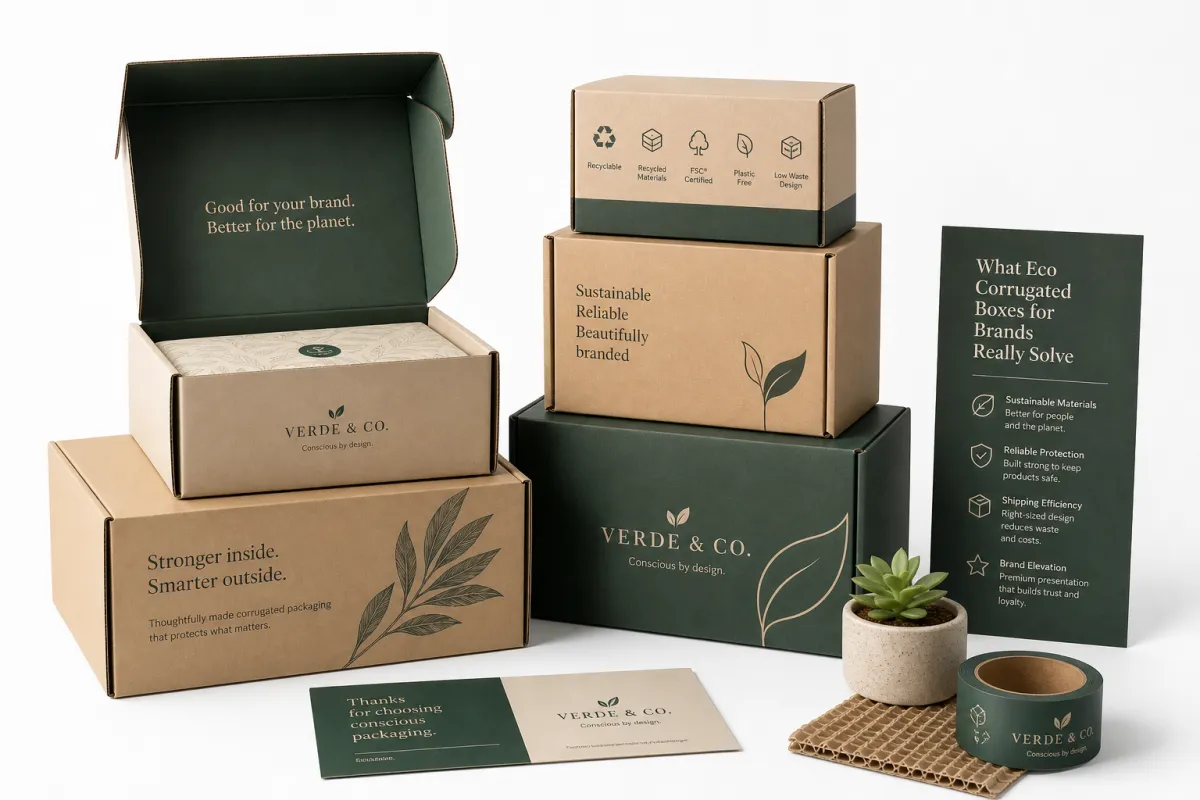
Eco corrugated boxes for brands are not only about recycled content, even though that matters. They are about building a carton that uses the right amount of material, can be recovered through normal recycling streams, and still performs under compression, vibration, and drop conditions. Corrugated board has stayed a packaging staple for a reason. The layered structure gives a strong stiffness-to-weight ratio, which is exactly what shipping needs.
The shipping scenario sets the tone. A product goes into an oversized carton, the team fills the empty space with paper or air pillows, and the parcel moves through a network where every extra inch can raise dimensional weight. Add a few inches on length, width, or height and the freight charge climbs for no useful reason. That is why eco corrugated boxes for brands often save more money through sizing discipline than through any single material tweak.
Brand value matters too. Clean presentation changes how the box feels in the hand and how it behaves in the warehouse. A carton that fits the product well tends to stack better, print more cleanly, and arrive with fewer crushed corners. If the box opens neatly, holds the contents snugly, and carries the right amount of graphics for the channel, the customer reads it as intentional instead of accidental. Eco corrugated boxes for brands can support that feeling without pretending to be luxury packaging.
Greener packaging is not automatically stronger packaging. That part gets glossed over a lot. A box made with higher recycled content can still perform well, but only if the board grade, flute, score pattern, and closure method match the load. I have seen lightweight cartons perform beautifully and heavy cartons fail because they were overbuilt in one dimension and weak in another. Packaging is funny that way, in the annoying sense. Eco corrugated boxes for brands should be treated as an engineered system, not a slogan.
Box sizing and board selection often matter more to total cost and carbon than printed artwork does. A simple one-color box with the wrong footprint can waste more fiber and create more transport inefficiency than a slightly richer print spec on a right-sized carton. For eco corrugated boxes for brands, the smartest savings usually live in structure first and graphics second.
There is also a retail and subscription angle. A carton that opens cleanly, sits square on a shelf, or makes a strong first impression on camera can do marketing work without extra inserts, wraps, or secondary packaging. That is where eco corrugated boxes for brands become more than shipping containers. They become part of the brand system, quietly carrying consistency from warehouse to doorstep.
To keep the sustainability claim honest, think in terms of fiber, reuse, and recovery. Recycled content is useful. FSC-certified sourcing matters for fiber stewardship. A recyclable structure is easier for customers to dispose of correctly. Still, the box only delivers those benefits if it avoids unnecessary layers and if local recycling systems can actually handle the material. Eco corrugated boxes for brands should describe a practical outcome, not a vague promise.
I have sat in too many packaging reviews where everyone talked about eco-credentials and nobody checked the actual product footprint. That is usually how brands end up with a carton that sounds good in a slide deck and behaves badly in a warehouse. The fix is not complicated. Measure the product, map the shipment, then let the box earn its place.
How Eco Corrugated Boxes for Brands Work in Production
Corrugated board looks simple from the outside, but the structure is doing a lot of heavy lifting. A standard board uses linerboard on the outside and fluting in the middle. That wavy flute profile creates air space, improves cushioning, and gives the sheet much better resistance to bending than a flat paperboard of similar weight. Geometry matters here. So does fiber mix.
Board anatomy
Single-wall board is the usual starting point for many eco corrugated boxes for brands. It is often enough for lighter consumer goods, apparel, accessories, and many subscription shipments. Double-wall board adds another fluted layer and more linerboard, which gives better stacking strength and a more forgiving safety margin for heavier products or longer transit routes. Triple-wall exists too, though most brands will never need it unless the unit load is substantial or the product is unusually fragile.
Flute choice changes the feel and performance. E-flute is thinner and often gives a crisper print surface. B-flute and C-flute offer stronger cushioning and better stacking characteristics. BC double-wall combines those properties for tougher shipments. Eco corrugated boxes for brands should be selected around actual product weight, compressive load, and transit conditions, not around what looked familiar last season.
Conversion and print
Once the board is chosen, the sheet moves into converting. That stage includes cutting, scoring, slotting, die-cutting, folding, gluing, and bundling. A well-designed die line can cut packing time because workers do not have to fight the box into shape or pile on tape just to keep it together. Locking tabs, tuck closures, and better score placement can also reduce assembly errors, which matters a lot in busy fulfillment environments.
Print method shapes both appearance and economics. Flexographic printing is common for corrugated cartons because it is efficient at scale and works well for simpler graphics, solid areas, and one- to three-color branding. Digital print can make sense for short runs, test programs, or highly variable artwork. Heavy ink coverage, specialty finishes, and tight registration usually raise cost and lead time along with visual impact. Eco corrugated boxes for brands often work best when graphics support the structure instead of fighting it.
Coatings, inks, and adhesives belong in the same conversation. Water-based inks are common in corrugated work, and aqueous coatings can add some moisture resistance without turning the carton into a recycling headache. Any treatment still needs to line up with the recycling goals of the program. A box can be recyclable in theory and still be a poor environmental choice if the coating adds complexity for little gain.
For brands that want a test benchmark, distribution standards matter. The ISTA distribution testing standards are a useful reference for vibration, drop, and handling scenarios, while ASTM methods such as compression testing help validate whether a carton can hold stack loads without buckling. Eco corrugated boxes for brands should be tested against real shipment conditions, not only against a pretty proof.
After conversion, boxes are folded, bundled, palletized, and shipped to the brand or fulfillment partner. That last leg matters more than people expect. If the carton bundles are bulky, heavy, or awkward to store, operational cost rises before a single product is packed. A clean production spec for eco corrugated boxes for brands should account for storage, handling, and packout in addition to the finished package.
For fiber sourcing, certification can be part of the story. The FSC system is one recognized way to support responsible sourcing goals, especially for brands that need documentation for retail partners or sustainability reporting. Certification does not replace good engineering. It supports the broader materials strategy behind eco corrugated boxes for brands.
In production reviews, I always ask for the same three things: the blank size, the flute grade, and the conversion method. If those three are fuzzy, the rest of the spec is kind of theater. And nobody needs more theater in packaging.
Key Factors That Shape Eco Corrugated Boxes for Brands
The product itself sets the starting line. Weight, dimensions, fragility, surface finish, center of gravity, and how the item moves inside the box all influence the final build. A ceramic set, a skincare kit, and a stack of folded shirts can all ship in corrugated packaging, but they do not need the same board grade or the same internal support. Eco corrugated boxes for brands work best when product data comes first and the carton is built around it.
Board grade and flute profile usually come first. If the product is light and the shipping lane is short, a single-wall structure may be enough. If the carton must survive pallet stacking or long parcel routes, a stronger board or double-wall construction may be better. The point is not to use the heaviest structure possible. It is to match the board to the real risk. Over-specifying adds cost, material, and dead weight the package never needed.
Dimensions and fit influence almost everything. Tight sizing reduces movement, cuts filler usage, improves pallet density, and can lower dimensional freight charges. It also makes the box feel more deliberate in the hand. Eco corrugated boxes for brands often save the most money through fit because every inch removed from a carton can reduce wasted space across thousands of shipments. A brand may think it needs a premium finish, yet the first meaningful improvement is often just removing empty air.
Graphics and brand requirements should be tied to channel behavior. A plain kraft shipper with one-color branding can look polished and serious for direct-to-consumer orders. A retail-facing box may need stronger print contrast, a cleaner die-cut, or a controlled white surface so the logo reads clearly. The trick is not to print more. It is to print in the right places. Eco corrugated boxes for brands usually look better when the graphic system is restrained and intentional.
Shipping environment changes the answer too. Parcel networks punish weak corners and loose contents because cartons get sorted, dropped, and stacked repeatedly. Palletized freight puts more emphasis on compression strength and load stability. Subscription fulfillment cares about pack speed and consistency because labor hours add up quickly. Retail display packaging may need shelf appeal and easier opening. There is no universal best version of eco corrugated boxes for brands. There is only the best version for a given route to the customer.
Sustainability inputs include recycled content, responsibly sourced fiber, recyclability, and the amount of material used per shipment. Those inputs should be considered together. A box with high recycled content is useful, but a box that is too large or too thick can still create unnecessary emissions and material demand. The better question is whether eco corrugated boxes for brands reduce waste across the whole system, not only in the raw material description.
Operational constraints are easy to overlook because they are less visible than print or material specs. Warehouse equipment, storage space, assembly speed, minimum order quantities, and the level of operator training all affect the final decision. A clever carton that takes too long to fold can become a labor problem. A beautiful custom dieline that only ships in massive quantities can freeze cash in inventory. Good eco corrugated boxes for brands work inside the real limits of the operation.
One thing I learned the hard way: the spec that looks clean on paper can still be awkward in a fulfillment center. If an operator has to fight the carton every tenth box, that friction will show up somewhere. Usually in labor cost. Sometimes in damaged goods. Occasionally in a manager muttering under their breath, which is not a formal metric, but it should be.
Eco Corrugated Boxes for Brands: Cost and Pricing Factors
Pricing starts with material, but it rarely ends there. Board type, box size, print coverage, order volume, structure complexity, and freight to the plant or warehouse all affect the final number. Eco corrugated boxes for brands can look expensive on a unit basis until the full picture is counted, especially if the current packaging drives damage, filler use, or oversized freight charges.
One of the simplest pricing truths is that volume matters. Larger runs usually lower the per-unit cost because the setup work gets spread across more pieces. Short runs can still make sense, especially for launches or seasonal products, but they often carry a higher cost per carton because tooling, plates, and production setup are not getting diluted. Eco corrugated boxes for brands are often most economical once the design is standardized and reordered in sensible quantities.
The other major price driver is customization. A simple regular slotted carton with modest printing is usually cheaper than a highly engineered die-cut mailer with locking tabs, interior print, and a specialty finish. That does not mean the simpler option is always better. It means the buyer should know what each added feature is buying. If a die-cut feature saves tape, improves pack speed, and reduces returns, it may justify itself quickly.
| Box style | Typical use | Indicative unit price at 5,000 units | What it tends to deliver |
|---|---|---|---|
| Single-wall RSC, 1-color print | Apparel, accessories, lightweight kits | $0.42-$0.68 | Low material cost, fast assembly, easy stacking |
| Die-cut mailer, E-flute, 1-2 color print | Subscription boxes, direct-to-consumer unboxing | $0.58-$1.05 | Cleaner presentation, less tape, stronger brand feel |
| Double-wall shipper, plain or light print | Heavier products, fragile items, pallet support | $0.88-$1.75 | Higher compression strength, better damage protection |
Those numbers are illustrative, not universal. Board market swings, freight distance, print coverage, and insert requirements can move pricing up or down. Even so, the table shows a useful pattern: the cheapest-looking carton is not always the cheapest package. Eco corrugated boxes for brands can reduce total spend if they cut freight weight, speed up packing, and reduce breakage.
A lower unit price means very little if the carton creates returns, repacks, or extra minutes on every order line.
Hidden costs matter more than many procurement teams expect. Excess void fill adds consumable spend and labor. Oversized cartons can trigger dimensional charges. Heavy board can increase shipping cost and make warehouse handling slower. Damaged goods cause returns, replacements, and customer service work. Eco corrugated boxes for brands should be judged by total landed cost, not by the invoice alone.
If a supplier can quote two or three structures, compare them on a full matrix: unit price, freight impact, pack speed, damage risk, and storage density. That is a much fairer way to buy eco corrugated boxes for brands than comparing only the price per thousand. A carton that saves twenty seconds per pack can pay for itself before the first shipment cycle ends.
The pricing part gets easier once someone actually counts the warehouse time. Most teams forget that labor is real money, not a foggy background detail. It is sitting right there on the packing line, waiting to be measured.
Step-by-Step Process and Timeline for Eco Corrugated Boxes for Brands
The strongest projects begin with a clear brief. Before anyone quotes eco corrugated boxes for brands, define the product dimensions, finished weight, fragility, shipping method, graphic needs, sustainability priorities, and target budget. A supplier can work much faster when the brief is specific, because there is less guessing about whether the box is meant for parcel shipment, pallet movement, or retail presentation.
Discovery and sample planning
Discovery should include the physical product, not just a SKU sheet. Measure the actual item in its retail form, note any inserts or protective wraps, and account for how the product sits in the box. A phone accessory that seems tiny can still need a larger footprint because of cables or molded trays. A beverage kit may seem rigid but need a very specific internal fit to stop rattle. Eco corrugated boxes for brands should be sized around the object as shipped, not around a marketing spec.
Prototyping comes next. Sample rounds often include blank fit samples, printed proofs, and final production samples. During this phase, it helps to check compression, edge crush, drop behavior, and packing speed. If the warehouse team says the carton is awkward to fold or the insert is too fiddly, that feedback matters. Those concerns are cheaper to hear now than after thousands of boxes are already in circulation.
That testing step is not glamorous, but it saves brands from themselves. I have watched a beautiful box fail because the product rocked around inside like it was in a toy car. The art department hated the fix. The warehouse loved it. Guess which team was right.
Artwork and production setup
Artwork setup begins with a dieline. That template shows fold lines, cut lines, glue areas, and safe print zones. If the print is simple, the setup can move quickly. If the carton carries multiple panels, a brand story, barcodes, or a lot of registration-sensitive artwork, the approval loop may take longer. Eco corrugated boxes for brands often move through proofing faster when the creative team respects the structure of the board instead of treating the carton like a flat poster.
After approval, tooling or digital production files go into motion, depending on the print method. A straightforward design might move from proof approval to production in 12 to 15 business days. A more complex die-cut or a carton requiring multiple revisions can take 15 to 25 business days or more. Add shipping time, and the total timeline becomes more realistic. That is why launch planning matters so much for eco corrugated boxes for brands.
Fulfillment testing and rollout
Before full conversion, it is smart to run a small operational test. Have packers assemble the box with live product, seal it using the intended tape or closure, and check how it stacks on a pallet or in a tote. If the box is being used in a subscription flow, make sure the opening sequence feels clean and the customer-facing side lands correctly. Eco corrugated boxes for brands are not just packaging specs; they are workflow tools.
A practical rollout usually includes warehouse training, a short pilot, and a review of damage reports once the box is in circulation. If the first pilot reveals corner crush, print rub, or slow assembly, adjust before scaling. It is far cheaper to revise a sample batch than to replace a bad program halfway through the season. A disciplined launch process gives eco corrugated boxes for brands the best chance to perform as intended.
From first brief to final shipment, the best programs leave room for revision. Not every sample will pass on the first round, and that is normal. Packaging is a physical system, and physical systems deserve proof. That mindset keeps eco corrugated boxes for brands grounded in reality instead of wishful thinking.
Common Mistakes Brands Make With Eco Corrugated Boxes
The first mistake is choosing the box for the message instead of the shipment. A brand may want to signal sustainability and pick a carton based on fiber language alone, then discover that the board is too light for the actual load or too large for the product. Eco corrugated boxes for brands work best when the shipping lane defines the structure and the sustainability story follows the performance.
The second mistake is overbuilding. If the product is light, fragile only on one axis, and moving through controlled parcel conditions, a heavy double-wall carton may be unnecessary. Extra board raises cost, weight, and sometimes carbon without delivering meaningful protection. It is better to specify the right strength than to buy insurance the product never needed.
The third mistake is ignoring internal fit. A box can look perfect from the outside and still fail because the contents move around inside. That movement can lead to scuffing, corner damage, crushed inserts, or a customer impression that the package was packed carelessly. Eco corrugated boxes for brands should always be checked for void space, product stability, and insert fit before sign-off.
The fourth mistake is treating recyclability as a universal behavior. Regional systems differ. Paper-based materials are widely recyclable, but coatings, laminations, wet-strength treatments, and heavy ink coverage can influence how a box behaves in recovery. That does not mean those treatments are always wrong. It means they should be chosen intentionally. Eco corrugated boxes for brands should be designed with local recovery pathways in mind.
The fifth mistake is separating print from structure. Graphics, coatings, and ink laydown can affect both production lead time and recycling profile. If the visual concept demands a large flood coat or a special finish, the production plan needs to account for it. A carton is not just a canvas. For eco corrugated boxes for brands, the print spec should support the box, not force the box to carry the wrong burden.
The sixth mistake is skipping real-world validation. Dummy weights in a conference room do not tell you how the box will behave after vibration, stacking, moisture changes, or repeated handling. A sample should be tested with live product and in the same conditions the order will face. Eco corrugated boxes for brands are too practical a subject to leave untested.
One more error shows up in purchasing teams that focus only on unit cost. A slightly cheaper carton can create more labor, more damage, and more returns. Once those expenses are counted, the “cheaper” option becomes the expensive one. That is why eco corrugated boxes for brands should always be evaluated with the warehouse, not only with procurement.
Expert Tips for Choosing the Right Eco Corrugated Boxes for Brands
Begin with the product and the shipping lane, then work backward to the lightest structure that still protects the contents. That approach keeps the box honest. A brand that ships mostly short-distance parcel orders does not need the same board spec as one that loads mixed freight on pallets. Eco corrugated boxes for brands improve fastest when the team resists the urge to copy an old spec without checking whether the old spec still fits the business.
Standardize where you can. A small family of box sizes often reduces inventory complexity, improves buying power, and makes training easier for warehouse staff. Standardization does not mean every package looks identical. It means the core structures are stable enough that the operation can move quickly. Eco corrugated boxes for brands often become more efficient, not less flexible, when the number of sizes stays under control.
Use graphics strategically. A well-placed logo, a modest one-color pattern, or a strong interior print panel can make the box feel branded without turning it into an expensive print project. Less can feel more if the structure is tidy and the typography is clear. For many eco corrugated boxes for brands, the strongest look is the one that appears deliberate rather than decorated.
Ask suppliers specific questions. What board grades are available? What recycled content is typical? Can the design be sourced regionally to cut freight? How will the coating or ink affect recyclability? What production method fits the quantity and lead time? A good supplier should be comfortable answering those questions in plain language. If not, that is a useful warning sign.
Test with actual product samples, not dummy weights. Real units have real surface finishes, odd corners, center-of-gravity shifts, and interaction points with inserts or closures. A sample that passes a weight test may still fail in transit because the product shape moves differently than the test block. Eco corrugated boxes for brands only become trustworthy when the samples match the real ship state.
Think in systems. The carton, insert, seal method, pallet pattern, and warehouse process all affect each other. A better box can help, but the biggest gains often come from pairing the right box with the right closure and the right pack sequence. That is why the most effective eco corrugated boxes for brands are usually part of a broader packaging system rather than a lone spec change.
If you want to compare formats before you commit, the Case Studies page can help you see how structure decisions affect damage rates, packing speed, and presentation. That kind of comparison is often more useful than a generic product sheet because it shows how eco corrugated boxes for brands behave in real packaging programs.
From a buyer’s point of view, the safest path is to start modestly, test carefully, and scale only after the box proves itself in the warehouse and on the route. That is the practical side of eco corrugated boxes for brands, and honestly, it is the side that saves the most headaches later.
What to Do Next With Eco Corrugated Boxes for Brands
Build a short packaging brief before you request quotes. Include product dimensions, finished weight, fragility, shipping method, desired print level, sustainability goals, and any warehouse limits such as pack speed or storage space. A brief like that gives suppliers enough context to recommend eco corrugated boxes for brands that actually fit the job instead of sending back a generic carton spec.
Review the current setup with a critical eye. Look for oversized cartons, too much void fill, heavy board that does not seem necessary, or a closure style that slows down packing. The quickest wins are often the most ordinary ones. Smaller dimensions, a better flute choice, or a cleaner die-cut can improve both cost and presentation without changing the product at all. Eco corrugated boxes for brands are often most powerful when they remove friction from the current process.
Next, request one or two sample structures and test them with live product. Run the same handling your orders actually face, not a gentle version of it. Check fit, pack speed, stacking, tape use, print readability, and how the box looks after a normal journey. If the carton performs well in those conditions, you have a real candidate. If it fails, the failure is useful because it tells you what to adjust before scale.
Then compare proposals using total cost instead of sticker price. Freight, labor, fillers, damage risk, inventory space, and customer presentation all belong in the calculation. A supplier who understands that math can help you make a cleaner decision. Eco corrugated boxes for brands are rarely a pure commodity purchase; they are a business tool with direct impact on operations and customer perception.
From there, create a rollout plan. Approve the sample, train the warehouse, launch a small pilot, and review damage data and packout time after the first wave. That sequence lowers risk and gives the team confidence. It also gives the packaging brief a chance to prove itself in the real world instead of only on paper.
If you are working through a new build or cleaning up an old spec, Custom Logo Things can help you narrow the design into something practical, economical, and still on-brand. The point is not to make the fanciest box on the shelf. The point is to make a carton that protects the product, respects the fiber, and keeps the shipping process from getting weird. That is the standard worth aiming for with eco corrugated boxes for brands.
The next move is simple: measure the shipped product, request two board grades, and run a warehouse pilot before signing off on artwork. That gives you a real answer instead of a hopeful one, which is usually the better deal.
What makes eco corrugated boxes for brands actually eco-friendly?
They usually combine responsible fiber sourcing, a recyclable corrugated structure, and a size and strength level that avoids unnecessary material use. The most meaningful gains come from right-sizing, reducing damage, and choosing print and coating options that still support recovery in normal recycling streams. Recycled content helps, but it is not the whole story.
Are eco corrugated boxes strong enough for shipping products safely?
Yes, when the board grade, flute profile, and box style match the product weight and shipping conditions. A well-designed corrugated carton can handle parcel shipping, palletized freight, and retail distribution very effectively, especially when tested under real handling conditions. The carton has to earn that trust, though. No free passes.
How do eco corrugated boxes for brands affect cost?
Cost depends on board choice, size, print complexity, quantity, and any custom structural features. They can lower total cost when they reduce freight weight, packing time, filler material, and damage-related returns, even if the unit price looks slightly higher at first glance. A cheap box that creates problems is not cheap for long.
How long does it take to produce custom eco corrugated boxes?
Timeline usually includes discovery, sampling, proofing, production scheduling, and shipment, so it helps to build time for review and testing. Simple designs can move faster, while highly branded or structurally complex boxes need more iteration before production starts. If there are multiple revision rounds, add buffer. It will be needed.
What should I test before ordering eco corrugated boxes in bulk?
Check product fit, stacking strength, transit durability, and how quickly the box assembles in your packing area. It is also smart to test print readability, tape performance, and how the package presents to customers on arrival so you can catch issues before the rollout. Real product, real handling, real result. That is the only test that matters.


