Buyer Fit Snapshot
| Best fit | Poly Mailers for Leggings Brands projects where brand print, material claims, artwork control, MOQ, and repeat-order consistency need to be specified before quoting. |
|---|---|
| Quote inputs | Share finished size, material target, print colors, finish, packing count, annual reorder estimate, ship-to region, and any compliance wording. |
| Proofing check | Approve dieline scale, logo placement, barcode or warning zones, color tolerance, closure strength, and carton packing before bulk production. |
| Main risk | Vague material claims, crowded artwork, missing packing details, or unclear freight terms can make a low unit price expensive after revisions. |
Fast answer: Poly Mailers for Leggings Brands: Practical Packaging should be specified like a repeatable production item. The safest quote records material, print method, finish, artwork proof, packing count, and reorder notes in one written spec.
Production checks before approval
Compare the actual filled-product size with the drawing, then confirm tolerance on folds, seals, hang holes, label areas, and retail display edges. Reserve space for logos, QR codes, warning copy, and material claims before decorative graphics fill the panel.
Quote comparison points
Review material grade, print process, finish, sampling route, tooling charges, carton quantity, and freight assumptions side by side. A quote is only useful when the supplier can repeat the same color, closure quality, and packing count on the next order.
Poly mailers for leggings Brands: Practical Packaging is not some sleepy warehouse side note. It is a margin decision, a brand decision, and a damage-control decision pretending to be one thing. Poly mailers for leggings brands matter because leggings are light, but customers still judge the parcel like it is carrying something expensive. A crushed, wrinkled, or overstuffed mailer makes the product feel cheaper before anyone even touches the fabric.
That is the trap. People see a soft apparel item and assume any bag will do. Then the brand gets stuck with complaints that never needed to exist, awkward unboxings, and postage that keeps creeping upward for no good reason. The right poly mailers for leggings brands protect stretch fabrics from moisture and scuffs, keep shipping weight down, and create a cleaner branded impression from packing table to doorstep.
I have seen brands spend hours obsessing over color palettes, then toss leggings into a flimsy bag and act surprised when the package feels cheap. Packaging does not care about your mood board. It only cares about fit, seal, and whether the material survives the trip.
Why poly mailers for leggings brands are not generic shipping bags
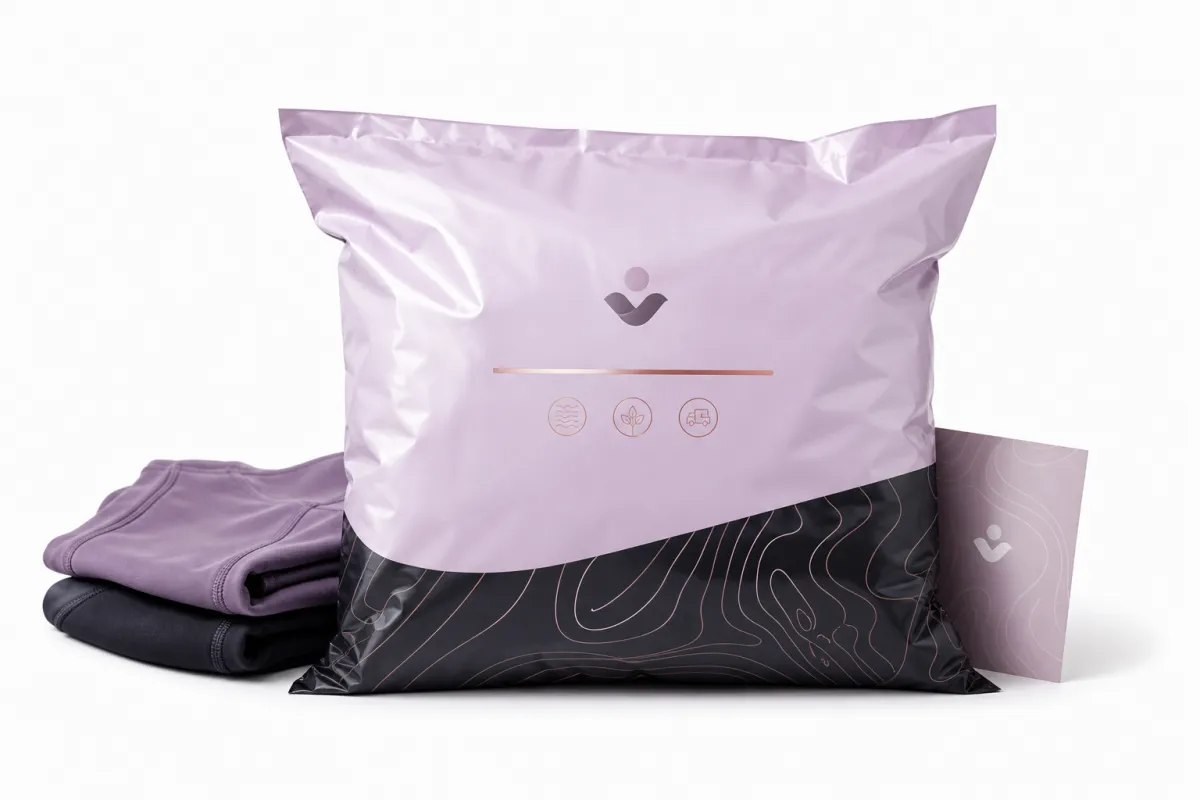
Poly mailers for leggings brands are not generic shipping bags because leggings are not generic products. They are compact, flexible, and usually sold on style as much as function. A customer paying for a sleek set wants the delivery to look deliberate, not like a hurried warehouse fix. A plain oversized bag can make a polished product feel careless. A bag that is too small creates the opposite problem: bulging corners, a seal that fights back, and an order that looks rushed. Because it was.
That matters more here than it does for a lot of apparel categories. Stretch fabrics crease differently. Branded inserts shift around. Fitted silhouettes create tighter packout dimensions than people expect. The real question is not whether a mailer can hold leggings. It can. The real question is whether the mailer supports the brand story without wasting postage or creating avoidable handling problems.
From a packaging buyer’s point of view, poly mailers for leggings brands sit in a useful middle zone. They are strong enough for everyday apparel shipping, but light enough to avoid the dimensional weight penalties that boxes can trigger. They also make fulfillment easier. One fold, one insert, one seal, one label. Faster than building every order into a tiny monument out of corrugate and void fill.
“A leggings order can look premium in a simple mailer if the fit is right. It can look cheap in a fancy box if the box is oversized. Packaging does not care about your brand deck.”
That is why poly mailers for leggings brands get judged on details that outsiders miss: opacity, seal strength, print clarity, and how well the mailer holds a folded garment without stuffing the corners. If the outer package feels sloppy, customers assume the same about what is inside. Harsh? Sure. Also true.
There is a practical shipping pattern here too. Leggings often move in repeat order shapes: single pairs, two-packs, bundles, and restock orders from returning customers. A mailer system needs to handle all of that without forcing the brand into a mess of separate packaging SKUs. The best poly mailers for leggings brands are sized around real order behavior, not the flat measurement of one folded legging.
If the goal is premium perception, the mailer is part of the brand face. If the goal is margin control, the mailer is part of the shipping math. In practice, it is usually both. That is why a smart packaging plan starts with the product and works outward. If you need a broader packaging stack, the Custom Packaging Products page is a useful place to compare the rest of the system without guessing.
How poly mailers for leggings brands protect products and reduce friction
Poly mailers for leggings brands protect products in a very specific way: they cover the actual problems that happen during shipping. They are naturally water-resistant, so light moisture is less likely to reach the garment. They resist tears better than flimsy paper bags. They flex around the product instead of forcing a rigid shape. That flexibility sounds boring until you realize it cuts down on wasted space and keeps the packout process moving.
For leggings, that is usually enough. Most orders do not need a rigid box unless the brand is shipping gift sets, adding hard accessories, or chasing a luxury presentation that depends on a structured reveal. Even then, many brands use a mailer as the outer shipper and save rigid packaging for higher-value sets. That split keeps costs under control without making every order feel stripped down.
Poly mailers for leggings brands also reduce friction in the warehouse. A box needs assembly. A mailer needs folding, filling, sealing, and labeling. That difference seems small until you multiply it by hundreds or thousands of orders. Less handling time means lower labor strain and fewer chances for the packer to make an awkward adjustment that wrinkles the product or weakens the closure. Small efficiencies are not glamorous. They just save money.
Here is where the branding side matters. A good custom mailer does not need to shout. It just needs to look deliberate. Clean printing, steady color, and a readable logo do real work for a brand that sells fitness, athleisure, or performance basics. Poly mailers for leggings brands can carry a recognizable visual identity without adding the weight of a box or the cost of extra inserts. That tradeoff is rare enough in packaging to appreciate.
Testing deserves a little discipline. A responsible spec should hold up to basic shipping abuse, and if the brand wants formal validation, packaging teams often look at standards such as ISTA test protocols for transit simulation. A mailer purchase does not need a 40-page science project, but it also should not be based on vibes. Simple drop, compression, and seal checks catch the problems that become customer complaints later.
There is another quiet benefit. Poly mailers for leggings brands are easy to stack, store, and distribute. Boxes eat shelf space. Mailers do not. In a warehouse where every inch matters, that alone can influence the decision. If the order mix is mostly apparel, the mailer often wins on total workflow efficiency, not just shipping cost.
For brands building a packaging set from scratch, the trick is to think in layers. The outer mailer protects the shipment. The inner wrap, card, or sticker reinforces brand identity. The garment stays the hero. If the outer package tries too hard, the product gets buried under packaging theater. Nobody needs that.
Key factors to compare before ordering poly mailers for leggings brands
The first comparison point for poly mailers for leggings brands is size. That sounds obvious until a brand ships folded leggings, a thank-you card, a tissue wrap, and maybe a sticker sheet, then discovers the “standard” mailer is suddenly too tight. Typical apparel mailer sizes often land around 10 x 13 inches, 12 x 15 inches, or 14 x 19 inches, but the right one depends on your fold method and any insert stack. Buy around the packout, not around a guessed garment dimension.
Thickness comes next. Too thin, and the bag tears at the corners or splits along the seal. Too thick, and you pay more per unit while adding material you do not need. For many leggings brands, a practical range sits around 1.5 to 3 mil, though heavier bundles or premium printed mailers may justify more. The number matters less than how the film behaves when it is folded, sealed, and shoved through a real shipping network.
Poly mailers for leggings brands also need decent opacity. Stretch apparel is usually sold with a polished aesthetic, and nobody wants the contents visible through a cloudy, uneven bag. A strong adhesive strip matters for the same reason. Weak seals create returns, repacks, and embarrassment. Packaging has a talent for charging you twice for the same mistake.
Print quality deserves more attention than some buyers give it. A logo that looks crisp on screen can blur on film if the artwork is low resolution, the ink coverage is too heavy, or the colors were not adjusted for the substrate. For a brand that relies on clean lines and a modern fit, bad print execution can undercut the whole shipment. A simple design printed sharply usually beats a crowded design printed badly. That rule keeps showing up for a reason.
Sustainability claims need the same bluntness. If the material uses recycled content, state the percentage clearly. If it is recyclable, explain what that means in practice and whether local programs actually accept it. Otherwise the claim starts drifting into greenwashing territory, which helps nobody. If you want a reality check on how a claim lines up with recovery guidance, the EPA recycling resources are useful. Packaging buyers need definitions, not slogans.
Poly mailers for leggings brands should also be judged on hand feel. Customers notice this. A mailer that feels flimsy or greasy sends the wrong signal. A mailer that feels clean, smooth, and properly sealed supports the product inside. It does not have to feel luxurious in the same way a rigid gift box does. It just needs to feel competent. Competent packaging gets ignored for the right reasons.
One more detail: decide whether your brand needs stock print, a custom logo, or a fully custom size. Stock mailers launch faster and cost less upfront. Custom dimensions fit better and look more branded, but they bring tooling and lead time. The smarter choice depends on whether your order volume is stable enough to justify it. If you need to compare mailer options alongside labels, inserts, and wraps, the Custom Packaging Products catalog makes that tradeoff easier to see in one place.
Poly mailers for leggings brands: pricing, MOQ, and hidden costs
Pricing for poly mailers for leggings brands is rarely just a unit price. The biggest cost drivers are size, film thickness, print coverage, color count, and whether the order is stock or fully custom. Add logo placement, matte or gloss finish, and any extras like thicker adhesive, and the quote can move quickly. That is normal. Packaging quotes are like restaurant menus with 12 add-ons. The base item never tells the whole story.
For simple stock mailers, lower-order quantities can be easy enough to handle. For Custom Printed Mailers, minimum order quantities often start around 1,000 to 5,000 pieces, depending on supplier setup and job complexity. Unit pricing can land roughly around $0.18 to $0.48 per bag for many common apparel runs, but strong print coverage, thicker film, or small-batch orders can push that higher. If a quote is dramatically below that range, ask what got left out. Sometimes the answer is “nothing.” Sometimes it is “everything useful.”
| Option | Typical MOQ | Approx. unit cost | Best for | Tradeoff |
|---|---|---|---|---|
| Stock poly mailer | 100 to 500 | $0.10 to $0.22 | Fast launch, early-stage testing | Less brand fit, limited sizing |
| Custom printed mailer | 1,000 to 5,000 | $0.18 to $0.48 | Consistent branded shipping | Setup time, proofing, freight |
| Custom size plus print | 3,000+ | $0.28 to $0.65 | High-volume fit and presentation | Higher upfront commitment |
Those numbers are working ranges, not promises. Freight, tariffs, sample charges, and color matching can move landed cost enough to matter, especially on smaller orders. A buyer who looks only at the quoted unit price can get blindsided once the cartons arrive. That is why poly mailers for leggings brands should be costed on landed cost per shipped order, not on the invoice alone.
Hidden costs sneak in through workflow too. Proof revisions can delay launch dates. Poor artwork files can create extra prepress fees. A late sample approval can push production into a different freight window. That is not just inconvenient. It can force emergency shipping, and emergency shipping is a fine way to make a cheap package feel expensive.
Poly mailers for leggings brands also interact with the rest of the shipping stack. If the mailer saves a few cents but forces the fulfillment team to repack damaged orders, the apparent savings vanish. If it reduces dimensional weight enough to trim postage by even a small amount per order, the annual savings can matter. This is why packaging buyers compare total cost, not just piece price. A mailer that costs a little more but lowers shipping friction can be the better deal. Annoying, yes. True, also yes.
If you want a cleaner view of where the money goes, compare these three buckets before approving a run:
- Material cost: film thickness, print coverage, and size.
- Operational cost: packout time, seal reliability, and storage footprint.
- Brand cost: how the package affects unboxing, repeat recognition, and complaint risk.
That framework keeps the conversation honest. It also helps explain why a slightly pricier custom mailer can be the better business choice for a leggings brand with a premium position. For a closer look at completed packaging setups, the Case Studies page is useful because it shows how packaging decisions play out in real shipment patterns.
Process and timeline for ordering poly mailers for leggings brands
The ordering process for poly mailers for leggings brands should start with packout specs, not artwork. That means measuring the folded product, listing anything that ships with it, and deciding whether the mailer must fit a single pair, a two-pack, or a bundled set. Once those dimensions are clear, the rest of the process gets a lot easier. Skip that step and the rest turns into guesswork dressed up as planning.
A practical workflow usually looks like this: sizing brief, artwork submission, proof review, sample approval, production, then freight and receiving. Each stage can be quick or painfully slow depending on how organized the brand is. The most common delay is not the factory. It is the buyer sending fuzzy logo files, changing the design after proofing, or waiting too long to approve a sample because three people need to comment on a bag.
Poly mailers for leggings brands on a stock program can move quickly, sometimes in a matter of days if inventory is already sitting in the supplier’s warehouse. Custom Printed Mailers usually need more runway. A realistic production timeline often lands around 12 to 20 business days after proof approval for many standard runs, then freight time gets added based on location and shipping mode. Rush jobs can happen, but rush jobs charge for their own chaos.
That timeline matters because packaging should not be the last thing on your launch checklist. It should arrive before the inventory it belongs to. Ideally, it should arrive before the launch assets, influencer mailers, or restock push so the team can test the whole process. If you ship a leggings drop with no packaging buffer, one delayed carton of mailers can turn into an avoidable panic. Packaging should not be the reason a product launch feels like a fire drill.
The best way to avoid that mess is to build a simple calendar with three checkpoints:
- Pre-production: confirm size, thickness, and artwork specifications.
- Midpoint: approve the proof or sample with real packout contents inside.
- Arrival: inspect the first cartons for print accuracy, seal consistency, and shipping damage.
Poly mailers for leggings brands also benefit from a sample test that is more realistic than the usual “lay it on the table and squint” method. Put the actual folded leggings inside. Add the insert card. Seal it. Shake it. Stack a few on top. Then see whether the bag still looks clean. That five-minute test can save a lot of frustration later.
For brands that order packaging and product components together, timing becomes even more important. Labels, tissue, thank-you cards, and outer mailers all need to land in the right sequence. If one item is late, fulfillment slows down. If you are assembling the rest of the shipping kit, the Custom Poly Mailers page can help anchor the outer package while you line up the supporting pieces.
There is also a sustainability angle to scheduling. If your mailer includes recycled content claims or a specific material disclosure, you want that language locked before artwork is printed. Changing claims after production is an expensive way to learn that packaging copy should not be treated like a draft email.
Common mistakes leggings brands make with poly mailers
One of the most common mistakes with poly mailers for leggings brands is choosing a size that is just a bit too small. That sounds minor until the garment has to be forced into the bag, the corners bulge, and the adhesive strip is asked to do work it was never designed for. Overstuffing makes the package look tired before it even leaves the facility. It also raises the chance of a split seam or crooked seal.
Another common error is using a generic black or clear mailer when the brand position depends on a stronger first impression. Black can work. Clear can work. If the rest of the brand is premium, athletic, or design-led, a generic outer bag can flatten the whole experience. Poly mailers for leggings brands do not need to be loud, but they should feel intentional. Branding is not just a logo. It is the visual consistency customers notice without naming it.
Poor adhesive choices are a quieter problem and often a more expensive one. A weak closure can open in transit, especially if the package is handled in warm conditions, under compression, or after being tossed around by a carrier. The same goes for low-resolution artwork. A crisp logo that prints cleanly on the proof can still look muddy if the file was stretched, flattened badly, or built for the wrong print method. A bad proof should never be “good enough.” That phrase has ruined more packaging runs than most buyers want to admit.
Poly mailers for leggings brands also face environmental and transit risks that are easy to overlook. Moisture exposure is one. Punctures from sharp secondary items are another. If leggings ship with metal accessories, hard tags, or anything with a corner, the mailer needs enough strength to survive that mix. A plain apparel bag is not a superhero cape. It has limits.
There is also the opposite mistake: overengineering. Some brands spend too much chasing a packaging moment that does not match the product or the margin. They add rigid inserts, oversized wraps, layered materials, and complicated packout steps when a simple, well-printed mailer would have done the job better. More packaging is not automatically better packaging. Usually, it is just more packaging.
For recycled content or paper-based add-ons, the claim language should be precise. If a supplier says the packaging is recyclable, confirm what stream it belongs in and whether that claim is backed by real material specs. The EPA guidance is a helpful reminder that disposal claims only matter if they reflect reality. A packaging claim that sounds nice but cannot be verified is not a sustainability strategy. It is a liability with good lighting.
If you want the short list of mistakes to avoid, keep it simple:
- Picking a mailer size that forces overstuffing.
- Using weak adhesive or thin film for heavier packouts.
- Approving low-resolution artwork because it looked fine on a laptop.
- Ignoring freight, storage, and setup costs when judging the quote.
- Ordering packaging that looks premium but slows fulfillment enough to erase the benefit.
Action steps to choose the right poly mailers for leggings brands
If you want to choose poly mailers for leggings brands without second-guessing every line item, start with the product itself. Measure the folded leggings. Add any cards, tissue, stickers, or inserts you actually ship. Then choose a size that allows the package to close without strain. That one move removes a lot of downstream problems. Packaging decisions are easier when they are tied to real packout, not hope.
Next, order samples. Not one sample. A few. Test them with a normal order, a slightly heavier order, and a bundle. Check the seal strength. Check the opacity. Check whether the mailer still looks clean after being handled a few times. Poly mailers for leggings brands should be judged after a rough pass, not just when they are sitting neatly on a table looking innocent.
Then compare landed cost per order. That means material, freight, sample fees, and any impact on postage or labor. The cheapest quote is not automatically the cheapest packaging. If a better mailer reduces tears, returns, or repacks, it may save more money than the bargain option. A good buyer does not just ask, “What does the bag cost?” The smarter question is, “What does the shipment cost once this bag is part of it?”
It also helps to decide early how much brand expression you want the mailer to carry. Some leggings brands need a subtle logo and a clean finish. Others need a strong printed exterior that stands out in a pile of parcels. Neither choice is wrong. The wrong choice is copying someone else’s packaging style and then acting surprised when it misses the mark.
Poly mailers for leggings brands should be spec’d around three things: product fit, branding goals, and shipping workflow. Get those three aligned and the rest becomes much easier to manage. Miss one of them and the packaging turns into a small but constant source of friction. That is usually how “minor” packaging problems grow into repeated costs.
Before placing a bulk order, use this checklist:
- Confirm folded product dimensions and packout contents.
- Choose stock or custom size based on repeat order behavior.
- Test closure strength and corner resistance with real product weight.
- Check artwork resolution and print placement on an actual proof.
- Compare total landed cost, not just unit price.
- Build a buffer into your timeline for approval, freight, and receiving.
That is the cleanest path. Not glamorous. Effective. And, honestly, packaging rarely rewards glamour anyway.
For brands that want to see how packaging choices connect to the bigger shipment experience, the Case Studies section is worth a look. The best poly mailers for leggings brands are the ones that keep the math under control, the product protected, and the first impression sharp enough to support repeat orders.
Frequently Asked Questions
What size poly mailers work best for leggings brands?
Start with your folded product dimensions, then allow room for inserts, tissue, or a thank-you card without forcing the seal. Most leggings ship well in compact mailers, but set bundles or thicker fabrics may need a slightly larger size to avoid bulging. Order samples in two nearby sizes and test real packout, not just flat garment dimensions.
Are custom poly mailers worth it for a leggings brand?
Yes, if your packaging needs to reinforce premium positioning or create a recognizable unboxing moment. If you are very early-stage, stock mailers can be the smarter move until order volume and branding are stable. Custom print makes more sense when you ship consistently enough to justify minimum order quantities and setup costs.
How much do poly mailers for leggings brands usually cost?
Pricing depends on size, thickness, print complexity, and quantity, so there is no honest one-price answer. Stock mailers are usually cheapest upfront; custom printed versions cost more but can improve brand presentation and repeat recognition. Always compare landed cost, including freight and sample fees, not just the quoted unit price.
Do poly mailers protect leggings from damage during shipping?
They protect well against light moisture, scuffs, and everyday handling, which is usually enough for apparel. They do not provide rigid crush protection, so add inner packaging or a box if the order includes accessories or premium presentation needs. A strong seal and correct size matter more than people think.
How long does it take to produce custom poly mailers for leggings brands?
Stock mailers can move quickly, while custom printed orders need time for artwork, proofing, production, and freight. Delays usually come from slow approvals or changes after the proof stage. Build extra buffer time before launches, seasonal drops, or influencer campaigns so packaging arrives before orders do.
If you spec poly mailers for leggings brands around the real garment size, the shipping workflow, and the brand finish you actually want, the packaging gets much easier to buy and much harder to mess up. That is the whole point. Simple, durable, and branded enough to feel intentional. No drama, no waste, and no surprise charges hiding in the carton. Make the sample pass the shake test, confirm the landed cost, and lock the size before the next production run. That is the part that saves money.


