Buyer Fit Snapshot
| Best fit | Eco Friendly Garment Mailers Bulk projects where brand print, material claims, artwork control, MOQ, and repeat-order consistency need to be specified before quoting. |
|---|---|
| Quote inputs | Share finished size, material target, print colors, finish, packing count, annual reorder estimate, ship-to region, and any compliance wording. |
| Proofing check | Approve dieline scale, logo placement, barcode or warning zones, color tolerance, closure strength, and carton packing before bulk production. |
| Main risk | Vague material claims, crowded artwork, missing packing details, or unclear freight terms can make a low unit price expensive after revisions. |
Fast answer: Eco Friendly Garment Mailers Bulk: Specs, Pricing should be specified like a repeatable production item. The safest quote records material, print method, finish, artwork proof, packing count, and reorder notes in one written spec.
Production checks before approval
Compare the actual filled-product size with the drawing, then confirm tolerance on folds, seals, hang holes, label areas, and retail display edges. Reserve space for logos, QR codes, warning copy, and material claims before decorative graphics fill the panel.
Quote comparison points
Review material grade, print process, finish, sampling route, tooling charges, carton quantity, and freight assumptions side by side. A quote is only useful when the supplier can repeat the same color, closure quality, and packing count on the next order.
Eco friendly garment mailers bulk orders sound simple until the freight invoice lands and the packing line starts showing you the real tradeoffs. A flat mailer can cut material use, trim dimensional weight, and protect apparel without paying for a carton full of empty space. For brands shipping soft goods at scale, those details are not small. They show up in margin, in labor, and in customer complaints if the spec is off.
I have watched apparel teams move from oversized boxes to smarter mailer programs and, honestly, the change is usually immediate. Less tape. Fewer void-fill purchases. Faster packing. That is the practical appeal of eco friendly garment mailers bulk. If you ship tees, hoodies, leggings, socks, or returns, a rigid carton is often more packaging than the product needs. The better choice is usually the one that fits the garment, closes cleanly, and survives the parcel stream without asking your team to babysit every order.
Buyers usually judge eco friendly garment mailers bulk by three things: shipping cost, warehouse speed, and how the package presents the brand. Everything else matters only if it improves one of those. A mailer that lowers dimensional weight, packs fast, and prints cleanly is doing useful work. A mailer that talks a big sustainability story but splits at the seam is just expensive frustration with a green label on it.
"A mailer that saves two cents but splits in transit is not a savings. It is a complaint with postage attached."
If you are comparing eco friendly garment mailers bulk options against boxes, start with the shape of the product. Apparel folds down well. That simple fact changes the shipping math. A flat mailer often keeps parcel dimensions low enough to avoid the penalty that comes with an oversized carton. For many direct-to-consumer apparel shipments, that savings is larger than the cost of the mailer itself, which is why the right mailer can feel kinda boring and still be the smartest thing on the dock.
Brands that need more than one packaging format should look at the full lineup, not just one SKU. Mailers may sit beside inserts, labels, or retail-ready outer packaging from Custom Packaging Products. If your operation already uses poly-based formats, the structure of Custom Poly Mailers is a useful benchmark for comparing cost, print quality, and durability.
Eco Friendly Garment Mailers Bulk: Why They Beat Boxes
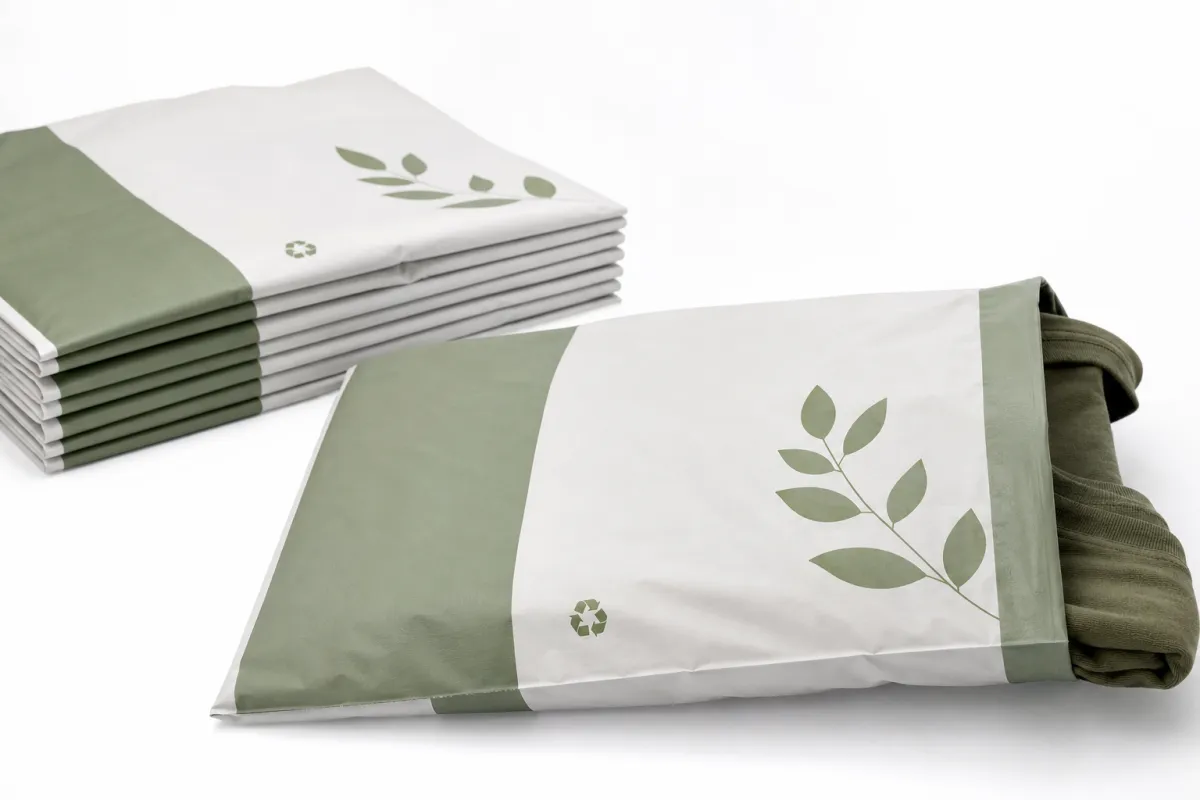
Eco friendly garment mailers bulk orders beat boxes in very plain ways. They use less material, take up less shelf space, speed up pick-and-pack, and usually lower freight charges because the package is not carrying dead volume. That is not a slogan. It is warehouse arithmetic.
Picture the usual apparel mix. A folded tee does not need a rigid carton. Most hoodies do not either, unless you are adding inserts or building a premium presentation. Leggings, base layers, baby apparel, loungewear, and return shipments all fit well in eco friendly garment mailers bulk because the product already has a compact fold and a forgiving profile.
The dimensional-weight issue is where boxes often lose ground. If a carton is bigger than the product requires, the carrier prices the shipment as if that extra space mattered. It matters to your invoice. Flat mailers help remove that waste. In many programs, the savings is larger than what you would gain by chasing a slightly cheaper box from a supplier who assumes cardboard can solve every packaging problem.
Eco friendly garment mailers bulk also reduce handling time. A carton usually needs tape, sometimes void fill, and a little more attention during assembly. A good mailer is faster: insert product, close strip, apply label, move on. Across thousands of orders, ten seconds saved per shipment becomes real labor savings. Fulfillment teams notice that kind of difference very quickly.
Storage is another quiet win. Bulk mailers stack flatter than corrugated shippers, so more units fit on a rack or in a bin. That helps growing brands that do not have warehouse space to burn on packaging inventory. Less cubic storage means fewer awkward pallet moves and less time spent digging for the correct carton size.
Brand presentation still matters. A mailer can feel polished if the print is crisp and the material suits the job. You do not need a heavy box to look professional. You need consistent print, a clean closure, and a package that arrives looking intact. That is an area where eco friendly garment mailers bulk can outperform cheaper-looking cardboard, especially if the artwork is simple and the finish matches the material instead of fighting it.
Returns deserve attention too. Many apparel sellers need a mailer that works for the outbound shipment and the return path. A dual-seal or reclosable structure can save the customer from hunting for tape or another envelope. Fewer return headaches usually mean fewer service tickets, and that is a real operational gain rather than a soft branding claim.
What buyers usually get wrong
They buy for the lowest unit price and ignore the actual product mix. A lightweight tee line and a heavy hoodie line do not need the same construction. If you force one spec across both, you usually overspend on the light items or underbuild the heavy ones. Neither outcome is smart.
They also confuse "eco friendly" with "thin." Those are not the same thing. A better eco friendly garment mailers bulk spec removes waste where it is unnecessary, but it still needs enough tear resistance and seal strength to do the job. Sustainable packaging that fails is just more landfill with better branding. That kind of mistake is easy to make if nobody has tested the package with the real product.
Eco Friendly Garment Mailers Bulk: Materials and Build Options
The material choice is where eco friendly garment mailers bulk decisions get real. There is no universal best substrate. The right answer depends on whether you need recycle-friendly film, paper-based structure, or compostable performance. Each option carries tradeoffs, and pretending otherwise is how buyers end up with packaging they regret six months later.
Recycled PE is one of the most common choices for apparel mailers. It often includes post-consumer recycled content, gives strong tear resistance, and keeps moisture out better than most paper formats. For brands shipping soft goods in changing weather, that moisture barrier matters. A recycled film mailer can offer a practical balance of price, protection, and waste reduction. It is not the most romantic choice, but it often works the best.
Kraft Paper Mailers are popular for brands that want a natural appearance and a paper-based feel. They print well with simpler graphics and are often easier for buyers to accept as visibly green. The tradeoff sits in performance. Paper structures can be more vulnerable to moisture and edge damage, so the spec needs to match the garment and the transit path. A dry regional route is a very different animal from a long cross-country move in bad weather.
PCR blends are another option for eco friendly garment mailers bulk. A good PCR blend can lower virgin material use without hurting the bag's working properties. I say "good" because recycled-content film is not all the same. Resin quality, thickness, and extrusion control all affect consistency. If a supplier cannot explain those basics clearly, keep looking.
Compostable films attract attention, but they need careful review. A compostable claim should connect to the actual substrate and the certification behind it, not just a green icon on a spec sheet. If the claim is about industrial compostability, ask for the standard used, such as ASTM D6400 or ASTM D6868 where relevant. If the answer stays vague, the claim is probably doing more sales work than technical work.
For paper-based mailers, FSC chain-of-custody is worth checking. FSC certification does not make a package perfect, but it does give buyers a real paper sourcing standard instead of a loose environmental promise. The same care applies to recyclability claims. If you need a reference point, the FSC organization at fsc.org explains the certification structure clearly enough for a purchasing team to use.
Closure style is another major build choice. The most common is the peel-and-seal strip. It is fast, inexpensive, and easy for fulfillment teams to use. For return-friendly eco friendly garment mailers bulk, a dual-seal format gives you an outbound adhesive strip and a second seal for the return path. Tamper evidence is another option if you want a package to show whether it was opened before delivery.
Print and finish should follow the material, not fight it. A kraft mailer usually looks best with solid, simple graphics, while film mailers can handle brighter color work and more coverage. Soft-touch coatings are not common on basic garment mailers, and honestly, they are often unnecessary. Clean print and the right substrate usually do more than extra finish claims.
For shipping performance testing, I think in plain terms. If the package will move through a rough parcel stream, check common distribution test logic such as ISTA procedures before you approve a full run. The point is not to pass a test for its own sake. The point is to avoid paying for a batch of eco friendly garment mailers bulk that looks good on a screen and fails in transit. The ISTA site is a useful reference if your team wants a starting point for transport testing expectations.
When a buyer asks for green, I usually push for three documents: a material spec sheet, a certification reference, and a sample. That is the only reliable way to know whether the eco friendly garment mailers bulk claim is credible. The package has to prove itself, not just describe itself.
Eco Friendly Garment Mailers Bulk: Sizes, Strength, and Print Specs
Size is where many eco friendly garment mailers bulk projects go wrong. Buyers often choose a mailer by guessing instead of measuring the folded product. That is a quick path to ordering something too tight for bulky hoodies or too large for basic tees, which wastes material and makes the package look sloppy.
A practical size range usually starts around 10 x 13 inches for slim tees or light accessories, then moves into 12 x 15, 14 x 17, and 14.5 x 19 inches for hoodies, sweatshirts, and multiple-item orders. For heavier or layered shipments, the next step might be 15 x 20 or larger. Those dimensions are not random. They come from fold count, product thickness, and how much closure overlap you need.
For eco friendly garment mailers bulk, thickness matters just as much as size. On film-based mailers, buyers often compare mil thickness. A thinner film may save a little money, but if it scuffs, tears, or punctures easily, the savings disappears fast. For paper mailers, gsm and reinforcement become the useful comparison points. In either case, the goal is durability without overbuilding.
Tear resistance is the first real strength check. If a mailer tears near the seal or at the edge during normal handling, it is not fit for production use. Puncture resistance matters next, especially for apparel with hard trims, zippers, hangtags, or boxed accessories tucked inside the same bag. Seal strength rounds out the picture. A weak seal turns a decent mailer into a liability, and that is the kind of problem that can snowball across an entire fulfillment day.
Print area is another detail buyers miss until artwork shifts around. Some eco friendly garment mailers bulk allow full-front coverage, while others are better with front-only branding or a smaller logo lockup near the seal. If the brand wants a wraparound design, confirm the printable panel and the edge-safe area before you send artwork. Otherwise, you may end up resizing the logo after proofing, and that is never a fun use of time.
Color count affects pricing and consistency. One-color prints are usually the easiest and least expensive to run well. Two-color work is still manageable. Full-color graphics can look excellent, but they need tighter proofing and can cost more depending on the substrate and ink system. The more coverage you ask for, the more careful you need to be about contrast, registration, and how the ink behaves on the material.
Spec checks that save money later
- Folded garment size: Measure the actual folded tee, hoodie, or legging stack, not the flat garment.
- Gusset need: Add room if the item has bulk at seams, cuffs, or zippers.
- Opacity: Confirm whether the contents should be hidden or partially visible.
- Seal overlap: Make sure the closure strip has enough surface area to hold.
- Sample test: Load the real product, drop test it, and check the seal after handling.
Eco friendly garment mailers bulk should always be tested with the actual product, not with a folded towel or a stack of paper. A hoodie behaves differently from a tee. A pair of leggings behaves differently from a boxy sweatshirt. That sounds obvious, but buyers still skip the sample step and then act surprised when production tells a different story.
If the order includes retail returns, test the second seal as well. A return-friendly mailer should reopen and close without destroying the structure. That matters for customer experience and for warehouse staff processing returned goods. A strong first seal and a workable return seal are worth more than a fancy graphic nobody remembers.
Eco Friendly Garment Mailers Bulk: Pricing, MOQ, and Bulk Breakpoints
Pricing for eco friendly garment mailers bulk gets easier to read when you split it into parts. Material cost, print setup, freight, and any tooling or plate charges all show up somewhere. Buyers who only look at the unit price usually miss the real landed cost, and that is how budgets get hit by shipping or setup surprises.
For a custom printed run, typical pricing can look roughly like this: recycled PE mailers may land around $0.12-$0.28 per unit at moderate quantities, kraft paper mailers often sit around $0.20-$0.45, and compostable films can move into the $0.28-$0.60 range depending on print coverage and certification requirements. Those are planning numbers, not promises. The spec always matters, and so does the market on the day you buy.
MOQ depends on the material and the level of customization. Stock-size eco friendly garment mailers bulk orders can sometimes start in the low thousands or even less if you are buying unprinted inventory. Custom printed runs often begin around 3,000 to 5,000 units, while larger plants may prefer 10,000 or more to make setup efficient. If you want a special size, expect the minimum to rise.
Bulk pricing usually drops in steps, not in a straight line. The jump from 3,000 to 5,000 units may save more per piece than the jump from 10,000 to 15,000. That is because setup costs get spread across more units early on, then savings flatten once material and production efficiency are already in place. Buyers need to compare breakpoints instead of chasing the cheapest headline quote.
| Material | Typical Unit Price | Best For | Tradeoff |
|---|---|---|---|
| Recycled PE | $0.12-$0.28 | Most apparel shipments, strong moisture resistance | Less paper-forward appearance |
| Kraft paper | $0.20-$0.45 | Natural look, simple branding, paper-based positioning | More sensitive to moisture and rough handling |
| Compostable film | $0.28-$0.60 | Brands with a specific compostability goal and verified certification | Usually higher cost and tighter claim requirements |
Eco friendly garment mailers bulk pricing also changes with print complexity. One-color logos keep cost lower. Full coverage graphics, white ink underlays, and multiple versions for different SKUs can add setup work. If you need variable artwork for different channels or stores, ask about version control early. Otherwise, the quote looks fine until proofing multiplies the labor.
Freight matters more than many people admit. A very cheap mailer can become a poor deal if it ships in a way that eats the savings. If you are comparing offers, ask for a landed-cost estimate that includes packaging, transport, and import charges if relevant. The best eco friendly garment mailers bulk purchase is not the lowest ex-factory number. It is the lowest total cost that still passes your handling requirements.
There is also a difference between cheap enough and cheap because the spec is weak. I have seen buyers trim thickness, shrink the seal area, or skip a return feature to hit a price target, then pay more later when claims and replacements stack up. That is not thrift. That is self-sabotage with a spreadsheet.
If you are buying at scale, ask about Wholesale Programs and volume-based breakpoints. Good wholesale pricing should show you the cost at several quantities, not one magic number that only works if everything else stays perfectly convenient.
Eco Friendly Garment Mailers Bulk: Process and Timeline
A good eco friendly garment mailers bulk order follows a clean process. First comes the specs conversation: garment type, folded dimensions, quantity, substrate, print count, seal style, and delivery target. Then comes artwork review, proofing, sampling, production, quality control, and freight booking. Skip one of those steps and the odds of rework rise fast.
Stock-style orders move faster. Fully custom sizes or custom printed eco friendly garment mailers bulk runs take longer because the supplier has to confirm material, plate or print setup, and final packing. A realistic timeline for a straightforward custom job is often 12 to 15 business days after proof approval, plus transit time. Complex specs or busy seasons can stretch that out. Anyone promising miracle timing without asking about the artwork is guessing.
Delays usually happen in a few predictable places. The first is artwork approval. If the file is low resolution, has missing fonts, or uses the wrong size, the proof cycle drags. The second is sample sign-off. If the buyer waits too long to test the sample, production sits idle. The third is shipping coordination. A bad ship-to address or a missed receiving appointment can turn a finished order into a warehouse headache.
What speeds things up? Final artwork. Confirmed size. Accurate quantity. Clear shipping instructions. A buyer who has those ready can move a eco friendly garment mailers bulk order forward without the usual back-and-forth. That does not mean rushing the process. It means not wasting time on avoidable questions.
Samples are worth the effort. A physical sample or a well-prepared digital proof catches mistakes that email alone will not. Seal placement, logo scale, material feel, opacity, and opening behavior are much easier to judge in hand. If you are spending real money on a bulk run, a sample is cheap insurance. Skipping it to save a few days is one of those decisions that sounds efficient and later feels embarrassing.
Quality control should happen before cartons leave the facility. That includes count checks, print alignment, seal inspection, and random sample pulls from the run. A supplier that treats QC as optional is not helping your brand. For eco friendly garment mailers bulk, consistency matters because apparel packing lines depend on repeatable behavior. One bad batch can slow the whole fulfillment operation.
Buyers who run recurring programs should also lock the spec sheet before reordering. The best repeat order is boring: same size, same material, same print, same closure, same pallet configuration. Boring is good here. Boring means fewer mistakes and better cost control.
Why Choose Us for Eco Friendly Garment Mailers Bulk
At Custom Logo Things, the goal is not to dress up packaging with fancy language and hope nobody checks the details. The goal is to help you buy eco friendly garment mailers bulk That Ship Well, print cleanly, and match the garment line you are actually packing. Practical wins beat packaging theater every time.
We focus on the things buyers care about: material choice, print quality, and repeatable production. If a mailer is supposed to protect lightweight tees, it should do that consistently. If it needs to handle hoodies or return shipments, the spec should reflect that. Fit and function matter far more than vague green claims with no documentation behind them.
Another reason brands choose eco friendly garment mailers bulk from a supplier like us is consistency across reorder cycles. A packaging program breaks down when one run looks different from the next. Shade variation, weak seals, and sloppy print placement all create operational friction. We aim to keep the spec stable, the proof clear, and the reorder simple.
We also understand that buyers are balancing price against performance. Nobody wants to pay more than necessary. Nobody wants a cheap mailer that fails in transit either. The right answer is usually somewhere in the middle: a material that supports the shipping method, a size that fits the folded product, and a print setup that gives the brand a polished finish without loading the package with unnecessary cost.
If your program needs broader packaging support, we can help you compare eco friendly garment mailers bulk against other options in Custom Packaging Products. That is useful when you are deciding whether a mailer, poly format, or another shipping solution gives the best mix of cost and protection.
For brands that buy across multiple product lines or roll out packaging in phases, a strong supplier should also help you think through ordering structure and volume planning. That is where Wholesale Programs become useful. The goal is not to overbuy. The goal is to buy enough, at the right spec, so the packaging program stays efficient.
Eco friendly garment mailers bulk should not become landfill theater. It should reduce waste where it actually matters: less void space, less unnecessary packaging mass, fewer damaged parcels, and fewer replacements. That is the standard we would want if we were buying for a brand ourselves.
Next Steps for Eco Friendly Garment Mailers Bulk Orders
If you are ready to request eco friendly garment mailers bulk, start with the basics: garment type, folded dimensions, order quantity, print colors, and whether you need return functionality. Those five pieces of information save time and prevent quotes that look fine on paper but fail in real use.
Next, gather your artwork files, your preferred substrate, and your target delivery date. If you already know whether you want recycled PE, kraft paper, or a compostable format, say so early. If you do not know, ask for two or three options side by side. That is usually the fastest way to see the tradeoff between price, durability, and appearance.
For eco friendly garment mailers bulk, ask for three practical items before you commit: a sample, a spec sheet, and a landed-cost estimate. The sample tells you how the package feels and performs. The spec sheet tells you what you are actually buying. The landed-cost estimate tells you what the order really costs once freight and other charges are counted. Without those three, you are guessing.
Compare the options against the shipping method you actually use. A mailer that works fine for standard parcel shipping may not be the right call for rough handling, long transits, or heavier hoodies. Test the sample with the real product, not an empty bag. It sounds basic because it is basic, and basic is where most packaging mistakes get made.
For teams managing recurring apparel shipments, compare two or three material options, then lock the one that fits the shipping profile and budget. Do not overcomplicate it. The best eco friendly garment mailers bulk choice is the one that protects the garment, keeps the line moving, and does not waste money on extra packaging that never added value.
That is the decision framework I would use on a real buying desk. Measure the product. Check the material. Verify the claim. Price the landed cost. Then choose the eco friendly garment mailers bulk option that works in the warehouse, not just on the quote sheet. If you start there, you will usually land on a spec that is practical, honest, and a lot easier to live with once orders start flying.
What MOQ should I expect for eco friendly garment mailers bulk orders?
Most custom runs start with a moderate MOQ, while stock sizes can usually be ordered in smaller quantities. Higher quantities lower unit cost, but only if the spec is stable and the artwork is finalized. Ask for breakpoints at different volumes so you can compare true savings, not just headline prices. For eco friendly garment mailers bulk, MOQ is usually tied to material, size, and print setup.
Are eco friendly garment mailers bulk options recyclable or compostable?
Some are recyclable, some are compostable, and some are simply made with recycled content. The right choice depends on local waste systems, the substrate used, and the product certification. Always verify the claim against the actual material spec sheet Before You Buy. If a supplier cannot explain the difference, that is a warning sign for any eco friendly garment mailers bulk order.
How strong should eco friendly garment mailers bulk packaging be for hoodies?
For heavier apparel, prioritize tear resistance, seal strength, and puncture resistance over the thinnest possible film. A sample should be tested with the real folded hoodie, not an empty bag on a desk. If the product is bulky or includes multiple items, step up the size and thickness instead of gambling. That rule saves a lot of frustration in eco friendly garment mailers bulk programs.
Can I print my logo in full color on eco friendly garment mailers bulk packaging?
Yes, but the print method depends on the substrate and the finish you choose. Kraft and film mailers handle branding differently, so color accuracy and coverage need to be checked early. A proof or sample is worth it if brand presentation matters, which it usually does. Full-color eco friendly garment mailers bulk work can look sharp if the material and artwork are matched correctly.
How long does production usually take for eco friendly garment mailers bulk orders?
Stock-style orders move faster than fully custom sizes or custom-printed runs. Artwork approval, sample sign-off, and freight scheduling are the usual bottlenecks. If you need a firm delivery date, confirm specs and shipping details before production starts. A clear spec sheet is the best way to keep eco friendly garment mailers bulk on schedule.


