Buyer Fit Snapshot
| Best fit | Eco-friendly Mailer Boxes for Small Business projects where brand print, material claims, artwork control, MOQ, and repeat-order consistency need to be specified before quoting. |
|---|---|
| Quote inputs | Share finished size, material target, print colors, finish, packing count, annual reorder estimate, ship-to region, and any compliance wording. |
| Proofing check | Approve dieline scale, logo placement, barcode or warning zones, color tolerance, closure strength, and carton packing before bulk production. |
| Main risk | Vague material claims, crowded artwork, missing packing details, or unclear freight terms can make a low unit price expensive after revisions. |
Fast answer: Eco-friendly Mailer Boxes for Small Business: Board, Finish, Dieline, and Unit Cost should be specified like a repeatable production item. The safest quote records material, print method, finish, artwork proof, packing count, and reorder notes in one written spec.
Production checks before approval
Compare the actual filled-product size with the drawing, then confirm tolerance on folds, seals, hang holes, label areas, and retail display edges. Reserve space for logos, QR codes, warning copy, and material claims before decorative graphics fill the panel.
Quote comparison points
Review material grade, print process, finish, sampling route, tooling charges, carton quantity, and freight assumptions side by side. A quote is only useful when the supplier can repeat the same color, closure quality, and packing count on the next order.
Eco-Friendly Mailer Boxes for Small Business do two useful jobs at once: they reduce packaging waste and give a small brand a more deliberate, polished presence the moment a parcel is opened. A well-chosen mailer can replace loose-fill, oversized cartons, and a lot of empty space, which helps with freight cost, product protection, and customer perception in one practical move.
Anyone who has packed a small order into a box that was clearly too large knows how awkward that feels. You end up shipping air, the item shifts around, and the opening moment feels improvised rather than considered. That is why eco-friendly mailer boxes for small business are more than a sustainability box to tick; they are a packaging format that can sharpen operations while still looking clean, thoughtful, and ready for the customer.
There is also a quieter benefit that gets missed in sales copy: consistent packaging makes the packing bench easier to manage. When the same style of box fits the same product family, staff stop guessing, label placement gets cleaner, and the whole workflow calms down. That can sound minor from the outside, but if you have ever watched a rushed ship day spiral because every order needs a different kind of filler, you already know the difference.
What Eco-Friendly Mailer Boxes for Small Business Really Mean
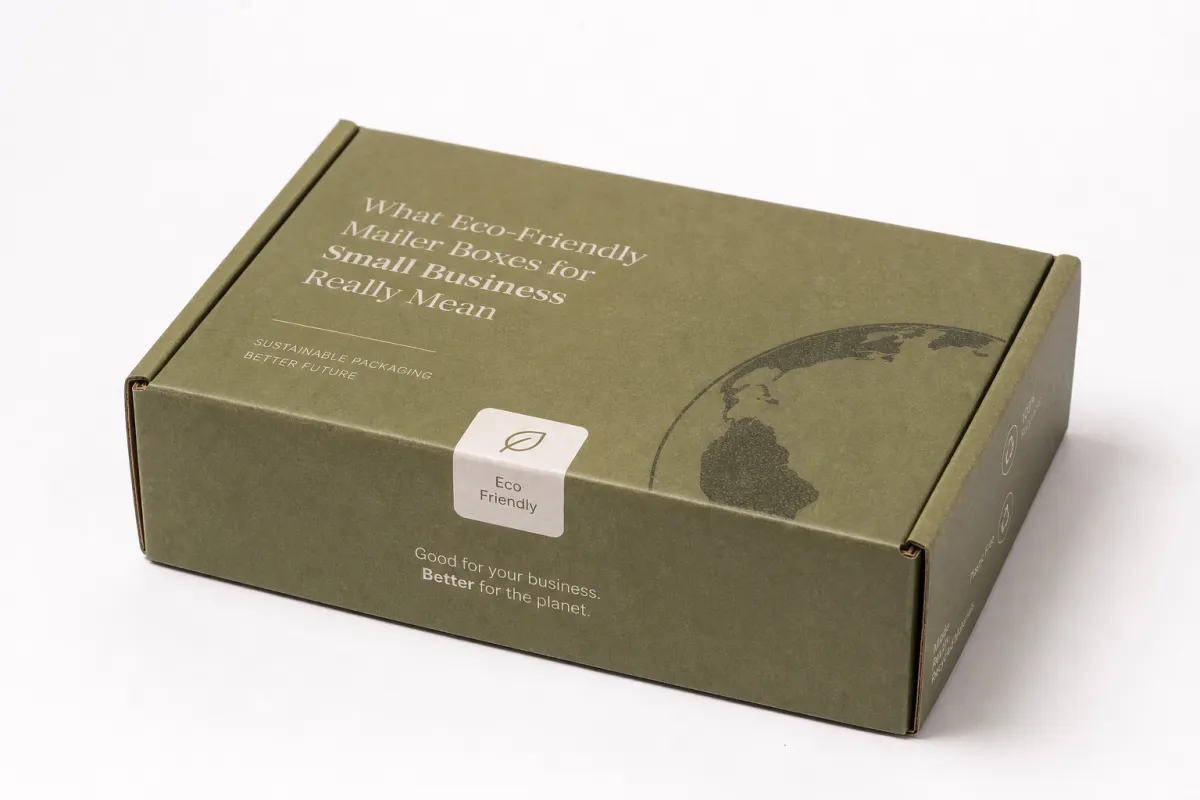
Eco-Friendly Mailer Boxes for Small Business usually refers to a die-cut paper-based mailer made from corrugated board or paperboard, sized to fold quickly, keep its shape, and ship a product with less excess material. The "eco-friendly" part can point to recycled fiber content, responsibly sourced paper, lighter board, soy- or water-based inks, fewer plastic components, or a structure that simply uses less packaging overall. It does not mean the box is green in color, and it does not automatically make it the lowest-impact choice available.
For a packaging buyer, the more useful question is whether the box is actually right-sized for the product. A sensible eco-friendly mailer boxes for small business spec uses the least material needed to protect the item in transit, while still keeping the box rigid enough for handling and easy to pack without wasting labor. That is usually where the value starts to become obvious.
The practical side matters just as much. A box made from recycled-content corrugated board may be easier to accept into curbside recycling streams than a mixed-material package with plastic windows, foam padding, and heavy coatings. FSC-certified fiber can support a sourcing story if that matters to your brand, while water-based inks can keep the print finish simple and more recyclable. The FSC standard gives buyers a clear reference point for responsible fiber sourcing, which is useful when claims need to be grounded in something more concrete than a label.
I usually think of eco-friendly mailer boxes for small business as a packaging system rather than just a box. The board, the insert, the print method, the closure style, and even the shipping size all affect waste, damage rates, and the customer's first impression. If the structure is weak, a sustainability claim only carries so much weight. If the structure is right, the whole experience feels cleaner and more intentional without adding packaging bloat.
That distinction matters because small businesses often grow faster than their packaging habits. A product that began in a padded envelope or a generic carton may need a proper mailer once order volume starts to rise. At that point, eco-friendly mailer boxes for small business can standardize packing, reduce rework, and present a stronger brand without making fulfillment more complicated than it needs to be.
It also helps to be honest about the tradeoff. A recycled board that looks a little more natural or has a few visible fibers is not a defect; it is often just the material doing what it is supposed to do. Some brands actually gain trust from that look, because it feels grounded and real instead of pretending to be something it is not.
How Eco-Friendly Mailer Boxes for Small Business Work
Eco-Friendly Mailer Boxes for Small Business are usually die-cut from a flat sheet, scored, folded, and locked into a rigid shape with tabs or tuck-in flaps. That self-locking structure is a big reason they work so well for light to medium-weight shipments: you do not always need a separate outer carton, extra tape, or a complicated packing sequence. A good mailer can be assembled in seconds and still stand up to ordinary handling.
Board selection is where the engineering starts to matter. Corrugated board brings crush resistance because of its fluted core, which works like a small cushion between the outer liners. Paperboard gives a smoother, more retail-style feel and can suit lightweight premium presentation pieces, but it generally has less structural strength than corrugated. For eco-friendly mailer boxes for small business, the board grade, flute type, and caliper need to match product weight and shipping conditions, not just the look a brand wants on the shelf.
A candle brand shipping glass jars may need a sturdier single-wall corrugated mailer with inserts or partitions, while a soap brand or accessory seller might do well with a lighter kraft mailer that still holds its shape. Longer shipping zones and rough carrier networks usually call for a stronger construction and a more dependable closure profile than local deliveries do. Standards like ISTA distribution testing help here, because they give a practical way to think about vibration, drop resistance, and compression before the box is put into regular use.
Eco-Friendly Mailer Boxes for Small Business also simplify the packing line. A right-sized box cuts down on void fill, which means fewer steps per order and less material consumed per shipment. When the item fits properly, staff are not crumpling paper into corners or trying to stop products from sliding around in oversized packaging. That efficiency matters more than many owners expect, because a few saved seconds per order becomes real labor savings once volume increases.
They fit especially well with products that need presentation as much as protection: apparel, books, beauty kits, candles, stationery, subscription kits, and small gifts. In those categories, eco-friendly mailer boxes for small business can replace a generic shipper and still feel like part of the brand. For a company that wants to pair these mailers with other branded formats, it is often smart to review Custom Packaging Products early, then compare the mailer format with alternatives like Custom Poly Mailers for lighter, less fragile items.
In practice, the best results usually come from a few boring-but-valuable checks: verify the item is centered, make sure the closure lands where the board has enough strength, and confirm the printed area does not interfere with folds. None of that is flashy, but it is the stuff that keeps a customer from opening a box that creases weirdly or pops back open in transit.
Cost, Pricing, and MOQ for Eco-Friendly Mailer Boxes
Eco-Friendly Mailer Boxes for Small Business are priced by more than one variable, and the "eco-friendly" label itself is rarely the main cost driver. Board type, box dimensions, print coverage, finishing, insert complexity, and order quantity all shape the final number. A simple kraft mailer with one-color print may cost far less than a white-lined mailer with heavy coverage, special coatings, or a custom insert that has to be cut and packed separately.
For small runs, setup costs matter a lot. A die, a plate, artwork prep, and sample approvals are spread across fewer boxes, so the unit cost is higher. As volume rises, the per-unit price usually drops. A realistic range for eco-friendly mailer boxes for small business might land around $0.90-$2.25 per unit for very small custom runs, roughly $0.35-$0.85 per unit for mid-range orders, and sometimes lower on larger repeat runs depending on board choice and print complexity. Those numbers can shift quickly if you add inserts, specialty finishes, or freight to a distant location.
MOQ, or minimum order quantity, is often misunderstood. Some suppliers set it based on machine efficiency, while others set it based on the economics of setup and raw material usage. The lowest sticker price is not always the most economical choice once you factor in waste, storage, and freight. For eco-friendly mailer boxes for small business, it is usually better to buy the box that packs well, ships safely, and fits your order volume than to chase the cheapest quote and end up with damaged goods or extra storage problems.
When comparing quotes, ask for the landed cost, not just the box price. That means you should check whether the estimate includes structural sampling, tooling, print plates, freight, and any extra charges for specialty inks or coatings. A quote that looks inexpensive on paper can become less attractive once those line items are added. In real purchasing conversations, I always recommend comparing apples to apples before deciding on a supplier for eco-friendly mailer boxes for small business.
| Option | Typical Unit Cost | Best Fit | Tradeoffs |
|---|---|---|---|
| Stock-style kraft mailer with custom print | $0.35-$0.75 at mid volume | Apparel, books, light accessories | Lower setup cost, limited structural customization |
| Custom printed corrugated mailer | $0.50-$1.10 depending on quantity | Beauty, gift sets, subscription kits | Better branding, more setup and design planning |
| Premium mailer with insert or specialty finish | $0.85-$2.25 or more | Fragile items, higher perceived value products | Higher cost, more assembly, more material use |
For a newer brand, a simpler one-color mailer can be the right move, especially if cash flow is tight and the product mix is still changing. For a more established shop, a stronger custom design may save money over time by reducing damage claims, tightening fulfillment, and improving the unboxing experience. Either way, eco-friendly mailer boxes for small business should be priced as part of the whole order system, not as an isolated supply purchase.
The cheapest quote can be the most expensive packaging decision if it leads to returns, replacement shipments, or a box that takes too long to assemble. I have seen that happen more than once, and it usually starts with a buyer focusing only on the print price while ignoring freight, storage, and labor. That is a kinda expensive way to learn the lesson.
Process and Timeline for Eco-Friendly Mailer Boxes for Small Business
Eco-Friendly Mailer Boxes for Small Business work best when the process starts with the product, not with the artwork. Measure the item carefully, then add room for any insert, sleeve, tissue, or inner wrap. Write down the finished size, shipping weight, fragility level, and brand goals before requesting samples. When the box is designed around a real shipping job, the result is usually cleaner and easier to pack.
The usual production path is straightforward, but each step matters. You start with a structural spec, move into artwork setup, review a proof, make any sample revisions, approve the final version, and then go to production. After that comes printing, finishing, die-cutting, folding, and shipment. For eco-friendly mailer boxes for small business, simple printed mailers can often move faster than a highly customized build, but approval speed and material availability usually matter more than the press run itself.
A practical schedule for a simple order might be 10-15 business days after proof approval, while more customized work can stretch into three to five weeks, especially if the box needs an insert, a special finish, or additional testing. If the project includes a first-article sample, add time for reviewing the sample and making changes. There is no benefit to rushing through a spec that will be used on thousands of parcels. If the launch date is fixed, build a buffer into the plan so eco-friendly mailer boxes for small business do not become the bottleneck.
Inventory planning matters too. Flat-packed mailers take less room than assembled cartons, but they still need dry storage, stable stacking, and edge protection. If they sit near moisture, heat, or heavy pallets, the board can warp or lose some of its crispness. That is especially relevant when eco-friendly mailer boxes for small business are being held for a few months before use. A flat box that stores well can save space and keep the packing line moving, but only if the storage environment is handled sensibly.
One more practical point: test the pack-out before committing to volume. Run a few units through your normal sequence, seal them the way staff will actually seal them, and inspect the corners, closures, and label placement. If you want a packaging spec that holds up under a distribution test, look at the kinds of checks used in standards such as ISTA distribution profiles and compression testing protocols from groups like ASTM. You do not need to quote every standard in marketing, but using them as reference points makes the buying process more disciplined.
And if the first sample is slightly off, do not force it. A small adjustment to a score line, flap depth, or insert fit can save a lot of headaches later, especially if your team is packing hundreds of orders a week.
Key Factors to Judge Before You Order
Eco-Friendly Mailer Boxes for Small Business should be judged first on protection, then on sustainability claim, then on presentation. A box that looks responsible but crushes in transit is not a good purchase. Start with the product weight, the shipping distance, and the amount of movement allowed inside the box. If the item needs a snug fit, the interior dimensions need to be accurate; if it needs cushioning, the structure should be designed around that need instead of hoping the outer walls will do all the work.
Next, look closely at the material story. Recycled-content corrugated board is common because it balances strength, printability, and recyclability. Kraft faces can give a natural, understated look, while white-lined board can improve logo contrast and color vibrancy. Finishes also matter. Heavy lamination, plastic windows, and glossy coatings can interfere with recyclability in some markets, so if your goal is a cleaner end-of-life profile, choose finishes carefully. The EPA recycling guidance is a useful reminder that the simplest package is often the easiest to sort and recover.
Branding needs should not be ignored. Some products look better in a raw kraft mailer with restrained print, while others need a bright white surface to keep colors accurate. The print method should match the artwork. A one-color logo may work beautifully with flexographic printing, but a detailed pattern or photographic design may need a different approach. For eco-friendly mailer boxes for small business, the right visual treatment usually feels more premium because it is controlled, not because it is overloaded with graphics.
Operational fit is just as important as the creative side. The box should be easy for staff to assemble, fast to pack, and compatible with labels, inserts, and shelf storage. If the mailer is too fiddly, it slows fulfillment. If it needs tape in awkward places, labor costs rise. If it stacks badly, it wastes room in storage. Good eco-friendly mailer boxes for small business make the whole workflow calmer, which is often the hidden advantage buyers notice after the first full run.
There is also a compliance and claims angle. If you say a box is recycled, recyclable, or responsibly sourced, be precise about what that means in your market. Recycled fiber percentage, FSC certification, and local recycling compatibility are not the same thing. Clear language builds trust. Vague language invites confusion. That is why I always encourage brands to ask suppliers exactly what is in the board, what coatings are used, and what end-of-life guidance should be shared with customers.
One detail that gets overlooked: print registration and fold quality. A box can have the right material spec and still feel off if the artwork drifts at the crease or if the tuck flaps fight each other. Those little imperfections show up fast once customers start posting unboxing photos, so a supplier's sample should be judged with a close eye, not just a quick glance.
Common Mistakes When Choosing Eco-Friendly Mailer Boxes
One common mistake is assuming that all recyclable boxes are equally sustainable. Eco-Friendly Mailer Boxes for Small Business can still waste a lot of material if they are oversized, overprinted, or paired with unnecessary inserts. A large box filled with extra paper is still a lot of paper. The better approach is to right-size the structure, reduce dead space, and only add cushioning where the product actually needs it.
Another mistake is choosing on appearance alone. Thin board can look elegant in a sample room, then crush when it moves through carrier systems, sorting conveyors, and handling points. The reverse can also happen: a sturdier mailer may look simpler in photos but protect better and reduce replacement shipments. For eco-friendly mailer boxes for small business, the box that performs better in transit is usually the better brand experience, even if it is not the flashiest sample on the table.
Poor sizing decisions create their own headaches. Too much empty space invites movement and makes the contents feel cheap when the customer opens the box. Too tight, and the packer struggles, the flap does not close cleanly, or the product rubs against the inside walls. In a real fulfillment line, that can turn into wasted labor and inconsistent pack quality. If the goal is smooth, repeatable shipping, eco-friendly mailer boxes for small business need to be sized with the product's actual tolerances in mind.
There is also a communication mistake that shows up more often than people admit: vague supplier conversations. If the print method, board grade, closure style, freight assumptions, and approval sequence are not defined early, the final box may miss both the budget and the performance target. That is especially risky for eco-friendly mailer boxes for small business, because the spec has to satisfy both the sustainability story and the shipping job. Clear requirements save time, and time is usually the most expensive thing to lose in a packaging project.
One more thing: do not let the phrase "eco-friendly" hide a weak pack-out. If the item needs a divider, use a divider. If it needs a light insert, use a light insert. If it ships safely without extras, leave them out. The goal is not to minimize every gram at any cost; the goal is to build the lightest package that still protects the order and makes sense for the customer. That balance is what separates a nice idea from a useful packaging decision.
I also see brands get tripped up by assuming one box style can cover every SKU forever. It rarely works that way. Once the product line changes, the original mailer may become too large, too shallow, or just plain awkward. A small revision now is a lot easier than living with a bad fit for a year.
Expert Tips and Next Steps for Eco-Friendly Mailer Boxes for Small Business
Start with one hero SKU and design around it. In many small businesses, one or two products account for most of the orders, so it makes sense to size the first eco-friendly mailer boxes for small business around the most common shipper before expanding into a whole family of formats. That keeps the project focused and helps you learn what works without locking yourself into too many variations too early.
Then request samples and do a real packing test. Assemble the box the way your team will actually use it, ship a few units through normal carrier routes, and inspect the corners, closure strength, label adhesion, and presentation on arrival. If the item slides, the board scuffs, or the print rubs, you will learn that before the full run is made. A controlled test is one of the fastest ways to separate a good spec from a merely attractive one. It is also the best place to decide whether your eco-friendly mailer boxes for small business need an insert or can ship safely on their own.
Use branding with restraint. A strong structural fit, one carefully placed logo, and a thoughtful inside message often create a better impression than heavy full-coverage artwork. Buyers sometimes assume more print means more premium, but packaging does not always work that way. A clean kraft exterior with one sharp color, or a white board with a modest inside print, can feel more considered than a box that tries to shout from every surface. For many eco-friendly mailer boxes for small business, less ink and fewer visual distractions actually improve the customer experience.
Here is a simple rollout sequence that works well: finalize dimensions, approve artwork, confirm pricing, place a pilot order, review performance, and then scale once the spec proves itself. That phased approach keeps risk manageable. It also gives you a chance to compare a few variations without overcommitting inventory space or cash. If you need to expand beyond mailers later, the same logic applies to your broader packaging line, and it can be useful to review other Custom Packaging Products before making the next move.
My honest advice is to treat eco-friendly mailer boxes for small business as a business tool first and a sustainability message second. The best box reduces waste, protects the product, supports the team packing orders, and gives the customer a better opening moment. If those pieces are working together, the packaging is doing its job. If one of them is off, the problem will usually show up in damage claims, labor time, or a less convincing brand experience.
If you need a practical starting point, pick one fast-moving SKU, spec the smallest mailer that protects it cleanly, and test it with real packing hands Before You Order in volume. That one step usually tells you more than a dozen polished mockups ever will.
FAQ
Are eco-friendly mailer boxes for small business actually strong enough for shipping?
Yes, when the board grade and box style match the product weight and shipping conditions. Eco-Friendly Mailer Boxes for Small Business made from corrugated board can handle a surprising amount of abuse if the fit is snug and the closure is designed well. For fragile items, add inserts or light cushioning instead of relying on wall thickness alone.
What materials are best for eco-friendly mailer boxes for small business?
Recycled-content corrugated board is one of the most practical choices because it balances strength, printability, and recyclability. Kraft surfaces give a natural look, while white-lined boards can improve color vibrancy for branding. The best material depends on product weight, presentation goals, and how the box will be recycled in your market. For many brands, eco-friendly mailer boxes for small business work best when the material choice stays simple and honest.
How much do eco-friendly mailer boxes for small business usually cost?
Price depends on size, board strength, print coverage, finishing, inserts, and quantity. Small runs usually carry a higher unit cost because setup is spread across fewer boxes. A larger re-order often drops the unit price noticeably. Ask for landed cost, not just box price, so freight and setup fees are included when you compare eco-friendly mailer boxes for small business from different suppliers.
How long does it take to get custom eco-friendly mailer boxes for small business?
Simple orders can move fairly quickly, but artwork approval, sampling, and material availability can add time. A realistic schedule should include proof review, testing, production, and shipping buffer. If your launch date is fixed, build in extra time for revisions so you are not forced into a rushed spec. That patience usually pays off with better eco-friendly mailer boxes for small business and fewer surprises later.
Do eco-friendly mailer boxes for small business need inserts?
Not always. Many products ship safely in a well-sized mailer without extra fill. Inserts are helpful when items can shift, break, or need separation as a set. Choose the lightest insert that solves the actual problem so you do not add unnecessary material or cost. The best eco-friendly mailer boxes for small business are the ones that protect the product with the least complexity that still makes sense.
How do I know if my box claims are accurate?
Ask your supplier for written details on recycled fiber content, certification, coatings, and end-of-life guidance. If a claim is specific, it should be backed by specific data. That way your messaging stays grounded and your eco-friendly mailer boxes for small business do not create avoidable confusion for customers.
For most small brands, the smartest move is to start with a practical spec, test it in real shipping conditions, and adjust only where the data shows a real need. That is how eco-friendly mailer boxes for small business stop being a nice idea and become a dependable part of fulfillment.


