Buyer Fit Snapshot
| Best fit | eco friendly packaging certifications selection review for packaging buyers comparing material specs, print proof, MOQ, unit cost, freight, and repeat-order risk where brand print, material, artwork control, and repeat-order consistency matter. |
|---|---|
| Quote inputs | Share finished size, material target, print colors, finish, packing count, annual reorder estimate, and delivery region. |
| Proofing check | Approve dieline scale, logo placement, barcode or warning zones, color tolerance, and any recyclable or compostable wording before bulk production. |
| Main risk | Vague material claims, crowded artwork, or missing packing details can create delays even when the unit price looks attractive. |
Fast answer: Eco Friendly Packaging Certifications Selection Review: Claims, Protection, MOQ, and Cost should be specified like a repeatable production item. The safest quote includes material, print method, finish, artwork proof, carton packing, and reorder notes in one written spec.
What to confirm before approving the packaging proof
Check the product dimensions against the actual filled item, not only the sales mockup. Ask for tolerance on folds, seals, hang holes, label areas, and retail display edges. If the package carries a logo, QR code, warning copy, or legal claim, reserve that space before decorative graphics fill the panel.
How to compare quotes without losing quality
Compare board or film grade, print process, finish, sampling route, tooling charges, carton quantity, and freight assumptions side by side. A lower quote is only useful if the supplier can repeat the same color, closure quality, and packing count on the next order.
What Are the Top Eco Friendly Packaging Certifications 2025?
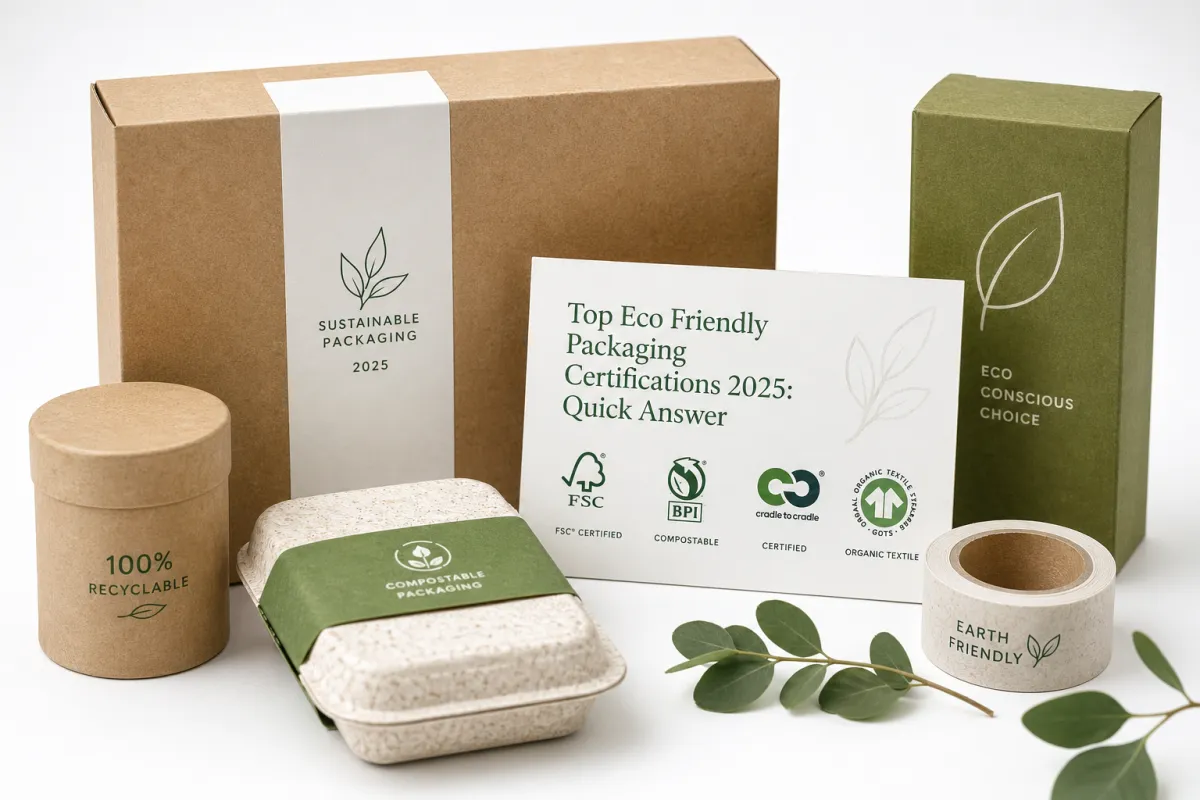
I still remember a converter visit in Dongguan, Guangdong, where the carton looked spotless on the shelf, but the paperwork told a different story. The paper had no valid chain-of-custody scope, and the “compostable” sleeve on a food tray had never been matched to a real lab report from an ISO 17025-accredited lab. I was standing there with a cup of terrible machine coffee at 9:10 a.m., thinking, well, this is gonna be a long morning. That habit has saved more launch schedules than I can count, especially when a label looks green but the scope statement is expired. That is why I treat top Eco Friendly Packaging certifications 2025 as a documentation exercise first and a branding exercise second. A green label is only as good as the certificate number, scope statement, test method, and expiration date behind it, whether the SKU is a 350gsm C1S artboard folding carton or a 60-micron compostable film pouch.
My blunt read is straightforward: FSC matters most for paper and board, PEFC and SFI sit in the same fiber-sourcing lane, BPI and TÜV Austria OK compost matter for compostable structures, and Cradle to Cradle Certified carries weight when a buyer wants broader material-health proof rather than a single environmental claim. Recycled-content packaging needs its own proof set too, especially if the carton includes 30% PCR or the mailer includes post-industrial fiber. top Eco Friendly Packaging certifications 2025 only matters if the certification actually matches the substrate you are buying, because a shiny icon on a mockup means exactly nothing if the underlying claim does not hold up in procurement review.
Paper mailers and folding cartons usually start with FSC or PEFC, especially for 1,000 to 10,000-piece runs coming out of Xiamen, Fujian, or Vietnam’s Binh Duong province. Compostable cups and foodservice items usually need BPI or OK compost, particularly when the structure is a PLA-lined 12 oz cup, a molded-fiber clamshell, or a coated paper bowl with water-based inks. Recycled-content claims deserve extra documentation if you want procurement teams to sign off without a long chain of emails that somehow always ends with someone asking for “just one more PDF.” That is the lens I use on top Eco Friendly Packaging certifications 2025: what each mark proves, where it is strong, where it gets overused in packaging design, and where a buyer should keep asking questions.
“If you cannot hand me the certificate number, the scope statement, and the current expiration date, I treat the green label as decoration, not evidence.” I heard that line from a procurement lead at a Midwest folding-carton plant in Rockford, Illinois, and I have repeated it in more than a few client meetings since then.
If you are building branded packaging, retail packaging, or Custom Printed Boxes around a sustainability claim, the right certification should support the product story instead of inflating it. That is the difference between Packaging That Sells and packaging that creates a compliance headache two months later. Honestly, I have seen both, and the second one is never as charming as the marketing deck made it look, especially once the retailer asks for a PDF at 4:30 p.m. on a Friday.
Top Eco Friendly Packaging Certifications 2025 Compared
Buyers keep searching for top eco friendly packaging certifications 2025 for a reason. The labels look similar from a distance, yet they sit on different rulebooks. A paper carton needs proof that the fiber came from a controlled source; a compostable cup needs proof that the whole structure actually breaks down under a defined standard; recycled-content packaging needs a chain that can survive document review all the way back to the bales or regrind, whether the source is Ohio MRF material or a post-industrial stream from a plant in Taicang, Jiangsu. That distinction shapes everything from sourcing to compliance to the way a buyer reads the final shelf claim.
I learned that the hard way on a foodservice project outside Chicago, in Aurora, Illinois. The brand team wanted one label, the sales team wanted three, and the retailer wanted zero ambiguity. We ended up stripping the claim down to the one certification that matched the material, because top eco friendly packaging certifications 2025 are not stickers you collect. They are claims you can defend, preferably without anyone in the room pretending a vague promise is the same thing as proof.
Fiber claims and compost claims are not the same proof
FSC, PEFC, and SFI focus on responsible fiber sourcing and chain-of-custody. The paper or board can be traced from forest management through the converter, printer, and finished pack if every handoff sits inside the certified scope. For FSC, the certificate only helps if the supplier’s scope statement actually covers your SKU, not just the company’s broader catalog. I have had more than one buyer discover, a little too late, that “the supplier is certified” is not the same as “this specific product is certified,” especially when the carton was printed in Shanghai and finished in Suzhou.
BPI and TÜV Austria OK compost sit in a different bucket. They are about compostability performance, which is why they matter for coated cups, molded fiber, compostable film, and foodservice packaging. A plain kraft box does not need the same proof as a PLA-lined cup, and forcing one standard onto both is how teams end up with claims that sound green but fall apart in procurement review. I wish that were a rare mistake. It is not, particularly on 8 oz soup cups, 16 oz cold cups, and thin-gauge lids that behave differently under the test conditions.
For buyers comparing top eco friendly packaging certifications 2025, that difference is the whole point. Fiber sourcing is about where the material came from. Compostability is about what the material does after use. Recycled-content claims are about what percentage of the pack comes from recovered feedstock. Those are three separate questions, and the best certification only answers one of them well, whether the pack is a 250gsm folding carton or a 1.2mm rigid setup box.
| Certification | Best Fit | What It Proves | Typical Timeline | Typical Cost | My Take |
|---|---|---|---|---|---|
| FSC Chain-of-Custody | Paper mailers, folding cartons, retail packaging | Responsible fiber sourcing and traceability | 2-6 weeks | $1,500-$5,000 setup; $1,200-$5,000 annual audit | Best first stop for most paperboard programs |
| PEFC | Paper, board, and some export programs | Certified forest sourcing and custody controls | 2-6 weeks | $1,500-$4,500 setup; recurring audit fees | Strong in many regions, less visible in some retail channels |
| SFI | North American fiber supply chains | Responsible sourcing and custody tracking | 2-5 weeks | $1,200-$4,000 setup; annual audit costs | Useful, though brand recognition varies by buyer |
| BPI | Compostable cups, cutlery, foodservice items | Compostability against recognized standards | 6-12 weeks | $3,500-$12,000+ | Credible for North American compost claims |
| TÜV Austria OK compost | Industrial or home compostable structures | Compostability under defined EU-oriented programs | 6-14 weeks | $4,000-$15,000+ | Very useful when regional acceptance matters |
| Cradle to Cradle Certified | Premium branded packaging, material-health-led programs | Material health, circularity, water, air, and social fairness criteria | 8-16 weeks, sometimes longer | $8,000-$30,000+ | Strong signal, but documentation heavy and not cheap |
| RCS / GRS | Recycled-content paper, plastics, and specialty packs | Recycled input verification and chain control | 2-8 weeks | $1,800-$6,500+ | Good when recycled content is the real claim |
My honest review: FSC usually gives the cleanest value for paper-based product packaging, BPI gives the clearest signal for compostable foodservice items in North America, and Cradle to Cradle Certified is the strongest premium option if the buyer wants a deeper sustainability story across the whole package. I would not spend money on extra labels just to make the artwork look busy; that is package branding theater, not a purchasing advantage. Procurement teams can smell that from across the room, usually before the supplier finishes the second slide.
One more practical point. How2Recycle is a labeling system, not a certification. It can help with disposal instructions, but it does not replace the underlying proof. Buyers often mix those up, then wonder why the retailer still asks for certificates, lab reports, and scope documents. That confusion shows up in top eco friendly packaging certifications 2025 conversations all the time, and yes, it still causes avoidable delays of 5 to 10 business days in real launches.
Detailed Reviews: Process, Timeline, and Real-World Use
Once you move past the logo, the process matters more than the marketing. I have seen buyers lose three weeks because a supplier could not find the latest scope statement, and I have seen a compostable pouch get held up because the adhesive changed by 1.5 grams per square meter. Those delays separate a clean certification project from a messy one, and they are exactly why top eco friendly packaging certifications 2025 should be managed like a production project, not a branding exercise. Packaging teams love skipping the boring part until the boring part becomes the whole schedule, which is somehow always on the same Tuesday as print proof approval.
FSC, PEFC, and SFI: sourcing proof for fiber packaging
For fiber packaging, the process usually starts with an application, then a review of your management system, supplier records, invoices, mass-balance controls, and labeling rules. If you are a printer or converter, the auditor will care about whether the mill, the board buyer, the coater, and the finishing operation all sit inside the same chain-of-custody logic. A single clean site can move fairly fast; a multi-site operation with different warehouses in Atlanta, Georgia, and Reno, Nevada, usually takes longer. That is not the glamorous part of packaging, but it is the part that keeps your claims from wobbling later.
In my experience, FSC is the label most buyers recognize in retail packaging. PEFC is also solid, especially for some export channels, while SFI is often most familiar in North American sourcing conversations. The best case is simple: a 350gsm C1S artboard carton, clean recordkeeping, and a supplier who can produce the certificate before the first proof is approved. The worst case is a “green” carton with a polished mockup and no current scope statement. I have sat through that meeting in Shenzhen at 2:00 p.m. after a red-eye from San Francisco. It is not fun, and it does not get better with more coffee.
Typical timeline? For a tidy single-site plant, two to six weeks is realistic. For a broader network with multiple printers or finishing lines, I would budget a month or more. For anyone comparing top eco friendly packaging certifications 2025, that time should be built into packaging design reviews, because changing a substrate after artwork sign-off often means new documentation and a fresh approval cycle, sometimes adding 7-10 business days just to reissue the proof set.
Verification is simple if you know what to ask for: certificate number, scope statement, expiration date, and the exact SKU language that appears on the invoice or pack sheet. If the supplier gives you a brochure instead of a certificate, keep asking. Politely, then less politely if needed. A real file should tell you whether the pack was produced in Kaohsiung, Taiwan, or Monterrey, Mexico, and whether the scope covers printing, lamination, and final assembly.
BPI and OK compost: proof for compostable materials
Compostability programs move differently because they depend on lab testing. The file set usually includes product specifications, resin declarations, adhesive and ink details, and test data tied to a standard such as ASTM D6400 or EN 13432, depending on the market. That is why a compostable cup can take longer than a paper box: the lab has to see how the whole structure behaves, not just the face stock. And yes, it is maddening when a tiny coating adjustment sends the whole thing back into review, but that is the job, especially on 12 oz cups with a water-based print layer and a 0.3 mm lid film.
I visited a molded-fiber line outside Shenzhen where a team was certain their trays were “compostable enough” because the pulp was natural and the coating was thin. The problem was the additive package. A small formula change forced another round of documentation, and they lost nearly two weeks. That kind of delay is common with top eco friendly packaging certifications 2025 because the certifier is checking material performance, not just the vendor’s intention. Good intentions do not pass lab review, and if they did, I could retire tomorrow with a very small celebratory cake.
BPI is especially helpful in North America because procurement teams recognize it quickly, while TÜV Austria OK compost can be a stronger fit if the product is moving through EU-oriented channels or if the brand needs industrial versus home compost clarity. The tradeoff is cost and patience. Expect six to fourteen weeks in many real programs, and longer if your film structure, print system, or barrier coating is still changing. A 90-micron pouch with a redesigned seal layer is rarely a “quick fix.”
What should you request from the supplier? Ask for the certificate, the exact certification class, the test standard, the current validity period, and any limitations on thickness, colorants, or food-contact use. If the claim is for foodservice packaging, ask whether the certification covers food-contact performance as well as compostability. Those are not the same thing, and the distinction matters a lot when a retailer in Minneapolis or a distributor in Rotterdam starts asking sharper questions.
Cradle to Cradle Certified and recycled-content standards
Cradle to Cradle Certified sits in a different category because it looks at material health, circularity, water stewardship, climate stewardship, and social fairness. That broader lens is appealing for premium brands, but the documentation burden is real. You need more than a clean supplier promise; you need a disciplined file trail, supplier declarations, and often some reformulation work. I have seen teams underestimate that part, and it slows launch day fast. The marketing team usually learns about this at the exact moment they were hoping to approve the final box render in a Monday morning meeting, which is never a happy scene.
For recycled-content packaging, standards like RCS and GRS are often the right tool, especially for a carton with PCR content or a specialty structure where the recycled claim is the main selling point. In a Chicago client meeting last spring, the brand group wanted six sustainability icons on the box. Procurement cut it back to two, because only two were backed by current paperwork. That is the kind of edit that saves trouble later, and it is a good reminder that top eco friendly packaging certifications 2025 work best when the claim set is tight. A crowded carton may look impressive in a slide deck, but it can become a paperwork circus in real life, especially if the pack is being sourced from both Dallas, Texas, and Ho Chi Minh City.
If your packaging line includes custom printed boxes, branded packaging, or retail packaging with mixed materials, I would start with the question, “What is the one claim that matters most to the buyer?” Then I would pick the certification that proves that claim cleanly. Anything beyond that should earn its place, whether the box uses metallic foil, aqueous coating, or a simple natural kraft finish. Clarity is worth more than decoration when the buyer is comparing three suppliers on a spreadsheet.
For transit-heavy jobs, I also like to check whether the pack survives the trip. Certification alone will not save a crushed carton on a pallet, which is why I often pair claims review with distribution testing from ISTA methods. A claim that looks good in a sales deck means little if the master carton fails after a 42-inch drop or a rough vibration cycle. I have seen a beautifully certified carton arrive in Los Angeles looking like it lost a fight with the truck. The certification was fine; the corrugate was not, and the pallet pattern was worse.
Price Comparison: What Eco Friendly Packaging Certifications Cost
The cheapest quote is rarely the cheapest project. I have watched buyers chase a low setup fee only to pay twice later for retesting, document translation, artwork revisions, and a second audit because the converter changed a subcontractor. That is why I break top eco friendly packaging certifications 2025 into setup fees, annual audit costs, lab testing, and hidden operational time, not just the first invoice. The line item on the proposal is usually the least interesting number in the whole story, especially when a 5,000-piece run is waiting on a certificate that was “almost ready” for ten business days.
For fiber certifications, the spend is usually manageable. A small to mid-size converter might spend roughly $1,500 to $5,000 to get started on a chain-of-custody program, then another $1,200 to $5,000 a year on audits and maintenance. That range shifts with site count, complexity, and how clean the records are. If the paperwork already lives in a disciplined ERP system, the cost stays lower. If the plant still uses spreadsheets and handwritten job bags in a warehouse outside Birmingham, Alabama, the audit gets slower and more expensive. I have no desire to shame old systems, but I do have a strong opinion about them.
Compostability certification is a different animal. BPI and TÜV Austria OK compost often land in the $3,500 to $15,000+ range once you account for testing and review. Cradle to Cradle Certified can go higher, especially when a first-time applicant needs reformulation, supplier data gathering, and a deeper review of inks, coatings, and additives. That is why I tell clients to budget for the whole program, not just the application fee. Otherwise the finance team gets surprised, which is a tradition nobody asked for and nobody seems to enjoy.
- Setup fees: application, documentation review, and certification body time.
- Lab work: compostability tests, material screening, recycled-content verification.
- Audit time: plant interviews, warehouse checks, invoice review, and traceability sampling.
- Hidden costs: reformulation, sample runs, retesting, translation, and artwork changes.
Here is the part most people miss: the hidden cost is often bigger than the label fee. A change from one ink system to another on a run of custom printed boxes can trigger new declarations from the ink supplier, a rerun of samples, and a revised label proof. If the substrate changes from virgin board to 30% PCR, you may need new documentation, and that paperwork effort can be worth more than the certification itself on a small SKU. It is the kind of thing that looks tiny in a spreadsheet and somehow turns into a week of someone’s life, usually with three people in three time zones chasing the same PDF.
So, how do I think about ROI for top eco friendly packaging certifications 2025? I tie it to three things: order volume, customer requirements, and risk reduction. If a retailer will not list the product without a certificate, the ROI is obvious. If the certification unlocks an export market in Germany, Canada, or California, the ROI can be strong. If the only benefit is a nicer logo on the shipper, the math gets weak fast. Pretty packaging is lovely; unnecessary spend is not.
How to Choose the Right Certification for Your Product
I tell buyers to start with the material, then the use case, then the market. That order saves time. A paper mailer does not need the same proof as a compostable cup, and a recycled-content mailer does not need the same file set as a molded-fiber food tray. Once you sort the substrate, top eco friendly packaging certifications 2025 become much easier to narrow down. It is a lot less mysterious when you stop asking one certification to do three different jobs, which is exactly what a lot of launch teams do when the deadline is ten days away.
For paper and board, start with FSC if the question is responsible sourcing, then look at PEFC or SFI where the buyer or region prefers those marks. For molded fiber, check whether the pack is being sold as fiber-sourced, compostable, or both, because those are separate claims. For compostable film and cups, use BPI or OK compost and make sure the exact structure, including adhesives and inks, is included. I cannot say this enough: the missing glue layer is often where the trouble hides, whether the line is in Osaka, Japan, or Tijuana, Mexico.
For recycled plastic or recycled-content cartons, I would ask for the recycled-content standard, the chain-of-custody details, and the exact percentage claim. A number like 60% PCR sounds good, but only if the evidence supports it. If not, the claim belongs in the artwork trash can, not on the retail shelf. That mistake shows up often in package branding, and it creates more risk than value. A buyer will forgive a modest claim more readily than an overstated one that makes them uneasy in a procurement call.
- Start with the substrate: fiber, compostable polymer, recycled content, or mixed material.
- Match the claim: sourcing, compostability, recycled content, or material health.
- Check the market: North America, EU, retail private label, foodservice, or export.
- Request the proof: certificate number, scope, test standard, and expiration date.
- Lock the timeline: give yourself 6-12 weeks for simpler programs and more for first-time compostable work.
That planning window matters. If you are building a launch around packaging design, do not wait until artwork approval to ask for certifications. For straightforward fiber claims, I would start the conversation at least a month before final press files. For compostable packaging, I would start earlier, because retesting after a formulation change can blow up a tight calendar. I have watched a “quick update” to a coating turn into a very long week, and nobody came away feeling enlightened, especially not the sales manager who had promised Amazon-ready cartons by month end.
One thing I have learned on factory floors is that the best claims survive supplier changes. The worst ones depend on a single sales rep’s promise. When you are comparing top eco friendly packaging certifications 2025, ask yourself whether the proof still holds if the board mill changes, the printer changes, or the adhesive vendor changes. If the answer is no, the claim is too fragile, and fragile claims have a habit of breaking at the worst possible moment.
If you need certified retail packaging, custom printed boxes, or a full branded packaging refresh, our Custom Packaging Products team can help you spec the board stock, coating, and print system before the sample deck goes to a certifier. That kind of early discipline saves expensive rework later, especially on fast-turn product packaging runs of 2,500 or 5,000 units. I know that sounds annoyingly practical, but the boring route is usually the profitable one.
Our Recommendation: Best Picks and Next Steps
My recommendation is practical, not flashy. For most paper mailers and folding cartons, FSC is the best value choice because it is widely recognized, relatively affordable, and easy for procurement teams to verify. For North American compostable foodservice packaging, BPI is usually the safest bet. For EU-facing compostable items, TÜV Austria OK compost deserves a hard look. If the brand wants a premium proof set that goes beyond one green claim, Cradle to Cradle Certified is the strongest premium option, but only if the budget and timeline can handle it, which often means 8 to 16 weeks and a larger documentation lift.
For buyers who need the shortest path to market, I usually recommend a simple three-step plan. First, shortlist the certification that matches the material. Second, request current documents from every supplier touchpoint, including the mill, converter, printer, and adhesive or coating vendor. Third, test one SKU before rolling the claim across the full line. That process is boring, but boring is good in compliance work. Boring is also how you avoid awkward calls from a retailer three weeks before launch, especially if the first shipment is already booked on a truck to Dallas.
Here is the direct version of my advice on top eco friendly packaging certifications 2025: do not buy extra logos you cannot explain to a retailer in one sentence. A clean FSC carton with a valid scope statement is often more persuasive than a cluttered box with three unverified badges. A compostable cup with a real lab-backed certification beats a dozen adjectives. Simple wins, because simple survives audits, customs checks, and the occasional skeptical buyer who wants proof before 11:00 a.m.
If I were setting up a new packaging program today, I would use this order of priority:
- Paper and board: FSC first, PEFC or SFI where the buyer expects them.
- Compostables: BPI or OK compost, depending on the sales region and disposal story.
- Recycled-content packs: RCS or GRS where recycled input is the main claim.
- Premium sustainability programs: Cradle to Cradle Certified if the customer is paying for deeper proof.
That is the playbook I would use on retail packaging, foodservice items, and custom printed boxes alike. The names on the label matter, but the file behind the label matters more. I have seen one clean certificate win a deal and one sloppy certificate kill a quarter of a launch schedule, including a 20,000-piece carton order that was already on press in Suzhou.
So if you are sorting through top eco friendly packaging certifications 2025 for a real procurement decision, keep the claim tied to the substrate, keep the paperwork current, and keep the story honest. That is the quickest route to packaging that your buyers can trust, your compliance team can defend, and your customer can actually believe, whether the order lands in Portland, Oregon, or Hamburg, Germany.
Which top eco friendly packaging certifications matter most for food packaging?
Prioritize the certification that matches the actual material and end-of-life claim. For paperboard food packaging, FSC is usually the first thing I check, while compostable food-contact items should carry a real compostability certification such as BPI or TÜV Austria OK compost. With top eco friendly packaging certifications 2025, the key is to ask for both the certificate and the exact scope statement so the claim covers the SKU you are buying, not just the supplier’s broader catalog. I have seen too many “close enough” claims get rejected when the buyer asked for proof one level deeper, especially on 8 oz bowls and 16 oz cups.
Is FSC enough for paper mailers and boxes?
FSC is strong for responsible fiber sourcing, but it does not prove recyclability, compostability, or recycled content by itself. For mailers and boxes, I usually pair it with the right substrate, verified print chemistry, and clear end-of-life instructions if the brand wants a stronger claim. If your customer is asking for multiple sustainability signals, top eco friendly packaging certifications 2025 may require more than one certification or label system. In plain English: one label rarely tells the whole story, particularly on a 350gsm folding carton with a water-based varnish and a hot-melt seal.
How long does compostable packaging certification usually take?
Simple, well-documented products can move faster, but many compostable claims take several weeks or months because lab tests and paperwork must align. Delays usually come from material changes, missing supplier declarations, or retesting after a formula or film layer changes. Build extra time into launch plans if you need top eco friendly packaging certifications 2025 before artwork sign-off or retailer approval. The calendar always looks friendlier on the first meeting than it does on week six, especially if the structure is still changing from 70 microns to 90 microns.
What is the cheapest eco packaging certification to start with?
Fiber chain-of-custody certifications are often more affordable than compostability programs because they rely more on documented sourcing than full material performance testing. The lowest-cost path depends on your plant setup, number of facilities, and whether you are certifying one SKU or a broad product line. Always compare total cost, not just application fees, because audit prep and renewals can change the real budget for top eco friendly packaging certifications 2025. The cheap route up front is not always the cheap route by the time the invoices stop arriving, especially after a second visit from the auditor in Minneapolis.
Can one package carry multiple eco friendly certifications?
Yes, but only when each claim is supported by separate documentation and the substrate, adhesive, coating, and print system all meet the required standards. Multiple certifications can strengthen buyer confidence, but stacking labels without a clean verification trail can create confusion or compliance risk. I tell clients to use only the certifications that truly match the material and disposal story for the package, especially when they are deciding among top eco friendly packaging certifications 2025. More badges are not automatically better; sometimes they just mean more ways for someone to ask hard questions at 3:15 p.m.


