Buyer Fit Snapshot
| Best fit | Branded Packaging for Etsy Sellers projects where brand print, material claims, artwork control, MOQ, and repeat-order consistency need to be specified before quoting. |
|---|---|
| Quote inputs | Share finished size, material target, print colors, finish, packing count, annual reorder estimate, ship-to region, and any compliance wording. |
| Proofing check | Approve dieline scale, logo placement, barcode or warning zones, color tolerance, closure strength, and carton packing before bulk production. |
| Main risk | Vague material claims, crowded artwork, missing packing details, or unclear freight terms can make a low unit price expensive after revisions. |
Fast answer: Branded Packaging for Etsy Sellers: Production Spec, Color Control, and Delivery Risk should be specified like a repeatable production item. The safest quote records material, print method, finish, artwork proof, packing count, and reorder notes in one written spec.
Production checks before approval
Compare the actual filled-product size with the drawing, then confirm tolerance on folds, seals, hang holes, label areas, and retail display edges. Reserve space for logos, QR codes, warning copy, and material claims before decorative graphics fill the panel.
Quote comparison points
Review material grade, print process, finish, sampling route, tooling charges, carton quantity, and freight assumptions side by side. A quote is only useful when the supplier can repeat the same color, closure quality, and packing count on the next order.
Branded Packaging for Etsy Sellers: A Smart Growth Guide
Branded packaging for Etsy sellers is often the first physical thing a buyer touches after checkout, and it can change how the whole order feels in a matter of seconds. A $24 handmade piece can feel premium with the right box, tissue, and insert. A $60 item can feel oddly unfinished if it lands in a generic parcel with all the personality of a storage closet. Packaging is not just decoration. It shapes perceived value, protects the product, and helps a customer remember one shop instead of another.
The better question is not, "Can I make this parcel prettier?" The better question is, "Can branded packaging for Etsy sellers work as a repeatable system that protects the item, supports margin, and still feels like the shop?" Those goals do not always line up neatly. Pretty is easy. Repeatable is where the work starts. The best packaging choices usually solve more than one problem at once, which is why the simple-looking setups are often the smartest ones.
I have seen tiny upgrades do more than expensive ones. A single well-placed sticker can make a parcel feel finished. A sloppy box, on the other hand, can make even a beautiful handmade item feel a little cheap. That part stings, but it is true.
How Does Branded Packaging for Etsy Sellers Help a Shop Stand Out?
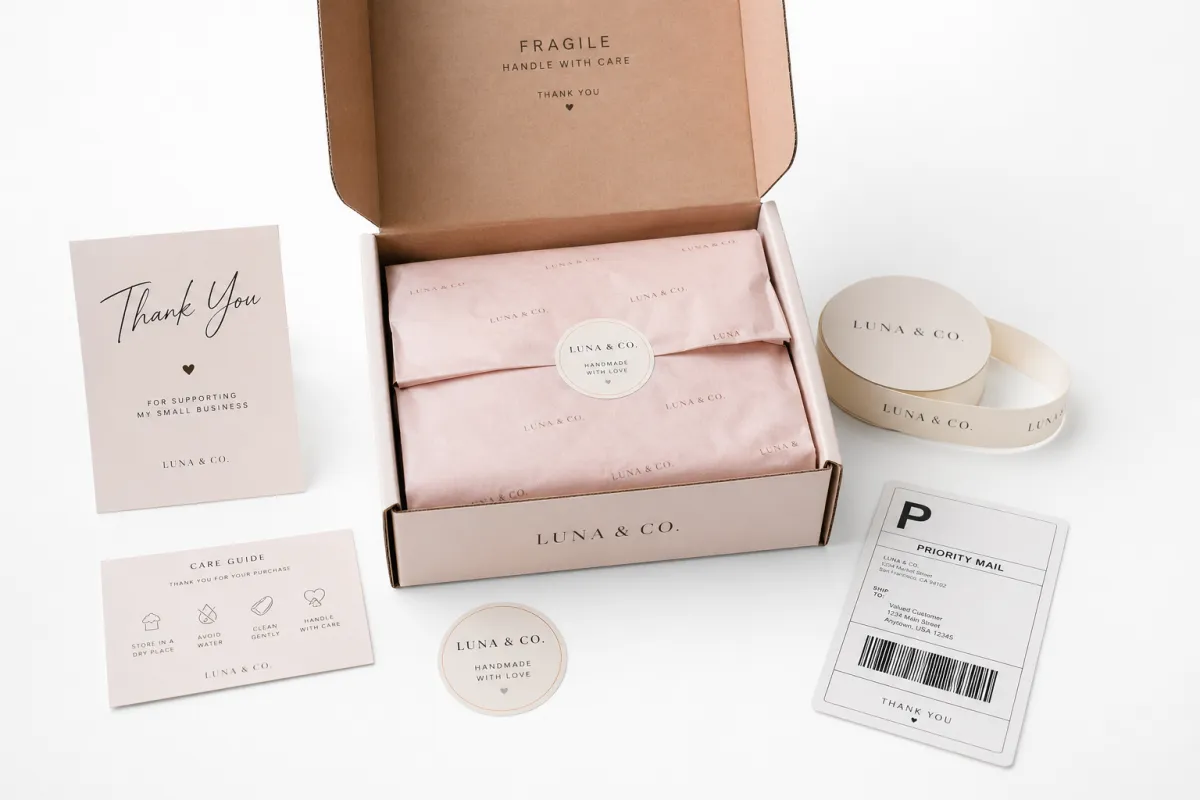
Branded packaging for Etsy sellers helps a shop stand out by turning a normal shipment into a clear, memorable experience. That matters because Etsy buyers are often shopping for something handmade, personal, or gift-worthy. They want the product to feel special, but they also want the order to arrive intact and on time. Packaging has to do both jobs. It has to protect the item and reinforce the shop identity.
A strong package also supports the unboxing experience, which is a very plain way of saying the buyer gets a small hit of anticipation and satisfaction before the product even comes out of the box. That can come from simple moves: custom stickers, tissue paper, an insert card, or a well-fitted mailer. None of those are dramatic on their own. Together, they make branded packaging for Etsy sellers feel intentional instead of improvised.
There is another practical benefit. Good packaging creates consistency. Consistency builds trust. When a buyer opens one order and sees the same care, structure, and visual language they saw in the listing photos, the shop feels more established. That is especially useful for sellers who want to move beyond one-off sales and into repeat buyers, gift orders, and better reviews.
Branded packaging for Etsy sellers also helps with photography and word of mouth. Buyers post photos of tidy boxes, printed inserts, and thoughtful notes more often than they post photos of plain shipping mailers. That does not mean every order needs Custom Printed Boxes. It means the package should give the buyer one or two details worth remembering.
Simple is usually enough. A clean kraft mailer, a branded sticker, and a short thank-you card can do a lot of heavy lifting. More expensive packaging only makes sense when the product, the margin, and the brand story can support it. There is no prize for spending more than you need to.
In practice, the package is doing brand work before the customer even touches the product. That is the part a lot of sellers miss. They think the box is just a container. It is not. It is a signal.
What Branded Packaging for Etsy Sellers Actually Covers
At its simplest, branded packaging for Etsy sellers is the set of materials that carries the shop identity beyond the product itself. That can mean outer mailers, rigid or folding boxes, tissue paper, custom stickers, tape, belly bands, thank-you inserts, care cards, and shipping labels with a consistent visual system. Some sellers add wax seals, sleeve wraps, or printed cards. Fine. The point is not how many pieces you use. The point is whether the package reads as one clear brand.
Think of branded packaging for Etsy sellers as the first physical conversation with the buyer. The confirmation email starts the relationship, but the parcel tells the customer whether the shop feels careful, consistent, and worth remembering. A plain pouch can still get the job done, but it does not give the buyer much to connect with. A package with intention starts doing work before the item is even unwrapped.
This matters more on Etsy than it does for many direct-to-consumer brands because Etsy buyers often want warmth and personality at the same time they want reliability. Handmade, vintage, and personalized products carry emotional weight. Buyers forgive some rough edges, but they spot inconsistency fast. In that setting, branded packaging for Etsy sellers acts like a trust signal. It says the maker cares about the item and about the experience around it.
A thoughtful unboxing can make a $24 item feel like a boutique purchase. Weak packaging can make a $60 item feel unfinished. That is not because packaging is more important than the product. It is because product packaging shapes perceived value before the customer has time to judge the item on its own.
Honestly, the most common mistake is treating packaging as a single decision instead of a system. Branded packaging for Etsy sellers works best when the outer layer, the protection layer, and the presentation layer each have a job. One part keeps the item safe in transit. Another part creates recognition. Another part adds the human touch. Mix those jobs together and the result usually gets expensive, busy, and harder to pack.
That system view also makes scaling easier. A seller may start with one custom sticker and one insert card, then move into custom printed boxes later if order volume supports it. Another seller may never need a full box program because a branded mailer, tissue wrap, and care card already cover the needs of the shop. There is no prize for buying the biggest package. There is only the question of whether branded packaging for Etsy sellers matches the product, the shipping method, and the shop's price point.
- Outer layer: mailer, box, or envelope that handles transit and first impression.
- Protection layer: tissue, bubble wrap, crinkle, padded inserts, or sleeves that reduce damage.
- Brand layer: sticker seal, printed card, tape, tag, or insert that communicates identity.
If you want a feel for how those pieces fit together, browse Custom Packaging Products for examples of labels, boxes, and inserts that can be mixed for smaller order volumes. For a look at presentation choices in real shops, the Case Studies page is useful because it shows packaging as a workflow decision, not just a design choice.
How Branded Packaging for Etsy Sellers Works in Practice
The easiest way to understand branded packaging for Etsy sellers is to walk through the order from the buyer's side. The customer places an order, gets the confirmation, waits for shipment, and then opens the parcel. Every step creates a small impression. The package can reduce anxiety, build anticipation, or quietly disappoint. That is why branded packaging for Etsy sellers should be planned as a sequence, not as a final wrapper chosen at the last minute.
Protection comes first. A ceramic ornament, a folded garment, a pressed print, and a personalized notebook each need different packaging logic. Protection is the unglamorous part, but it is also the part that protects reviews. If the item is damaged, no amount of pretty tissue paper will rescue the experience. Fragile products may need foam, corrugate, rigid board, or a box-in-mailer setup. Light and durable items can usually get by with a smaller mailer, less waste, and lower postage.
Presentation comes next. At that point, branded packaging for Etsy sellers starts to feel like retail packaging instead of plain shipping supplies. A folded tissue wrap with a sticker seal, a printed insert that explains care or materials, and a consistent color palette can make the parcel feel intentional without adding much labor. In many shops, a small custom sticker or label does the heavy lifting. It is a modest spend, but it ties the package together visually.
Then comes the brand layer. This is the part buyers remember in photos, unboxing videos, and repeat orders. It can be as simple as a logo mark on an insert card or as detailed as custom printed boxes with matching tape and inner messaging. Consistency matters. If the outer box says one thing, the insert says another, and the color choices drift from product to product, the customer gets noise instead of recognition. Good package branding should sound like the same shop speaking in the same voice.
"Your packaging does not need to be expensive. It needs to be repeatable, protective, and easy to assemble on a busy Tuesday."
That line sounds plain because it is. It gets to the center of why branded packaging for Etsy sellers succeeds or fails. A package that looks beautiful in a mockup and slows fulfillment to a crawl will not survive once orders pick up. A package that assembles quickly but feels indifferent will not support premium positioning. The sweet spot is usually a package that can be packed in a few fixed steps with almost no room for improvisation.
There is also a useful line between branding and over-branding. Not every surface needs a logo. Not every empty space needs copy. Too much branding can make a parcel feel cluttered or cheap, especially if the print colors are loud, the message count is high, and the materials do not hold up well in transit. Strong branded packaging for Etsy sellers usually feels edited. It leaves breathing room. It lets the product stay the star.
Use this rule of thumb: if a customer can identify the brand quickly, remember one or two details, and repack or reuse the material without fuss, the packaging is probably doing its job. If the package takes too long to open, requires too much explanation, or looks like a collage of marketing ideas, it is probably doing too much.
Product type changes the answer every time. Handmade jewelry may work well with a small rigid box, anti-tarnish insert, and branded tissue. Art prints may need a flat mailer, corner protection, and a clear care card. Personalized stationery may benefit from a sleeve, sticker seal, and matching thank-you insert. Branded packaging for Etsy sellers has to reflect the item's fragility, size, and the expectation set by the listing photos. Buyers notice when the shipping format matches the promise.
I have also seen shops get in trouble by copying a bigger brand's packaging without copying the logic behind it. That's how you end up with lovely boxes that are absurdly expensive for the product. Pretty, sure. Smart, not always.
What Drives Cost and Pricing for Etsy Packaging
Cost is where a lot of conversations about branded packaging for Etsy sellers get warped. Sellers look at the invoice total and forget the real question is per-order impact. A $500 packaging order sounds huge until it gets spread across 2,000 shipments and lands at a few cents per sale. A cheap-looking package that triggers even one extra damaged order each week can erase the savings fast. That is a bad trade, no matter how tidy the spreadsheet looks.
The main cost buckets are straightforward: materials, printing, setup fees, minimum order quantities, assembly time, and shipping weight. Materials cover the substrate itself, whether that is paperboard, corrugated board, kraft mailer stock, or tissue. Printing covers the design application, ink coverage, and special finishes. Setup fees show up more often on custom printed boxes, where dielines, plates, or file prep may be involved. Assembly time matters because labor is part of packaging, even when the labor is your own.
Here is the part most sellers skip: branded packaging for Etsy sellers should be measured by total landed cost and packing time, not just the printed unit price. If a sticker-based system adds eight seconds per order and a full box system adds forty-five, the labor difference can matter just as much as the materials. In a shop shipping fifty orders a week, those extra seconds stack up quickly.
Budget-friendly entry points
If the budget is tight, start with the pieces that create the biggest visual return for the smallest spend. Custom stickers, stamp branding, insert cards, tissue seals, and simple belly bands are usually the easiest on cash flow. They also let a seller test visual direction before moving into custom printed boxes. That is a good thing, because packaging design mistakes are much cheaper to fix when they are printed on a card than when they are built into a full box run.
For Etsy sellers watching margins closely, a simple branded insert may cost around $0.05-$0.15 per order, while a sticker seal can be even less depending on size and quantity. A branded mailer or custom tissue wrap pushes the spend higher, but it can still stay sensible if the order value supports it. The trick is matching the spend to the average order value, not to the emotional appeal of the sample on your desk.
| Packaging Option | Typical Cost per Order | Best Use Case | Notes |
|---|---|---|---|
| Sticker seal | $0.03-$0.08 | Quick brand cue on tissue or envelopes | Low labor, easy to test, strong for visual consistency |
| Thank-you insert | $0.05-$0.15 | Care notes, review prompts, repeat-order messages | Works well as a low-cost piece of branded packaging for Etsy sellers |
| Branded tissue + sticker | $0.12-$0.28 | Boutique presentation for small to mid-size orders | Needs careful folding to stay consistent |
| Custom mailer | $0.35-$0.90 | Light apparel, prints, or non-fragile goods | Good balance of protection and presentation |
| Custom printed boxes | $0.85-$2.50 | Higher-value products, premium unboxing, fragile items | Better for scale, but higher risk if sizing is not tested first |
Those figures are not fixed prices. Quantity, ink coverage, board thickness, lamination, and shipping lane all move the numbers. A 1,000-piece order will usually beat a 250-piece order on unit price, but the larger run also raises the stakes if the design is wrong. That is why branded packaging for Etsy sellers should be tested at a small scale before the shop commits to deeper inventory.
If sustainability matters to the brand story, material choice matters too. Paper-based components with FSC certification can support a clearer sourcing story, especially for brands that want to show responsibility without overclaiming. Certification and recyclability are not the same thing, though. A laminated piece may be FSC-certified and still be harder to recycle than an uncoated paper component, depending on local collection rules.
Risk is the other useful lens. Larger quantities lower unit cost, but they also create the chance of slow-moving inventory, design rework, or size mismatch. I have watched shops save pennies on custom packaging and then spend weeks using up cartons that fit badly. That is not a savings. It is a storage problem with a nice print finish.
For shipping durability, ISTA test methods are a sensible reference point. You do not need a full lab program for every Etsy product, but you do need to know how the pack handles compression, drop, and vibration. The more fragile the item, the more useful it is to test the packaging before placing a large purchase order.
Where the money usually disappears
The silent budget killer is not always the printed piece itself. It is often the extras: heavier mailers that raise postage, insert cards that need multiple proofs, or finishes that look elegant but slow production. Soft-touch lamination, foil, and specialty die-cuts can be worth it, but only when they support the product position. If the item is a $16 craft supply, a luxe finish may not make sense. If the item is a $78 personalized gift, the math changes quickly.
Strong branded packaging for Etsy sellers should improve at least one of three things: conversion, repeat purchase rate, or damage reduction. If it does none of those and only raises aesthetic satisfaction, it is probably not pulling its weight. That does not mean the package has to be bare. It means the package should earn its place in the cost stack.
And yes, sometimes the cheapest-looking option is the one that performs best. That is kinda annoying, but margin has a way of making the decision for you.
Step-by-Step Guide to Building a Packaging System
The cleanest way to build branded packaging for Etsy sellers is to start with the item, not the artwork. Measure the product first. Note the dimensions, the weight, the fragility, and the way the buyer opens it. A flat print has different needs from a bottle, and a boxed candle has different needs from a set of earrings. The packaging system should fit the product, not the other way around.
Step one is choosing the brand story you want the package to tell. Minimal, earthy, playful, luxe, artisanal, heritage, colorful, modern, and gift-ready are all real directions. The mistake is trying to hold two or three of them at once. A shop can be warm and modern, or rustic and refined, but if it tries to be everything, the package loses clarity. Good packaging design makes a decision and repeats it.
Step two is narrowing the component list. For most shops, the smallest useful set is a shipping container, a brand cue, and a note or care piece. That might look like a kraft mailer, a sticker seal, and an insert card. Branded packaging for Etsy sellers does not have to start with custom printed boxes. In fact, many shops should not start there. It is easier to prove the concept with low-risk components, then expand if the system feels right after a few hundred orders.
Step three is making a sample kit before the full order. Build one mockup for the product, photograph it in natural light, and pack it the way a real order would be packed. If the item is brittle, drop-test the mockup gently from waist height onto a hard floor using the outer package only, then inspect the corners and contents. That is not a lab test, but it is a useful sanity check before a seller spends money on inventory that does not fit the real product.
Step four is reviewing the workflow. At that point, many branded packaging for Etsy sellers programs rise or fall. A parcel that looks polished in a design file can still be annoying if it needs too many folds, too much tape, or a precise alignment step on every order. A good packing process should be predictable enough that it looks the same on a slow morning and a hectic weekend.
Step five is documenting the standard. Create a short packing checklist. Keep the box count, tissue size, insert placement, and sticker location consistent. If multiple people pack orders, even informally, the checklist prevents drift. That discipline is what turns package branding from a one-off idea into a repeatable shop asset.
- Measure the product and the packed product.
- Pick one visual direction and stick to it.
- Start with the lowest-cost branded piece that adds recognition.
- Mock up the package with real items, not just a digital proof.
- Write the packing steps so each order looks the same.
There is a practical reason to keep the system simple at first. Etsy sellers often deal with uneven demand. A shop may ship five orders one week and fifty the next. Branded packaging for Etsy sellers should survive that swing without creating a bottleneck. If the package takes too long to assemble, the owner ends up choosing speed over consistency. If it is too elaborate, it gets skipped during busy periods. Simplicity is not a compromise. It is an operations strategy.
For more ideas on how the right components can be combined by product type, Custom Packaging Products can help you compare box, label, and insert options in one place. If you want to see how the same packaging logic is applied across different shop sizes, the Case Studies page shows how teams balance cost, presentation, and shipping durability.
Production Timeline: From Artwork to Arrival
Timeline planning is where branded packaging for Etsy sellers becomes real. A beautiful idea is useless if the stock arrives after the launch or the holiday rush. The timeline usually moves through briefing, design, proofing, revisions, sampling, production, and shipping. Each stage can move fast, and each stage can also stall if one file, one measurement, or one approval gets delayed.
The brief should be specific. Include the product dimensions, the pack sequence, the brand colors, the print methods you want, and the quantity target. If the product needs a rigid box, note the internal clearance needed so the item is not forced into a tight fit. If the package needs a hang tag or insert, specify the copy length early. Vague briefs create back-and-forth. Back-and-forth burns days.
Proofing is another place where branded packaging for Etsy sellers often slows down. Artwork files may look fine in a browser and fail once the printer checks bleeds, safe zones, or dielines. If a box uses a custom cut, the dieline needs exact dimensions and the seller needs to inspect the fold lines before approval. A sloppy proof stage is how shops end up with labels sitting too close to the edge or inserts clipping text on the trim.
Simple items move faster. Sticker runs, insert cards, and basic tissue are usually the quickest path because they need less structural engineering. Custom printed boxes, specialty coatings, and complex finishes take longer because they may require more file prep and more production steps. A seller who wants branded packaging for Etsy sellers ready before a product drop should plan backward from the launch date, then add buffer for samples and revisions.
Fast items versus slower items
In many production schedules, stickers and thank-you inserts turn around faster than custom boxes. That does not mean every order is fast. It means the production complexity is lower. A simple branded insert might only need a proof and a short print run, while a box with multiple print surfaces and a special finish may need a longer queue and more quality checks. If the packaging is being launched alongside a new product, assume the slower path until the supplier confirms otherwise.
One practical rule helps here: never let the first batch of branded packaging for Etsy sellers be the first time the package is tested in real fulfillment. That first batch should already be a refinement, not a prototype. Even a small sample order can reveal whether the tissue tears too easily, whether the insert curls, or whether the box needs another millimeter of clearance.
For sellers who ship seasonally, timing matters even more. Packaging should land before the sales window opens, not during it. If you know your shop gets a surge around gift-giving periods, order earlier than your instinct tells you to. Printing delays, freight delays, and proof revisions do not care about your launch calendar. They only care about the queue.
The practical target for many simple branded items is a short cycle after proof approval, while custom boxes and specialty finishes often need a longer runway. The exact timing depends on quantity, material, and shipping lane, but the more complex the packaging, the less forgiving the schedule. Branded packaging for Etsy sellers looks much better when it arrives early enough for testing, not just barely in time to pack the first order.
One thing people miss is that timeline planning is not just for production. It is also for training. If the packaging is new, pack a few sample orders before the full launch. That helps catch muscle-memory mistakes, such as placing the insert upside down or forgetting the sticker on the tissue. Small errors are easier to fix before the rush.
Common Mistakes Etsy Sellers Make With Branded Packaging
The biggest mistake is spending for style before proving the economics. Branded packaging for Etsy sellers should fit the margin, not compete with it. If the packaging cost pushes the gross margin into dangerous territory, the seller may create a nicer parcel and a weaker business. That trade-off is tempting because packaging is visible. Profit is less visible, but it pays the bills.
A second mistake is ordering too much too soon. Minimum order quantities can make a seller feel as if a larger run is automatically smarter. Sometimes it is. Often it is not. If the box size, print colors, or fold structure have not been tested in real shipping conditions, a deep order just magnifies the risk. A 2,000-piece mistake is harder to recover from than a 200-piece one, even when the unit price looks better on paper.
A third mistake is choosing packaging that looks good in a mockup but is slow to assemble. A design can photograph beautifully and still be a nuisance in daily fulfillment. Branded packaging for Etsy sellers should be judged in real packing time, with real hands, in real order volume. If pack time grows by half a minute per order, the long-term labor hit can be surprisingly large.
A fourth mistake is visual overload. Too many colors, too much copy, too many finishes, and too many brand marks can make the package harder to read. The customer does not need a brochure taped to a box. They need clear identity, good protection, and one or two memorable details. Over-branding is especially risky for handmade goods, where the appeal often comes from restraint and authenticity.
A fifth mistake is ignoring transit conditions. A design That Holds Up in a studio can fail in a courier network. Corners scuff. Labels rub. Glossy finishes show fingerprints. Soft paper tears when damp. If the packaging is part of the product experience, it has to survive the trip to the buyer. Testing with parcel handling in mind matters more than making the package look good on a flat lay.
The other error I see a lot is treating packaging as decoration only. That mindset misses half the job. Good packaging protects the item, speeds packing, supports repeat purchases, and creates a recognizable identity. The best branded packaging for Etsy sellers does all four. When it only does one, it is usually more expensive than it needs to be.
- Do not buy a large quantity before checking the fit on the real product.
- Do not choose finishes that slow the packing line without adding value.
- Do not make the design so busy that it competes with the product.
- Do not ignore shipping weight if the product is sold at a tight margin.
- Do not assume the sample box will behave like the full production run.
Branded packaging for Etsy sellers gets easier when the seller starts thinking like a production manager for a minute. What is the fastest repeatable version of the package? Where is the failure point? Which detail carries the most brand recognition per dollar? Those questions usually lead to better decisions than "What looks nicest on screen?"
One more point, because it matters in real life: if the package makes returns, claims, or replacements harder to handle, it is failing operationally. A beautiful but impossible-to-repack box is not always a good choice. Neither is a delicate insert that falls apart once the buyer opens it. The package should be sturdy enough to support the whole post-purchase journey.
Branded Packaging for Etsy Sellers: Next Steps That Pay Off
For most shops, the smartest next step is not a full redesign. It is a controlled test. Pick one best-selling SKU, one core color palette, and one low-cost improvement that can be measured. That might be a custom sticker, a thank-you insert, or a better mailer. Branded packaging for Etsy sellers works best when the seller learns from one product before rolling the same system across the whole catalog.
Set a goal before you spend anything. Maybe the goal is fewer damage claims. Maybe it is more repeat orders. Maybe it is more review comments that mention presentation. Maybe it is simply reducing packing time while keeping the parcel neat. Without a goal, packaging decisions drift into opinion. With a goal, the seller can compare options in a disciplined way.
Then watch three signals closely: customer feedback, repeat-purchase behavior, and packing time. If customers mention the unboxing, the package is doing something useful. If repeat orders rise in the categories where the packaging was upgraded, that is a stronger signal. If packing time drops because the system is easier to assemble, that is real value too. Branded packaging for Etsy sellers should not just look good; it should pay back in ways the seller can track.
A staged rollout is usually the least risky route. Start with stickers or inserts. Move to tissue, labels, or a branded mailer if the product and margin justify it. Consider custom printed boxes only when the volume is high enough to absorb the setup and the design is validated in transit. That sequence keeps the learning cost small. It also gives the shop a way to improve package branding without blowing up the fulfillment process.
Think of the packaging stack as a ladder. At the bottom are the simplest tools: a logo sticker, a note card, a clean envelope. In the middle are cohesive branded materials like tissue, tape, and mailers. At the top are custom printed boxes and more complex finishing options. Not every shop needs to climb all the way up. Some stop halfway and still Create a Memorable experience. The right level is the one that supports the offer, the margin, and the packing operation.
If you want a practical filter, ask three questions Before You Buy: Does this help the product arrive safely? Does it make the shop easier to remember? Does it fit the budget at current order volume? If the answer is yes to all three, branded packaging for Etsy sellers is probably headed in the right direction. If the answer is no to any one of them, pause and adjust.
That is the real advantage of thinking this way. Branded packaging for Etsy sellers stops being a decorative extra and starts acting like a business asset. It supports trust, protects the product, and gives the buyer a clearer sense of who made the item and why it matters.
And that is where the payoff lives: in the repeat order, in the review that mentions presentation, in the fewer claims, and in the feeling that the shop has moved from handmade side project to something more established. Branded packaging for Etsy sellers is not magic. It is a series of small, deliberate choices that add up when they are tested, measured, and refined.
So start with one product, one packaging lane, and one change you can actually track. If it saves time, protects the item, or makes the shop easier to remember, keep it. If it only looks nice in a mockup, let it go. That is the whole trick.
How much should branded packaging for Etsy sellers cost per order?
Set the budget from your margin backward, not from a random shopping target. Simple upgrades such as stickers, stamps, and insert cards usually sit in the lowest-cost tier, while custom printed boxes and specialty finishes belong in a higher tier only if they improve protection, repeat buying, or perceived value enough to justify the spend.
What is the best first branded packaging upgrade for Etsy sellers?
A custom sticker or branded thank-you insert is usually the easiest place to start. It adds identity without forcing a major workflow change. If protection matters more than presentation, custom tape or a branded mailer may be the better first move.
How long does branded packaging for Etsy sellers usually take to produce?
Simple items often move faster than custom printed boxes or specialty finishes, but every supplier works on a different schedule. Allow time for design, proofing, sample review, and shipping before you need the stock. Add extra buffer if you are launching a new product or preparing for a seasonal sales spike.
Do branded packaging choices really help Etsy sales?
Yes, they can improve trust, memorability, and repeat-purchase behavior when the packaging matches the product and price point. They also reduce the gap between an Etsy shop and a more established retail brand. The effect is strongest when the packaging feels intentional rather than overloaded.
What should small shops avoid when designing branded packaging for Etsy sellers?
Avoid oversized minimum orders before you have tested the design in real shipping conditions. Do not pick materials that are pretty but weak, slow to pack, or expensive to ship. Keep the design simple enough that every order looks consistent, even when you are fulfilling quickly.
What is the most practical takeaway for a new Etsy seller?
Pick one packaging layer that improves the customer experience without making fulfillment harder, then test it on a real SKU. If it protects the product, fits the budget, and still looks like your shop, keep it. If not, simplify and try again.


