Buyer Fit Snapshot
| Best fit | Eco Friendly Packaging Sleeves Supplier projects where brand print, material claims, artwork control, MOQ, and repeat-order consistency need to be specified before quoting. |
|---|---|
| Quote inputs | Share finished size, material target, print colors, finish, packing count, annual reorder estimate, ship-to region, and any compliance wording. |
| Proofing check | Approve dieline scale, logo placement, barcode or warning zones, color tolerance, closure strength, and carton packing before bulk production. |
| Main risk | Vague material claims, crowded artwork, missing packing details, or unclear freight terms can make a low unit price expensive after revisions. |
Fast answer: Eco Friendly Packaging Sleeves Supplier: Material, Print, Proofing, and Reorder Risk should be specified like a repeatable production item. The safest quote records material, print method, finish, artwork proof, packing count, and reorder notes in one written spec.
Production checks before approval
Compare the actual filled-product size with the drawing, then confirm tolerance on folds, seals, hang holes, label areas, and retail display edges. Reserve space for logos, QR codes, warning copy, and material claims before decorative graphics fill the panel.
Quote comparison points
Review material grade, print process, finish, sampling route, tooling charges, carton quantity, and freight assumptions side by side. A quote is only useful when the supplier can repeat the same color, closure quality, and packing count on the next order.
Eco Friendly Packaging Sleeves Supplier: How to Choose
Choosing an eco friendly packaging sleeves supplier changes a lot more than the surface of a carton. It affects how much waste a customer notices, how premium the pack feels on shelf, and how confident you can be when the sustainability questions start later. A sleeve is often the first part of the package people touch, see, and remember, so a small material decision ends up carrying a very big brand job.
For a packaging buyer, that matters across cosmetics, food, supplements, apparel, and gift sets. The sleeve may be the lightest piece in the system, yet it often carries the heaviest branding load. A weak eco friendly packaging sleeves supplier can leave you with soft board, muddy print, poor fit, or claims that sound tidy in a sales deck but wobble under scrutiny. I have seen more than one project get slowed down by a sleeve that looked fine in PDF form and then went a little sideways once the physical sample arrived.
What an eco friendly packaging sleeves supplier really changes
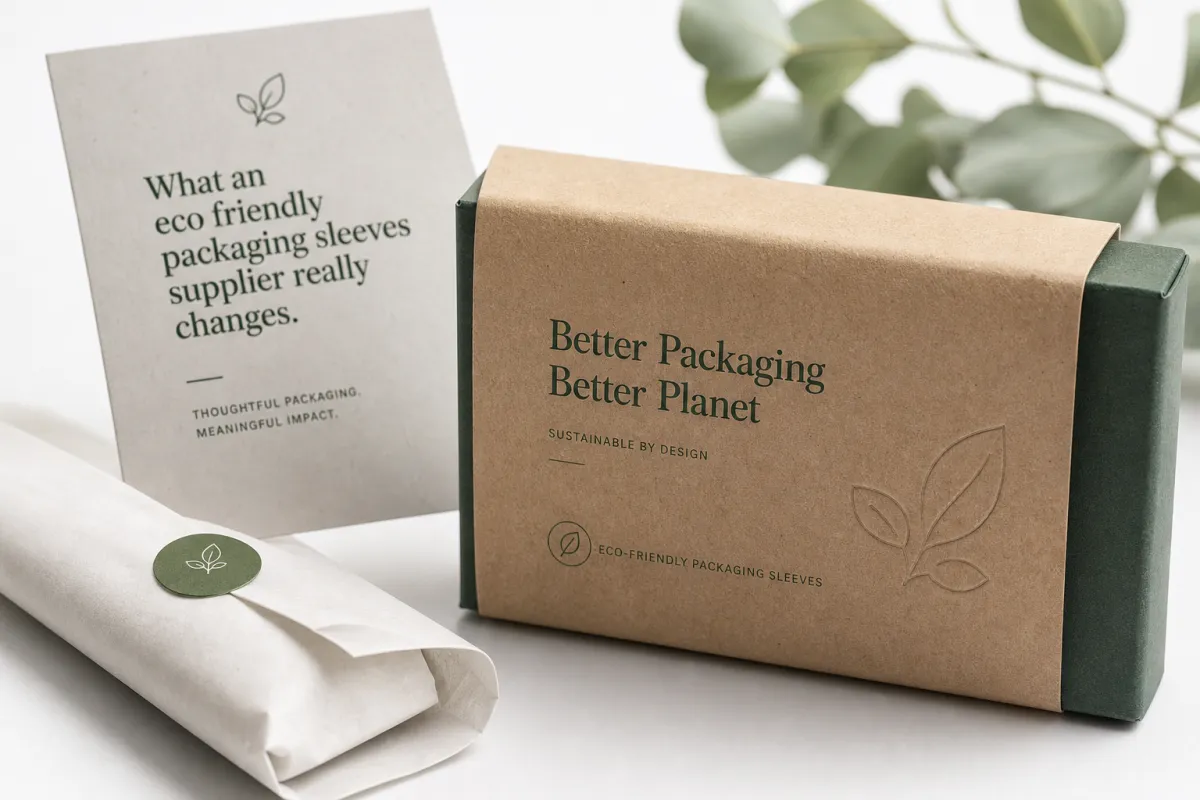
An eco friendly packaging sleeves supplier does not simply swap one paper for another and call it a day. The right partner changes the whole equation: fiber source, coating choice, print coverage, adhesive selection, and even how much waste ends up in the bin after opening. That is why sleeves deserve more attention than they usually get. They are small, yes, but they sit right in the customer’s line of sight.
In practice, a sleeve is a brand’s quickest path to package branding. It can make simple product packaging feel deliberate, or it can make an otherwise premium box feel cheap if the board creases, the ink rubs, or the cut is off by a few millimeters. The same holds true for retail packaging. A sleeve can carry enough identity to replace a heavier carton embellishment, which is useful when teams want cleaner branded packaging without piling on extra layers.
“Eco friendly” also means more than recycled content. A serious eco friendly packaging sleeves supplier may use FSC-certified paper, lower-ink artwork, water-based coatings, paper-first construction, and adhesives that do not interfere with recovery streams. A design with modest coverage can be easier to justify than one with a dense flood of black ink and a plastic lamination, even if both are technically paper-based. That distinction matters because sustainability claims are only as useful as the build behind them.
A sleeve is a small piece of product packaging with an outsized job: it has to look good, communicate clearly, and survive handling without making the pack feel wasteful.
The central question is not “Can this be made green?” The better question is how an eco friendly packaging sleeves supplier balances appearance, cost, compliance, and durability so the sleeve still performs under real-world conditions. That is where comparison becomes useful. Two suppliers may both describe their materials as recyclable, but one may offer cleaner graphics, tighter tolerances, and better documentation. The difference usually shows up later, often when a buyer is trying to explain a reprint or a claim to procurement.
If your sleeve is part of a broader launch, it should also sit comfortably beside the rest of the pack system. A good supplier will think about how the sleeve works with Custom Packaging Products, not in isolation. That matters for cosmetics, subscription boxes, and seasonal kits where custom printed boxes and sleeves need to share the same visual language.
For teams comparing multiple vendors, one practical filter helps: ask each eco friendly packaging sleeves supplier what, exactly, makes their version eco conscious. If the answer stops at “recycled paper,” keep asking. If the answer includes substrate, finishing, test method, and end-of-life guidance, the conversation is moving in the right direction.
How an eco friendly packaging sleeves supplier works
A reliable eco friendly packaging sleeves supplier usually follows a predictable workflow, and understanding that workflow makes the buying process easier to manage. It begins with a brief: sleeve dimensions, application method, artwork files, target quantity, and the sustainability story the brand needs to tell. From there, the supplier builds or checks a dieline, confirms material options, and flags anything that could cause trouble later, such as a barcode sitting too close to a fold or a heavy ink area that may crack on a tight crease.
Substrate selection is the first technical fork in the road. Common choices include kraft paper, recycled SBS, FSC-certified board, paperboard with water-based coatings, and specialty papers that can handle grease or moisture more effectively. For food, supplement, or personal care lines, a strong eco friendly packaging sleeves supplier will ask how the pack is handled: dry shelf, chilled display, high-touch retail, or direct ship in a fulfillment center. That detail changes the recommendation more than most buyers expect.
Printing choices matter just as much. Offset printing can deliver strong color control at higher volumes, while digital printing often makes sense for shorter runs or faster turnarounds. Soy-based inks, low-coverage layouts, and matte finishes can all support a more restrained material profile. Gloss coatings may still be appropriate, but they should be justified by function, not habit. The best suppliers do not force a single aesthetic. They help you choose the finish that fits the job.
Sample and approval stages are where an eco friendly packaging sleeves supplier proves whether the first promise matches the final result. A proper sample review should cover fit, color, score lines, copy legibility, and handling. If the sleeve wraps a cosmetic carton or a gift set, the sample should also be checked against the assembled pack, not only against the flat art file. That simple step catches a surprising number of issues.
The supplier model matters too. A manufacturer, broker, and converter may all sell sleeves, but they do not offer the same level of transparency. A manufacturer or converter is usually closer to the press and die-cutting line, which can improve control over tolerance and scheduling. A broker may offer broader sourcing but less visibility into the actual production path. Neither model is automatically better. The right choice depends on whether your team values direct accountability, lower-MOQ flexibility, or access to a wider range of mills and finishing options.
For buyers who need deeper distribution testing, a good supplier can also point to recognized methods from ISTA, especially if the sleeve will move through e-commerce channels or sit inside a shipping carton. That kind of detail separates a polished sales deck from a supplier that understands packaging as a working system.
One more practical point: a strong eco friendly packaging sleeves supplier should be able to explain what happens if the artwork changes after approval. Revisions happen. A supplier with a clear change-control process can tell you whether a small text tweak is free, whether a revised plate is needed, and how that affects the timeline. That clarity saves money and keeps surprises to a minimum.
Cost, pricing, MOQ, and quote basics
Pricing from an eco friendly packaging sleeves supplier is shaped by more variables than many teams realize. Material grade is the obvious one, but print coverage, sleeve size, finishing, and quantity often move the number just as much. A compact sleeve with one-color printing and no coating might be straightforward. A larger sleeve with full-bleed graphics, precise registration, and a specialty coating is a different job entirely.
MOQ, or minimum order quantity, is another point worth unpacking. Lower MOQ often means a higher unit cost because setup work, plates, and labor are spread across fewer pieces. Higher MOQ can reduce unit cost, but it increases inventory exposure if the SKU changes or the campaign ends early. A disciplined eco friendly packaging sleeves supplier will explain that tradeoff rather than hiding it behind a headline price.
Here is the part buyers sometimes miss: the cheapest quote is not always the lowest total cost. If a sleeve fits poorly, needs rework, or arrives with inconsistent color, the bill gets larger very quickly. A bad quote can also hide freight, sampling, plate fees, or rush surcharges. When that happens, the “low” price becomes a moving target.
| Option | Typical use | Common sustainability signal | Approx. unit cost at 5,000 pcs | Notes |
|---|---|---|---|---|
| Kraft paper sleeve | Soap, apparel, simple gift sets | Paper-first, often recycled fiber | $0.11-$0.18 | Best when the design is restrained and print coverage stays low. |
| FSC-certified paperboard sleeve | Cosmetics, supplements, premium retail | Forest management and chain-of-custody documentation | $0.16-$0.28 | Good balance of print quality and sustainability proof. |
| Recycled SBS sleeve | Full-color branded packaging | Higher post-consumer or recycled fiber content | $0.18-$0.30 | Often chosen when color consistency matters across a brand family. |
| Water-based coated board | Food, skincare, high-touch retail packaging | Lower plastic use and easier recovery story | $0.20-$0.34 | Useful where scuff resistance matters but lamination is not desired. |
| Specialty moisture-resistant paper | Cold-chain or humid environments | Function-led material choice | $0.24-$0.42 | Worth it only if the environment truly demands it. |
Those ranges are directional, not absolute, and they move with market pricing, board availability, print method, and the amount of finishing work required. A smaller sleeve with a simple die cut may sit at the bottom of the range, while a larger format with heavy coverage, foil accents, or tight color matching can climb fast. An experienced eco friendly packaging sleeves supplier should spell out whether the quote includes tooling, plates, sampling, freight, taxes, and packaging for shipment protection. If those items are buried, the quote is incomplete.
It also helps to ask for a cost breakdown by quantity. A run of 1,000 pieces might look expensive per unit, but the real comparison is against 3,000 or 5,000 pieces with the same artwork and finish. In many cases, unit cost drops sharply once setup costs are absorbed. The upside is obvious. The risk is overbuying inventory that expires before use. That is why a smart eco friendly packaging sleeves supplier should be comfortable discussing both price and stock risk in the same conversation.
For buyers building a larger line, sleeves should be considered alongside the rest of the pack system. If you are also sourcing Custom Packaging Products, ask whether the supplier can hold consistent color across sleeves, cartons, and inserts. Visual mismatch is one of the easiest ways to make premium package branding look patched together.
Process and timeline: from brief to delivery
The process with an eco friendly packaging sleeves supplier usually follows a clear sequence: discovery brief, material recommendation, dieline creation, artwork setup, sampling, approval, production, packing, and dispatch. It sounds linear, but it is often shaped by two things that slow projects down: incomplete information and revision loops. If dimensions are off by even a few millimeters, the sleeve can fail at fit stage, which costs time and can trigger a redesign.
Lead time depends mostly on print method, tooling, supplier queue, and freight mode. A simple sample can move in roughly 3-7 business days when artwork and sizes are ready. Full production often lands around 10-18 business days after proof approval, though it can stretch if the order requires complex finishing or if the supplier is booked. An eco friendly packaging sleeves supplier that gives you milestone dates in writing is usually easier to work with than one that only promises a vague ship window.
There is also a difference between sample speed and production speed. Samples can move quickly because they are made in small numbers, but mass production requires setup, press time, die cutting, and packing. Buyers sometimes assume that a quick sample means a quick order. Not always. If the order includes a special board, a new die, or a color-critical artwork build, the final run still needs proper scheduling.
Buffer time matters more than most teams admit. Seasonal launches, retailer onboarding, influencer kits, and subscription drops all have hard deadlines. Missing them can cost far more than a rush fee. From a packaging buyer’s point of view, the best eco friendly packaging sleeves supplier is the one that helps protect the launch date, not the one that only quotes the lowest price. That is especially true if the sleeves have to match custom printed boxes or other branded packaging elements arriving on the same day.
Ask for the timeline in a simple written format:
- Artwork received
- Dieline and structural confirmation
- Proof or sample delivery
- Approval deadline
- Production start
- Production complete
- Shipping and delivery estimate
That list turns an abstract promise into something your team can manage. It also makes it easier to spot where an eco friendly packaging sleeves supplier may be waiting on you rather than the other way around. In real projects, that distinction prevents a lot of blame-shifting.
If the sleeve will travel through normal distribution, ask how the supplier checks for abrasion, corner crush, and edge wear. Transit stress is not glamorous, but it is where many print jobs lose their polish. A good supplier may suggest sample drops or carton-packing tests that align with common distribution thinking, and if a project is fragile enough, it can be worth cross-checking with EPA recycling guidance to keep recovery assumptions realistic instead of optimistic.
Key factors to compare before you choose
Not every eco friendly packaging sleeves supplier is evaluating the same thing. Some lead with price. Some lead with speed. Some lead with sustainability claims that sound impressive but are thin on proof. The challenge is to compare suppliers using the same yardstick, or the sales pitch with the best wording can win over the partner with the best process.
Start with proof, not language. If a supplier says the board is recycled or FSC-certified, ask for the certificate status, chain-of-custody details, or material documentation. If they claim curbside recyclability, ask how that claim fits local paper-stream behavior and whether coatings, foils, or adhesives complicate the story. A well-prepared eco friendly packaging sleeves supplier will not treat that question as a nuisance. They will treat it as normal procurement discipline.
Then look at physical quality. Online mockups hide a lot. Real sleeves reveal whether color stays consistent, whether the board scuffs under handling, and whether the cut edge feels clean or rough. They also show whether the sleeve supports the weight of the pack without bowing. A sleeve that looks sharp in a PDF can still fail in hand. That is why samples are not a luxury. They are the filter.
Communication speed matters too. The best suppliers ask good questions early: What is the fill process? Is there a barcode? Will the sleeve live with a paper insert or over a rigid carton? Is the line automated or hand-applied? A thoughtful eco friendly packaging sleeves supplier will use those answers to reduce risk before production starts. That is a sign of technical maturity, not just sales polish.
Capacity and repeatability matter for reorders. A supplier that handles a one-off run well but cannot repeat the same result on a reorder can create headaches six months later. If you are planning a family of SKUs, ask whether color matching, die retention, and material continuity are stable across seasons. That question is especially relevant for branded packaging that needs to stay consistent across a broad shelf set.
Use a simple scorecard if the options look similar:
- Sustainability proof
- Price transparency
- Lead time confidence
- Print and structural quality
- Communication and technical support
- Reorder consistency
- Logistics fit
Geography belongs on the list too. Freight distance, warehouse location, and local manufacturing capacity can influence both cost and carbon footprint. A nearby eco friendly packaging sleeves supplier may reduce transit emissions and shorten replenishment cycles, while a farther supplier may still win if their material options or print control are stronger. The point is not to assume local always wins. The point is to compare what really changes the outcome.
From a packaging design perspective, you should also ask whether the supplier can help simplify the artwork. Lower ink coverage, fewer spot colors, and smarter placement of legal copy can improve both cost and sustainability. That is the kind of practical advice that separates a generic vendor from a useful eco friendly packaging sleeves supplier.
Common mistakes buyers make with sleeves
The first mistake is buying on unit price alone. A sleeve that saves two cents may cost far more if it fits poorly, needs reprints, or slows your packing line. An experienced eco friendly packaging sleeves supplier will often push back on the cheapest option if it creates hidden cost later. That is not upselling. It is risk control.
The second mistake is vague specification language. “Eco-friendly paper” is not a specification. It is a broad hope. Better language includes board weight, finish, size tolerances, ink system, required certification, and whether the sleeve needs to be compatible with retail handling or shipping. If the pack needs to feel premium, say that too. A good supplier cannot read minds, but they can translate a clear brief into a better result.
The third mistake is assuming all recyclable materials behave the same. They do not. A sleeve that performs nicely in a dry showroom may behave differently in humidity, refrigeration, or high-touch retail conditions. The right eco friendly packaging sleeves supplier will ask about those environments because they affect print scuffing, board warp, and adhesion. That is why one-size-fits-all sourcing rarely works.
The fourth mistake is skipping the physical sample. It sounds basic, yet teams still approve flats and PDFs, then discover too late that a barcode is partly hidden, a legal panel is too small, or the sleeve tears during application. A sample catches those problems before production. For packaging teams working on product packaging and custom printed boxes at the same time, this step can save an entire launch from embarrassment.
The fifth mistake is sloppy claim language. If the sleeve is not truly recyclable in the intended market, do not write as if it is. If it uses recycled content, say what percentage and whether the claim is based on pre-consumer or post-consumer fiber. If the supplier cannot document the material, the claim should not move into the design file. One useful habit is asking the eco friendly packaging sleeves supplier to review claim language before artwork goes to print.
Clear specs protect the budget. Clear claims protect the brand.
There is also a quieter mistake: overlooking the sleeve’s role in the rest of the pack architecture. A sleeve that looks clean on its own may not align with the carton, the insert, or the shipper. That kind of mismatch can make otherwise strong package branding feel scattered. A supplier who understands retail packaging should help keep those pieces in the same visual family.
Another trap is forgetting application method. If the sleeve is hand-applied, small tolerances may be acceptable. If it runs through an automated line, the fit needs to be tighter and more consistent. That is one reason a serious eco friendly packaging sleeves supplier will ask about line speed and fill method before quoting. The production environment changes the spec, kinda a lot more than people expect.
Expert tips and next steps for a smarter shortlist
Here is the simplest way to narrow the field: build a shortlist of three suppliers and give each one the same brief. Same size, same artwork, same quantity, same sustainability goal. That keeps the comparison clean. If one supplier suddenly becomes much more expensive or much slower, the reason is easier to identify. A strong eco friendly packaging sleeves supplier should be comfortable being measured this way.
Ask for a sample pack that includes at least one recycled option, one premium print option, and one lower-cost alternative. The point is not to collect paper for a drawer. The point is to compare feel, print density, cut quality, and claim support side by side. In many projects, that sample pack reveals more than a long quotation ever will.
Use a scorecard with weighted criteria rather than gut feel. For example, sustainability proof can count for 30%, pricing clarity for 20%, lead time for 15%, print quality for 20%, and communication for 15%. You can adjust the weights to match the category, but the discipline helps. A strong eco friendly packaging sleeves supplier should score well across the board, not only on one flashy line item.
Run a pilot order if the sleeve will land on retail shelves, pass through a fulfillment center, or sit inside a complex package branding system. Pilot runs expose issues that mockups hide. They are especially useful when the sleeve needs to align with branded packaging across multiple SKUs. If the pilot behaves well, scaling becomes much less stressful.
One more practical step: check whether the supplier can support both the sleeve and the adjacent pack components. A partner who can coordinate with Custom Packaging Products may save you time because the color targets, carton finish, and sleeve dimensions are discussed in one place instead of three. That matters when the brand wants a unified shelf presentation and fewer handoffs between vendors.
As you evaluate suppliers, compare the claims against the build, not just the brochure. A real eco friendly packaging sleeves supplier can tell you why a 300gsm FSC-certified board may be better for one SKU, why a recycled SBS board may fit another, and why a water-based coating is the cleaner choice for a third. That kind of detail is what you want when the order needs to be justifiable to procurement, marketing, and operations at the same time.
My practical recommendation is simple: request quotes, confirm certifications, review samples, and test the sleeve in the environment where it will actually be used. Do that well, and the eco friendly packaging sleeves supplier you choose will support the product instead of creating noise around it. Skip that work, and you will probably spend more time fixing avoidable problems than planning the next launch.
What should I ask an eco friendly packaging sleeves supplier before I request a quote?
Ask which substrates, coatings, inks, and certifications are available for your exact use case. Then request pricing with MOQ, sampling, tooling, freight, and lead time spelled out separately. A reliable eco friendly packaging sleeves supplier should be able to answer those questions without hiding the numbers in a vague summary.
How do I know if an eco friendly packaging sleeves supplier is truly sustainable?
Look for proof such as FSC documentation, recycled content evidence, and clear end-of-life guidance. Compare the full build, not just the paper, because inks, coatings, and adhesives can change how the sleeve performs in recovery systems. A credible eco friendly packaging sleeves supplier should explain the build in plain language.
What MOQ is typical for custom packaging sleeves from a supplier?
MOQ varies by material, print method, and whether tooling is needed, but custom runs usually price better at higher volumes. If you are testing a new product, ask for a pilot run or a lower-MOQ option before scaling. A practical eco friendly packaging sleeves supplier will explain where unit cost begins to improve.
How long does the process usually take with an eco friendly packaging sleeves supplier?
Sampling can move quickly if your artwork and dimensions are ready, while production lead time depends on print complexity and supplier queue. Build in extra time for proof approvals, freight, and revisions after the first sample. A dependable eco friendly packaging sleeves supplier should share milestone dates in writing.
Can eco friendly packaging sleeves still look premium and print in full color?
Yes. Many recycled and FSC-certified papers support strong full-color printing and premium finishes. The key is matching the substrate and ink system to the job so appearance, durability, and recyclability stay in balance. A capable eco friendly packaging sleeves supplier will help you choose that balance instead of forcing a compromise that hurts the brand.
The practical takeaway is straightforward: ask for documentation, physical samples, and a written timeline before you compare price, because that is the fastest way to separate a real eco friendly packaging sleeves supplier from one that only sounds good on paper. Once those three pieces are in hand, the rest of the decision gets a whole lot clearer.


