Buyer Fit Snapshot
| Best fit | Branded Shopping Bags Supplier projects where brand print, material claims, artwork control, MOQ, and repeat-order consistency need to be specified before quoting. |
|---|---|
| Quote inputs | Share finished size, material target, print colors, finish, packing count, annual reorder estimate, ship-to region, and any compliance wording. |
| Proofing check | Approve dieline scale, logo placement, barcode or warning zones, color tolerance, closure strength, and carton packing before bulk production. |
| Main risk | Vague material claims, crowded artwork, missing packing details, or unclear freight terms can make a low unit price expensive after revisions. |
Fast answer: Branded Shopping Bags Supplier: Film, Print, MOQ, and Carton Packing should be specified like a repeatable production item. The safest quote records material, print method, finish, artwork proof, packing count, and reorder notes in one written spec.
Production checks before approval
Compare the actual filled-product size with the drawing, then confirm tolerance on folds, seals, hang holes, label areas, and retail display edges. Reserve space for logos, QR codes, warning copy, and material claims before decorative graphics fill the panel.
Quote comparison points
Review material grade, print process, finish, sampling route, tooling charges, carton quantity, and freight assumptions side by side. A quote is only useful when the supplier can repeat the same color, closure quality, and packing count on the next order.
Branded Shopping Bags Supplier: How to Choose Smartly
Choosing a branded Shopping Bags Supplier is a packaging decision with real commercial weight. The bag does not stay in the store for long. It moves through streets, offices, cafés, transit stations, and events, carrying both the product and a visible reminder of the brand. A well-made bag can lift the whole purchase. A flimsy one can flatten that feeling fast, and it usually happens sooner than people expect.
Two products can sit beside each other on a shelf and create very different impressions once they leave the checkout counter. One lands in a thin bag with uneven ink coverage and a handle that twists under pressure. The other goes out in a structured bag with sharp print, balanced proportions, and a finish that suits the brand. The item inside may be identical, yet the customer reads the second one as more valuable. That is the part a branded shopping bags supplier shapes every day, whether the order is for retail, cosmetics, gifting, food, or a campaign launch.
Buyers rarely need a factory that only prints logos. The stronger partner can source the right stock, keep dimensions accurate, manage artwork properly, coordinate finishing, and deliver within the window that the campaign actually needs. That mix of technical control and timing discipline is what separates an average vendor from a dependable branded shopping bags supplier.
There is also a quieter benefit that people miss on first pass. A good bag can make the entire purchase feel cared for, not just packaged. That matters in premium retail, but it also matters in everyday sectors where customers still notice whether a brand shows basic attention to detail.
What a branded shopping bags supplier really changes
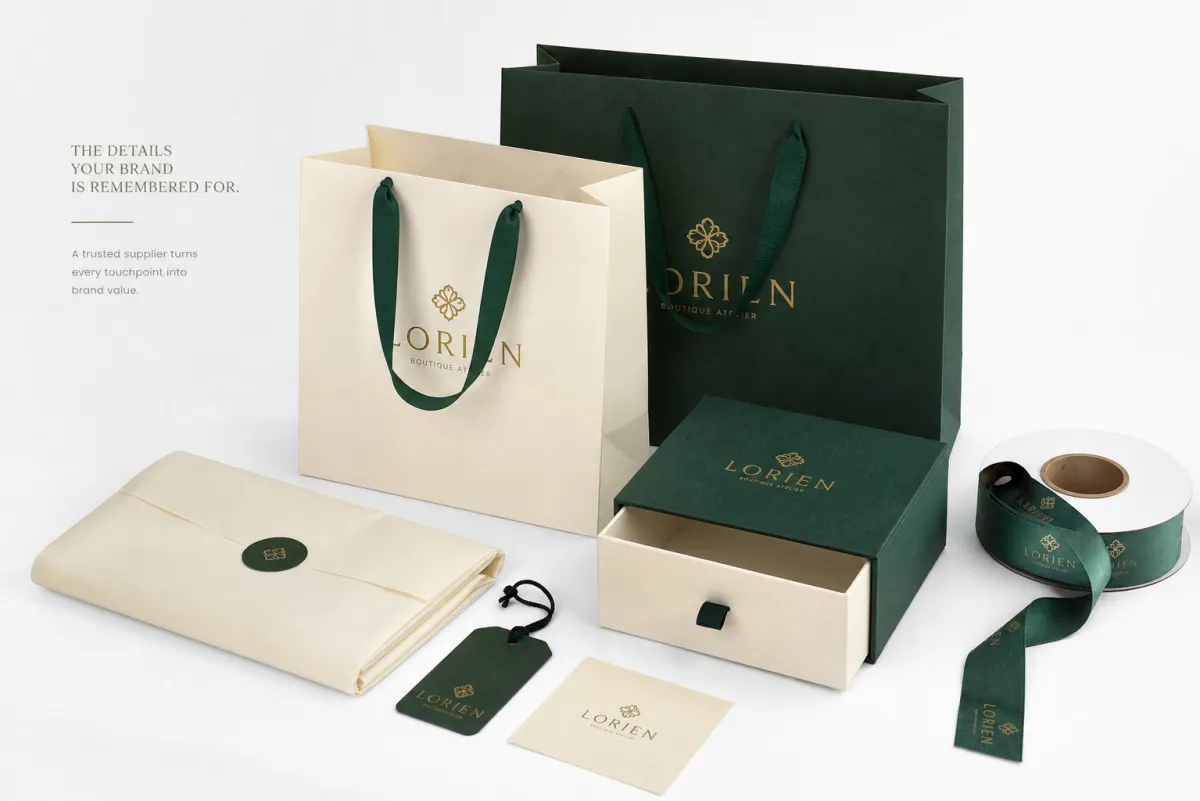
A shopping bag is mobile packaging. It leaves the store, travels into public view, and often gets reused enough times to create more brand impressions than the original sale ever did. That is where a branded shopping bags supplier earns their keep. They influence not only the first handoff at checkout, but the second, third, and fourth moments when other people notice the bag in a customer’s hand, on a desk chair, or hanging from a car seat.
Packaging buyers feel that difference quickly. A heavy bag with clean edges and sturdy handles sends a message of care. A bag that buckles, scuffs, or arrives with inconsistent print coverage sends the opposite signal. The physical choices behind the bag affect perceived value, and for some categories the bag becomes part of the product experience itself. Fashion, premium gifting, specialty food, cosmetics, and event merchandising all rely on that extra layer of presentation. A branded shopping bags supplier who understands that role will ask better questions before the order is even approved.
Here is the kind of mismatch that causes problems: one project uses 157gsm art paper with matte lamination, reinforced edges, and cotton rope handles. Another uses light kraft with a pasted handle and no finishing. On paper, the two jobs may look similar enough. In the hand, they are not even close. The first feels deliberate. The second feels temporary. A good branded shopping bags supplier helps buyers avoid that gap between the brand promise and the physical result.
The supplier’s work usually covers five areas:
- Material sourcing: paper grade, recycled content, fabric choice, coatings, and handle stock.
- Print setup: color separation, plate or screen preparation, foil stamping, embossing, and digital output.
- Structural design: dimensions, gusset depth, base reinforcement, and load performance.
- Quality control: alignment, glue strength, handle attachment, and finish consistency.
- Delivery coordination: packing, palletizing, freight booking, and arrival timing.
That is why price alone never tells the whole story. A low quote can hide weak stock, unclear tolerances, or a production line that treats artwork as a generic file instead of a brand asset. A reliable branded shopping bags supplier balances appearance, strength, budget, and timing in a way that keeps the buyer out of trouble.
Teams comparing packaging options often get better answers by looking at finished work rather than polished sales language. Our Case Studies page is useful for reviewing how similar packaging choices perform in real programs.
How a branded shopping bags supplier production process works
Most buyers want a short path from concept to delivery. The path is usually longer than the first estimate, yet it becomes manageable once the steps are clear. A dependable branded shopping bags supplier usually moves through inquiry, spec review, artwork checks, proof approval, sampling, production, inspection, and shipment. Leave out one of those stages and the project usually pays for it later.
Strong quotes start with clean inputs. Bag dimensions matter because they shape the structure, the fit, and the logo placement. Artwork quality matters because a low-resolution file can blur edges or distort color. Quantity matters because 500 bags and 5,000 bags carry very different setup costs. A branded shopping bags supplier cannot give a sound price without those basics.
Sampling is where careful buyers protect the budget. A sample shows handle feel, fold accuracy, print clarity, and how the coating behaves under light. Foil stamping, embossing, and specialty varnish deserve extra attention because they can look very different on a monitor than they do under store lighting. I have seen projects where the logo looked perfect in PDF form and then sat too close to a fold line on the physical sample, which made the whole design feel cramped. One sample would have caught that immediately.
Once production starts, the work usually moves through these checkpoints:
- Material cutting: paper sheets or fabric rolls are cut to size, with tolerance checks on the first run.
- Printing: offset, flexographic, screen, or digital methods are selected based on substrate and volume.
- Finishing: lamination, aqueous coating, matte varnish, soft-touch film, foil, or embossing may be added.
- Bag forming: side gussets, folded tops, bases, and seams are assembled.
- Handle attachment: twisted paper, cotton rope, ribbon, die-cut, or woven handles are fitted.
- Final packing: counts are checked, bundles are packed, and cartons are labeled for shipping.
Every step has a common failure point. Late artwork changes can throw off print plates. A finish described only as “premium” can turn into a cost dispute if no one specified gloss, matte, or soft-touch. Handle assumptions drift when the buyer imagines thicker rope than the supplier actually stocks. The cleanest way to keep a branded shopping bags supplier on course is to treat the brief like a production document, not a rough idea.
For bags that need to hold up in transit or under repeated retail use, testing language helps too. Packaging professionals often refer to ISTA methods for distribution testing. Shopping bags do not always need formal lab work, yet the framework is useful when evaluating drop resistance, compression, and handling stress.
“The easiest project to ship is usually the one with the clearest file set. The slow projects are rarely slow because the factory lacks skill. They are slow because the brief leaves too much open.”
Key factors that separate a strong supplier from a risky one
Material choice is the first filter. A branded shopping bags supplier should be able to explain the practical differences between kraft paper, coated paper, recycled paper, non-woven polypropylene, cotton, and woven reusable formats. Kraft works well for a natural look and usually keeps costs in check. Coated paper supports sharper graphics and richer color. Cotton and woven bags cost more, but they can keep a logo visible for months instead of days. Recycled paper helps brands tell a clearer sustainability story, though the stiffness and finish vary depending on the fiber mix and the source material.
Printing capability matters just as much. A one-color logo on kraft is a simple job. A full-color layout with foil and embossing asks much more from the supplier. The better suppliers explain which print method suits the artwork instead of pushing one process onto every job. Fine lines do not always behave well in screen print. Photographic detail needs closer color management and a clearer conversation about substrate limitations. A solid branded shopping bags supplier will raise those points before the first proof goes out.
Construction details tell you more than a clean mockup does. Handle type, seam quality, base reinforcement, and board inserts shape the way the bag actually performs. A bag can look polished and still fail if the handle bond is weak or the bottom splits under normal weight. I usually tell buyers to think in terms of load first and appearance second. A premium bag that cannot carry a boxed candle safely is not doing its job. A capable branded shopping bags supplier should be able to discuss weight capacity in concrete terms, not broad promises.
Consistency is another dividing line. Strong suppliers have repeatable quality checks, clear approval records, and a way to keep color, size, and finish aligned from one run to the next. The weaker ones rely on reassurance. They say the order will be fine, but they cannot show a traceable approval trail. That is where packaging teams get caught, especially on reorders when the first batch looked excellent and the second batch arrives with slight drift.
Business understanding matters too. Does the supplier know the difference between retail packaging, trade show handouts, promotional mailers, gift packaging, and restaurant carryout? Those uses are not interchangeable. A retail bag may need a stronger base and a more refined print. An event bag may need to be lighter and faster to produce. A branded shopping bags supplier who understands the use case will ask better questions from the start.
For sustainability-driven buying, documentation is part of the quality check. If a supplier claims recycled content or responsible forestry sourcing, ask for proof. For paper products, FSC chain-of-custody documentation can help, and standards-backed claims hold up better than marketing language on its own. Learn more from the FSC about responsible forest management and certification pathways. A good supplier will expect that request.
A simple comparison helps narrow the field quickly:
| Bag type | Typical MOQ | Indicative unit cost | Best fit | Main trade-off |
|---|---|---|---|---|
| Kraft paper with twisted handles | 1,000-3,000 | $0.18-$0.32 | Retail, gifts, food service | Lower premium feel |
| Coated paper with laminate | 1,000-5,000 | $0.28-$0.65 | Fashion, cosmetics, luxury gifting | Higher finish cost |
| Recycled paper bag | 2,000-5,000 | $0.22-$0.48 | Sustainability-led brands | Color and texture variability |
| Non-woven reusable bag | 500-3,000 | $0.30-$0.90 | Events, promotions, repeat use | Less premium than paper |
| Cotton or woven reusable bag | 300-2,000 | $0.75-$2.50 | Higher-end brand merch | More expensive to ship |
This table gives direction, not a quote. Quantity, print coverage, handle upgrades, and shipping lane can move the final number in a noticeable way. A dependable branded shopping bags supplier will explain those shifts before you approve the order, which is much better than discovering them after the paperwork is locked.
Branded shopping bags supplier pricing, MOQ, and quote drivers
Pricing becomes confusing when buyers compare numbers that do not describe the same spec. A quote from a branded shopping bags supplier should always be read against the same variables: size, material, print colors, finishing, handle type, quantity, proofing method, and delivery destination. Change one of those, and the quote stops being a fair comparison.
The biggest pricing drivers are usually easy to spot. Larger bags use more material. Heavier paper costs more. More print colors add setup and production complexity. Special finishes such as foil stamping, embossing, soft-touch lamination, or UV coating add time and cost. Handles can move the number too. A die-cut handle is simpler than a cotton rope handle, and a stitched woven handle usually costs more than a pasted paper loop. A careful branded shopping bags supplier will itemize those differences rather than burying them in one total.
MOQ, or minimum order quantity, is not just a factory rule. It marks the point where setup costs begin to make sense across the run. If a supplier has to create plates, set up the print line, and calibrate a finish for a small order, the unit price rises quickly. That is why a 500-piece job can look expensive next to a 5,000-piece run. The same setup spread over more units almost always improves the price per bag.
The landed cost matters more than the factory quote. Freight, duties, packing, and storage can shift the real project budget far beyond the first spreadsheet. If you are importing bags, a lower unit cost does not guarantee a better result. I have seen buyers save money at the factory and lose it later in air freight, rush customs clearance, or re-packing charges. A solid branded shopping bags supplier should be willing to discuss landed cost, not only ex-works pricing.
A useful rule applies whenever quotes differ sharply: do not assume the higher number is inflated or the lower one is a bargain. First, check whether the specs are identical. Then confirm that the cheap quote includes the same finish, the same handle stock, the same print coverage, and the same shipping term. After that, ask whether spoilage, overages, and inspection are included. Cheap numbers often leave those pieces out until later.
“A good quote still has to survive a second read. If the spec sheet is thinner than the price gap, the comparison is probably off.”
Buyers often ask for speed, volume, and low cost at the same time. That can be done, but not for every format. A branded shopping bags supplier may move quickly on a standard kraft bag with limited print coverage. The same supplier may need more time for a laminated fashion bag with custom foil and hand-assembled handles. The price should reflect that complexity honestly.
To make quotes comparable, send every supplier the same information:
- Finished dimensions, including width, gusset, and height
- Material preference and target thickness or GSM
- Logo files in editable or high-resolution format
- Number of print colors and any finish requirements
- Handle type, reinforcement needs, and load expectations
- Quantity, delivery address, and required arrival date
That list prevents most quote disputes. It also lets a branded shopping bags supplier tell you early if the request is realistic. An honest supplier tends to be more useful than an agreeable one.
Process, timeline, and turnaround: from artwork to delivery
Lead time depends on two things: how ready the file set is and how complex the bag build is. A straightforward project with approved artwork, standard materials, and a simple print layout may move from brief to delivery in roughly 12-20 business days, plus freight. Add custom structural features, specific brand color matching, or multiple sample rounds, and the schedule can stretch. A practical branded shopping bags supplier will give you a range instead of a polished promise that leaves no room for production reality.
The fastest way to shorten the timeline is to arrive with final artwork and a finished specification sheet. If your logo is in vector format, the bag size is fixed, and the finish is chosen, the supplier can move straight into proofing. If the artwork still needs redesign, the bag dimensions are undecided, or the team is comparing three handle styles, the schedule slows down. That is normal. A good branded shopping bags supplier will work to prevent waste, not just fill a production slot.
Production time and transit time are different numbers, and buyers need both. A factory may quote 10 business days, which sounds quick, but ocean freight or customs processing can add another two to six weeks depending on the route. Air freight moves faster and costs much more. If a launch date matters, the total timeline is what matters, not the factory-only estimate.
Rush orders tend to fail for the same predictable reasons. Files arrive incomplete. The buyer changes the bag size after proof approval. The finish gets upgraded after sampling. A compliance requirement appears late, and suddenly the order needs new labeling or carton marks. None of that is mysterious. Each issue can be avoided if the branded shopping bags supplier and the buyer work from the same schedule with clear decision dates.
For seasonal launches, pop-up stores, trade fairs, or gift-with-purchase campaigns, extra approval time is worth building in. That buffer often separates a smooth launch from a warehouse full of bags that arrive after the campaign has already ended. If the project ties to a public event, ask for a production calendar rather than only a ship date.
A practical way to read the schedule is this:
- Brief and quote: 1-3 business days if the specs are clear.
- Proof and approval: 1-5 business days, longer when internal sign-off moves slowly.
- Sampling: a few days for simple items, longer for custom finishes.
- Production: often 7-20 business days depending on complexity and volume.
- Shipping: several days by air, longer by sea or ground freight.
If a branded shopping bags supplier cannot explain where the time goes, that is a warning sign. Clear scheduling is part of basic process maturity.
Common mistakes when choosing a supplier
The biggest mistake is choosing on price alone. Cheap bags can look fine in a spreadsheet and weak in the hand. Thin stock, poor adhesion, off-color ink, and loose handles quickly change the customer’s impression of the brand. If the bag tears on the way to the car, the savings were imaginary. A strong branded shopping bags supplier should help you compare value, not only unit cost.
Vague specifications cause a different set of problems. “Make it premium” is not a production brief. The supplier needs a size, material, finish, handle type, and quantity. Without those details, the quote comparison gets noisy and the sample stage becomes harder to judge. Vague specs also trigger a chain reaction: the supplier guesses, the proof comes back wrong, the sample gets revised, and the schedule slips.
Logistics gets ignored more often than it should. Imported bags can look inexpensive until freight, duties, warehousing, and delivery are added. A project that seemed well priced can become expensive if cartons are bulky or the deadline forces premium shipping. A seasoned branded shopping bags supplier will raise those issues early, especially for larger orders or repeat campaigns that depend on predictable stock timing.
Skipping samples or proof checks is risky even for experienced buyers. Small design shifts become obvious only after production begins. A logo may sit too close to a fold. A pattern may repeat awkwardly across the gusset. A color may look richer in a proof than on the actual substrate. Once the order is moving, fixing those issues is rarely cheap.
There is also a branding mistake that gets missed too often: choosing a bag style that does not fit the customer journey. A luxury brand using a flimsy disposable-looking bag sends a mixed message. A practical utility brand using an overly ornate bag can feel off too. The best branded shopping bags supplier does more than reproduce artwork. They help align the bag with how the customer will carry it, reuse it, and remember the purchase.
For teams that want proof before they scale, our packaging case studies are a useful way to compare how different material and finish choices affect the final result.
Expert tips: shortlist your branded shopping bags supplier
Start with three suppliers, not twelve. Send each one the same brief and compare more than the price. Watch how quickly they respond, how clearly they quote, what questions they ask, and whether they flag risks instead of hiding them. A strong branded shopping bags supplier is usually obvious in the first two email exchanges.
Ask for a sample or a prior production photo before you commit. If you can, review it under the same lighting your customers will see in-store. That helps you judge color, sheen, and legibility more accurately. Fluorescent retail lighting can make a matte finish look softer and a gloss finish look brighter than expected. A practical branded shopping bags supplier should be comfortable talking through those visual differences.
I like a simple decision matrix for this kind of work. Give quality, price, lead time, and communication each a score out of ten, then weight them according to the project. For a luxury refresh, quality may matter most. For a store opening with a fixed date, timing may carry more weight. That keeps the decision grounded. It stops the team from being swayed by one beautiful sample that cannot be delivered on time.
Another useful habit is asking for proof of repeatability. Can the supplier show a reorder from the same spec? Do they keep approved artwork on file? Can they explain how they control color across batches? Those questions matter because a one-off sample is easy. A consistent second run is where a branded shopping bags supplier proves real competence.
For buyers in sustainability-sensitive categories, ask for documentation early: recycled content claims, FSC certification if applicable, and any local compliance paperwork the shipment may need. It is better to ask before order placement than to discover missing documents during customs review. Standards protect both the brand and the budget.
Here is the short list I would use before signing off:
- Confirm dimensions, material, and handle style.
- Approve artwork with a color reference and dieline.
- Request a sample, photo proof, or both.
- Compare landed cost, not just factory price.
- Build in a buffer for approval and shipping.
If you handle those five steps well, the odds improve sharply. The branded shopping bags supplier becomes a packaging partner rather than a source of surprises.
The best results usually come from disciplined buying, not heroic recovery. Finalize the spec, check the proof, verify the sample, and only then lock the order. A branded shopping bags supplier that welcomes that process is usually the right one. The bag should work hard for the brand, and the supplier should make that work look ordinary.
One final practical takeaway: choose the bag structure first, then the decoration, then the freight plan. That order keeps the project honest and saves a lot of backtracking later.
How do I compare branded shopping bags suppliers?
Use the same specs for every quote so price, materials, print method, and lead time are truly comparable. Ask for samples or production photos to verify bag strength, color accuracy, and finish quality. Check communication speed and revision handling, because slow replies often predict slower production from a branded shopping bags supplier.
What affects branded shopping bags supplier pricing the most?
Material grade, bag size, print colors, finishing, and handle style are the biggest cost drivers. MOQ changes unit cost because setup expenses are spread across the order quantity. Freight, duties, and storage can make a low factory quote more expensive than it first appears, so a branded shopping bags supplier should help you look at landed cost.
How long does a branded shopping bags supplier need for custom orders?
Timing usually depends on artwork readiness, sample approvals, production capacity, and shipping method. Simple orders move faster than complex jobs with special finishes, multiple colors, or structural changes. Always separate production time from transit time so your launch date reflects the full timeline a branded shopping bags supplier needs.
What should I send before requesting a quote from a branded shopping bags supplier?
Send bag dimensions, material preference, quantity, logo files, and target delivery date. Include print color count, handle type, and any finish requirements to avoid quote surprises. If possible, share a reference bag or photo so the branded shopping bags supplier understands the look you want.
Should I choose paper or reusable bags from a branded shopping bags supplier?
Choose Paper Bags for Retail, gifts, and shorter use cycles where presentation matters most. Choose reusable bags when durability, repeated exposure, and long-term brand visibility matter more. Match the bag type to customer behavior, budget, and sustainability goals instead of defaulting to the cheapest option from a branded shopping bags supplier.

