Buyer Fit Snapshot
| Best fit | Eco-friendly Pillow Boxes Custom Printed projects where brand print, material claims, artwork control, MOQ, and repeat-order consistency need to be specified before quoting. |
|---|---|
| Quote inputs | Share finished size, material target, print colors, finish, packing count, annual reorder estimate, ship-to region, and any compliance wording. |
| Proofing check | Approve dieline scale, logo placement, barcode or warning zones, color tolerance, closure strength, and carton packing before bulk production. |
| Main risk | Vague material claims, crowded artwork, missing packing details, or unclear freight terms can make a low unit price expensive after revisions. |
Fast answer: Eco-friendly Pillow Boxes Custom Printed: Material, Print, Proofing, and Reorder Risk should be specified like a repeatable production item. The safest quote records material, print method, finish, artwork proof, packing count, and reorder notes in one written spec.
Production checks before approval
Compare the actual filled-product size with the drawing, then confirm tolerance on folds, seals, hang holes, label areas, and retail display edges. Reserve space for logos, QR codes, warning copy, and material claims before decorative graphics fill the panel.
Quote comparison points
Review material grade, print process, finish, sampling route, tooling charges, carton quantity, and freight assumptions side by side. A quote is only useful when the supplier can repeat the same color, closure quality, and packing count on the next order.
Eco-friendly pillow boxes custom printed are one of those packaging formats that look simple on the surface and then get surprisingly technical once a buyer starts pricing them, specing them, and trying to get them through production without a headache. The shape is straightforward. The decisions behind it are not. Board thickness, print coverage, score quality, finish choice, and freight all pull on the final result, and the cheapest-looking box is often cheap for the wrong reason.
The real value of eco-friendly pillow boxes custom printed shows up when the structure, artwork, and material all support the product instead of fighting it. A well-built pillow box can feel polished without becoming wasteful. It can present a small item with enough care to make the customer pause, open it more slowly, and remember the brand after the packaging is gone. That is a small thing on paper and a meaningful thing in the hand.
For jewelry, apparel, accessories, gift cards, sample kits, and subscription add-ons, this format earns attention for practical reasons. It stores flat, packs fast, and takes up very little shelf space. The curved shape gives the box a softer feel than a standard tuck carton, while the print area still carries enough branding to matter. That balance is what makes the format useful. It does a lot without demanding much room, which is kinda the whole appeal.
Here is how eco-friendly pillow boxes custom printed are made, which materials tend to work best, what Drives the Price, and how to write a brief that keeps revisions to a minimum. The tradeoffs matter here, and sustainable packaging only pays off when the spec is grounded in real production limits instead of wishful thinking.
Eco-Friendly Pillow Boxes Custom Printed: What They Are and Why They Sell
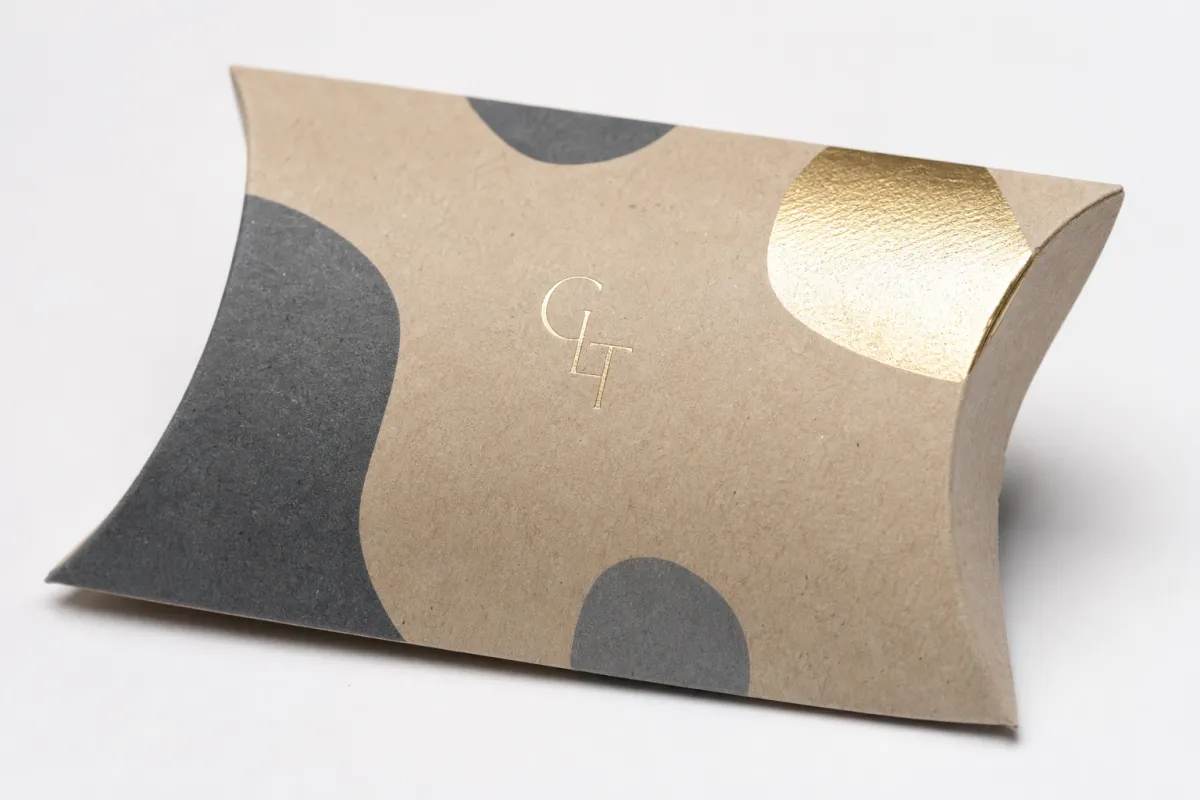
Eco-friendly pillow boxes custom printed are curved, self-closing cartons with a pillow-like profile. Most open at the side edges and are used for small to medium products that need a tidy presentation without the bulk of a rigid set-up box. Jewelry, socks, cosmetics samples, accessory kits, thank-you gifts, and small retail bundles all fit the format well. The profile feels pleasant in the hand and photographs cleanly on a shelf or in an unboxing clip.
The appeal is easy to understand once you handle a good sample. A pillow box gives a brand more presence than a plain mailer and more personality than a kraft envelope or a basic poly bag. A small product suddenly has a stronger first touchpoint. That matters for package branding because the box becomes part of the product experience, not just a container. Plain packaging can be useful too, but it rarely adds the same sense of care.
Eco-friendly does not have to mean rough, dull, or fragile. That assumption hangs around because people often picture recycled packaging as a compromise. In practice, eco-friendly pillow boxes custom printed can be made from recycled kraft paperboard, FSC-certified board, uncoated paper stocks, and other responsibly sourced substrates. Soy or vegetable inks, water-based coatings, and efficient sizing all help reduce waste. They also make the packaging easier to justify when operations or procurement are reviewing the numbers.
Structure still matters. Thin board can flatten under pressure, wrinkle at the scores, or arrive looking tired before the customer opens it. A box with a nice sustainability story but weak folding behavior is still a bad box. Good eco-friendly pillow boxes custom printed need accurate die-cuts, reliable scores, and enough crush resistance to survive a packing table, a freight carton, and a customer who opens things without much ceremony.
I have seen plenty of brands get stuck on the sustainability label and forget the hand feel. A recycled board that looks honest on screen can still feel flimsy if the caliper is too light or the score depth is inconsistent. The box has to behave like a package first and a message second.
There is a branding upside too. Pillow boxes are compact, so the front and back surfaces get read quickly. That makes them useful for retail packaging where the product needs to communicate clearly from a short distance. The shape suggests care without requiring heavy board or expensive structural extras. For brands that want better presentation without overbuilding every carton, that is a useful middle ground.
A pillow box can read premium or careless in a split second. The difference usually lives in the board, the print setup, and whether the size was chosen by someone who actually measured the product.
If you are building a packaging lineup, this format sits neatly beside other Custom Packaging Products without forcing every item into the same visual language. That matters for brands with several product families, since a coordinated packaging design system makes the whole line feel deliberate rather than stitched together from separate decisions.
How Eco-Friendly Pillow Boxes Custom Printed Work
Eco-friendly pillow boxes custom printed follow a familiar production path, but each step affects the final result in a visible way. The process starts with product dimensions, then moves into dieline selection, artwork setup, proofing, printing, cutting, scoring, folding, and shipping. Rushing any of those stages tends to show up later in the finished box. Packaging has a habit of revealing shortcuts after the invoice is already paid.
The dieline is the flat template that shows cut lines, folds, glue areas, and the real geometry of the package. If that template is off by even a small amount, the box may bow in the middle, open badly, or crush at the edges. A careful proof catches those issues before the press run begins. A careless proof creates a stack of cartons that look printable but behave badly once somebody tries to use them.
Print method changes the economics too. Digital printing usually suits shorter runs because setup is lighter and artwork changes are easier to manage. Offset printing tends to work better at larger quantities because the per-unit cost drops once the press is running. Artwork coverage, board type, and the supplier’s equipment all influence the answer, so there is no single rule that fits every order. Even so, small runs often favor digital and larger runs often favor offset.
Construction choices affect both performance and shipping. A flat-packed box reduces freight volume and warehouse space. A pre-assembled box saves labor during packing but raises storage and transport costs. Glued seams can speed up assembly, though they need dependable bonding. Fold-only structures can reduce materials and simplify recycling, but they need careful engineering so the closure tabs hold under use. None of that is glamorous. It is simply the practical side of good packaging.
With eco-friendly pillow boxes custom printed, the sustainability tradeoff often appears in color behavior. Recycled kraft has a different visual character than bright white board. Uncoated stock absorbs ink differently. Brand colors can shift a little, especially on earthy substrates. Deep blues may soften, reds may mute, and fine details can lose contrast if the artwork is too delicate. The fix is straightforward: design for the stock instead of expecting the stock to act like a coated sheet.
Buyers usually notice four things first: print contrast, paper texture, fold quality, and whether the package feels intentional. That final point is hard to fake. Tight sizing, clean curves, and accurate alignment give the box credibility. Weak folds, sloppy registration, and overextended artwork do the opposite, no matter how many sustainability claims are printed on the flap.
For brands comparing options, it helps to treat eco-friendly pillow boxes custom printed as part of a larger branded packaging system rather than a one-off purchase. The box should fit the product, the shipping method, and the shelf display. A format that only works in one context usually means the design looked good in a mockup and failed in operations. I have watched that mistake happen more than once, and it always costs more to fix later.
Materials, Coatings, and Print Choices That Change the Result
The material choice drives a large share of the outcome for eco-friendly pillow boxes custom printed. Recycled kraft is a natural starting point because it signals lower waste, looks honest, and usually feels appropriate for sustainable branding. FSC-certified paperboard is another strong option when responsible sourcing and broader print flexibility both matter. Premium uncoated sheets bring a softer, quieter texture that suits brands aiming for restraint rather than loud retail packaging. Heavier boards work better when the product has weight or the display needs a firmer hand feel.
Uncoated stock often fits earthy brands, minimal graphics, and product packaging that should feel tactile rather than glossy. It lets the material stay visible. That is part of the appeal. The drawback is that uncoated surfaces scuff more easily and do not always reproduce deep, saturated color with the same control as coated board. If the artwork depends on razor-sharp gradients or dense solids, the sample needs to prove that the image survives the stock. Guessing is expensive.
A light coating can help when the box needs extra rub resistance or a slightly more controlled finish. Water-based coatings and aqueous finishes are practical because they add protection without pushing the surface into plastic territory. A matte coating can reduce glare and help the box read more calmly under retail lighting. The downside is that a coating changes recyclability, surface feel, and sometimes the whole visual tone that made the eco-friendly look appealing in the first place. The real question is not whether to coat. The real question is what problem the coating is meant to solve.
Heavy metallics, glossy laminations, and dramatic spot treatments can still work on eco-friendly pillow boxes custom printed, but they need to be chosen carefully. Strict sustainability goals can clash with too much finishing, and the package can start sending mixed messages. A little restraint usually looks better anyway. A natural board with strong typography, one ink color, or a single accent effect often feels more premium than a box trying to prove itself with every trick available.
Size is another material decision hiding in plain sight. The smallest box that safely fits the product and any insert is usually the right answer. Oversized packaging wastes board, raises freight volume, and looks slack if the product rattles inside. Too small, and corners crush or closures fight the fold. Plenty of brands lose money simply because nobody measured the product with the insert included. That is not a creative problem. That is a measurement problem.
Here is a practical comparison of common setups for eco-friendly pillow boxes custom printed:
| Option | Best For | Typical Strength | Eco Fit | Tradeoff |
|---|---|---|---|---|
| Recycled kraft board | Natural brands, gift items, simple graphics | Good for light to medium products | Strong | Color can print softer and less saturated |
| FSC-certified paperboard | Retail packaging, polished branding, broader print needs | Good to very good depending on caliper | Strong | Often costs more than plain commodity board |
| Uncoated premium sheet | Minimalist branding, cosmetics, artisanal products | Moderate to good | Strong | Lower scuff resistance unless handled carefully |
| Heavier board with light coating | Higher-end presentation, longer shelf life | Very good | Moderate | More material and a less natural feel |
Print expectations need to stay grounded. Eco-friendly packaging does not have to look rough, and it does not need to shout to feel premium. Eco-friendly pillow boxes custom printed can look crisp and refined when the artwork is designed for the stock. Strong typography, moderate ink coverage, and a controlled use of empty space usually outperform overworked graphics. More ink does not automatically create more value. Sometimes it only creates a louder box and a higher bill.
Beauty brands, candles, apparel, corporate gifts, and accessories usually get the strongest balance from this format. The box can support package branding while staying manageable in production. When comparing substrate and finish choices against other Custom Packaging Products, ask for samples on the exact board. A screen mockup is not a material, and it will never behave like one under light, ink, or pressure.
Process and Timeline: From Dieline to Delivery
The production path for eco-friendly pillow boxes custom printed is direct enough, but the schedule only works when approvals move on time. The process starts with the brief. The supplier confirms size, stock, and construction. The next step is dieline and artwork setup. After that comes proof review, change requests if needed, sample approval, production, finishing, packing, and shipping. Every stage can move quickly or crawl, depending on how ready the buyer is.
Timelines depend on quantity, print method, and finish complexity. A simple short run may land in about 8 to 12 business days after proof approval if stock is in hand and the artwork is clean. Larger runs or jobs with more complex finishing often fall into the 12 to 20 business day range. Specialty coating, multiple print passes, and a physical sample approval stage all add time. That is not a warning meant to scare anyone. It is the normal shape of production.
Most delays come from artwork revisions, color changes, and stock issues. A logo sent in low resolution can turn into a fuzzy proof. A box can be approved before the product dimensions are truly locked, and then the insert no longer fits. A sustainability change can arrive after the proof is already built. Late spec changes feel small in the moment and costly later, which is why they cause so much trouble.
Sampling is worth the time for eco-friendly pillow boxes custom printed, especially when the box has tight folds, a distinctive texture, or a finish that could alter the final look. One physical sample can save a full production run from being wrong. That matters even more when the packaging relies on fold behavior. Paperboard remembers how it is scored. A line that is too shallow resists the fold. A line that is too deep makes the box look tired. A sample exposes that before thousands of units are made.
Score depth, grain direction, and glue placement are the three details I watch most closely at this stage. If the grain runs against the fold, the board can fight back and create a subtle but ugly bow. If the adhesive area is too narrow, the seam opens under pressure. Those are small issues that turn into big ones once the cartons are packed and shipped.
Rush service changes the sequence. Artwork needs to be final earlier. In-stock substrates may be the only available choice. Some finishing options disappear. Freight may need a faster method. Speed costs money because the vendor has to compress labor and give up flexibility. There is no hidden shortcut. The schedule only gets shorter when something else gets sacrificed.
Plan backward. That rule saves more packaging projects than almost any other. Start from the launch date, event date, or ship date, then add proof time, sample time, and a buffer for revisions. A smart buyer does not ask only, “How fast can you make it?” The better question is, “How much room do we need so the boxes arrive before the project turns into a scramble?”
For background on sustainability claims and recycling language, the EPA recycling guidance is useful. If responsibly sourced board is part of the spec, the Forest Stewardship Council is the reference many buyers use. If the packaging needs to hold up under shipping stress, the test framework from ISTA is worth knowing. Clear standards make packaging decisions easier because they replace guesswork with something measurable.
Cost, Pricing, MOQ, and Quote Drivers
Pricing for eco-friendly pillow boxes custom printed usually comes down to a predictable set of variables. Size is first. Board type comes next. Print coverage matters a great deal. After that come quantity, coating, special finishes, assembly requirements, and shipping terms. If a quote seems unusually low, something is usually missing. Freight, tooling, samples, repacking, or even the die itself may not be included. That is one of the easiest ways for a tidy-looking budget to fall apart.
MOQ, or minimum order quantity, is the point where setup costs spread across enough pieces to make the unit price sensible. A short run of 500 may cost much more per box than 5,000 because the same setup work gets divided over fewer units. That does not make the short run wrong. It means the short run is paying for flexibility. For a seasonal drop or a test batch, that tradeoff can be exactly right.
The better comparison is total landed cost, not just unit price. Eco-friendly pillow boxes custom printed can look inexpensive per box and still cost more once freight, samples, and assembly are added. A larger order can improve unit cost while increasing inventory risk. A smaller order protects cash flow but can sting on per-piece pricing. The right answer depends on sales speed, storage, and how often the artwork changes.
Clear quote requests help a lot. Send exact dimensions, target quantity, artwork count, preferred substrate, and finish expectations. Say whether the boxes need to ship flat. Say whether they should be pre-glued for faster packing. Mention inserts up front if they are part of the package. A vague brief invites vague pricing, and then everybody acts surprised when the quote does not match the need.
There are easy savings too. Simplify the print sides. Reduce finish complexity. Use a standard size if the product allows it. Keep the artwork efficient. A single strong color on recycled kraft can do more than a crowded full-bleed design that uses more ink and hides the material. Experienced buyers often build from the substrate outward because it keeps the packaging honest and the costs under control.
Here is a realistic pricing pattern for eco-friendly pillow boxes custom printed. These are not fixed quotes. They are the kind of ranges buyers often see once the spec is clear:
| Quantity | Basic Print + Kraft Stock | More Complex Print + Coating | Typical Use |
|---|---|---|---|
| 500 units | $0.70-$1.40 per unit | $1.10-$2.20 per unit | Sampling, launches, seasonal tests |
| 2,000 units | $0.28-$0.65 per unit | $0.45-$0.95 per unit | Small retail runs, events, promos |
| 5,000 units | $0.18-$0.38 per unit | $0.28-$0.60 per unit | Established product lines, repeat ordering |
| 10,000+ units | $0.12-$0.28 per unit | $0.20-$0.42 per unit | High-volume retail packaging |
Those ranges shift with board caliper, print coverage, and assembly. A heavily printed black box on specialty stock behaves very differently from a light one-color kraft box. Cheaper is possible, but only when the spec supports it. That is why eco-friendly pillow boxes custom printed should be quoted like a manufactured product, not a fuzzy branding accessory.
If you are comparing vendors, keep the assumptions identical. Same board. Same dimensions. Same quantity. Same finish. Same shipping term. Anything else turns the comparison into noise. Good buying depends on discipline, and packaging quotes are only useful when they are measured against the same baseline.
Common Mistakes That Make Sustainable Packaging Look Cheap
The most common mistake with eco-friendly pillow boxes custom printed is choosing a sustainable substrate that clashes with the brand palette, then blaming the printer for muddy color. Recycled kraft looks beautiful in the right setting. It can also make pale colors disappear and make dark solids look uneven when the artwork was built as if it were going onto bright coated white board. The stock is not the problem. The mismatch is.
Ordering before the product dimensions are fully locked causes another mess. That sounds basic because it is basic, yet it happens constantly. The product arrives a few millimeters larger than expected, the insert no longer fits, and the box has to be revised. That creates waste, delays, and a presentation issue at the same time. Good buyers measure the product, the insert, and the closure tolerances before the final art is approved.
Too many finishes can work against the box. Foil stamp, laminate, and spot UV can be useful individually, but stacked together they can make the package expensive, harder to explain, and less aligned with the eco-friendly message. Decoration should support the design, not compete with it. A single well-placed detail usually does more for the final impression than a pile of effects fighting for attention.
The inside deserves attention too. A beautiful exterior with a sloppy interior still feels cheap. If folded tabs snag the product, if the item shifts during packing, or if inside printing bleeds awkwardly, the customer notices. The unboxing moment is part of the product experience, not a side issue. For brands using eco-friendly pillow boxes custom printed, the inside should feel as deliberate as the outside, even when the interior is simpler.
Another trap is assuming every supplier means the same thing by “eco-friendly.” They do not. One vendor may mean recycled stock. Another may mean FSC-certified board. Another may simply mean less plastic than usual, which is a very loose standard. Ask for details. What board? What recycled content? What ink system? What coating? The actual spec matters more than the label on the quote.
These are the checks I would insist on before approving eco-friendly pillow boxes custom printed for production:
- Confirm the final product dimensions with any insert included.
- Review a proof with the exact dieline and fold direction.
- Ask for the board type, caliper, and finish in writing.
- Test how quickly the product loads into the box.
- Check whether the package still looks good under retail lighting.
- Verify that the sustainability claim matches the actual material and coating.
Packaging is not magic. It is measurement, material control, print discipline, and restraint. The brands that get eco-friendly pillow boxes custom printed right usually do fewer things, but they do them carefully. That is less dramatic than a glossy concept deck. It also works better once the boxes are on the line.
Expert Tips and Next Steps for a Better Box Brief
If you want better results from eco-friendly pillow boxes custom printed, start with a one-page spec sheet. Keep it tight. Include product dimensions, target quantity, artwork file type, preferred board, sustainability goals, and any finish requirements. Add whether the boxes should ship flat or assembled. Add whether inserts are needed. A supplier can work far faster from a clean brief than from a paragraph that says “make it nice and eco.” That is not a specification. That is a wish.
Order a physical sample or press proof when color accuracy or fold performance matters. That step matters even more for custom printed boxes with dark coverage, fine typography, or natural board that may shift under ink. A sample catches issues a screen will never show. Screens lie by omission. Paper does not.
Choose one hero detail instead of five. Texture, print contrast, or one accent finish is usually enough. A box that tries to do everything begins to compete with itself, and the result tends to feel busy rather than premium. Good packaging design gives the eye one thing to notice and one thing to remember. That is cleaner and, frankly, more convincing.
Compare suppliers on equal terms. Keep the board identical. Keep the size identical. Keep the quantity identical. Keep the shipping terms identical. Then compare the quote lines. If one vendor looks cheaper but uses a lighter stock or leaves freight out of the number, the quote is not cheaper. It is incomplete. Buyers who miss that detail end up paying for the correction later, which is a much worse deal.
If you are building a broader line, eco-friendly pillow boxes custom printed can sit comfortably beside other branded packaging formats. They work well for small gifts, retail add-ons, and presentation pieces where the product should feel considered without adding unnecessary bulk. They are also easy to coordinate with other Custom Packaging Products, which helps a packaging system feel connected instead of random.
Here is the shortest practical path forward: measure the product, pick the stock, request a quote, review the proof, approve a sample, then move to production. That sequence is plain, but it avoids waste. If the timeline is tight, plan backward and leave space for revisions. If the brand needs a more natural look, choose the material first and build the art around it. If the goal is stronger shelf impact, prioritize clarity and contrast over decoration. Eco-friendly pillow boxes custom printed can do all of that, but only when the brief respects the limits of real manufacturing.
The final decision should still feel like a branding choice, not only a procurement one. Packaging shapes how a product is perceived before it is opened. That is why eco-friendly pillow boxes custom printed are worth the effort. Get the structure right, keep the finish honest, and make sure the box earns its place in the customer’s hands.
What materials are best for eco-friendly pillow boxes custom printed?
Recycled kraft and FSC-certified paperboard are the most practical starting points. Uncoated stock gives a more natural look, while a light aqueous coating can help with scuff resistance. The right board strength depends on the product weight, because weak stock makes the whole package feel less premium.
How much do eco-friendly pillow boxes custom printed usually cost?
Cost depends on size, quantity, print coverage, finishes, and whether the box needs special assembly. Short runs usually cost more per unit, while larger orders bring the unit price down because setup is spread across more pieces. Ask for a line-item quote so you can see whether samples, tooling, and freight are included.
What is the usual turnaround for eco-friendly pillow boxes custom printed?
Simple jobs can move quickly, but artwork revisions, sampling, and special finishes add time. The biggest delays usually come from proof approval and material availability, not the printing itself. Plan backward from your launch date and leave a buffer for revisions.
Can I use foil, lamination, or spot UV and still stay eco-friendly?
Sometimes, but it depends on how strict your sustainability goals are and how the box will be recycled. Light water-based coatings usually fit better than heavy plastic laminates. If recyclability is the priority, keep the finish simple and confirm the tradeoff with your supplier.
What do I need to send to get an accurate quote for eco-friendly pillow boxes custom printed?
Send exact product dimensions, quantity, artwork files, preferred stock, and finish expectations. Tell the printer whether the boxes should ship flat, be pre-glued, or include inserts. Mention any sustainability requirements up front so the quote matches the real job.
If you only do one thing before ordering eco-friendly pillow boxes custom printed, make it this: measure the product with the insert, choose the board first, and approve a physical sample before the full run. That one habit catches most of the problems that make sustainable packaging feel expensive or underwhelming, and it gives the final box a much better shot at doing its job the first time.

