Buyer Fit Snapshot
| Best fit | Eco Friendly Return Mailers Order projects where brand print, material claims, artwork control, MOQ, and repeat-order consistency need to be specified before quoting. |
|---|---|
| Quote inputs | Share finished size, material target, print colors, finish, packing count, annual reorder estimate, ship-to region, and any compliance wording. |
| Proofing check | Approve dieline scale, logo placement, barcode or warning zones, color tolerance, closure strength, and carton packing before bulk production. |
| Main risk | Vague material claims, crowded artwork, missing packing details, or unclear freight terms can make a low unit price expensive after revisions. |
Fast answer: Eco Friendly Return Mailers Order: Specs, Price & Lead Times should be specified like a repeatable production item. The safest quote records material, print method, finish, artwork proof, packing count, and reorder notes in one written spec.
Production checks before approval
Compare the actual filled-product size with the drawing, then confirm tolerance on folds, seals, hang holes, label areas, and retail display edges. Reserve space for logos, QR codes, warning copy, and material claims before decorative graphics fill the panel.
Quote comparison points
Review material grade, print process, finish, sampling route, tooling charges, carton quantity, and freight assumptions side by side. A quote is only useful when the supplier can repeat the same color, closure quality, and packing count on the next order.
Eco Friendly Return Mailers Order: Specs, Price & Lead Times
A return package gets judged twice. Once on the way out. Again when the customer has to send it back. If the mailer tears too early, needs a ridiculous amount of tape, or turns the return into a little packaging puzzle, the brand takes the hit. That is why an eco friendly return mailers order is not just a sustainability checkbox. It is an operations decision, a cost decision, and a customer experience decision all rolled into one.
From a buyer’s perspective, the math is pretty straightforward. The right mailer can cut damage claims, keep postage under control, and reduce labor at the return desk. The wrong one creates extra steps everywhere: more tape, more repacking, more confusion, more complaints. A smart eco friendly return mailers order should be judged on seal strength, weight, ease of reopening, and how well it fits the actual return flow. Fancy language does not matter much when a warehouse associate is trying to keep the line moving.
I have watched teams lose weeks because they approved a sample that looked good in a photo but failed once it met the real product. That usually happens when the item is measured in its retail form instead of its return form. Flat in a box is one thing. Folded, zipped, bundled, and half-restuffed is another. This article stays on the practical side so buyers can compare materials, Specs, Pricing, and Lead Times without getting buried in fluff. If you need a broader reference while narrowing the brief, the site’s Custom Packaging Products page and FAQ can help.
Why eco friendly return mailers order matters at the return desk
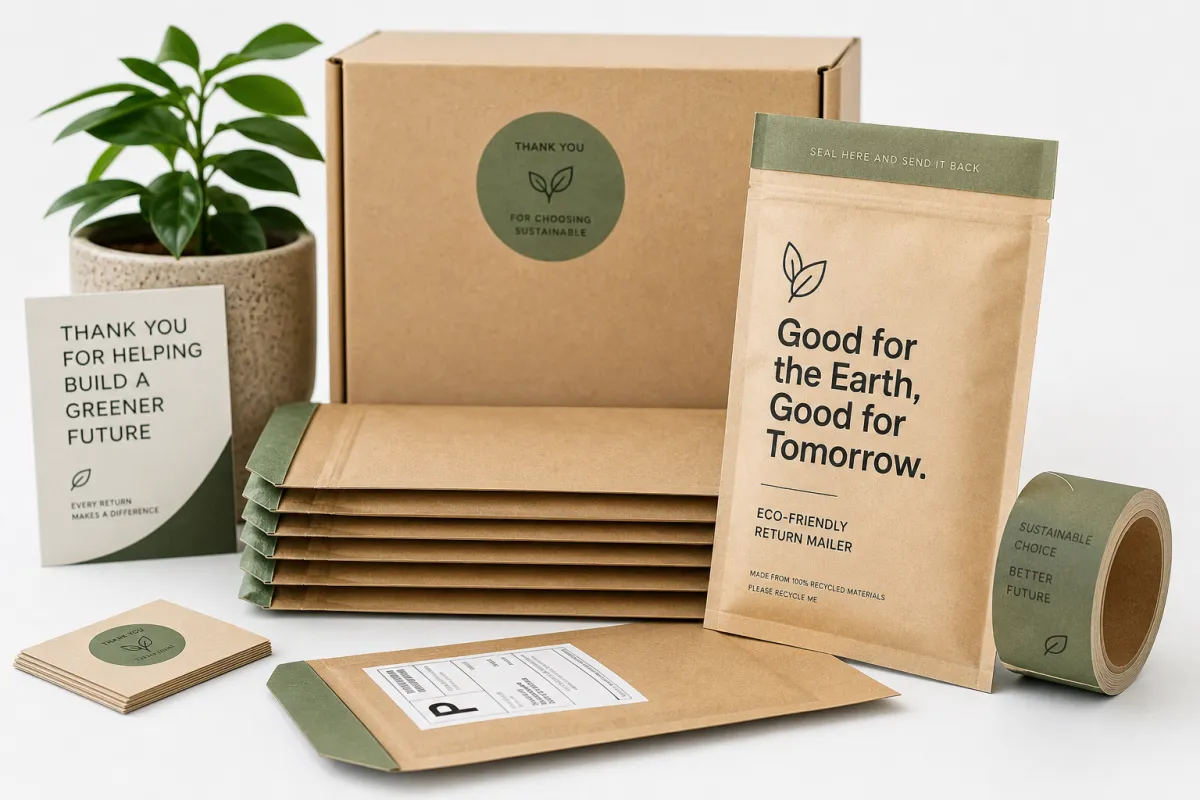
The return desk is where packaging gets a reality check. The customer already has a problem. The last thing they need is a mailer that makes the return harder. An eco friendly return mailers order matters here because the package is not just protecting the shipment on the way out. It also has to survive the trip back without falling apart or turning into a pile of waste that everyone has to deal with later.
That changes what buyers should care about. A mailer that saves a few grams but fails on the second opening does not really save anything. A cleaner closure can eliminate the need for extra tape. A lighter structure can keep postage in a better rate band. If the pack-out team can use one format for both outbound shipping and return handling, training gets easier and errors go down. Nice little win. Not glamorous, but useful.
There is a brand side to this too, and it shows up at the worst possible moment. The customer sees the packaging right when the product did not work out. Not ideal. A well-designed eco friendly return mailers order can make that moment feel organized instead of messy. Small detail, big difference.
From a packaging buyer’s point of view: the cheapest return mailer is not the one with the lowest unit price. It is the one that keeps the return moving without extra tape, extra labor, or extra complaints.
The best way to think about this is as a system, not a single box score. Too flimsy, and the item gets damaged in transit. Too rigid, and freight plus material cost start to balloon. Too easy to open, and the outbound journey suffers. The most useful eco friendly return mailers order balances protection, reuse, and cost control without pretending those tradeoffs do not exist.
For teams building a shortlist, the questions are simple. What is being returned? How many times does the package need to be opened? Does the item have corners, hardware, or mixed components that could puncture the wall? What happens to the mailer after the return? The answers shape the entire eco friendly return mailers order brief.
Documentation matters too. If you are making recycled-content claims, the language should be supportable and backed by records. The EPA’s recycling guidance is a solid reference for general materials thinking, while paper sourcing claims are often easier to defend when they line up with FSC certification standards. Buyers who ask for documentation early usually save themselves from rework later. A rare victory, but a welcome one.
Eco friendly return mailers order options: materials and formats
An eco friendly return mailers order usually starts with one of three structures: Recycled Paper Mailers, compostable film mailers, or recyclable mono-material options. Each one solves a different problem. None of them is magic. The right answer depends on the product, the return path, and the claims the brand is willing to stand behind without crossing its fingers.
Paper-based mailers
Recycled paper mailers are often the easiest place to start. They usually offer a clean brand surface, good print visibility, and a straightforward recycling story when the build stays mostly paper. In many programs, buyers look for 100-130 gsm kraft or similar weights, sometimes with a water-based adhesive and a tear strip for controlled opening. For an eco friendly return mailers order, that setup works especially well for apparel, flat accessories, and lightweight subscription items.
Paper has limits, though. Sharp hardware can puncture it. Heavy items can push it beyond its comfort zone. If the return item is damp, oily, or likely to catch on rough edges, paper may be the wrong call. Still, for many retail programs, paper is the easiest material to explain and the least painful to approve through procurement. And, honestly, that matters more than people admit.
Film-based and mono-material formats
Mono-material polyethylene mailers are usually the practical choice when puncture resistance matters more than a paper look. They can be built with recycled content, printed cleanly, and designed for return use with a peel-and-reseal strip or dual-adhesive closure. For an eco friendly return mailers order, this format often makes sense for apparel with zippers, cosmetics with rigid caps, and mixed kits that shift around during transit.
Compostable films are a separate conversation. They can work in the right system, but the claim only matters if the material, inks, coatings, and disposal route are all aligned. Buyers should ask for a clear certification path, such as ASTM D6400 or EN 13432 where relevant, rather than assuming “compostable” means everyone accepts it everywhere. Packaging claims love to sound clean. Real waste streams are less cooperative. That is one reason an eco friendly return mailers order needs documentation, not just a marketing line.
For brands that want a more controlled plastic story, mono-material PE is often the easier route to explain and the easier route to recycle in the right collection environment. The tradeoff is that the buyer has to watch labels, inks, and any barrier layers that make recovery messier. A good supplier should say where those limits are before production starts, not after the truck leaves.
Closure systems that affect the return experience
The closure system matters as much as the substrate. A self-seal strip is fine for outbound shipping, but a return mailer usually needs a second-use feature. That might be a peel-and-reseal flap, a dual-adhesive strip, or a tear strip that creates a clean opening for the return journey. In a serious eco friendly return mailers order, the closure choice should match the item’s weight and the customer’s likely behavior, not just the artwork.
- Self-seal only: lowest complexity, good for simple outbound use, weaker for return reuse.
- Peel-and-reseal: common for apparel returns, balances convenience and control.
- Tear strip + reseal: useful when the package needs to open cleanly without shredding the face.
- Dual-adhesive return strip: helpful when the same mailer must handle outbound and inbound trips.
Print decisions matter too. One-color branding can be enough if the design already carries the message. Full coverage looks bold, but heavy ink coverage may complicate end-of-life claims on some substrates. For an eco friendly return mailers order, the better move is to decide how much branding is actually needed, then design around the return label, barcode area, and any automated scan zones.
Procurement teams should define “eco friendly” in operational terms. That usually means recycled content, certified sourcing where relevant, clear end-of-life guidance, and proof that the claim can be supported with documents. A supplier who can explain the structure clearly is usually easier to work with on repeat orders. That matters in an eco friendly return mailers order because the same structure may need to serve multiple programs across a season, and nobody wants to rehash the basics every quarter.
Specifications buyers should check before they place an order
The fastest way to get an eco friendly return mailers order wrong is to approve a nice-looking sample without checking the actual size and performance data. A return mailer has to fit the product in its return configuration, not just in its pristine outbound form. That means the buyer needs to measure the item folded, bundled, or reboxed the way customers will actually send it back. Guessing is not a strategy. It is a future headache.
Start with internal dimensions. Then confirm gusset depth, usable width, and the amount of room needed for any folded garment, instruction insert, or return form. A mailer that is technically large enough on paper can still fail if the opening is too narrow or the seam steals too much usable space. In an eco friendly return mailers order, this is where a few millimeters can save an entire production rerun.
After dimensions, check performance. Thickness matters, but so do puncture resistance, seal integrity, and how the mailer behaves under compression. Sorting systems and mixed parcel networks can be rough. If your item has corners, clasps, or hard edges, the structure needs enough strength to survive transit without splitting. A good supplier should be able to talk through performance in practical terms, not just material names. If the order must meet specific transit standards, ask how it lines up with ISTA-style drop and handling expectations before you approve volume.
Operational details deserve the same attention. Does the mailer stack flat? Will it feed cleanly into the packing line? Does it add noticeable weight to the outbound parcel? Can it be bundled efficiently, or does it puff up and eat storage space? An eco friendly return mailers order that looks efficient in a catalog but jams a fulfillment line is not efficient at all. It is just a prettier problem.
Documentation should be part of the spec, not an afterthought. Ask for recycled content percentages, certification details, test information, and any limits on print coverage or coatings. If the supplier says a paper structure is FSC-certified, ask for the right paperwork. If the claim depends on recycled fiber, ask how it is measured and what level of post-consumer or post-industrial content is included. A buyer should be able to defend the order internally without hunting through five folders and three email chains.
- Finished size: confirm usable internal space, not just outer dimensions.
- Wall or film thickness: check the actual spec, especially for mixed-content returns.
- Seal performance: look for strong adhesive and clean reseal behavior.
- Print zones: reserve space for return labels, barcodes, and scan windows.
- Documentation: collect recycled-content data, certifications, and test notes.
For any eco friendly return mailers order, I also recommend asking one blunt question: “What can go wrong in actual use?” That question tends to expose weak points fast. Maybe the flap is too short. Maybe the label sits right on top of the reseal strip. Maybe the paper stock is fine but the adhesive softens in warm freight. Buyers who ask that question early usually end up with a cleaner spec and fewer surprises. That is kinda the whole trick.
Pricing and MOQ for eco friendly return mailers orders
Price on an eco friendly return mailers order is usually driven by five variables: material type, size, print coverage, closure complexity, and volume. Stock items are cheaper to start with because the tooling and inventory already exist. Fully custom formats cost more because they carry setup, conversion, and sometimes artwork prep. That is not a flaw in the market. It is just how packaging economics work.
MOQ is the next decision point. Stock recycled paper mailers may have a lower entry threshold, sometimes in the 500 to 2,500 piece range depending on size and print needs. A custom eco friendly return mailers order often starts higher, commonly around 5,000 to 10,000 units, especially if there is special converting, a unique adhesive layout, or a print spec that needs dedicated setup. When quantity is uncertain, buyers should ask whether a semi-custom run is possible before jumping straight into a large commitment.
Volume breaks can be meaningful. In many cases, moving from a small production run to a larger one lowers unit cost enough to change the project math. That does not mean the biggest order is automatically the smartest one. Inventory carrying cost matters, and old packaging ties up cash. The best eco friendly return mailers order is the one that balances unit price against storage, usage rate, and forecast confidence.
Do not compare unit price alone. Setup fees, sample charges, freight, and special handling can change landed cost more than people expect. A quote that looks attractive on paper may be more expensive once the pallet actually lands at the warehouse. Teams should compare the total order, not just the per-unit number. That is especially true for a recurring eco friendly return mailers order, where freight and reorders can compound over time like a mildly irritating spreadsheet surprise.
| Option | Typical MOQ | Indicative Unit Price | Best Fit | Lead Time |
|---|---|---|---|---|
| Stock recycled paper mailer | 500-2,500 | $0.18-$0.32 | Apparel, flat accessories, lighter returns | 5-10 business days |
| Custom recycled paper return mailer | 5,000-10,000 | $0.24-$0.48 | Brand-forward programs with return use | 12-18 business days after approval |
| Mono-material PE return mailer | 5,000-10,000 | $0.15-$0.29 | Puncture-prone products, mixed contents | 10-16 business days after approval |
| Compostable film mailer | 10,000+ | $0.28-$0.62 | Programs with defined compostability claims | 14-22 business days after approval |
Those numbers are practical ranges, not promises. Size, print coverage, adhesive layout, and freight method can move the final number up or down. Still, they give buyers a realistic frame for an eco friendly return mailers order. If a quote lands far outside the range, it is worth asking why before signing off.
One more point: pricing should reflect the use case. A mailer that protects a high-value item deserves a stronger spec than a disposable promotional pack. In that sense, an eco friendly return mailers order is less about buying the lowest-cost envelope and more about buying the cheapest format that still performs on the return path.
Process and timeline for an eco friendly return mailers order
A clean eco friendly return mailers order usually follows the same path: brief, quote, proof, production, inspection, and shipping. The more complete the brief, the faster everything else moves. If the buyer can supply dimensions, quantity, artwork, sustainability requirements, and the return-use scenario up front, the supplier can match the right structure instead of guessing and hoping for the best. Hope is not a workflow.
The quote stage should be a spec-matching exercise. This is where a supplier confirms the material, print method, closure type, and approximate production feasibility before the final price is issued. It is also where the buyer should confirm whether the order is for outbound use only or for both outbound and return handling. That detail changes the design of an eco friendly return mailers order more than many teams expect.
Proofing comes next. Artwork should be checked for label space, barcode quiet zones, and any claim language tied to recycled content or compostability. If the dieline needs adjustment, that should happen here, not after production starts. A rushed proof can add a week or more to an eco friendly return mailers order, and sometimes more if the supplier has to rebuild the structure. Nobody wants that kind of delay because someone clicked “approve” too soon.
Production usually moves through printing, converting, inspection, packing, and freight booking. Delays tend to show up for predictable reasons: artwork revisions, material availability, or a freight method that does not match the delivery window. Stock items move faster. Fully custom runs take longer. That is normal, and a good supplier should say so plainly rather than trying to sound heroic.
For most buyers, a realistic schedule looks like this:
- Brief and quote: 1-3 business days if the spec is complete.
- Artwork and proofing: 2-5 business days depending on revisions.
- Production: often 7-14 business days for standard custom work.
- Freight: depends on lane, but domestic parcel or pallet shipping is usually faster than consolidated import freight.
That timeline matters because it forces a realistic conversation before artwork is approved. In an eco friendly return mailers order, missing the delivery date can cost more than upgrading production speed. If the launch date is fixed, say it early and say it plainly.
It also helps to ask for samples before a larger commitment. A sample pack can show whether the mailer is easy to reseal, whether the label sits cleanly, and whether the material feels right in hand. A sample will not answer every question, but it will answer enough to reduce risk. That is a sensible habit for any eco friendly return mailers order.
Why choose us for eco friendly return mailers orders
Custom Logo Things is built for buyers who want packaging that works in the actual flow of commerce, not just in a mockup file. For an eco friendly return mailers order, that means the focus stays on fit, material choice, print clarity, and repeatability. The goal is to match the structure to the real return use case, then keep the branding clean enough that the fulfillment team can still move quickly.
That matters because over-specifying a mailer gets expensive fast, and under-specifying it is worse. Too much material adds cost and weight. Too little leaves the product exposed. A good supplier should help a buyer land in the middle, where the package is strong enough for transit and lean enough to protect margin. That is the sweet spot for an eco friendly return mailers order.
The other advantage is documentation. Procurement teams often need a clean set of specs, a clear material description, and confirmation of the sustainability claim. When those details are organized, internal approval moves faster. If your team is comparing structures across programs, the broader Custom Poly Mailers page can help with side-by-side review, and recurring buyers can also look at Wholesale Programs when volume is steady enough to justify better planning.
There is also a practical branding point here. Return packaging still has to look like part of the brand system. The logo should be readable, the instructions should be clear, and the layout should leave room for return labels without turning the whole thing into visual noise. A well-planned eco friendly return mailers order does not slow fulfillment. It supports it.
For buyers working under a deadline, the best help is often simple: an accurate quote, a realistic lead time, and a material recommendation that avoids waste. That is especially useful when the team has multiple stakeholders weighing in. Sustainability, operations, finance, and customer experience do not always want the same thing. A disciplined eco friendly return mailers order gives them one spec to agree on instead of four competing opinions.
Next steps for your eco friendly return mailers order
If you are preparing an eco friendly return mailers order, the fastest way to get an accurate quote is to send a complete brief. Include the finished dimensions, the estimated monthly or annual quantity, the product being returned, branding files, and any sustainability requirements such as recycled content targets or certification preferences. If the item has an unusual shape, add a photo. That one small step can save a long chain of back-and-forth.
It also helps to share the operating setup. Does the mailer need to fit a standard label? Will it be packed by hand or on a machine? Must it stay flat in storage? Will the return item be folded, boxed, or placed loose inside? Those details affect the design more than most buyers expect, and they separate a decent eco friendly return mailers order from a strong one.
Before final approval, ask for samples if you are choosing between two materials. Compare seal strength, handling feel, and label placement with the actual product in hand. Then confirm the freight method and the target delivery window. If the program is seasonal, protect the launch date first and optimize the packaging second. That order of operations keeps an eco friendly return mailers order from becoming the thing that holds up everything else.
- Send dimensions: finished size, gusset needs, and any folded return configuration.
- Send usage details: apparel, cosmetics, accessories, or mixed kits.
- Send artwork: logo files, color targets, label zones, and return instructions.
- Send requirements: recycled content, FSC paper sourcing, or compostability criteria.
- Send timing: delivery address, target date, and whether freight is time-sensitive.
A well-run eco friendly return mailers order does three things at once: it cuts waste, it keeps operations clear, and it makes the return easier for the customer. That is not hype. It is the practical result of choosing the right structure, the right spec, and the right production path. If you want the cleanest result, start with the product in its return condition, not its retail condition. That is the detail people miss.
FAQ
What should I send with my eco friendly return mailers order request?
Send the finished size, estimated quantity, branding files, and the product type being returned so the quote matches real use conditions. Include any sustainability requirements, such as recycled content targets or preferred certifications, and add the delivery location plus target date so freight and lead time can be quoted accurately. A complete brief makes an eco friendly return mailers order faster to price and easier to approve.
How do I choose the right size for an eco friendly return mailers order?
Measure the product in its return configuration, not just its retail form, and leave room for folding, padding, or internal paperwork. Check that the mailer will still fit a return label, barcode, or instruction insert without covering the important zones. When the fit is uncertain, test two sizes with actual samples before approving production. That small step can prevent a bad eco friendly return mailers order from becoming an expensive reprint.
Are eco friendly return mailers orders recyclable?
Recyclability depends on the exact build, not a generic label. Material structure, inks, coatings, and closures all matter. Paper-based formats and mono-material constructions are often easier to position honestly than mixed-material builds, but the claim should still match the real end-of-life path. Ask for clear guidance so your eco friendly return mailers order supports a claim that customers can actually follow.
What is the minimum quantity for a custom eco friendly return mailers order?
Stock items usually have the lowest entry point, while fully Custom Printed Mailers often require a larger MOQ because of setup and conversion requirements. The exact minimum depends on the material, print coverage, and whether special adhesive or return-strip features are involved. If volume is still uncertain, start with a smaller approved format and scale up after testing. That keeps the first eco friendly return mailers order controlled.
How long does production take after approval on an eco friendly return mailers order?
Production time depends on artwork approval, material availability, and whether the job is a stocked item or a custom run. After proof approval, the sequence usually moves through printing, converting, inspection, packing, and freight booking. Stock items can move faster; custom jobs usually need more time. If the delivery date is fixed, ask for the timeline before artwork starts so the eco friendly return mailers order stays on schedule.
The simplest way to move fast is to send the finished dimensions, quantity, product type, artwork, and sustainability requirements in one shot. Then compare samples against the actual return product, not the retail version. That keeps the eco friendly return mailers order honest, usable, and a lot less annoying to launch.


