Buyer Fit Snapshot
| Best fit | Ecommerce Boxes Price Comparison projects where brand print, material claims, artwork control, MOQ, and repeat-order consistency need to be specified before quoting. |
|---|---|
| Quote inputs | Share finished size, material target, print colors, finish, packing count, annual reorder estimate, ship-to region, and any compliance wording. |
| Proofing check | Approve dieline scale, logo placement, barcode or warning zones, color tolerance, closure strength, and carton packing before bulk production. |
| Main risk | Vague material claims, crowded artwork, missing packing details, or unclear freight terms can make a low unit price expensive after revisions. |
Fast answer: Ecommerce Boxes Price Comparison: Costs, MOQ, and More should be specified like a repeatable production item. The safest quote records material, print method, finish, artwork proof, packing count, and reorder notes in one written spec.
Production checks before approval
Compare the actual filled-product size with the drawing, then confirm tolerance on folds, seals, hang holes, label areas, and retail display edges. Reserve space for logos, QR codes, warning copy, and material claims before decorative graphics fill the panel.
Quote comparison points
Review material grade, print process, finish, sampling route, tooling charges, carton quantity, and freight assumptions side by side. A quote is only useful when the supplier can repeat the same color, closure quality, and packing count on the next order.
Ecommerce Boxes Price Comparison: Costs, MOQ, and More
Two quotes can sit side by side and still tell very different stories. One looks cheaper. The other is built for the messier part of reality: shipping, handling, stacking, returns, and the occasional carton tossed a little too hard onto a pallet. That is why an ecommerce boxes price comparison should start with the box, the route, and the product, not the headline price.
Packaging is doing a few jobs at once. It protects the product, carries the brand, and keeps fulfillment moving. Miss one of those jobs and the “cheaper” box stops being cheap. A serious ecommerce boxes price comparison needs to include total landed cost, storage space, pack-out speed, damage risk, and how much protection the carton actually delivers once it leaves the warehouse.
I have watched teams save a few cents on the unit price and then spend the difference three times over on void fill, tape, and replacement orders. Not exactly genius budgeting. A box that fits well, ships cleanly, and survives the trip usually costs less over the life of the order than the one that only looks light on paper.
Ecommerce Boxes Price Comparison: Why the Lowest Quote Can Cost More
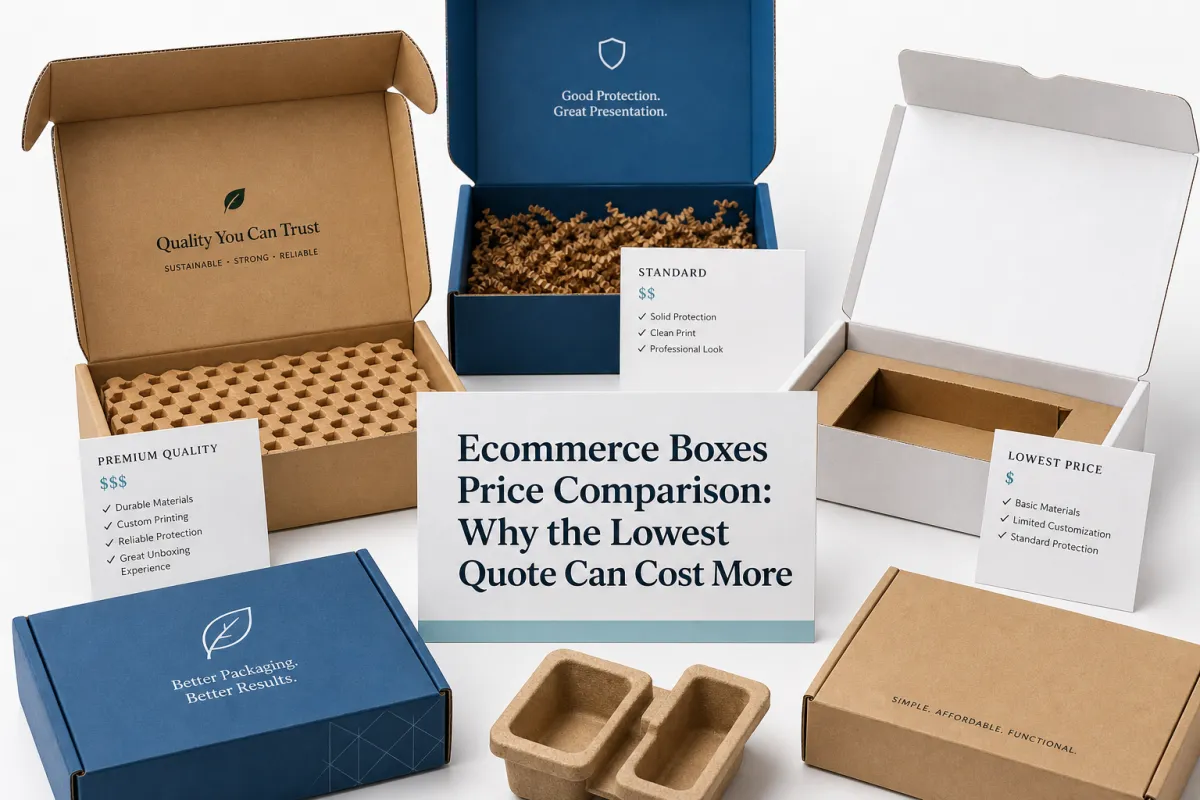
The first mistake in an ecommerce boxes price comparison is comparing cartons that are not built the same way. A light-stock mailer can look appealing because the unit price is low, but if the product really needs stronger corrugated board, a better closure, or an insert to stay secure, the cheap quote grows teeth fast. Extra tape. Extra void fill. Extra damage. That little savings story gets ugly in a hurry.
The smarter question is not which quote is lowest. It is which quote gives the lowest cost per shipped order. That number includes board cost, freight to the warehouse, labor to pack the box, field damage, and any dimensional weight charges tied to box size. A clean ecommerce boxes price comparison should show the full route from supplier to doorstep, not just the factory line item.
The lowest quote only matters if the carton protects the product, supports the brand, and keeps fulfillment from turning into a slowdown.
A box that is a little too large can push up cubic shipping costs, demand more void fill, and take longer to seal. A box with walls that are too light can crush under stack pressure or scuff in transit, which leads to replacement orders and support headaches. That is the hidden tax inside a sloppy ecommerce boxes price comparison. The invoice does not show it. The returns department does.
Mixing packaging categories creates another trap. A buyer may compare a stock mailer with a Custom Corrugated Box and assume the only difference is branding. It is not. Board grade, construction method, closure style, and print coverage can all change the economics. Once those details differ, the quotes are no longer describing the same job, and the ecommerce boxes price comparison gets muddy fast.
Keep the comparison honest with one spec sheet, one product weight, one shipping method, and one target customer experience. That gives you a clean read on where the money goes and whether a supplier is offering real value or just a smaller number at the top of the page.
Choose the Right Ecommerce Box Style Before You Compare Prices
Box style changes the math more than most teams expect. A mailer box, folding carton, literature mailer, shipper box, and heavier custom corrugated carton do not behave the same way in production or in transit. Each one uses board differently, closes differently, prints differently, and lands at a different cost. That is why style choice belongs at the front of any ecommerce boxes price comparison.
Mailer boxes fit apparel, subscription kits, accessories, and premium unboxing jobs where presentation matters. Folding cartons work well for smaller retail goods that need crisp shelf appeal and efficient print economics. Literature mailers make sense for flat items. Heavy-duty corrugated shippers are better for dense, fragile, or awkward products that need stack strength and real protection. Match the carton to the product and the route before you compare prices.
Labor changes too. Self-locking mailers can reduce tape time, but they may require tighter die-cut tolerances. Regular slotted shippers are often quicker to source and easier to run in bulk, yet they may need tape, inserts, or extra wrap to perform the same job. Skip the pack-out step in your ecommerce boxes price comparison and you miss a major chunk of the real cost.
On one project I reviewed, a brand wanted to move a glass accessory kit into a prettier mailer because the old shipper felt boring. The mailer looked great on the quote. The first samples crushed too easily. We switched the board, added a small insert, and the unit price went up a bit. Still cheaper than breakage, still better looking, and the warehouse stopped cursing the packaging team. That is a win.
| Box Style | Best For | Common Spec | Typical MOQ | Illustrative Unit Price Range |
|---|---|---|---|---|
| Mailer box | Apparel, kits, premium unboxing | E-flute or B-flute corrugated, custom print | 250-1,000 | $0.85-$1.80 |
| Folding carton | Light retail items, inserts, cosmetics | Paperboard, printed and folded flat | 1,000-5,000 | $0.18-$0.55 |
| Literature mailer | Flat documents, books, printed sets | Light corrugated, quick assembly | 500-2,500 | $0.40-$0.95 |
| Custom corrugated shipper | Heavier products, fragile goods | B-flute or double wall, stronger stack performance | 500-5,000 | $0.55-$1.25 |
| Rigid presentation box | Luxury gifts, high-end kits, elevated reveal | Rigid board, wrapped paper, specialty finish | 250-1,000 | $2.50-$6.50 |
The table is not a quote sheet. It is a reality check. A rigid box looks expensive beside a folding carton, and it is. Still, if the product needs a premium reveal and the customer expects a keepsake-style opening, that price can make sense. If the product only needs basic shipping protection and a bit of branding, a rigid box is just expensive overkill. Good ecommerce boxes price comparison work separates style from ego.
If you want a broader view of formats before requesting pricing, our Custom Packaging Products page is a good place to sort through box structures first. The right style makes every later ecommerce boxes price comparison more accurate.
Specifications That Shift Ecommerce Boxes Price Comparison Results
Once the box style is set, specs do the heavy lifting. Inside dimensions matter more than people think. A box that is even slightly oversized can force extra void fill, raise dimensional weight, and let the product move around in transit. A box that is too tight creates packing friction and slows the line, especially when the warehouse is handling mixed orders at speed.
Board construction changes the quote in a real way. E-flute is often chosen for lighter mailers because it gives a smooth print surface and a slimmer profile. B-flute and heavier corrugated boards are more common when puncture resistance or stack strength matters. Single wall and double wall constructions are not interchangeable, and they should never be compared without matching product weight and shipping method. A proper ecommerce boxes price comparison lines up those board details before anyone starts staring at unit cost.
Print coverage and finishing add another layer. A one-color logo on kraft board is a different job from full-bleed CMYK with spot coating or soft-touch lamination. Ink coverage, registration tolerance, and extra coating passes all affect setup time and labor, which means they affect cost. If the carton has to work as both shipper and display piece, print spec is part of the value, not just decoration.
Practical thinking helps here. A clean, efficient box with a small print area may cost less to make, but if the brand needs a strong first touchpoint, a more finished box can sell more for a few cents extra. That is why ecommerce boxes price comparison work should include the customer experience on arrival. A spreadsheet that ignores the unboxing moment is missing half the story.
Material sourcing and transit testing matter too. If sustainability is part of the brief, FSC-certified paperboard may be requested, and that can affect supplier selection and pricing. Packaging teams often lean on ISTA protocols or test plans similar to ASTM distribution testing so the carton is judged on more than appearance. For fiber sourcing, FSC standards help buyers track responsible material choices without guessing.
Small add-ons create quiet cost. Tear strips, self-locking closures, inserts, dividers, and custom fitments improve usability and protection, but they also increase tooling, die complexity, and sometimes hand assembly. A thorough ecommerce boxes price comparison should spell those extras out. “Simple” quotes have a habit of getting less simple once the box is built to do a real job.
And yes, the warehouse crew notices. If a box needs three extra motions to close, it slows everything down. If it saves ten seconds per order across thousands of shipments, that turns into real labor savings. The spreadsheet crowd loves unit price. Operations loves fewer headaches. Both matter.
Ecommerce Boxes Price Comparison: MOQ, Unit Cost, and Setup Fees
MOQ and unit cost drive a lot of ecommerce boxes price comparison decisions. Bigger runs usually lower the per-box price because setup costs are spread across more units. The tradeoff is cash flow and inventory. A lower unit price can still be the wrong move if it ties up too much money or fills a corner of the warehouse with cartons that will not move for months.
Setup fees deserve the same attention. Depending on the structure and print method, a quote may include cutting dies, plates, prepress work, proofing, sample runs, and sometimes palletizing or carton prep. Those are normal production costs. The mistake is comparing one quote that includes everything to another that hides half the bill. An honest ecommerce boxes price comparison puts the same fee structure on both sides.
The basic test is simple. If one supplier has a lower unit price but a high MOQ, more tooling, and a longer storage commitment, the total project cost may be worse than a quote with a slightly higher unit price and a better run size. That shows up fast for smaller brands that reorder often and cannot afford pallets of unused packaging sitting around.
Ask for landed cost. Production, freight, and packaging prep charges should appear together. Once those numbers are visible, the ecommerce boxes price comparison becomes easier to read because you can see the real order value instead of only the factory price. The factory price matters. It just does not pay the bill by itself.
- Ask for the same spec on every quote so MOQ, board grade, and print coverage stay aligned.
- Confirm what setup fees include so dies, plates, proofs, and sample runs do not appear later.
- Check freight separately because destination, pallet count, and carton size can swing the landed total fast.
- Compare reorder economics if you buy every month or quarter rather than once a year.
For small and mid-sized brands, the best price is often not the absolute lowest unit price. It is the quote that balances MOQ, storage space, reorder rhythm, and supply stability. That is where an ecommerce boxes price comparison turns into a planning tool instead of a shopping chore. If the carton supports replenishment without stress, the savings show up over time.
Short runs are not automatically expensive. High-volume orders are not automatically smart. A controlled 1,000-piece order can beat a 10,000-piece order if the product changes often, the artwork is seasonal, or storage is tight. Good buyers match MOQ to the business, not to bravado. Plain and simple.
How Process and Timeline Affect Ecommerce Box Pricing
Price does not live alone. An ecommerce boxes price comparison only gives the full picture if the timeline is visible too, because speed has a cost. The usual path runs from quote request to artwork review, dieline confirmation, proof approval, production, and shipment. If one step slips, the whole project can slide. Rush freight or rework can wipe out whatever savings came from the lower quote.
Artwork readiness changes the equation fast. Approved dielines and clean print files let suppliers move quickly. Late logo changes, finish swaps after proofing, or files that need heavy prepress cleanup stretch the schedule and can push pricing up. A delayed file is often more expensive than a slightly pricier carton because the delay shows up in stockouts and customer service pressure.
Lead time belongs beside price in every ecommerce boxes price comparison. A carton that lands a week late can force a brand to use generic packaging, pay rush freight, or pause a launch. None of that appears on the original quote. All of it hits margin. Packaging teams should ask suppliers to be clear about production windows, transit time, and the point where the schedule becomes firm.
Sample timing and production timing are not the same thing. A prototype can arrive quickly, but it still needs checks for fit, print quality, stack performance, and line speed. If the sample exposes a problem, correction adds days. That is normal packaging development, not a failure. A good ecommerce boxes price comparison accounts for that stage instead of pretending every job goes from file to carton in a straight line.
Time also affects labor in a very literal way. If a box is chosen only because it is cheaper but it slows pack-out by a few seconds per order, labor cost can overtake the material savings. That is why speed and usability belong in the same conversation as unit price. In a warehouse, the box that packs cleanly usually has more value than the one that just looks good on paper.
The best suppliers ask the right questions early. They want product dimensions, shipping method, estimated drop-test requirements, and artwork details before locking the quote. That discipline keeps the ecommerce boxes price comparison tied to real production conditions instead of wishful thinking.
There is also a boring truth here that people skip over because it sounds boring: freight availability changes. Fuel moves, lanes get weird, and peak season can add pressure. If a supplier promises a magic lead time with no caveats, I get suspicious. Packaging is manufacturing, not fairy dust.
Why Choose Custom Logo Things for Ecommerce Packaging
Custom Logo Things is built for buyers who want clear specs, practical guidance, and packaging that fits real shipping conditions rather than showroom assumptions. A solid ecommerce boxes price comparison gets easier when the team reviewing it understands dimensions, wall strength, print coverage, and how the box will be handled after it leaves the warehouse. That kind of help saves time before the order even starts.
The value is in matching the carton to the product from the start. If the item is light and presentation-led, the box can be designed for a cleaner reveal and efficient print usage. If the item is heavier or fragile, the structure can be tuned for protection and stable stack performance. That is the difference between a quote that looks nice and a quote that works in the field. A disciplined ecommerce boxes price comparison should make those tradeoffs obvious.
Support around proofs and file checks matters too. Small artwork issues, wrong dielines, or missed fold lines can create expensive delays, so responsive prepress support is not a bonus. It is part of staying on budget and on schedule. When the project stays organized, the final carton does what it should: protect the product, represent the brand, and move through the packing line without drama.
If you want to compare a wider range of formats and build styles, our Custom Packaging Products can help narrow the field before you request quotes. That makes the ecommerce boxes price comparison based on the right structure, not the nearest stock option. It is easier to choose well once the packaging category is clear.
For repeat orders, consistency matters as much as the first run. A dependable carton means less retraining, fewer packing mistakes, and fewer surprises when the next batch arrives. That reliability has value, even if it does not always show up on the first spreadsheet.
Honestly, the best packaging relationships cut down guesswork. When a supplier can help compare board grades, spot hidden setup costs, and keep the timeline honest, the entire ecommerce boxes price comparison becomes more useful. That kind of practical support protects both the brand image and the margin.
I like packaging teams that ask annoying questions early. What is the actual product weight? How many seconds does this box add to pack-out? Is the print there for branding, or does it need to do some selling too? Those questions sound fussy. They also save money.
Next Steps After Your Ecommerce Boxes Price Comparison
Before requesting another quote, gather the basics in one brief: box dimensions, product weight, shipping method, monthly usage, artwork files, and any special needs like inserts or tear strips. Those details turn an ecommerce boxes price comparison into a useful buying tool instead of a pile of mismatched numbers. The cleaner the brief, the clearer the pricing.
Build a simple comparison sheet next. Include unit price, MOQ, tooling, freight, lead time, material grade, print coverage, and finishing. If one supplier is cheaper but the spec is lighter, freight is higher, or setup fees are buried, the real value may be worse than it first appears. A disciplined ecommerce boxes price comparison makes those gaps visible in one place.
Then sample the top two options. A physical sample tells you more than a spreadsheet ever will. Check fit, closure strength, how the product sits inside the carton, how much void fill is needed, and how the box feels during opening. If the sample clears those checks, the price has a chance to mean something. If it fails, the lowest quote is usually just the loudest one.
Use the same specs across every supplier and compare landed cost, not just factory price. That rule saves time, reduces confusion, and gives you a fair picture of the options on the table. Keep that discipline, and the ecommerce boxes price comparison becomes a dependable decision tool for protection, presentation, and replenishment speed.
The practical takeaway is pretty simple: write the spec first, then compare quotes that match it exactly. If the board grade, dimensions, finish, freight, and setup fees are aligned, the real winner usually shows itself fast. If they are not aligned, you are not comparing prices. You are comparing guesses.
What should I compare in an ecommerce boxes price comparison?
Compare unit price, MOQ, tooling, freight, and lead time on the same spec sheet. Match board grade, dimensions, print coverage, and finish so the quotes are truly comparable. Check whether inserts, proofing, or pallet charges are included before deciding on the lowest price.
How do I keep hidden costs out of an ecommerce boxes price comparison?
Ask for a landed-cost quote that includes production, freight, and any setup fees. Confirm whether the price covers plates, dies, proofs, and packaging preparation. Use one standardized product brief for every supplier so assumptions do not change the quote.
What MOQ is normal for custom ecommerce boxes?
MOQ varies by box style, print method, and material, but larger runs usually reduce unit cost. Short runs may be possible, yet they often carry higher per-box pricing because setup is spread across fewer units. The best MOQ is the one that fits your storage space and reorder cycle without creating excess inventory.
Are mailer boxes cheaper than corrugated shipping boxes?
Mailer boxes can be less expensive for lighter products and premium presentation, but not always for heavier items. Corrugated Shipping Boxes may cost more per unit, yet they can reduce damage and lower overall shipping risk. The cheapest option depends on product weight, required protection, and whether the box must also serve as the brand reveal.
How long does custom ecommerce box production usually take?
Lead time depends on artwork approval, material availability, print complexity, and current factory schedule. Simple orders can move faster, while custom structures, coatings, or special inserts usually take longer. Final timing should always be confirmed after proof approval, because late changes can extend the schedule.
Choose the carton that protects the product, fits the pack-out process, and supports the brand without inflating freight or inventory, and your ecommerce boxes price comparison will pay off long after the first shipment leaves the dock. Start with one clean spec sheet, compare landed cost on matching quotes, and sample the finalists before you commit. That is the boring answer. It is also the one that usually saves the most money.