The Small Beanie Detail That Changes Perceived Tech Brand Value
Electronics Logo Patch Beanies unit cost review sounds oddly specific until the order becomes real: 600 launch gifts for a hardware release, winter uniforms for a repair chain, a booth giveaway that cannot look like bargain-bin merch, or a distributor incentive that needs to feel more substantial than a pen and sticker sheet. Then the buyer’s question changes from “How much is a beanie?” to “What am I actually paying for, and which choices affect the finished piece?”
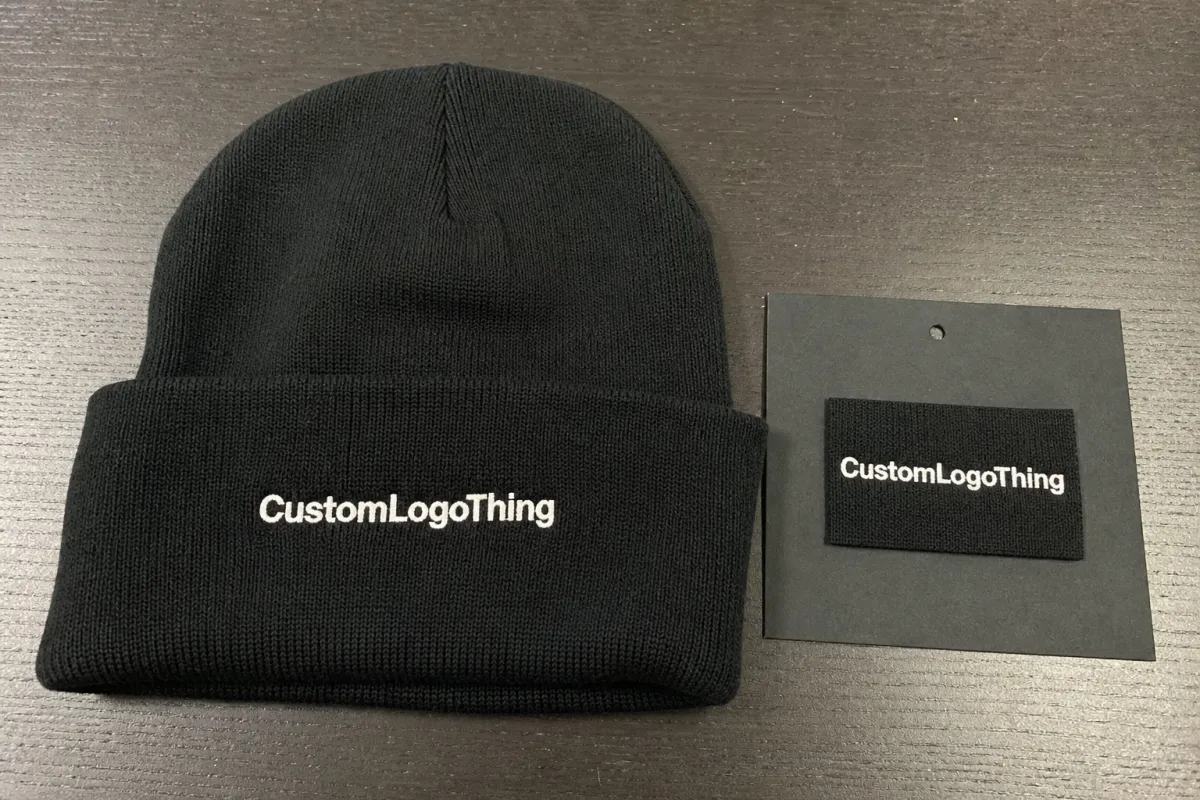
The patch usually carries more brand weight than its size suggests. The knit cap may be the larger physical item, but the patch is what people notice first. It is touched, photographed, compared against brand standards, and judged in one second. A clean woven badge on a charcoal cuff can make a basic acrylic beanie feel retail-ready. A molded PVC patch can give a rugged electronics campaign the same tactile language as protective cases, chargers, tools, or field equipment. A distorted patch does the opposite. It makes an expensive logo system look careless.
Direct embroidery still has a role. It is familiar, durable, and efficient for simple marks. Patch beanies, though, give electronics brands a cleaner badge effect, especially when the logo includes thin typography, app icons, circuit motifs, registered marks, or multi-color lockups. Technology companies tend to protect logo consistency because the same mark appears on packaging, product interfaces, sales decks, warranty cards, installation guides, and partner portals. The beanie has to sit inside that ecosystem, not drift away from it.
A useful cost review looks past the factory unit price. It weighs blank beanie quality, patch material, patch size, decoration limits, minimum order quantity, setup charges, packaging, freight, and reorder consistency. That is the difference between buying “some hats” and buying a controlled branded item. Custom Logo Things helps buyers turn those variables into a quote procurement can read without guessing what was left out.
Buyer reality: a $0.35 patch decision can change the perceived value of a $7.00 beanie more than a $1.00 upgrade in knit weight, especially if the logo is the visual anchor.
Patch Beanie Options That Fit Electronics Brands
Electronics branding usually rewards precision. The decoration needs to hold small edges, tight curves, controlled color, and clean geometry. That is why woven patches are often the safest starting point for detailed tech logos. Threads can capture compact typography better than standard embroidery at small sizes. For a 2.25-inch badge with a wordmark, icon, and border, woven often keeps the logo more legible than direct stitch.
PVC patches fit a different brief. They are molded, flexible, and dimensional, with a rubber-like surface that suits rugged device launches, field-service teams, repair programs, charging accessories, outdoor electronics, or installation crews. PVC often costs more than woven because tooling, mold complexity, and layer count enter the calculation. The finish can justify the premium when the beanie is tied to durability, hardware, or product-adjacent storytelling.
Leatherette patches give a warmer, premium-gift feel. They work well for simple marks, debossed-style artwork, dealer gifts, employee appreciation programs, and neutral beanie colors. They are less convincing for bright app icons or logos that depend on four precise brand colors. The material has its own character; it does not behave like a tiny printed label.
Embroidered patches bring a classic workwear look. They suit warehouse staff, technician uniforms, repair teams, and companies that want a more traditional service-brand feel. The tradeoff is detail. Dense circuit illustrations, tiny legal lines, and narrow letterforms can lose definition once thread and border thickness are involved.
The beanie body changes the equation too. Cuffed acrylic is the broad promotional standard because it balances price, comfort, and color availability. Rib knit gives more visible texture and a retail feel. Recycled yarn can support sustainability messaging, provided the claim is backed by documentation rather than vague wording. Fleece-lined beanies cost more, but field installers and warehouse employees may wear them for an entire shift. For that audience, warmth and fit are not upgrades; they determine whether the item gets used.
- Internal IT teams: comfort, neutral colors, and repeat wear matter more than decorative complexity.
- Channel partners: clean patch edges, consistent placement, and retail styling protect brand perception.
- Trade show giveaways: lower landed cost, fast production, and efficient pack-out usually dominate.
- Launch kits: a stronger patch can make sense because the beanie sits beside packaging, inserts, and device accessories.
Three production cautions appear often. Oversized patches can buckle on a curved cuff. Very small text can blur, fill in, or disappear, depending on the method. Dark-on-dark branding may look expensive under office lights and nearly invisible in event photography. A careful quote review catches those conflicts before artwork approval, not after the first carton arrives.
Electronics Logo Patch Beanies Unit Cost Review: What Changes the Quote
An electronics logo patch Beanies Unit Cost review should treat price as a layered calculation. Start with the blank beanie. Add patch type, patch dimensions, color count, attachment method, artwork setup, proofing, packaging, freight, and quantity. Then judge the delivered cost per piece, not only the product line printed near the top of the quote.
MOQ is the first pressure point. A 72-piece order spreads setup and labor over too few units, so the per-piece price can look higher than expected. At 500 pieces, patch production and sewing time usually spread more efficiently. At 2,500 or 5,000 pieces, bulk pricing may improve again, although freight, carton count, storage, and internal distribution start to matter. Quantity helps, but it does not erase every cost. A layered PVC patch with tight molded detail can remain more expensive than a simple woven badge at the same order size.
Patch size changes the math quickly. Moving from a 2-inch woven square to a 4-inch wide cuff label increases material, handling, and sewing time. It may also require more careful placement so the patch does not wrinkle near the cuff edge. The blank beanie may be identical; the labor is not.
| Option | Best Use | Typical Cost Behavior | Buyer Watchpoint |
|---|---|---|---|
| Woven patch | Detailed tech logos, small type, crisp badge edges | Often efficient at mid to large quantities; setup charges may apply | Thread colors reflect light differently than screen colors |
| PVC patch | Rugged electronics, field service, hardware-related campaigns | Can carry higher tooling fees and higher patch cost | Very thin lines may need simplification for molding |
| Leatherette patch | Premium dealer gifts, simple marks, neutral palettes | Moderate cost with strong perceived value | Not ideal for multi-color app icons or tiny typography |
| Embroidered patch | Classic workwear and technician programs | Varies by stitch count, size, border, and fill area | Small letters and complex icons can lose definition |
Freight needs its own line. Beanies are soft, but they still occupy carton space. Add individual polybagging, kitting, hang tags, or split shipments to 12 offices, and the landed unit cost changes. Rush freight can damage a budget more than a patch upgrade. For trade shows, advance warehouse deadlines may be stricter than the event date itself, so the quote should reflect the real in-hand requirement.
Packaging can be either useful or wasteful. Individual bags help with employee kit assembly, inventory counts, and split shipments. They may be unnecessary for a local event where staff will hand out beanies from bulk cartons. Hang tags can help if the beanie is part of a premium launch kit, but they add printing, attachment labor, and sometimes paper-sourcing questions. Buyers should decide whether packaging improves the program or merely adds steps.
Useful quote inputs are straightforward: quantity, target in-hand date, vector logo file, patch preference, beanie color, packaging needs, shipping ZIP code, and whether the order is one-time or recurring. If the program may repeat, say so early. A recurring distributor or technician program should preserve specifications and color references from the first run, even if the initial order is modest.
Specifications Buyers Should Confirm Before Artwork Approval
Artwork approval is where a rough idea becomes production instruction. Confirm beanie material, knit style, cuff height, patch dimensions, patch material, border style, backing method, color count, and logo placement before signing off. A 3-inch patch centered on a 3-inch cuff leaves little visual margin. A 2.25-inch patch on a 3.5-inch cuff often looks more controlled.
Vector artwork is strongly preferred. It gives cleaner edge definition, more reliable color separation, and fewer proofing surprises. A PNG pulled from a website may be enough for an early discussion, but it is weak production evidence. Electronics logos often include thin lines, registered marks, gradients, small secondary typography, or exact spacing rules. Those elements must be translated into the chosen patch method. They should not be copied blindly at a size where they cannot survive.
Color matching needs realism. Pantone references improve control, but yarn, PVC, leatherette, and woven thread do not reflect light like coated paper or a backlit screen. A blue used on device packaging may appear darker in woven thread and flatter in PVC. Black thread on a dark graphite beanie can look subtle in hand and vanish in photographs. If exact brand color is mission-critical, ask about sample review, available materials, and acceptable tolerance before full production.
Comfort is not a cosmetic detail. Cuff thickness, patch stiffness, backing, seam placement, and stretch all affect wearability. A thick PVC patch may feel substantial, but if it sits too low on the forehead, employees will avoid it. Fleece lining improves warmth, yet it can reduce stretch. For crews doing outdoor installations, that small fit issue becomes a daily complaint.
Compliance and brand control also deserve attention. Procurement teams may need approved logo lockups, distributor co-branding rules, carton labels, internal item codes, material information, or sustainability documentation. Packaging claims should be handled carefully. If FSC-certified paper hang tags or recycled packaging are part of the plan, confirm documentation rather than relying on loose supplier language. The Forest Stewardship Council provides useful context for responsible paper sourcing claims.
For larger orders, launch programs, or high-visibility internal campaigns, a physical pre-production sample can be worth the extra time and cost. Digital proofs are useful for layout, but they cannot fully show patch stiffness, thread sheen, cuff stretch, or the true scale of the badge on a head. That extra review step is not ceremony. It is risk control.
Production Steps and Timeline From Proof to Delivery
The production path is predictable, but delays rarely identify themselves early. A typical order moves through quote review, artwork cleanup, digital proof, buyer approval, patch production, beanie sourcing, patch attachment, quality control, packing, and shipping. For many custom patch beanie orders, the clock starts after proof approval, not after the first inquiry.
That detail matters. Procurement may need a PO. Legal may need to check co-branding. A brand manager may reject a logo version that looked harmless to the event team. Two quiet days can disappear before the supplier is cleared to produce. If the event date is fixed, those two days often return later as rush charges, limited decoration choices, or a reduced sample window.
Common timeline risks include late artwork changes, unavailable beanie colors, complex PVC molding, international freight delays, split destination shipping, and booth freight deadlines that require warehouse arrival before the show floor opens. Electronics launch kits add another layer because beanies may need to arrive with inserts, warranty cards, demo accessories, QR cards, or outer packaging.
Quality control should be specific. Check logo position on the cuff, patch alignment, stitch consistency, color, loose threads, packaging count, carton labels, and destination details. For a 1,000-piece order split across sales regions, the total quantity can be correct while two locations still receive the wrong count. That is not a small issue if one region has a kickoff event and another is overstocked.
Shipping standards can shape how buyers think about risk, even for soft goods. ISTA transit testing is more relevant to packaged products than loose beanies, but its focus on distribution hazards is useful for higher-value kits or bundled merchandise. Buyers planning launch boxes, retail-style mailers, or mixed-item packages can review general packaging test concepts through ISTA.
Planning differs by order type. Trade show orders need a buffer before advance warehouse deadlines. Employee kit orders may need coordinated ship dates so one region is not wearing the new beanie three weeks before another region receives it. Recurring distributor programs benefit from saved proofs, item codes, and reorder notes, especially when the same patch must match across multiple drops.
Custom Logo Things can help evaluate whether the requested patch style, order quantity, and delivery date are aligned before budget is committed. If the spec requires a slower process, it is better to know before the PO than after the event freight window closes.
Procurement Mistakes That Quietly Raise Beanie Costs
Most cost overruns are not dramatic. They are small decisions made in the wrong order. Changing artwork after proof approval can trigger new proofs, new setup, or production delays. Choosing PVC before checking whether the logo can mold cleanly may force artwork simplification. Ordering below an efficient MOQ can make each beanie carry too much fixed cost.
The biggest mistake is comparing quotes only by the top-line unit price. One quote may exclude setup charges. Another may include freight. A third may assume a smaller patch, no individual bagging, no sample, and delivery to one ZIP code. On paper, the lowest price wins. In practice, the landed number may lose.
Decoration assumptions create another set of problems. A logo that works on a printed sticker may not translate to embroidery at 2 inches wide. A QR-style mark may need printing or weaving rather than raised PVC. A legal line under a logo may be readable on a device box and useless on a beanie cuff. Buyers should ask what must change before approving the quote, not after reviewing the proof.
Inventory discipline matters if the campaign repeats. Preserve patch dimensions, thread or PVC color references, proof files, beanie SKU, cuff height, placement notes, packaging instructions, and shipping records. Without those details, a reorder six months later can look close but not identical. For channel partner programs, that inconsistency is visible because items from different drops often sit in the same room.
- Mass giveaway: choose the lowest cost structure that still keeps the logo clean.
- Product launch: prioritize detail, color control, and presentation packaging.
- Field technicians: choose durability, comfort, warmth, and repeat-wear construction.
- Partner gifts: raise perceived value with leatherette, woven detail, or premium knit texture.
A strong supplier should question the spec when the spec is wasting money. Oversized patches, unnecessary packaging, unsupported sustainability claims, and decoration methods that do not improve the finished beanie all deserve scrutiny. Paying for features nobody sees is not brand building. It is budget leakage.
Build a Quote Package That Gets an Accurate Price
A clean quote package reduces guesswork. It also reduces the chance that the final invoice feels disconnected from the first estimate. Send enough information to price the real job, not a placeholder version that will be revised three times.
- Target quantity and any price breaks you want reviewed.
- Preferred beanie color, knit style, cuff style, and warmth level.
- Patch type preference, or permission to compare two options.
- Vector logo file, Pantone references, and approved logo lockup.
- Approximate patch size range, such as 2 to 3 inches wide.
- Required in-hand date and shipping destination ZIP code.
- Packaging requirements, including individual bags, hang tags, or kitting.
- Budget target or expected delivered cost per piece range.
Ask for two or three costed options if the decision is not obvious. A woven patch versus PVC patch comparison can show whether the added texture is worth the price. A standard cuffed beanie versus fleece-lined beanie comparison can reveal whether comfort upgrades fit the audience. For a distributor incentive, the premium option may be sensible. For 3,000 booth giveaways, it may not be.
Share the final use case. Conference giveaway, employee uniform, electronics launch kit, distributor incentive, retail merch, and warranty registration gift are different buying problems. The right patch for a rugged field team may look too heavy for a SaaS event. The right low-cost beanie for a booth may feel underbuilt for staff uniforms.
Before issuing a purchase order, confirm MOQ, setup charges, proofing steps, production timeline, freight estimate, sample options, and what happens if the preferred beanie color is unavailable. Ask whether the quote includes attachment labor, packaging, and delivery to the requested destination. Also confirm whether files and specifications will be saved for reorder consistency.
The practical goal is simple: turn a soft promotional item into a controlled branded product. Custom Logo Things can review the specs, compare the tradeoffs, and build a quote that shows the real delivered price. Start with the logo, quantity, deadline, and shipping ZIP code. Those four details usually reveal the smartest path fastest.
FAQ
What affects electronics logo patch beanies unit cost the most?
The largest cost drivers are order quantity, patch material, patch size, number of colors, attachment labor, packaging requirements, and freight. MOQ matters because setup, proofing, and labor costs are spread across fewer units on small orders, which can make the cost per piece climb quickly.
Which patch type is best for electronics company beanies?
Woven patches are often best for detailed tech logos, small typography, and clean badge-style branding. PVC patches work well for rugged, modern, device-related campaigns, while leatherette patches fit premium partner gifts or employee gifts with simpler logos.
What MOQ should buyers expect for custom logo patch beanies?
MOQ depends on the beanie style, patch method, artwork complexity, and supplier setup requirements. Buyers should request price breaks at multiple quantities, such as 100, 250, 500, and 1,000 pieces, to see where the unit cost becomes more efficient.
How long do custom electronics logo beanies take to produce?
The timeline usually includes artwork review, proof approval, patch production, beanie sourcing, sewing, quality control, and shipping. The clock typically starts after proof approval, so fast artwork decisions help protect the delivery date and reduce rush costs.
Can I review a sample before ordering logo patch beanies in bulk?
Digital proofs are standard for checking layout, patch size, and logo placement. For larger or high-visibility orders, a physical pre-production sample may be recommended to verify material feel, color, patch scale, and comfort before full production begins.