A jewelry Woven Label Beanies unit cost review should start with an uncomfortable truth: the blank beanie is rarely the only meaningful cost. Label setup, thread density, sewing labor, packaging, freight, sampling, and inspection choices all move the final invoice. A $5.25 blank can become a $9.80 landed item faster than a buyer expects.
That does not make Woven Label Beanies a bad merch idea. Quite the opposite. A customer may not buy another ring this month, but she might wear a branded beanie all winter. That is useful retention with a practical object attached.
The trick is choosing a beanie, label, and packaging setup that matches the jewelry brand's price point without turning a simple order into a margin-eating custom apparel project. Premium does not mean complicated. Often it means restrained, well-proportioned, and not scratchy.
Why Jewelry Brands Use Woven Label Beanies as Low-Risk Merch
Beanies solve one of apparel's ugliest buying problems: sizing. Shirts require size curves, return planning, storage space, and optimistic guesses about how many mediums humans will claim to need. Beanies usually come in one adult size, sometimes with youth or oversized options. Less size risk means cleaner buying for holiday gifts, launch kits, pop-ups, boutique retail add-ons, and staff wear.
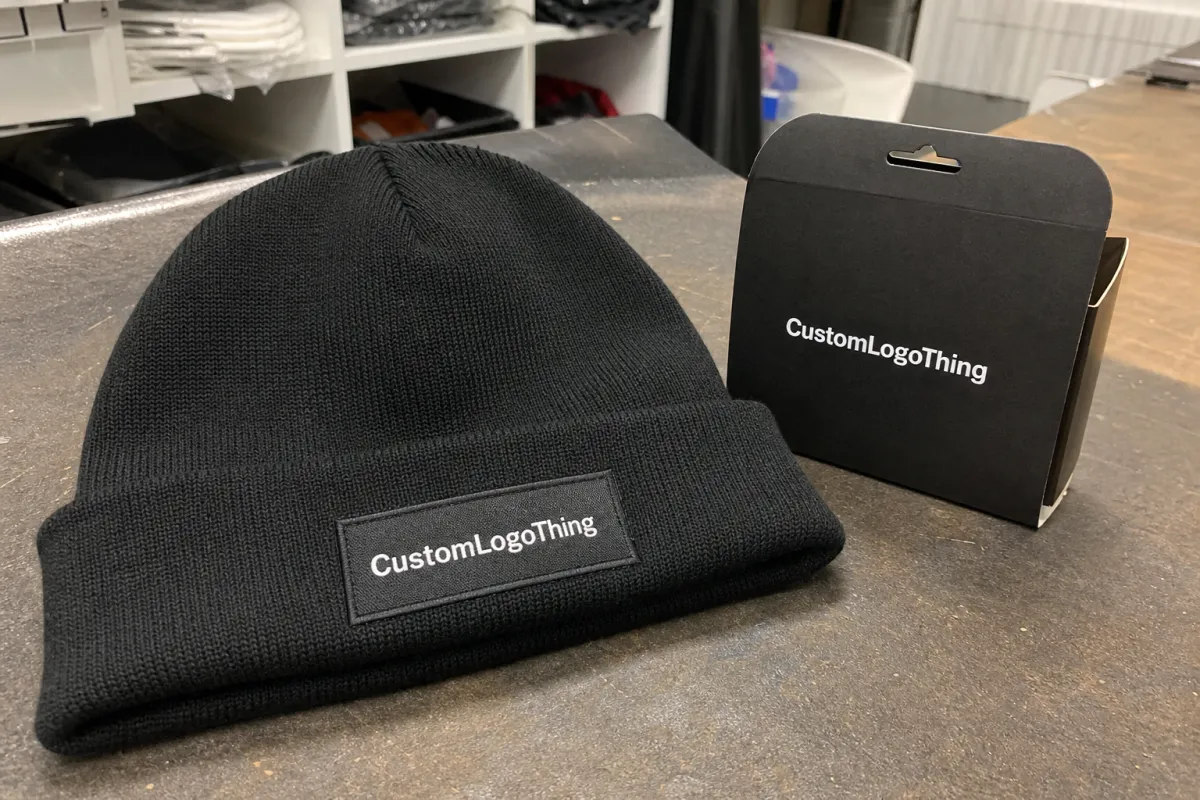
The branding footprint is small, which suits jewelry. Fine jewelry, piercing studios, charm bars, bridal boutiques, and artisan makers usually look better with a restrained woven label than a huge embroidered logo across the forehead. A 1.25 x 2 inch damask label on a cuffed rib beanie can feel polished. A loud stitched mark on thin acrylic can feel like a parking-lot giveaway. Nobody needs a scratchy forehead billboard.
Woven labels also echo details jewelry customers already recognize: pouch labels, box inserts, tissue seals, hang tags, ribbons, polishing cloths, and care cards. If the ring box uses clean typography and the beanie label looks like it came from a discount ski bin, the mismatch registers. Customers may not name the problem. They still feel it.
These beanies work best for four use cases: retail merch, VIP client gifts, seasonal bundle add-ons, and staff or event wear. They are less ideal for a 75-piece dream project involving exact yarn dyeing, custom knit patterns, folded labels, ribbon wrap, and luxury mailers. Could a supplier build it? Maybe. Will the unit cost stay friendly? No.
Buying note: cheap beanies with beautiful labels still look cheap. Spend first on the knit that touches the customer's skin, then refine the label and packaging.
Beanie and Woven Label Product Details Buyers Should Check
The main beanie styles are cuffed acrylic, rib-knit, fisherman, slouch, recycled yarn, wool blend, and heavyweight winter knit. Cuffed acrylic beanies are usually the most cost-efficient and easiest to decorate because the cuff gives the label a flat, visible placement. Rib-knit versions add texture and stretch. Fisherman beanies feel more boutique, though the shorter cuff can restrict label height. Slouch styles can work for lifestyle brands, but label placement may sit less predictably once worn.
For jewelry brands, the safest starting points are usually a cuffed rib beanie or a short fisherman style. The cuffed rib option gives better label visibility and more flexible placement. The fisherman style looks more curated, but it leaves less real estate. If the logo includes a wordmark, icon, and tiny tagline, do not force all of it onto a folded tab and expect miracles. Thread has rules.
Woven label construction matters. Damask woven labels give the crispest detail and are usually best for fine jewelry logos, delicate serif type, thin icons, or monograms. Satin woven labels have a softer shine that can suit bridal or gift-focused brands. Cotton-look woven labels feel warmer and more handmade, useful for artisan jewelers or permanent jewelry studios with a less formal voice. Merrowed-edge labels add a durable stitched border, although they often read more casual than a clean heat-cut or folded label.
Placement options include centered cuff, side seam, folded tab, hem wrap, and tone-on-tone label placement. Centered cuff labels sell well because the logo is easy to read on a retail rack or product photo. Side seam labels feel quieter. Folded tabs look boutique but limit artwork space. Tone-on-tone labels can be excellent for premium brands that want recognition, not shouting.
Packaging changes perceived value and total cost. A belly band, hang tag, tissue wrap, kraft mailer, branded poly bag, or small jewelry-style insert card can move the beanie from "freebie" to "giftable." Keep the math honest. A $0.35 belly band, $0.20 insert, and $0.45 branded bag can add a full dollar once handling is included. On 500 pieces, that is not a rounding error.
If the project also needs garment labels, hang tags, or packaging details, Custom Logo Things can align the beanie decoration with Custom Labels & Tags specs so the woven label, retail tag, and jewelry packaging do not look like three different brand systems stitched together by accident.
Material Specs, Label Size, and Logo Detail Limits
Most budget-friendly beanies use 100% acrylic. It is durable, washable, widely available, and usually consistent across bulk production. Acrylic-spandex blends add stretch and recovery, which helps the beanie keep shape after handling. Recycled polyester blends support sustainability messaging, though the cost per piece often rises. Wool blends feel warmer and more premium, but they can be itchier, pricier, and more sensitive to washing. Cotton blends feel softer, yet they may not hold the same winter structure as acrylic or wool blends.
Label size should match the logo and the beanie style. Common ranges include 1 x 1.5 inches for minimalist marks, 1.25 x 2 inches for standard jewelry logos, and 1.5 x 2.5 inches for more visible retail branding. Folded tab labels often show only about 0.75 x 1.5 inches per visible face. That is a tiny canvas. If the logo has a gemstone icon, script wordmark, and five-word tagline, something needs to go. Simplify or suffer.
Most woven labels handle 2 to 6 thread colors cleanly. Fewer colors usually look sharper and cost less. High-density damask labels are better for fine linework, but even damask has limits. Thread is not a Retina screen. Thin script, micro taglines, dotted gemstone details, and detailed crest marks often need artwork cleanup before sampling.
Edge and backing choices include heat-cut edges, merrowed borders, center fold, end fold, adhesive backing for positioning before sewing, and standard sew-on construction. For beanies, sew-on construction is the durable choice because the fabric stretches. Adhesive can help position the label during sewing, but it should not be treated as the final bond for a wearable product.
Color matching needs a practical eye. Pantone matching may be possible, but thread reflects light differently than ink, foil, enamel, or metal plating. A gold thread will not look like 14k gold. A soft champagne thread may feel closer to a jewelry brand's tone than a loud yellow metallic. Review thread options under normal light, not only under a desk lamp at midnight.
Sustainability claims need documentation. If recycled fibers, responsibly sourced paper tags, or certified materials are part of the pitch, ask what proof is available. The Forest Stewardship Council is a useful reference for paper-based packaging, and the EPA sustainable packaging resources are helpful for broader material claims. Green-ish wording without proof is not strategy. It is a refund request waiting for oxygen.
Jewelry Woven Label Beanies Unit Cost Review
A practical jewelry woven label Beanies Unit Cost Review looks at the full build, not only the blank. Basic acrylic beanies with a woven label often land around $4.50 to $8.50 per unit at moderate volume. Premium knits, recycled yarns, wool blends, complex labels, special packaging, or tighter inspection requirements can push pricing into the $8.50 to $14.00+ per unit range. Small runs can sit higher because setup charges and labor spread across fewer pieces.
The largest cost drivers are blank beanie quality, label size, thread count, number of label colors, sewing labor, packaging, sampling, freight, and order quantity. Bulk pricing helps, but it does not erase physics. A larger label takes more thread and more handling. A heavier beanie fills more carton space. A custom insert card, belly band, and branded poly bag add material cost plus packing time.
| Option | Typical MOQ | Estimated Unit Cost | Best Fit | Tradeoff |
|---|---|---|---|---|
| Standard cuffed acrylic beanie with small damask label | 100-300 pieces | $4.50-$8.50 | Client gifts, staff wear, simple retail merch | Limited premium feel if the blank is too thin |
| Rib-knit or fisherman beanie with premium woven label | 200-500 pieces | $7.50-$12.00 | Boutique jewelry brands and launch bundles | Less label height on shorter cuffs |
| Recycled yarn or wool blend beanie with custom packaging | 300-1,000 pieces | $9.50-$14.00+ | Retail programs and higher-ticket gifting | Higher freight, longer lead time, stricter approval needs |
| Fully custom knit color or pattern | 500-1,000+ pieces | $11.00-$18.00+ | Serious retail drops and brand campaigns | More tooling fees, longer sampling, more inventory risk |
MOQ expectations vary. Standard woven label beanie orders often start around 100 to 300 pieces. Custom yarn colors, fully custom knit patterns, unusual label construction, or specialty packaging can require 500 to 1,000+ pieces. Lower MOQs may be possible, but the unit cost usually climbs because labor and setup charges do not disappear just because the order is small.
Setup costs can include woven label setup, artwork cleanup, pre-production sample fees, sewing setup, and packaging setup. Some suppliers roll those charges into the unit price. Others list them separately. Neither structure is automatically better. The useful number is total landed cost, with a clear explanation of what is included.
Here is the blunt tradeoff: saving $1 per unit on a flimsy beanie can make the whole item feel disposable. A better blank often protects the jewelry brand more than another fancy insert card. The customer touches the knit first, not the spreadsheet.
Freight deserves attention too. Beanies are soft but bulky, so carton dimensions can matter as much as weight. Air shipping is faster and expensive. Ocean or consolidated freight is slower and cheaper. If 1,000 beanies must arrive for a launch in 12 business days, freight may make the quote look rude.
For a useful quote, avoid vague requests like "black beanie with label." That is not a quote brief. It is a guessing game wearing a hat. Include style, quantity, label size, label colors, placement, packaging, delivery zip code, and in-hands date. A cleaner spec produces cleaner pricing and fewer surprises.
Process, Lead Time, and Approval Steps Before Production
The buying process is straightforward when the specs are clear. Submit the logo and target quantity. Choose the beanie style. Confirm label size and placement. Review the quote. Approve a digital mockup. Approve a woven label sample or full production sample. Then bulk production begins.
Simple, unless the artwork is blurry, the Pantone color is undecided, and the event date is next Thursday. Then everyone gets to enjoy stress as a group activity.
Typical quoting takes 1 to 3 business days when the request includes usable details. Artwork prep can take 1 to 3 days, especially if the logo needs simplification for thread. Woven label sampling often takes 5 to 10 days. A full beanie sample may take 7 to 14 days, depending on whether the blank is in stock and whether sewing setup is required.
Bulk production commonly runs 2 to 4 weeks after approval for standard styles. Custom-dyed yarns, specialty labels, custom packaging, or added inspection steps can add 2 to 5 more weeks. For holiday retail, winter drops, trade shows, influencer boxes, or jewelry launch kits, build in buffer time. Factories have calendars. Apparently they do not operate on wishful thinking.
Most project delays come from ordinary things: blurry artwork, unresolved thread colors, changing label placement after sampling, late payment, added packaging after the quote, and event deadlines that ignore production math. If the logo needs to be reworked for a woven label, approve that change early. Do not wait until the sample arrives and then ask why the tiny tagline looks like dental floss.
Approve the beanie color, label thread colors, logo readability, stitch alignment, label position on the cuff, packaging count, carton labeling, and shipping method. If the beanies are for resale, ask how many units are packed per carton and whether individual poly bags, hang tags, or belly bands are included. If they are for client gifting, check that the packaging does not crush the cuff or wrinkle the label.
ISTA testing may be relevant for more complex retail or shipping programs, especially if beanies are packed with jewelry boxes, inserts, candles, or other fragile gift items. The International Safe Transit Association provides recognized packaging test standards. Not every beanie order needs formal transit testing, but higher-value kits should not be packed like yard sale leftovers.
Quality Checks That Protect a Jewelry Brand Look
Quality control matters more for jewelry brands because customers expect polish, symmetry, and restraint. A crooked label on a luxury-adjacent brand looks careless fast. It does not matter if the beanie is technically "just merch." The customer reads it as part of the brand.
Key inspection points include label centering, stitch consistency, thread snags, label fraying, beanie stretch recovery, cuff height consistency, color variation, seam alignment, and packaging cleanliness. For a standard order, a practical acceptable quality check may include random carton pulls plus measurement checks on label placement. For larger retail programs, ask about inspection level, defect categories, and photo documentation before final shipment.
Test the logo at real viewing distance. Not zoomed to 400% on a screen. Hold the sample at arm's length. Put it on a mannequin head or have someone wear it. If the name only reads under perfect light from six inches away, it does not read. Jewelry logos often use delicate typography, and delicate typography can turn into thread soup if the label is too small.
Comfort is not a soft detail. Labels should not scratch the forehead, curl at the edges, or pull away when the cuff stretches. The beanie should recover shape after handling and packing. If a wool blend feels premium but itchy, choose a softer blend or move the label placement. A customer will forgive a simple insert card before she forgives an annoying beanie touching her skin for three hours.
Packaging QC should match the standard of jewelry boxes and pouches. Tissue should be clean. Belly bands should sit straight. Hang tags should use the correct string or attachment method. Insert cards should not be bent, misprinted, or thrown loosely into the carton. Merch should not feel like an afterthought, especially if the brand sells pieces at $80, $150, or $400.
Custom Logo Things supports buyers with spec review, material options, mockups, sampling guidance, production coordination, and quote transparency. That matters because a mystery quote with a polished PDF can hide setup charges, freight assumptions, packaging omissions, or label compromises. Clear options beat fluffy brand adjectives every time.
If the project also needs hang tags, garment labels, or retail packaging details, align those pieces through Custom Labels & Tags instead of building the beanie label in isolation. Consistency is cheaper than reordering because the merch tag looks nothing like the jewelry pouch.
Next Steps to Get an Accurate Beanie Quote
Accurate pricing starts with production details. A vague estimate may feel faster, but it usually changes once real specs appear. Useful quotes need quantities, materials, placement, packaging, and timing. Wishes do not price well.
Send the target quantity, beanie style, beanie color, label dimensions, logo file, preferred label colors, placement, packaging needs, delivery zip code, in-hands date, and budget range. If the label size is undecided, say that. A supplier can recommend a 1 x 1.5 inch, 1.25 x 2 inch, or 1.5 x 2.5 inch label based on the logo. Guessing is optional. Accuracy is better.
- Quantity: common starting points are 100, 250, 500, and 1,000 pieces.
- Artwork: AI, EPS, SVG, or clean PDF files reduce cleanup time and sampling errors.
- Placement: centered cuff, side seam, folded tab, and hem wrap all price and sew differently.
- Packaging: poly bag, belly band, hang tag, tissue wrap, insert card, and kraft mailer each add cost.
- Deadline: include the real in-hands date, not the date someone remembers after the quote is approved.
Decide whether the beanie is for resale, gifting, staff use, or launch kits. Each use case changes the right quality level. Staff beanies can be simpler. VIP gifts need better handfeel and cleaner packaging. Retail merch needs margin planning, barcode or hang tag decisions, and a clear target cost per piece.
For most jewelry merch orders, the strongest buying path is simple: choose a standard quality blank and put the money into a premium woven label. Reserve fully custom knit beanies for larger runs, serious retail programs, or brands with enough demand to carry inventory. A standard blank with a sharp damask label often looks better than an overcomplicated custom knit built on a tiny budget.
Custom Logo Things can compare two beanie grades, recommend label sizing, and quote packaging options without making the process weirdly mysterious. If existing packaging standards already cover jewelry cards, pouches, or tags, include them with the quote request. If not, start with the beanie and label, then add packaging only where it improves value.
The best jewelry Woven Label Beanies unit cost review is not a single number. It is a clear comparison of materials, decoration, labor, packaging, freight, and timing. Send the specs, not wishes, and the quote becomes more useful immediately.
FAQ
What affects jewelry woven label beanies unit cost the most?
The biggest cost drivers are beanie quality, order quantity, woven label size, number of thread colors, sewing labor, packaging, and freight. A small damask label on a standard cuffed acrylic beanie is usually the most cost-efficient setup. Premium yarns, recycled materials, custom-dyed colors, and gift-style packaging raise the unit cost quickly.
What MOQ should I expect for woven label beanies for a jewelry brand?
Most standard woven label beanie orders start around 100 to 300 pieces, depending on the blank style and label requirements. Fully custom knit beanies, special yarn colors, or complex packaging can push MOQ to 500 to 1,000+ pieces. Lower MOQs are possible in some cases, but the unit cost will usually be higher.
Are woven labels better than embroidery for jewelry beanies?
Woven labels are usually better for small jewelry logos, fine lettering, and a boutique retail look. Embroidery works well for bold marks, but it can distort tiny serif type, thin linework, or delicate icons. For a clean jewelry merch piece, a damask woven label is often the safer choice.
How long does production take for custom woven label beanies?
Standard projects commonly take 2 to 4 weeks after artwork and sample approval. Sampling can add 1 to 2 weeks depending on label complexity and whether a physical beanie sample is required. Rush options may be available, but rushing usually limits material choices and increases freight cost.
What files do I need for a woven label beanie quote?
Send vector artwork such as AI, EPS, SVG, or a clean PDF whenever possible. Also include quantity, beanie style, color, label size, placement, packaging needs, delivery location, and deadline. If only a PNG or JPEG is available, send it anyway, but expect possible artwork cleanup before sampling.