Cosmetics Logo Patch Beanies Material Sample Guide: What You’re Really Approving
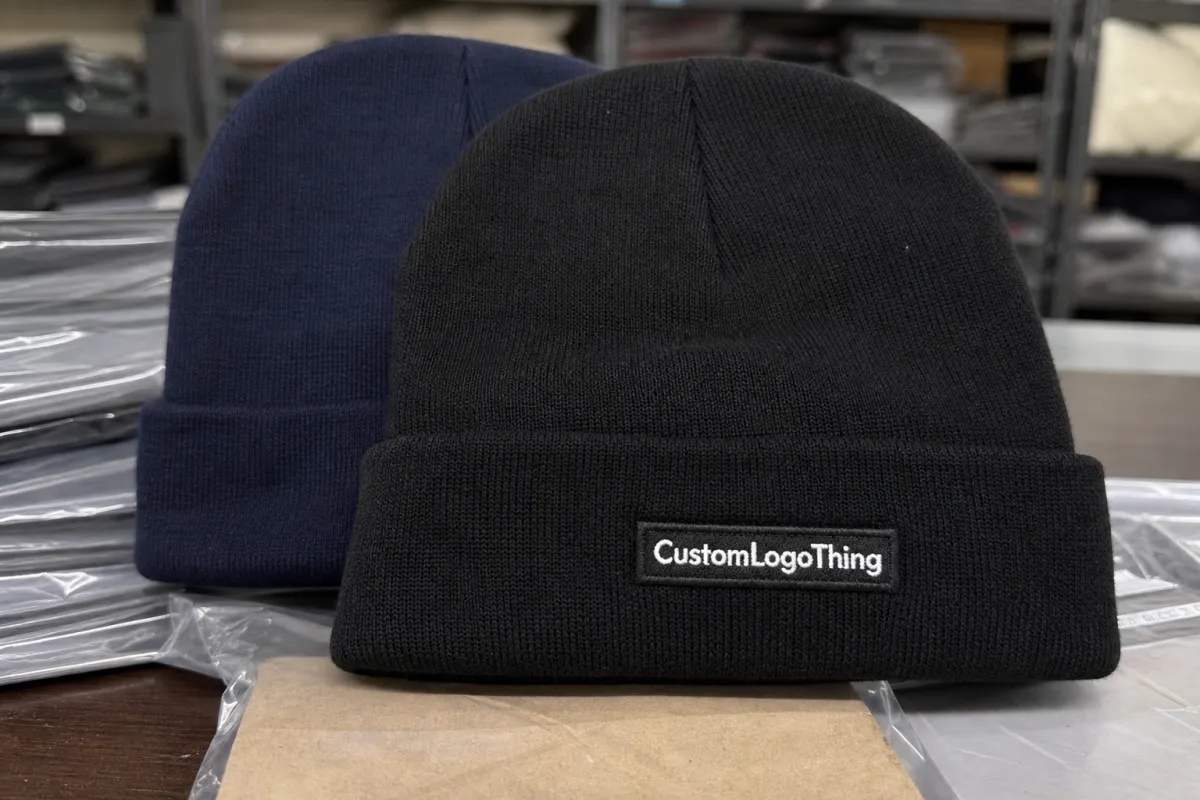
Cute mockups lie. Materials do not. A cosmetics Logo Patch Beanies material sample guide is useful because most sample problems are not caused by the logo file. They come from the whole material stack: yarn, knit gauge, cuff height, patch base, backing, border, thread, adhesive, and how that stack behaves when stretched across an actual head.
That last part matters more than buyers expect. A beanie lying flat on a table can look clean, centered, and premium. Put it on someone with hair, forehead movement, and a folded cuff, and suddenly the patch puckers, the serif logo blurs, or the backing feels like a tiny piece of sandpaper. Very glamorous. Very beauty-brand.
Cosmetics and skincare brands usually need a softer, more controlled result than event merch or sports promo programs. The patch cannot feel bulky, scratchy, cheap, or strangely stiff next to a brand system built around serum bottles, soft-touch cartons, glass jars, kraft paper inserts, and tidy unboxing photos. If the product line says “calm clinical skincare” but the beanie says “county fair giveaway,” the materials are fighting the brand.
A practical sample kit should include beanie fabric swatches, knit options, patch material samples, logo decoration examples, thread colors, backing choices, and notes on wash behavior, stretch, and skin contact. For cosmetics brands, compare those pieces against current packaging, PR mailers, retail displays, and launch kit components. A matte silicone patch may sit naturally beside minimalist cartons. A rustic faux leather patch may work better for a natural body care brand using corrugated cardboard shippers and unbleached inserts.
A sample is not a tiny preview for fun. It is a risk filter before bulk production. That matters if the beanies are going into holiday kits, influencer drops, staff uniforms, retail bundles, or a paid launch campaign with photography already scheduled. Buyers do not need another supplier brochure pretending every material is magical. They need a way to approve what will actually arrive in boxes.
Practical rule: approve the logo on paper, but approve the product in your hands. Digital proof, material sample, and pre-production sample are three different approvals.
How Patch Beanies Are Built for Beauty and Skincare Brands
A patch beanie is simple only if you ignore the parts that cause problems. Start from the outside in: beanie body, cuff height, knit construction, patch placement, patch material, logo method, stitching, backing, trimming, finishing, and packing. Each choice changes the final result.
The beanie body sets the tone. Acrylic is common because it offers broad color availability, predictable pricing, and decent softness for stock programs. Cotton feels more natural and breathable, but it can relax faster and may not recover as neatly after repeated wear. Recycled polyester blends can support sustainability claims if the supplier can provide documentation for recycled content. Wool blends feel warmer and more premium, though some wearers find them itchy. Cashmere-like acrylic gives a soft retail feel without true luxury pricing, which is why many beauty merch programs land there.
Cuff height is prime real estate. A folded cuff between 2.5 and 3.5 inches usually gives enough room for a visible patch without turning the beanie into a billboard. A patch placed on the cuff photographs better, merchandises better, and distorts less than one placed too high on the crown. High crown placement can disappear once the beanie is worn. Great for hiding your logo, if that was somehow the plan.
Patch type changes the mood. Woven labels handle fine detail better than many buyers expect and work well for thin lettering. Embroidered patches add texture and a tactile surface. Faux leather is clean for debossed or printed marks. Genuine leather feels more premium but raises cost, care, sourcing, and animal-origin questions. Silicone patches feel modern, durable, and slightly technical, which suits many skincare brands. Chenille is fuzzy, loud, and playful. Subtle? Not really. Useful for a color-heavy lifestyle campaign? Absolutely.
Beauty logos often include thin serif type, tiny icons, metallic effects, gradients, or delicate ingredient-inspired marks. Some survive production beautifully. Some become fuzz. A foil effect in a brand guide does not mean foil belongs on a curved knit cuff. The right sample process tests those details before they turn into 2,000 units of regret.
Material Factors That Change the Look, Feel, and Brand Fit
The best material is not always the most expensive one. It is the one that matches the product story, customer expectations, use case, and budget. A dermatologist-style skincare brand usually needs a different beanie than a playful lip gloss brand built around bold seasonal colors.
Yarn hand feel is the first checkpoint. Soft acrylic is practical for many campaigns because it balances cost, color range, and wearability. Cotton feels more breathable and natural, but it can stretch out faster, especially in looser knits. Wool blends can justify a premium winter kit, but test for itch near the forehead. Recycled blends support sustainability messaging only if documentation backs the claim. Ask for certificates or material declarations instead of accepting “eco” as a personality trait.
Knit density is the second checkpoint. A loose knit feels cozy, but it can distort the patch, especially if the patch is stiff or oversized. A tighter rib knit gives the patch a cleaner foundation and helps the cuff hold shape after wear. For most Logo Patch Beanies, a 1x1 or 2x2 rib knit is safer than a loose chunky knit if logo clarity matters.
Patch base material is the third checkpoint. Woven patches look crisp. Embroidered patches look dimensional. Faux leather looks sleek. Silicone looks waterproof, modern, and easy to wipe. Chenille feels tactile and promotional. The wrong one can make a high-end serum brand look like it ordered leftover campus merch. Harsh, but not inaccurate.
| Material Option | Best Use | Typical Tradeoff | Buyer Check |
|---|---|---|---|
| Acrylic beanie with woven patch | Budget-friendly beauty merch, staff wear, influencer extras | Less premium than wool or specialty blends | Check softness, pilling risk, and logo legibility under daylight |
| Cotton beanie with faux leather patch | Natural skincare, body care, spa-style brands | May relax faster than acrylic rib knits | Test shape recovery after stretching over a head form |
| Recycled blend with silicone patch | Modern skincare, refill programs, sustainability-led campaigns | Requires documentation if claims are used publicly | Ask for recycled content details and care instructions |
| Wool blend with genuine leather patch | Premium winter kits, retail bundles, higher-value gifting | Higher cost and possible skin sensitivity | Check itch, odor, leather source, and care limitations |
| Chunky knit with chenille patch | Bold lifestyle drops, color-heavy cosmetic launches | Logo detail can get messy fast | Use simple artwork and approve the patch at final scale |
Color matching needs physical proof. Screens lie almost as much as mockups. Yarn dye lots, thread sheen, patch substrate, and lighting can shift the final look. If your cosmetics packaging uses strict Pantone targets, request physical chips, lab dips, or existing material swatches. A blush tone on coated paper will not behave exactly like blush yarn. Neither will ink on faux leather.
Comfort is not optional. A patch with rough backing, a heavy stitched border, or a sharp synthetic edge can irritate skin near the forehead. For a beauty brand, that is especially awkward. The product is supposed to feel considered, not like it was designed by someone who has never worn a hat.
Wash and care behavior also deserve a line in the approval notes. Acrylic and polyester blends often tolerate basic wear well, but pilling, shrinkage, color bleeding, and patch edge curling can still appear depending on yarn quality and finishing. Cotton may change shape after washing. Wool blends may need gentler care. Genuine leather patches can limit wash instructions. If the beanie will be sold, not just gifted, the care label and fiber content need to be accurate.
For packaging claims, be equally practical. If the beanie ships in FSC certified cartons or biodegradable packaging, keep the material story consistent. The Forest Stewardship Council is a useful reference for paper-based packaging claims, while textile claims require their own documentation. Do not let a recycled mailer carry the entire sustainability message if the beanie materials tell a different story.
Sample Process and Timeline Before Bulk Production
A clean sampling process has stages. Skip stages and you save three days now, then lose three weeks later. Charming math.
Start by confirming the product goal. Is the beanie for retail sale, influencer gifting, launch kits, staff uniforms, event merch, or customer rewards? Then select the beanie body, choose patch material, submit artwork, review a digital proof, approve material samples, produce a pre-production sample, revise if needed, and only then move into bulk production.
Timelines vary by supplier workload and material availability, but practical ranges help. A stock material sample kit may ship within 2 to 5 business days if the beanie colors and patch bases are already available. Custom patch sampling often takes about 7 to 14 business days, depending on artwork complexity, mold needs, embroidery setup, or woven label production. A full pre-production beanie sample can take 10 to 20 business days or longer if yarn is custom dyed, the patch is specialty molded, or the factory queue is full.
Each approval means something different. The digital proof approves size, placement, logo layout, patch shape, and general proportions. The material sample approves touch, finish, thickness, color direction, and comfort. The pre-production sample approves the actual assembled product: patch stitched onto the selected beanie body at the chosen placement, with final backing and finishing.
Do not treat those as the same approval. A digital proof cannot tell you if a silicone patch is too heavy for a loose rib knit. A material swatch cannot confirm whether the patch lands centered on a folded cuff. A pre-production sample cannot fix a logo that should have been simplified before patch production, at least not without restarting parts of the process.
Revision loops are normal in moderation. One revision for patch size, thread color, or backing comfort is common. Four rounds because nobody decided whether the logo should feel minimal or loud is not a supplier problem. It is a planning problem wearing a merch hat.
Shipping can bend the schedule too. Domestic sample shipping may take 1 to 5 business days. Imported components can add a week or more, especially around peak holiday production windows. Beauty brands planning PR boxes should work backward from the required in-hand date, not the launch event. If cartons, inserts, tissue, or corrugated cardboard mailers need to arrive at the same co-packer, build that into the timeline.
Sampling takeaway: build time into the front of the project. Rushing the sample stage usually moves the pain into bulk production, where every mistake has more zeros attached.
Cost, MOQ, and Quote Details Buyers Should Check
Pricing depends on beanie material, knit type, patch type, patch size, number of colors, stitch complexity, order quantity, packaging, freight, and whether the beanie body is stock or custom knitted. That is why one-line quotes are dangerous. They hide too much.
Stock acrylic Beanies with Woven or embroidered patches are usually the most economical path. They use available colors, standard beanie bodies, and established patch methods. Silicone patches, genuine leather, custom-dyed yarn, custom knit patterns, specialty borders, and premium packaging push the unit cost up. Not always dramatically, but enough that buyers should compare options before falling in love with the prettiest sample.
MOQ means minimum order quantity. Stock beanie programs often allow lower MOQs because the base product already exists. Custom yarn colors, custom knit construction, specialty patch molds, and private-label packaging usually require higher minimums because setup and materials have to be justified. Factories are not running a custom dye lot for twelve beanies and good vibes.
As a planning range, many stock patch beanie programs start making sense around 100 to 300 units, depending on decoration method. More custom builds may push into 500, 1,000, or more units. Specialty materials can require higher commitments if the supplier must buy full rolls, create molds, or reserve production capacity. Treat these as planning numbers, not gospel.
Ask for quote details by line item. You want unit cost by quantity tier, sample cost, setup fee, mold fee if applicable, patch cost, packaging cost, freight estimate, production lead time, revision policy, and overage or shortage tolerance. Many custom product orders allow a small overage or shortage, often around 5%, because production is not always exact. Confirm that before finance starts counting units like a courtroom exhibit.
Cheap and brand-correct are not enemies. A low unit cost can be perfectly smart for giveaway merch, campus ambassador kits, or internal staff use. Retail beauty kits need better hand feel, cleaner patch edges, tighter color control, and packaging that does not crush the cuff. Cheap can be strategic. Cheap-looking is different. One saves money; the other burns it.
Ask for two quote versions: a budget-friendly version and a premium version. Compare a stock soft acrylic beanie with a woven patch against a recycled blend beanie with a silicone patch and FSC certified belly band. The comparison turns vague taste into actual tradeoffs: cost, MOQ, lead time, feel, and brand fit.
For transit testing on larger launches, review packaging expectations against standards from organizations such as ISTA. You may not need full lab testing for every beanie order, but if the product ships in a fragile PR kit with bottles, jars, and inserts, distribution handling deserves more than a shrug.
Common Sampling Mistakes That Make Beanies Look Cheap
The biggest mistake is approving from a digital mockup only. A mockup cannot show stretch, puckering, patch thickness, thread sheen, backing comfort, or whether the logo looks like it was ironed on during a lunch break. The mockup is a planning tool. It is not proof of production quality.
Artwork causes plenty of avoidable pain. Tiny type, thin lines, gradients, foil effects, and overly detailed icons do not always translate to patch materials. Cosmetics brands often have delicate marks, especially skincare labels with serif typography or fine botanical symbols. Simplification may be necessary. That is not ruining the brand. That is adapting the mark to the medium.
Patch sizing is another common failure. Too small looks like an afterthought. Too large makes the cuff stiff and awkward. For many adult beanies, patch widths around 2 to 3.5 inches are common, but the right size depends on cuff height, logo shape, and use case. Retail product? Keep it clean. Staff uniform? Make it readable. Influencer kit? Make sure it photographs well without swallowing the whole beanie.
Placement can ruin an otherwise decent sample. A patch too close to the fold edge may curl. Too high, and it can disappear when worn. Off-center placement looks especially bad in product photography because the face, cuff, and patch create obvious alignment lines. If your product photographer has to keep tilting the beanie to hide the placement, the sample failed.
Packaging context gets ignored far too often. If the beanie ships inside a PR box, kraft paper pouch, mailer, or holiday bundle, the patch material should make sense with the rest of the system. A rustic faux leather patch next to glossy silver serum cartons may look confused. A crisp woven patch beside clean matte cartons may feel more intentional. A silicone patch paired with refillable skincare packaging can look modern and durable.
Another mistake: choosing material only by cost. A lower price can be smart if the audience expects casual merch. But if the product sits inside a $95 skincare set, the beanie cannot feel like the freebie nobody asked for. Texture, weight, edge finish, and color match carry the brand message as much as the logo.
Also watch the backing. Buyers obsess over the front of the patch and forget the part touching skin. Rough backing, stiff corners, and thick borders can make the beanie uncomfortable after ten minutes. A proper cosmetics Logo Patch Beanies material sample guide should force that check early, before bulk stitching locks the problem in place.
Build a Sample Request That Gets the Right Beanie
A strong sample request starts with real project details, not “send options.” Give the supplier your audience, use case, target quantity, target budget, launch date, preferred beanie material, patch style, logo files, brand color references, and packaging expectations. The more specific the brief, the less random the sample set.
Request a small but useful comparison set. Two beanie body options, two patch material options, one safe logo execution, and one more premium logo execution are usually enough. That gives the team real choices without turning sampling into a science fair. Nobody needs nine nearly identical black beanies unless the goal is decision fatigue.
Send the right files. Vector logo files are best, usually AI, EPS, SVG, or clean PDF. Include Pantone references or brand color values, desired patch dimensions, placement notes, product inspiration images, and any compliance or sustainability requirements. If the beanie must coordinate with paper packaging, mention whether the boxes are coated, uncoated, recycled, FSC certified, or using post-consumer waste. Materials do not match by telepathy.
Judge samples in real conditions. Put the beanie on a head. Look at it in daylight. Photograph it on a phone. Place it beside current cosmetics packaging. Fold and unfold the cuff. Handle it for a few minutes. If it will ship in a PR kit, test how it sits beside bottles, jars, inserts, and tissue. A beanie that only looks good flat on a desk is not finished doing its job.
- Softness: check the yarn against skin, especially near the forehead.
- Stretch: confirm the patch does not warp badly when worn.
- Logo clarity: inspect small type, icons, borders, and color contrast.
- Patch edge quality: look for fraying, uneven stitching, curling, or bulky borders.
- Backing comfort: touch the inside surface and test for scratchy areas.
- Color match: compare yarn, thread, and patch under daylight and indoor light.
- Cuff height: make sure the patch stays visible when worn normally.
- Packaging fit: test the beanie inside the actual box, pouch, or mailer.
- Landed cost: include product, setup, sample, packaging, freight, duties, and overage allowance.
Use the sample stage to turn opinions into specs. “Make it premium” is not a production instruction. “Soft acrylic rib knit, 3-inch cuff, 2.5-inch woven patch, off-white yarn, warm gray thread, soft backing, packed in FSC certified kraft belly band” is much better. See the difference? One is a mood. The other can be made.
The point of a sample guide is not to make the buying process feel more complicated. It is to make the risks visible while they are still cheap to fix. Compare touch, stretch, color, patch quality, MOQ, packaging fit, and cost before bulk production starts. That is how beanies end up feeling connected to the beauty brand instead of random merch wearing a logo.
FAQs
What should a cosmetics logo patch beanies material sample guide include?
It should include beanie fabric swatches, knit options, patch material samples, logo method examples, thread or substrate colors, backing details, patch size options, and notes on stretch, comfort, wash behavior, MOQ, and Lead Time. For cosmetics brands, compare samples next to current packaging so the beanie feels connected to the product line instead of random merch.
Which patch material works best for cosmetics logo beanies?
Woven patches work well for small clean logos, embroidered patches add texture, faux leather gives a polished lifestyle look, silicone feels modern and durable, and chenille works for bold promotional drops. The best choice depends on logo detail, brand tone, budget, and whether the beanie is for retail, gifting, staff uniforms, or influencer kits.
How long does it take to sample custom logo patch beanies?
Stock material sample kits may be available within 2 to 5 business days, while custom patch samples often take about 7 to 14 business days depending on material and artwork complexity. Full pre-production samples take longer because the beanie, patch, placement, stitching, and finishing all need to be assembled and checked before bulk production.
What affects the cost of cosmetics logo patch beanies?
Major cost factors include beanie material, knit type, patch material, patch size, number of logo colors, artwork complexity, order quantity, packaging, freight, and whether stock or custom-dyed materials are used. Ask for quantity breaks and separate sample, setup, packaging, and freight costs so the quote is not one mysterious number wearing a trench coat.
Can small cosmetics brands order logo patch beanie samples before committing to bulk?
Yes, and they should. Sampling helps confirm softness, logo clarity, color match, patch comfort, and overall brand fit before spending on a larger order. Smaller brands should ask for stock beanie options and lower-MOQ patch methods first, then upgrade materials once demand or campaign volume justifies it.


