Buyer Fit Snapshot
| Best fit | Embossed Corrugated Cartons Manufacturer Explained projects where brand print, material claims, artwork control, MOQ, and repeat-order consistency need to be specified before quoting. |
|---|---|
| Quote inputs | Share finished size, material target, print colors, finish, packing count, annual reorder estimate, ship-to region, and any compliance wording. |
| Proofing check | Approve dieline scale, logo placement, barcode or warning zones, color tolerance, closure strength, and carton packing before bulk production. |
| Main risk | Vague material claims, crowded artwork, missing packing details, or unclear freight terms can make a low unit price expensive after revisions. |
Fast answer: Embossed Corrugated Cartons Manufacturer Explained should be specified like a repeatable production item. The safest quote records material, print method, finish, artwork proof, packing count, and reorder notes in one written spec.
Production checks before approval
Compare the actual filled-product size with the drawing, then confirm tolerance on folds, seals, hang holes, label areas, and retail display edges. Reserve space for logos, QR codes, warning copy, and material claims before decorative graphics fill the panel.
Quote comparison points
Review material grade, print process, finish, sampling route, tooling charges, carton quantity, and freight assumptions side by side. A quote is only useful when the supplier can repeat the same color, closure quality, and packing count on the next order.
Embossed Corrugated Cartons Manufacturer Explained
An embossed corrugated cartons manufacturer works at the point where packaging stops being purely utilitarian and starts carrying a tactile signature. The carton still has to protect the product, survive the warehouse, and hold its shape through transit, but embossing adds a surface detail that changes how the box feels before anyone even opens it. That raised or recessed impression can make a plain shipper read as deliberate, polished, and worth remembering.
Brands That Sell directly to customers, move goods through retail channels, or want a shipper that looks considered on arrival often turn to embossing for that extra layer of character. From a buyer's side, the appeal is not only visual. A skilled embossed corrugated cartons manufacturer understands how to shape texture without weakening the carton, and that balance matters a lot more than a glossy render suggests. If you are comparing formats, Custom Shipping Boxes are a useful place to start, and About Custom Logo Things gives more background on how custom packaging requests are handled.
What an Embossed Corrugated Cartons Manufacturer Actually Does
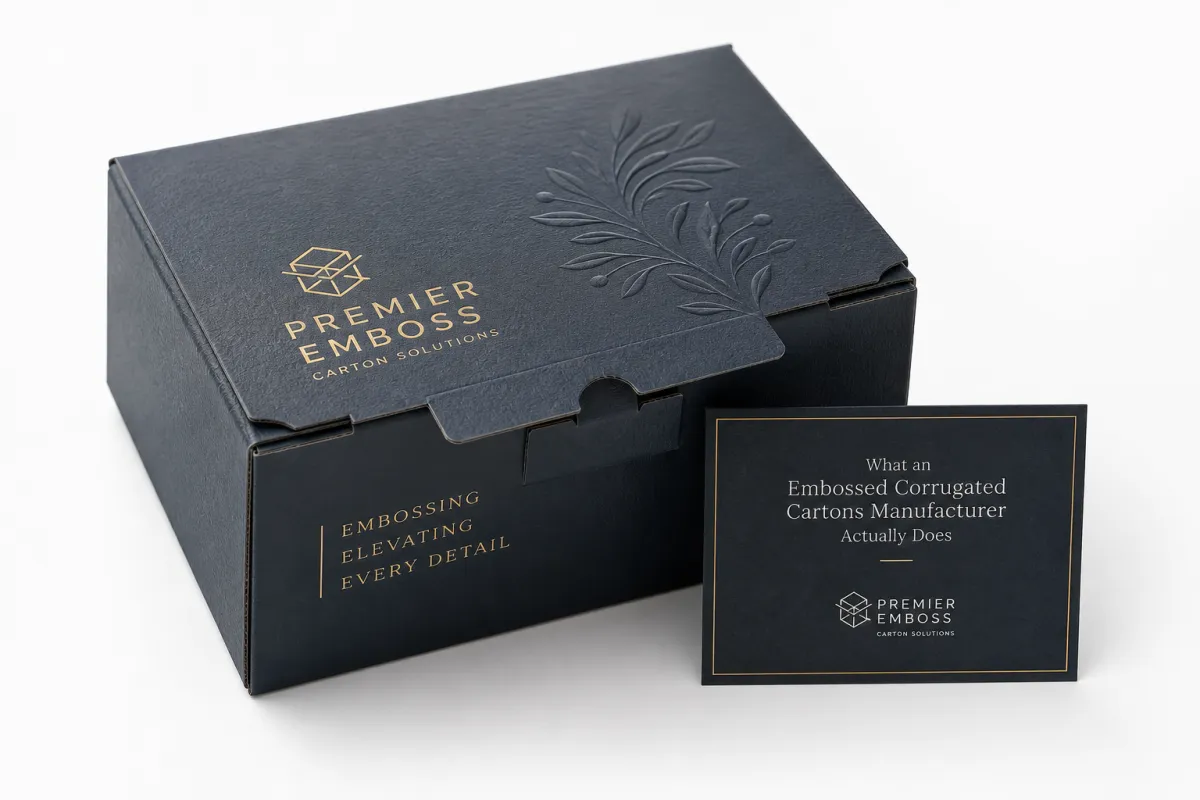
A good embossed corrugated cartons manufacturer does far more than press a logo into a sheet and call the job done. The carton begins as a structure built for a specific weight, route, and handling pattern, then receives a raised or recessed treatment that changes the surface experience. That treatment may be a logo, a border, a repeat pattern, or a subtle texture that catches light in a way print alone cannot. The effect looks decorative at first glance, but it often carries real branding weight because it gives the packaging a physical cue customers notice immediately.
Embossed corrugated cartons use a matched die and counter-die to shape the board, creating either a blind emboss with no printed alignment or a registered effect that sits in line with artwork. The details matter more than most first-time buyers expect. Board direction, flute profile, liner smoothness, and pressure all influence whether the finished impression feels crisp or soft. A serious embossed corrugated cartons manufacturer will choose the design with the material in mind, because corrugated fiberboard rewards bold forms and punishes tiny, fragile detail.
These cartons show up across a wide range of packaging programs. E-commerce brands use them to make the unboxing feel more intentional. Subscription businesses use embossing to keep recurring shipments from feeling generic. Retail-ready packs use surface texture to carry brand identity on the outer shipper itself. Industrial programs use it too, especially where a premium, tamper-conscious, or brand-forward outer carton has more value than a plain kraft box. In that sense, an embossed corrugated cartons manufacturer sits at the meeting point of branding and logistics, not just finishing.
The advantage is straightforward: stronger perception, better shelf or doorstep impact, and a more memorable pack without needing heavy ink coverage. The caution is just as direct. Embossing is not a fix for weak carton structure. If the board is underspecified, the flute is wrong, or the carton is being asked to do more than it can, the embossing will not save it. A careful embossed corrugated cartons manufacturer starts with performance, then layers the visual effect onto that foundation.
That distinction is easy to miss if the sample looks impressive. Texture can suggest quality, but quality comes from the whole system: liner choice, flute selection, adhesive integrity, die accuracy, cut quality, and how the carton behaves under stacking and vibration. I have seen first-round samples that looked excellent on a clean table and then went a little flat after real handling, which is kinda the whole reason sample approval exists. When the structure is right, embossing can elevate the box without making it fragile. When the structure is wrong, embossing only gives the failure a better surface.
Many brands compare embossed corrugated packaging against other premium carton styles before they settle on a direction. That comparison is healthy. A knowledgeable embossed corrugated cartons manufacturer should be able to explain where embossing makes sense beside print, coating, windows, or a heavier liner, and where another route is a better fit.
How an Embossed Corrugated Cartons Manufacturer Creates the Look
The process starts well before the press touches the board. An experienced embossed corrugated cartons manufacturer first translates the artwork into a die plan, since embossing depends on exact geometry. The die is the physical tool that creates the raised or recessed area, and its shape determines whether a mark reads cleanly or turns into a soft, vague impression. Fine detail can disappear if the board is too unforgiving. Too little depth, and the effect gets lost in handling or print.
Tooling setup follows. The manufacturer checks registration, pressure, and the fit between the embossing die and the carton blank. Corrugated stock behaves differently from folding carton stock because it has a fluted middle layer, a liner surface, and enough variation in caliper to change how pressure spreads across the sheet. A die that looks ideal on paper can compress one portion of the box too much and barely touch another. A capable embossed corrugated cartons manufacturer adjusts for that spread rather than chasing a perfect screen image that never existed in the first place.
Material selection affects the outcome more than many buyers expect. Coatings can soften tactile definition. Moisture content changes how the board rebounds after pressing. White-top liners and kraft liners respond differently. E-flute, B-flute, and double-wall builds all behave in their own way. Smooth liners and smaller flute profiles tend to hold fine texture more cleanly, while heavier shipping cartons often need broader emboss shapes because the board itself resists delicate depth.
Blind embossing and registered embossing are not the same thing. Blind embossing gives a texture or shape without printed alignment. Registered embossing ties that raised or recessed detail to artwork so the two elements work together. Some brands pair embossing with restrained print or limited foil, though foil is less common on corrugated because the substrate is less forgiving than folding carton stock. A thoughtful embossed corrugated cartons manufacturer usually keeps the discussion focused on clarity, not decoration for decoration's sake.
The real goal is not microscopic detail. It is a clean, durable tactile effect that survives the conditions corrugated cartons actually live through: warehouse handling, stacked loads, conveyor contact, and the occasional damp corner of a distribution center. A box can look excellent on a table and lose its impact after a few hours in transit. That is why a good sample tells you more than a render ever can.
Sample approval is part of the craft, not a formality. It shows whether the board grabs the emboss too hard, whether the depth feels intentional, and whether the design still reads after normal handling. A competent embossed corrugated cartons manufacturer will expect at least one sample round before production is released.
Key Factors That Shape Results from an Embossed Corrugated Cartons Manufacturer
Board choice usually decides more of the final look than the artwork file does. An embossed corrugated cartons manufacturer working on a lightweight e-flute display shipper has far more room for detail than one building a heavy double-wall carton for industrial goods. E-flute is often around 1.5 mm thick, B-flute roughly 3 mm, and that difference changes how pressure travels through the board. A logo that reads sharply on one board can soften on another because the material bends and rebounds differently under the die.
Artwork complexity comes next. Strong logos, broad textures, geometric borders, and clear shapes emboss well. Small type, thin rules, and intricate illustrations are much less reliable. That is not a flaw in the process; it is simply how corrugated fiberboard behaves. The best embossed corrugated cartons manufacturer will guide the design toward confident forms rather than fragile detail, because a strong silhouette reads better in the hand and from a distance.
Durability is the next filter. A carton that travels a short distance from warehouse to customer may tolerate a more expressive surface. A carton that spends time on a pallet, moves through mixed freight, or sits under heavier loads needs a different balance. Testing matters here. Compression performance, vibration resistance, and distribution simulation are often checked against standards such as ASTM D642 for compression and ASTM D4169 for distribution testing. An embossed corrugated cartons manufacturer that skips testing is asking the finish to carry more weight than it should.
Quality control extends beyond the final inspection table. It includes alignment, depth consistency, die wear, and run-to-run repeatability. On a 5,000-unit order, the first cartons may look excellent while a worn die or a shifting press setting begins softening the impression later in the run. Repeatability matters as much as the first approved sample. A dependable embossed corrugated cartons manufacturer documents pressure settings, die specs, and board selection so the next production run does not become a guessing exercise.
Brand strategy also shapes the brief. Some brands want a premium signal without filling the carton with ink. Others want anti-counterfeit cues that are difficult to copy quickly. Some want a tactile experience that makes the packaging feel less disposable. Those goals overlap, but they are not the same. A thoughtful embossed corrugated cartons manufacturer can help decide whether the project should emphasize texture, structure, or a mix of both.
If the carton will sit near a retail shelf edge, the tactile effect can matter more than marketers expect. If it is going straight into parcel networks, the question changes to whether the effect survives tape, labels, abrasion, and repeated handling. The strongest specifications are usually the clear ones: board grade, flute type, emboss depth, and the conditions the carton will face after it leaves the plant.
Cost and Pricing: What an Embossed Corrugated Cartons Manufacturer Charges
Pricing from an embossed corrugated cartons manufacturer usually comes down to a handful of factors that rarely act alone: die creation, setup time, board grade, carton size, print complexity, run length, and whether embossing is single-sided or paired with another finish. Two quotes can look close on the surface and still diverge once tooling, freight, revision rounds, and scheduling are included. Packaging pricing rewards specificity.
Short runs almost always carry a higher per-unit cost because the fixed expenses are spread over fewer cartons. That is simple manufacturing math, yet it still catches people by surprise. A tooling charge of a few hundred dollars can feel minor on a 25,000-unit order and heavy on a 500-unit prototype. A seasoned embossed corrugated cartons manufacturer will separate tooling from unit pricing so the real cost curve is easy to see.
Here is a practical comparison for a 5,000-unit order. These numbers are estimates rather than promises, because board choice, carton size, and artwork complexity can move them quickly.
| Packaging option | Typical use | Approximate unit price | Typical setup or tooling |
|---|---|---|---|
| Plain corrugated shipper with print | Basic shipping and brand labeling | $0.45-$0.95 | $150-$400 |
| Embossed corrugated carton with blind logo | Premium unboxing and stronger brand feel | $0.70-$1.40 | $350-$1,200 |
| Embossed carton with registered print | Retail-ready or more visual brand programs | $0.90-$1.80 | $500-$1,500 |
| Higher-spec embossed carton with special board or coating | Luxury, presentation, or heavy-duty packaging | $1.20-$2.50+ | $750-$2,000+ |
The table is a starting point, not a promise. Freight on oversized cartons can add meaningful cost, especially if the blanks are bulky before assembly. Rework after dieline approval can increase the budget quickly. A second sample round, rushed scheduling, or storage fees can do the same. A practical embossed corrugated cartons manufacturer will ask about the distribution path, not only the dimensions, because shipping method changes both board selection and landed cost.
Comparing embossing with other finishes is useful too. In some programs, embossing is less expensive than full-coverage premium printing or multiple finishing steps. In other programs, especially very small runs, it costs more than a clean printed carton and returns value through perception instead of lower spend. Packaging is not only a line item. It is part of the product experience. A smart embossed corrugated cartons manufacturer helps you spend where the customer can actually feel the difference.
One more budgeting habit keeps surprises down: ask for separate quotes for tooling, per-unit production, and reorder pricing. That makes the first run comparable to the next five runs, not just to the opening invoice. For recurring packaging programs, reorder economics often matter more than the first quote.
Process and Timeline: From Spec to Production
The timeline for an embossed corrugated cartons manufacturer usually moves through discovery, structural review, artwork preparation, die approval, sample production, revision, and full production release. That sounds neat on paper. Real projects loop back. A carton that looks right in concept can still need small changes once the emboss depth is tested against the actual board. Good teams expect that. Poor ones promise the impossible and lose days trying to catch up later.
The biggest delays are usually preventable. Incomplete dielines, missing logo files, unclear depth targets, and last-minute structural changes are common culprits. If the product weight or pack-out is still changing, the spec stays unstable. If the spec stays unstable, the embossing die cannot be finalized. A reliable embossed corrugated cartons manufacturer will ask for product dimensions, target quantity, shipping method, and launch date before quoting, because those inputs shape everything downstream.
Lead time depends on the complexity of the job. A simple embossed shipper with a single logo and standard board may move from approved art to production in about 10 to 15 business days if samples are approved quickly. A more involved build with custom structure, multiple revision loops, or special finishing can stretch into 3 to 5 weeks or more. If the cartons are tied to a retail launch, that buffer matters. A good embossed corrugated cartons manufacturer should be direct about where the schedule can flex and where it cannot.
Sampling deserves the most respect in the process. A digital proof can show placement. It cannot show tactile depth, fiber rebound, or how the carton feels after pressure. Sample cartons answer those questions. They show whether the logo reads from the expected distance, whether the emboss feels too deep, and whether the board survives normal handling. The right embossed corrugated cartons manufacturer treats the sample as a decision tool rather than a box-checking step.
If the emboss carries the branding, the structure still has to carry the shipment. When either side is weak, the whole carton feels uncertain.
Logistics deserve a place in the calendar too. Production capacity, transit time, warehousing, and sequencing needs should be built into the schedule from the start. A launch that depends on cartons arriving one week before go-live is asking for stress. A launch that gives itself two weeks of buffer is far easier to manage. That difference is often the gap between a calm rollout and a scramble in receiving.
For buyers comparing carton programs across categories, the same planning logic applies whether the box is a mailer, a retail shipper, or a protective outer pack. A disciplined embossed corrugated cartons manufacturer should help align sample approval, production slotting, and freight so the project does not stall at the finish line.
Common Mistakes When Working with an Embossed Corrugated Cartons Manufacturer
One common mistake is over-detailing the artwork. Tiny type, thin serifs, and delicate lines often disappear or distort in corrugated embossing. An embossed corrugated cartons manufacturer can improve the die, but board has limits. If the design depends on hairline precision, the substrate is probably wrong for that design.
Choosing appearance before performance causes trouble too. A carton that looks striking but fails stacking, compression, or transit testing is a false economy. The product may arrive damaged, and the packaging spend does nothing to prevent it. A practical embossed corrugated cartons manufacturer will keep asking about board grade, flute structure, and shipping conditions because a clean surface cannot rescue an underspecified carton.
Approval errors cost money. Skipping a physical sample, approving from a low-resolution render, or signing off before checking the carton in actual light can create surprises later. The texture may feel deeper than expected, or the mark may read weaker than the proof suggested. That is why a careful embossed corrugated cartons manufacturer will push for a proper approval loop, even if it adds a few days.
Board mismatch is another quiet problem. A lightweight board may work for a cosmetic mailer, but if the product is heavy or the route is rough, the embossed area can flatten or the surrounding panel can deform. That becomes risky in stacked warehouse environments. If the carton is carrying real weight, choose the structure for the load first and design the emboss around it, not the other way around.
Reorders can drift if the spec is not documented clearly. This happens often when multiple facilities or vendors are involved. A logo can shift a few millimeters, a die can be replaced with a slightly different version, or the board supplier can change and alter the surface feel. A disciplined embossed corrugated cartons manufacturer should store the approved spec, but buyers should keep their own benchmark sample too. That small habit saves headaches later.
There is one more mistake worth calling out because it is so easy to make: assuming one embossing approach works for every carton in a product line. It does not. A large master shipper, a retail-ready display carton, and a subscription mailer all behave differently. The same surface treatment can feel elegant in one format and awkward in another. The right embossed corrugated cartons manufacturer adjusts by application, not by habit.
Expert Tips for Choosing the Right Embossed Corrugated Cartons Manufacturer
Start with real board samples, not only digital mockups. Texture is tactile, and tactile decisions should be made with something in hand. A capable embossed corrugated cartons manufacturer will send samples that let you judge depth, crispness, and how the surface behaves under normal light. If the effect only looks good on a screen, it is not enough.
Test the carton under shipping conditions next. Compression, vibration, and moisture exposure can change the result more than buyers expect. A box can look perfect off the press and still feel underwhelming after a rough distribution cycle. The embossed corrugated cartons manufacturer you choose should be willing to discuss those conditions instead of treating them as someone else's concern.
Supplier conversations go better when branding and performance are discussed together. A vendor who only talks about decoration may miss the transit risks. A vendor who only talks about strength may miss the brand opportunity. The best fit understands both. For transport simulation, the International Safe Transit Association (ISTA) resources are useful for framing the testing conversation. For fiber sourcing, FSC matters if your packaging program depends on responsible paper procurement.
- Provide board grade, flute type, emboss depth target, and carton dimensions.
- Share product weight, pack-out, and whether the carton is for parcel, pallet, or retail display use.
- State the print method, if any, so the emboss and ink stay in harmony.
- Describe warehouse conditions, including humidity, stacking, and storage duration.
- Keep one approved benchmark sample for future reorders.
The checklist feels basic because it is. Most costly packaging problems are not caused by obscure manufacturing flaws; they come from incomplete communication. A good embossed corrugated cartons manufacturer can deliver very specific outcomes, but only if the brief is specific enough to support them.
There is another lesson buyers usually learn after a few packaging cycles: the best supplier is not always the one with the most dramatic mockup. It is the one that can explain why a particular flute, liner, or emboss depth will survive your shipping lane and still look like your brand. That answer tends to save money later, even if it sounds quieter up front.
From a sourcing angle, keep reorder consistency in view from the beginning. Ask what happens if a die wears, how the file is stored, and whether the approved sample will be used as a production benchmark. A dependable embossed corrugated cartons manufacturer should have a direct answer to all three.
Next Steps: Turn Your Packaging Spec into a Production Quote
If you are ready to move from concept to numbers, the shortest path is clear. Gather carton dimensions, product weight, and the shipping environment first. Then define the effect you want. Should the emboss feel understated and premium, or should it read from across a retail shelf? Those are different briefs, and an embossed corrugated cartons manufacturer will price them differently.
After that, request samples from at least two suppliers. Compare unit price, tooling, lead time, board grade, and how easy the vendor is to work with during revisions. A low unit price with a messy approval process is not a bargain. A slightly higher quote that includes clear documentation, a good sample loop, and repeatable specs often costs less over the life of the program. A practical embossed corrugated cartons manufacturer should be able to show you that math, not just describe it.
Document one approved benchmark sample and use it as the reference for future runs. That step is boring in the best way. It prevents drift. It keeps the emboss from changing subtly over time. It gives your internal team a physical standard to compare against whenever a reorder comes back into the system. A consistent embossed corrugated cartons manufacturer relationship is built on that kind of discipline.
For a packaging buyer, the real advantage is not novelty. It is control. You get a carton that looks deliberate, ships reliably, and supports the brand without asking corrugated board to do more than it reasonably can. That balance is worth aiming for, and it is exactly why the right embossed corrugated cartons manufacturer should be treated as both a packaging partner and a logistics partner.
What does an embossed corrugated cartons manufacturer do differently from a standard box supplier?
An embossed corrugated cartons manufacturer adds tactile design features to corrugated board using embossing dies, controlled pressure, and board-specific setup. The work is not only about making the box look better. It is about keeping the carton protective, repeatable, and suitable for shipping or retail handling. Many suppliers can print a box; fewer can manage the balance between surface detail and structural performance with real consistency.
Can embossed corrugated cartons be used for heavy shipping products?
Yes, if the board grade, flute structure, and emboss depth are selected for the product weight and transit conditions. Heavy items usually need stronger board and less delicate detail so the emboss does not flatten or distort. An embossed corrugated cartons manufacturer should also recommend testing before full production, because compression and vibration can change the result in ways a mockup will not show.
How much does an embossed corrugated cartons manufacturer charge?
Pricing depends on tooling, setup, carton size, board grade, artwork complexity, and quantity. Most embossed corrugated cartons manufacturer quotes also vary depending on whether the emboss is blind, registered to print, or combined with other finishing steps. Short runs usually cost more per unit because fixed setup costs are spread over fewer cartons. For that reason, ask for separate tooling and unit-price quotes.
How long does the embossing process usually take?
The timeline usually includes brief, artwork review, sample approval, and full production. Simple projects can move faster, while custom structures or multiple revision rounds add time. A careful embossed corrugated cartons manufacturer will tell you where the schedule is most likely to slip, which is usually the sample stage or late dieline changes. Sending final specs early helps reduce delays.
What should I send to an embossed corrugated cartons manufacturer before requesting a quote?
Provide carton dimensions, product weight, shipping method, and target quantity. Share artwork files, embossing goals, and any structural or branding requirements. A good embossed corrugated cartons manufacturer will also want your target launch date, because lead time, sampling, and freight planning all depend on it. The more concrete the brief, the more useful the quote.
The cleanest next step is simple: build a one-page spec with board grade, flute profile, emboss depth target, product weight, and shipping route, then ask for a physical sample before you approve anything for production. That one habit cuts through a lot of guesswork and gives you a carton that can earn its keep from the first run onward.