For a lot of brands, small business Woven Label Beanies print options sound straightforward until the first real quote arrives. Then the conversation shifts from logo ideas to stitch counts, placement tolerances, knit stretch, and what the decoration will look like after a customer has worn the hat, folded it, and stuffed it into a coat pocket. A beanie is not a flat canvas. It behaves more like a moving surface with opinions.
That difference matters. The decoration method should fit the fabric, the use case, and the quantity, not just the artwork file. A crisp woven label can look premium on a cuff, while a heat transfer may make more sense for a cleaner graphic hit. Embroidery adds texture and weight. Patches land somewhere in the middle. Each option changes the final read of the product, and the wrong match can make even good artwork feel awkward.
For smaller brands, the real challenge is not finding a decoration method. It is choosing one that survives production without becoming fussy or expensive. The best orders usually start with a simple design, a realistic timeline, and a hard look at how the beanie will be handled once it leaves the factory.
What Changes When a Small Brand Orders Beanies
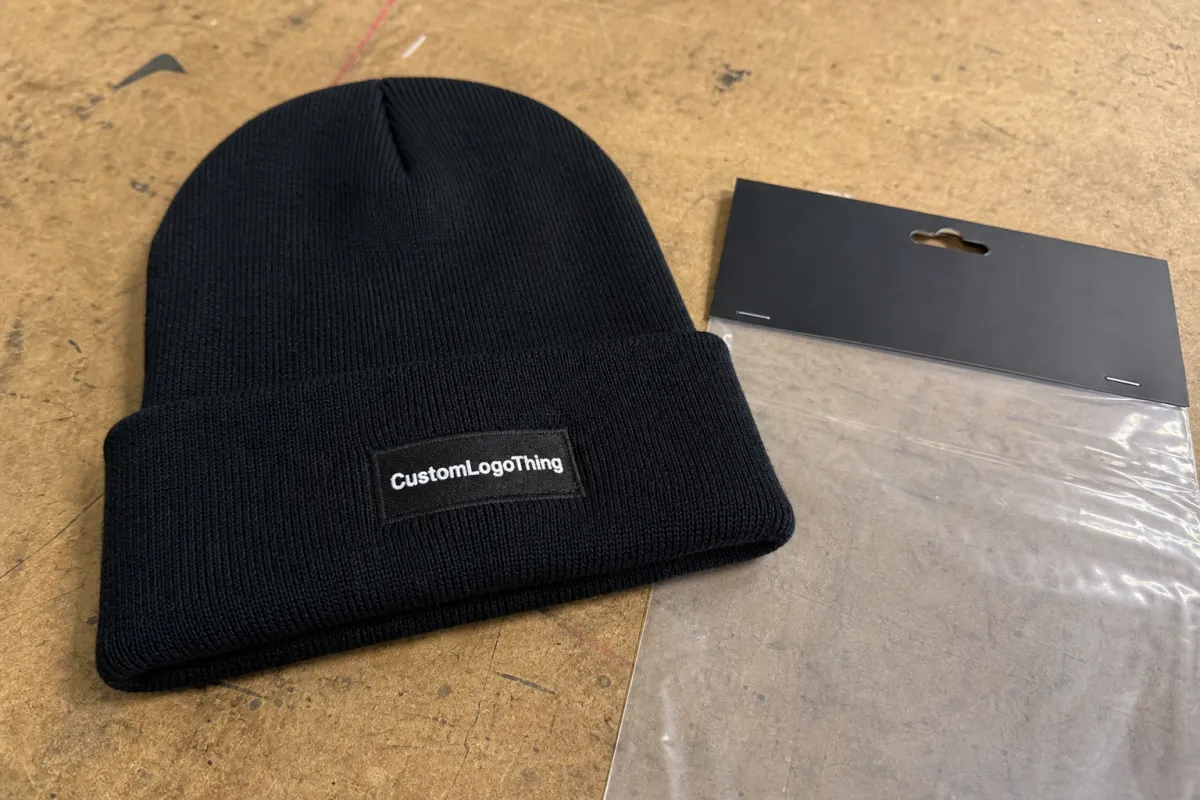
A blank beanie is forgiving. A branded beanie is less generous. The moment a logo, label, or patch enters the picture, the knit structure starts dictating what will work and what will not. Ribbed knits, chunkier yarns, and folded cuffs all change how the decoration sits. A mark that looks centered on a mockup can drift once the fabric relaxes.
That is why small orders often require more discipline than larger ones. On a 100-piece run, a two-millimeter placement shift is visible. On a 1,000-piece run, it is still visible, but the bigger issue is usually consistency from one carton to the next. The label height, the fold line, the trim length, and the way the hat is packed can change the retail impression more than most buyers expect.
There are four decisions that usually drive the whole job:
- Label position - cuff edge, side seam, front fold, or sewn patch.
- Decoration method - woven label, print, embroidery, or patch application.
- Artwork complexity - how much detail the knit or print surface can actually carry.
- Finish behavior - whether the branding stays flat, rises off the surface, or flexes with the fabric.
Small brands usually get better results when they simplify before production begins. Strong contrast helps. Clear shapes help. A two-color logo often survives knitwear far better than a detailed badge with fine lines and tiny type. That does not mean the design needs to feel stripped down. It means the design needs enough restraint to survive real-world wear.
Supporting packaging can carry the extra brand detail when the beanie itself should stay clean. A care card, hang tag, or folded insert can hold the storytelling that does not fit on the cuff. If a brand is building that supporting set, the Custom Labels & Tags page is a useful reference point for comparing label and tag formats that work alongside knitwear.
"The best beanie orders are usually the ones where the artwork got simpler before anyone asked for a sample."
How Print Methods Sit With Woven Labels
Woven labels and print methods do different jobs. A woven label gives the product a finished, apparel-style identity. The thread edges are tidy, the branding feels integrated, and the result usually reads as more considered than a basic printed mark. Print, by contrast, is better for graphics that need a flatter look or a larger visual footprint.
Heat transfer is useful when a brand wants a smooth surface and a lighter hand. It can be a smart choice for smaller logos, numeric marks, or secondary branding. Screen print works well for opaque color blocks and simple artwork, but it needs enough surface area and a knit that will not fight the ink. Embroidery brings the most texture and the strongest tactile read, although it can flatten small details into a dense, almost clotted shape if the stitch count is too high. Patches give a more retail-like finish and can be a good compromise when the design needs to feel substantial without being stitched directly into the fabric.
For woven labels, thread color and line clarity matter more than most art files suggest. Complex shading is usually a poor trade on a small label. Clear edges, solid contrast, and deliberate spacing are more reliable. If the brand graphic depends on gradients, hairline strokes, or photographic detail, that artwork is better moved to an insert or hang tag where print has more room to breathe.
There is a production reality behind all of this: knit stretch is not forgiving. A decoration that looks perfect on a flat table can distort once the beanie is worn. A print that sits cleanly on a swatch may crack, feather, or feel stiff on a ribbed cuff. That is one reason the most practical small business woven Label Beanies Print Options are usually the ones that tolerate motion rather than only looking good in a mockup.
Packaging adds another layer. For short-run cards and inserts, digital printing is usually the quickest route. Offset printing makes more sense as quantity rises and the job stabilizes. Flexographic printing can fit simple roll-fed components or repeat labels. The beanie decoration and the packaging do not need the same process, but they should feel like part of the same brand system.
For packed products headed into distribution, basic transit testing is not a luxury. If hats are being shipped in cartons, ISTA guidance is a useful benchmark for understanding how much handling the package should survive before the customer sees it. And if the brand wants a cleaner paper story for inserts or tags, FSC-certified stock is a sensible question to ask early rather than after the print order is already moving.
| Decoration method | Best use | Typical add-on cost per beanie | Common MOQ | Usual lead time |
|---|---|---|---|---|
| Woven label sewn to cuff | Crisp branding, small logos, retail presentation | $0.55-$1.25 | 100+ | 10-15 business days |
| Heat transfer | Flat graphics, secondary marks, simple color blocks | $0.70-$1.60 | 50-100+ | 7-12 business days |
| Embroidery | Premium tactile feel, bold logos, durable wear | $1.25-$3.50 | 50-100+ | 10-18 business days |
| Woven or embroidered patch | Higher perceived value, stronger shelf presence | $1.00-$2.75 | 100+ | 12-18 business days |
Those numbers only make sense when you compare them against the whole order. A low decoration price can lose its appeal once setup, file prep, placement labor, packing, and freight are added back in. On small runs, that add-up effect is often larger than buyers expect. A quote that looks expensive at first may be the better value if it already includes the work that would otherwise appear later as line-item surprises.
Cost, MOQ, and Quote Drivers That Move Pricing
Beanie pricing is rarely controlled by one factor. It is usually a stack of small decisions, each one nudging the final number upward or downward. The art complexity matters. The number of colors matters. Whether the branding is sewn, pressed, or embroidered matters. So does how much manual handling the product needs before it is packed and shipped.
The biggest quote drivers tend to be predictable:
- Setup fees - art prep, loom setup, print plates, or transfer file preparation.
- Color count - more thread or ink colors usually mean more handling and more checks.
- Placement complexity - a centered cuff label is easier than a patch placed on a curved crown panel.
- Application labor - sewing, pressing, trimming, and folding take time even on small runs.
- Packaging finish - polybags, inserts, stickers, belly bands, and carton labels all add work.
MOQ is where many small businesses feel the pressure. A supplier may be willing to quote a lower threshold for a simple single-placement job, but once the order includes multiple decoration points or custom colors, the labor equation changes. A 100-piece run can be possible and still carry a unit cost that feels close to a 250-piece run because the setup work is almost the same. That is not a trick; it is the arithmetic of short production.
One of the easiest ways to compare small business Woven Label Beanies print options is to ask for tiered pricing. Request 100, 250, and 500 units, then measure the real drop in unit cost. If the savings between 250 and 500 are small, more inventory may not be worth the cash tied up on a shelf. If the savings are meaningful and the design is evergreen, the larger run can be the better decision.
Ask how the quote handles assumptions. Some suppliers include sample or strike-off costs. Others do not. Some build basic folding and polybagging into the unit cost. Others charge separately for every extra step. The quote that looks higher on paper can be the cheaper order if it already includes the work that usually shows up later as add-ons.
For brands watching margins closely, there is one practical rule: the more the decoration depends on labor, the more it rewards quantity. A simple woven label scales more gracefully than a highly handled patch or a multi-step print-and-sew order. That difference can be the gap between a profitable seasonal drop and inventory that sits unsold because the margin never had room to begin with.
Process, Timeline, and Production Steps From Art to Carton
The cleanest orders usually follow a familiar path: artwork review, method selection, proofing, sample approval, production, quality control, and packing. The sequence sounds obvious, but this is where many small orders lose time. A missing vector file delays proofing. A late placement change pushes the schedule back. A color revision that would have been cheap before production can become expensive after a run has already started.
For most small business Woven Label Beanies print options, the schedule depends less on the sewing or printing itself and more on how quickly the approvals move. If the beanie body is already in stock and the artwork is clean, a straightforward order can often move in about 10-15 business days after proof sign-off. Custom yarn-dyed labels, multiple decoration methods, or a sample round can stretch the timeline. That is normal, especially when the order is trying to do several jobs at once.
The production sequence usually looks like this:
- Artwork check - confirm vector files, Pantone or thread references, and minimum line thickness.
- Placement mockup - review where the label or print sits on the cuff or body.
- Proof approval - lock dimensions, color, and copy before anything is made.
- Sample or strike-off - verify texture, contrast, and real-world fit.
- Production run - weave, print, sew, trim, and inspect.
- Final packing - fold consistently, polybag if needed, and carton for transit.
A buyer who respects that sequence usually gets fewer surprises. A 10-minute proof review can save a week of correction work later. That is especially true on knitwear, where the surface can hide a problem in the proof and reveal it only after the item has been folded, stretched, or worn.
If packaging is part of the order, the print method for the supporting pieces should be lined up with the timeline too. Digital printing is typically faster for short-run cards and inserts. Offset printing becomes more efficient as quantities rise. Flexographic printing can make sense for simple labels or repeat components. The goal is not to chase the most elaborate method; it is to keep the decoration, packaging, and shipping schedule in step so nothing is waiting on something else.
Design Factors That Protect Legibility and Fit
A beanie is not static. It stretches, folds, and moves with the head underneath it. That is the reason logo size matters so much. A tight-knit surface can carry more detail than a loose one, but only up to a point. Tiny type, thin outlines, and crowded symbols are the first elements to disappear once the hat is worn or the cuff relaxes.
Contrast matters just as much. Tonal branding can look sophisticated on premium knitwear, but if the contrast is too low, the label disappears from a few feet away. For shelf visibility, a cleaner contrast pair often performs better than a subtle tone-on-tone palette. If the goal is easy recognition in retail, legibility should lead the design decisions.
Placement changes the feel of the piece. A front-panel label gives a stronger read. A side-seam placement feels quieter and more apparel-like. A folded-edge mark can look neat in a display wall but may disappear once the cuff loosens. The right answer depends on the use case: retail shelf, event merch, employee uniforms, or wholesale resale.
Two details get overlooked often: stretch recovery and wash behavior. A decoration that looks perfect flat can shift after wear, then settle again after washing. Even a well-made woven label should be checked for how it sits after folding and handling, because buyers do not see the beanie in a vacuum. They see it in a box, on a rack, or pulled on in motion. Those are different tests.
When a brand already has an apparel system, consistency is usually the smarter move than invention. Matching thread colors, repeating the same icon treatment, or keeping label dimensions close across accessories helps the line feel deliberate. If the beanie belongs to a broader accessory program, the linked set of Custom Labels & Tags can carry part of that identity without forcing every detail onto the knit itself.
Common Mistakes That Make Beanies Look Less Premium
The most common mistake is trying to do too much in too little space. A logo that looks elegant on a website banner can turn muddy on a one-inch woven field. Microtype is usually the first thing to fail. Thin outlines follow close behind. Knitwear simply does not behave like paper, and it will not reward overdesigned art.
Another problem is assuming every decoration method behaves the same way. It does not. Embroidery adds height and structure. Heat transfer gives a flatter profile but can show edge issues on textured surfaces. Woven labels can look beautifully crisp, yet they still need the right thread count and edge treatment to avoid visual clutter. Treating all of those methods as interchangeable often produces a result that feels slightly off even when the work is technically correct.
Skipping proofing is an expensive habit. A proof is not paperwork for the sake of paperwork. It is where small corrections stay cheap. Catch a contrast issue before production and the fix may be simple. Catch it after the full order is made and the decision becomes uncomfortable: sell it anyway, discount it, or absorb the loss. None of those options are great on a small budget.
Packaging can weaken a strong decoration choice, too. A carefully sewn label still looks rough if the beanie is stuffed into a bag with no fold discipline, or if the carton crushes the knit during transit. Print finishing and packing matter because they shape the first impression. If the customer opens the box and sees carelessness, the product feels less premium no matter how good the label is.
"Premium knitwear usually relies on restraint: a clean blank, a readable mark, a disciplined fold, and packaging that respects the shape of the product."
Think about shipping the same way a packaging engineer would. The beanie may not need elaborate distribution testing, but folding, bagging, and boxing should still protect shape and surface. Simple packing usually beats decorative overkill. It costs less, fails less, and keeps the hat looking like it belongs on a shelf instead of a warehouse floor.
Expert Tips and Next Steps for a Cleaner Order
The fastest way to improve a beanie order is to send better input before asking for quotes. A vector logo, preferred label size, color references, placement photos, and target quantity give the supplier enough information to respond without guessing. Guessing is where a lot of small-run mistakes begin.
If the branding is new, ask for a sample or strike-off. That is the easiest way to check stitch density, print clarity, edge behavior, and placement at the same time. A digital mockup can look polished while still failing in hand. A real proof on the actual beanie style tells the truth, and that truth is cheaper to learn before production starts.
It also helps to choose the decoration based on how the hat will actually be used. Retail merch usually justifies a cleaner woven label and stronger finishing. Event giveaways often call for a simpler, more durable mark that keeps cost under control. Employee apparel sits in the middle. Wholesale resale needs the best balance of branding and margin because the product will sit next to competing pieces on the same shelf.
For buyers narrowing small business woven label beanies print options quickly, a practical sequence works well:
- Pick two decoration methods that fit the knit texture.
- Confirm MOQ and timeline before locking the art.
- Request a proof or sample on the actual beanie style.
- Approve only after checking fold, contrast, and placement.
- Lock the artwork so the production run stays consistent.
The most reliable final check is the shelf test. If the beanie reads clearly from three feet away, folds cleanly, and still feels comfortable in hand, the order is probably on track. That is the point where aesthetics, production reality, and cost all meet. For small brands, that intersection matters more than perfect art on a screen.
Put differently: the best result is not the decoration that looks most impressive in isolation. It is the one that survives the knit, survives the carton, and still looks intentional when a customer pulls it on in winter light.
What are the best small business woven label beanies print options for retail merch?
Woven labels are usually the cleanest starting point for retail because they give sharp brand identity without fighting the knit. If you need a secondary graphic, a simple print or patch can work beside the label, but keep the artwork readable on rib knit and ask for a proof on the actual beanie style before approving the run.
How much do woven label beanies print options usually add to unit cost?
Cost rises with more colors, more placements, more labor, and more complicated finishing. Small orders pay a higher share of setup, so a 100-piece run often feels much more expensive per unit than 500 pieces. A tiered quote is the quickest way to see where the savings really begin.
Can I use both woven labels and printed decoration on the same beanie?
Yes, and many small brands do exactly that. A woven label can carry the main brand mark while print handles a secondary message or icon. The key is keeping both elements simple enough that the knit does not distort the art or make the front panel feel crowded.
What affects turnaround when ordering small business woven label beanies?
Artwork approval, proof revisions, material availability, and label weaving time are the main schedule drivers. Simple art with fast approvals moves sooner, while custom colors or multiple decoration methods take longer. If timing matters, ask which step is most likely to slow the order before you submit files.
How do I choose the right print method for a beanie body or cuff?
Start with the knit texture and stretch, then match the method to the detail level you need. Ribbed or flexible surfaces usually do better with simpler, higher-contrast art. If you are unsure, ask for two mockups so you can compare how each option sits on the beanie before you approve production.


