Flyers disappear into bags. Caps keep moving. That is the practical appeal of an event merch Five Panel Caps bulk order: the item gets worn, photographed, and seen again after the entry line has cleared. A good cap is not just giveaway material. It becomes a small, repeatable branding surface that stays active across the venue, the commute home, and the social posts that follow.
Buyers tend to notice that only after they compare it with other merch. T-shirts are useful, but they require sizes. Tote bags have reach, but they are carried, not worn. A five-panel cap lands in the middle: low-friction distribution, broad fit range, and enough front-panel space to keep a logo readable from a distance. That combination matters at festivals, sponsor activations, trade shows, volunteer programs, and staff uniforms where speed at distribution points can matter as much as appearance.
The other advantage is operational. A single cap style simplifies pack-out, counts cleanly by carton, and reduces sorting at the table. If the event team needs to separate stock by crew, sponsor, floor, or entrance, the same product can be staged in different bundles without turning the handout into a size-matching exercise. For event buyers, that kind of simplicity is not a luxury. It is often the difference between a clean rollout and a last-minute scramble.
The strongest runs are planned around the actual use case rather than the catalog photo. That means choosing a blank that fits the weather, a decoration method that holds up in crowds, and a delivery schedule that leaves room for proofing, approval, and freight. A cap can look good on screen and still fail on site if the brim shape, closure, or logo size is wrong for the audience.
"If the cap fits the crew and the logo reads in photos, it earns its keep."
What an event merch five panel caps bulk order delivers at the gate
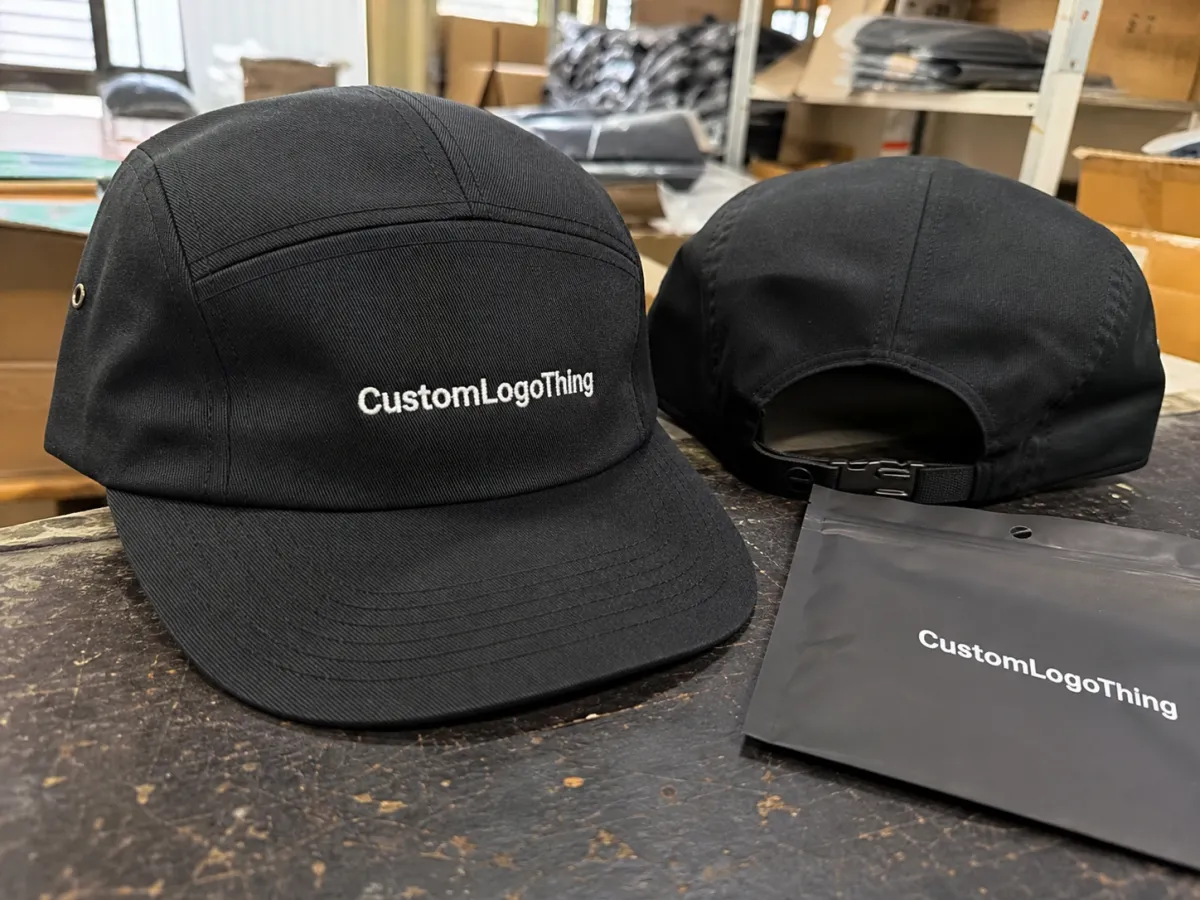
The gate is where value becomes visible. A cap handed out at check-in is usually worn immediately, which means the logo starts working before the event has fully settled. That is a meaningful advantage over print items that get pocketed and forgotten. In a crowded venue, a five-panel cap also reads better than many other small-format merch items because it sits high in the frame and remains visible in overhead photos, short video clips, and casual crowd shots.
That is why this format shows up so often in event merch programs. It fits staff, volunteers, booth teams, street crews, and sponsor activations because it is simple to size, simple to ship, and simple to distribute in batches of 25 or 50. The math is straightforward: fewer touchpoints at the table, fewer fit questions, fewer leftovers in the box after the event ends.
- One size fits most: snapback, strapback, or buckle closures reduce guesswork at distribution.
- Fast handout: no size racks, no fitting line, and no re-bagging by garment size.
- Visible branding: the front panel stays in sight in photos and on busy walkways.
- Easier overage use: extra caps can be reassigned to volunteers, vendors, or later events.
There is also a quiet staffing benefit. A coordinated cap helps identify crews without requiring everyone to wear the same shirt or jacket. For venue teams, that is useful in heat, rain, or mixed indoor-outdoor conditions where a cap reads clearly but does not add much bulk. It also helps sponsors get consistent visibility without depending on a full uniform program.
Buyers sometimes underestimate how often a cap is seen after the event. People wear caps on the trip home, to meals nearby, and in later photos. The repeated exposure is what gives the item a better long-tail return than many other one-time handouts. That is the real reason the format keeps resurfacing in event budgets.
Five-panel cap details that make logos read from a distance
The five-panel build matters because it gives the decoration a cleaner front panel. A six-panel cap has a seam running through the center front, which can interrupt small type, narrow badges, or artwork with fine edges. The five-panel version uses one larger panel across the front, so the logo sits on a flatter, less interrupted surface. For brand marks, that difference shows up fast in both embroidery and patch work.
Most buyers choose a low-profile crown with a flatter front and a slightly streetwear-leaning shape. That silhouette feels current without being fashionable in a way that will age badly. More importantly, it works across mixed teams. A cap that suits volunteers in a stadium, staff at a trade booth, and sponsor reps at a launch event needs to be neutral enough to fit all three.
Decoration method is where the tradeoffs become real.
- Embroidery: durable and clean for simple logos, solid shapes, and short wordmarks.
- Woven patch: better for fine lines, small text, and marks that would blur in stitches.
- PVC patch: good for dimensional branding and bold color blocks with a tactile finish.
- Transfer print: practical for multicolor art or tighter budgets if the front panel is smooth enough.
Stitch count deserves attention because it changes both price and appearance. A simple one-color logo may sit around 3,000 to 5,000 stitches. A more detailed crest can climb far past that, especially if the artwork includes thin outlines or small lettering. More stitches do not automatically mean better results. Once the detail gets too dense, the logo can become heavier, less legible, and slower to produce.
For event merch, clarity usually wins. A strong icon, a short wordmark, or a mark with high contrast will read from a greater distance than a complicated graphic packed with tiny features. Buyers often want to fit too much into the front panel. In practice, a cleaner design is almost always the better choice for a cap that needs to work in motion and in photographs.
Specs to confirm before you approve the proof
A proof is only useful if the underlying cap specification is already settled. One common mistake is asking for mockups before the build details are fixed. That tends to create revisions that cost time but do not improve the product. The cleaner sequence is simple: choose the cap spec, then approve the artwork against that exact blank.
Start with the basics. Fabric changes the feel of the cap, the drape of the front panel, and even how the decoration sits on top of it. Cotton twill has a different texture than nylon ripstop. Washed cotton feels softer and more casual than a structured twill. Recycled poly-cotton can work well for buyers who want a lighter environmental story, but the finish and color depth can differ from traditional cotton options.
- Material: cotton twill, washed cotton, nylon, recycled blends, or specialty fabrics like corduroy.
- Panel build: five-panel construction with a broad front panel for decoration.
- Structure: structured or unstructured crown, depending on the look and the stiffness needed.
- Closure: snapback, fabric strap, slide buckle, or metal buckle with the fit range in mind.
- Packing: loose packed, polybagged, carton counts, and whether cartons need labels for split delivery.
Comfort details matter more than buyers sometimes expect. A decent sweatband can help during long shifts. Ventilation eyelets matter in warm weather or under stage lights. The crown height also affects wearability; a cap that sits too tall can feel awkward on different head shapes, while one that is too shallow can ride up during movement. These are minor details on a spec sheet and major details once the team starts wearing the product for eight or ten hours at a stretch.
Color control should be handled early. If a logo has to match a known brand standard, ask for Pantone references or physical swatches before approval. Do not wait until production starts to discover that the cap color and the thread color are both “close enough” but not actually correct. Small mismatches are very visible on headwear because the eye reads the cap as a single unit.
Packaging is another decision that sounds administrative but affects the rollout. If the order has to be split by venue, floor, sponsor level, or staff group, say that before production begins. A supplier can pack and label to plan, but only if the plan is clear. If insert cards or hangtags are part of the order, ask for FSC-certified paper stock so the packaging matches the standards many event buyers now expect for printed collateral.
One final spec point: brim shape. A pre-curved brim gives a more casual ready-to-wear look. A flat brim can feel more modern and often photographs cleanly when the audience wants a stronger streetwear angle. The wrong brim profile will not ruin the order, but it can move the cap away from the visual tone the event actually needs.
Cost, pricing, and MOQ for bulk cap runs
Pricing for an event merch Five Panel Caps bulk order is rarely just the blank cap plus the logo. Quantity, decoration method, artwork complexity, fabric choice, and production timing all shape the final number. Freight and setup fees matter too. A quote that looks attractive at the unit level can end up less competitive once it is delivered to a venue or warehouse.
Minimum order quantity depends on what is already in stock and how much custom work is involved. Standard blank colors usually support lower MOQs. Custom-matched fabric, specialty trims, or nonstandard patch shapes tend to raise the minimum because they require separate allocation from the mill or the decorator. Buyers planning a short run should ask whether a stock blank can reduce the order floor without changing the appearance too much.
| Decoration method | Typical unit impact | MOQ pressure | Best use |
|---|---|---|---|
| 1-color embroidery | Often adds about $1.25-$2.50 at volume on stock blanks | Moderate | Simple logos, names, and clean brand marks |
| Woven patch | Usually adds about $1.50-$3.00 depending on size and detail | Moderate | Fine text and artwork that needs sharper definition |
| PVC patch | Commonly adds about $1.75-$3.50 | Higher | Dimensional branding with bold color blocks |
| Transfer print | Often adds about $0.90-$2.25 for multicolor art | Lower, depending on setup | Graphics with multiple colors or lighter stitch budgets |
At 500 pieces, a stock five-panel cap with simple embroidery often lands around $3.25-$6.00 per unit before freight. At 2,500 pieces, the same style can fall closer to $2.00-$4.00. Those are working ranges, not promises. The blank, the thread count, the patch size, and the production calendar all move the number.
Buying in tiers helps. Ask for quotes at 100, 250, 500, 1,000, and 2,500 units so you can see where the price curve bends. Sometimes the jump from 250 to 500 is small enough that the larger run is better value. Sometimes the opposite is true because a custom element pushes the cost up faster than expected. Comparing tiers turns a vague merch budget into an actual decision.
Freight deserves a separate line of thought. Some orders are cheap until they move across the country. Some are only sensible if the delivery is local or if the receiving dock is already prepared for carton counts and labels. Total landed cost is the figure that matters, not the printed unit price on the first page of the quote.
Process and lead time from artwork to delivery
The production flow is simple on paper: artwork intake, mockup, proof approval, decoration, quality check, packing, and shipping. The catch is that each step depends on the buyer giving clear input. A clean order can move fast. A vague one can stall for days, even if the supplier is ready to start.
- Artwork intake: send vector files if possible, along with notes on placement and color.
- Mockup: the supplier maps the logo onto the exact cap style and confirms scale.
- Proof approval: the buyer signs off on product specs, artwork size, and color references.
- Decoration and QC: embroidery, patch application, or print is completed and inspected.
- Packing and shipping: cartons are counted, labeled, and staged for freight.
For a standard run using stock blanks and simple embroidery, lead time often falls around 10-15 business days after proof approval. Woven patches, PVC patches, special thread colors, or custom fabric work can stretch that to 15-20 business days or more. If the event date is close, ask what part of the schedule is fixed and what part can actually be compressed. Not every production step can be rushed without affecting consistency.
Artwork quality is one of the most common causes of delay. Low-resolution logos, unoutlined fonts, and files built in the wrong color space slow the process because someone has to rebuild the art before decoration. Last-minute color changes do the same thing. A proof is a checkpoint, not a working draft. Once the buyer starts changing logo placement after approval, the calendar starts slipping.
Quality control should be visible in the process, not hidden behind a shipping notice. Good headwear runs get checked for stitch alignment, patch placement, logo centering, thread tension, and panel symmetry. A cap might pass on first glance and still fail under closer inspection if the emblem sits low, the brim is warped, or the closure is inconsistent across the run. Those issues are not dramatic, but they are exactly the sort of thing that gets noticed by staff wearing the product all day.
Shipping also deserves a practical plan. If the cartons are headed to several venues or if they will be opened and redistributed on arrival, the pack-out should reflect that. If the route involves parcel networks rather than pallet freight, the packaging has to survive more handling. Standards like ISTA testing principles are a useful reference point because they reflect transit stress rather than just shelf appearance.
Why buyers reorder the same cap program
Repeat orders usually happen for a reason that is less glamorous than design and more valuable than trend: consistency. Buyers reorder the same cap program because the spec has already proven itself in the field. The logo reads correctly, the fit works for different wearers, and the cap looks the same from one batch to the next. That matters for franchise events, touring teams, school programs, and sponsor activations that need visual continuity over time.
The strongest programs keep the details on file. Cap color, closure type, logo placement, decoration method, and thread references should all be documented. That saves time on the next run and reduces the risk of rebuilding the job from scratch. It also helps when several people touch the order internally. Marketing wants the brand to look exact. Events wants the handout to be simple. Procurement wants the price to stay within range. A repeatable spec helps all three.
Quality control becomes more important, not less, on the second order. Stitch density should match the approved sample. Patch placement should stay square. Brim shape should remain consistent across cartons. If a newer production batch looks different from the first one, the buyer notices immediately, especially when the order is being used as staff wear rather than a one-off giveaway.
That consistency has practical value on site. A crew that looks coordinated is easier to identify. A logo that lands in the same place every time reads as organized rather than improvised. For a venue team or a sponsor program, that can matter more than shaving a few cents off a unit price. The cheapest option is not always the one that holds the program together across multiple dates.
There is also a fulfillment benefit. Once the packaging scheme is established, caps can be split by location or team without extra sorting. That reduces labor at arrival, which is where event operations often get noisy and expensive. The order stops being a single purchase and becomes part of a repeatable system.
Next steps to request a quote and lock production
The fastest quote starts with the few facts that matter most: logo file, quantity, cap color, decoration method, delivery date, and shipping location. With that information, a supplier can build a useful estimate without waiting for back-and-forth on the basics. If the event has multiple delivery points, that should be included immediately because it affects packing and freight.
- Artwork: AI, EPS, or PDF is ideal; clean up low-resolution PNGs before sending them.
- Quantity: give a target number and a backup volume for tiered pricing.
- Decoration: specify embroidery, woven patch, PVC patch, or print.
- Deadline: include both the event date and the date the caps must be on site.
- Delivery: list the receiving address, hours, and any split-ship requirements.
Internal approval time is the hidden schedule risk. A supplier can reserve a clean production window and still miss the event if marketing, finance, or operations needs several days to sign off. That delay is not a production problem, but it affects production all the same. The best orders are the ones that leave room for the buyer side to move at an actual pace.
Proofing should be treated as a final checkpoint. Check logo size, cap style, placement, thread color, and packaging format before release. If the artwork has fine lines or multiple spot colors, a sample or pre-production approval is safer than a blind production run. That extra step costs time, but it can prevent a batch of caps that looks correct on paper and wrong in the hand.
Pack-out deserves one more round of attention before the order is locked. Decide whether the caps need to be counted by crew, venue, or sponsor tier, and say so before production starts. If they are part of a larger merch kit, the cartons should be labeled to match the distribution plan. The job is not finished when the logo is approved. It is finished when the boxes arrive in the right order.
For event teams trying to keep the brand visible at the gate and after the crowd disperses, an event merch Five Panel Caps bulk order is one of the few items that keeps working long after handout day. The value comes from fit, speed, and repeat visibility, not novelty. That is why the format keeps showing up in procurement plans that are built for more than one event date.
Questions buyers ask
What is the MOQ for event merch five panel caps in bulk?
MOQ depends on the decoration method, the blank cap availability, and whether the order uses a standard color or a custom match. Many stock programs begin around 50-100 pieces. Specialty fabrics, nonstandard colors, or more involved decoration often push the minimum to 250 or more. If the deadline is tight, a stock blank can sometimes lower the threshold.
Which decoration method works best for five-panel event caps?
Embroidery works well for simple logos and solid shapes because it is durable and easy to read. Woven patches are better when the artwork has small type or fine linework. PVC patches suit bold branding with a dimensional look. Print can work for multicolor graphics, but the front panel needs to be smooth enough to support the design without distortion.
How long does a bulk order usually take after proof approval?
Standard stock runs often ship in 10-15 business days after approval. More complex jobs, including custom fabric work or specialty decoration, can take 15-20 business days or longer. The actual schedule depends on blank availability, decoration complexity, and current production load.
What specs should I confirm before ordering five-panel caps for an event?
Confirm the fabric, crown style, brim shape, closure type, and front panel decoration area. Ask for Pantone references or swatches if brand accuracy matters. Check carton counts and packing format if the caps need to be split across teams or venues.
What artwork files are best for a five-panel cap quote?
Vector files such as AI, EPS, or PDF usually produce the cleanest mockup and the most accurate decoration. Outline fonts and avoid low-resolution raster files if possible. Include placement notes, color references, and size preferences so the estimate reflects the actual job.


