Trade Show Five Panel Caps Lead Time: Plan the Order Around the Show Date starts with a practical reality: a cap order is usually easier to control when it is planned a little early, not squeezed to the edge. For trade show five panel caps lead time, the difference between a calm schedule and a rushed one is often a single proof cycle, a cleaner art file, or enough time to choose a stocked blank instead of forcing a special request.
Five-panel caps have a broad front panel with no center seam cutting through the decoration area, which is why they present logos so cleanly compared with many six-panel styles. At a trade show, that front panel has a job to do. It has to carry the booth identity, match the rest of the kit, and still look good under harsh hall lighting after a long day of wear. The order is rarely just about buying hats; it is about getting the right visual result on a fixed deadline.
The shortest schedule is not always the safest one. A buyer who leaves room for proof corrections, thread matching, packing, and transit usually ends up with a better-looking cap and fewer surprises on arrival.
A show-ready cap is not the one that leaves the factory fastest; it is the one that arrives with the logo centered, the crown sitting cleanly, and the cartons landing before setup starts.
Why a few extra days can make trade show caps look sharper
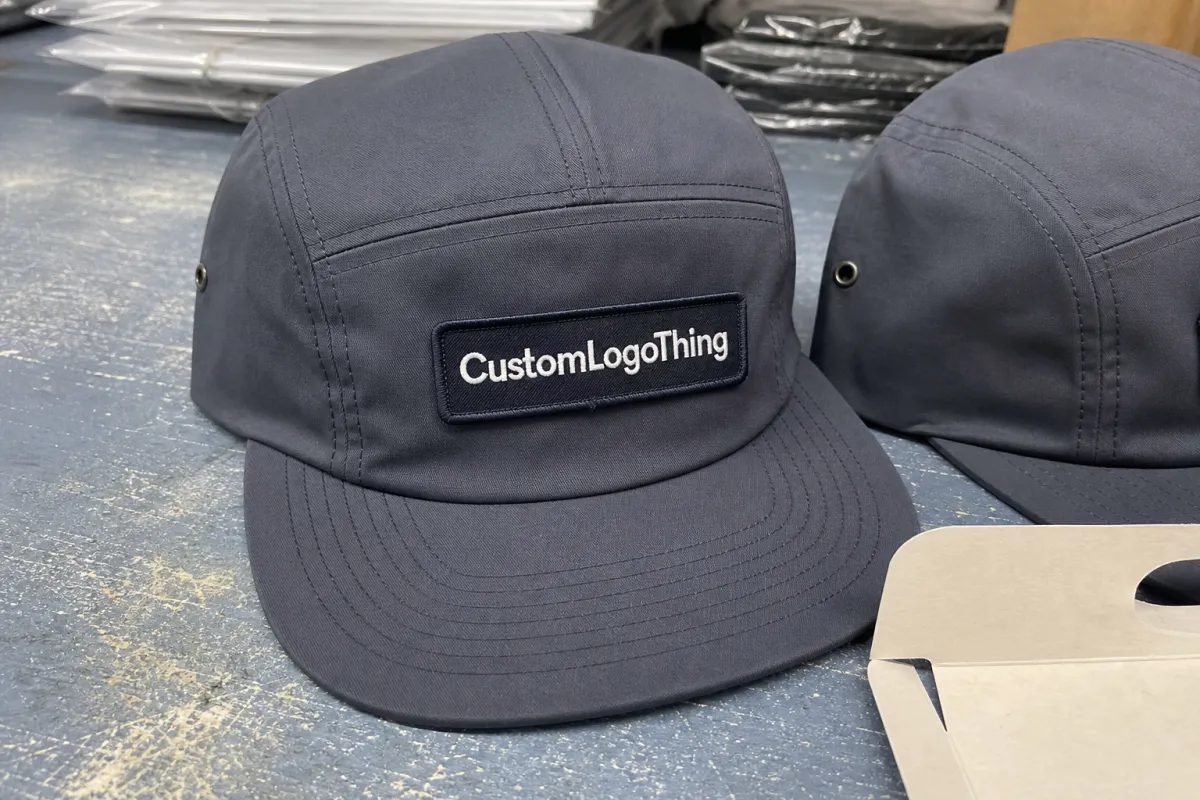
The five-panel build gives a broad decoration field, but that also means the front panel is the first thing people notice. A logo placed a little too high, a patch that runs close to the seam, or embroidery approved from a fuzzy screenshot can look fine on a screen and awkward in person. A little schedule cushion gives the decorator time to confirm placement and, if needed, tune the stitch balance so the graphic reads well from a few feet away.
That matters because trade show hats are usually seen in motion. A visitor notices them while crossing an aisle, during a handshake, or while glancing at the booth from the next row. The cap does not need to shout, but it does need to look intentional. Five-panel construction helps because the front panel sits flatter for branding, which is one reason buyers keep returning to it for events.
There is also a receiving problem hiding inside the timeline. A cap that finishes on time is not necessarily safe if it arrives at the loading dock late in the day, goes to the wrong facility, or still needs to be unpacked and counted. Planning around the in-hands date is more useful than planning around the production-finish date. That small shift prevents a lot of last-minute scrambles.
In the market, buyers generally want three things at once: a decent price, a tidy logo, and a delivery window that does not threaten the booth schedule. The catch is that those three goals do not always move together. A better proof process or a more available blank can add a little time but save more trouble than it costs.
Trade show five panel caps lead time, explained
Trade show Five Panel Caps lead time is the sum of several small steps, and the order only moves as fast as the slowest one. If the blank cap is in stock, the art file is clean, and the proof is approved without delay, the run can move at a steady pace. If any of those parts is unclear, the schedule starts to slip.
Most orders follow a fairly predictable path:
- Blank sourcing: choosing the cap body, color, closure, and any special trim.
- Art setup: cleaning the logo, checking size, and deciding how it will sit on the front panel.
- Proofing: reviewing the mockup, fixing spelling, and confirming colors and placement.
- Decoration setup: digitizing embroidery, preparing patches, or setting transfer art.
- Production: running the caps through decoration and checking consistency across the lot.
- Finishing: trimming threads, pressing the hats, attaching labels, and doing final inspection.
- Packing and transit: boxing the caps so they hold shape and arrive on schedule.
Stock blanks usually move faster than fully custom builds. A standard black, navy, or stone cap with one front decoration location is much easier to schedule than a special color match, a custom sweatband, or a branded inner label. Once the order includes nonstandard fabric, a different closure, or custom underbill printing, the calendar needs more breathing room for sourcing and approval.
Decoration method matters too. Embroidery often needs digitizing, thread selection, and a stitch-count check so the design does not distort on the crown. A simple wordmark may sit around 4,500 to 7,000 stitches, while a dense logo with fine detail can go well beyond that and take longer to prep correctly. Patches bring their own approval cycle because the buyer usually wants to see edge finish, border detail, and color accuracy before production starts. Transfers can be faster in some cases, but they still depend on clean art and a clear placement proof.
A schedule can also stall on the human side. If a proof sits in an inbox for two days, the order usually stops right there. Same-day sign-off keeps the line moving; a slow response can push the job into the next production slot. Good communication is part of lead time, even though it does not show up on the invoice.
For packaging and transit planning, it helps to think about the cap the same way a shipper thinks about any shape-sensitive product: carton strength, stacking pressure, and repeat handling all matter. The testing framework published by ISTA is useful when an order will change hands more than once before it reaches the event.
Cost, pricing, and unit cost drivers buyers should expect
Pricing for trade show caps comes from several parts: the blank cap, the decoration method, setup work, packaging, and freight. Two quotes can look close on the page and still land very differently once setup charges, patch handling, or shipping are included. Buyers should ask what is included in the unit price and what is billed separately.
Quantity has a strong effect on cost. A 72-piece order usually carries a higher per-cap price than a 500-piece order because the same setup is spread across fewer items. Small runs are perfectly workable, but they rarely benefit from the same scale as larger programs. If the show needs a giveaway cap that must still look polished, the buyer should expect the unit cost to soften as the run gets larger.
The biggest price drivers are usually front-panel stitch density, patch type, multiple decoration locations, and special trims. A thick embroidered crest costs more than a simple text mark. A woven patch often costs less than a molded PVC patch, but the appearance is different, so the right choice depends on the brand style and how the cap will be used. A retail-style program often justifies more finishing detail than a plain staff uniform.
| Option | Typical lead time | Typical unit cost at 144 pcs | Best fit |
|---|---|---|---|
| Stock blank with front embroidery | 8-12 business days | $4.50-$7.50 | Simple booth wear and staff uniforms |
| Stock blank with sewn patch | 10-14 business days | $5.25-$8.75 | Sharper graphic detail or textured branding |
| Stock blank with woven label or custom inner label | 12-18 business days | $6.25-$9.50 | Premium giveaways and presentation-focused programs |
| Rush-aware stock cap order | 5-8 business days | $6.00-$10.00 | Fixed show dates with limited schedule cushion |
Those ranges are useful, but they are not a promise. A dense logo, a dark cap that needs careful thread contrast, or a run that requires extra inspection can move the price upward. Sampling and revisions can also add cost if the art is not final. A buyer may pay for redraw work, one more proof, or a small setup adjustment if the first version does not hold the logo the way it should.
Freight deserves its own line in the budget. A cap order can finish on time and still miss the show if the ship method was chosen too loosely. Ground freight may be fine for a nearby event, but it can be a poor fit when the receiving dock closes early or the venue is several zones away. In those cases, the cheaper option is often not the cheaper option once missed time is counted.
If sustainability matters, ask about cartons, inserts, and labels as well as the cap itself. Recycled paperboard and certified packaging can support the brand story without changing the cap spec. The certification behind paper-based packaging can be checked through FSC when that detail matters to the brief.
What changes the production window most
Some inputs affect the schedule much more than others. Artwork readiness is usually at the top of the list, followed by blank availability and decoration complexity. If the buyer sends a vector file, gives clear color notes, and confirms the cap style early, the order has a far better chance of staying inside the original window.
Five-panel construction helps because the front panel is friendly to decoration, but the cap still needs careful placement and finishing. A good fit should sit balanced, not pinch at the brow, and not twist after the first stitch run. Structured and unstructured builds behave differently here. A structured crown supports embroidery differently than a soft, unstructured crown, and the choice can change both sourcing and assembly time.
Closure style matters too. A snapback is often easier to source in standard programs, while a buckle, strap, or elastic-adjusted version can slow the order if the exact hardware is not on hand. Sweatband choices, contrast underbills, and mixed sizes create the same drag. None of these changes seems large by itself, but each one adds a little more coordination.
Production is usually fastest when the order is simple enough to move through one clean lane: stocked blank, one decoration location, one approval, one ship-to address. Add complexity and the schedule becomes more fragile. That is not a flaw in the product; it is how sewn goods behave. Buyers who understand that usually plan better and negotiate better.
There is also a quality tradeoff that does not always show in the quote. If the cap is meant for a packed trade show floor, the logo should still read well after being worn, packed, and worn again. Thin embroidery can look elegant but disappear at distance. A heavy patch can look premium but add weight or stiffness. The right choice depends on the booth environment, not just the art file.
Step-by-step production timeline from quote to delivery
The most reliable way to manage trade show Five Panel Caps lead time is to work backward from the in-hands date. If the show opens on Tuesday, the caps should usually be in hand before Monday morning, not just shipped on Monday morning. Someone still has to receive the cartons, count the units, and get them to staff or into the booth kit.
A practical order flow looks like this:
- Briefing: send quantity, event date, ship-to address, logo files, and preferred cap color.
- Quote: compare blank options, decoration method, and freight assumptions.
- Proof: confirm panel placement, stitch color, label needs, and carton count.
- Approval: sign off quickly so the order moves without sitting idle.
- Production: complete decoration, trim, inspect, and pack the caps.
- Transit: allow room for shipping mode, carrier handoff, and delivery buffer.
- Receiving: inspect cartons, count caps, and distribute them before the show.
On a simple stock-blank embroidery order, the proof-to-ship window can be fairly tight if the logo is already clean. Once the order includes patch sampling, special labeling, or a nonstandard blank, it is safer to add time rather than compress the calendar. That is especially true for multi-location shipments or orders that need to pass through a distribution center before reaching the convention site.
Packaging should protect the crown, not just hold the quantity. Cartons need enough stiffness to prevent crushing, and if the route includes repacking or repeated handling, that matters even more. A cap can pass inspection at the factory and still arrive misshapen if the box is too weak or stacked too heavily. That kind of failure is frustrating because it has nothing to do with the decoration and everything to do with transit.
Final inspection should not be treated like a formality. A good check looks for centered logos, consistent thread tension, clean patch edges, even cap shaping, and matching color across the lot. Buyers rarely see the full QC process, but the process is what keeps a front panel from drifting slightly left or a patch from sitting crooked on half the run.
Common mistakes that stretch schedules and budgets
Low-resolution art is still one of the most common problems, and it slows everything down. A logo pulled from a website screenshot is not the same as a vector file with clean edges. If the art needs redraw work, the proof cycle gets longer and production starts later. That delay is avoidable.
Changing quantity after pricing has already been built causes another round of trouble. A jump from 100 caps to 180 caps can affect the quote, the carton count, the decoration setup, and sometimes the blank availability. Even a small revision can break the schedule if the order has already been slotted into a specific run. Buyers often underestimate how much a “small” change touches the back end.
Unclear decoration placement creates more issues than most people expect. Buyers may want a front mockup, a side view, and a back view, but they only approve one flat image. If the logo needs to sit higher or lower on the panel, or if a patch border should not cross a seam, that needs to be shown before production starts. Otherwise, the shop may need to stop and ask again.
Freight is another trap. The caps can finish on time and still miss the event if the ship method was too optimistic. A ground quote that looks fine on paper may not work if the destination is far away or the receiving dock closes early. Ordering late also pushes buyers toward rushed material choices, which can affect finish quality even if the deadline is technically met.
One more issue is proof ownership. When multiple people weigh in on thread shade, patch size, or crown height, approvals slow down. A single decision-maker can keep the order moving. A crowded approval chain usually adds days, and sometimes it adds disagreement that the production team has to resolve before it can even start.
Expert tips and next steps to lock your order window
If you want a cleaner schedule, send a simple spec sheet first. Include quantity, target in-hands date, ship-to ZIP code, cap color, logo placement, and the decoration method you prefer. If you already know whether the hats are for staff, giveaways, or a higher-end merchandising table, say that too. That context helps the estimator Choose the Right blank and avoid overbuilding the order.
Standard blanks are usually the safest path when the show date is close. Widely available colors and common constructions tend to keep pricing steadier and sourcing easier. If you need a special color or a very specific closure, ask whether there is a stocked alternative that still fits the brand well enough for the booth floor. That kind of substitution often preserves both the look and the schedule.
Build a little room for receiving and counting into the calendar, not just for manufacturing. A cap order that lands a day early is useful; one that lands the morning of setup is risky. The difference can be a calm team and a stressed one, and that is usually worth more than a small savings on shipping.
It also helps to ask for two quotes: one standard and one rush-aware. Compare them against the show date, not just the unit price. The cheapest option is not always the one that protects the event, and the most expensive option is not always needed. A buyer who understands where the time goes can usually choose the middle path with confidence.
For trade show Five Panel Caps, the cleanest result usually comes from a simple plan: final art early, stocked blank if possible, one proof owner, and enough shipping room to absorb a delay. Keep trade show five panel caps lead time tied to the event date, and the order becomes much easier to manage.
Common questions
How long is the lead time for trade show five-panel caps?
It depends on whether the order uses stock blanks or custom materials, plus the decoration method and how quickly proofs are approved. Simple stock runs can move fairly quickly when the art is final, while specialty finishes and larger quantities usually need more room. Plan backward from the in-hands date so shipping and receiving do not become the bottleneck.
What slows down trade show cap turnaround the most?
Artwork problems are one of the biggest delays, especially missing vector files, unclear colors, or logos that need cleanup before proofing. Material sourcing can also stretch the schedule when the requested color, closure, or trim is not immediately available. Delayed approvals are another common culprit because production usually cannot start until the proof is signed off.
Can five-panel trade show hats be rushed without losing quality?
Yes, but only when the design is simple, the blank cap is available, and the buyer responds quickly to proofs. Rush orders work best when the decoration method is straightforward and the quantity is realistic for the available schedule. Quality holds up better when the order is planned around standard materials instead of forcing a custom finish at the last minute.
How should I budget for trade show five panel caps pricing?
Start with the unit price, then add setup, decoration complexity, packaging, and freight so the full landed cost is clear. Smaller runs usually carry a higher per-cap price because the setup is spread across fewer pieces. If the event date is fixed, compare standard and rush quotes so you can weigh cost against delivery certainty.
What should I send first to get a faster quote on five-panel caps?
Send the target quantity, logo file, preferred decoration location, cap color, and the exact in-hands date. Include whether the caps are for staff, giveaways, or retail so the supplier understands the finish level you need. If possible, add a backup option for color or decoration method, which gives the estimator more flexibility and usually speeds up pricing.