Buyer Fit Snapshot
| Best fit | Export Shipping Boxes Manufacturer projects where brand print, material claims, artwork control, MOQ, and repeat-order consistency need to be specified before quoting. |
|---|---|
| Quote inputs | Share finished size, material target, print colors, finish, packing count, annual reorder estimate, ship-to region, and any compliance wording. |
| Proofing check | Approve dieline scale, logo placement, barcode or warning zones, color tolerance, closure strength, and carton packing before bulk production. |
| Main risk | Vague material claims, crowded artwork, missing packing details, or unclear freight terms can make a low unit price expensive after revisions. |
Fast answer: Export Shipping Boxes Manufacturer: Choose the Right One should be specified like a repeatable production item. The safest quote records material, print method, finish, artwork proof, packing count, and reorder notes in one written spec.
Production checks before approval
Compare the actual filled-product size with the drawing, then confirm tolerance on folds, seals, hang holes, label areas, and retail display edges. Reserve space for logos, QR codes, warning copy, and material claims before decorative graphics fill the panel.
Quote comparison points
Review material grade, print process, finish, sampling route, tooling charges, carton quantity, and freight assumptions side by side. A quote is only useful when the supplier can repeat the same color, closure quality, and packing count on the next order.
An Export Shipping Boxes manufacturer does not really sell cardboard. It sells a better chance that the shipment survives the trip in the condition you planned for. Boxes rarely fail in the dramatic way people picture. More often, they weaken under compression, soften in moisture, split at the corners, or get beat up by vibration and rough handling over several days in transit. That is why the right export shipping boxes manufacturer treats packaging as part of the risk plan, not as a finishing touch.
From a packaging buyer’s point of view, the job is bigger than product protection. It is about keeping freight claims down, avoiding repacking, and sidestepping the expensive chain reaction that starts when one carton arrives crushed and the rest of the order has to be checked by hand. For brands balancing order fulfillment and ecommerce shipping, a box that saves twenty cents but loses two cartons in transit is not saving money at all. It is quietly draining it.
A lot of buyers still underestimate how sharply the shipping environment changes the answer. A carton that performs well in domestic distribution may stumble once it faces humidity, container stacking, longer dwell times, or rougher handoffs at ports and warehouses. The best export shipping boxes manufacturer translates those variables into a usable spec: board grade, flute type, wall construction, closure method, and reinforcement options that match the load instead of guessing at it.
The real idea is simple, even if the execution is detailed. Export packaging works as a system. The box, pallet, liner, strapping, corner protection, and desiccants all affect whether the shipment reaches its destination in usable condition. A strong export shipping boxes manufacturer coordinates those parts instead of treating the carton as a standalone purchase. If you want a quick picture of the broader packaging mix, Custom Logo Things also organizes useful categories like Custom Packaging Products and Custom Shipping Boxes.
What an Export Shipping Boxes Manufacturer Actually Does
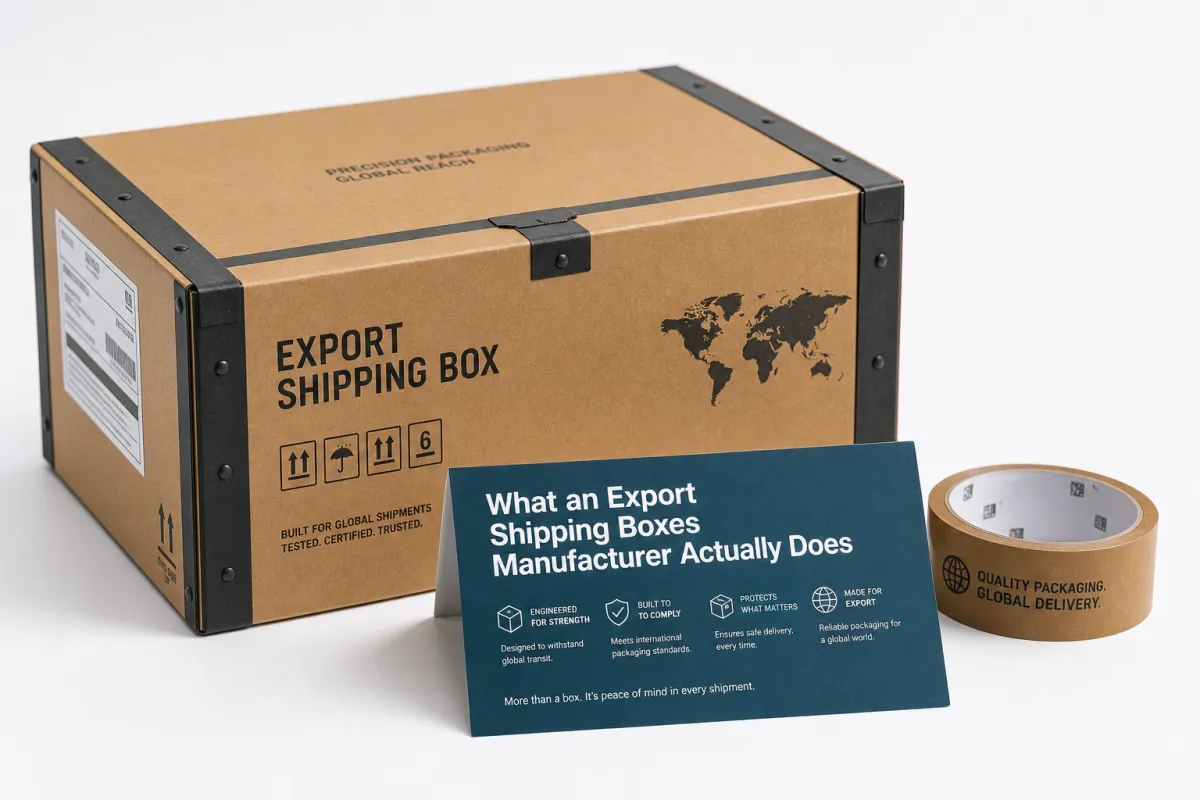
An export carton is not chosen by instinct. A good export shipping boxes manufacturer starts with the product itself: gross weight, center of gravity, fragility, dimensions, and the way it behaves when stacked, shifted, or handled by different teams along the route. A sealed bottle set has different needs than a flat-packed component or a boxed retail kit. The manufacturer maps those realities to corrugated performance, not to a generic catalog label.
That is where board science matters. Domestic cartons often rely on a simple size-and-style decision. Export-ready boxes usually need a closer look. The manufacturer may recommend edge crush test strength, burst strength, double-wall construction, water-resistant coatings, or stronger closures when the route includes humid ports, long ocean transit, or extended warehousing. In practice, the box must survive compression more often than a clean drop, so the spec has to reflect that.
The role of the export shipping boxes manufacturer also reaches beyond the carton walls. Good exporters often need pallet patterns that reduce overhang, strapping that avoids crushing corners, and liners or inserts that keep products from shifting during movement. Add desiccants when moisture is a real risk, and the shipping materials begin to work like one protective system instead of separate line items.
That systems view is why standards matter. If the supplier references ISTA test methods, ASTM compression testing, or can point to FSC-certified fiber sourcing, that is a useful signal. It does not guarantee performance by itself, and I would not pretend that it does, but it shows that the export shipping boxes manufacturer is thinking in measurable terms rather than relying on vague promises.
“The cheapest carton is rarely the cheapest shipment once damage, repacking, and freight penalties enter the picture.”
A buyer should hear that and immediately think about total landed cost, not just unit price. One carton may look expensive on paper and still save money across the shipment because it reduces breakage, supports pallet stability, and lowers chargebacks. That matters especially in export shipping, where a single weak point can create a chain reaction. A box designed for the wrong compression load can fail under stacked inventory long before it reaches the final consignee.
The best export shipping boxes manufacturer understands that reality and builds backward from risk. What if the route is long? What if the container sits in a hot yard? What if pallets are double-stacked? What if the receiving warehouse uses fork handling that is less gentle than expected? Each question shifts the spec. That is why export packaging is not a simple buy-and-sell transaction. It is an engineered answer to a logistics problem.
For buyers comparing partners, the real difference is often not whether the supplier can make a box. It is whether the export shipping boxes manufacturer can explain why a particular build is better for your product and your route. That explanation should include material grades, testing logic, and practical handling advice. If it does not, you are probably just buying a shape.
How the Export Shipping Boxes Manufacturer Process Works From Quote to Shipment
The quote process usually starts with a surprisingly basic question: what, exactly, are you shipping? A serious export shipping boxes manufacturer wants product dimensions, packed weight, fragility concerns, and a few photos. If the shipment includes sets, accessories, or nested parts, that matters too. A carton specified for a single unit can be wrong for a master pack, and a master pack can be wrong for mixed SKUs.
After intake comes the recommendation stage. This is where the supplier decides whether the job calls for a regular slotted carton, a die-cut design, a heavier double-wall box, or a reinforced structure with inserts and corner boards. The export shipping boxes manufacturer should also ask about stacking height, export lane, humidity exposure, and whether the boxes will travel by sea, air, or a mixed freight route. Those details shape board grade and closure method.
Then comes pricing and sampling. For repeat orders with a known spec, a quote may move quickly if the board is in stock and print is simple. New export projects usually take longer because the supplier may need tooling, sample cutting, or test cycles. A realistic timeline for a straightforward repeat run can be 10-15 business days after approval, while a fresh design often needs 3-5 weeks depending on testing and board sourcing. The exact pace depends on the export shipping boxes manufacturer and how complete the brief is.
Most delays happen for familiar reasons. Late artwork approval. Incomplete dimensions. A supplier waiting on confirmation of quantity. Last-minute changes to pallet counts or shipping counts. If the order is complex, the wrong spreadsheet can cost days. Buyers who send a clean RFQ usually get faster, more accurate responses from the export shipping boxes manufacturer because fewer assumptions have to be corrected later.
Testing is the step many people skip until damage forces the conversation. Better suppliers will recommend compression checks, drop considerations, and vibration thinking based on standards such as ASTM and ISTA guidance. That does not mean every carton needs a full lab program, but it does mean the export shipping boxes manufacturer should be willing to explain how the structure will be validated. A claim without a test method is only a claim.
Once the design is approved, production begins. Here, quality control matters more than many buyers realize. A strong export shipping boxes manufacturer will verify board consistency, print registration if needed, die-cut accuracy, and glue performance or fold integrity before the shipment leaves the facility. For export orders, a small defect is not small if it repeats across thousands of units.
If you are comparing packaging formats, it helps to think beyond one carton type. Export shipping boxes may sit beside other transit packaging choices in a broader program, including Custom Poly Mailers for lighter outbound orders. The point is not to force every SKU into the same format. The point is to match the package to the handling conditions.
One useful rule: the more uncertainty in the route, the more value there is in a structured sampling step. A careful export shipping boxes manufacturer will welcome that. A weak one may rush you to production before the spec is truly ready.
Key Factors That Shape Cost and Pricing
Price usually starts with board grade and construction. A single-wall carton with standard print and a modest run size will cost far less than a double-wall design with reinforced edges and custom inserts. An export shipping boxes manufacturer often prices by a mix of corrugated specification, print complexity, order quantity, and whether the project needs tooling. That is the right way to read the quote, because box cost is rarely just about the liner board itself.
There is also a large difference between unit price and landed cost. The cheapest carton can become the most expensive choice once you add repacking labor, product loss, claims, and freight penalties. Dimensional weight plays a role too. Oversized cartons can push shipping charges higher even if the actual product is light. A smart export shipping boxes manufacturer helps buyers balance external dimensions with protection so they do not pay twice.
Climate matters more than many people think. Humid export lanes often need stronger materials or moisture-management features, which Changes the Quote. So do long dwell times, refrigerated storage, and container stacking. A route that crosses multiple climate zones can force a stronger build than a domestic shipment of the same product. That is why the same box style from a export shipping boxes manufacturer can vary in price depending on destination and handling profile.
Hidden costs are where budgets get distorted. Sample revisions. Special die cuts. Rush production. Storage fees for nonstandard inventory. Rework when the spec is wrong. Excess carton void because pallet utilization was never planned. The right export shipping boxes manufacturer should be able to explain these cost centers before you commit, because surprise charges often show up after the order is already approved.
| Box Option | Typical Use | Relative Cost | Why Buyers Choose It |
|---|---|---|---|
| Single-wall corrugated | Lighter export cartons, short or controlled routes | Lowest | Useful when package protection needs are moderate and weight matters |
| Double-wall corrugated | Heavier goods, longer routes, stronger stacking needs | Mid to high | Common when compression resistance and transit packaging strength matter more than unit cost |
| Reinforced die-cut export carton | Fragile products, custom inserts, precise fit | Higher | Reduces movement and can improve order fulfillment consistency |
| Heavy-duty export master pack | Bulk shipments, palletized freight, rough handling | Highest | Built for stacking, strapping, and long-haul export shipping |
As a rough market reality, a standard export carton may land in the low single dollars at mid-volume, while a reinforced double-wall build with custom print and inserts can move noticeably higher. Exact pricing depends on size, board caliper, flute selection, order volume, and freight. That is normal. A credible export shipping boxes manufacturer should be able to explain those drivers clearly instead of hiding them behind a vague “custom pricing” answer.
One more point that buyers often miss: overbuilding is also a cost. If the carton is stronger than necessary, the shipment may become heavier, more expensive to move, and harder to pack efficiently. The best export shipping boxes manufacturer does not simply add strength until the quote feels safe. It chooses the smallest adequate structure for the route and the load.
That is the difference between a packaging purchase and a packaging decision. A number on a quote sheet is useful only if it reflects the real shipping environment. If it does not, the cost conversation is incomplete.
Step-by-Step: Specifying the Right Export Box
Start with the product, not the carton. Measure the packed item accurately, including any inserts, trays, or accessories. Record gross weight, not just product weight. Note fragile points, print surfaces, and anything that shifts, bends, or leaks. A capable export shipping boxes manufacturer cannot spec the box correctly if the input data is fuzzy.
Next, map the route. Will the shipment move by truck first, then port, then ocean container, then warehouse storage, then final delivery? Each leg changes exposure. Long sea freight plus high humidity is very different from a short regional move. A serious export shipping boxes manufacturer should ask about storage conditions, stacking height, and whether pallets will be double-stacked in transit or at destination.
After that, choose the box style and material. Single-wall corrugated may be enough for light, stable products. Double-wall may be the better answer for heavy or stack-sensitive goods. Die-cut structures are useful when product fit needs to be precise. The closure method matters too: tape, glue, staple, or banding can all change performance. A good export shipping boxes manufacturer will explain the trade-offs rather than pushing one default design.
Then test the concept. You do not need a giant lab program for every project, but you do need some kind of verification. That might include stacking tests, vibration thinking, compression checks, or a practical drop sequence based on the actual handling risk. If the carton is carrying high-value goods, request a sample run before the final order. The export shipping boxes manufacturer should treat samples as a normal part of responsible packaging design.
At this stage, the right question is not “Does it fit?” The right question is “Does it still perform after handling?” That is where compression, pallet behavior, and moisture exposure come back into play. A box can look perfect in a warehouse and still fail under load. An experienced export shipping boxes manufacturer knows the difference between a neat prototype and a field-ready spec.
Then document the final version. This sounds simple, but it saves real money. Record dimensions, board grade, flute type, print version, closure method, pallet pattern, and approved artwork. Put that record in procurement, quality, and logistics files so every team reorders the same build. When that step is skipped, an export shipping boxes manufacturer may receive conflicting instructions and produce the wrong carton even when everyone believes the spec was “already agreed.”
For brands with regular order fulfillment rhythms, standardization helps. You do not need one special box for every SKU if a few well-designed sizes cover the range. That reduces tooling, improves forecasting, and simplifies shipping materials inventory. It also gives your export shipping boxes manufacturer a clearer baseline for repeat production.
From an operations standpoint, this is where good packaging and ecommerce shipping meet. A carton is not just a freight container. It is part of the handoff between warehouse, carrier, and customer. Better transit packaging means fewer exceptions, fewer claims, and fewer people scrambling to replace damaged goods.
Common Mistakes That Cause Damage, Delays, and Rework
The first mistake is judging strength by size alone. A box can be the right footprint and still fail if the wall construction is too light for the load. That sounds obvious, yet it happens constantly. A buyer orders dimensions that fit the product, then assumes the export shipping boxes manufacturer will automatically choose the correct board. Sometimes they do. Sometimes they do not. The result is a carton that looks right and performs poorly.
The second mistake is ignoring moisture. Export shipping often means long dwell times, humid ports, and container environments that can soften corrugated board. If the shipment crosses regions with high humidity or temperature swings, the box may need a stronger grade, coating, or internal protection. A reliable export shipping boxes manufacturer will ask about this early because moisture damage is one of the quietest reasons export packaging fails.
The third mistake is treating the pallet as an afterthought. A weak pallet pattern, poor overhang, or sloppy strapping can undo even a strong carton. Corner boards, top frames, and balanced stacking patterns are not extras; they are part of package protection. When the pallet is unstable, the export shipping boxes manufacturer is forced to compensate for a problem that packaging alone cannot solve.
The fourth mistake is poor documentation. Missing test records, inconsistent spec sheets, or a PDF that differs from the purchase order create avoidable errors. In export work, that kind of mismatch is expensive because orders are bigger, freight is costlier, and correction is harder once the shipment moves. A disciplined export shipping boxes manufacturer should maintain version control, but the buyer still needs to keep the internal records clean.
The fifth mistake is quote comparison without context. One supplier may quote a lighter carton because they assume short transit. Another may quote a heavier build because they accounted for compression and moisture. If the buyer only compares the headline price, the stronger design looks overpriced. In reality, it may be the more accurate answer. That is why quoting an export shipping boxes manufacturer without giving the shipment environment almost always produces false savings.
There is also the hidden issue of waste in order fulfillment. If the box is too large, void fill increases, pallet counts shift, and shipping costs rise. If the box is too small, you risk product damage or awkward pack-out. Either way, the wrong spec can echo through the warehouse and the carrier network. Good export packaging lowers that friction because it fits the product and the process.
The cleanest way to avoid these mistakes is to stop treating the carton as a one-line commodity. The right export shipping boxes manufacturer will help you think through the whole route, from warehouse to vessel to destination dock. That is the level of detail export work demands.
Expert Tips for Buying Smarter Without Overpaying
Ask for performance targets instead of generic language. Tell the export shipping boxes manufacturer what the load weighs, how high it will be stacked, and what kind of handling it will face. That gives the supplier a basis for recommending the right board and structure. “Strong enough” is not a spec. “Must survive six-high stacking during a 30-day export transit with moderate humidity exposure” is much more useful.
Standardize where you can. If a small set of box sizes covers most of your SKUs, you reduce tooling, simplify inventory, and improve purchasing control. Standardization also makes it easier to compare quotes because every export shipping boxes manufacturer is bidding against the same base design. That can sharpen cost discipline without weakening package protection.
Request proof, not just promises. Board specs, sample photos, test summaries, and material descriptions help you separate real expertise from polished sales language. If a supplier cannot explain the difference between burst strength and compression resistance, or cannot tell you why a certain flute was chosen, you are not getting much beyond a pretty quote. A serious export shipping boxes manufacturer should be able to connect the spec to the shipment risk.
| Decision Area | Low-Cost Approach | Smarter Buying Approach |
|---|---|---|
| Box strength | Choose the lightest carton that fits | Match strength to load, route, and stacking pressure |
| Sampling | Skip it and move fast | Approve a sample before scaling production |
| Quote review | Compare only unit price | Compare landed cost, defect risk, and freight impact |
| Inventory | Order many custom sizes | Standardize a few high-use box formats |
Negotiate around total value, not just the sticker number. Better lead times, lower defect rates, and fewer repacks often matter more than shaving a few cents off a carton. A good export shipping boxes manufacturer can often save more money by reducing errors than by reducing material mass. That is especially true for higher-value products where one damaged pallet can wipe out a month of savings.
Build in a safety margin. Export conditions are messy. Trucks brake hard. Forks jab corners. Containers sweat. Warehouse teams are busy. A margin in the design is usually cheaper than a margin in claims and replacements. That does not mean overbuild everything. It means accept that field conditions are less controlled than lab conditions and ask the export shipping boxes manufacturer to design accordingly.
If sustainability matters to your sourcing program, ask whether the paper and board can be aligned with FSC-certified supply chains. Buyers should still verify details, but it is a useful filter when the export program sits inside broader procurement goals. A thoughtful export shipping boxes manufacturer can often help balance performance and material responsibility instead of forcing buyers to choose one or the other.
And if your packaging mix includes lighter outbound items, it may make sense to separate export cartons from retail mailers entirely. That prevents overpacking and keeps costs aligned with use. It also helps the team build a cleaner packaging catalog, which makes procurement and order fulfillment simpler over time. When packaging is organized, the whole shipping operation feels less improvised.
How to Choose an Export Shipping Boxes Manufacturer
Start with a basic audit of your last three shipments. Did boxes crush? Did moisture show up? Were there pallet failures? Did the warehouse need to rework anything before dispatch? Those answers tell you more than a glossy brochure ever will. A strong export shipping boxes manufacturer should be willing to discuss the root causes of those problems, not just promise a lower price.
Prepare a better RFQ. Include product dimensions, gross weight, photos, pallet plans, shipping lanes, destination climate, target quantity, print needs, and any compliance or test requirements. If you already know the carton needs to fit a certain pallet pattern or stack height, say so. The more precise the brief, the more likely the export shipping boxes manufacturer will quote accurately on the first pass.
Then compare suppliers using the same questions. Ask each one about sample availability, production lead time, testing approach, minimum order quantity, and revision policy if the spec needs to change after sampling. Two suppliers can quote similar prices and still offer very different levels of support. The better export shipping boxes manufacturer will make the process easier to understand, not harder.
Run a pilot before scaling. A smaller order lets you inspect how the cartons behave in the warehouse, on the pallet, and after handling. Get feedback from operations, quality, and logistics, not just purchasing. That is how you find the practical fit between the carton and the route. A professional export shipping boxes manufacturer should welcome that pilot because it improves the final outcome.
It also helps to know how transparent the supplier is about standards. If they reference compression testing, ISTA-related thinking, or board performance in plain language, that is a good sign. If they stay vague and keep circling back to price, that is a warning. The best export shipping boxes manufacturer can prove performance, not just quote a low number.
One more practical point: the supplier should fit your internal workflow. A manufacturer that communicates clearly, provides clean documentation, and keeps version control tight will save time for procurement and order fulfillment. That matters as much as unit price, especially when export shipping windows are tight. If a team has to chase missing details every time, the packaging supplier is becoming an operational drag.
If you want to see how Custom Logo Things positions its packaging support, the company overview at About Custom Logo Things is a useful place to start. The broader point is simple. Choose the export shipping boxes manufacturer that understands your route, documents the spec, and can show evidence that the carton will hold up under real freight conditions.
That is the real buying test. Not “Can you make boxes?” Nearly everyone can. The better question is, “Can your export shipping boxes manufacturer make the right box, prove it, and keep the shipment moving without avoidable damage?”
For many teams, that answer decides whether export packaging feels like a recurring problem or a controlled part of the supply chain. Pick the export shipping boxes manufacturer that treats every carton as part of the shipment system, and the freight tends to behave better.
What should I ask an export shipping boxes manufacturer before I order?
Ask what board grade, flute type, and closure method they recommend for your product weight and route. Confirm sample lead time, production lead time, and whether they can revise the spec after testing. Request any available test data so you can compare claims against performance. A good export shipping boxes manufacturer should answer those questions without dodging the details.
How does an export shipping boxes manufacturer determine the right box strength?
They usually combine product weight, stacking height, transit duration, and handling conditions to set the strength target. In export work, compression often matters more than a clean drop, so the manufacturer should think beyond dimensions alone. Moisture exposure also matters. A dependable export shipping boxes manufacturer will adjust the spec for long transit times and humid routes.
How long does it take an export shipping boxes manufacturer to make custom boxes?
Simple repeat orders can move quickly if materials are in stock and artwork is finalized. New export box designs take longer because sampling, approval, and testing can add time. Rush jobs are possible, but they may limit material choice or raise cost. The right export shipping boxes manufacturer will tell you the real timeline up front.
Are export shipping boxes more expensive than regular cartons?
Usually yes, because they often use stronger materials and more careful construction. The better comparison is landed cost, since a stronger carton can reduce damage, repacking, and claim losses. In that sense, a well-designed export carton from an export shipping boxes manufacturer can be cheaper overall if it prevents freight damage.
What information helps an export shipping boxes manufacturer quote accurately?
Provide product dimensions, gross weight, fragility, and whether items ship singly or in sets. Share the shipping lane, pallet pattern, and expected climate exposure so the quote matches real use. Include target quantity, print needs, and any compliance or testing requirements to avoid quote revisions. The more complete the brief, the better the export shipping boxes manufacturer can match price to performance.


