Buyer Fit Snapshot
| Best fit | Foil Stamped Rigid Boxes with Logo projects where brand print, material claims, artwork control, MOQ, and repeat-order consistency need to be specified before quoting. |
|---|---|
| Quote inputs | Share finished size, material target, print colors, finish, packing count, annual reorder estimate, ship-to region, and any compliance wording. |
| Proofing check | Approve dieline scale, logo placement, barcode or warning zones, color tolerance, closure strength, and carton packing before bulk production. |
| Main risk | Vague material claims, crowded artwork, missing packing details, or unclear freight terms can make a low unit price expensive after revisions. |
Fast answer: Foil Stamped Rigid Boxes with Logo: Board, Finish, Dieline, and Unit Cost should be specified like a repeatable production item. The safest quote records material, print method, finish, artwork proof, packing count, and reorder notes in one written spec.
Production checks before approval
Compare the actual filled-product size with the drawing, then confirm tolerance on folds, seals, hang holes, label areas, and retail display edges. Reserve space for logos, QR codes, warning copy, and material claims before decorative graphics fill the panel.
Quote comparison points
Review material grade, print process, finish, sampling route, tooling charges, carton quantity, and freight assumptions side by side. A quote is only useful when the supplier can repeat the same color, closure quality, and packing count on the next order.
Foil Stamped Rigid Boxes with Logo: Practical Guide
Foil Stamped Rigid Boxes with logo can change the first impression of a product before the customer has even touched the package. Foil catches the light, rigid board adds presence in the hand, and a clean logo mark often says more than a crowded full-color layout ever could. The effect is quiet when it is done well, which is usually why it feels expensive rather than loud.
People comparing foil stamped rigid boxes with logo are usually trying to solve three problems at once: presentation, protection, and cost control. That combination gets tricky only when the box is treated like decoration first and packaging second. A strong structure, a sensible finish, and a clear production plan make the whole thing easier to manage, and honestly, it keeps a lot of avoidable headaches off the table.
Premium packaging does not have to be wasteful. Foil stamped rigid boxes with logo can be elegant, durable, and efficient if the board thickness, wrap paper, insert style, and foil coverage are chosen around the product instead of around a mood board full of shiny reference images. I have seen plenty of boxes lose their appeal because someone chased visual drama and forgot that the package still had to travel, stack, and close cleanly.
A glossy finish will not rescue a weak structure. Premium packaging still has to close cleanly, survive shipping, and hold up after repeated handling.
Foil Stamped Rigid Boxes with Logo: What They Are
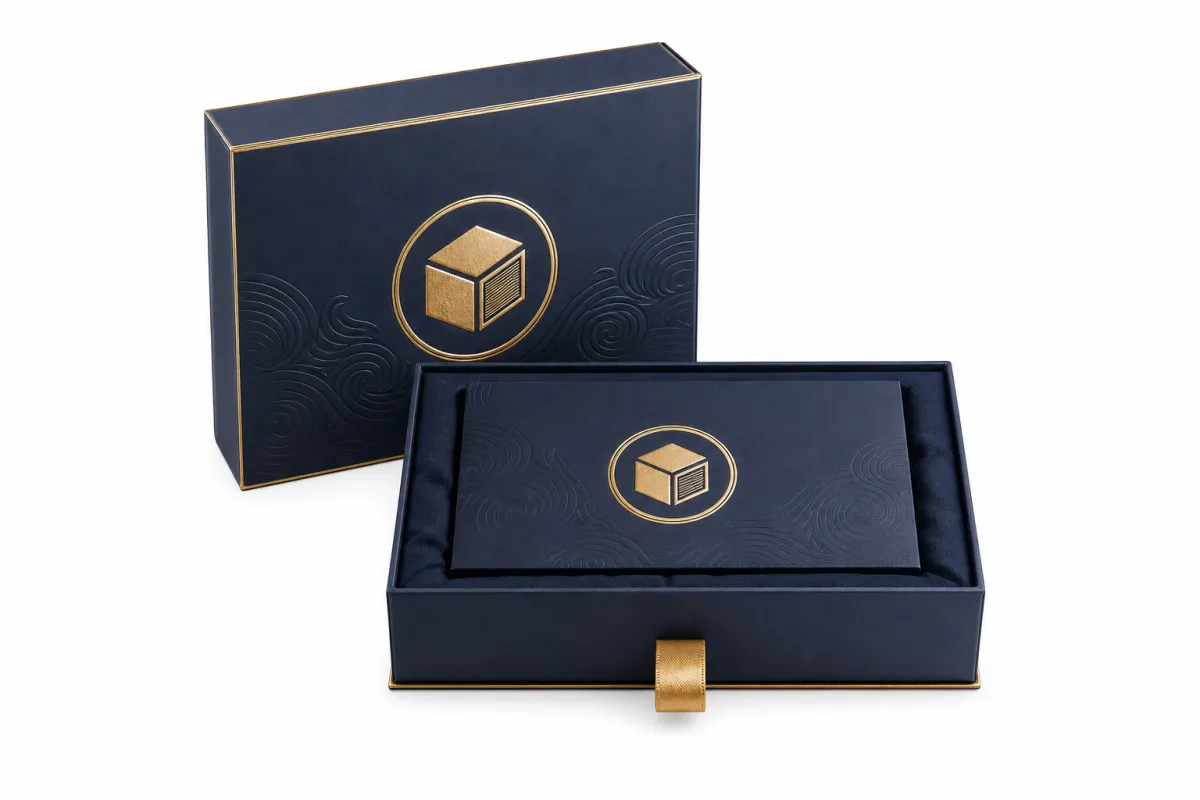
Rigid boxes are built from thick paperboard, usually greyboard or chipboard in the 1000-2000 gsm range, then wrapped in printed, colored, kraft, or specialty paper. They feel sturdy because they are sturdy. That is why foil stamped rigid boxes with logo show up so often in gift packaging, cosmetics, electronics accessories, luxury candles, and premium subscription kits.
Foil stamping adds another layer of visual weight. A heated metal die presses the logo into the surface and transfers a thin film of foil onto the wrap paper. Depending on the foil choice, the mark can read metallic, matte, satin, holographic, or pigment-based. In foil stamped rigid boxes with logo, the brand mark often becomes the anchor point, pulling the eye toward the right detail instead of letting it wander across a busy layout.
Foil is not only about flash. A small foil logo on textured paper can feel more premium than a full-panel print because the eye responds to contrast before it reads complexity. Gold, silver, black, rose gold, and restrained matte foil all create different moods, and each one changes how foil stamped rigid boxes with logo communicate the product inside. A black foil mark on natural stock, for example, can read as quiet and refined; gold on a deep matte wrap feels warmer and more ceremonial.
The structure matters just as much as the decoration. A rigid box with loose corner wraps, a poorly aligned lid, or a weak magnetic closure can undermine even the cleanest foil stamp. If foil stamped rigid boxes with logo are meant to feel premium, the build needs tight corners, consistent board thickness, crisp wrap folds, and a closure that feels controlled rather than forced. You are not gonna fool a customer with a pretty logo if the lid bows or the tray rattles.
From a production standpoint, these boxes are attractive because they hold shape, photograph well, and offer a reliable canvas for branding. That reliability matters. On press and in finishing, every material behaves a little differently, so the goal is not perfection in the abstract. The goal is a package that consistently looks intentional from one carton to the next, which is what buyers usually mean by “premium” even if they never say it that plainly.
Sustainability belongs in the discussion from the start. Premium packaging does not have to mean excessive packaging. Foil stamped rigid boxes with logo can be built with FSC-certified board, paper-based inserts, and dimensions matched closely to the product. Extra lamination, mixed-material inserts, and oversized voids drive up shipping cost and make recycling harder. Buyers who ignore those details usually pay for it twice, once on the invoice and once in the waste stream.
Foil Stamped Rigid Boxes with Logo: How They Are Made
The production path for foil stamped rigid boxes with logo looks simple on paper and becomes detail-heavy the moment samples and tooling enter the conversation. It usually moves through concept approval, dieline review, artwork preparation, foil die creation, sampling, full production, and then packing and cartonizing. Each stage feels manageable on its own. Together, they decide whether the box arrives crisp or comes back for another round of corrections.
Structure comes first. The supplier needs dimensions, product weight, insert requirements, and the closure style before anything else can be quoted with confidence. A hinged lid, a two-piece lift-off lid, a magnetic closure, and a drawer box all behave differently. Foil stamped rigid boxes with logo need the logo placement to respect folds, seams, and lid edges. Put the stamp too close to a corner or hinge and registration gets messy very quickly.
Artwork is the next pressure point. Vector files are the standard for foil stamped rigid boxes with logo because foil dies depend on clean edges. Thin serif fonts and fine line art can work, but only with restraint. A logo that is 12 mm wide cannot carry a detailed icon and tiny lettering without risking fill-in or distortion under heat and pressure. The machine is not being dramatic; the physics are just unforgiving.
The foil die is usually made from brass, magnesium, or copper depending on the required detail and the expected run length. Brass costs more, but it tends to hold finer detail for longer runs. Magnesium can be perfectly suitable for a simple mark or a shorter production run. For foil stamped rigid boxes with logo, die choice is one of those behind-the-scenes decisions that influences both cost and consistency.
Sampling is where the real story starts. A digital mockup helps, but it cannot replace a physical proof. Foil looks different on textured paper than it does on a screen, and the press settings affect sheen, edge sharpness, and temperature response. Foil stamped rigid boxes with logo can shift depending on the wrap paper, whether the logo is flat or embossed, and how much pressure the press applies. On a sample table, I have seen a logo that looked a bit too bright in rendering settle into exactly the right tone once it hit the actual board.
Typical timing depends on complexity. A simple sample may take 5-10 business days after artwork approval, while full production often runs 12-25 business days. Add more time if the box needs a new foil plate, a custom insert, or hand assembly. Holiday queues can stretch those numbers further. Anyone who has ordered packaging near peak season knows how quickly a clean schedule can slip.
There are a few bottlenecks that show up over and over:
- Artwork revisions that change foil size, placement, or font weight.
- Insert complexity, especially EVA foam or molded pulp with multiple cutouts.
- Tooling changes after the sample stage.
- Factory queue time during peak gifting seasons.
Foil stamped rigid boxes with logo are easiest to manage when the final spec is locked before sampling begins. If the logo size keeps changing, the die changes. If the box size changes, the wrap layout changes too. Every revision looks minor until it turns into calendar time, extra tooling, and another proof. That is where projects start to feel slow for no good reason.
Foil Stamped Rigid Boxes with Logo: Material, Finish, and Sustainability Choices
Material choices decide how foil stamped rigid boxes with logo look, feel, and recycle. The board is the backbone. The wrap paper is the surface the customer sees first. The finish is what they remember when they pick up the box and turn it in their hands. If those layers fight each other, the package stops reading as premium and starts feeling overworked.
Most rigid boxes use greyboard wrapped in art paper, kraft paper, or textured specialty paper. Greyboard is strong and economical. Art paper gives better print fidelity if the design needs graphics before the foil. Textured papers can make foil stamped rigid boxes with logo look richer, though they also demand tighter press control because the foil has to settle cleanly onto a surface that is not perfectly smooth.
Board thickness usually ranges from about 1.5 mm to 3 mm for premium presentation boxes, though size and product weight matter just as much as a catalog spec. A small ring box does not need the same build as a heavy skincare set. Well-made foil stamped rigid boxes with logo are sized around the product, not around a trend reference that ignores how the item will travel, sit on a shelf, or be opened by a customer.
Finish choices shape the final impression more than many buyers expect. Soft-touch lamination gives a velvety hand feel, but it adds a plastic film that complicates recycling. Matte wrap paper is cleaner from a sustainability standpoint. Embossing and debossing can add depth to foil stamped rigid boxes with logo without covering the box in metallic coverage. Spot foil often gives the best balance between visual impact and material restraint.
A little foil usually goes farther than people expect. A logo-only stamp can look focused, sharp, and easier to defend from a sustainability point of view. A fully metallic lid gives a louder result, but it also adds cost, assembly time, and recycling friction. Buyers need to decide whether the brand needs drama or clarity. In many cases, clarity with better lighting is the stronger answer.
If sustainability is a priority, ask for:
- FSC-certified board or recycled-content board where the product can support it.
- Paper-based inserts instead of plastic trays when protection allows.
- Minimal coatings so foil stamped rigid boxes with logo are easier to process after use.
- Right-sized dimensions to reduce shipping volume and excess material.
- Reusable structure design if the box is meant to be kept rather than discarded.
For broader sustainability rules, I usually point buyers to FSC certification guidance and EPA recycling guidance. Those resources do not solve every packaging decision, but they keep the conversation anchored in real materials instead of marketing language.
Foil stamped rigid boxes with logo can also be tested against handling expectations. If the package is going through parcel networks, ask for an ISTA 3A-style distribution test or an equivalent transit test. If the box only lives on a boutique shelf, the priority shifts toward presentation and repeat handling. A thoughtful spec can support both, provided the shipping path is considered before the artwork becomes too attached to the render.
Rule of thumb: if the packaging will be opened, closed, and kept, a well-built rigid box with a restrained foil logo usually feels more premium than a crowded box loaded with mixed materials.
Foil Stamped Rigid Boxes with Logo: Cost, Pricing, MOQ, and Quote Drivers
Cost is where foil stamped rigid boxes with logo become very real, very quickly. The quote depends on size, board thickness, foil coverage, number of decoration locations, wrap paper choice, insert complexity, and order quantity. Buyers often assume the logo itself is the expensive part. It usually is not. The expense comes from everything that has to happen around the logo.
Packaging that requires setup rewards larger runs. A small batch of foil stamped rigid boxes with logo still needs a die, press setup, calibration, wrapping labor, and packing. That means low quantities usually carry a higher per-unit price. As volume increases, those fixed costs spread out and the unit price becomes much easier to live with.
For reference, the ranges below fit a standard presentation box around 6 x 6 x 2 inches with one foil logo, one wrap paper, and a basic insert. These numbers are not universal, but they work as practical starting points for quoting.
| Option | Typical Build | MOQ | Ballpark Unit Price | Best Fit |
|---|---|---|---|---|
| Value build | 1.5 mm board, printed wrap, single foil logo, no insert | 500-1,000 | $1.80-$3.20 | Launches, small retail runs, subscription kits |
| Mid-tier premium | 1.8-2.0 mm board, matte or soft-touch wrap, foil plus emboss, paper insert | 1,000-3,000 | $2.80-$5.00 | Gift sets, cosmetics, branded retail packaging |
| Luxury build | 2.0-3.0 mm board, specialty paper, foil plus deboss, custom insert, hand assembly | 500-2,000 | $4.50-$8.50 | High-margin products, PR kits, premium gifting |
Those numbers move quickly if the box gets larger, the foil area grows, or the insert turns into a custom die-cut foam cavity. Magnetic closures add cost too. Ribbon pulls, hidden trays, specialty papers, and hand assembly all push the quote upward. Foil stamped rigid boxes with logo can look simple from the outside while hiding four or five cost layers underneath.
There are hidden quote drivers worth asking about early:
- Tooling for the foil die and any emboss or deboss plate.
- Sampling fees for a physical proof or structure sample.
- Shipping from factory to warehouse, especially for bulky rigid boxes.
- Assembly labor if the box is complex or hand-finished.
- Insert production if the tray is not a simple paperboard insert.
One of the easiest ways to save money is to request pricing at several quantities. A quote for 500 units may look rough, but a quote for 1,000, 3,000, and 5,000 units usually reveals the actual breakpoints. It also helps to ask what is included and what is missing. If the supplier leaves out tooling, insert pricing, or shipping until the end, the low number was never really low. It was incomplete.
Foil stamped rigid boxes with logo can be surprisingly affordable when the decoration stays disciplined. A single logo hit, standard board, and one straightforward insert are far easier to control than a box that tries to solve every brand problem at once. A premium box should feel deliberate, not overdesigned by committee.
Foil Stamped Rigid Boxes with Logo: Step-by-Step Guide to Ordering
Ordering foil stamped rigid boxes with logo goes more smoothly when you treat it like a packaging brief instead of a quick email. The strongest buyers give the supplier enough information to quote accurately on the first round. That usually means dimensions, product weight, retail channel, shipping conditions, and the exact role the box needs to play in the customer experience.
-
Define the product brief.
List the product dimensions, weight, how the item sits inside the box, whether it ships direct-to-consumer or through retail, and whether the box is meant to protect, present, or do both. Foil stamped rigid boxes with logo for a luxury candle need a different support structure than a jewelry set or a skincare duo.
-
Lock the structure first.
Choose the box style before you spend time refining decoration. Two-piece lift-off lids, magnetic closures, drawer boxes, and book-style boxes all affect the usable surface area. If the logo sits too close to a fold or lid edge, foil stamped rigid boxes with logo can lose precision right where the brand mark matters most.
-
Prep artwork in vector format.
Send AI, EPS, or print-ready PDF files. Outline fonts. Specify foil color, size, and exact placement. If you want a flat logo, say so. If you want embossing or debossing with foil, say that too. Give the supplier a clean target instead of asking them to guess which version of premium you had in mind.
-
Review the sample like a buyer, not a fan.
Check closure strength, lid alignment, foil sharpness, corner wrapping, insert fit, and how the box feels in hand. Foil stamped rigid boxes with logo should open cleanly and close without forcing the user to fight the structure. If the sample feels slightly off, that is the time to fix it.
-
Confirm the spec sheet before production.
The final spec sheet should list dimensions, board thickness, wrap paper, foil type, insert material, carton count, packing method, and delivery schedule. This is where many orders drift. A nice email thread is not a production document. The spec sheet is.
-
Approve freight and carton planning.
Rigid boxes are bulky. Ask how many units fit in a master carton, what the gross weight is, and whether the boxes need palletizing. If your launch date is fixed, freight timing matters almost as much as foil quality. A beautiful box that shows up late is still late.
If you are comparing structures or need a wider view of packaging formats, it helps to browse Custom Packaging Products before locking the rigid box spec. That kind of review also helps determine whether foil stamped rigid boxes with logo are the right level of packaging for the product, or whether another presentation style gives you the same brand effect with less cost.
One more practical point: ask for a written lead time that separates sampling, tooling, production, and transit. A supplier saying “two weeks” can mean almost anything. A supplier saying “10 business days for sample, 15-20 business days for production after approval, plus freight” is speaking the language of actual packaging work.
Foil Stamped Rigid Boxes with Logo: Common Mistakes
The biggest mistake is choosing a shiny finish before the structure is solved. A weak box with a beautiful foil logo still feels cheap. Foil stamped rigid boxes with logo only work when the build supports the presentation. If the lid gaps, the corners split, or the insert rattles, the customer notices the problem long before they notice the foil.
Artwork mistakes come next. Thin lines, tiny type, cramped spacing, and logo placements too close to edges create trouble fast. Foil stamping is less forgiving than digital printing. If the logo line weight drops below about 0.3 mm, fill-in or uneven edges become much more likely depending on the paper texture and the press setup. Foil stamped rigid boxes with logo need cleaner artwork than many buyers expect.
Quote confusion costs money too. Some buyers compare only the unit price and ignore the rest. Then the invoice arrives with tooling, insert fees, sample shipping, and assembly labor. That is how a tidy quote turns into a budget apology. A slightly higher quote that clearly names the moving pieces is usually more honest than a suspiciously neat number that grows later.
Overcomplicating the build creates a sustainability trap as well. Mixed materials can look premium in a presentation and still produce recycling headaches. A foil layer, plastic lamination, magnetic closure, EVA insert, ribbon pull, and spot UV panel might sound impressive on a deck. In production, that combination means more labor, more failure points, and more separation issues after use. Foil stamped rigid boxes with logo do not need every finish on the menu.
Another mistake is forgetting the user journey. If the box is hard to open, hard to reseal, or much larger than the product needs, it loses value. Premium packaging should protect the product and respect the customer’s time. That sounds obvious, yet oversized boxes with nested foam for tiny products still show up every season and drive freight costs into unpleasant territory.
Here are the warning signs I would not ignore:
- Logo placed too close to a lid seam or corner fold.
- Foil area too large for the budget or timeline.
- Insert specified before the final product sample is confirmed.
- Soft-touch lamination chosen without checking recyclability goals.
- Supplier quote that omits tooling, freight, or sample charges.
If any of those appear in a quote or sample, slow down and sort them out before you approve the run. Foil stamped rigid boxes with logo are not difficult to get right, but they punish rushed decisions. A clean spec and a realistic schedule solve most of the common headaches.
Foil Stamped Rigid Boxes with Logo: Expert Tips and Next Steps
If you want a smoother buying process, start with a narrow decision set. Pick one premium structure, one foil option, and one backup budget path before you ask for quotes. That keeps foil stamped rigid boxes with logo from turning into an endless round of “what if we also tried...” decisions. Packaging teams often think they are being creative when they are really just delaying a call that has to be made sooner or later.
My practical advice is simple: request a mockup or sample first if the logo is small, the foil coverage is tight, or the box is mailer-heavy. Foil stamped rigid boxes with logo can look perfect in a rendering and slightly off in hand. The sample tells you whether the logo reads from arm’s length, whether the closure feels sturdy, and whether the finish matches the brand level you are trying to communicate.
Keep a production checklist in front of you:
- Final dimensions for the product and insert.
- Quantity target for pricing and MOQ planning.
- Sustainability goal such as FSC board, recycled content, or paper-only inserts.
- Foil details including color, area, and placement.
- Delivery deadline with room for sample approval and freight.
It also helps to sanity-check the box against the product itself. If the product is a low-margin item, premium foil stamped rigid boxes with logo may be too much packaging spend. If the product is a high-margin launch or a giftable SKU with strong repeat visibility, the box can pay for itself through perceived value. That is the real decision: not whether the box is attractive, but whether it earns its keep.
For buyers who need options beyond a single rigid build, compare a few structures on Custom Packaging Products and see where the tradeoffs land. Sometimes the best answer is still foil stamped rigid boxes with logo. Sometimes it is a lighter structure with a strong printed mark. The right choice is the one that fits the product, the channel, and the deadline without wasting material or money.
My final advice is blunt: compare specs, verify lead time, and do not order foil stamped rigid boxes with logo until the structure, foil coverage, and shipping plan all make sense together. That is how you get Premium Packaging That looks good, works hard, and does not become a very expensive lesson. A box should support the product, not compete with it.
Frequently Asked Questions
Are foil stamped rigid boxes with logo recyclable?
Usually yes, though the answer depends on the board, adhesive, coatings, and how much foil is used. Minimal foil on paper-based rigid structures is easier to defend than heavy mixed-material builds. Check the recycling rules in your main sales markets before you commit to the spec.
What is the usual turnaround for foil stamped rigid boxes with logo?
Turnaround depends on whether you need new tooling, a physical sample, or custom inserts. Simple runs move faster; complex structures and large foil areas take more time. Build in extra room for revisions, especially if logo placement is tight or the packaging has multiple components.
What affects the price of foil stamped rigid boxes with logo the most?
Size, board thickness, foil coverage, and the number of decoration locations are the biggest drivers. MOQ matters because setup and tooling costs spread better across larger quantities. Special finishes, inserts, and hand assembly can push the unit cost up quickly.
Can I make foil stamped rigid boxes with logo more eco-friendly?
Yes, by using recycled or FSC-certified board, minimal foil coverage, and paper-based inserts. Right-sizing the box reduces waste and shipping volume. Avoid unnecessary laminations and mixed materials when recyclability matters.
What file should I send for a clean foil logo stamp?
Send a vector file so the foil die can hold clean edges and consistent detail. Keep thin lines and tiny text under control because foil stamping is less forgiving than digital printing. Specify exact placement, size, and whether the logo should be flat, embossed, or debossed.


