Buyer Fit Snapshot
| Best fit | Folding Cartons Supplier projects where brand print, material claims, artwork control, MOQ, and repeat-order consistency need to be specified before quoting. |
|---|---|
| Quote inputs | Share finished size, material target, print colors, finish, packing count, annual reorder estimate, ship-to region, and any compliance wording. |
| Proofing check | Approve dieline scale, logo placement, barcode or warning zones, color tolerance, closure strength, and carton packing before bulk production. |
| Main risk | Vague material claims, crowded artwork, missing packing details, or unclear freight terms can make a low unit price expensive after revisions. |
Fast answer: Folding Cartons Supplier: Artwork Proof, Packing Count, and Landed Cost should be specified like a repeatable production item. The safest quote records material, print method, finish, artwork proof, packing count, and reorder notes in one written spec.
Production checks before approval
Compare the actual filled-product size with the drawing, then confirm tolerance on folds, seals, hang holes, label areas, and retail display edges. Reserve space for logos, QR codes, warning copy, and material claims before decorative graphics fill the panel.
Quote comparison points
Review material grade, print process, finish, sampling route, tooling charges, carton quantity, and freight assumptions side by side. A quote is only useful when the supplier can repeat the same color, closure quality, and packing count on the next order.
Folding Cartons Supplier Guide: What Buyers Should Know
A folding cartons supplier guide matters because two cartons can look almost identical on a screen and still land at very different prices once board grade, coatings, die-cuts, and freight show up in the quote. Packaging loves that trick. The mockup looks tidy. The invoice does not.
From a buyer’s point of view, a folding cartons supplier guide saves time, money, and a few rounds of backtracking. Folding cartons are paperboard packages shipped flat, then glued, folded, and filled on the packing line. That sounds simple. It is simple in the way a machine with twelve moving parts is simple. The small decisions are where cost, lead time, and quality start acting up.
I have seen buyers spend weeks tweaking artwork before they even lock the structure. That is backwards. If the carton does not fit the product, run cleanly, or hold up in transit, the prettiest print job in the world is still gonna cause problems.
What Buyers Usually Miss
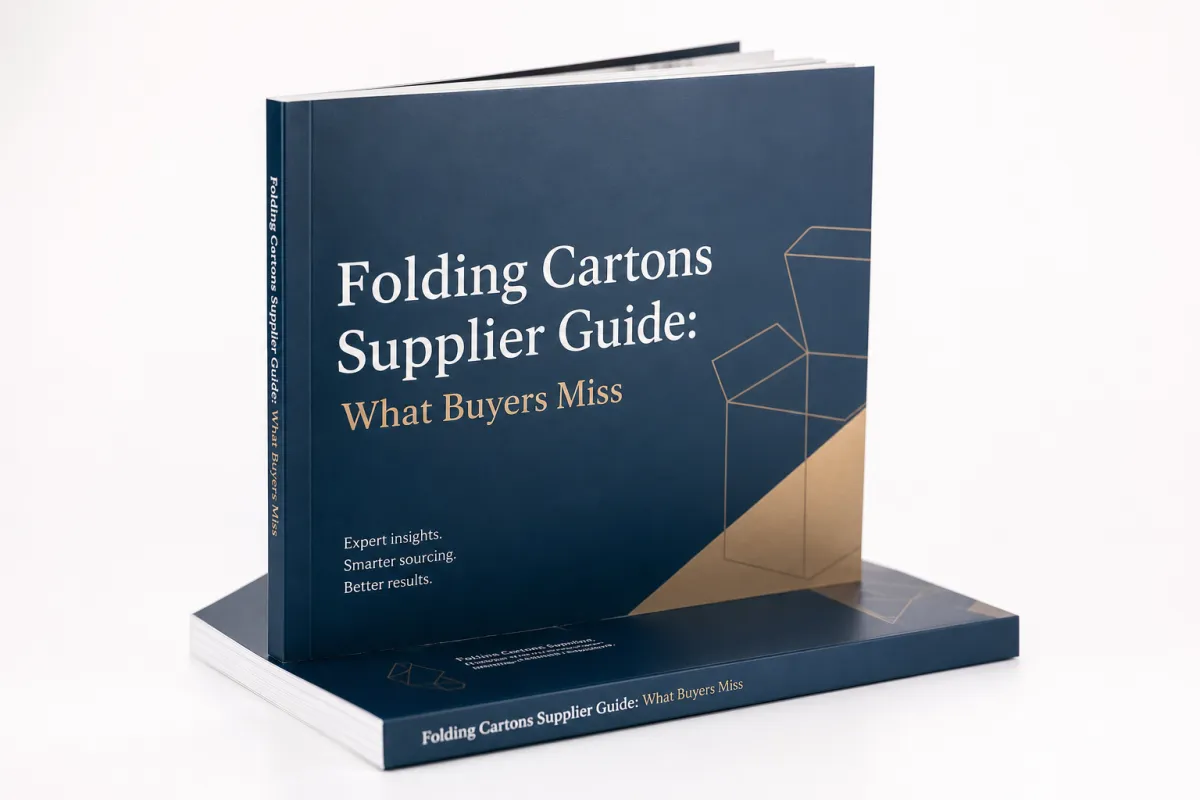
Most buyers start with artwork and end with surprise fees. That order is backwards. A folding cartons supplier guide should start with structure, product fit, and production limits, because the supplier is not just printing a nice box. The supplier is building packaging that has to open correctly, run on the line, hold the product, survive transit, and still look like it belongs to your brand.
Here is the trap: two cartons can match on paper and still quote very differently. Change a standard 16pt SBS board to a heavier 18pt board, add aqueous coating, move from two colors to four-color process, then toss in foil or embossing, and the price jumps fast. That is why a folding cartons supplier guide earns its keep before anyone sends out RFQs. Thin specs create delays, then everybody gets annoyed at the printer because blaming the printer is easier than admitting the brief was flimsy.
Folding cartons are paperboard packages that arrive flat. They are scored, cut, printed, finished, shipped, then erected and filled where the product gets packed. That flat-shipping part is a big reason brands use them. You save storage cube, trim freight, and get a box that can carry real branding without turning into a bulky rigid package.
From a packaging buyer’s point of view, the right carton does three jobs at once:
- Protects the product from crush, abrasion, and handling damage.
- Sells the brand with color, finish, and shelf presence.
- Supports fulfillment by folding, stacking, and packing cleanly.
A folding cartons supplier guide also helps you avoid the rookie mistake of treating every quote like a commodity. A carton for a skincare jar is not the same as a carton for supplements, a candle, or a food item with compliance needs. If the carton has to meet FSC sourcing expectations, that belongs in the brief. If the product takes a beating in transit, performance testing may matter. If the finish has to survive shipping and retail handling, that changes what is worth paying for.
A carton that looks cheap on screen often gets expensive on the line. The reverse happens too: a modest-looking spec can run beautifully if the structure is clean and the brief is honest.
That is the practical value of a folding cartons supplier guide. It forces the questions that save money later. What is the exact board? How many colors? What finish? How many pieces? What is the actual ship-to location? Those are not glamorous questions, but they are the ones that keep the quote process from turning into a guessing contest.
How the Supplier Process Works
The supplier workflow usually follows the same chain, even if the software names and sales jargon change. A solid folding cartons supplier guide starts with inquiry, moves through quoting, then into dieline review, artwork proofing, sampling, production, finishing, packing, and freight. Skip one step and the schedule starts wobbling.
Here is the usual path. First, the buyer sends a spec sheet or brief. The estimating team checks carton size, board, print method, quantity, and finishing. Prepress looks at dielines and artwork. If the structural format is new, the die maker gets involved. Once the artwork is approved, the job moves into press setup, print, coating, die-cutting, folding, gluing, quality control, and shipment. A folding cartons supplier guide looks boring on paper because the job itself is built out of a lot of boring steps. That is exactly why it works.
On the supplier side, different people own different pieces:
- Estimating checks cost, quantities, and production constraints.
- Prepress checks files, color setup, bleed, traps, and dieline alignment.
- Die making creates the cutting tool for the structure.
- Press setup handles inks, registration, and coverage control.
- Quality control checks cut accuracy, color, glue, and finish consistency.
- Logistics packs, labels, and ships the cartons to the right location.
A folding cartons supplier guide also needs to explain approvals, because approval gates are where the calendar either moves or stalls. A quote approval says the budget is acceptable. A dieline approval says the structure is right. An artwork proof approval says the file is ready to print. A sample approval says the carton fits and behaves the way you wanted. Each one matters. If someone says, “We approved it in spirit,” that does not count. Machines do not care about spirit.
Lead time usually gets eaten in three places: file prep, sampling, and production scheduling. Simple jobs can quote in a few business days. Straightforward print runs may move into production after proof approval and ship in roughly 10 to 15 business days, depending on quantity and finishing. More complex cartons, especially ones with custom die-cuts, premium coatings, or imported tooling, can stretch to 20 business days or more. A folding cartons supplier guide should give you those ranges up front so nobody invents a fantasy date.
The most common back-and-forth points are predictable. Dimensions are missing by a few millimeters. Artwork arrives without bleed. The buyer wants “the same blue as the last box” but has no physical sample or Pantone reference. Structural changes show up after proofing, which means the supplier has to rework the die or the layout. A folding cartons supplier guide is useful because it makes those friction points visible before they start eating time.
If your carton has transit requirements, ask whether the supplier uses test methods aligned with ISTA. If paper sourcing matters, ask whether the stock can be supplied with FSC chain-of-custody documentation. That does not magically make the box better. It does make the conversation more honest.
One more thing people underestimate: a good supplier will ask annoying questions. That is a good sign. If the questions are about product weight, stack height, finish durability, or pack-out method, the supplier is trying to keep the carton from failing later. A folding cartons supplier guide should teach buyers to welcome that back-and-forth, not resent it.
Cost and Pricing Factors
Pricing is where the spreadsheet gets real. A folding cartons supplier guide should break cost into the pieces buyers can actually control, because “too expensive” is not a useful diagnosis. The biggest drivers are size, board thickness, print coverage, number of colors, coatings, special finishes, tooling, quantity, and freight. That is the list. Everything else is noise until one of those items changes.
Small runs look expensive because setup costs get spread across fewer cartons. That is not a scam. That is math. A die, plates, press setup, and prepress work cost money whether you print 1,000 cartons or 100,000 cartons. If you order 2,500 cartons, those fixed costs hurt more per unit than they do at 20,000. A folding cartons supplier guide should say that plainly so buyers stop comparing tiny runs against big-volume pricing and calling it unfair.
For planning, simple folding cartons in moderate quantities can land anywhere from about $0.08 to $0.20 per unit for very straightforward specs at higher volume, while more finished cartons with heavier board, more color coverage, and premium finishes can sit closer to $0.18 to $0.45 per unit or more depending on the run size and complexity. Small quantities can go higher, sometimes sharply higher, because setup costs do not shrink just because the order is tiny. A folding cartons supplier guide should frame those numbers as planning ranges, not promises.
Here is a practical comparison that buyers can use before they ask for quotes. It is not a universal rate card, because there is no such thing in packaging, but it does show how the price moves.
| Carton Spec | Typical Cost Impact | Best For | Main Tradeoff |
|---|---|---|---|
| 16pt SBS, 2-color print, aqueous coating | Lower setup cost, lower unit cost at higher quantities | Simple retail SKUs, sample packs, standard shelf cartons | Less visual drama, fewer premium cues |
| 18pt C1S, 4-color process, matte varnish | Moderate unit cost, stronger shelf presence | Cosmetics, supplements, small-batch retail launches | More prepress control, slightly longer proof cycle |
| 18pt recycled board, spot color, no special finish | Good balance if brand wants a natural look | Eco-positioned products, mailer cartons, food-adjacent items | Color can feel less bright than coated SBS |
| Premium board with foil, emboss, or soft-touch lamination | Highest setup and finish cost, strongest premium signal | Giftable products, luxury retail, hero SKU packaging | Higher waste risk, longer lead time, more approval steps |
That table is the kind of thing a folding cartons supplier guide should push onto the desk early. It shows why the quote is not only about printed paper. It is about operations. Foil means another process. Soft-touch lamination changes feel and can slow turnaround. Embossing needs tooling and careful registration. All of that can be worth it, but only if the value is real, not decorative for the sake of being decorative.
Tooling and extras are where people get burned. Dies are often a separate charge. Plates may be separate. Structural samples can cost money. Freight is often excluded from the first quote, which is charming in the same way a hidden service fee is charming. If the job needs rework because artwork was approved too early, that cost can show up later too. A folding cartons supplier guide should tell you to ask for a line-item quote, not a single mysterious number.
Quantity planning matters more than buyers expect. If your forecast is stable, higher volume usually lowers the unit cost. If your forecast is shaky, ordering too much can turn “savings” into dead inventory. A folding cartons supplier guide should not push big orders just to make the unit price look pretty. Cartons sitting in storage are not a victory. They are a warehouse problem with branding on them.
Comparing quotes properly is where serious buyers save money. Match board grade to board grade. Match print method to print method. Match finish to finish. Then compare exactly what is included. Does the quote cover dieline work? Does it include sampling? What about freight? Are cartons packed in bulk or bundled in a specific count per case? A folding cartons supplier guide is useful because it teaches you to compare like with like instead of buying the cheapest-looking quote and discovering it was stripped of half the work.
How to Choose the Right Supplier
Choosing the Right partner is not about the prettiest website. It is about whether the supplier can actually make the carton you want without turning the process into a mess. A folding cartons supplier guide should start with production capability. Not every shop can handle heavy board, tight tolerances, foil, embossing, or food-safe specifications. If your carton needs all of that, asking a lightweight trade printer to “figure it out” is not a strategy. It is a hobby.
Communication speed is the next filter. Slow quoting usually predicts slow problem solving later. That does not mean the fastest reply is the best one, but it does mean a supplier who takes a week to answer basic questions may take longer when a proof needs correction or a shipment gets delayed. A folding cartons supplier guide should push buyers to judge responsiveness, clarity, and follow-through before the purchase order goes out.
Ask how color is controlled. Some suppliers rely on press checks and operator judgment. Others use tighter prepress workflows, calibrated proofing, and structured quality checkpoints. Neither is perfect, because print is still print, but the method matters. If color consistency is critical across reorders, get specifics on proofing and QC. A folding cartons supplier guide is not doing its job if it never asks how the supplier keeps one run from drifting against the last one.
Food, health, and regulated products deserve extra scrutiny. Ask whether the supplier can support the relevant compliance requirements, from barcode placement to inner-coated structures or food-contact expectations, if applicable. If you need testing or evidence for transit performance, ask about standards rather than vague promises. A folding cartons supplier guide should give buyers enough vocabulary to ask the right questions, not enough optimism to ignore them.
Minimum order quantity matters more than many buyers expect. Some suppliers are happy with smaller test batches. Others want volume that makes their setup worthwhile. If you are launching a new SKU, a lower MOQ can be more valuable than a lower unit price, because it lets you test demand without clogging the warehouse. A folding cartons supplier guide should treat MOQ as a strategic variable, not a footnote.
Geography changes the math too. A local supplier may quote higher on paper, but once you add freight, customs, duties, communication lag, and time-zone friction, the “cheap” offshore option may not be cheap at all. That is not anti-offshore. It is just accounting. A folding cartons supplier guide should compare landed cost, lead time, and risk together. Otherwise you are only pricing half the job.
Look for a supplier who asks for a proper carton brief, not one who just wants artwork and a quantity. The better the intake process, the fewer surprise corrections later. A decent brief usually includes:
- Finished carton dimensions
- Product dimensions and weight
- Board preference or target thickness
- Color count and print method
- Coating or finish requirements
- Quantity and reorder expectations
- Ship-to location and timing needs
A folding cartons supplier guide also helps buyers decide what kind of supplier they actually need. Some projects are best handled by a premium converter with custom finishing. Others fit a high-volume plant that keeps things efficient and simple. There is no single winner. The right supplier is the one whose strengths match the job.
Step-by-Step Process and Timeline
Every strong folding cartons supplier guide should make the timeline visible, because lead time is where many launches get squeezed. The most efficient jobs start with a clean spec sheet. Include product dimensions, carton style, board preference, quantity, finish requirements, and delivery location. If the product has shelf life, handling issues, or compliance needs, say so early. Guessing in packaging is expensive. It is also unnecessary.
Send the same spec to every supplier. Not similar specs. The same spec. A folding cartons supplier guide only works when comparisons are fair. If one supplier gets a vague email and another gets a detailed brief, the quotes will not mean the same thing. That sounds obvious. It still gets missed constantly.
The next step is quotation and scope review. This usually takes a few business days for standard jobs, longer for complex structures or premium finishes. If the supplier asks clarifying questions, answer fast. The schedule stalls while everyone waits for missing dimensions, missing artwork status, or a decision on finish. A folding cartons supplier guide should make that delay visible so teams stop pretending the clock is the supplier’s fault alone.
After the quote, the dieline and artwork proof stage starts. This is where the cheap mistakes live. Check trim, bleed, fold lines, panel orientation, barcode placement, legal copy, and finish callouts. If something is off, fix it now. Once plates, dies, and production files are set, corrections get more expensive. A folding cartons supplier guide saves money here because it treats proofing as a real approval step, not a box-checking ritual.
If the structure, fit, or finish matters to the launch, request a sample or prototype. Some jobs can move without one, especially if the carton is a standard format. For higher-value products, a sample is cheap insurance. A folding cartons supplier guide should never tell a buyer to skip samples just to save a little time. A bad carton can cost far more than the sample ever would.
Use this rough timeline as a planning base:
- Quote review: 2 to 5 business days for straightforward jobs.
- Proofing and revisions: 2 to 7 business days, depending on artwork readiness.
- Sampling: 3 to 10 business days if a physical prototype is needed.
- Production: often 10 to 20 business days after approval, depending on complexity and quantity.
- Freight: can add 2 to 7 business days domestically, longer for international moves.
That is not a promise. It is a realistic framework. A folding cartons supplier guide should always leave room for artwork changes, press scheduling, and shipping delays. If your launch has a fixed date, build a buffer. Internal approvals are usually the hidden problem. Someone will be on vacation, legal will want one more revision, or marketing will suddenly dislike the shade of blue they already signed off on last week. Packaging has a way of exposing how organized the rest of the company really is.
Receiving and inspection matter too. Check count, print quality, glue quality, board damage, and carton fit before the goods are moved into inventory. If the cartons are going straight to a packing line, make sure the erection and closure behavior matches the intended use. A folding cartons supplier guide should end with the warehouse, not the invoice. That is where the box either proves itself or causes grief.
One practical habit helps a lot: keep a file with your approved specs, proofs, samples, and final quote. Reorders get easier when you are not digging through five email chains and a PDF named “final_FINAL_use_this_one.” A folding cartons supplier guide is partly about process discipline. The better your records, the less likely you are to pay for your own confusion twice.
Common Mistakes Buyers Make
A folding cartons supplier guide is basically a list of ways people waste money and time, then recover once they stop improvising. The first mistake is buying on unit price alone. The cheapest quote often excludes tooling, freight, packaging, or a finish you thought was included. Then the “cheap” carton gets expensive. Shocking. Nobody saw that coming except everyone who has ever bought packaging.
Another common mistake is sending incomplete artwork. If the file is missing bleed, safe zones, dieline layers, or proper barcode placement, the supplier has to stop and fix it or risk a misprint. That means revisions, not production. A folding cartons supplier guide should treat prepress as part of the manufacturing process, because that is exactly what it is.
Some buyers ignore how coatings and finishes affect look and timing. Soft-touch lamination changes the feel, but it can mute color slightly. A matte varnish can look elegant but not be as durable as a tougher coating for handling-heavy cartons. Foil and embossing bring visual impact, but they also add steps and cost. A folding cartons supplier guide is useful because it shows that finish choices are not decoration alone. They are tradeoffs.
Underestimating lead time is another classic mistake. A buyer thinks the order is simple, so the schedule should be simple. Then the launch date creeps closer, the proof is still open, and suddenly everyone wants a rush. Rush fees exist for a reason. They are the price of being late. A folding cartons supplier guide should encourage buyers to set internal sign-off dates early and protect them like they matter.
Skipping a sample is a risky shortcut. A screen mockup is not a carton in your hand. Print color, board feel, glue performance, and fold behavior are physical realities, not digital vibes. A folding cartons supplier guide should be blunt about this: if the carton is important, sample it.
Here are a few more traps that show up again and again:
- Changing dimensions after the quote and expecting the price to stay put.
- Assuming all “white board” is the same.
- Forgetting that shipping cartons and retail cartons solve different problems.
- Not telling the supplier whether the order is a launch run, test batch, or reorder.
- Leaving legal copy and compliance review until the end.
A folding cartons supplier guide also reminds buyers that color expectations need reality checks. A monitor is not a press sheet. A proof is closer, but it still needs interpretation. If brand color is mission-critical, ask for a physical sample, a press proof, or a controlled reference. Otherwise you are hoping for a match and calling it a plan. That is not a plan.
The last mistake is not thinking about inventory and reorder flow. A carton that is perfectly priced for 25,000 pieces may still be the wrong choice if your monthly usage is only 2,000. A folding cartons supplier guide should force the math on consumption, storage, and reorder timing. Cartons are not useful sitting in a corner because the brand bought too much to “save” a few cents each.
Practical Tips and Next Steps
If you want cleaner quotes, use a one-page carton brief. A strong folding cartons supplier guide always comes back to this because the brief sets the rules of the game. One page is enough if it includes dimensions, structure, board, colors, finishes, quantity, delivery address, and timeline. The supplier should not have to hunt through scattered emails to figure out what you mean.
Ask for a physical sample or sample kit before placing a full run, especially if the carton needs a premium feel or precise fit. A folding cartons supplier guide should encourage tactile review because board, coating, and print can look very different in person than they do in a mockup. The sample also helps marketing, operations, and leadership stop arguing about guesses.
Request a line-item quote breakdown. You want to see where the money goes: board, print, die-cutting, coatings, plates, tooling, freight, and any extras. That breakdown helps you spot easy savings. Maybe you can simplify the finish. Maybe you can cut a special effect that nobody will notice after the carton sits on a shelf under fluorescent lights. A folding cartons supplier guide is most useful when it shows where to trim cost without wrecking the brand.
If the budget is tight, cut finishes before you cut structural quality. A clean, sturdy carton that folds well and protects the product will outperform a flashy carton that crushes, scuffs, or jams the line. A folding cartons supplier guide should be honest about this: the carton’s first job is to work. Looks matter, but they are not allowed to sabotage production.
For sustainability claims, keep the language specific. If the board is FSC-certified, say so accurately. If the carton uses recycled content, state the actual percentage if you can verify it. If you need help understanding sourcing and environmental claims, the industry has plenty of reference points, but the supplier should still give you documentation rather than slogans. A folding cartons supplier guide is not a substitute for evidence.
My practical recommendation is simple:
- Lock the spec.
- Request two or three quotes from suppliers with comparable capability.
- Compare lead time, inclusions, tooling, and freight.
- Approve the proof carefully.
- Sample anything that needs fit, premium finish, or line performance.
That process is not flashy. It does not sound clever. It does prevent most of the pain that buyers blame on everyone except the brief. A folding cartons supplier guide should leave you with a clearer buying process, not just a prettier vocabulary.
Use this folding cartons supplier guide as your filter before you commit to a vendor. If the supplier can explain the spec in plain English, show how pricing changes with the real variables, and give you a timeline that survives contact with production, you are in decent shape. If not, keep shopping.
The real takeaway is simple: lock the carton spec first, then compare suppliers on the same inputs, and do not approve a run until the sample, proof, and freight terms all make sense together. That is how you avoid the expensive little surprises that packaging loves to hide.
How do I compare folding carton suppliers fairly?
Use the same carton spec, quantity, board, and finish requirements for every quote. A folding cartons supplier guide only works if the comparison is apples to apples, not one supplier’s plain carton against another supplier’s fully finished version. Ask what is included: tooling, samples, proofing, freight, and packaging. If color and finish matter, request sample photos or production photos, not just a low number on a quote.
What should I send for an accurate folding cartons quote?
Send finished dimensions, carton style, board type, quantity, delivery zip code, artwork status, and finish requirements. If the order needs food-contact consideration, barcode placement, or other compliance details, include those too. A folding cartons supplier guide gets you farther faster when the supplier has the product weight, launch timing, and reorder intent instead of having to guess what kind of job it is.
How long does folding carton production usually take?
Quotes often take a few business days, while complex jobs take longer. Proofing and sample approval can add days or even weeks if artwork is not ready. Production commonly runs 10 to 20 business days after approval, then freight adds its own clock. A folding cartons supplier guide should always build in a buffer because artwork changes and shipping delays are annoyingly normal, not exceptional.
What drives folding carton pricing the most?
Quantity, board thickness, print coverage, and special finishes usually have the biggest impact. Tooling and setup costs hit small orders harder than larger ones, which is why a short run can look expensive on a unit basis. Freight and rush charges also change the real landed cost more than most people expect. A folding cartons supplier guide helps buyers see the whole cost picture instead of only the per-piece quote.
Can small brands order folding cartons in low quantities?
Yes, but the unit price will usually be higher because setup costs are spread across fewer cartons. Keep the design simpler if cost is a concern: fewer colors, fewer finishes, and standard board when possible. A folding cartons supplier guide is especially useful for smaller brands because it shows where to simplify without making the carton flimsy or generic. Plan reorders early so you are not paying rush premiums later.
If you keep the spec tight, compare quotes like-for-like, and verify the sample before launch, this folding cartons supplier guide will save you from the usual packaging nonsense. That is the job: fewer surprises, fewer wasted cartons, and a supplier choice you can actually stand behind.


