For agencies trying to balance presentation, cost, and speed, Frosted Zipper Poly Bags for agency buyers moq planning are one of the more practical packaging formats to source. They look cleaner than plain clear bags, protect contents better than open sleeves, and usually stay in a price range that still works for sample kits, client mailers, and event handouts.
That matters because packaging often gets judged before the product inside does. A small shift in material finish can make a kit feel considered instead of rushed. A poorly planned bag size can do the opposite, and then everyone gets to discuss “emergency rework” like it was inevitable. It wasn’t.
For agency procurement, the real challenge is not finding any bag. It is finding one that can be reused across campaigns, quoted quickly, and ordered in the right MOQ without tying up cash in dead inventory. That is where Frosted Zipper Poly Bags become useful. Not flashy. Useful. Which is usually better.
Why agency buyers use frosted zipper bags to control cost and presentation
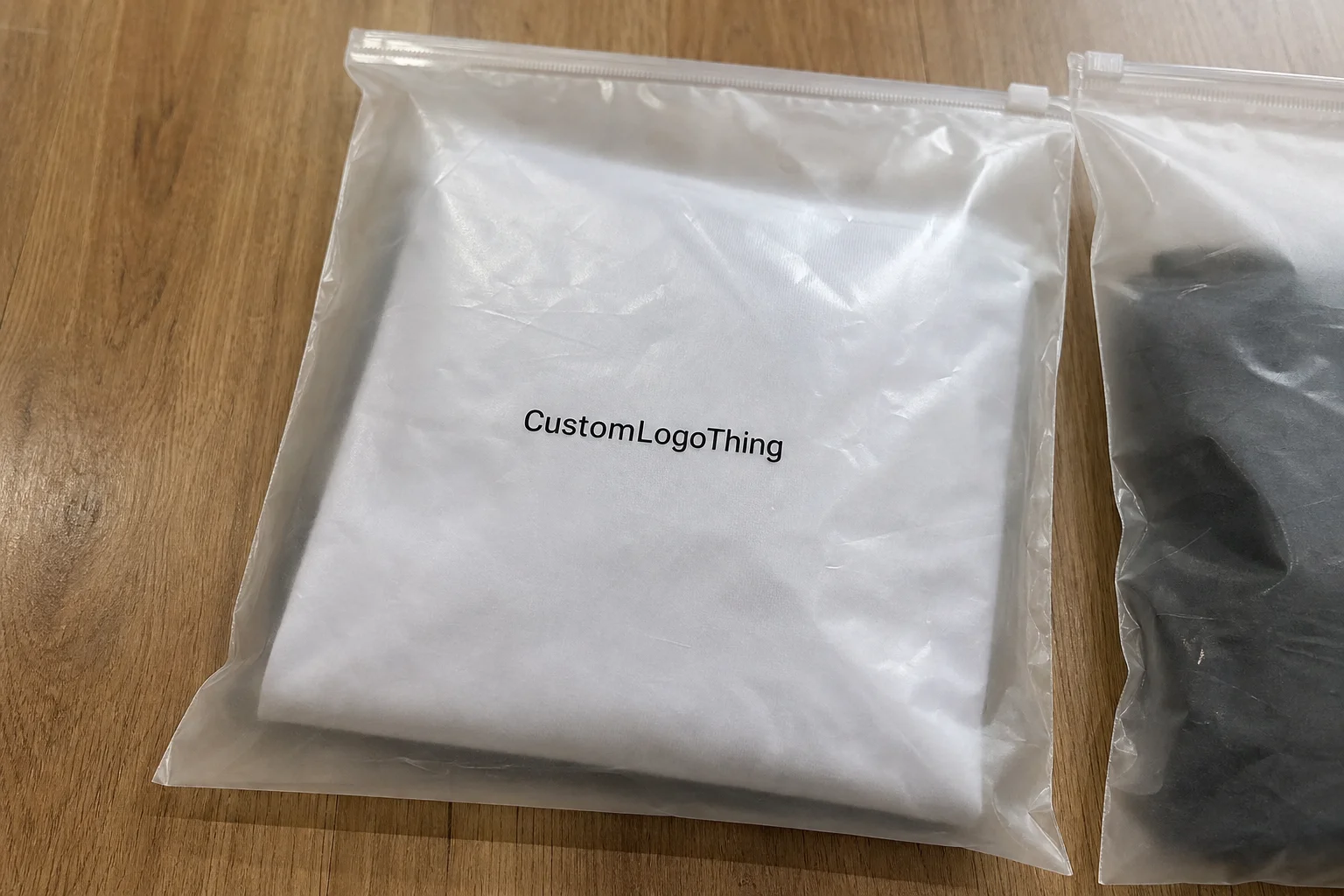
Agencies buy packaging for a wide range of client needs: beauty samples, branded accessories, onboarding kits, influencer mailers, trade show inserts, and internal presentation packs. Frosted Zipper Poly Bags fit that mix because they sit between plain utility and premium presentation. The frosted surface softens the look of the contents, so the package feels deliberate rather than exposed.
That finish is not just decoration. In buyer review, texture and closure style often influence perceived quality more than heavier print coverage does. A one-color logo on a frosted bag can look more polished than a busy full-print clear bag, especially when the contents already carry the brand story.
The closure matters too. A standard press-to-close zipper helps keep sample pieces, small accessories, and insert cards from spilling during packing or transit. For reusable kits, it is much more practical than a simple fold-over sleeve. Less loss. Fewer complaints. Less time explaining why a “temporary” packaging choice caused a very permanent problem.
Agencies sometimes overestimate what print can fix and underestimate what material finish can do. A matte-frosted appearance, paired with a clean zipper, can raise presentation quality without pushing the order into specialty-packaging pricing. That is useful when the bag is part of a short campaign or a budget-sensitive rollout.
“The fastest way to improve a kit is not always more print. Often it is better structure, better closure, and a surface that feels intentional.”
Flexibility is the other reason buyers keep coming back to this format. One supplier that can support different sizes, print levels, and reorder patterns is usually more helpful than a great quote on one campaign and a headache on the next. Repetition is the whole point in agency procurement, even if nobody wants to say it that plainly.
Product details that matter before you request a quote
At the product level, this is a frosted polyethylene zipper bag built for sample packaging, retail inserts, promotional distribution, and kit assembly. Most buyers are choosing between stock bags, lightly customized versions, or fully printed bags. Each path changes lead time, MOQ, and Cost per piece.
Finish is usually the first decision. A frosted translucent body gives a softer display. A clearer variant shows the contents more directly. Frosted stock often works better when the product inside is colorful, visually busy, or not meant to be seen at full detail. The background becomes calmer, which helps the contents look more organized.
The zipper should not be treated as a minor detail. A standard single-track press-to-close zipper is fine for light-duty use. If the bag will be opened and closed repeatedly, or if it will hold small accessory items, tighter seal retention matters more. Ask for samples if the bag is meant for repeated handling. It is far cheaper to test a closure than to learn after fulfillment that contents are slipping out.
Print compatibility matters as well. Some agencies only need a one-color logo or a simple side label. Others want a small brand message or multi-color imprinting. And some should skip print entirely to keep turnaround tight. There is no prize for adding decoration when the bag is a temporary campaign item and the launch date is already breathing down your neck.
Use case changes the spec. Beauty samples need a clean display and light protection. Tech accessories may need a thicker film gauge and a tighter closure. Apparel add-ons often need larger dimensions but not aggressive sealing. The bag should be sized to the real contents, not just the item on its own. Include insert cards, tissue, instructions, and any other piece that actually ships with it.
Here is a quick comparison agencies can use during early sourcing:
| Option | Best use | Typical cost impact | MOQ tendency |
|---|---|---|---|
| Stock frosted zipper bag | Fast-turn kits, samples, internal packs | Lowest unit cost | Lower MOQ |
| Lightly customized bag | One-color logo, simple branding | Moderate setup charges | Mid-range MOQ |
| Fully printed custom bag | Client-facing launches, premium presentations | Higher cost per piece | Higher MOQ |
That table is not decorative. It is the starting point for deciding whether a campaign needs speed, a branded look, or the lowest possible landed cost. Pick one priority too many and the quote starts getting weird.
Specifications agencies should lock in early
The most common quoting problem is incomplete specification. If you want an accurate quote, lock in the basics early: width, height, side gusset if needed, gauge or thickness, zipper style, and print area. Those details determine whether the bag is a stock match, a light modification, or a custom run.
Size should always be matched to the finished contents, not only the main product. A pouch that fits a lipstick on paper may fail once the insert card, tissue, or instruction sheet is added. That is how reorders get messy. A half-inch error is enough to change the fit and force artwork or dieline changes later.
Material choice usually comes down to polyethylene grade and thickness. PE is popular because it gives good flexibility and manageable clarity control. Heavier gauges add structure and can improve reuse value. If the bag will move through a fulfillment line, the thicker side of the range usually makes sense because the zipper is more likely to survive handling without distortion.
For agencies buying across several brands, compliance can matter too. Packaging that moves through retail, trade show, or e-commerce channels may need documentation or a clear statement of material consistency. If sustainability claims are part of the brief, get those claims confirmed in writing. Do not assume recycled content, recyclability, or other environmental attributes unless the supplier can support them. For broader references, the EPA recycling guidance and FSC resources are useful starting points for packaging discussions, even though they do not replace product-specific verification.
Artwork should not be approved before the dieline or sample measurements are confirmed. That sounds obvious, which is exactly why people ignore it. Ask for a proof with exact print placement. Confirm the safe area. Then get signoff from the decision-maker who can actually stop revisions, not the one who forwards comments at 6:40 p.m. after everyone else has logged off.
If the bag needs to coordinate with cartons or mailers, keep the spec discipline consistent across formats. Many buyers keep Custom Packaging Products aligned under one artwork system so the kit does not look like three different brands got into a fight. That also makes it easier to pair the bags with Custom Poly Mailers when a full shipment system needs the same visual language.
Cost, pricing, and MOQ planning for agency forecasts
Pricing is driven by size, material thickness, print complexity, number of colors, zipper style, and quantity. If any one of those changes, the quote changes. That is why frosted zipper poly bags for agency buyers moq planning should never be based on a single unit price. You need the tier, the setup charges, the freight assumptions, and the reorder path.
For stock bags, smaller runs usually have a lower MOQ and faster dispatch. Once print is added, tooling fees, screen setup, or plate charges often enter the quote. Those charges do not always scale neatly. A 5,000-piece run can be a better value than 2,000 if the setup fee is already being spread across more units.
Here is a practical way to think about it. Suppose a 4 x 6-inch frosted zipper bag is used for a sample kit. At 2,000 units, the cost per piece may sit in one bracket. At 5,000 units, the unit cost may drop enough to offset the bigger spend if the client is planning multiple campaign waves. That is the difference between buying packaging and planning inventory.
A simple comparison model helps keep the conversation grounded:
| Order tier | Typical quote behavior | Risk level | Best fit |
|---|---|---|---|
| Lower MOQ | Higher cost per piece | Lower inventory risk | Pilot runs, test kits, urgent campaigns |
| Mid-volume | Balanced unit cost and setup charges | Moderate risk | Quarterly client programs |
| Higher volume | Best bulk pricing | Higher storage and forecast risk | Recurring programs, standardized agency SKUs |
The smarter forecast is to group similar client orders into one size-and-spec family. If three clients use similar insert cards or accessory dimensions, one shared bag format can reduce re-sourcing time and improve pricing. That is a real procurement advantage. It also makes replenishment easier when campaigns are repeated or extended.
Hidden cost factors deserve attention. Ask about shipping method, sample approval fees, freight packaging, and whether artwork revisions trigger new setup charges. Some suppliers quote an attractive base price and recover margin through extras. That is not unusual. It is just why buyers need a full landed-cost view before presenting an option to a client.
For a clean comparison, ask for tiered pricing at common volume breaks, a clear MOQ, and any one-time charges listed separately. If the supplier cannot show that, the comparison is incomplete. And yes, a quote that looks cheap until freight and setup are added is still an expensive quote. Packaging math has a sense of humor like that.
In many agency programs, price ranges for plain stock Frosted Zipper Bags can land in the low cents per piece at scale, while printed or custom-sized versions move upward depending on dimensions and setup. Exact numbers depend on the spec sheet, but the pattern stays the same: simpler orders reward speed, and custom work rewards volume.
Process, lead time, and approval steps from sample to shipment
The standard path is straightforward: inquiry, spec confirmation, artwork review, sample approval, production, quality check, dispatch. The process is not the hard part. The back-and-forth before proof approval usually is.
Lead time depends on order type. Stock bags move faster because there is less setup. Printed or custom-sized bags need more time for verification, color alignment, and production scheduling. If the bag is tied to a launch, assume the supplier will need proof approval before the clock really starts.
Most delays happen in the same places: missing dimensions, low-resolution logo files, late proof approval, or repeated revisions after sampling. A simple approval workflow works best. One decision-maker. One proof round. One final signoff. Anything beyond that should be treated as a scope change, not a casual tweak that somehow “should be easy.”
Build buffer time for internal approvals, not just factory production. That buffer is often what saves the campaign from becoming expensive. More than once, packaging has technically arrived on schedule and still missed the launch because the agency underestimated its own review timeline. The factory was not the bottleneck.
If the spec is already finalized and the artwork is production-ready, rush options may be available. But rush work is much easier to secure when the bag size, zipper style, and print area are settled. If you are still deciding whether the frosted effect should be heavier or lighter, you are not in rush-order territory yet.
Quality checks matter at the end of the run. Agencies should confirm zipper function, material consistency, print alignment, and pack count accuracy before shipment leaves the production stage. If the bags are being used for client-facing kits, check at least a sample from the finished batch, not only the pre-production proof. A proof is not the same thing as a production run. Funny how that gets forgotten right when it matters.
Why our packaging approach fits agency procurement better
Agency procurement works best when the packaging supplier behaves like a predictable part of the workflow, not a one-off vendor that disappears after the quote. That means consistent specs, repeatable production, and fewer surprises when the same bag is reordered for a different campaign. A dependable format reduces re-briefing and saves time across account teams.
Responsive quoting matters too. Agencies often need to compare several sizes, finishes, and quantities before presenting options to a client. Fast, clear pricing helps the buyer move from estimate to approval without chasing missing numbers. It also reduces the risk of misquoting unit cost and eating margin later.
Quality control is another practical advantage. For frosted zipper poly bags for agency buyers moq planning, the important details are simple but non-negotiable: consistent zipper function, clean frosted finish, stable print placement, and packaging that arrives ready for client presentation. If those four things are right, the bag does its job.
There is also a vendor-management benefit. When one supplier can support similar SKUs across multiple brands, the agency spends less time re-sourcing every time a campaign changes. That helps account teams standardize packaging without committing to oversized inventory. Standardization sounds boring until you realize how much time it saves.
Packaging support should be practical. Clear communication. Sample guidance. Predictable fulfillment. No mystery charges buried in the third attachment. No “minor clarification” that turns into a new setup fee. That is the service model that helps agencies keep moving and keep client conversations grounded in facts rather than packaging jargon.
“The best supplier relationship is the one that reduces your admin load without creating new surprises in production.”
Next steps to finalize frosted zipper poly bags for your agency
Start with three inputs: target size, intended use, and estimated quantity by client or campaign. That is enough to get a serious quote moving. If you already know whether the bag should be frosted, fully printed, or plain stock, include that as well. It changes the MOQ and the pricing structure immediately.
Send artwork files and any reference sample photos early. That helps the supplier confirm print area, finish expectations, and likely fit issues before production is booked. If there is an existing pouch from another campaign, include its measurements. A physical reference is often more useful than a long email thread that nobody wants to own.
Ask for a price-break table. Do not accept one number and call it a comparison. You need at least two or three volume tiers so you can test pilot runs against rollout quantities. That matters especially for frosted zipper poly bags for agency buyers moq planning, because the gap between a short run and a recurring SKU can be large.
If the bag is client-facing or part of a premium kit, request a pre-production sample. That small step can save a much larger mistake later. It is the cleanest way to confirm zipper feel, frosted appearance, logo placement, and overall presentation before the run starts.
The practical sequence is simple: confirm specs, compare unit cost at two or three volumes, approve the proof, then schedule production. That keeps procurement controlled and protects margin. If you need support across broader packaging formats, the same logic applies to the Custom Packaging Products lineup, and the FAQ can help with common quoting questions before a brief gets locked.
Bottom line: frosted zipper poly bags are a solid fit for agency work because they manage cost, presentation, and reordering with very little drama. Handle the MOQ carefully, compare bulk pricing instead of chasing the lowest headline number, and frosted zipper poly bags for agency buyers moq planning becomes a reliable part of the procurement playbook.
FAQ
What is the MOQ for frosted zipper poly bags for agency buyers?
MOQ depends on size, material thickness, and whether the bag is stock or printed. Printed custom runs usually require a higher minimum than plain stock bags. The practical move is to group similar client projects together so you can hit a better volume tier without overbuying.
How do frosted zipper poly bags compare with clear poly bags for client kits?
Frosted bags create a softer, more controlled presentation and reduce the stark look of clear plastic. Clear bags show contents more directly, which helps when visibility is the priority. Choose frosted when presentation matters more than full product exposure.
What information should agencies send to get an accurate quote fast?
Send finished dimensions, expected quantity, print requirements, and closure preference. Include artwork files and a description of the contents so the supplier can confirm fit. Add your timeline if the bags are tied to a launch, event, or client approval deadline.
How long does production usually take after artwork approval?
Lead time depends on whether the order is stock, custom printed, or made to a special size. Production usually starts after final proof approval and deposit confirmation. Rush options may be available, but only if specs and artwork are already finalized.
Can frosted zipper poly bags be used for repeated client deliveries?
Yes, especially when the gauge is selected for durability and the zipper is designed for reclosure. They work well for reusable sample kits, accessory packaging, and internal presentation packs. Ask for a thickness recommendation based on whether the bag will be reused or shipped once.

