Startup packaging gets messy fast. You want something that looks polished, protects the product, and does not trap you in an order size you cannot move. That is why Frosted Zipper Poly Bags for startup brands moq planning comes up so often in early packaging decisions. These bags sit in a useful middle ground: premium enough for retail, light enough for shipping, and flexible enough for brands that are still testing demand.
The appeal is practical. One item can handle branding, presentation, and basic protection without adding much weight or complexity. No rigid box. No insert system that eats margin. No oversized packaging stack sitting in a storage closet like a bad decision with a label on it.
For apparel, accessories, wellness products, and sample kits, Frosted Zipper Bags can do a lot of work for relatively little money. They are not the cheapest option on paper, but cheap on paper is how people end up paying twice later. First for the packaging. Then for the fix.
Why frosted bags fit startup launches better than most packaging
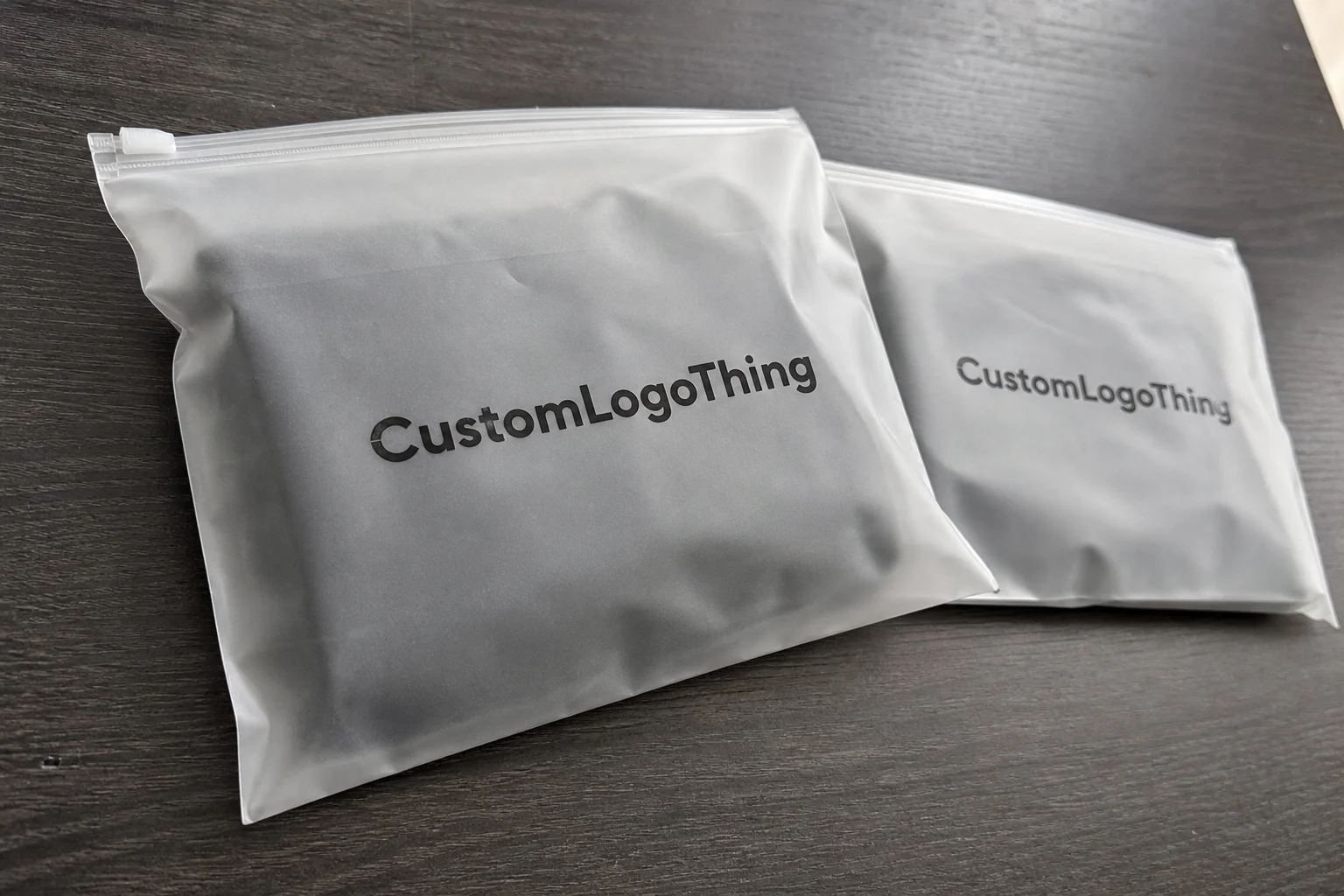
A startup usually does not need the fanciest package on day one. It needs the right package. That usually means something that ships flat, stores flat, and still gives the product a finished look. Frosted Zipper Poly Bags for startup brands moq planning fit that brief better than most first-time buyers expect.
The frosted finish does real visual work. Clear PE bags show everything, including wrinkles, labels, and whatever chaos is inside the package. Frosted film softens that view. It gives a cleaner reveal and makes a simple product feel more considered. That matters for apparel, socks, jewelry, beauty items, supplement sachets, and starter kits where the packaging often carries a chunk of the brand impression.
Zipper closures help too. They make the bag resealable, which is useful when the customer wants to store the product after opening. They also reduce the “cheap throwaway bag” feeling that plain poly sometimes creates. A decent zipper can improve usability and cut down on minor damage in transit without pushing you into rigid packaging territory.
There is a tradeoff, of course. Frosted Zipper Bags are not the absolute cheapest poly format. If the only goal is the lowest unit price, plain clear bags win. But once you factor in presentation, shipping weight, and the fact that early brands usually need a tidy first impression more than a bargain-bin solution, frosted bags start making sense fast. Boxes may look prettier in a deck. They also cost more, weigh more, and add more moving parts to production.
“Premium enough for retail, simple enough for a sane MOQ.” That is the real brief.
For shipping-heavy SKUs, some brands pair bagged product with a separate mailer format for outer transit. Different job, different spec. If you are comparing options, a good benchmark is our Custom Poly Mailers page. It helps to separate the presentation layer from the shipping layer before the quote turns into a mess.
And yes, different products need different packaging. That sounds obvious until a brand tries to use one format for everything and wonders why costs keep creeping up.
What makes a frosted zipper bag feel premium
The difference between a bag that looks branded and one that looks disposable usually comes down to a few specs: film thickness, frost level, zipper style, print method, and overall bag format. None of those sounds glamorous. All of them matter.
Most startup-friendly frosted zipper bags land somewhere around 3.5 mil to 6 mil, depending on what they need to carry. Lighter gauges are fine for soft goods and simple presentation. Thicker film makes more sense if the contents are heavier, the bag needs more structure, or the customer will open and reseal it repeatedly. Too thin, and the bag feels limp. Too thick, and you may be paying for rigidity you do not actually need.
The frost finish deserves more attention than buyers usually give it. A lighter frost lets some of the product show through, which works if the contents are attractive or organized. Heavier frost hides more and gives a cleaner, more consistent look, which is useful if the product appearance varies from unit to unit. That one choice can change how polished the packaging feels in hand and on camera.
Small upgrades that improve usability without bloating the spec
- Hang holes for retail display
- Tear notches for easier opening
- Writable panels for size, SKU, or batch notes
- Flat or stand-up formats depending on shelf presence
- Matte or spot gloss print accents for a cleaner logo read
Print is another place where startups accidentally overbuild. A one- or two-color logo is often enough for early branding. It keeps artwork simpler, lowers setup complexity, and usually prints more cleanly at smaller quantities. Full-coverage artwork can look strong, but it raises cost quickly and can create more room for registration issues. Fancy is fine. Needlessly expensive is not.
| Option | Typical Use | Cost Impact | Buyer Take |
|---|---|---|---|
| Plain frosted zipper bag | Storage, fulfillment, simple presentation | Lowest | Useful for testing, but light on brand presence |
| 1-color logo print | Startups, DTC apparel, sample kits | Moderate | Best balance of price and branding |
| 2-color or spot print | Retail-ready starter packaging | Moderate to higher | Better visual impact, slightly more setup work |
| Full-coverage branding | Premium launch kits, gift sets | Highest | Looks strong, but can burn budget fast |
For clothing, cosmetics, socks, supplements, and bundle sets, the right build is usually simple: enough structure to look intentional, not so much customization that the bag becomes a project. The goal is to support the product, not turn packaging into its own product line.
Quality and compliance still matter. If the bag will touch food-adjacent items, cosmetic goods, or regulated products, ask for material declarations and the right use-case confirmation. Do not assume every poly bag is suitable just because it looks clean. If your shipment needs to survive parcel handling, ask how the bag performs under compression, stacking, and typical transit abuse. For broader packaging standards and sustainability background, the Packaging Association has practical references at packaging.org.
Specs to lock before you request pricing
Before requesting samples or quotes, get the core specs in order. Otherwise you will spend time approving the wrong thing, which is an efficient way to waste a week and irritate everyone involved.
Start with dimensions. Bag size should reflect the actual product, the closure space, and any insert card or label. A bag that is too tight looks cheap and stresses the zipper. A bag that is too large wastes material, adds bulk, and lets the product shift around inside.
Then define what goes inside. One unit or multiple units? Light item or heavier bundle? Retail display, protective storage, or promo packaging for influencer kits? Those answers affect size, thickness, and closure style more than most people expect.
Here is the spec checklist worth having before quoting:
- Bag dimensions in width, height, and gusset if needed
- Film thickness target, usually in mil
- Zipper style and whether reseal strength matters
- Print area and number of colors
- Bag format: flat or stand-up
- Quantity target and acceptable MOQ range
- Product use: retail, shipping, sample, or storage
If the bag is for cosmetics, food-adjacent goods, or other sensitive applications, ask about material declarations and any relevant compliance language. For example, a bag that is fine for apparel may not be acceptable for a product that has stricter contact expectations. This is not the place to guess. Packaging that fails a basic review creates delays that are far more expensive than a few extra specification questions.
Seal strength and moisture resistance also deserve attention. A frosted zipper bag used for apparel has different needs than one used for powders, bath products, or bundled samples. Heat, pressure, and humidity can change zipper performance over time, especially in storage or transit. If the product is likely to sit in inventory for a while, ask about closure consistency after repeated use and shelf exposure.
Sampling should not be optional. Ask for a physical sample or at least a proof with dimensions, artwork placement, and finish clearly marked. A proof catches the predictable mistakes: wrong logo size, print too close to the zipper, awkward spacing, or a bag dimension that only works in theory. Catching that before production is annoying. Catching it after the run is expensive. Simple math.
If you need to compare formats before you commit, our Custom Packaging Products page is a useful place to narrow the structure first. The wrong bag shape makes everything harder later.
Pricing and MOQ planning that keeps cash flow intact
This is the part where most new brands get surprised. Packaging quotes look cheap until you separate the unit price from the rest of the bill. Then the real number shows up.
Frosted zipper poly bags for startup brands moq planning usually comes down to four cost drivers: bag size, thickness, print colors, and quantity. Add hang holes, gussets, special finishes, or more complex print coverage, and the price climbs again. If you want custom shapes or heavier film, expect the quote to move. Packaging is not mysterious. It is just very good at hiding cost in small line items.
For smaller runs, the unit cost often lands around $0.18 to $0.45 per piece for basic to moderately branded frosted zipper bags, depending on spec and quantity. More complex builds can go higher. Larger orders usually drop the per-piece cost, sometimes enough to matter, but they also tie up more cash and storage space. Cheap unit price is nice. Dead stock is not.
There are a few things worth separating in the quote:
- Unit price versus setup charges
- Tooling fees if the design or closure structure needs them
- Sample cost and revision rounds
- Freight and duty for landed cost
- Rush fees if the timeline is tight
MOQ is not just a supplier preference. It reflects material usage, print setup, and production efficiency. Lower quantities mean the fixed costs get spread across fewer units, so the unit price rises. Larger quantities can improve economics, but they also increase inventory risk. Startup brands should avoid chasing the lowest MOQ just because it feels safer. Sometimes the tiny run has so many setup charges that it is not actually the cheaper option. Sometimes the “low MOQ” is just a pricier way to say “we had to do more work for fewer pieces.”
A useful planning move is to ask for two quote levels: the smallest viable run and a second quantity where the unit cost drops meaningfully. That makes the cost curve obvious. It also helps answer the real question: is the better unit price worth the extra inventory, or are you just buying more boxes of hope?
If product-market fit is still uncertain, prioritize manageable MOQ and clean branding over complicated finishes. You can move into more elaborate packaging after sales prove out. Recovering cash from overordered packaging in a back room is much harder than it sounds.
For early launches, price should be judged against landed cost, not only factory price. A quote that looks attractive before freight can become annoying very quickly once shipping, duties, and sample rounds are included. That is how budgets drift without anyone officially approving a budget increase.
Lead time and approval workflow
The workflow is simple enough: inquiry, spec review, artwork proof, sample approval, production, inspection, and shipping. The reason it goes wrong is also simple: someone sends incomplete information and hopes for the best. Hope is not a production document.
Missing dimensions. Low-resolution logo files. No clear zipper style. A print request that changes three times because nobody defined the layout early. Every one of those issues adds time. They also increase the chance that the final bag matches the brief only in the loosest possible sense.
For many custom runs, production often lands around 12 to 18 business days after proof approval. That can shift based on quantity, stock availability, print complexity, and whether any tooling is required. If artwork needs corrections, add time. If the supplier is waiting on a decision, add more time. Shipping can add several days or several weeks depending on destination and freight mode. There is no magical shortcut hidden in the calendar.
Ask for an approval checkpoint before full production begins. It saves money. Catching a mistake on a proof is irritating. Catching it after 10,000 printed bags is how small issues become large invoices.
Startups should also build real buffer time into launch schedules. Influencer kits, event drops, retail resets, and restock windows all have different deadlines. Packaging should arrive before those deadlines, not somewhere in the middle of them. That sounds obvious until someone approves art late and starts asking whether overnight freight can fix a three-week delay.
If the bag is part of a larger shipping system, ask whether the supplier has testing references tied to ISTA procedures or similar transit standards. That matters most when the package must survive compression, vibration, and parcel sorting without zipper failure or seam damage. For broader material and waste context, the EPA has useful background at epa.gov.
What good small-batch suppliers do differently
A good supplier does not just quote a bag. They help narrow the spec so you do not pay for nonsense. That means asking better questions early: What is the product? How is it shipped? Is this retail display or fulfillment packaging? What quantity can you actually absorb?
Clear communication matters more than flashy promises. You want direct answers on MOQ, revision limits, print tolerance, and lead time. You also want the supplier to tell you when a feature adds cost without adding much value. That kind of honesty is useful. It keeps the job from becoming a bloated packaging exercise.
Proofing and consistency are the real test
Sample checks should cover more than print placement. Look at zipper function, frost uniformity, seal quality, and whether the bag arrives clean and ready to use. If the zipper feels weak, the film looks blotchy, or the logo alignment is drifting, those are not tiny defects. They are production problems that will show up at scale.
For small-batch brands, the best suppliers also think ahead. They should be able to start with a lower MOQ, then scale the same design later without forcing a complete redesign. That continuity matters. Rebuilding artwork, die lines, and print setup every time quantity changes is a waste of time and money.
Look for three things: clear mockups, realistic cost guidance, and repeatable production quality. Pretty simple. Surprisingly rare.
There is also a practical difference between suppliers who understand startup constraints and those who only like large, tidy orders. The former will tell you where to simplify the design. The latter will bury you in optional extras and act surprised when your quote gets expensive. One of those approaches is useful. The other is just invoice theater.
How to quote the right bag the first time
Before requesting pricing, gather the essentials: product dimensions, target quantity, artwork files, finish preference, and the exact role of the bag in the customer journey. Retail packaging, protective storage, and promo kits do not need the same build, so do not pretend they do.
Then compare two versions of the order. One should be the startup-friendly run with a manageable MOQ. The other should show the scale-ready option so you can see how bulk pricing changes the economics. That side-by-side view makes it easier to decide whether the lower per-piece cost is actually worth the extra inventory.
Request a sample or at least a proof review before approval. That one step catches most avoidable mistakes. If the bag size is off, the print is too busy, or the frost level is not right, you want to know before production starts, not after.
frosted zipper poly bags for startup brands moq planning works best when packaging is treated like part of the product strategy, not an afterthought. Send clear specs, ask for a real price range, confirm lead time, and approve only after the sample checks out. That is how you keep the order clean, the budget controlled, and the launch on schedule.
If you need to compare packaging formats before settling on one, the FAQ page covers the basics, and the product pages can help you narrow the structure before you commit.
What is the typical MOQ for frosted zipper poly bags for startup brands?
MOQ depends on size, print complexity, and whether the bag is stock-based or fully custom. Smaller runs are possible, but unit cost usually rises as quantity drops. Ask for a range instead of assuming one fixed minimum, because that range tells you a lot about the supplier’s pricing structure.
How much do frosted zipper poly bags cost per unit for small orders?
For small orders, unit cost is shaped by bag size, thickness, print colors, and quantity. A basic branded run may fall around $0.18 to $0.45 per piece, though more complex specs can go higher. Always ask for freight, setup charges, and any tooling fees separately so the landed cost is clear.
Are frosted zipper poly bags better than clear bags for a new brand?
Usually, yes, if your goal is a cleaner, more premium presentation. Frosted bags hide clutter better and feel more elevated than plain clear PE bags. Clear bags still make sense when product visibility is the main selling point, but frosted is often the better balance for startup branding.
How long does production usually take after artwork approval?
Lead time depends on stock availability, print setup, and order size. Many custom runs take about 12 to 18 business days after proof approval, then shipping time gets added on top. Faster responses on artwork and approvals help a lot.
What should I prepare before requesting a quote for frosted zipper poly bags?
Have product dimensions, quantity, artwork files, finish preference, and intended use ready before asking for pricing. If you know whether the bag is for retail display, shipping protection, or storage, the quote will be more accurate and revisions will be fewer.

