Garment Poly Bags for Sports Clubs Artwork Proof Checklist
For club kit packaging, an artwork proof is where the order either becomes straightforward or turns into avoidable rework. A bag can look simple on screen and still fail in production if the crest is too close to the seal, the size label is wrong, or the film width does not suit the folded garment.
That is why the proof needs to answer production questions, not just design questions. It should show how the bag fits, how the artwork prints, and how the finished pack will be handled. If those points are unclear, the proof is not ready.
A good proof answers three questions at once: does it fit, does it look right, and can it be manufactured exactly as shown?
That matters more on sports club orders because several people usually want a say in the final layout. Coaches, merch teams, and operations staff often review different things. Without one final owner, the proof can be “approved” while still being wrong.
Why Sports Club Bag Proofs Fail Fast
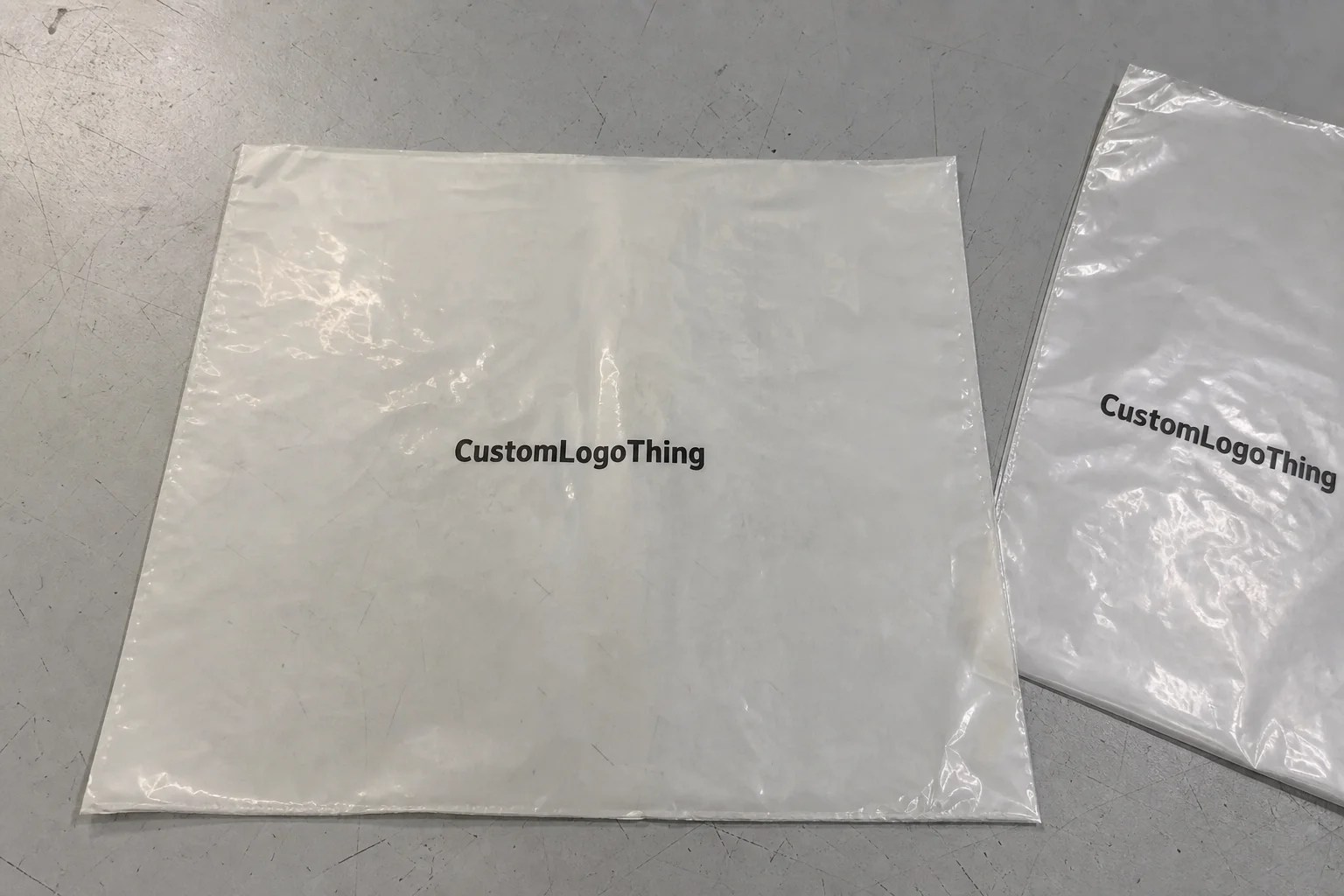
Sports club orders move under deadline pressure. Season launches, tournament packs, and school handovers all arrive on fixed dates, so proofing tends to happen quickly and with too many opinions in the loop. The artwork may be correct, but the bag spec, fold, or seal position is often assumed rather than checked.
Clear poly packaging exposes that kind of mistake fast. If the shirt folds wider than expected, the logo can sit under a crease. If sponsor copy runs long, it can drift into the heat seal or header area. If the bag is meant for a full kit set instead of a single shirt, the whole layout changes.
The other common problem is split responsibility. One person focuses on branding, another on pack speed, and a third on costs. That is fine internally, but the supplier needs one clear answer. If nobody owns the final proof, small issues get missed and the order slips.
Printed garment bags for clubs should be treated as production documents. If the proof looks attractive but hides a seal issue, wrong size, or incorrect fold logic, it is not a usable proof.
What a Garment Poly Bag Proof Should Confirm
A proper proof should show the artwork, bag dimensions, print area, safe zone, seal style, and any pack-specific features such as a hang hole, tear notch, or barcode panel. If the supplier only sends a flat image with no dimensions or notes, that is not enough to approve production.
For custom logo bag printing, the proof should also show fold positions and how the artwork sits once the garment is packed. A logo that is centered on a flat layout can shift once the film is folded or sealed. Text that looks fine in a mockup can disappear into a crease.
Material details matter too. Club runs often use clear LDPE or similar poly film in a practical gauge, commonly in the 25 to 40 micron range for lighter garments and higher when the pack needs more stiffness. If the film is too thin, it wrinkles and tears more easily. If it is too heavy, the order becomes more expensive than it needs to be.
The proof should also confirm whether the bag is transparent, tinted, or partially printed. A fully clear bag behaves differently from a bag with a printed header or solid back panel. If the club wants the kit visible, that needs to be explicit. If the bag is supposed to hide the garment color, that should be visible on the proof too.
Do not overlook small copy. Player numbers, sponsor names, division labels, URLs, and care text are easy to miss because everyone stares at the crest. A clean-looking mockup does not protect against a wrong line of text.
For clubs that also order inserts or shipping materials, it helps to keep artwork rules consistent across the wider packaging range, including Custom Packaging Products and Custom Poly Mailers. That reduces confusion when different items are approved by different people.
Artwork Proof Process and Timeline
The process is simple: the buyer sends final files and order notes, the supplier builds the proof, the buyer reviews it, revisions happen if needed, and production starts after approval. The weak point is usually not the software. It is the quality of the inputs and the speed of internal sign-off.
Clean vector logos, final sponsor text, accurate size labels, and a clear bag spec move the proof through faster. If the supplier has to redraw a badge, match a precise club color, or rebuild the layout for multiple print areas, the timeline stretches. One extra revision can add a couple of business days.
There is a difference between a digital preview and a production proof. A preview helps with general layout. A production proof should reflect the actual bag size, print position, closure method, and any limits caused by the film or seal. If the supplier is serious, they should mark what is tentative and what is locked.
Timelines get tight around kit launch dates, end-of-season distribution, and tournament travel. One internal reviewer with final authority is usually faster and safer than a group thread. If the order is high priority, ask for packaging and transit checks too. Standards associated with ISTA are useful when the question is not only whether the proof looks right, but whether the finished packs will survive shipping and handling.
Cost, Pricing, and MOQ for Club Orders
Pricing usually comes from setup cost, artwork handling, unit price, and any extras for multiple print colors, special film gauge, or non-standard dimensions. A low headline price can change quickly if there is a reproof fee, a rush surcharge, or a packing change that was not included in the quote.
MOQ matters because setup is spread across the run. Small club orders tend to carry a higher unit cost, while larger runs become more efficient as fixed costs are divided across more bags. A 1,000-piece run usually costs more per unit than a 5,000-piece run, even if the artwork is identical.
Indicative pricing often lands around $0.18-$0.30 per unit on larger runs with simple one-color print, and closer to $0.30-$0.55 on smaller runs or jobs with more complex branding. Thicker film, extra colors, a euro slot, or a special closure will push the price up.
| Order Type | Typical MOQ | Indicative Unit Cost | What to Confirm Before Approval |
|---|---|---|---|
| Simple clear bag with one-color logo | 1,000-3,000 | $0.18-$0.30 | Bag size, seal style, logo placement, and whether the folded kit fits cleanly |
| Printed club bag with sponsor text and size label | 3,000-5,000 | $0.22-$0.40 | Copy accuracy, safe area, color expectations, and carton count |
| Custom size or multi-color print | 5,000+ | $0.30-$0.55 | Proof revisions, print coverage, film thickness, and any pack changes |
| Rush club order with tight delivery window | Varies | Usually higher than standard | Rush fee, reproof timing, and whether production slots are actually available |
Ask the quote and the proof to line up line by line. If the bag size, print count, or pack format on the proof does not match the quote, stop and correct it before approval. Hidden cost usually comes from missed assumptions, not the artwork itself.
If the supplier mentions recycled content or sustainability claims, ask what part of the order the claim applies to. Recycled film, paper inserts, and outer cartons are not the same thing. Paper-based components can be checked against paper standards such as FSC, but that does not validate poly film by itself.
Garment Poly Bags for Sports Clubs Artwork Proof Checklist
Use this checklist before approving any club order, whether it is for shirts, shorts, socks, or full kit packs.
- Spelling: Check the club name, sponsor names, division labels, and player or kit identifiers exactly as they should appear.
- Logo placement: Confirm the crest, sponsor mark, and secondary logos stay inside the safe area and clear of seals, folds, and edges.
- Scale: Compare the artwork with the bag dimensions and folded garment size, not with the open mockup alone.
- Color treatment: Confirm how the club colors are meant to print, especially on clear film or when the design uses a printed header.
- Bag spec: Verify width, length, film gauge, seal style, closure method, and whether the bag is clear, tinted, or partially printed.
- Pack format: Check whether the bag is for one garment, a full kit set, or an accessory pack with a header or hang hole.
- Barcode or label area: Confirm where size stickers, barcodes, or carton labels will go if they are part of the packing plan.
- Carton count: Make sure the packing quantity matches the order sheet and that the carton configuration fits the distribution plan.
- Revision history: Read the latest proof version number so nobody approves an older file by mistake.
Annotate the proof in a way the supplier can act on without guessing. Vague comments like “make it pop” create delay. Specific notes such as “move the sponsor line 8 mm down” or “increase the logo width by 10%” shorten the loop and reduce rework.
Do not approve from a compressed low-resolution preview if the order matters. Blurry text can hide clipped copy, and a small logo shift is easy to miss when the file has been reduced for email.
Common Mistakes That Trigger Reprints
The biggest mistake is treating the proof like a branding sign-off only. A garment bag proof is a production document. If the buyer approves the look but ignores the pack size, seal location, or folding logic, the factory may still need to stop later and ask for clarification.
Color assumptions create another problem. A monitor can make navy look warmer, brighter, or darker than the printed film will. That matters when a sports club has a strict brand palette or a sponsor expects consistency across packaging, uniforms, and signage.
Late text changes are also common. A club might swap a sponsor line, add a new kit category, or change quantity after the proof has circulated internally. Even a small text edit can trigger a new version, and if the old file keeps moving through email, someone may approve the wrong one.
The folded garment is easy to forget. A shirt that seems compact in hand may expand in width once folded. If the bag is too tight, the artwork can end up hidden behind a crease or the seal can distort the print area. That is why garment measurements belong in the review.
Pack format is the last easy place to slip. If the club is using insert cards, headers, or multiple garments per pack, the specification changes. A bag that works for one folded shirt may fail the moment socks, shorts, or a larger jersey are added.
Expert Tips for Cleaner Approvals
Use one internal approver with final authority. Different teams will care about different details, and that is normal, but the supplier needs a single decision. One owner keeps the proof moving and avoids contradictory edits.
Keep a master asset folder for the club. Store approved logo files, sponsor artwork, text copy, and recurring size or division labels in one place. The next reorder then starts from clean inputs instead of forwarded emails and file names like “final_final_v7_reallyfinal.”
Ask for annotated feedback instead of broad comments. A supplier can work from a note that says “move logo left 5 mm,” but not from “the top feels off.” Precision shortens the proof loop and usually keeps the order on schedule.
If the order is high priority, request a second check against a physical sample or a more detailed production note before final approval. That extra step is worth it on larger club runs, especially where bag thickness, seal quality, or carton handling matters.
Do not skip the distribution side. Carton stacking, pallet weight, storage time, and route conditions matter as much as print quality. If the order is headed to multiple sites, the packaging needs to survive handling by people who care about speed, not the artwork.
Next Steps Before You Approve the Proof
Before you send approval, gather the final artwork, bag size spec, pack count, and internal sign-off list in one place. Then compare the proof against the quote, compare the proof against the garment measurements, and compare both against the club brand sheet. That three-way check catches most errors before they turn into waste.
If something looks off, ask for a revision immediately and state the correction plainly. Do not rely on implied feedback. A supplier can only correct what is written, and a clean revision note is faster than a long email thread full of assumptions.
If the club order is time-sensitive, lock the review window before the proof arrives. A file that sits unreviewed for two days is often more dangerous than a file that needs one revision, because the production slot can disappear while the team is still debating small details.
For buyers who order packaging regularly, treat each proof as part of a repeatable control process, not a one-off approval. That is where the Garment Poly Bags for sports clubs Artwork Proof Checklist earns its value: use it to keep the order aligned to the pack you actually want, not the one that only looked neat in email.
What should be checked on a garment poly bag proof for sports clubs?
Check the club name, sponsor text, logo size, bag dimensions, seal style, and closure method against the order sheet. Confirm that the folded garments will fit without crowding the print area or hiding important copy, and review color expectations, carton counts, revision numbers, and any special packing notes before approval.
How many proof rounds are normal for club poly bag artwork?
One round is common when the files are clean and the spec is already agreed. More rounds are normal when multiple stakeholders need to approve logos, sponsors, or pack details, but each extra round adds time, so consolidate feedback before sending revisions back.
What affects the unit cost of garment poly bags for clubs?
Quantity, bag size, film thickness, number of print colors, and any custom packing requirements are the main drivers. Low quantities usually carry a higher unit cost because setup is spread across fewer bags, and rush timing or reproofs can increase the total cost even when the base price looks competitive.
How long does artwork proof turnaround usually take?
Simple proofs can move quickly if the artwork is final and the spec is straightforward. Complex club orders take longer when there are multiple sponsors, custom sizes, or repeated revisions, and internal approval speed matters just as much as supplier turnaround, so assign one decision-maker.
Can changes be made after the proof is approved?
Small changes may be possible, but they usually trigger a revised proof and can delay production. Major changes after approval can create extra cost, rework, or a full order reset, so treat final approval as the point where all text, layout, and packing details must be locked.