Garment Poly Bags for Sports Clubs: Quote Guide
Quotes for club kit packaging go off track when the brief is incomplete. A supplier is not being difficult. They are trying not to price the wrong size, the wrong film, or a bag that does not fit the folded bundle.
That matters more for sports clubs than for a simple apparel order. A club pack can include shirts, shorts, socks, sponsor cards, size labels, and sometimes an extra insert for members. If the request only describes the shirt, the quote will miss something important. Usually enough to create a revision loop.
The cleanest way to buy garment poly bags for sports clubs supplier quote checklist is to treat the RFQ like a spec sheet. Not a sales pitch. Not a vague request for “plastic bags.” A proper brief gives the supplier enough detail to price accurately and lets you compare quotes on the same basis.
Good packaging quotes are boring. That is the point.
Why quote delays start before sampling
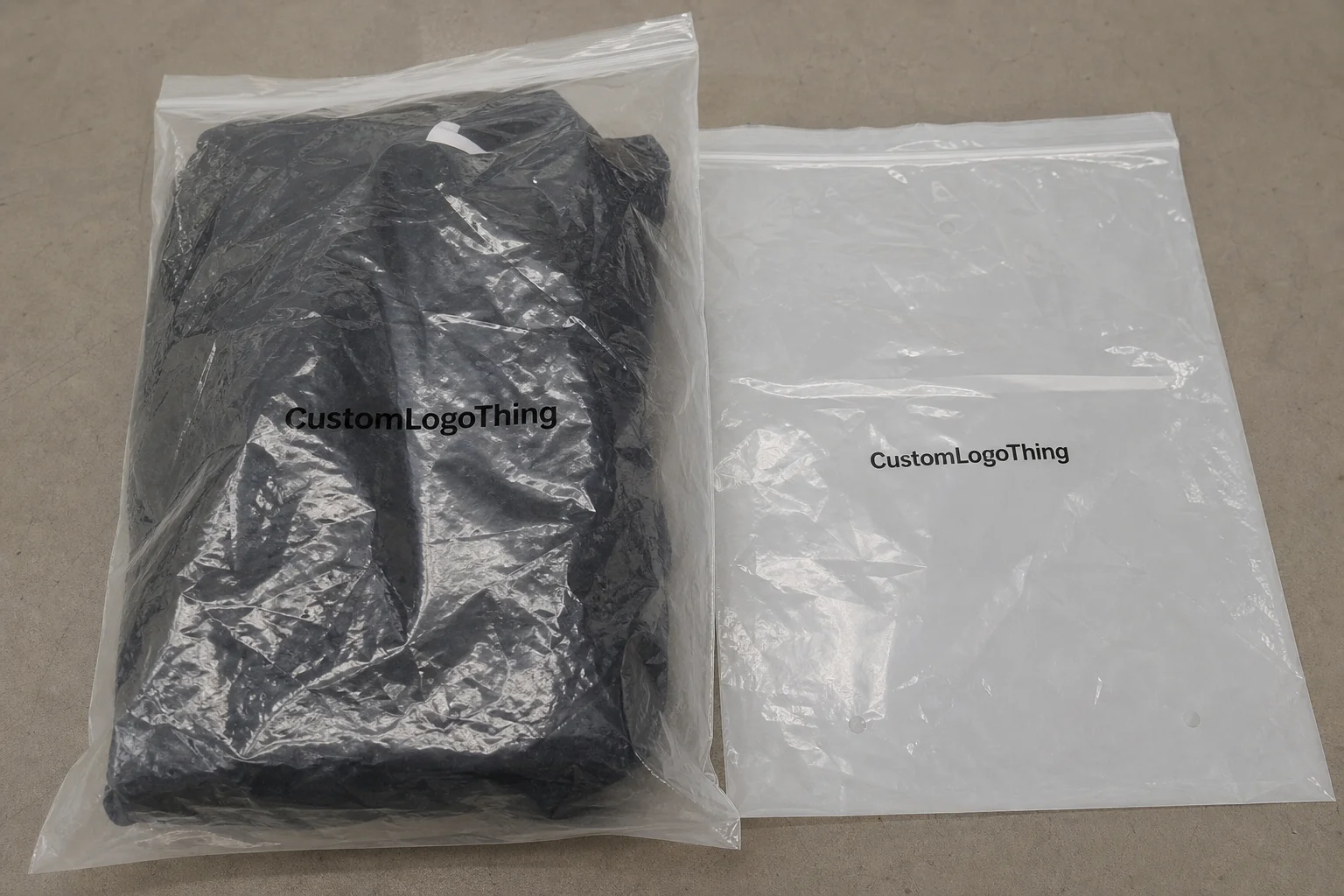
Most delays start before anyone talks about samples. The first email leaves out finished size, print count, closure style, packing format, or delivery terms. Then the follow-up cycle begins: one message for dimensions, another for artwork, another for carton or wicket packing. Each round adds time and increases the chance that someone is guessing.
Sports clubs add another layer because orders are rarely uniform. Match shirts are slim. Training sets are bulkier. Academy packs often include inserts. Tournament giveaways may need a warning line or a barcode label. If the bundle is not described clearly, the supplier has to build assumptions into the price. That is how a low-looking quote turns into a more expensive order.
Late changes cause more damage than most buyers expect. The first request says plain clear bag. The second adds a printed crest. The third adds a resealable flap. The fourth adds a hang hole because someone wants retail presentation. Each change can affect tooling, setup, waste allowance, and packing speed.
A clean RFQ does not need polished language. It needs measurements, artwork status, quantity, and the real packing use case.
If you want a quote that can be compared without a detective story attached, remove ambiguity first. That is what a good checklist does. It tells the supplier what they need to price and tells you whether the quote is complete.
Size, film, and closure choices that change the price
Bag format drives most of the cost. Flat bags are the easiest to quote and the cheapest to run. Side-gusseted bags give more depth and suit bulkier bundles. Wicketed bags help on high-volume packing lines because they speed hand loading. Resealable styles cost more, but they improve presentation and reduce dust or handling marks if the bags are going straight to members. Hanging formats help retail, but they need the right hole position and header space.
Size should be based on the folded bundle, not the garment alone. A shirt that fits in a compact bag by itself may not fit once shorts, socks, and a care card are added. Leave enough clearance to pack without stretching the film around the corners. If the bag is too tight, packing slows down and the seal area becomes a problem.
Film choice changes both appearance and performance. Low-density polyethylene is flexible and forgiving. Higher-clarity film gives a cleaner retail look. Recycled-content film can work well if the club wants a lower-impact message, but it is not automatically the cheapest option and it does not always behave the same in print. Some recycled films are slightly hazier and may need tighter print control.
Closure style is another place where buyers overspend without realizing it. Open-top bags are simple and fast. Self-seal bags improve presentation and make member packs easier to assemble. Zip closures sit higher again and make sense only when there is a real functional reason. If the bags are being packed by volunteers or a small team, simple usually wins.
- Flat open-top bags: lowest cost, fast packing, good for bulk distribution.
- Self-seal bags: cleaner presentation, useful for direct member packs, slightly higher cost.
- Wicketed bags: efficient for repetitive packing, but the bag spec has to match the line setup.
- Hanging bags: useful for retail or display, but they need coordinated hole and header specs.
One practical point that gets missed: ask for the finished internal dimensions, not just nominal size. Two bags listed as the same width can pack differently if the seal margin, fold, or gusset changes. That is why a bag that looks fine on paper sometimes fails on the floor.
Branding, print, and compliance details suppliers need
Print is not usually the biggest cost item, but it is one of the easiest places to create quote noise. A one-color club logo on clear film is a different job from a full-color crest with sponsor marks, size text, and a barcode. Add white ink or reverse printing and the job becomes more technical. Suppliers need the actual art and the actual print area, not a vague “put the logo on it somewhere.”
Send vector files if you have them. AI, EPS, or print-ready PDF is fine. A screenshot forces someone to rebuild the artwork, and that usually means either an art charge or a delay. Colors should be referenced properly. “Blue” is not a spec. Pantone, or a fixed CMYK target if that is all you have, is better. If the logo must stay clear of seal edges, state the safe zone. If the club crest cannot be distorted, say that too.
Retail-ready packaging can also trigger compliance details. Some markets need suffocation warnings on poly bags above a certain size. Some buyers need recycling marks. Some need visible size labels or barcode placement. If the bags are part of a wider distribution chain, ask the supplier what labeling or packaging rules apply in the destination market. General shipping standards are useful here. For example, the ISTA testing and shipping standards reference is a decent starting point when the bag is one part of a larger kit pack.
Print setup also affects how the bag should be quoted. A clear bag with outside print is one thing. A bag with inside reverse printing is another. White backing changes both appearance and cost. A supplier that quotes those as the same thing is not giving you a usable price.
Send these details with the RFQ:
- Vector logo files in AI, EPS, or PDF format
- Exact print colors, with Pantone references if possible
- Print area and safe margin
- Any barcode, SKU, size label, or care icon requirements
- Warnings, recycling marks, or retail text that must appear
There is a reason experienced buyers lock the artwork before they ask for the final price. Every post-proof change has a cost, even when it looks minor.
Cost, MOQ, and quote ranges buyers should expect
The main cost drivers are predictable: size, film thickness, print coverage, and closure style. Packing format sits right behind them. A plain stock bag sits in a very different price band from a custom printed bag with a special fold, a resealable flap, and a retail finish.
MOQ follows the same logic. Stock-style plain bags may be available in modest quantities. Custom printed bags usually need a higher minimum because the setup cost has to be spread across the run. If a supplier gives you a single price and no quantity tiers, the quote is incomplete.
Tiered pricing is the smarter way to compare. Ask for prices at 1,000, 3,000, 5,000, and 10,000 units, or whatever quantities make sense for your club. That shows where the cost begins to flatten out. It also helps you decide whether to do a small run for a trial season or move straight to a larger buy.
Indicative ranges are useful for sanity checks, not for pretending every order is the same. For simple club packaging, the numbers often sit in these bands:
| Option | Typical Use | Indicative Unit Cost | Notes |
|---|---|---|---|
| Plain stock flat bag | Basic team kit distribution | $0.03-$0.08 | Lowest MOQ, limited size choices, fastest to quote |
| Custom printed one-color bag | Club branding, season handouts | $0.08-$0.18 | Print setup applies; clearer specs reduce revisions |
| Custom printed with flap or zip | Retail or premium member packs | $0.16-$0.32 | Better presentation, more packing time, higher unit cost |
| Recycled-content printed bag | Sustainability-led club programs | $0.10-$0.24 | Material choice can affect clarity, print feel, and MOQ |
Those are broad ranges, not promises. Freight, duties, carton configuration, and split shipments can change the landed cost more than people expect. That is why comparing ex-factory numbers only is a waste of time. Ask for landed cost if you actually want the quotes on the same basis.
The cheapest quote only counts if it matches the same size, thickness, print, packing, and delivery terms as the others.
One more practical warning: if a quote looks too low, check whether the supplier omitted carton packing, overs/unders tolerance, print colors, or artwork prep. Missing items do not stay missing. They show up later as variation charges.
Process, lead time, and quality checks
A supplier should be able to map the process before the order is placed. The normal sequence is straightforward: RFQ, spec confirmation, artwork submission, digital proof, sample approval if needed, bulk production, inspection, and shipment. If any of those steps is unclear, the timeline is not a schedule. It is a guess with a date attached.
Lead time depends on complexity. Plain bags move faster than printed bags. Standard sizes move faster than custom dimensions. Virgin film tends to have fewer surprises than recycled-content film, especially if the print needs tight registration. A simple stock run can move quickly. A custom printed order with proofing, color matching, and carton labeling takes longer.
The biggest delay points are predictable: missing artwork, vague dimensions, and late proof revisions. If a club asks for a sample and then changes the logo placement, the timeline resets. Not because anyone wants drama, but because the production path changed.
Quality control should be discussed before production starts, not after the shipment arrives. At minimum, ask how the supplier checks film thickness, print registration, seal integrity, and carton counts. If the order is going into a fulfillment operation, packing consistency matters as much as the bag itself. One underfilled carton or mixed-size bundle can slow the entire outbound process.
Useful checks before approval:
- Finished bag dimensions against the actual folded bundle
- Print position, color, and safe zone on the proof
- Seal strength or closure performance for the chosen format
- Carton count and pack quantity per carton
- Labeling requirements for size, SKU, or warnings
There is also a practical decision point around samples. A plain unprinted sample can confirm size fast. A printed sample is slower, but it can stop a bad artwork or color choice before it becomes a full production problem. If the order is large enough to hurt, sample it. If it is small and the spec is simple, a digital proof plus a blank fit check may be enough.
Lead time planning gets easier when the buyer understands where the friction lives. Printing adds steps. New dimensions add tooling questions. Recycled film can tighten color tolerance. None of this is exotic. It just means the RFQ should reflect the actual job, not the ideal version of it.
Garment Poly Bags for Sports Clubs Supplier Quote Checklist
This is the part that saves time and money. A usable Garment Poly Bags for sports clubs supplier quote checklist gives the supplier enough information to price the job correctly the first time. It also makes it possible to compare suppliers without turning the process into a spreadsheet argument.
What to send with the RFQ
Start with the basics: finished bag size, folded bundle size, quantity by SKU, film preference, closure style, and print colors. Then add the real use case. Matchday distribution, academy packs, retail sale, tournament giveaways, or staff kit. Each one changes the needed finish and sometimes the packing method.
Include the details buyers often forget until the second round of questions:
- Target delivery date and shipping destination
- Whether you need blank samples, printed samples, or both
- Bulk-packed, carton-packed, or individually counted requirements
- Recycling marks, suffocation warnings, or retail text
- Artwork status and whether final logos are approved
How to ask for comparable pricing
Do not ask for “a plastic bag price.” That phrase creates useless quotes. Ask for fixed specs and make the assumptions identical across all suppliers. Same dimensions. Same thickness. Same print method. Same carton count. Same delivery terms. If one supplier quotes an open-top bag and another quotes a self-seal bag, the prices are not competing.
It helps to request both a plain version and a printed version in the same email. That gives you a clean view of what branding actually costs. In some club programs, the logo uplift is worth it. In others, the plain option is the smarter spend because the bags are only used for internal distribution.
Final buyer check
If the bags are going to be handled by volunteers, packed on a small bench, or distributed at a wet sideline, the spec should reflect that reality. A pack built for retail shelf appeal is not automatically right for club logistics. A pack designed for speed is not always the same as one designed for presentation. That distinction matters.
The strongest quote checklist is short, concrete, and complete. Send the bundle size, film spec, print details, quantity tiers, delivery terms, and use case. Then compare like with like. Anything less turns the quote process into a guessing exercise with numbers on it.
Good quoting is not about asking for more. It is about asking for the right things in the right order.
FAQ
What should I include in a garment poly bags for sports clubs quote request?
Include bag size, folded bundle size, film thickness, closure style, print colors, quantity tiers, delivery location, and whether the order is plain or custom printed. Add sample requirements and any labeling rules if the bags are going into retail or wider distribution.
How do I choose the right size for club garment poly bags?
Measure the folded kit bundle, not just the garment. Shirts, shorts, socks, inserts, and labels all add bulk. Leave enough room for fast packing without forcing the film to stretch around the contents.
What MOQ is normal for custom sports club poly bags?
MOQ depends on size, print complexity, and material, but custom orders usually need higher minimums than stock bags. Ask for tiered pricing so you can compare a smaller pilot run against a larger seasonal buy.
How long does production usually take after artwork approval?
Plain or stock-style bags move faster than custom printed bags. Lead time depends on proofing, print setup, and material choice. Revisions after proof approval will push the date back, so it pays to lock the spec early.
Can I get recycled or retail-ready garment poly bags for sports clubs?
Yes. Recycled-content film and retail-ready finishing are both common, but they can affect price, clarity, and MOQ. Ask the supplier to quote standard and upgraded options so you can compare presentation against cost instead of guessing.


