Buyer Fit Snapshot
| Best fit | Green Packaging Affordable projects where brand print, material claims, artwork control, MOQ, and repeat-order consistency need to be specified before quoting. |
|---|---|
| Quote inputs | Share finished size, material target, print colors, finish, packing count, annual reorder estimate, ship-to region, and any compliance wording. |
| Proofing check | Approve dieline scale, logo placement, barcode or warning zones, color tolerance, closure strength, and carton packing before bulk production. |
| Main risk | Vague material claims, crowded artwork, missing packing details, or unclear freight terms can make a low unit price expensive after revisions. |
Fast answer: Green Packaging Affordable: Practical Options That Fit should be specified like a repeatable production item. The safest quote records material, print method, finish, artwork proof, packing count, and reorder notes in one written spec.
Production checks before approval
Compare the actual filled-product size with the drawing, then confirm tolerance on folds, seals, hang holes, label areas, and retail display edges. Reserve space for logos, QR codes, warning copy, and material claims before decorative graphics fill the panel.
Quote comparison points
Review material grade, print process, finish, sampling route, tooling charges, carton quantity, and freight assumptions side by side. A quote is only useful when the supplier can repeat the same color, closure quality, and packing count on the next order.
Green Packaging Affordable: Practical Options That Fit
I still remember standing on a packing line in Shenzhen at 6:40 a.m. while a buyer insisted recycled kraft had to cost more because it looked less polished. He was wrong. Once we tightened the dieline, cut print coverage from 70% to 18%, and switched the board from a heavy coated stock to a smarter recycled spec, the quote dropped by $0.18 per unit on a 5,000-piece run, and the lead time held at 12-15 business days after proof approval. That is what green packaging affordable actually looks like: not a slogan, not a virtue badge, just packaging that protects the product, ships cleanly, and keeps landed cost under control.
People use "eco" like it is a pricing strategy. It is not. Green packaging affordable only matters if the numbers work on the invoice, in the warehouse, and on the delivery lane from Shenzhen to Los Angeles or Rotterdam. Too many brands pay for thick board, full-bleed ink, and finishes they never needed, then wonder why the margin vanished on a 10,000-unit order. Honest packaging design starts with the product, the route, and the breakage risk. Everything else is decoration.
At Custom Logo Things, I always look at three cost buckets first: material, structure, and freight. If one of those is bloated, the whole project gets ugly fast, especially when a carton is oversized by even 8 mm in width or 12 mm in height. A box that saves $0.08 per unit sounds tiny until you multiply it by 25,000 or 100,000 pieces. Then the savings become real money - $2,000 to $8,000 is enough to fund a better insert, a stronger shipper, or both. That is the difference between green packaging affordable as a buzz phrase and green packaging affordable as a buying decision.
Is Green Packaging Affordable?
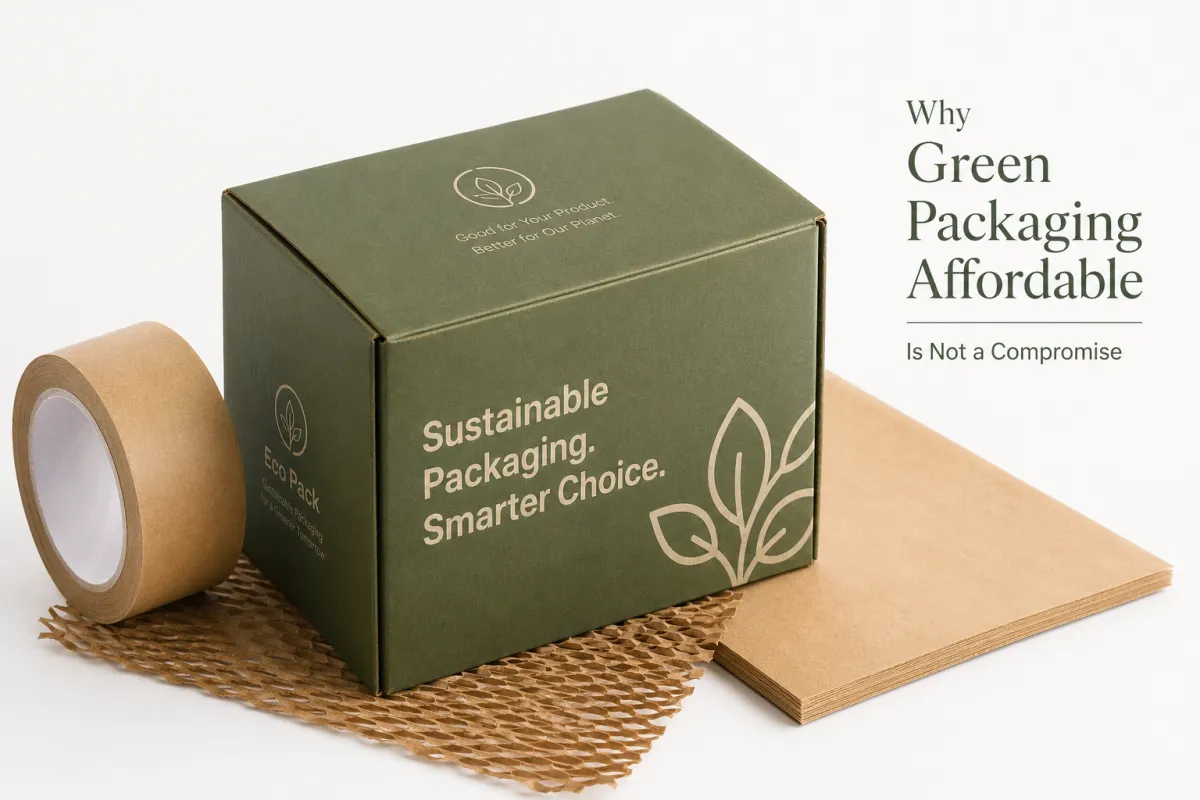
Yes - if you compare the full picture instead of staring at one paper line and calling it a day. I have sat in client meetings where everyone focused on sheet price and ignored the waste factor, the replacement rate, and the freight cost from a factory in Dongguan to a fulfillment center in Ohio. That is amateur hour. Green packaging affordable is usually about lowering total cost, not squeezing the paper buyer for a cheaper sheet.
One cosmetics client I worked with wanted premium-looking retail packaging for a 120 ml serum. Their first spec called for a coated artboard with heavy ink coverage and a soft-touch finish. It looked nice on the render. On the carton, it was expensive and overbuilt. We moved them to a recycled paperboard with a restrained two-color print, adjusted the insert size by 4 mm, and cut out a layer they did not need. The unit cost dropped by $0.14 at 10,000 pieces, the box still protected the bottle, and the package branding looked cleaner. That is green packaging affordable doing real work.
In practice, affordable means four things at once: lower unit cost, lower waste, fewer damage claims, and fewer surprises in production. If a box is cheap but collapses in transit on an 8,000-km route, it is not affordable. If the mailer looks good but eats up storage space because the dieline is oversized by 15 mm on every side, it is not affordable. If the insert cracks because the recycled fiber grade is wrong, you pay twice. That is why I compare green packaging affordable against landed cost, not against a factory brochure. One number is marketing. The other is reality.
There is also a brand side to this. Buyers want branded packaging that still feels responsible, whether the order is 3,000 folding cartons or 50,000 ecommerce mailers. They want Custom Printed Boxes that look intentional, not preachy. They want Product Packaging That fits the product, not a theater set. You can do that without burning margin. I have seen brands save more than $8,000 on a single 100,000-unit order by trimming paper usage by one sheet size and reducing ink coverage by 22%. That is not theory. That is a forklift moving pallets at 6:40 a.m. in a Shenzhen warehouse.
"If the packaging saves money only on paper, you have not finished the math. Check damage, freight, and storage too - a 2% breakage rate can erase a $0.05 unit saving fast."
For readers comparing options, I also point them to industry references like EPA guidance on source reduction and recycling and ISTA test methods. Standards do not make packaging perfect, but they keep the discussion honest. Green packaging affordable should still pass a 1.2-meter drop test, compression checks, and real transit handling, not just a mood board.
The sales truth is simple: green packaging affordable is not a compromise if you design it like a business decision instead of a virtue signal.
Green Packaging Affordable Materials That Actually Work
Not every material belongs in the same conversation. I have watched brands waste money trying to force one substrate to do everything, from a 250 g soap bar to a 1.8 kg glass candle set. The smarter move is to match the material to the product and the shipping stress. That is where green packaging affordable starts making sense.
Kraft paper is usually the first stop. A 120 gsm unbleached kraft wrap or a 250 gsm kraft board gives a natural look, decent printability, and a lower cost base than many coated alternatives. For light shipping boxes, subscription mailers, and retail packaging that does not need photographic color, kraft is hard to beat. It is especially useful for package branding that wants an honest, tactile look rather than a glossy sales pitch. If the product is light, do not pay for heavy board you do not need. That is the quickest way I know to keep green packaging affordable.
Corrugated board is the workhorse. For shipping boxes, ecommerce packs, and protective outer cartons, it offers the crush strength that plain paperboard cannot match. E-flute at about 1.5 mm gives a tighter, cleaner print surface and works well for smaller custom printed boxes. B-flute at roughly 3 mm handles more abuse and is often the safer choice for heavier items. If the product travels far or gets stacked 6 to 8 pallets high in a warehouse, corrugate is usually the practical option. Green packaging affordable often comes down to choosing the right flute instead of overbuilding the whole structure.
Recycled paperboard works well for folding cartons, inserts, and lightweight retail packaging. A 350gsm C1S artboard can be a strong fit for cosmetics, supplements, small electronics, and candle sleeves when the print needs a clean face and the board needs enough stiffness to hold a tuck-end or crash-lock structure. You may give up a bit of brightness versus virgin board, but you gain cost discipline and a lower carbon footprint. In many projects, that trade is more than acceptable. I have had buyers worry that recycled board would make the box look cheap. It usually does not, provided the design team understands packaging design and does not drown the surface in 95% ink coverage.
Molded pulp is a strong option for inserts, trays, and cushioning. It is not the prettiest material on the shelf, but it is excellent for protection. For fragile glass, small appliances, and products that need corner support, molded pulp can reduce breakage better than paper filler. If the inside fit matters more than the outer finish, molded pulp can keep green packaging affordable because it reduces damage claims and replacement shipments. That is a trade most finance teams understand very quickly.
Compostable mailers have a place, but I am blunt about this: they are not always the cheapest green option. They make sense for soft goods, apparel, and lightweight items where the format matters more than crush protection. A 250 x 350 mm mailer for a T-shirt is one thing; a 2 kg sample kit is another. If you need serious structural integrity, a mailer may not be the right answer. Buyers should not confuse "compostable" with "best value." Those are different questions, and mixing them up is how budgets get weird.
The practical comparison looks like this:
| Material | Best Use | Typical Strength | Typical Cost Range at 5,000 pcs | Notes |
|---|---|---|---|---|
| Kraft paperboard | Light retail cartons, sleeves, mailers | Medium | $0.14-$0.32/unit | Good for restrained print and natural branding |
| Corrugated board | Shipping boxes, ecommerce packs | High | $0.22-$0.48/unit | Best for transit protection and stacked loads |
| Recycled paperboard | Folding cartons, inserts | Medium | $0.11-$0.28/unit | Strong value for retail packaging |
| Molded pulp | Trays, inserts, cushioning | High for protection | $0.09-$0.26/unit | Excellent for fragile items and reduced damage |
| Compostable mailer film | Soft goods, apparel, lightweight kits | Medium | $0.18-$0.42/unit | Value depends on shipping route and use case |
Those figures are not magic. They move with quantity, print method, shipping lane, and pack style. A 3,000-piece order in Guangzhou will not price the same way as a 50,000-piece run in Ningbo. Still, they show the logic behind green packaging affordable. You are not buying "eco." You are buying the right material for the right job. The smartest buyers I know ask how the material behaves under pressure, how it prints, and how much waste it creates before they ask for a prettier render.
One more thing. If you need a fast starting point, browse our Custom Packaging Products and compare the formats side by side. A simple product scan often saves a week of email back-and-forth, especially when the choice is between a 350gsm folding carton and a 32 E-flute mailer. I have seen it happen more times than I can count.
Specifications That Keep Green Packaging Affordable
Specifications decide whether the project stays sane. I have watched a quote jump 17% because someone added 6 mm of length for no reason. I have also seen freight drop because the carton nested better on a pallet loaded 1,200 mm high. Green packaging affordable is not just material choice. It is math, dimensions, and discipline.
Size is the first lever. A tighter dieline cuts paper usage, lowers unit weight, and usually improves storage efficiency. If the product is 145 x 95 x 32 mm, do not quote a box for 170 x 120 x 50 mm just to make the mockup look roomy. Oversized packaging means more board, more void fill, and more shipping cost. That is how packaging design stops being design and starts being waste.
Thickness and grade matter next. For corrugated, E-flute is common for presentation-friendly custom printed boxes, while B-flute gives more protection. For paperboard, the GSM or caliper should match the product weight and insert needs. A 350 gsm recycled board can be perfect for a folding carton, while a 450 gsm spec may be unnecessary unless the item is heavy or the box is carrying structural load. Green packaging affordable depends on resisting the urge to over-spec. You can always make a package fancier later; it is harder to make a bloated spec cheap.
Decoration is where budgets quietly disappear. Fewer print colors, less ink coverage, and no unnecessary lamination usually keep costs down. Full-bleed graphics look dramatic, but they are not free. I once cut a quote by nearly $0.09 per unit simply by changing a heavy black background to a natural kraft field with one spot color and a 1-color logo. The client got a better visual story and a lower bill. Funny how that works.
Closure style also changes the number. Tuck-end cartons, crash-lock bottoms, adhesive strips, tear tape, and peel-and-seal all have different cost profiles. If the product does not need a premium unboxing sequence, do not pay for one. A simple tuck-end carton for a 120 ml bottle can save $0.03 to $0.06 per unit versus a more complex glued structure. Green packaging affordable should favor the simplest structure that still protects the item and makes fulfillment easy.
Standard tooling is another quiet win. Custom everything sounds flattering until the tooling invoice arrives. Shared die sizes, standard carton footprints, and repeatable inserts are cheaper than one-off inventions. When I visited a paperboard plant in Dongguan, the production manager showed me two jobs side by side on the same 700 x 1000 mm sheet size. One had a custom footprint that forced a new cutting layout; the other used a standard footprint. The standard job saved $1,200 on setup before the first sheet even ran. No drama. Just better planning.
For buyers comparing specs, this checklist helps keep green packaging affordable:
- Match box dimensions to the product plus minimal clearance.
- Choose the lightest board or flute that still survives transit.
- Limit print to the areas that support package branding.
- Avoid lamination, foil, and specialty coatings unless they solve a real problem.
- Use inserts only where the product needs restraint or protection.
And yes, certifications matter. FSC paper can be a strong fit for eco-friendly packaging programs, especially when a client wants traceability for retail packaging claims. Certification alone does not make a package affordable, though. It still needs to be designed with the product and the cost target in mind. Otherwise you just have a certified box that is too expensive to repeat.
Green packaging affordable is easiest to achieve when the spec sheet is boring. Boring is good. Boring ships well.
Pricing, MOQ, and What Changes Your Quote
People love to ask for "best price" and then send a vague brief with no dimensions, no weight, and no artwork. That is not a quote request. That is a guess request. If you want green packaging affordable, you need to understand what pushes the number up and what pulls it down.
The main drivers are straightforward: material choice, box size, print complexity, finishing, quantity, packing method, and shipping lane. Add one more item to that list: color matching. If your brand demands exact Pantone matching across recycled stock, you may pay for more setup and more testing. That is not a scam. It is physics and process. I have negotiated with suppliers in Shanghai who could hit the color target perfectly, but only after we agreed on a wider tolerance and a better press schedule. Good pricing comes from knowing where the factory can save money and where it cannot.
MOQ is another source of confusion. Minimum order quantity exists because tooling, setup, and labor have to be spread across the run. A supplier might ask for 3,000 units for a simple unprinted mailer, 5,000 for a printed carton, and 10,000 for a more complex custom job. That does not mean there is no flexibility. A first run can sometimes be structured as a trial quantity, especially if the factory already has similar tooling or the design uses standard sizes. Green packaging affordable often starts with a realistic first order, not a fantasy one.
Never compare only ex-works pricing. Landed cost matters. Freight can erase a low unit price fast, especially if the carton is bulky or the pack method is inefficient. I have watched buyers celebrate a $0.05 savings at the factory, then lose $0.11 in extra freight because the package got larger and heavier on a palletized ocean shipment. Cheap does not mean affordable. Not even close.
There are also hidden costs that buyers forget to ask about:
- Plates and dies: setup fees for print and cutting tools, often $120-$380 depending on size.
- Proofs and samples: physical checks before mass production, usually $45-$120 plus courier fees.
- Color matching: extra attention for exact brand tones, especially on kraft or recycled board.
- Special packing: inner cartons, pallet wrapping, edge protection, and corner boards.
- Inspection: third-party or internal QC before shipment, often in Shenzhen or Ningbo.
One buyer from a food brand once insisted on a glossy coated finish because "premium" was in the brief. We ran the numbers. The finish added cost, slowed production, and made no functional difference. We switched to an uncoated recycled board with a clean two-color layout and a better logo lockup. The final quote came in $0.14 per unit lower at 10,000 pieces, and the sample approval was turned around in 4 business days. That saved enough money to upgrade the insert, which actually improved shelf presentation. Green packaging affordable should make those kinds of moves possible.
If you want to compare offers honestly, build the quote around the same assumptions. Same board. Same print side. Same closure. Same packaging method. Same freight terms. Otherwise you are comparing apples to cardboard oranges, and the cheapest line item is usually the one hiding the most extra work.
Process and Timeline for Green Packaging Orders
Good packaging projects move in a clear sequence. Bad ones wander around like they are lost in a warehouse. If your launch date matters, and it usually does for a retail drop or ecommerce campaign, you need the process mapped before the order starts. That is how green packaging affordable stays affordable. Rush fees are what happen when people improvise.
The order flow usually looks like this: specs intake, quote, sampling, approval, production, inspection, and shipment. That sounds simple. It is simple. The trouble begins when the product details are missing or the artwork keeps changing after the first proof. A tight brief saves more time than any sales pitch. Send the dimensions, product weight, pack style, and delivery address on day one. That alone can shave 2 to 4 days off the back-and-forth.
Typical timing ranges vary by format. A plain kraft mailer may move from proof to production in 7-10 business days. A custom printed box with a new dieline can take 12-15 business days after sample approval. If the job needs molded pulp tooling or a new insert mold, you may be looking at 3-4 weeks before the first production run. None of that is mysterious. It is just the real schedule in Shenzhen, Dongguan, or Foshan. Green packaging affordable is easier to preserve when you plan around those lead times instead of pretending they do not exist.
Most delays come from the same few problems: missing dielines, artwork that is not press-ready, late sample sign-off, and structural changes after approval. I have seen a launch slip two weeks because a client decided they wanted a different closure style after the sample was already approved. That is not a supplier failure. That is a planning failure.
Communication is the cheapest way to reduce lead time. Send one consolidated feedback round. Mark the revision file clearly. Confirm the color standard, whether that is Pantone 7499 C or a custom brand tone, and tell the factory if the delivery window is fixed to a Friday in week 14. If the product is fragile, ask for an ISTA-style transit check or a packaging stress review before mass production. You do not need a full lab report for every job, but you do need enough testing to avoid preventable damage. That is especially true for glass, ceramics, and cosmetics with pump assemblies.
Here is a practical planning window I give buyers who want green packaging affordable without panic:
- Day 1-2: Brief, dimensions, material target, and quantity.
- Day 3-5: Quote and structural recommendation.
- Day 6-10: Sample or proof review.
- Day 11-20: Production for standard custom printed boxes or mailers.
- Day 21+: Final inspection and shipping, depending on route.
That is a normal rhythm. Not every order fits it perfectly. Still, this is the kind of schedule I trust when I am managing product packaging for a client who cannot afford surprises. Green packaging affordable is not only about the carton. It is about getting the carton in time, in spec, and without the "expedite" line item that wrecks the budget.
For brands working across retail packaging and ecommerce, a clean handoff matters. Ask for sample photos, QC notes, and pallet photos before shipment. I prefer that over hopeful language every single time. Hope does not protect margins, and it does not stop a 120 kg pallet from shifting on a truck from Ningbo to Shanghai port.
Why Choose Us for Green Packaging Affordable Projects
I like simple, direct relationships with suppliers. Fewer handoffs. Fewer mysteries. Better price control. That is how I approach green packaging affordable projects at Custom Logo Things. We do not try to sell you a polished story and then disappear when the carton needs adjustments. We stay close to the details because the details decide the cost.
When I built packaging programs for brands with tight budgets, the biggest savings always came from sourcing discipline. One factory in Shenzhen may be excellent at paperboard but mediocre at corrugate. Another in Dongguan may handle inserts beautifully but struggle with repeat color control on large print runs. Knowing which shop should do which job matters. That is why I prefer a supplier network rather than one generic source trying to do everything. It helps us match the right factory to the right material and keep green packaging affordable without gambling on quality.
I have negotiated enough quote sheets to know where the factory can save money and where it cannot. They can optimize sheet size. They can reduce waste in the cutting layout. They can recommend a better flute or board grade. They cannot magically make a heavy box cheap if the structure is oversized and the print spec is unrealistic. Buyers respect that honesty. So do I. Frankly, it saves everybody time.
We also care about verification. That means sample checks, packaging tests, defect photos, and clear notes if something drifts from spec. If a box arrives with a 2 mm crease misalignment or a print shift that crosses the acceptable tolerance, I want it documented. No soft language. No shrugging. That kind of QC protects reorders and keeps green packaging affordable over time, not just on the first PO.
"The cheapest quote is often the most expensive lesson. I learned that after a run of mailers saved $200 on paper and cost $1,700 in replacement stock because the corners crushed in transit."
That line came from a client in apparel, and I still use it. A nice price is not the goal. A repeatable price is. That is the difference between one lucky order and a supply chain you can rely on, whether the run is 5,000 units in Suzhou or 75,000 units for a U.S. launch.
If you need a wider view of options, our Custom Packaging Products page is a good starting point. It lets you compare formats before you commit to a structure. For teams building branded packaging across multiple SKUs, that kind of comparison saves time and reduces rework. It also makes it easier to align product packaging across retail and ecommerce channels without paying for custom everything.
Green packaging affordable is not a marketing slogan here. It is a sourcing method. It is also the reason our clients keep coming back when they need green packaging affordable with clear specs, realistic lead times, and no drama.
Next Steps to Lock In the Right Quote
If you want a useful quote, send useful information. I know that sounds obvious, but plenty of buyers still send a logo and hope the factory mind-reader appears. It does not happen. For green packaging affordable, the quote gets sharper when the brief is complete.
Send these items first: product dimensions, weight, pack style, artwork files, target quantity, delivery address, and any material or certification requirements. If you need FSC paper, say so. If you need a specific insert shape, include the product drawing. If the item is fragile, explain the drop risk. The more exact the input, the less time we spend guessing. That saves money and keeps green packaging affordable from the start.
Then compare quotes on an apples-to-apples basis. Check board grade, print method, MOQ, packing method, and freight terms. A supplier quoting $0.21/unit may actually be more expensive than one quoting $0.26/unit if the first quote hides setup fees, larger cartons, or higher freight. I have seen that trap many times on jobs shipping from Guangzhou to Chicago. The number in the top-right corner is not the whole story.
My favorite low-risk move is a sample or short run. If the design is new, if the product is fragile, or if the pack style is unfamiliar, test it before scaling. That small run can reveal a closure problem, a print issue, or a fit problem before the full order locks in. One client saved a full production cycle by catching an insert tolerance issue on a 300-piece sample. That is not an expensive lesson. That is a cheap one.
For buyers comparing Eco-Friendly Packaging Options, I also recommend asking for the simplest possible version first. Start with the structure that protects the product, then add only the extras that improve conversion or brand experience. That path keeps green packaging affordable and keeps the team from polishing a box into a budget problem.
Here is the decision rule I use:
- If the product is light, use lighter board.
- If the route is rough, protect the corners and edges.
- If the print area is large, simplify the graphics.
- If the budget is tight, standardize the size first.
- If the claim is sustainability, prove it with material choice and fit, not filler words.
That is the whole playbook in plain language. Green packaging affordable works best when you think like a buyer, not a slogan writer. Start with the product weight, the shipping route, and the damage risk. Then pick the lightest material that still protects the item, lock the dimensions before you touch the artwork, and compare quotes on the same assumptions. Do those three things and the price usually stops lying to you.
How do I make green packaging affordable without making it look cheap?
Use a natural material like kraft or recycled board, then keep the structure clean and the print coverage limited to 1 or 2 colors. I have seen a simple one-color layout on 350gsm C1S artboard outperform a busy "premium" design because the fit was better and the finish did not fight the material. Focus the budget on fit and protection first. A box that ships safely is cheaper than replacing damaged product, and that is the real path to green packaging affordable.
What is the lowest MOQ for affordable green packaging?
MOQ depends on the material, print method, and whether the packaging needs custom tooling or plates. A plain mailer may start lower than a printed retail carton, and molded pulp can have a different minimum because tooling is involved. For a first run, ask for a trial quantity or a mixed-size quote if the factory offers it, such as 1,000 sample cartons or 3,000 mailers. That is often the easiest way to keep green packaging affordable while you test the market.
Which material is best for cheap green packaging mailers and boxes?
Kraft paper and corrugated board are usually the most cost-effective starting points for shipping packs. Kraft works well for light retail packaging and mailers with modest protection needs, especially in 120 gsm or 250 gsm specs. Corrugated is better for ecommerce boxes and heavier shipments, with E-flute for presentation and B-flute for protection. Molded pulp makes sense for inserts or cushioning when protection matters more than a printed finish. If your goal is green packaging affordable, start with the lightest material that still protects the item.
Does affordable eco packaging cost more than standard packaging?
Not always. Recycled or right-sized packaging can lower total cost when material waste and freight are reduced. I have seen eco-friendly packaging come in cheaper than a standard coated option once the structure was adjusted and the print was simplified from 4 colors to 2. The quote only gets expensive when the design adds heavy board, full bleed print, or unnecessary finishing. That is why green packaging affordable is a design choice, not a label.
How long does a green packaging order usually take?
Sampling and proofing usually take the longest if artwork is not ready or the structure needs changes. Once approved, production and shipping timing depends on quantity, factory schedule, and delivery method. A simple run can move quickly in 7-10 business days, while new tooling or more complex inserts will add 3-4 weeks. If you plan early and keep the spec stable, green packaging affordable stays on schedule far more often than not.
Green packaging affordable works because it respects the numbers, the product, and the route from Guangzhou or Shenzhen to the destination dock. I have seen a 4 mm fit adjustment save more than a fancy finish ever could, and I have seen a weak spec blow up a perfectly good budget. The actionable takeaway is simple: write the brief before you buy the look. Lock the dimensions, choose the lightest usable material, and compare quotes with freight, tooling, and protection costs included. That is how green packaging affordable stays honest.


