Buyer Fit Snapshot
| Best fit | Green Packaging Comparison projects where brand print, material claims, artwork control, MOQ, and repeat-order consistency need to be specified before quoting. |
|---|---|
| Quote inputs | Share finished size, material target, print colors, finish, packing count, annual reorder estimate, ship-to region, and any compliance wording. |
| Proofing check | Approve dieline scale, logo placement, barcode or warning zones, color tolerance, closure strength, and carton packing before bulk production. |
| Main risk | Vague material claims, crowded artwork, missing packing details, or unclear freight terms can make a low unit price expensive after revisions. |
Fast answer: Green Packaging Comparison: Materials, Costs, and Fit should be specified like a repeatable production item. The safest quote records material, print method, finish, artwork proof, packing count, and reorder notes in one written spec.
Production checks before approval
Compare the actual filled-product size with the drawing, then confirm tolerance on folds, seals, hang holes, label areas, and retail display edges. Reserve space for logos, QR codes, warning copy, and material claims before decorative graphics fill the panel.
Quote comparison points
Review material grade, print process, finish, sampling route, tooling charges, carton quantity, and freight assumptions side by side. A quote is only useful when the supplier can repeat the same color, closure quality, and packing count on the next order.
A strong green packaging comparison starts with a blunt question: will the package survive the trip, or will it create more waste by failing? I have seen this play out on packing lines and at receiving docks more times than I can count. A carton that buckles, a mailer that tears, or a tray that forces double boxing can trigger returns, replacements, and extra freight. Those hidden costs usually wipe out any virtue claimed by shaving off a few grams of material.
The smarter comparison starts with the product, the route, and the likely point of failure, not with the material name printed on a supplier sheet. A bottle sent direct to consumer, a rigid retail set, and a frozen meal all demand different answers. One format may use less fiber, another may protect better, and a third may fit local recycling streams more cleanly. The right decision depends on packaging design, recovery infrastructure, total landed cost, and the package's behavior after it leaves the dock. A basic life cycle assessment can sharpen that view, especially when source reduction and transport efficiency are part of the goal.
Brands working on eco-friendly packaging, branded packaging, or tighter product packaging standards usually discover that the lowest-weight option is not automatically the best one. The better choice protects the product, supports fulfillment, and keeps the carbon footprint as low as practical without creating problems in the warehouse or confusion for the customer. That balance is a little messy, and honestly, that is what makes the work interesting.
Green Packaging Comparison: What Actually Matters First
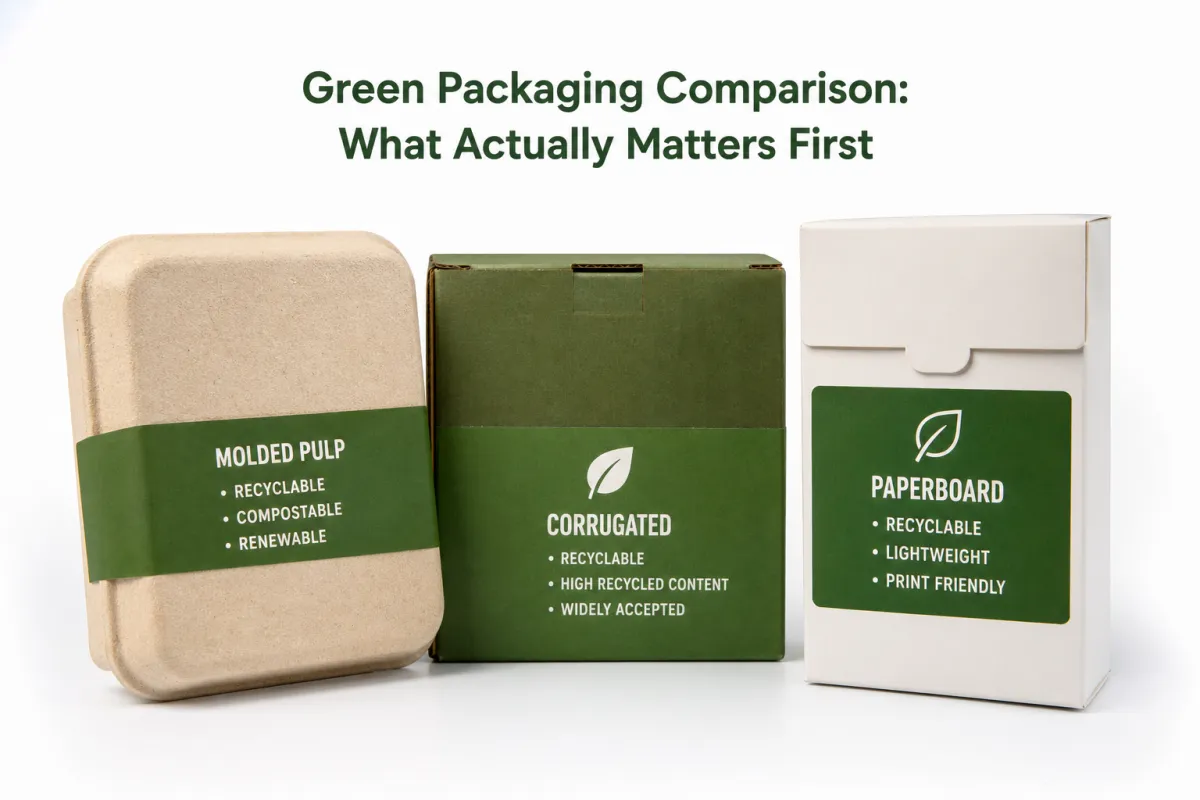
The first surprise in a serious green packaging comparison is how often the thinnest structure turns out to be the worst environmental choice. A lighter carton that fails in transit can create more replacement shipments, more reverse logistics, and more material use than a slightly heavier pack that arrives intact. In real procurement terms, the greenest option is usually the one that reduces total waste across the full trip, not the one that looks elegant in a sample room.
Plain definitions help cut through the marketing haze. Recycled content means some of the feedstock came from recovered material. Recyclable means the package can be collected and processed where local systems support it. Reusable means the package is intended for more than one trip, which depends on reverse logistics and customer behavior. Biodegradable and compostable are not interchangeable, and compostable usually needs a specific facility or a controlled composting process to matter in practice. A package can be eco-friendly in one setting and a poor choice in another.
A practical green packaging comparison asks three questions up front. What protection does the product actually need? What does the channel require, whether that is e-commerce, retail shelving, club-store palletization, or subscription fulfillment? What happens at end of life in the customer's actual region, not in a brochure? Those questions matter because a package that is technically recyclable but too awkward to sort can be less useful than a simpler structure with fewer layers.
Packaging design changes the answer more than many buyers expect. A disciplined structure can reduce board grade, improve stack strength, cut dunnage, and still support print quality for Custom Printed Boxes or other forms of package branding. In many programs, a clean right-sized carton or tray does more for the carbon footprint than a loud claim about compostability ever could.
For retail packaging or private-label formats, performance targets should come before material preferences. The wrong comparison asks which material sounds greener. The better one asks which format uses the least total resource while still doing the job. That is the foundation of a useful green packaging comparison.
A package that protects the product, fits the route, and can be recovered by the customer is usually the better environmental choice, even if it does not look the most stripped down on paper.
How a Green Packaging Comparison Works in Real Life
A real green packaging comparison follows the full life cycle, from raw material sourcing to end-of-life recovery. The first stage is feedstock: virgin fiber, recycled fiber, resin content, molded pulp, or a reusable substrate such as rigid plastic or durable textile. Then comes converting, where sheets, rolls, trays, or films are cut, formed, printed, and assembled. After that, the package moves through transport to the filler, pack-out, shipping, customer use, and finally disposal, recycling, composting, or reuse.
That chain matters because the same material can behave very differently depending on thickness, coating, adhesive, and closure style. A paperboard carton with a water-based coating may still be recyclable in some streams, while a heavily laminated version may not be. A corrugated shipper with minimal print coverage may recycle cleanly, but add a plastic window, a metallized layer, or a complex closure and the recovery picture changes fast. A thoughtful green packaging comparison looks beyond the base material and checks the whole build.
Infrastructure matters as much as material choice. The EPA recycling guidance is useful because it reminds brands that local systems decide what actually gets recovered. A package accepted in one region may be rejected in another because of contamination risk, fiber quality, or the available sorting equipment. Compostable packaging has the same problem: if industrial composting is not nearby, the theoretical benefit never reaches the bin.
Product loss belongs in the calculation too. A too-light mailer for a cosmetics kit, a weak tray under a heavy glass jar, or a carton with poor compression strength can cause damage and returns. That creates more freight, more labor, and more material than a sturdier option would have used. The same logic applies to shelf life. For food and personal care, a package that fails barrier testing can shorten product life, and wasted product carries its own environmental burden.
That is why a useful green packaging comparison asks whether the package reduces waste without creating a new problem for operations, customers, or the recovery stream. Recycled content alone does not make a structure a good fit. It still has to survive the route, work on the packing line, make sense in the customer's hands, and match the available end-of-life path.
In many product packaging projects, the strongest answer is the one that uses a bit less material, packs faster, and arrives with fewer defects. Those three wins often do more for the carbon footprint than chasing a single material headline. That is the kind of practical thinking a proper green packaging comparison should reward.
Green Packaging Comparison: Key Factors That Change the Verdict
The verdict in a green packaging comparison rarely comes down to one feature alone. Source, structure, barrier, cube efficiency, printability, and line speed all pull the decision in different directions. One brand may favor molded fiber, while another lands on corrugate, paperboard, or a reusable system. The product, not the trend, should decide.
Material source and composition come first. Paper-based formats remain popular because they often fit existing recycling systems and can be sourced with FSC-certified fiber when needed. Molded fiber can replace plastic inserts in many applications and often feels more premium than it gets credit for. Corrugate is still the workhorse for shipper strength, especially when compression and stacking matter. Bioplastics can help in narrow use cases, but they should never be treated as automatically compostable or automatically better. Reusable systems can be excellent in controlled loops, yet they require discipline, tracking, and customer participation.
Barrier needs change the outcome quickly. Moisture, grease, oxygen, puncture resistance, and aroma retention all shape the design. A cereal liner, a frozen-food tray, and a skincare jar each need different levels of protection. If the barrier is too weak, the product fails. If the barrier is too heavy, the package may become harder to recover and more expensive to print, seal, or convert. That tradeoff sits at the center of nearly every serious green packaging comparison.
Cube utilization is another hidden variable. If the package leaves too much empty space, shipping costs rise and more vehicles are needed to move the same number of units. Tight pack geometry, nested components, and right-sized cartons can shrink void fill and reduce the need for air pillows or paper dunnage. That is a genuine sustainability gain because fewer truck trips and less fill material lower total resource use. In a warehouse, those gains also show up as faster pick and pack.
Print, labeling, and adhesive compatibility matter more than many buyers expect. Heavy flood coating, UV varnish, transfer adhesives, and plastic labels can interfere with recycling, especially on fiber-based packs. If brand graphics are important, a well-planned packaging design can keep the look sharp while still respecting the recovery path. That is one reason Custom Printed Boxes remain common: they can balance shelf impact and practical conversion requirements better than generic stock cartons.
Customer handling and channel fit can settle the argument. A package for subscription fulfillment needs quick assembly and a low error rate. A retail packaging format needs shelf appeal and tamper awareness. A fragile e-commerce item may need crush resistance that a simple mailer cannot deliver. If the package is awkward to open, hard to reseal, or difficult to separate into material streams, the customer experience suffers and so does the end-of-life outcome.
For brands that want a cleaner package branding story, the best path is usually a simpler structure, fewer components, and graphics that do not interfere with recovery. That often means a more disciplined green packaging comparison, not a more dramatic one. The most successful packs are often the least fussy ones.
Green Packaging Comparison by Cost and Pricing
Price is where many green packaging comparison discussions become messy, because unit price tells only a small part of the story. A carton that costs $0.08 less per unit may still be more expensive once freight, labor, damage, and inventory carrying cost are included. The better lens is total landed cost: material, conversion, tooling, transit, storage, assembly time, and loss.
Setup costs matter as well. A simple paperboard sleeve may have a lower per-piece cost, but if it needs a die, a custom insert, or a longer qualification process, the upfront spend can be meaningful. Minimum order quantities can land anywhere from a few thousand pieces to tens of thousands depending on construction and print method. Changeover time matters too, especially in plants that run multiple SKUs in a day. If a package slows the line by 10 to 15 seconds per unit, that labor impact adds up quickly.
The hidden cost of waste is often larger than the material delta. Product returns, breakage, spoilage, rework, and added dunnage all chip away at margin. A food brand that loses even 1% of product to failed sealing or transit damage may spend far more than it saved by choosing a thinner package. That is why the best green packaging comparison is also a business comparison.
To make the pricing picture more concrete, here is a practical comparison. These ranges are directional only, usually based on mid-volume runs of about 5,000 to 10,000 units, and they shift with size, print coverage, tooling, and material grade.
| Option | Typical Unit Cost | Strengths | Tradeoffs | Best Fit |
|---|---|---|---|---|
| Corrugated shipper with minimal print | $0.22-$0.55 | Strong compression, easy recycling, good for e-commerce and bulk shipping | Can be bulky if oversized; plain appearance unless upgraded with print | Fragile goods, direct shipping, multi-pack retail packaging |
| Paperboard carton with custom print | $0.18-$0.42 | Good branding, lower weight, efficient for shelf presentation | Lower crush resistance than corrugate; may need inserts | Cosmetics, supplements, light consumer products, custom printed boxes |
| Molded fiber insert or tray | $0.12-$0.38 | Replaces plastic dunnage, good fit protection, can reduce component count | Tooling and lead time can rise; surface finish is less polished | Electronics accessories, jars, personal care sets |
| Specialty film or compostable pouch | $0.15-$0.48 | Low weight, flexible format, useful for certain food or refill systems | Recovery path is inconsistent; barrier performance varies widely | Dry goods, refills, limited-use barrier pouches |
| Reusable rigid container system | $1.25-$4.00+ | Excellent in closed loops, durable, lower packaging waste per cycle | Needs reverse logistics, tracking, cleaning, and customer compliance | Controlled B2B programs, internal distribution, premium subscription loops |
Notice the pattern: the cheapest unit is not always the cheapest solution. A slightly higher-cost carton can reduce dunnage, lower freight cube, and improve shelf presentation, which matters for branded packaging and retail packaging alike. If a package also lowers returns by even a small margin, the savings can exceed the added material cost.
If you are comparing a stock format to a custom structure, the decision often comes down to volume and fit. A well-engineered pack from Custom Packaging Products may cost more up front than an off-the-shelf substitute, but it can remove extra wraps, eliminate filler, and speed up the line. That is a real cost advantage, not just a design win. A second look at the custom packaging options available for your product line can be worthwhile if your current pack is overbuilt or wasting space.
Pricing should always be tied back to the bigger question in a green packaging comparison: does the package reduce waste across the full system, or does it merely move the cost from one line item to another? The answer is not always obvious, which is why a pilot run is so valuable.
How Do You Run a Green Packaging Comparison?
A disciplined green packaging comparison works best when it follows a clear sequence. Jumping straight to materials usually creates compromises that show up later in the warehouse or at the customer’s door. Start with the business goal. Is the priority to reduce virgin material, lower freight weight, improve recovery, simplify assembly, or protect a fragile product more effectively? Pick one primary goal and one or two secondary goals so the review stays focused.
Next, build a short list of candidate structures. Keep the list realistic. There is no point testing a compostable pouch against a rigid clamshell if the product needs high compression strength and shelf stability. A better comparison might be corrugate versus molded fiber, or paperboard versus a lighter corrugated redesign. A good green packaging comparison protects time as well as budget.
Then request spec sheets and samples. Ask for basis weight, thickness, coating type, closure method, print process, recycled content, and any certification claims. If the supplier says the package is recyclable, ask what stream they mean and whether that claim depends on local acceptance. If the supplier mentions compostable material, ask for the standard used, such as ASTM D6400 where appropriate, and confirm whether the item needs industrial composting or another controlled process.
Testing should use real conditions. The ISTA test methods are useful because they reflect drop, vibration, and compression concerns that happen in distribution. If your product ships on a pallet, test for stacking strength. If it moves through parcel carriers, look hard at corner crush and seam failure. If humidity is part of the route, expose the package to that environment before approval. A sample that looks perfect on the conference table can fail after 48 hours in a hot dock.
Here is a simple practical checklist for a more reliable green packaging comparison:
- Define the product weight, dimensions, fragility, and shelf-life needs.
- Match the structure to the channel: parcel, retail, pallet, or subscription.
- Compare material thickness, closure style, and print coverage side by side.
- Run compression, drop, and seal checks with real product inside.
- Measure pack-out time, labor touchpoints, and dunnage usage.
- Review end-of-life guidance for the regions where the product is sold.
Scorecards keep the review honest. A simple 1-to-5 rating for protection, cost, recovery fit, supplier reliability, and line efficiency gives every option a fair shot. It also helps teams avoid the common trap of liking one sample because the print looks nice. Pretty is not the same thing as practical, and a useful green packaging comparison should say that plainly.
If the best option is not obvious, run a small pilot. Even 500 to 1,000 units can reveal issues with fit, assembly, tape usage, shelf appearance, or customer opening experience. That kind of test often saves a brand from scaling a package that looks promising but creates delays in production. For teams balancing custom printed boxes, recovery goals, and logistics, a pilot is usually the cheapest insurance available.
Common Mistakes in a Green Packaging Comparison
One of the biggest mistakes in a green packaging comparison is assuming that recyclable automatically means widely recycled. Those are different things. A package can be technically recyclable and still struggle in the real world if the local sortation system does not accept it, if it is too small to be captured reliably, or if it carries labels and coatings that confuse the stream. The same caution applies to compostable items. A compostable claim without access to composting infrastructure is more promise than practical value.
Another common error is choosing sustainability first and protection second. A package that looks environmentally elegant but breaks under normal shipping conditions is not a win. The damaged product, extra freight, and added labor often outweigh the packaging savings. In the field, the best green packaging comparison is the one that treats product protection as a sustainability requirement, not as an afterthought.
Overdesign creates its own waste. Heavy walls, oversized cartons, nested inserts, and too many components make the package harder to produce, harder to pack, and harder to recover. A box that needs three fillers, two tapes, and a sleeve may be doing too much. Simpler structures often win because they reduce touch labor and material count at the same time. That matters in retail packaging, subscription packs, and product packaging for fragile goods.
Production realities are easy to overlook in a spreadsheet. Adhesive compatibility, machine speed, platen pressure, fold memory, pallet pattern, and storage humidity all influence the final result. A board grade that works beautifully in a sample may crack on a high-speed folder-gluer if the score lines are off. A film that seals in a lab test may misbehave once it hits a colder line. Those details belong in the review because they affect both cost and waste.
Greenwashing is the final trap. If a supplier cannot explain the material, the recovery path, the standards used, or the testing behind the claim, the claim does not mean much. Ask for facts instead of adjectives. Ask for recycled content percentages, basis weights, certification references, and shipping test results. If a package is described as eco-friendly, find out what that means in numbers, not just language. A strong green packaging comparison is built on documentation.
It also helps to watch for emotional bias. A natural kraft look can feel greener even when the actual performance is only average. A glossy package can feel less sustainable even if it uses less material and ships more efficiently. Good package branding should support function, not override it. A disciplined team compares actual data first and visual impression second. That sounds obvious, but teams still miss it all the time.
Expert Tips and Next Steps for Smarter Decisions
The cleanest way to keep a green packaging comparison objective is to use one scorecard across every option. Give each material or structure the same categories, the same weighting, and the same test conditions. If protection counts for 40%, cost for 25%, recovery fit for 20%, and operational fit for 15%, keep that formula fixed. Otherwise, the review drifts toward whichever sample looks nicest in the room.
Ask suppliers for practical proof, not broad claims. Good documentation usually includes material specs, construction drawings, testing data, print limitations, storage recommendations, and any certifications that matter for the application. FSC references help if fiber sourcing matters to your brand. ISTA-aligned test data helps if shipping damage is a concern. For compostable formats, ask how the material behaves in industrial composting conditions and whether inks, adhesives, or coatings change the outcome. That is the level of detail a serious green packaging comparison deserves.
Focus first on the highest-volume or highest-risk SKUs. A packaging change on a best seller gives you the biggest environmental and financial return. A change on a fragile item can prevent a lot of returns. That is also where branded packaging and functional package branding can work together. A cleaner structure on a high-visibility SKU improves the customer experience while cutting material use, which is a much stronger story than a generic sustainability claim.
Set a realistic timeline. A basic review can move quickly if samples are ready, but a full conversion often needs multiple steps: sample request, fit check, lab test, redesign, approval, pilot run, and inventory planning. A brand should expect several weeks for a simple package and longer for complex custom work. Build in time for revisions because the first sample almost never lands perfectly. That patience usually leads to a better green packaging comparison outcome and fewer surprises at launch.
One more practical point: do not let the word "green" narrow the conversation too much. The most successful package is usually the one that balances source reduction, recovery, product protection, and operational fit. Sometimes that means a lighter fiber design. Sometimes it means a better insert. Sometimes it means Custom Packaging Products built around the real product instead of a stock size. The right answer is the one that performs across the whole system.
If you are still sorting through options, create a shortlist of two or three structures, test them with real product, and compare the results in one simple matrix. That approach usually reveals the strongest candidate faster than endless spec-sheet debate. A focused green packaging comparison should end with less guesswork, less waste, and a package that holds up in the hands of the customer.
What is the best green packaging comparison method for a small brand?
Use a simple scorecard with four columns: protection, sustainability recovery, cost, and operational fit. Then test two or three realistic options with your actual product before you compare claims on paper. That keeps the green packaging comparison grounded in real performance instead of marketing language.
Is recyclable always the best choice in a green packaging comparison?
Not always. A package only performs well if customers can actually recycle it through local systems, and collection rules vary a lot. In some cases, a lighter format, better product protection, or a package with fewer components may be the smarter choice even if the recovery path is different.
How should I compare green packaging costs fairly?
Compare landed cost, not just unit price, and include freight, labor, storage, damage, and any tooling or setup fees. Also look for hidden savings from fewer returns, less breakage, faster pack-out, and lower shipping cube, because those can change the real cost picture quickly.
What should I test before approving a new green package?
Test compression, drop resistance, moisture behavior, seal strength, and how the package performs through your actual shipping route. If the package is for food or personal care, test shelf life and barrier performance as well. A sample that passes visually is not enough if it fails after transit.
How long does a green packaging comparison usually take?
A basic comparison can take a few weeks if samples are available and the materials are close to your current setup. A full conversion often takes longer because it may include revision cycles, supplier approvals, pilot runs, and inventory planning. A careful green packaging comparison is worth the time because it reduces the chance of costly changeovers later.
Done well, a green packaging comparison gives you a package that protects the product, fits the line, respects recovery realities, and supports your brand without excess material. The clearest next step is simple: pick two or three realistic structures, run them with real product, and approve the one that performs best across protection, cost, and end-of-life fit. That is the kind of result that holds up in the warehouse, on the shelf, and in the customer's hands.


