Buyer Fit Snapshot
| Best fit | Green Packaging Manufacturer projects where brand print, material claims, artwork control, MOQ, and repeat-order consistency need to be specified before quoting. |
|---|---|
| Quote inputs | Share finished size, material target, print colors, finish, packing count, annual reorder estimate, ship-to region, and any compliance wording. |
| Proofing check | Approve dieline scale, logo placement, barcode or warning zones, color tolerance, closure strength, and carton packing before bulk production. |
| Main risk | Vague material claims, crowded artwork, missing packing details, or unclear freight terms can make a low unit price expensive after revisions. |
Fast answer: Green Packaging Manufacturer: Artwork Proof, Packing Count, and Landed Cost should be specified like a repeatable production item. The safest quote records material, print method, finish, artwork proof, packing count, and reorder notes in one written spec.
Production checks before approval
Compare the actual filled-product size with the drawing, then confirm tolerance on folds, seals, hang holes, label areas, and retail display edges. Reserve space for logos, QR codes, warning copy, and material claims before decorative graphics fill the panel.
Quote comparison points
Review material grade, print process, finish, sampling route, tooling charges, carton quantity, and freight assumptions side by side. A quote is only useful when the supplier can repeat the same color, closure quality, and packing count on the next order.
Green Packaging Manufacturer: What to Know Before Buying
Learn what a green packaging manufacturer actually does, how the materials and production process work, what drives cost, and how to pick a partner that can protect your product without dressing up weak claims.
A green packaging manufacturer is not just selling a box that happens to be brown and vaguely earthy. If that were the whole story, everyone would be done by lunch. The real value is usually much less flashy: lower material use, fewer damaged shipments, better warehouse flow, and a package that does not make your operations team roll their eyes every time it shows up on the line.
I have seen brands get seduced by the surface layer. They swap to recycled fiber or a lighter mailer and call it a win, then shipping damage creeps up and wipes out the savings. That happens more often than people admit. A good green packaging manufacturer looks at the whole system, not just the substrate. If a smaller box reduces dimensional weight, speeds pack-out, and still survives the carrier network, that is a real improvement. If it just looks nicer in a pitch deck, not so much.
That broader view matters because packaging lives in the mess between design and reality. Custom printed boxes, inserts, coatings, adhesives, inks, and even the way a carton folds can change how a package behaves after it leaves the sample table. Buyers who understand that tend to ask better questions. They do not stop at recycled content. They ask about recovery, damage rates, unit economics, and what happens when the product gets tossed around by people who do not care about your brand story.
If you are planning a packaging refresh, start with the problem, not the trend. Is the current pack too heavy? Too large? Too expensive to store? Too difficult to recycle? A serious green packaging manufacturer should answer with tradeoffs, testing data, and actual options. Not slogans. Slogans are cheap.
What a Green Packaging Manufacturer Actually Does
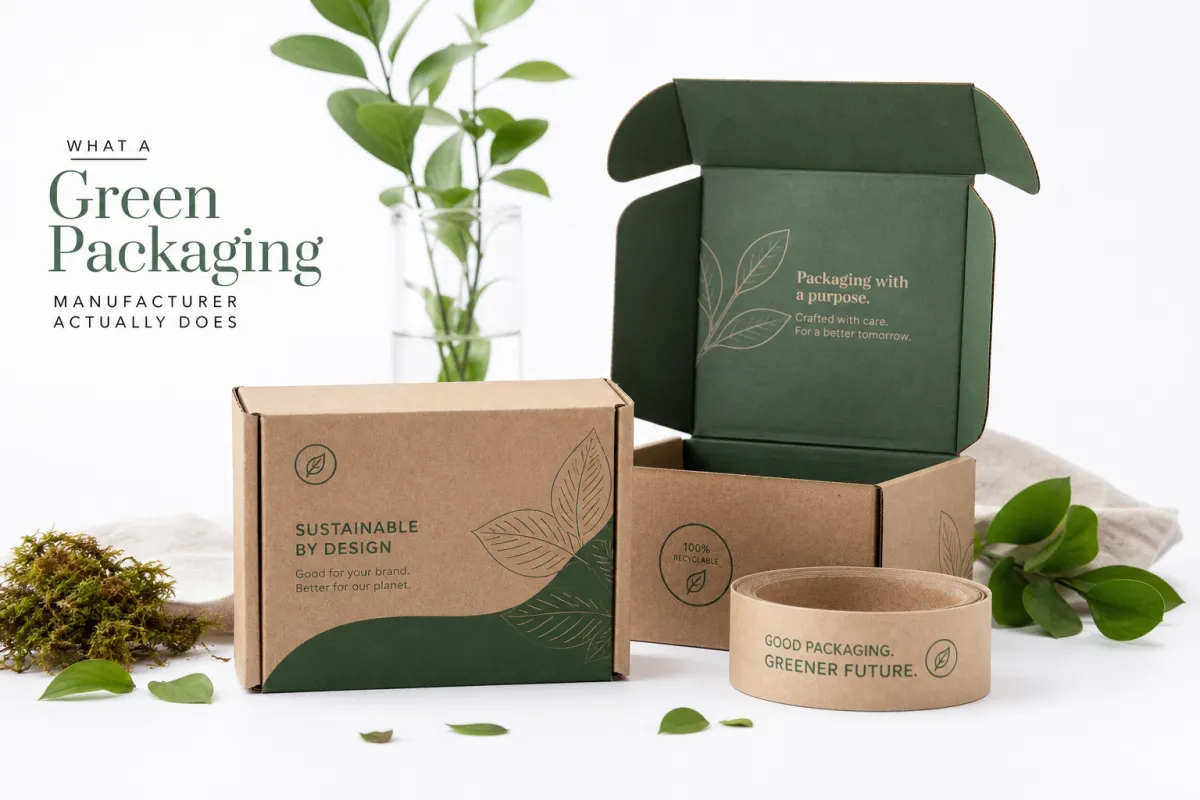
A green packaging manufacturer designs and produces packaging that uses fewer virgin resources, is easier to recover, and still protects the product on the trip from the warehouse to the customer. That sounds simple enough. The hard part is that every product asks for something slightly different. A fragile serum bottle may need molded pulp. A subscription box may need a right-sized corrugated shipper. A food item may need a barrier structure that respects shelf life and food-contact rules. The right answer shifts with the product, the route, and the market.
The common mistake is thinking sustainability starts and ends with material choice. It does not. A green packaging manufacturer also has to think about package branding, assembly steps, freight weight, shelf impact, and end-of-life recovery. If a lighter pack breaks more often, total waste goes up. If a glossy finish blocks recycling, the environmental claim gets shaky fast. If a package takes an extra 12 seconds to assemble, that cost shows up somewhere, usually in labor. Buyers should ask a simple question: what combination of structure, material, and finish lowers waste across the whole chain?
That question matters in different ways across categories. In ecommerce, reducing empty space can lower dimensional weight charges and damage claims. In beauty, a cleaner carton with a minimal insert can still look premium without stuffing the box with unnecessary material. In food, barrier performance and compliance are non-negotiable. In industrial goods, protection usually wins because one crushed shipment can blow up a month of savings. A green packaging manufacturer has to balance all of that without pretending the same structure works for every category. It does not. Never has.
I have also seen buyers get handed a recycled board option, a compostable mailer, or a plant-based film and told the story ends there. It never does. The better green packaging manufacturer asks how the pack will be filled, sealed, stacked, stored, opened, and recovered. That is the difference between a legitimate improvement and a surface-level eco label.
There is a compliance side too, and it is where a lot of marketing claims get slippery. Depending on the market, claims around recyclability, compostability, or recycled content may need supporting documents tied to standards such as FSC chain of custody, SFI sourcing, or regional recovery rules. A supplier worth trusting can explain what is certified, what is self-declared, and what changes by geography. That kind of honesty matters more than a leaf icon slapped on the flap.
One useful way to think about a green packaging manufacturer is this: it is a decision engine for packaging reduction. It helps lower material use, reduce damage, simplify fulfillment, and back up eco-friendly claims with evidence. That role matters a lot more than pretending a single green-looking carton fixes everything.
For some brands, the first move is a small redesign. For others, it is a full conversion from mixed-material retail packaging to a simpler structure. Either way, the best green packaging manufacturer builds around the product, not around a trend report from someone who has never packed a box in their life.
How Green Packaging Manufacturing Works From Material to Box
The process usually starts with material sourcing. A green packaging manufacturer may work with recycled fiber, responsibly sourced paperboard, molded pulp, corrugated board, mono-material films, or bio-based alternatives depending on the application. In paper-based formats, recycled content can vary a lot; 30% to 100% is common, but the grade matters. Not every board behaves the same way in print, die-cutting, compression, or moisture exposure. For films and flexible packs, the challenge often sits in recoverability. A mono-material structure may be easier to sort than a layered one, even if the barrier performance looks similar on paper.
Then comes design for sustainability. This is the part many brands underestimate. Right-sizing a mailer can cut filler by 15% to 40% on some ecommerce lines. Eliminating a window, a foil layer, or a second substrate can make recovery simpler. Water-based inks, lower-coverage graphics, and minimal coatings can reduce environmental impact without gutting package branding. A good green packaging manufacturer will often suggest changes that save board, not just changes that sound green in a presentation. There is a difference.
Testing is where theory gets punched in the face. Compression testing, drop testing, moisture resistance, vibration checks, seal integrity, and shelf-life validation all matter. If a carton is for shipping, ASTM-style distribution testing or ISTA protocols are common reference points. If the pack is for food or personal care, barrier and seal performance matter just as much as recycled content. A package that fails in humidity, cold chain, or long-distance shipping is not green just because it used recycled board.
Printing and finishing can help or hurt the story. Water-based inks are often a smart choice for paper formats. Soft-touch coatings may look luxurious, but they can complicate recovery depending on the substrate and region. The real question is not whether a finish looks premium; it is whether the finish supports product packaging goals without turning the pack into recycling trouble. A green packaging manufacturer should be able to explain that tradeoff plainly, without the usual hand-waving.
There is a quieter operational layer too. Production efficiency affects waste. Better nesting on a sheet, tighter die layouts, and fewer changeovers can cut scrap. Smaller trim losses may not show up in a mood board, but they show up in material yield, labor time, and cost per unit. On a 10,000-piece run, a 2% scrap reduction can matter more than a slightly greener coating. That is not sexy. It is just true.
The final step is the recovered or composted outcome, and this is where marketing claims often run ahead of reality. A compostable pouch only helps if the customer actually has access to industrial composting. A recyclable carton only helps if it fits the local paper recovery stream. A green packaging manufacturer that knows the market will talk about end-of-life reality, not just theoretical disposal paths. For policy context and waste data, the U.S. EPA remains a useful reference point: EPA guidance and waste stream resources help separate facts from wishful thinking.
The workflow is not one decision. It is a chain: material sourcing, structural design, print choice, testing, production, and recovery. That chain turns eco-friendly packaging from an idea into something a warehouse can actually ship without drama.
Key Factors That Separate Good From Greenwashed
The cleanest claims usually come with paperwork. A credible green packaging manufacturer should be able to show recycled content documentation, FSC or SFI chain-of-custody records, and clear language on what is certified versus what is simply made from recycled feedstock. FSC certification information is useful because it reminds buyers that forest sourcing and chain of custody are separate issues; both matter. If a supplier cannot explain the difference, that is a warning sign, plain and simple.
End-of-life reality is another filter. Many brands advertise compostable packaging, but industrial composting access is uneven. Many paper items are recyclable, but coatings, adhesives, and contamination can change the outcome. A green packaging manufacturer should be able to say, “This structure is recyclable in most curbside systems,” or “This format depends on local composting infrastructure,” instead of pretending every city has the same rules. That level of honesty builds trust faster than a green badge ever will.
Performance still rules. Puncture resistance, barrier properties, stiffness, moisture response, and shelf stability all affect whether the package helps or hurts the business. A lighter board grade may cut cost, but if it crushes during palletization, the savings disappear. A thinner mailer might reduce material use, but if the seal fails under temperature swings, customer complaints rise. Sustainability falls apart quickly if the package cannot protect the product. No mystery there.
Transparency is measurable too. Ask for data on the supplier’s energy use, water use, scrap rate, and sourcing regions. Some green packaging manufacturer teams track carbon footprint by substrate or by production line, which makes comparison easier. Others do not. If a supplier can only talk in broad terms, push for specifics: what is independently verified, what is estimated, and what is self-reported? Real numbers beat vague language every time.
Another separator is category knowledge. A luxury candle, a subscription box, and a corrugated shipper for metal parts all need different decisions. One may need premium tactile branding. Another may need stack strength. Another may need oily-part resistance. A green packaging manufacturer that treats every job the same can still sell boxes, but it will not always solve the actual business problem. Sometimes it just sells a prettier version of the wrong answer.
Buyer behavior matters too. Many brands focus on the first order and ignore the second. What happens if demand rises 30%? What happens if a paper grade is out of stock? What happens if a recycled film is substituted for a virgin one? A trustworthy green packaging manufacturer will talk about supply continuity and approved alternates because sustainability does not help much if the line stops. You cannot ship a philosophy.
One practical test is to ask for examples of similar work. Not a shiny brochure. Real production examples, sample photographs, and material specs. If you are buying custom printed boxes, ask how much ink coverage was used, what coating was applied, and whether the structure passed shipping tests. The more concrete the answer, the less likely the claim is greenwashed.
Good suppliers also avoid pretending perfection exists. A responsible green packaging manufacturer will say that recycled fiber can still vary, that compostable materials are not universal, and that no package is ideal for every market. That sounds less polished. It is also more believable. In this category, believability pays.
Green Packaging Manufacturer Cost, MOQ, and Timeline
Price depends on more than board grade. A green packaging manufacturer quotes material, tooling, printing, finishing, testing, freight, and sometimes setup labor separately. A simple mailer might land near $0.18 to $0.28 per unit at 5,000 pieces if print coverage is light and the structure is standard. More customized builds, thicker recycled board, Molded Pulp Inserts, or special coatings can push that into the $0.35 to $0.75 range or higher. Those numbers vary by region and spec, but they are a more honest starting point than “affordable” ever is.
Volume changes everything. Once a die is paid for and a print run is optimized, unit cost usually falls. Minimum order quantities can rise with custom sustainable formats because suppliers need enough volume to justify tooling, sourcing, and press setup. A green packaging manufacturer may quote 1,000 units for a stock-style conversion, yet 5,000 to 10,000 units for a truly custom build. That tradeoff affects inventory risk, storage, and cash flow. No one likes that part, but it is real.
Timelines need realism too. A standard project often runs 12 to 15 business days from proof approval to production, but that starts after the brief, dieline, sample round, and revisions are complete. New molds, specialty pulp, or custom barrier structures can stretch into several weeks. If a brand wants eco-friendly packaging for a seasonal launch, it should start early enough to absorb at least one revision round. Rushing a structure usually costs more than planning for it.
Here is a practical comparison that many buyers find useful:
| Format | Typical Use | Indicative Unit Cost | Strengths | Watchouts |
|---|---|---|---|---|
| Folding carton | Retail packaging, beauty, supplements | $0.22-$0.48 | Print-friendly, lightweight, strong package branding | Needs good structure planning for protection |
| Mailer box | Ecommerce and subscription product packaging | $0.30-$0.85 | Good unboxing experience, easy to customize | Can become bulky if overbuilt |
| Molded pulp insert | Protection for fragile goods | $0.18-$0.55 | Recoverable fiber, good shock absorption | Tooling and mold cost can be high |
| Corrugated shipper | Transit-heavy ecommerce or industrial goods | $0.25-$0.70 | High protection, efficient shipping, recyclable in many markets | Print quality may be more limited than premium cartons |
MOQ and cost should never be judged in isolation. A higher unit price may still win if it lowers damage, reduces filler, and speeds fulfillment. A slightly heavier carton may look less efficient until you factor in fewer replacements. That is why a green packaging manufacturer should provide unit price, tooling, sample charges, freight, and estimated landed cost in one view. If the quote only shows the box price, the comparison is incomplete.
It also helps to ask how much of the price is tied to print coverage. Heavy ink coverage, foil accents, lamination, and window patches can add cost quickly. If the goal is eco-friendly packaging with a clean visual system, a restrained palette can often cut cost and reduce environmental load. Good branding does not always need more ink. Sometimes the opposite is smarter.
One more practical point: storage and freight can quietly shape the budget. Flat-packed cartons ship efficiently. Bulky inserts do not. If you are comparing a green packaging manufacturer quote against a standard supplier, make sure both include the same assumptions about pallet count, shipping lane, and storage footprint. Otherwise, the cheaper quote can become the expensive one. That kind of mistake is annoying, but avoidable.
Step-by-Step Guide to Choosing the Right Partner
Start with a packaging audit. Measure current board usage, filler volume, damage rate, return rate, warehouse pack time, and customer complaints. Without that baseline, any green packaging manufacturer is guessing. A brand that knows it loses 1.8% of shipments to crush damage has a very different brief from a brand that mainly wants to reduce SKU count. Data clarifies the job.
Next, build a spec sheet that covers product dimensions, shipping conditions, regulatory requirements, branding goals, and sustainability targets. If the pack must pass drop testing or shelf-life checks, say so. If the goal is to replace mixed materials with a simpler structure, say that too. A green packaging manufacturer can design faster when the brief is specific. For brands already investing in branded packaging, this document becomes the anchor that keeps design and operations aligned.
Shortlist suppliers by capability, not by promise. Ask each one for samples, certifications, print examples, and a realistic timeline. If they only sell the story, keep looking. If they can show previous packaging design work, explain why one substrate was chosen over another, and discuss recovery pathways, they are closer to the mark. A supplier that understands both product packaging and distribution usually saves time later.
Then test prototypes in the real world. Drop tests on concrete, stack tests in a humid room, cold-chain or heat exposure if relevant, and warehouse handling by the people who actually pack the orders. That is where many green packaging manufacturer projects succeed or fail. A sample that looks ideal on a desk can behave differently under load, vibration, or temperature swings. The package has to survive the route, not just the presentation.
It can help to use a decision matrix. Weight categories might include cost, lead time, protection, sustainability proof, recovery pathway, and brand fit. Score each supplier on the same scale. A three-vendor comparison gives the team a clearer picture than a single quote ever will. It also creates a paper trail for internal approvals, which is useful when procurement, operations, and marketing do not agree on the same priority.
As you compare options, do not ignore documentation quality. A good green packaging manufacturer should be able to supply material specs, FSC or recycled-content paperwork, testing notes, and substitution rules. If a resin, coating, or board grade changes, how will they notify you? What happens if a material shortage forces an alternate? Those answers reveal how resilient the supplier really is.
If you need help sorting formats before requesting quotes, start with Custom Packaging Products and map the structure to the product, not the other way around. If you want to understand the company behind the process, About Custom Logo Things gives useful context on the approach. A supplier should be easy to evaluate before the first sample ever arrives.
Finally, pilot before you roll out. One SKU. One lane. One warehouse. That controlled launch tells you more than a broad theoretical review. A green packaging manufacturer worth working with will be comfortable starting small because the right structure usually proves itself in the field.
Common Mistakes Brands Make With Sustainable Packaging
The first mistake is choosing a material before checking the recovery system. Compostable packaging sounds attractive until you realize customers may not have access to industrial composting. Recyclable packaging sounds simple until you learn the local stream rejects a specific coating or film. A green packaging manufacturer can help, but the brand still needs to verify what the customer can actually do with the pack.
The second mistake is ignoring protection. I see this constantly: a brand wants less material, trims the structure too hard, and then sends more replacements to customers. That is not sustainability; that is waste with better branding. If a package fails once in twenty shipments, the environmental cost of re-shipping can overwhelm the material savings. A green packaging manufacturer should be asked to prove that the design protects the product under real distribution stress.
The third mistake is vague communication. “Eco-friendly,” “green,” and “natural” are not substitute data points. Claims need specifics: recycled content percentage, certification type, recoverability, and any regional limits. For retail packaging, the risk is even higher because shelf-facing language can trigger scrutiny from buyers, regulators, or consumer advocates. Strong package branding can still be honest. It just needs to be precise.
The fourth mistake is skipping prototype testing. A package that survives a tabletop sample may fail in humidity, cold storage, or a long freight lane. Water absorption, glue performance, and print rub can all change in those conditions. A green packaging manufacturer that encourages validation is doing you a favor. The one that rushes approval without testing is passing the risk downstream.
The fifth mistake is overdesigning for appearance. Beauty matters, especially in retail packaging, but aesthetics cannot outrank logistics. Heavy lamination, unnecessary inserts, oversized cartons, and decorative layers can all increase material use and shipping cost. There is a sweet spot where the package still looks premium while carrying less waste. Finding that spot is usually a design exercise, not a branding exercise alone.
There is also a compliance risk that gets ignored too often. If a supplier cannot support claims with FSC paperwork, recycled content records, or clear end-of-life guidance, the buyer may inherit the liability. A strong green packaging manufacturer understands that documentation is part of the deliverable, not a favor at the end.
One more pattern shows up constantly: brands ask for a greener version of an old package without revisiting the old package’s flaws. If the original structure was oversized, difficult to pack, and expensive to ship, a material swap alone will not solve much. The better move is to redesign from the product out. A smaller footprint, smarter insert, and cleaner print system can reduce the carbon footprint more than a simple substrate change.
Bottom line, sustainable packaging should be treated as a business system. A green packaging manufacturer can help fix the system, but only if the brand is willing to test assumptions instead of decorating them.
Expert Tips and Next Steps for Smarter Buying
Ask every green packaging manufacturer for a sustainability dossier. It should include material specs, certifications, sourcing notes, recovery pathway guidance, and examples of similar projects. If the supplier cannot supply that without hesitation, the project is not ready for scale. Documentation is not paperwork for its own sake; it is how you keep claims aligned with reality.
Use a three-vendor comparison whenever possible. One quote is a price. Two quotes are a range. Three quotes give you a benchmark against which cost, lead time, and performance can all be judged. A green packaging manufacturer that looks expensive on unit price may look better once you include damage reduction or lower freight weight. That is why total landed cost should sit next to the unit quote.
Build a weighted rubric before the sample round starts. A useful model might score cost at 25%, protection at 25%, sustainability proof at 20%, lead time at 15%, and brand fit at 15%. You can shift the weights, of course. A premium consumer brand may value unboxing more heavily, while a shipping-intensive business may prioritize durability. The key is consistency. A green packaging manufacturer should be evaluated against the same criteria as everyone else.
Start with one SKU or one lane. A small rollout tells you whether the new structure actually improves packing speed, reduces waste, and preserves the customer experience. If the package is for custom printed boxes, pilot the exact print coverage and coating, not a simplified mockup. Small tests catch big surprises. They also make internal approval easier because the team sees evidence instead of theory.
Pay attention to warehouse feedback. The people taping, filling, and loading the boxes often notice issues before anyone in marketing does. Are the flaps harder to close? Does the insert tear? Does the adhesive peel in cold storage? A green packaging manufacturer should want those answers because real-world handling is the final proof point.
Do not overlook timing. If the project involves new tooling, special molding, or custom print, pad the calendar. Even a well-run green packaging manufacturer project can be delayed by a material shortage or a revision cycle. Build in room for one round of changes, and you reduce the chance of rushing into a compromise.
If you are just starting, the smartest move is simple: shortlist a green packaging manufacturer, request samples and documentation, and run real-world tests before ordering at scale. That sequence protects budget, product quality, and the brand story at the same time. It also turns sustainable packaging from a vague ambition into a measurable business decision.
For brands that want packaging to do more than look responsible, this is the path. A green packaging manufacturer should help you lower waste, control cost, and improve customer experience without pretending those goals never conflict. The best partners know the tension is real, and they build around it.
FAQ
What does a green packaging manufacturer actually produce?
They make packaging designed to reduce environmental impact through recycled content, renewable fibers, lighter structures, or recoverable materials. That can include mailers, cartons, inserts, molded pulp, labels, and protective packaging. The strongest green packaging manufacturer teams also help with packaging design, testing, and material selection so the package performs as well as it looks.
How do I know if a packaging supplier is truly sustainable?
Ask for documentation, not slogans: certifications, recycled content proofs, sourcing data, and recovery guidance. Check whether the material can be recycled or composted in the places your customers live. A real sustainable supplier can explain tradeoffs instead of claiming every option is perfect. If the answer sounds too tidy, it probably is.
What affects green packaging pricing the most?
Material choice, customization, tooling, print complexity, and order quantity usually drive the biggest price changes. Prototype rounds and testing can add upfront cost, but they often save money by preventing damage and rework. Freight and storage matter too, especially if the packaging is bulky or needs special handling.
How long does custom sustainable packaging usually take?
Simple projects can move from brief to sample relatively fast, but custom structures usually need several rounds of approval. Production lead times depend on material availability, tooling, and order size. If the project includes new molds or special finishes, expect a longer timeline and plan earlier. Rushing usually ends badly.
What should I ask a green packaging manufacturer before ordering?
Ask about certifications, end-of-life options, minimum order quantities, lead times, and the exact cost breakdown. Request samples tested for your shipping conditions so you can verify performance before scaling. Ask how they handle claims, substitutions, and supply disruptions so there are no surprises later. That part is not glamorous, but it saves headaches.
If the goal is better product packaging without wasteful shortcuts, the right green packaging manufacturer can make a measurable difference. The trick is to look past surface claims, compare the documentation, and test the real pack before you scale. If you remember one thing, make it this: choose the structure that protects the product, fits the recovery system, and holds up in the warehouse, because that is where the truth shows up.


