Buyer Fit Snapshot
| Best fit | to custom kraft paper sleeve packaging for packaging buyers comparing material specs, print proof, MOQ, unit cost, freight, and repeat-order risk where brand print, material, artwork control, and repeat-order consistency matter. |
|---|---|
| Quote inputs | Share finished size, material target, print colors, finish, packing count, annual reorder estimate, and delivery region. |
| Proofing check | Approve dieline scale, logo placement, barcode or warning zones, color tolerance, and any recyclable or compostable wording before bulk production. |
| Main risk | Vague material claims, crowded artwork, or missing packing details can create delays even when the unit price looks attractive. |
Fast answer: To Custom Kraft Paper Sleeve Packaging: Dieline, Finish, Proof, and Buyer Review should be specified like a repeatable production item. The safest quote includes material, print method, finish, artwork proof, carton packing, and reorder notes in one written spec.
What to confirm before approving the packaging proof
Check the product dimensions against the actual filled item, not only the sales mockup. Ask for tolerance on folds, seals, hang holes, label areas, and retail display edges. If the package carries a logo, QR code, warning copy, or legal claim, reserve that space before decorative graphics fill the panel.
How to compare quotes without losing quality
Compare board or film grade, print process, finish, sampling route, tooling charges, carton quantity, and freight assumptions side by side. A lower quote is only useful if the supplier can repeat the same color, closure quality, and packing count on the next order.
Guide to Custom Kraft Paper Sleeve Packaging Essentials
The guide to Custom Kraft Paper sleeve packaging starts with a blunt packaging truth: a narrow strip of kraft can pull more attention on shelf than a much larger printed panel if it lands in the right place. A sleeve turns one flat band into a brand signal. In retail, that signal has to work fast. A shopper gives you a second, maybe less, before moving on.
From a buyer's perspective, the guide to Custom Kraft Paper sleeve packaging is less about theory and more about fit, line speed, print behavior, and cost. Some brands use it to refresh packaging without replacing a full carton. Others use it to add product details, seasonal copy, or a more tactile layer to package branding. The decisions are practical. Bad stock looks cheap. Bad sizing slows the line. Sloppy artwork makes a decent concept look unfinished. Not ideal, obviously.
That is why the guide to custom kraft paper sleeve packaging deserves attention from production, not just design. A sleeve can wrap a carton, band a jar, hold a gift set together, or give custom printed boxes a more natural finish. It can also carry UPCs, ingredients, promo copy, or tamper cues without rebuilding the whole structure. The best sleeve programs solve one job cleanly and stop there. Trying to make one piece do five things is how you end up with a mess.
Guide to custom kraft paper sleeve packaging: what it is
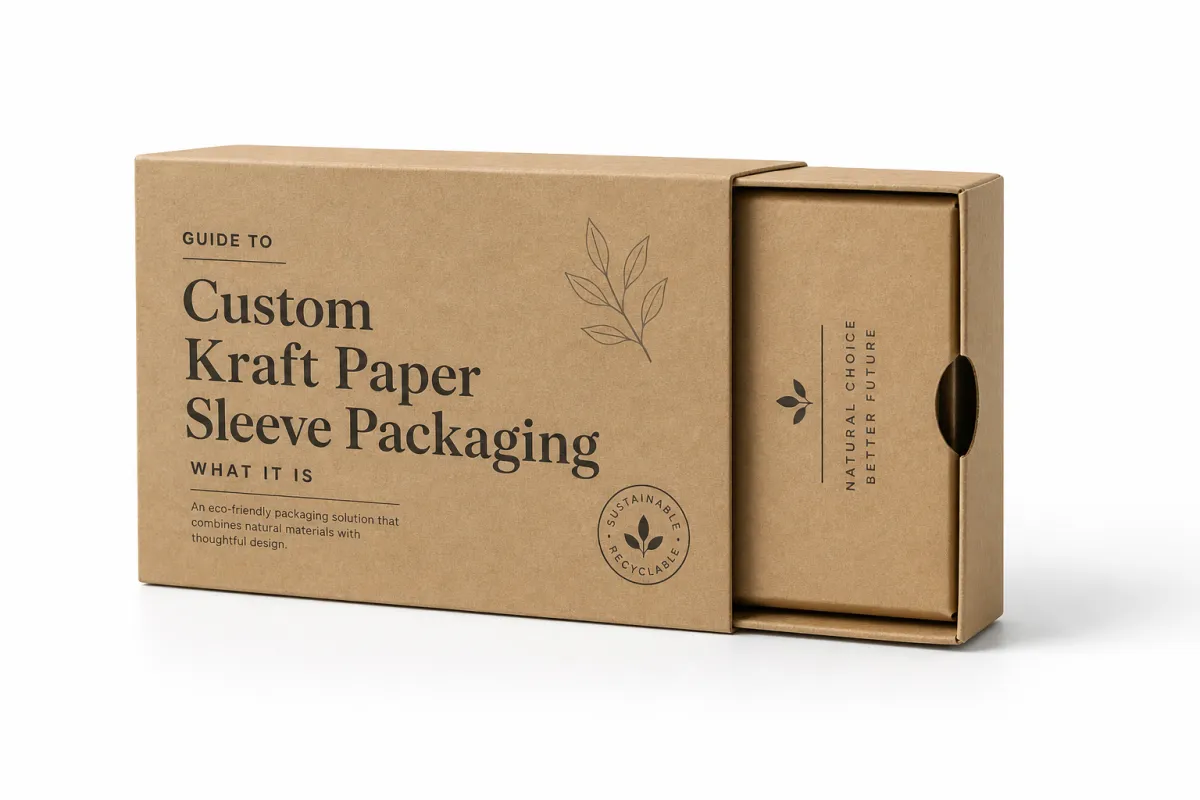
At the simplest level, a sleeve is a paper wrap that partially covers a product or secondary package. It might band around a folding carton, slide over a kraft mailer, sit across a candle box, or hold together a two-piece gift set. In the guide to custom kraft paper sleeve packaging, that distinction matters because the sleeve is usually not the main container. It is the visible layer that supports the package underneath.
That also explains why sleeves and belly bands get mixed up so often. A belly band is usually narrower and wraps once around the package. A sleeve can be wider, may include branding or copy panels, and often covers more surface area. A full carton is different again. It is structural packaging. It carries weight, protects contents, and often replaces another container. The guide to custom kraft paper sleeve packaging sits between those worlds: more expressive than a band, less material-heavy than a full box rebuild.
Food and beverage brands use sleeves on jars, trays, and multipacks. Cosmetics teams use them for shade names, claims, and ingredient notes. Candle brands like the natural texture because it fits kraft paper and earthy visual systems without trying too hard. Apparel and gift sets benefit too, especially when the goal is to add branded packaging without adding another carton. Subscription packaging is another strong fit, particularly when a brand wants a seasonal look without redesigning every insert.
Here is the part people underestimate: a slim sleeve often changes perceived value more than a bigger format change. Why? Contrast. A plain box with one well-placed sleeve reads as deliberate. It signals order, hierarchy, and intent. In retail packaging, that can matter more than another full-color panel that nobody notices. The guide to custom kraft paper sleeve packaging is really about controlling that contrast.
Buyers comparing options should treat sleeves as a package branding shortcut, not a compromise by default. They can be elegant. They can be cost-conscious. They can also support sustainable packaging goals because material use is usually lower than a full custom printed box. The catch is simple: the sleeve still has to be measured, printed, and applied well, or it becomes a loose band that looks improvised.
I have seen teams spend weeks polishing a box design, then slap a sleeve on late in the process and act surprised when the fit is off by three millimeters. That is how you end up with a crooked front panel and a production manager giving you the look. Measure first. Design second.
Packaging.org's format overviews point out that material choice and package structure shape conversion, handling, and brand presentation. That holds here, where the visible band has to perform without carrying the whole structure alone: packaging industry reference at packaging.org.
So when someone asks for the guide to custom kraft paper sleeve packaging, the real answer is not “it is just a wrap.” It is a format with a specific job, a specific fit, and a specific place in the product packaging hierarchy.
How custom kraft paper sleeves work in real packaging
The mechanics are straightforward. The details are not. A sleeve starts with a dieline, the flat map of the finished piece. That dieline shows folds, wraps, cut lines, glue areas, tuck points, and any locking features. In the guide to custom kraft paper sleeve packaging, this is where creative intent meets manufacturing reality. If the dieline is off by even a few millimeters, the sleeve can open too much, overlap badly, or land with the logo slightly crooked on the front face.
Most sleeves use one of four common construction methods: friction-fit wrap, glued seam, tuck closure, or a die-cut locking tab. A simple friction-fit sleeve is often enough for low to medium quantities. A glued seam adds security and repeatable alignment. Tuck systems help when the sleeve needs to be opened and closed. Locking tabs are less common, but they can work well when a presentation piece needs extra polish without a full box redesign. The guide to custom kraft paper sleeve packaging should always ask which method matches the product, because the “best” construction depends on handling, speed, and budget.
Fit is everything. Too loose, and the sleeve slides or flares. Too tight, and staff waste time forcing it into place. That sounds small until you multiply it across 5,000 units. A difference of 2 or 3 seconds per unit turns into hours of labor on a hand-applied run. In the guide to custom kraft paper sleeve packaging, fit also affects print alignment. If the wrap shifts, the front panel can land half a centimeter off center, and the whole piece feels less finished.
Sleeves can wrap over folding cartons, rigid boxes, jars, trays, pouches, or corrugated shippers. They can add a seasonal band to a mailer or help a flat-packed bundle feel more complete. That is one reason designers like them: one system can serve several SKUs with a relatively small print change. They also let brands refresh retail packaging without replacing every base structure in the line.
Decoration options are broad. Offset printing usually gives the cleanest color on larger runs. Digital printing works well for shorter quantities, variable copy, or frequent artwork changes. Embossing and debossing add texture to kraft paper. Foil can work, though it needs restraint on a natural substrate. Spot coatings, matte varnish, and soft-touch finishes change both appearance and handling. The guide to custom kraft paper sleeve packaging benefits from understanding these tradeoffs early, because the finish affects visual quality, scuff resistance, and assembly behavior.
Operations matter too. Will sleeves be hand-applied, semi-automated, or machine-applied? Small brands often start with manual application because it keeps tooling simple. Higher-volume runs may justify a folder-gluer or application system, especially when consistency and labor savings matter. A sleeve that takes 4 seconds to apply by hand may not sound expensive, but on 15,000 units it becomes a real line item. That is why the guide to custom kraft paper sleeve packaging should include the plant floor, not just the art board.
Think of it this way: the sleeve has to look easy even when it is not. The best ones guide the eye, hold position, and disappear into the product story. The weak ones announce their own problems the second they hit the pack line.
Key factors that shape sleeve design and performance
Paper stock is the first real decision. Lightweight kraft can be a strong choice for simple branding, especially when the sleeve is mostly decorative and the base pack already carries the load. Heavier board makes more sense if the sleeve needs stiffness, edge integrity, or a more premium hand feel. In the guide to custom kraft paper sleeve packaging, I usually reduce stock selection to three questions: how much structure is needed, how much print fidelity is expected, and how much handling the sleeve will get before the consumer opens it.
Thickness matters, but not by itself. A 250gsm kraft sheet behaves very differently from a 350gsm board with the same artwork. The thicker stock may hold folds better and resist scuffing, yet it may also crack if score lines are too shallow or grain direction is ignored. Good packaging design is rarely about picking the heaviest material. It is about matching the material to the job.
Size planning deserves the same attention. Measure the product or base pack first, then build in overlap and tolerance. For many custom sleeve projects, a design team will allow 1.5 to 3 mm of working tolerance on each critical edge, though the right number depends on whether the sleeve is hand-applied or machine-applied. The guide to custom kraft paper sleeve packaging also has to account for wrap direction. A beautiful front panel means nothing if the logo lands on the seam or the barcode ends up hidden.
Typography and content placement matter more than teams expect. On natural kraft paper, small text can sink into the fibers if the contrast is weak. Barcodes need a clean quiet zone. Ingredient statements and compliance copy need room to breathe. If the sleeve is doing double duty as both brand layer and information carrier, the layout should be planned like product packaging, not like a decorative band. That distinction gets missed a lot, which is why the guide to custom kraft paper sleeve packaging keeps circling back to structure.
Finish choice is another balancing act. Uncoated kraft reads natural, warm, and honest. Coated or laminated surfaces can improve color reproduction and reduce scuffing, but they can also soften the tactile character that makes kraft appealing in the first place. In the guide to custom kraft paper sleeve packaging, the best starting point is the brand story. If the point is earthy, minimal, and recyclable-looking, uncoated stock usually wins. If the sleeve needs sharper photography or stronger color blocks, a coating or varnish may earn its keep.
Sustainability should be discussed with precision. Recycled content, FSC-certified sourcing, minimal ink coverage, and right-sized dimensions all help. Claims still need to be supportable. A sleeve is not automatically “green” because it is brown. Heavy lamination, specialty foils, or adhesives that complicate recovery change the end-of-life picture. FSC certification remains a useful benchmark for responsible fiber sourcing, and it is worth checking documentation directly rather than trusting a supplier’s shorthand: FSC information and chain-of-custody resources.
For brands building a broader system, sleeves should fit into the rest of the package family. That means thinking about custom printed boxes, outer shippers, inserts, and shelf displays as one visual system. When the sleeve and the carton speak the same design language, the result feels intentional. When they do not, package branding looks fractured. The guide to custom kraft paper sleeve packaging works best when it is treated as part of the broader packaging design toolkit.
One practical rule helps here: design for the real production method, not the mockup. A concept board can look perfect while the finished piece fights the grain, the fold, or the barcode clear zone. The guide to custom kraft paper sleeve packaging is where those details stop being invisible.
Guide to custom kraft paper sleeve packaging pricing and cost drivers
Pricing is where the conversation gets concrete. The guide to custom kraft paper sleeve packaging usually starts with quantity, because quantity drives almost everything else. A short digital run may cost more per unit, but it can avoid higher setup costs and get a brand into a test market faster. Larger offset runs bring unit cost down, though they also require more planning, more proofing, and more discipline around storage.
Here is the range I would use for planning, not as a quote: simple sleeves at around 5,000 units often land near $0.18 to $0.35 per piece, depending on size, paper grade, and coverage. Add heavier board, special folding, foil, embossing, or more complicated print work, and the figure can climb into the $0.40 to $0.85 range or beyond. The guide to custom kraft paper sleeve packaging should treat those numbers as directional. Production region, labor, freight, and cartonization can push the final result either way.
| Production Option | Typical Quantity | Indicative Unit Cost | Best Use Case | Main Tradeoff |
|---|---|---|---|---|
| Digital print, simple die-cut | 250-2,000 | $0.45-$1.20 | Launches, tests, seasonal drops | Higher unit cost, faster turnaround |
| Offset print, standard kraft stock | 3,000-10,000 | $0.18-$0.35 | Stable SKUs, retail packaging, recurring orders | More setup, lower cost at scale |
| Offset print with premium finish | 5,000-25,000 | $0.35-$0.85 | Premium product packaging, gift sets, branded packaging programs | Higher spend, stronger shelf impact |
What drives cost up fastest? Print coverage is one. A full-bleed, ink-heavy sleeve uses more press time and can change drying or curing needs. Paper grade is another. A cleaner, higher-density kraft board usually costs more than a basic recycled sheet. The guide to custom kraft paper sleeve packaging also has to account for tooling and assembly. Custom cutting, special scoring, glue application, and fold complexity can add more than many buyers expect.
Hidden costs matter too. Dieline development is often overlooked, yet it is the backbone of a clean sleeve program. Proofing can add another layer, especially if color matching needs more than one round. Sampling may sound optional, but it is usually the cheapest way to avoid a batch of loose or misaligned sleeves. Freight and storage can also matter, especially when cartons must be held before a launch or distributed to several fulfillment sites. A sleeve that looks inexpensive on paper can stop looking cheap once total landed cost is calculated.
The better question is not “What is the lowest unit price?” It is “What does the program actually cost per finished saleable unit?” That includes material, assembly, spoilage risk, freight, and how the sleeve affects sell-through. Sometimes a slightly higher sleeve cost pays back by improving presentation, reducing the need for extra inserts, or making seasonal product packaging faster to swap. The guide to custom kraft paper sleeve packaging should always push buyers toward that broader view.
If your team is comparing options, ask for pricing at three quantity tiers and compare more than the line item. Look at setup, proofing, delivery schedule, and whether a supplier can support related formats like Custom Packaging Products for matching shippers, boxes, or inserts. That comparison usually shows whether the sleeve is actually economical or just looks cheap at first glance.
Labor matters too. A sleeve that saves $0.05 in material but adds 6 seconds in packing time can wipe out the savings quickly. For that reason, the guide to custom kraft paper sleeve packaging should be read with the plant floor in mind. Packaging is not only printed paper. It is also a motion, a hand, a line speed, and a deadline.
Step-by-step process and timeline for production
The cleanest sleeve projects follow a predictable path. The first step is the brief: product dimensions, target quantity, artwork goals, substrate preferences, regulatory copy, and launch date. The guide to custom kraft paper sleeve packaging begins here because everything downstream depends on how clearly the brief is written. A vague brief invites delay. A specific brief shortens the review cycle.
Next comes the dieline. The supplier translates the physical product into a printable template. At this stage, the team checks overlap, seam placement, fold direction, and any locking or glued areas. Expect at least one round of back-and-forth on a new sleeve, especially if the product is oddly shaped or the brand wants the logo centered in a very specific way. The guide to custom kraft paper sleeve packaging works best when the creative team treats the dieline as a working document, not an afterthought.
After the dieline comes proof review. A digital proof may be ready in 1 to 3 business days once measurements are confirmed. Physical samples or short-run prototypes often take 3 to 7 business days, depending on the print method and finishing. If artwork changes after proofing, the clock resets. That is one of the main reasons timelines slip. The guide to custom kraft paper sleeve packaging is, bluntly, often a lesson in decision discipline.
For production, simple digital orders can sometimes be completed in roughly 7 to 12 business days after approval. Offset or more complex jobs often take 10 to 20 business days, and premium finishes or high-volume schedules can push beyond that. Freight is separate. If materials move by sea, air, or regional truck, the timeline shifts again. Build buffer time into launch planning. A brand that needs product on shelves by a fixed date should not approve artwork on the edge of that deadline.
What should a strong packaging brief include?
- Exact product or base-pack dimensions, with units clearly stated.
- Desired sleeve position, seam location, and wrap direction.
- Artwork files, font rules, color references, and barcode requirements.
- Paper stock preference, finish preference, and any sustainability requirements.
- Target quantity, ship-to locations, and the hard deadline.
There is also a testing stage that should not be skipped. For sleeves that travel in transit or ship as part of kitted product packaging, ask whether the pack should be checked against ISTA-style vibration and drop expectations or distribution testing such as ASTM D4169. Those standards matter because a sleeve that looks perfect on a table may scuff, shift, or split once it moves through real logistics. The guide to custom kraft paper sleeve packaging should always include the distribution path, not just the shelf moment.
That is the rhythm: brief, dieline, proof, sample, approval, production, delivery. If a supplier cannot explain where each step sits on the calendar, ask more questions before placing the order.
Common mistakes when ordering kraft paper sleeves
The first mistake is designing too early. Teams often build graphics before the final product dimensions are confirmed, then discover the sleeve no longer fits after a jar, box, or insert changes by a few millimeters. That sounds tiny. It is not. In the guide to custom kraft paper sleeve packaging, the product measurement comes first because everything else depends on it.
The second mistake is treating kraft like a neutral background that behaves the same way under every ink system. It does not. Natural kraft can mute color, shift warm tones, and make fine details harder to read. Heavy graphics can look muddy if contrast is weak. Thin serif type can disappear. The guide to custom kraft paper sleeve packaging needs a quick color reality check before artwork is approved, especially if the brand is used to coated custom printed boxes with brighter color behavior.
Another common problem is ignoring assembly time. A sleeve that takes only a few extra seconds to place may seem harmless until volume increases. Hand application gets expensive when the line is busy. If workers must rotate the sleeve to find the front panel or force the fit, the project may need a redesign. The guide to custom kraft paper sleeve packaging should always ask, “How will this be applied at 100 units? At 5,000? At 25,000?”
Prototype testing gets skipped because everyone wants to move fast. A sample can reveal corner scuffing, loose wraps, weak fold memory, or a barcode that will not scan at retail. It can also show whether the sleeve slides when the carton is handled or whether the glue seam catches a finger during packing. Small issues turn into expensive ones once a run is already in motion. The guide to custom kraft paper sleeve packaging is much cheaper when those problems are found on the sample table.
Vague specifications cause their own mess. “Natural look,” “premium feel,” and “eco-friendly” may sound clear inside a brand team, but they can mean very different things to a supplier. One team imagines recycled stock, another imagines uncoated fibers, and a third expects a soft-touch finish. That mismatch leads to revision cycles and missed deadlines. The guide to custom kraft paper sleeve packaging works best when the brief names actual materials, measurable sizes, and explicit expectations.
There is also a structural mistake that shows up a lot: asking the sleeve to do too much. If it needs to carry detailed copy, hold a bundle closed, provide tamper evidence, and carry premium visual design all at once, the format can become crowded. Better to decide what the sleeve must do first. Then let the base pack carry the rest. That keeps package branding clear and product packaging easier to produce.
A sleeve should earn its place by solving one job well. If it tries to do five jobs badly, the package usually feels overworked.
Finally, teams sometimes forget the customer experience. A sleeve that tears too easily, sheds fiber, or blocks opening can frustrate the buyer. A sleeve that looks elegant but arrives crumpled because the master cartons were packed too tightly also misses the mark. The guide to custom kraft paper sleeve packaging is not just about print files. It is about how the package behaves from the filler table to the shelf to the unboxing moment.
Expert tips and next steps for smarter sleeve packaging
Start with a prototype on the actual product, not on a guess. That sounds obvious, yet it is one of the most reliable ways to avoid surprises. A sample shows how the sleeve sits, how the seam behaves, how the print reads on kraft paper, and whether the package still feels balanced in the hand. The guide to custom kraft paper sleeve packaging becomes much easier once the real object is in front of the team.
Design the sleeve around one primary job first. Is the goal shelf impact, seasonal messaging, product information, or tamper awareness? The best sleeve programs pick the main objective and let every other decision support it. That makes branded packaging sharper and keeps the layout from getting crowded. A sleeve that knows its job usually performs better than one trying to act like a miniature billboard.
Ask for a sample kit or short-run proof before committing to the full order, especially if this is a new SKU or a new supplier relationship. A proof does not only confirm color. It confirms handling, fold quality, and whether the sleeve survives packing. The guide to custom kraft paper sleeve packaging often saves money here, because a small correction at the sample stage is far cheaper than a remanufacture.
Use a short checklist before you approve production:
- Final dimensions confirmed against the actual package or product.
- Artwork reviewed with barcode, legal copy, and front-panel hierarchy checked.
- Stock, finish, and adhesive choices documented in writing.
- Assembly method understood by both the design team and the plant.
- Timeline includes proofing, sampling, and freight buffer.
That checklist looks simple, but it prevents most expensive surprises. It also makes conversations with suppliers more useful. Instead of asking for “a nicer sleeve,” you are asking for a defined structure with known requirements. The guide to custom kraft paper sleeve packaging becomes much easier to execute when the question is specific.
Compare sleeves alongside other formats in your packaging system. If you already use Custom Packaging Products, ask whether the sleeve should match your shippers, inserts, or display boxes in board tone, print style, or finish. A consistent family of product packaging can do more for package branding than a one-off design that never connects to the rest of the line.
Keep sustainability claims narrow and factual. If the sleeve uses recycled fiber, say so only if documentation supports it. If the supplier offers FSC-certified paper, ask for the certificate number or chain-of-custody proof. If the program is trying to reduce material use, measure it against the old format so the savings are real, not rhetorical. The guide to custom kraft paper sleeve packaging should make sustainability visible in the specs, not just in the sales language.
My final advice is simple. Measure the product. Gather the artwork. Compare quotes at multiple quantities. Request samples. Then decide. The guide to custom kraft paper sleeve packaging is most useful when it ends in action, not in a pile of vague opinions. A well-made sleeve can sharpen retail packaging, support product packaging goals, and make even modest budgets look more intentional. That is a small format with a big job.
If you want the next step to be orderly instead of rushed, use the guide to custom kraft paper sleeve packaging as your checklist: confirm the fit, choose the stock, test the print, verify the timeline, and move forward only after the sample proves the idea. That is how the guide to custom kraft paper sleeve packaging pays off in the real world.
FAQ
What is the best material for guide to custom kraft paper sleeve packaging?
Most brands start with uncoated kraft because it feels natural, prints well for simple branding, and keeps costs manageable. Heavier board makes sense when the sleeve must hold shape, resist scuffing, or support premium finishing. The right choice depends on product weight, how much handling the sleeve will see, and whether the sleeve is mostly decorative or doing light structural work. In the guide to custom kraft paper sleeve packaging, material should follow function first.
How do I measure for a custom kraft paper sleeve?
Measure the exact product or primary package dimensions first, then add overlap and production tolerance. Check the wrap direction so the artwork lands where shoppers will actually see it on shelf or in an unboxing sequence. Always request a dieline or sample before approving final print. The guide to custom kraft paper sleeve packaging works best when the measurements are written down clearly, not estimated from memory.
What affects the price of custom kraft paper sleeves most?
Quantity, paper grade, print complexity, and finish choices usually have the biggest impact on pricing. Artwork setup, sampling, and special cutting can add cost, especially on lower-volume runs. Comparing total landed cost gives a clearer picture than unit price alone. If you are using the guide to custom kraft paper sleeve packaging for budgeting, ask suppliers to quote several quantities so the pricing curve is easy to see.
How long does production usually take for custom kraft paper sleeves?
Timeline depends on whether the design is ready, how many proofing rounds are needed, and which printing method is used. Sampling and revision rounds often add the most time, so buffer time before launch is smart. Simple digital runs are usually faster than complex, high-volume production orders. In the guide to custom kraft paper sleeve packaging, the safest schedule is the one that assumes at least one round of changes.
Are kraft paper sleeves a good sustainable packaging option?
They can be, because sleeves often use less material than a full box and can be made with recycled content. Sustainability claims should match the actual paper source, inks, coatings, and end-of-life guidance. The most sustainable version is usually the one that fits the product properly and avoids unnecessary extras. The guide to custom kraft paper sleeve packaging should treat sustainability as a measurable spec, not a marketing phrase.

