Buyer Fit Snapshot
| Best fit | Packaging Cost Affordable projects where brand print, material claims, artwork control, MOQ, and repeat-order consistency need to be specified before quoting. |
|---|---|
| Quote inputs | Share finished size, material target, print colors, finish, packing count, annual reorder estimate, ship-to region, and any compliance wording. |
| Proofing check | Approve dieline scale, logo placement, barcode or warning zones, color tolerance, closure strength, and carton packing before bulk production. |
| Main risk | Vague material claims, crowded artwork, missing packing details, or unclear freight terms can make a low unit price expensive after revisions. |
Fast answer: Packaging Cost Affordable: Cut Spend Without Waste should be specified like a repeatable production item. The safest quote records material, print method, finish, artwork proof, packing count, and reorder notes in one written spec.
Production checks before approval
Compare the actual filled-product size with the drawing, then confirm tolerance on folds, seals, hang holes, label areas, and retail display edges. Reserve space for logos, QR codes, warning copy, and material claims before decorative graphics fill the panel.
Quote comparison points
Review material grade, print process, finish, sampling route, tooling charges, carton quantity, and freight assumptions side by side. A quote is only useful when the supplier can repeat the same color, closure quality, and packing count on the next order.
Packaging Cost Affordable: Cut Spend Without Waste
Packaging cost affordable is not about chasing the cheapest box and hoping the product survives the journey with its dignity intact. I learned that on a skincare launch in Shenzhen, where a mailer-box quote came in at $0.41 per unit for 1,000 pieces, but the carton crushed on a 1.2-meter drop test and the return rate hit 6.8% in the first month. We moved the build to an E-flute structure with a 1.5 mm wall and paid $0.53 per unit instead. Damage claims dropped, reprints stopped, and finance stopped treating freight like a slow leak in the ceiling. That is packaging cost affordable in the real world: a lower total bill, not a prettier spreadsheet.
I have stood on factory floors in Shenzhen and Dongguan while press operators counted waste sheets by hand and explained why a 2 mm size shift could throw a die line off by 18 to 22 mm after folding. I have also sat in procurement meetings where someone stared at a $0.08 unit difference and ignored the $620 ocean freight surcharge from Ningbo to Los Angeles. Packaging cost affordable only means something if the full landed number is on the table, including proof charges, palletization, and a 12-15 business day production window after proof approval. Anything else is just wishful math with a glossy cover sheet.
The honest version is simple: packaging cost affordable means the best total cost for the product, the shipping lane, and the margin. Sometimes that looks like 350gsm C1S artboard with one-color black print. Sometimes it looks like SBS board with a matte aqueous coat and no foil. Sometimes it means skipping embossing, spot UV, or a magnetic closure because those finishes can add $0.18 to $1.25 per unit without moving sell-through enough to justify the spend. I have watched brands save $0.12 per unit on 10,000 pieces and then lose $1,400 to rework because the spec sheet missed the glue flap width by 3 mm. That is not savings. That is a costume with a shipping label.
Packaging Cost Affordable: Why Cheap Quotes Usually Cost More
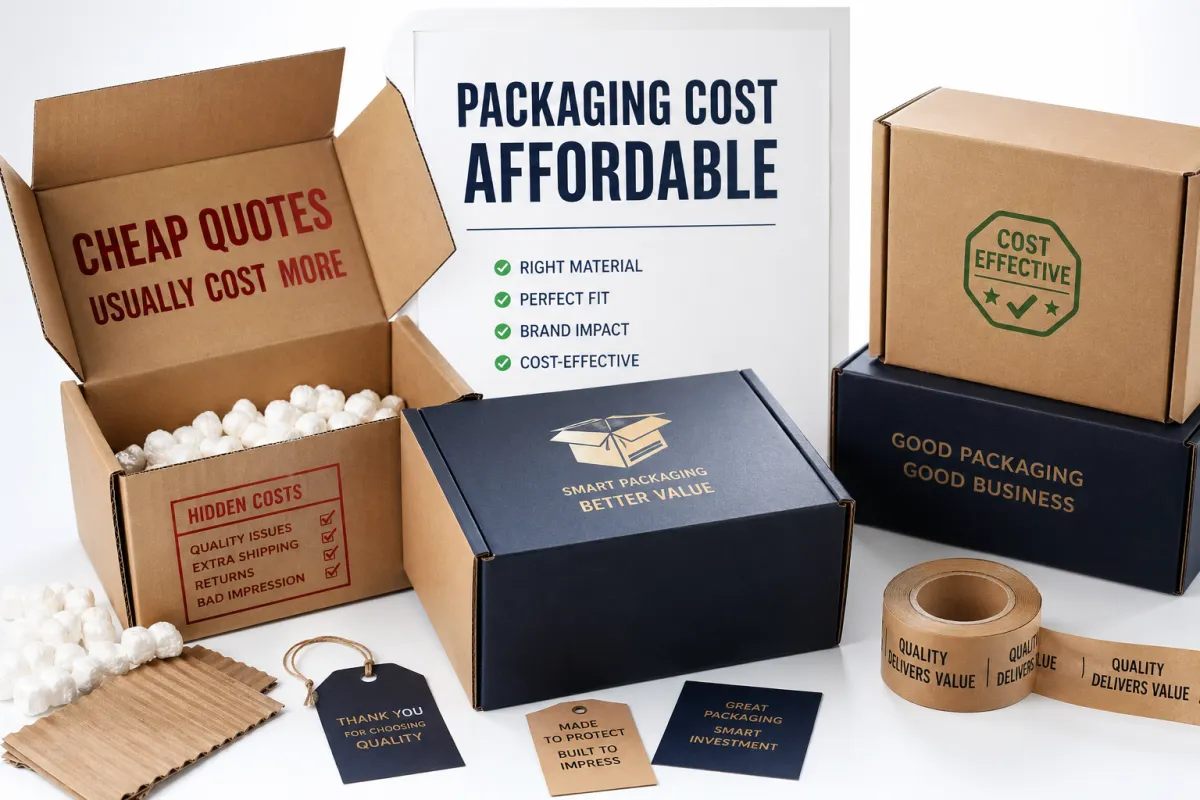
The lowest quote usually looks irresistible because it leaves out the parts nobody wants to price honestly. Sticker price is one line. Freight from Shenzhen to Chicago is another. Waste sits on the floor in a 4% to 7% overrun if the die line is sloppy. Rework appears after the first 200 samples miss the lock tab by 1.5 mm. Delays show up once the launch calendar is already packed and the supplier asks for another 5 business days. Packaging cost affordable only holds together when those five costs are treated like one conversation, not five separate excuses.
I remember a small food brand comparing two Custom Printed Boxes for the same 450 g granola product. One quote was 7 cents lower per unit on paper, but the board was 280gsm instead of 350gsm C1S artboard and the glue coverage was lighter by about 12%. The cheaper quote lost because pallet three crushed during LCL freight from Dongguan to Sydney, the customer complained, and a second run had to be scheduled. The "expensive" option saved them more than $3,800 across damage claims and reshipments. That was not luck. It was arithmetic with a pulse.
People get trapped by line-item pricing because they assume every packaging supplier is quoting the same thing. They are not. One vendor may include a 3% waste allowance, a stronger outer shipper, and a cleaner print setup using 4-color CMYK on a Heidelberg line in Suzhou. Another may undercut the price by assuming a looser tolerance, thinner liner, or a 28-day delivery window that pushes inventory risk onto you. If packaging cost affordable matters, the comparison has to start with what is actually included, not what the sales email hopes you will assume.
"The lowest quote was the most expensive mistake we made. We paid for the reprint, the rush freight from Xiamen, and the apology emails."
That line came from a subscription client after I pushed the team to review total landed cost instead of the first-page quote. The order was 5,000 units, the unit price was $0.19 lower on paper, and the rush freight added $960 when the delivery date slipped by 8 days. One person kept pointing at the unit price as if it could erase the rest of the bill. I pointed at the return rate, which had climbed to 4.2% in the first two weeks. The return rate won. Numbers are rude like that.
A practical way to think about it is five buckets: material, print, finishing, freight, and failure risk. Material and print are obvious. Finishing gets sneaky fast once someone adds foil on the lid and soft-touch lamination on the sleeve. Freight can climb 15% when pallet count changes from 18 pallets to 22. Failure risk is the hardest bucket to price, yet it matters most on fragile or premium branded packaging, especially when the product weighs 680 g and travels through three hubs before it reaches a warehouse in Dallas.
If packaging cost affordable is the goal, the work is not to strip the box until it looks poor. The work is to remove waste that does not help the package sell, ship, or survive handling. That usually starts with dimensions, structure, and print coverage. A box that is 8 mm too wide can waste board, increase void fill by 14%, and inflate freight by 0.6 lb per carton. The fewer pointless extras, the less chance your budget starts bleeding in silence.
What Makes Packaging Cost Affordable?
Right-sizing is the fastest route to packaging cost affordable. A box that is 8 mm too wide can force extra board usage, more void fill, and higher freight weight. I have seen a simple dimension shift cut material use by 7.4% on a run of 20,000 folding cartons, which translated to a savings of $1,280 before shipping. If the product is a 120 ml bottle, do not quote a carton built for a 150 ml bottle just because the old template was sitting there like a lazy filing cabinet with a dusty label.
Standard dielines matter for the same reason. A custom shape with extra lock tabs, curved windows, or unusual folds may look striking on a render, yet it can increase tool complexity and slow the line. Standard mailer structures and standard tuck-end cartons keep packaging cost affordable because the converter already knows the geometry, the likely waste, and the press setup time. Less guessing. Less scrap. Fewer headaches. Fewer situations where someone on the floor mutters, "Who approved this?" while holding a stack of warped blanks.
Color count changes unit cost more than most founders expect. A one-color kraft print often lands at $0.15 per unit for 5,000 pieces, while a full-coverage CMYK design on the same structure can rise to $0.29 or $0.34 depending on plate count and ink coverage. During a meeting in Dongguan last spring, I watched a brand owner cut two PMS colors and remove a metallic hit from the side panel. The package still looked premium because the structure was disciplined and the typography did the heavy lifting. That is packaging design with restraint, and restraint is underrated.
Material choice should follow the product, not ego. Kraft is often strong and direct for e-commerce and mailers, especially in 250gsm to 350gsm weights. SBS gives a smoother presentation for retail packaging and cosmetics, and 350gsm C1S artboard can carry a crisp print face without adding the cost of a laminated premium build. Corrugated protects better in transit, especially for heavier product packaging like glass serum bottles or 1 kg supplement jars. Rigid boxes feel premium, but they carry more cost in board, wrap, labor, and shipping volume. I am not against rigid. I am against waste wearing a tuxedo and calling itself strategy.
The part many teams miss is this: simple structures protect margin. Every extra fold, glued pocket, or insert cavity adds handling time. A simple die-cut carton may take 18 seconds to assemble on a line in Zhejiang, while a complex insert with two glue points can take 31 seconds. Labor is cost. Cost eats packaging cost affordable alive if the build piles up with little add-ons that look harmless in a design deck but behave like tiny tax collectors in production. Leave out the dramatic flourishes unless the product truly needs them.
If the product sits in stores, branded packaging can still be affordable without looking stripped down. A sharp logo, one accent color, and a well-sized panel can do more for package branding than three finishes stacked together. I have seen buyers spend $0.42 on foil and embossing where $0.08 worth of restrained print would have done a better job, especially on a 300 ml skincare carton with a 60 mm front panel. That part still annoys me, to be honest. Beautifully wasted money is still wasted money.
Before you send a quote request, our Custom Packaging Products page helps narrow the field. Knowing whether you need a folding carton, a mailer, or a rigid setup makes the cost conversation sharper from the start, and it can shave 1 to 2 rounds off the proof cycle when the supplier knows whether you are shipping from Shanghai, Shenzhen, or Ningbo.
Packaging cost affordable is also a margin question. If a box lifts perceived value by $2 and adds only $0.25 in production cost, that is a healthy trade. If the same box adds $1.10 because of layered finishing, the economics get rough fast. The right answer depends on what the package has to do: sell, ship, or both. A subscription box sent through UPS Ground in the US has a different cost profile than a retail carton sitting under lights in Singapore for six weeks.
Product Details: Packaging Formats That Fit the Budget
Mailers are often the first stop for packaging cost affordable because they ship flat, assemble quickly, and work well for e-commerce. A regular slotted mailer in E-flute, with one-color print and a water-based ink system, is usually cheaper than a rigid presentation box, and it can still look sharp with the right artwork and a clean closure. I have watched DTC brands in Los Angeles use a simple kraft mailer and beat a fancier competitor on perceived honesty alone. People can smell fake luxury from across a checkout page, especially when the shipping fee is $7.95 and the box is trying too hard.
Folding cartons are another strong option for retail packaging. They are flat-packed, efficient to store, and easier to customize than most buyers expect. A 350gsm C1S artboard carton with a matte aqueous coating can deliver a polished retail look without the cost jump of foil or spot UV. If the product sits on a shelf for six weeks and is opened at home, that is a good place to keep packaging cost affordable. There is no medal for making the outside fancier than the actual product needs, especially when the item inside retails for $18 and the carton starts acting like a luxury car brochure.
Paper bags can work for promotions, events, and lightweight items. They are often one of the lowest-cost branded packaging formats, especially when the print area is limited and the handle style is standard. A 120gsm kraft bag with twisted paper handles can land at $0.11 to $0.18 per unit in 3,000-piece quantities. I would not put heavy glass jars or awkward shapes into them. Cheap bags that tear in transit are not affordable. They are a public apology, and nobody enjoys those in a trade show lobby in Chicago.
Rigid boxes belong in the premium lane. They offer a strong unboxing moment and can support high-value gift sets, electronics, and luxury product packaging. A 1200gsm grayboard wrapped in 157gsm art paper may look excellent, but the tradeoff is plain: more board, more wrap, more labor, and higher freight volume. If your margin is thin, packaging cost affordable and rigid packaging only overlap in select cases, such as a $220 fragrance set or a $399 gift bundle. A rigid box is not the default. It is a choice with consequences, and sometimes those consequences are perfectly fine if the product can carry them.
Labels are the quiet workhorse. For products with an existing container, labels can be the cheapest route to package branding at speed. A 90 mm x 120 mm BOPP label on a stock bottle often beats a complex Custom Printed Box when the launch budget is tight. I have seen a wellness brand in Austin launch 5,000 units with a label cost of $0.06 per bottle and still look polished enough to sell through the first run in 11 days. The trick is letting the label support the packaging design instead of hiding weak product presentation behind it.
A quick comparison helps buyers see the terrain:
| Format | Typical MOQ | Approx. Unit Cost | Best Use | Cost Notes |
|---|---|---|---|---|
| Mailer box, E-flute | 1,000 pcs | $0.62-$0.96 at 5,000 pcs | E-commerce, subscription kits | Good balance of strength and packaging cost affordable pricing; usually 12-15 business days from proof approval |
| Folding carton, SBS | 3,000 pcs | $0.15-$0.34 at 10,000 pcs | Retail packaging, cosmetics, supplements | Lower labor, flat shipping, easy to brand; 350gsm C1S artboard often lands in the sweet spot |
| Corrugated shipping box | 500 pcs | $0.78-$1.35 at 3,000 pcs | Heavy product packaging, transit protection | Affordable when protection matters more than shelf display; stronger for 700 g to 1.5 kg products |
| Rigid box | 1,000 pcs | $1.85-$4.20 at 3,000 pcs | Luxury gifts, premium kits | High perceived value, higher setup and freight cost; often wrapped with 157gsm art paper over 1200gsm board |
| Paper bag | 2,000 pcs | $0.11-$0.28 at 5,000 pcs | Retail carry-out, events | Low unit cost, limited protection; best for light items under 1.5 kg |
Special inserts change the picture quickly. Custom foam, molded pulp, die-cut cardboard inserts, and magnetic closures can add cost fast because they raise tooling, assembly, and waste. On one supplement launch in Guangzhou, we removed a foam insert and replaced it with a die-cut carton cradle made from 300gsm board. The bottle still held firm, the tamper features stayed intact, and the unit cost dropped by 21%, from $0.76 to $0.60. That is the kind of move that keeps packaging cost affordable without flattening the brand.
If you are choosing between formats, match the structure to the channel. E-commerce usually favors corrugated or mailer formats. Retail shelves often favor folding cartons. Subscription kits can use a hybrid structure if the unboxing matters, especially when a 1.8 kg set ships by regional courier in Europe. The mistake I see most often is forcing one structure to do three jobs it was never built for. Packaging has limits. Human ambition does not, apparently.
For more format examples, our custom printed boxes page shows how different structures behave across product packaging and shipping needs, including a 350gsm carton for cosmetic tubes and a double-wall shipper for 2.4 kg candle sets.
I once visited a plant in Foshan where a brand insisted on a magnetic rigid box for a low-margin sample kit. The supplier quoted 18 to 24 business days for production, plus 4 more days for sea freight to Singapore. The client still wanted it because the sample looked impressive. After we ran the numbers, the box cost more than the contents by $1.07 per unit. We changed to a folding carton with a coated insert, and the launch finally made sense. The room got quieter after that, which is usually a sign that the spreadsheet has won.
Specifications That Drive Packaging Cost Affordable Results
Good specifications are the backbone of packaging cost affordable work. Skip dimensions, board thickness, print sides, coating, and finishing, and you are basically asking the supplier to guess. Guessing breeds revisions. Revisions breed cost. Cost is the enemy of a clean unit price. It is also the reason people keep saying they are "almost ready to quote" for three weeks straight while the launch date in Toronto gets closer by the hour.
Start with dimensions in millimeters, not opinion. I want the exact outer size, product size, and any clearance needed for a cap, pump, or insert. On a bottle project last year, a 3 mm change in neck height meant the inner tray had to be rebuilt from scratch, which added a new tool, a 6-business-day sample cycle, and a higher MOQ of 3,000 pieces. It also pushed the box out of packaging cost affordable range until the client accepted a simpler insert. A tiny change can have the manners of a wrecking ball.
Board thickness matters too. A 350gsm C1S artboard is not the same as a 300gsm SBS, and a single-wall corrugated board is not a rigid board. If the product weighs 800 grams, do not spec a thin carton just because the render looks elegant. Ask for a compression check or a sample run in Dongguan or Qingdao. Too many launches fail because the box looked fine on a screen and bent under real weight on a warehouse shelf. Screens are very polite. Warehouses are not.
Print sides affect production and price. Full inside and outside print is nice, but one-side print is often enough for packaging cost affordable orders. If the interior panel is hidden or covered by inserts, it may not need full coverage. That is a direct way to trim ink, setup, and proofing time. On a 10,000-piece cosmetics job, dropping interior print saved $0.04 per unit and reduced the proof cycle by one round. Quiet savings beat loud upgrades. They also keep the proofing thread from becoming a group therapy session.
Coatings should be chosen for use, not fashion. Matte aqueous is often enough for folding cartons. Gloss can improve shelf pop. Soft-touch feels premium but adds cost and can scuff in transit if the carton is handled a lot, especially on a route that runs through two depots in the UK. Spot UV, foil, and embossing should be the exception, not the default. I have watched buyers delete all three and still end up with a cleaner package because the typography was disciplined and the layout had breathing room.
Artwork simplification saves money too. One PMS palette is easier than a mixed bag of spot colors, gradients, and metallic effects. Fewer color breaks mean fewer proofing problems. Fewer proofing problems mean packaging cost affordable stays on track. That sounds basic because it is basic, and basic is often where the savings hide. The dramatic stuff gets the presentation, but the boring stuff keeps the budget alive.
Before you request pricing, gather these details:
- Exact product dimensions and target outer box size in mm
- Material preference, such as kraft, SBS, corrugated, or rigid board
- Print coverage, including inside, outside, or both
- Finish choice, such as matte, gloss, soft-touch, foil, or spot UV
- MOQ target and acceptable quantity tiers, such as 1,000, 3,000, or 5,000 pieces
- Ship-to city, destination country, and delivery deadline
- Whether you need inserts, windows, handles, or closures
Testing deserves a real discussion too. For shipping boxes and subscription kits, I often point clients to ISTA test methods, especially when product fragility is part of the equation. For fiber sourcing and environmental claims, I check whether the material carries FSC certification. Those details influence both trust and cost, and ignoring them is how brands get burned later. I have seen that movie in a Guangzhou warehouse, and I would not recommend the sequel.
There is a point where packaging cost affordable and overcomplicated packaging design stop being friends. I saw it in a factory meeting in Suzhou where a cosmetic brand wanted five finish effects on a small carton. The supplier finally said what everyone was thinking: the box had more decoration than product information. We cut two effects, kept the logo strong, and reduced proof iterations from four rounds to two. That saved time and money, which felt like a tiny miracle wrapped in cardboard.
Packaging Cost Affordable: Pricing & MOQ That Actually Work
Unit price is not a mystery if you know the drivers. Quantity tiers matter because setup time gets spread across more pieces. Material yield matters because every sheet or roll has a natural waste pattern. Packaging format matters because a rigid box needs more labor than a flat carton. Freight matters because volume and weight change the landed number. Packaging cost affordable starts with those four levers before anyone starts fighting over 3 cents like it is a sacred principle.
MOQ can be annoying, but it exists for a reason. A folding carton run may start around 1,000 pieces, while a rigid box or a custom insert set may start closer to 2,000 or 3,000 pieces because of manual labor and setup. If packaging cost affordable is the target, ask for tiered pricing at 500, 1,000, 3,000, and 5,000 pieces. Those breakpoints reveal where the real savings live. They also tell you if the supplier is serious or just tossing numbers into the wind from a desk in Yiwu.
A recent quote set gives a useful example. A kraft mailer at 1,000 pieces came in at $0.94 per unit. At 3,000 pieces, the same build dropped to $0.62 per unit, and at 5,000 pieces it reached $0.55. That 32-cent difference looked small until we multiplied it by 2,000 extra units. The client saved $640 at the 3,000-piece tier, which paid for a better outer shipper and still kept packaging cost affordable. Scale does not always reward you evenly, but it usually rewards you if the setup is sensible.
I have seen the opposite too. A buyer increased quantity slightly and expected a huge drop in unit cost. It did not happen because the finishing step still carried a fixed setup charge of $85 and the foil plate cost stayed flat. The lesson is blunt: not every extra thousand pieces changes the price curve in the same way. Honest suppliers should tell you where the breaks are and where they are not. If they cannot, keep your hand on your wallet.
Compare quotes only when the specs match. Match material grade. Match dimensions. Match print coverage. Match coating. Match finishing. Match shipping terms. If one supplier quotes EXW from Dongguan and another quotes DDP to your warehouse in Melbourne, you are not looking at the same price. That mistake costs more buyers than bad artwork does, and it tends to show up after the pallet reaches customs, which is a miserable time to learn arithmetic.
Packaging cost affordable also depends on how the supplier handles waste. A converter who plans efficient sheet layout can cut scrap in a way that lowers your price without weakening the box. I once negotiated a run where a 2-up layout replaced a wasteful 1-up layout for a cosmetic carton. The board usage improved by 11%, die-cut waste dropped, and the client got a better number without changing the outside look. I wish every savings story was that tidy, but most of them arrive with a few bruises and a missing Friday.
A rough guide helps brands balance cost and presentation:
- Under 1,000 pieces: focus on simple structures and standard materials
- 1,000-3,000 pieces: add moderate branding and one solid finishing choice
- 3,000-10,000 pieces: optimize board yield, freight, and color count
- 10,000+ pieces: negotiate print scheduling, carton packing, and pallet density
If you need a clean comparison across formats, our Custom Packaging Products catalog is a practical starting point before you ask for a quote. It helps you decide whether you need retail packaging, shipping protection, or a mix of both, and it gives the supplier enough detail to quote a 12-15 business day or 18-24 business day schedule with less guesswork.
One more truth: packaging cost affordable is not the same as the lowest possible number. I have seen brands pick a tiny MOQ that felt safe, then pay premium air freight at $1.80 per unit and miss their shelf window by two weeks. I have also seen clients move from a 500-piece order to a 3,000-piece tier and cut enough from unit price to fund the next launch sample. The supplier stayed the same. The math changed because the quantity changed. That is why I keep pushing people to look beyond the first line of the quote.
Process & Timeline: From Quote to Delivery Without Surprises
The process should be boring. That is praise. A clean order flow keeps packaging cost affordable because it removes emergency charges that appear when people improvise. My standard path runs through inquiry, spec review, sampling, approval, production, quality control, and shipping. Every step has a deadline, and every deadline gets cheaper when the buyer answers quickly. Slow feedback is a budget tax in disguise, and it usually shows up as a 2-day delay that turns into a 9-day delay.
Sampling usually moves faster than full production, but production is where the calendar becomes real. A sample may take 5 to 10 business days depending on complexity. Mass production might take 12 to 15 business days after approval for simpler cartons in Shenzhen or Dongguan, and 18 to 24 business days for rigid boxes or custom inserts. If a buyer waits three days to approve a proof, the schedule slips. Slow feedback is expensive. It wrecks packaging cost affordable without touching the board.
Fast feedback matters because factories book slots. During a visit to a corrugated line in the Pearl River Delta, the supervisor showed me the production board and pointed to the booked windows like they were train tickets from Guangzhou to Hong Kong. Miss your slot and you wait. Waiting can mean rush freight, overtime, or a later shipment date. None of that helps margin, and none of it makes the sales team calmer. I have seen that mood, and it is not pretty.
Give the supplier a complete file package from the start. I want the dieline, final artwork, target quantity, shipping destination, and target delivery date. If you have product samples, send them. If the bottle has a pump top, mention it. If the carton has to fit a tray or blister, say so. The fewer assumptions in the first email, the more likely you keep packaging cost affordable through the whole project, especially when the shipment is headed to Rotterdam, Sydney, or Toronto.
Quality control is another place where a little discipline saves a lot of money. Ask for production photos, carton measurements, and a packing check before shipment. For shipping-critical jobs, use a drop test or compression check when the product weight warrants it. ASTM D4169 exists for a reason. Packaging that survives a warehouse and a courier route is usually cheaper than reprinting a box that failed in transit, particularly if the original run was 8,000 pieces and the reprint would take another 14 days.
I also push clients to confirm freight terms early. FOB, EXW, and DDP are not tiny details. They change who pays for export handling, ocean freight, customs, and final-mile delivery. I have seen a "good" box quote become a bad total number because the buyer forgot to ask about freight until the pallet was already built in Ningbo. That kind of moment tends to age badly, especially when the invoice arrives with a customs line item nobody planned for.
A practical launch checklist keeps projects moving:
- Confirm final dimensions and material before sampling
- Approve artwork on a single deadline, not in fragments
- Review the sample against product fit, not just color
- Lock production quantity before the factory books the line
- Verify shipping terms and destination charges before approval
That process is not glamorous, but it is how packaging cost affordable survives contact with reality. A clean schedule prevents the classic chain reaction: late proof, rushed production, expensive freight, and a frustrated launch team. I have seen all four happen in the same week in Los Angeles and Singapore. Nobody was smiling, and the coffee budget mysteriously doubled.
Why Choose Us for Packaging Cost Affordable Orders
Custom Logo Things works best for buyers who want straight answers, not sales fog. I like quoting from real production constraints because it keeps the conversation honest. If a structure needs a higher MOQ, I say so. If a finish adds too much cost for the margin, I say that too. Packaging cost affordable only works when someone is willing to talk about tradeoffs instead of pretending they do not exist. A 3000-piece run in Guangdong is not the same as a 500-piece test order in Ohio, and the quote should reflect that plainly.
We check specs before they become expensive mistakes. That means reviewing dimensions, material, print method, coating, and shipping details before we lock the quote. I have watched too many jobs fall apart because a salesperson promised a low number without checking the die line, the carton strength, or the actual freight lane from Shenzhen to Vancouver. That is not service. That is a gamble with the launch budget, and the odds are rarely kind.
We also look at material sourcing and print runs the way a buyer should. A clean board spec, a sensible layout, and a realistic MOQ often do more for pricing than a dramatic design tweak. I have negotiated enough runs to know the difference between a marketing promise and a usable number. Packaging cost affordable comes from production discipline, not wishful thinking. It is less glamorous than people hope, and more useful than they expect, especially when the goal is a $0.15 to $0.25 unit price at 5,000 to 10,000 pieces.
If you are comparing vendors, ask three things: what is the exact spec, what is the MOQ, and what is the landed cost to your destination. If the answers are vague, keep looking. If the supplier can show you the pricing impact of a smaller change in board grade, print coverage, or finish, you are talking to someone who understands the work. That is the kind of partner that keeps packaging cost affordable after the first invoice, not just on the first quote.
We can help with custom printed boxes, retail packaging, branded packaging, and product packaging across common formats. The key is matching the structure to the job. A premium gift set does not need the same build as a subscription mailer. A shelf carton does not need the same freight profile as a protective shipper. Simple logic, yes. Rare in practice. A 157gsm art paper wrap on 1200gsm board can make sense for a $300 gift set, while a 350gsm C1S carton makes more sense for a $24 retail item.
Send us the dimensions, material preference, quantity, finish, and ship date, and we can build a line-by-line quote that shows where the money goes. That is the fastest way to see whether packaging cost affordable is realistic for your project or whether one spec needs to change before production starts. If the run is headed to Miami with a 14-day deadline, we will tell you quickly whether the build fits or whether the material should shift from rigid to folding carton.
I have spent enough time in factories, sales rooms, and loading bays to know this: packaging cost affordable is possible, but only if the buyer treats packaging like a production decision, not a design fantasy. Give me the real specs, the real deadline, and the real budget, and I can usually find the cleanest path to a result that sells, ships, and survives. That is packaging cost affordable done properly, whether the run starts in Shenzhen, Dongguan, Ningbo, or Foshan.
How do I keep packaging cost affordable without using flimsy materials?
Choose the lightest material that still protects the product in transit, then test it against the product weight and handling route. A 300gsm carton may work for a 120 ml serum, while a heavier glass item may need E-flute or a stronger 350gsm C1S build. Standard sizes, simpler die lines, and one matte aqueous coat usually save more than shaving board thickness first, which is why I always start there. On a 5,000-piece run, that difference can be $0.07 to $0.14 per unit. If the route is rough, I would rather add a little board than gamble on a sad-looking return rate.
What MOQ should I expect for affordable custom packaging?
Folding cartons and mailers usually start lower than rigid boxes or custom inserts, and the difference is often tied to labor and setup. MOQ changes by print method, finish, and structure, so ask for tiered pricing at 500, 1,000, 3,000, and 5,000 pieces. That gives you a clean view of where packaging cost affordable improves and where the curve gets stubborn. For a Shenzhen supplier, a 3,000-piece carton run is often the point where the unit price begins to move meaningfully. Below that, the setup charge can make the math feel kinda annoying.
Which packaging style is usually cheapest to customize?
Flat-packed formats like folding cartons and mailer boxes are often the lowest-cost options because they use less labor and ship efficiently. Limited-color kraft print usually costs less than full-coverage artwork with foil or spot UV. Simple structures keep tool complexity down and help unit cost stay predictable. Predictable is good; surprise invoices are not. A one-color mailer in E-flute can be dramatically cheaper than a rigid setup with a wrapped lid and magnetic closure, and it still does the job if the brand story is clear.
How long does an affordable packaging order take?
Sampling is usually faster than production, but approval speed matters more than most people expect. For simple folding cartons, production often runs 12 to 15 business days after proof approval; rigid boxes and inserts may need 18 to 24 business days. Complex finishes, custom inserts, and larger runs extend lead time, especially if the factory has to book a narrow production window in Dongguan or Qingdao. Share your deadline early so the quote reflects a realistic schedule instead of wishful thinking. If the launch date is fixed, the packaging plan has to fit it, not the other way around.
Can I lower packaging cost affordable pricing without changing the design?
Yes, by adjusting material grade, print coverage, coating, or carton dimensions while keeping the outward look close to the original. Small spec changes can lower waste and reduce freight without changing the design language much. A good supplier should show you the price impact of each option before you commit, and if they cannot, that is its own answer. In one case, swapping soft-touch lamination for matte aqueous saved $0.11 per unit on 8,000 cartons without changing the artwork. That is the kind of quiet savings people notice only after the invoice lands.
Packaging cost affordable is not a lucky break. It is the result of clear specs, sane quantities, and a supplier who knows where the real waste hides. If you want that kind of outcome, start with the numbers, not the hype, and keep packaging cost affordable tied to the full landed cost from quote to delivery. A 1,000-piece rush order can look cheap until the freight and reprint lines show up 10 days later. The cleanest move is usually the least dramatic one.

