Buyer Fit Snapshot
| Best fit | Sustainable Packaging for Vegan Chocolate projects where brand print, material claims, artwork control, MOQ, and repeat-order consistency need to be specified before quoting. |
|---|---|
| Quote inputs | Share finished size, material target, print colors, finish, packing count, annual reorder estimate, ship-to region, and any compliance wording. |
| Proofing check | Approve dieline scale, logo placement, barcode or warning zones, color tolerance, closure strength, and carton packing before bulk production. |
| Main risk | Vague material claims, crowded artwork, missing packing details, or unclear freight terms can make a low unit price expensive after revisions. |
Fast answer: Sustainable Packaging for Vegan Chocolate: Quote Scope, Sample Proof, MOQ, and Lead Time should be specified like a repeatable production item. The safest quote records material, print method, finish, artwork proof, packing count, and reorder notes in one written spec.
Production checks before approval
Compare the actual filled-product size with the drawing, then confirm tolerance on folds, seals, hang holes, label areas, and retail display edges. Reserve space for logos, QR codes, warning copy, and material claims before decorative graphics fill the panel.
Quote comparison points
Review material grade, print process, finish, sampling route, tooling charges, carton quantity, and freight assumptions side by side. A quote is only useful when the supplier can repeat the same color, closure quality, and packing count on the next order.
I still remember the first time sustainable Packaging for Vegan chocolate looked perfect on a proof sheet in a Manchester studio and then fell apart on a production floor in humid Selangor. The compostable wrapper ran cleanly through the converter at 22 C, then started lifting at the corners after 48 hours beside cocoa butter-rich bars stored at 31 C and 68% relative humidity. Seal strength dropped by about 18%, the odor barrier weakened enough for a peppermint filling to pick up cardboard notes, and the brand lost two weeks of launch time. That kind of failure is exactly why sustainable packaging for vegan chocolate has to be engineered with numbers, not vibes.
The product promise is ethical, the shelf life is often 6 to 9 months, and the package has to protect flavor, brand trust, and the disposal story at the same time. That sounds tidy on paper. In real life, it is a juggling act with a few sharp edges.
Sustainable packaging for vegan chocolate is not one material and not one badge on a carton. It is a system built from lower material use where possible, responsibly sourced paperboard or film, food-safe inks, a realistic end-of-life path, and enough barrier performance to keep the chocolate stable through a 12- to 15-month retail cycle, parcel sorting, and the occasional warm car ride in July. If one layer is weak, the structure starts to wobble. That is true in a lab in Eindhoven, and it is even truer on a shelf under 4,000-lumen store lights beside a checkout queue in Toronto.
For vegan chocolate, the pressure rises fast. The buyer is often label-conscious, ingredient-conscious, and packaging-conscious at the same time, so a wasteful-looking pack or a vague sustainability claim lands badly. I have sat in meetings where a 72% cocoa bar with oat milk and vanilla from Madagascar tasted excellent, yet the packaging told a different story because the structure could not be explained cleanly. Sustainable packaging for vegan chocolate only works when the materials, the print, the supply chain, and the recovery path all point in the same direction. If they do not, shoppers can spot the mismatch from three meters away, usually before they even pick up the box.
That is the frame I use on every project: shelf life, brand presentation, material choice, and disposal pathway have to line up. A 350gsm C1S artboard sleeve with a 20-micron barrier liner behaves very differently from a 280gsm kraft fold-over box, and the packaging decision should reflect that reality. If you are also building broader product packaging or retail packaging programs, it helps to treat the pack as both a technical barrier and a piece of package branding, not just a wrapper.
Why Sustainable Packaging for Vegan Chocolate Matters
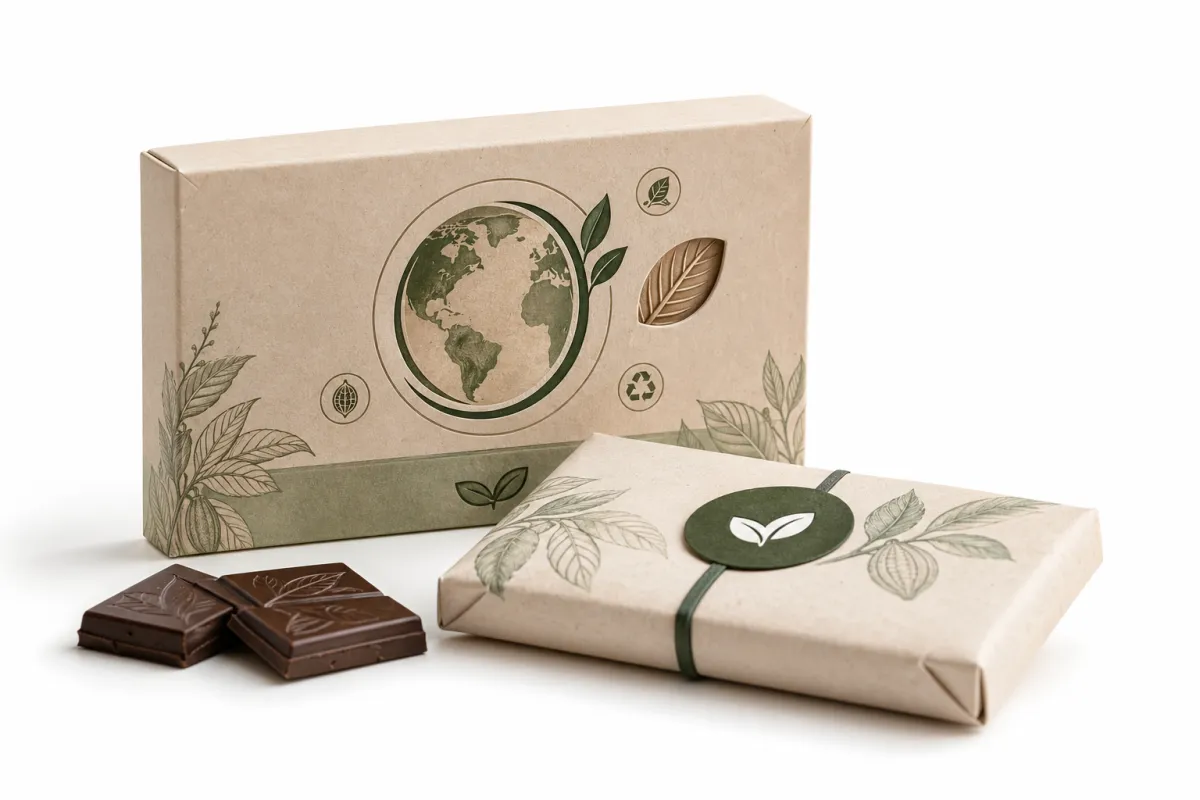
On a humid Tuesday at a converting line outside Kuala Lumpur, I watched a team pull 500 samples of a plant-based chocolate bar wrapped in a glossy compostable film that looked excellent under 5,500K inspection lights. The print registration was tight to within 0.3 mm, the seal looked crisp, and the client was thrilled until the cold-room test came back with channel leaks along the fin seal after 72 hours at 8 C. The issue was not the concept; it was the structure. Cocoa butter migration changed the seal behavior, and humidity exposed a barrier layer that was too thin for the route the product would actually travel. That is the practical reason sustainable packaging for vegan chocolate matters: ethics and aesthetics do not count for much if the pack cannot survive the trip from factory to shelf.
In practical terms, sustainable packaging means using less material where possible, choosing paperboard, paper, or film from responsible sources, and designing for a clear recovery route such as recycling or composting. The definition cannot stop there. A package that is theoretically greener but fails after 14 days in transit creates waste, returns, complaints, and spoiled inventory. I have seen a retailer in Birmingham reject a pallet of bars because the outer sleeves scuffed so badly in corrugated transit that the branding looked tired before the cartons even hit shelf. That is why sustainable packaging for vegan chocolate has to deliver protection first and then reduce impact with intent.
Vegan chocolate raises the bar in a very specific way. The audience often reads ingredient lists, checks for FSC certification, and asks whether the pack is recyclable or home-compostable before they ask about roast notes or origin. That level of scrutiny is healthy, but it also means sloppy claims get punished quickly. If the wrapper says one thing and the material system does another, shoppers notice. I have heard buyers say, straight to a supplier rep in Hamburg, "The bar is plant-based, but the carton feels like theater." That kind of feedback stings because it is usually right. Good sustainable packaging for vegan chocolate should make the product story feel honest from the outer sleeve down to the inner liner.
There is also the shelf-life angle, which too many branding conversations rush past. Vegan chocolate can be sensitive to fat bloom, odor pickup, and temperature swings, especially if the recipe uses nut pastes, oat solids, or coconut components that behave differently from standard dairy chocolate. A paper-based sleeve alone rarely solves that. The right system may need a barrier liner, a coated carton, or a mono-material film with measured oxygen transmission rates below 15 cc/m2/day and water vapor transmission rates below 1.5 g/m2/day, depending on the recipe. The smartest sustainable packaging for vegan chocolate projects start with those numbers, not with a mood board in a Soho studio.
"The first version looked beautiful, but the bars tasted stale after a cross-country shipment from Chicago to Denver. Once we adjusted the barrier and increased the seal width from 3 mm to 6 mm, the packaging finally matched the brand promise."
That quote came from a client who sold premium bars through both wholesale and DTC channels, and it captures the real balance. The package has to preserve flavor, communicate values, and hold up through factory handling, palletization, and retail display. If you can do that, sustainable packaging for vegan chocolate becomes more than a label claim; it becomes part of product quality itself. For teams building custom printed boxes or changing Custom Packaging Products, this is where the packaging design conversation should begin, because a 60g bar and a 120g tablet do not need the same structure.
How Does Sustainable Packaging for Vegan Chocolate Work?
The clearest way to think about sustainable packaging for vegan chocolate is from the outside in. Start with the paperboard sleeve or carton, then the inner liner or barrier film, then the adhesive, then the seal geometry, and finally the ink and coating system. A 350gsm C1S artboard carton with a water-based varnish behaves differently from a 250gsm kraft sleeve with a matte dispersion coating, and each layer influences recyclability, compostability, food protection, and retail appearance. A layer chosen in isolation can make the whole structure impossible to recover in a real waste stream or too fragile for shipping.
Paperboard cartons remain one of the most useful formats for vegan chocolate bars, especially when the brand wants a premium front face for graphics and regulatory copy. A carton can use FSC-certified board, soy or water-based inks, and a simple aqueous coating, then pair with a thin liner for grease control. That can be a strong route for sustainable packaging for vegan chocolate because it uses familiar materials and gives the shopper a tactile, high-value impression. I have seen it work well for 50g bars, 85g bars, and seasonal gift sets when the inner wrap stays minimal and the die-cut tolerance stays within 0.5 mm.
On the film side, the choice usually splits between mono-material recyclable structures and compostable films. Mono-material structures, often based on PE or PP, are easier to position for recycling where collection systems exist, and they can offer dependable seal performance and shelf-life stability. Compostable films can fit brands that want a lower-plastic story, but they need careful qualification because heat resistance, moisture control, and shelf stability vary widely from one supplier in Barcelona to another in Jiangsu. For sustainable packaging for vegan chocolate, I usually ask one question first: what end-of-life route can the customer actually use within 50 km of their home or warehouse? If there is no realistic pathway, the claim can become more marketing than substance.
The coatings and adhesives matter more than most designers expect. A beautiful matte finish can sabotage recovery if it uses a heavy barrier coating that a recycler cannot process cleanly, and a pressure-sensitive adhesive can contaminate a recycling stream if the glue is not chosen with the substrate in mind. I once watched a supplier negotiation in Shenzhen stall for 43 minutes over a tamper label because the client wanted a natural-finish kraft box, a soy-based ink system, and a seal that would not tear the fibers. Nobody in that room was having a good time, but the argument saved the launch from a very expensive mistake. That is the kind of detail that separates polished branded packaging from packaging that only looks sustainable on a PDF exported at 96 dpi.
Format changes performance too. A flow-wrapped bar behaves differently from a stand-up pouch, and both behave differently from a rigid carton. Flow wrap can be efficient on line speeds of 80 to 120 bars per minute, while a pouch may be better for resealability or larger family sizes, such as a 220g sharing pack. A rigid carton gives structure and gift appeal, but it adds material and shipping bulk. So the right sustainable packaging for vegan chocolate is not one universal answer; it is the format that fits the recipe, the channel, and the handling reality in places like Rotterdam, Austin, or Melbourne.
- Cartons work well for premium retail packaging, especially when the brand needs shelf presence and print detail on 350gsm to 400gsm board.
- Mono-material films suit bars that need a tight barrier and a clearer recycling story in curbside streams that accept flexible plastic.
- Compostable wraps can be effective when the target market understands the disposal route and the shelf-life requirement is moderate, such as 90 to 120 days.
- Hybrid systems often solve the hardest problem: protecting flavor while keeping the visible pack largely paper-based and under 18g total material weight.
One practical trick I use is to ask the supplier for the actual material stack, not just the marketing name. I want thickness in microns, seal initiation temperature, grease resistance data, and food-contact documentation before I approve a sample. That level of detail keeps sustainable packaging for vegan chocolate grounded in material science instead of vague green language. If a supplier cannot show the stack-up, the path is usually not ready for production. And if they get annoyed by the question, that is often the answer.
Key Factors That Shape the Right Pack
The first technical filter is shelf life. Vegan chocolate is vulnerable to fat bloom, odor pickup, oxidation, and temperature swings, and those problems are not abstract. A bar that sits on a truck at 32 C for six hours can lose its snap, especially if the barrier is weak or the pack has microscopic seal flaws. Good sustainable packaging for vegan chocolate starts by matching barrier performance to the way the product will actually move through the market, not the ideal scenario in a lab in Zurich. I wish that were less true. It is not.
Brand claims are the second filter, and they need discipline. Recyclable, compostable, plastic-free, and FSC-certified all mean different things, and each claim should be backed by documentation. On one client project in Bristol, the sales team wanted to say "plastic-free" because the outer carton looked fully paper-based, but the inner laminate told a different story. We rewrote the claim to match the structure and saved the launch from a much bigger correction later. That is the honest side of sustainable packaging for vegan chocolate: the story has to survive scrutiny from retailers, auditors, and customers who read the fine print.
Retail and e-commerce add different pressures. On shelf, the package needs blocking, brand blocking, and enough print contrast to stand out next to almond snacks, oat bars, and confectionery from mainstream brands. In DTC, the bar has to survive parcel sorting, drop impacts from 1.2 m, and temperature swings inside a courier network that might move a parcel from Berlin to Munich in 18 hours. A package that works in a boutique retail box may fail in a mailer, and vice versa. If you need both, think about how your Custom Packaging Products can support one core structure across channels without doubling your SKU count.
Food-contact compliance and traceability are non-negotiable. Ask for migration testing, material specifications, lot traceability, and a clear chain of custody for paperboard, inks, coatings, and adhesives. For paper-based components, FSC documentation is worth reviewing line by line, especially if you plan to reference certified sourcing in your package branding. For recycling claims, the EPA's guidance on recycling basics at EPA recycling resources is a useful reality check, because local acceptance matters as much as the claim printed on the carton. None of that makes sustainable packaging for vegan chocolate easy, but it does make it defensible in front of a retailer in Dallas or a certification body in Amsterdam.
There is also a practical brand question many teams underestimate: what does the package feel like in the hand? A 300gsm carton with a soft-touch coating communicates something very different from an uncoated 250gsm kraft sleeve, and both send different signals about price point and ethics. I have watched buyers in a London food hall pick up two bars with nearly identical recipes, then choose the one with tighter pack engineering because it felt more deliberate. That tactile judgment is part of sustainable packaging for vegan chocolate, whether we admit it or not. People do not just buy ingredients; they buy the feeling that somebody cared enough to finish the job properly.
"We thought the recycled look would sell itself. It did not. Once the carton structure, finish, and message lined up, the whole brand became easier to trust."
Sustainable Packaging for Vegan Chocolate: Cost and Pricing
Cost is where good intentions either get sharpened or drift away. The main drivers in sustainable packaging for vegan chocolate are substrate choice, barrier level, print coverage, special finishes, die cuts, converting complexity, and minimum order quantity. A simple one-color kraft sleeve will price very differently from a four-color laminated carton with foil stamping and a custom insert. The line item everyone forgets is often the one that bites hardest: qualification time. That is the sneaky expensive part nobody puts on the first slide.
For a 5,000-piece project, I have seen budgetary pricing move like this: a basic FSC paperboard carton with a simple inner liner around $0.15 per unit, a mono-material recyclable film wrap around $0.11 per unit, and a compostable wrapper closer to $0.29 per unit once the barrier and seal quality are brought up to retail standards. At 25,000 pieces, those numbers can drop to roughly $0.09, $0.07, and $0.18 respectively, depending on print coverage and finishing. These are planning numbers, not quotes from a specific mill in Dongguan, but they help teams understand why sustainable packaging for vegan chocolate can cost more at small volume and become much more efficient as the run grows.
Hidden pricing items matter too. Tooling can run $350 to $1,500 for a custom die or cutter set, prototype revisions can add one or two extra weeks, and print plates or cylinders may cost another $200 to $900 depending on the process. If you need certification support, expect another round of document review and testing. One customer once budgeted only for the cartons themselves and then discovered they still needed two sample rounds, a seal test, a drop test, and a corrected barcode panel before launch. That is not unusual. It is simply the true cost of sustainable packaging for vegan chocolate when quality and compliance are taken seriously.
The good news is that you can control cost without weakening the concept. Standardize sizes where possible so one board blank fits multiple bars. Reduce SKUs by using a common structure across flavors. Keep decoration lean, because a clean one- or two-color design often looks more confident than a crowded sheet full of special effects. And if the product allows it, choose a structure that keeps the material count low. In my experience, a smart packaging design team can save 8% to 15% just by trimming unnecessary complexity from the first round of artwork and structure, especially on runs of 10,000 to 20,000 units.
| Option | Typical Structure | Planning Cost at 5,000 Units | Best Fit | Main Trade-Off |
|---|---|---|---|---|
| Recyclable mono-material wrap | Single-film structure with strong seal zone, 50 to 60 microns | $0.11/unit | Retail bars with tight shelf-life needs | Less premium feel than a carton |
| FSC paperboard carton + liner | 350gsm C1S artboard, thin barrier insert | $0.15/unit | Premium retail packaging and gift bars | More components to manage in production |
| Compostable wrapper | Cellulose-based or certified compostable film | $0.29/unit | Brands with strong end-of-life messaging | Barrier and seal performance must be validated carefully |
| Hybrid carton + minimal wrap | Paperboard outer, slim protective inner, 2-layer build | $0.21/unit | Gift sets, seasonal SKUs, branded packaging | Requires tighter artwork and assembly control |
That table is a starting point, not a final bill of materials, but it gives a more honest view of sustainable packaging for vegan chocolate than the usual "eco" pitch deck. If you are comparing Custom Printed Boxes against lighter wrappers, remember that freight weight, pallet density, and retail readiness also affect the real cost. A carton that adds two cents at the unit level may still save money if it reduces damage by even 1.5% on a national rollout. I have seen that happen on a 40,000-unit shipment, and it is deeply satisfying when the math behaves for once.
Step-by-Step Process and Timeline
The smartest projects begin with a product and channel audit. I want the bar size, fill weight, ingredient list, shelf-life target, shipping method, target retail channels, and carton dimensions before I talk about materials. A 45g bar sold in a museum shop in Edinburgh has a very different packaging brief from a 120g family bar shipped in a corrugated mailer from a warehouse in New Jersey. That is why sustainable packaging for vegan chocolate should never be selected before the business model is clear.
Once the brief is set, move into material selection and sampling. Ask for three options that are realistic, not ten options that are glamorous. One should lean paper-based, one should lean recyclable film, and one should show what a compostable route would actually look like if the barrier is acceptable. Then test the samples with the real bar, not a dummy block. Measure seal strength, scuff resistance, moisture pickup, and fit. In my experience, the sample that looks slightly less impressive on day one often performs better after five days of storage at 24 C and one parcel test. That is the sample that deserves attention in sustainable packaging for vegan chocolate.
Creative and technical artwork should be built together. I have seen too many teams finish the branding first, then discover that the legal copy has no room, the barcode lands on a fold, or the disposal claim is too vague to print with confidence. Keep the package branding strong, but leave room for structure notes, traceability codes, and the marks required by your market. If the pack includes custom printed boxes, make sure the dieline is checked against the actual product thickness and machine tolerances, not only a concept drawing. A perfect-looking mockup in Figma is not the same thing as something that folds up at speed on a line in Leeds.
For time planning, I usually map a project like this:
- Brief to sample: 7 to 14 business days for standard materials, longer if a new barrier is sourced from a mill in Fujian or Lombardy.
- Sample to prototype: 5 to 10 business days, depending on print setup, cutter availability, and seal adjustments.
- Prototype to approval: 3 to 7 business days if testing passes on the first round and the barcode scans correctly.
- Approval to production: 12 to 15 business days from proof approval for a normal run, or 18 to 22 business days if custom coatings or inserts are involved.
That schedule can stretch if you need certification paperwork, a fresh FSC review, or a second sealing round after the first prototypes. When I worked with a bean-to-bar client in Vancouver, we lost nine business days because the inner liner passed visual inspection but failed odor transfer testing on mint bars stored at 25 C. Nobody loved that delay, but fixing it in development was far cheaper than recalling 20,000 units. Good sustainable packaging for vegan chocolate protects the launch calendar by forcing those problems into the open early. Annoying? Yes. Cheaper than a recall? Also yes.
If the product is heading into DTC, build in extra time for parcel testing. If the product is heading into cold distribution, add time for condensation checks and dew-point monitoring. If the bar will travel internationally, you need another layer of diligence around labels, country-of-origin marks, and disposal language. The process sounds longer because it is longer, but that is exactly how you avoid waste later. A disciplined schedule is part of sustainable packaging for vegan chocolate, not a separate administrative chore.
Common Mistakes to Avoid
The first mistake is making claims before the paperwork is ready. A beautiful label with "compostable" or "recyclable" on it does not prove anything if the supplier cannot provide certification, test data, or a clear material declaration. I have seen brand teams get excited by a sample and then discover, two weeks later, that the adhesive or coating made the claim hard to defend. In sustainable packaging for vegan chocolate, claims should always follow evidence, not the other way around.
The second mistake is choosing the greenest-looking material even when it cannot protect the chocolate. This is the fastest way to lose customer trust. A wrapper that allows fat bloom, odor pickup, or corner splits may feel virtuous for a moment, but customers only remember the stale bite and the damaged bar. I once reviewed a 60g hazelnut vegan bar that looked elegant in a paper sleeve, then arrived with oily spots and broken corners after a three-day truck run from Milan to Lyon. The team had to redesign the package from scratch. Good sustainable packaging for vegan chocolate should preserve quality first, because a spoiled product is not sustainable in any meaningful sense.
The third mistake is mixing too many materials without a recovery plan. A carton with a plastic window, a metallized film, a foil seal, and a wax label may be technically possible, but it can become impossible to recycle cleanly. Even when each part looks eco-friendly on its own, the assembly can create a sorting problem. If your end-of-life goal is recycling, keep the architecture simple. If your goal is composting, make sure every component supports that path and that the customer can actually access it. That discipline is central to sustainable packaging for vegan chocolate.
The fourth mistake is skipping real-world testing. Factory success does not guarantee shipping success. I always recommend a minimum set of tests: cold storage at 4 C, warm transit at 32 C, drop resistance from 1 m, seal performance, and visual scuff checks after corrugated handling. If the product is DTC, add vibration simulation or parcel drop testing. The best teams understand that a warehouse pallet in Phoenix and a consumer doorstep in Portland are different environments. When a supplier asks whether tests are really necessary, I usually answer with one number: 1 damaged pallet can erase the savings from a 10,000-unit material decision.
The fifth mistake is ignoring line speed and machine behavior. A wrapper that seals beautifully at 20 packs per minute may become troublesome at 80 packs per minute if the fin seal requires too much dwell time. That matters on production days, because line slowdowns cost labor, cartons, and tempers. Good sustainable packaging for vegan chocolate has to run cleanly, not just look good on a sample bench. I have seen operators stare at a jammed web for ten minutes with the exact expression you get when the machine decides to have its own opinion. Nobody enjoys that moment.
Expert Tips and Actionable Next Steps
My first tip is simple: choose one primary end-of-life goal and design for that goal before you start decorating. If the project is going to be recyclable, make the structure as close to a straightforward recovery stream as possible. If the project is going to be compostable, verify that the barrier, inks, and adhesives all support that route and that the customer can actually use it. Trying to satisfy every sustainability claim at once usually creates a pack that is harder to explain and harder to trust. That is a trap I have seen many teams fall into while building sustainable packaging for vegan chocolate.
My second tip is to ask suppliers for data, not adjectives. Request barrier values, food-contact statements, sample kits, chain-of-custody records, and certification documents before you compare options. A well-organized supplier folder saves hours of debate. For paperboard, I also like to see FSC documentation early, because it anchors the sourcing conversation and keeps the team focused on material proof instead of marketing gloss. If you are comparing branded packaging structures, that evidence will help you Choose the Right path faster.
My third tip is to run a pilot launch. Start with one SKU, one fill weight, and one region, such as 5,000 bars in the Pacific Northwest or 8,000 bars across North Rhine-Westphalia. Measure waste, returns, customer comments, and line efficiency for at least 30 days. I have seen a pilot reveal a scuff issue on a navy carton, a barcode problem on a pale kraft sleeve, and a seal weakness that only appeared in humid storage. Each time, the pilot saved money because the fix happened before a national rollout. That is the practical value of sustainable packaging for vegan chocolate: it gives you room to learn before scale makes every mistake expensive.
My fourth tip is to keep the visual system lean and intentional. Strong packaging design does not need five foils, three varnishes, and a crowded illustration to feel premium. A single bold typeface, a restrained ink palette, and a well-built structure can make a bar feel more considered than a noisy design packed with decorative extras. In many cases, the best sustainable packaging for vegan chocolate is also the simplest to print, the easiest to assemble, and the easiest to explain on shelf in a 90-second buyer meeting.
Here is a straightforward action checklist I would use with a client team before ordering production:
- Confirm the target shelf life and shipping route for the bar, including summer transit temperatures above 30 C.
- Choose the primary sustainability claim and the proof behind it, with certificates dated within the last 12 months.
- Approve the material stack, seal method, and print finish, including board weight and film thickness.
- Validate the artwork, legal copy, and barcode placement on the actual dieline at 100% scale.
- Test the final sample in heat, humidity, and parcel handling before releasing a 10,000-unit run.
- Lock the production schedule and release the order only after sign-off from brand, compliance, and operations.
If you need a place to start with formats, structures, and retail-ready options, our Custom Packaging Products page is a useful reference point, especially if you are comparing custom printed boxes, cartons, sleeves, and other product packaging builds. The right pack is the one that fits the product, the channel, and the brand story without forcing any one of those three to carry the whole load. That is why I always come back to sustainable packaging for vegan chocolate as a systems question, not a single material choice.
If you want the shortest honest version from someone who has stood next to the line, argued with suppliers in Shenzhen and Ghent, and watched good bars fail because the wrapper could not keep up, it is this: sustainable packaging for vegan chocolate works best when you respect the chocolate first, the material second, and the story third. Get those in the right order, and the package will do its job in the warehouse, on the shelf, and in the customer’s hands.
Frequently Asked Questions
What is the best sustainable packaging for vegan chocolate bars?
The best option is usually the one that balances shelf life, brand goals, and local disposal systems, and that often means a recyclable mono-material structure or an FSC paperboard carton with a thin barrier liner. For a 50g or 80g bar, I would test both formats with the actual chocolate, because cocoa butter, humidity, and transit time can change the answer faster than most teams expect. For many brands, the best sustainable packaging for vegan chocolate is the one that performs cleanly and is easy for customers to understand at a glance in a shop or on a product page.
Is compostable sustainable packaging for vegan chocolate always a good choice?
Not always, because compostable materials only make sense when the barrier level is strong enough and the disposal route is realistic for your customers. If the film cannot handle 28 C heat, 65% humidity, or grease transfer, the product can suffer before the environmental benefit ever reaches the bin. I usually recommend compostable packaging only after the team has checked shelf-life data, customer access to composting, and the exact certification behind the claim. That keeps sustainable packaging for vegan chocolate grounded in facts rather than hope.
How much does sustainable packaging for vegan chocolate usually cost?
Cost depends on material type, print complexity, order volume, tooling, and certification needs, so small runs often cost more per unit than larger commercial runs. As a rough planning guide, a 5,000-piece project might land around $0.11 per unit for a mono-material wrap, $0.15 per unit for an FSC carton with a liner, or $0.29 per unit for a compostable wrapper with stronger barrier requirements. The cheapest option is not always the best value, because better protection and clearer brand perception can reduce waste and improve sell-through for sustainable packaging for vegan chocolate.
How long does it take to develop sustainable packaging for vegan chocolate?
A simple project can move from brief to approved production in a few weeks, while custom structures with testing, compliance checks, and certification review can take much longer. A realistic timeline often includes 7 to 14 business days for samples, another 5 to 10 business days for prototype revisions, and 12 to 15 business days from proof approval to production on a standard run. Building time for samples, revisions, and supplier review into the schedule early helps keep sustainable packaging for vegan chocolate on track.
How do I prove my packaging is truly sustainable?
Ask for supplier documentation such as material specifications, chain-of-custody records, certification files, and any relevant compostability or recyclability proof. If possible, use third-party testing or a clear lifecycle assessment so your claims are supported by evidence rather than marketing language alone. That kind of file trail makes it much easier to defend sustainable packaging for vegan chocolate with retailers, auditors, and customers who want specifics instead of slogans.
When the material stack, test data, artwork, and production plan all line up, sustainable packaging for vegan chocolate stops being a debate and becomes a practical advantage: the bar tastes right, the brand feels honest, and the pack does exactly what it is supposed to do.


