Buyer Fit Snapshot
| Best fit | To Export Packaging Cartons projects where brand print, material claims, artwork control, MOQ, and repeat-order consistency need to be specified before quoting. |
|---|---|
| Quote inputs | Share finished size, material target, print colors, finish, packing count, annual reorder estimate, ship-to region, and any compliance wording. |
| Proofing check | Approve dieline scale, logo placement, barcode or warning zones, color tolerance, closure strength, and carton packing before bulk production. |
| Main risk | Vague material claims, crowded artwork, missing packing details, or unclear freight terms can make a low unit price expensive after revisions. |
Fast answer: To Export Packaging Cartons: Board, Finish, Dieline, and Unit Cost should be specified like a repeatable production item. The safest quote records material, print method, finish, artwork proof, packing count, and reorder notes in one written spec.
Production checks before approval
Compare the actual filled-product size with the drawing, then confirm tolerance on folds, seals, hang holes, label areas, and retail display edges. Reserve space for logos, QR codes, warning copy, and material claims before decorative graphics fill the panel.
Quote comparison points
Review material grade, print process, finish, sampling route, tooling charges, carton quantity, and freight assumptions side by side. A quote is only useful when the supplier can repeat the same color, closure quality, and packing count on the next order.
Guide to Export Packaging Cartons: Costs, Timeline, Tips
The first time I watched a shipment fail in person, the cartons looked spotless on the warehouse floor in Dongguan, Guangdong. Fresh print, sharp corners, clean tape lines, and a neat 1,200-carton pallet stack gave no hint of trouble. Twelve hours later, in a humid container yard outside the Port of Yantian, the bottom rows had softened, the corners curled, and the stack leaned like it had lost its patience with the weather. That is the real lesson behind a guide to export packaging cartons: a box that looks perfect in a packing room can turn into a very expensive problem at sea. If you are buying Custom Packaging Products, the carton has to survive the route, not just the approval meeting.
Export cartons are not ordinary shipping boxes with a fancier name. They are built for stacking pressure, forklift contact, vibration, moisture, and the small disasters that happen between a factory gate in Shenzhen and a receiving dock in Rotterdam or Long Beach. The gap between acceptable packaging and weak packaging usually stays hidden at first, then shows up later in claims, repacks, damaged inventory, and the awkward email asking why a pallet arrived crushed at the corners. I have had buyers call after discovering that a "minor" carton issue turned into a warehouse headache across three shifts and 18 labor hours.
This guide to export packaging cartons is about risk control as much as it is about money. A carton spec that adds $0.18 per unit on a 5,000-piece run can save $1,500 in damage claims and a full week of labor when the alternative is a repack line, insurance paperwork, and angry calls from the buyer in California or Hamburg. I have seen that trade more than once, usually after someone tried to save pennies and paid for it in freight, labor, and reputation. The box is one of the most underappreciated parts of a product launch, and buyers who treat carton selection as part of product margin make better decisions than the ones who leave it until the end of packaging design.
Guide to Export Packaging Cartons: What They Really Are
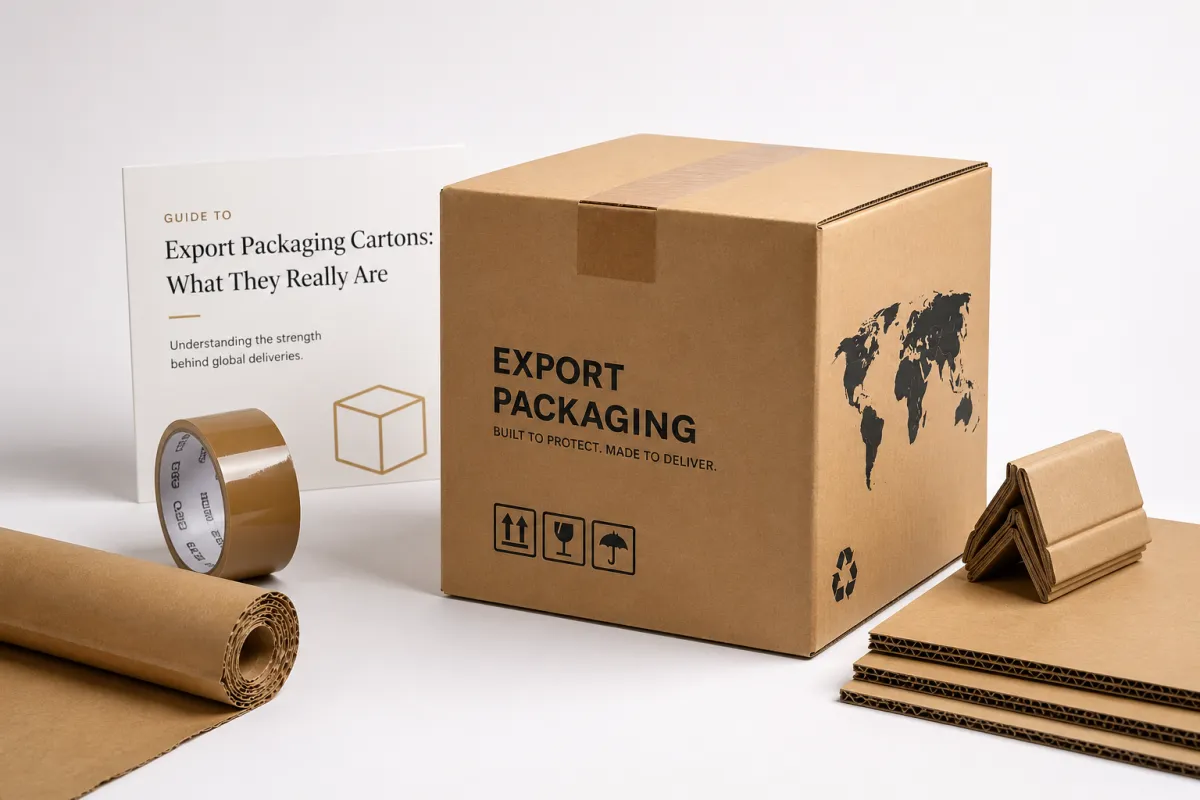
A guide to export packaging cartons starts with plain language. An export carton is a corrugated box designed to protect goods across long transit lanes, multiple handoffs, and rough real-world handling. It is not the same thing as a retail carton, which is meant to sell the product on a shelf in a Seoul department store or a Paris pharmacy. It is not always the same thing as a domestic shipper either, because export routes tend to punish the box harder, and for longer, than a local delivery ever will. I still remember a supplier in Foshan telling me, with full confidence, that their domestic spec was "basically the same." It was not basically the same. Not even close.
Think in layers. Retail packaging handles shelf appeal, brand story, and the consumer's first touch. Transit cartons are built for movement inside a country or a controlled warehouse loop. Export-grade cartons sit one step tougher than that. They are made to carry weight, resist humidity, and hold shape after being stacked inside a container for 21 to 35 days. That is why the best guide to export packaging cartons talks about board grade, flute structure, closure method, pallet pattern, and adhesive performance instead of stopping at print quality. If the board and glue are wrong, the prettiest artwork in the world just becomes an expensive sticker on a failure.
I once walked a floor in Shenzhen where a cosmetics client had specified a beautiful printed outer carton with a soft-touch finish and a deep navy logo panel. It was a gorgeous box, built around a 350gsm C1S artboard sleeve wrapped over a corrugated shipper, and it would have looked excellent on a boutique shelf in Singapore. It was also the wrong box for the route they had chosen. The shipment was heading into Southeast Asia, transit time was long, and the container sat in a wet yard after a storm rolled through. The board absorbed moisture, the glue softened, and the bottom tier collapsed under the weight above it. The buyer thought they had ordered premium branded packaging. What they actually bought was a future claim. I had to bite my tongue that day, which, frankly, was hard because the box had failed in exactly the way the route had warned us it might.
That is why a guide to export packaging cartons has to explain supply-chain placement. The carton gets filled at the warehouse, sealed before pickup, stacked on pallets, loaded by the freight forwarder, checked at customs, and handled again at destination. If any one of those links is sloppy, the carton pays for it. The box is not glamorous, and it is not supposed to be. It is a working part of the shipment, the part everybody notices only after it fails, which is a terrible way to build a reputation, by the way.
"The carton was fine in the meeting room. It failed in the container." I have heard that sentence from frustrated buyers more than once, usually after a 28-day ocean move through Yantian, Singapore, and Felixstowe, and the root cause was usually the same: someone optimized for looks, not for the route.
When buyers ask me for a guide to export packaging cartons, I tell them to define the box by its worst day, not its best day. If the route includes humidity, transshipment, or rough warehouse handling, design for that. If the product is light but fragile, do not assume light weight means easy packaging. A 250 g glass cosmetic jar can crush just as easily as a 12 kg appliance part if the board and inserts are wrong. The outer box is not a sleeve around the product; it is part of the protection system, and a good spec should say so in exact terms, not hopeful ones.
If your team also manages retail packaging, that is fine. Just keep the two jobs separate. Retail packaging may need a premium print system, a display window, or a finish built to impress a shopper. Export cartons usually need a different mindset: stronger corrugated board, tighter spec control, and fewer creative surprises. That is the practical side of package branding. The brand still matters, but the carton has to function first, and that means a little less ego and a little more engineering.
How Guide to Export Packaging Cartons Move Through Shipping
A realistic guide to export packaging cartons follows the box from idea to destination. First comes the brief. Then the spec. Then samples. Then approval. Then production. Then packing, palletizing, export paperwork, transit, and final unloading. Every stage can improve the carton or damage it. If the dimensions are wrong at the start, the whole chain inherits the mistake, and the rest of the process spends its time working around a bad decision. I have seen this play out so many times that I can practically smell the problem before the carton even leaves the factory in Suzhou.
Shipping mode changes the rules. Ocean freight is brutal in a slow, boring way. Air freight is faster, yet rough handling still happens in cargo terminals and at transfer points. Trucking creates vibration and compression on pallets, especially if the load is dense or badly stacked. A guide to export packaging cartons that ignores transport mode is only half a guide. I learned that the hard way after a client insisted a carton spec that worked on domestic truck runs from Tianjin to Beijing would be "good enough" for a 30-day ocean route. It was not good enough. It was cheap in the wrong place, which is the kind of cheap that comes back to haunt you later.
Here is the chain I use with clients:
- Confirm product dimensions, weight, fragility, and surface finish.
- Choose the carton structure, flute, and board grade.
- Build a sample and test fit the product, inserts, and closure.
- Lock artwork, shipping marks, and pallet count.
- Run production, then inspect the finished cartons before dispatch.
- Coordinate with the freight forwarder so the carton spec matches the route.
That sequence sounds straightforward because it should be straightforward. The trouble usually starts between steps two and four. Someone changes a product insert late. Someone measures the product and forgets the polybag or the tamper seal. Someone assumes the pallet footprint will be "close enough." A good guide to export packaging cartons drags those details into daylight before the order is locked and the factory has already cut the board. The board mill in Guangdong will not care that somebody had a "quick update." It will just cut what was approved.
I remember a client in Columbus who measured the jar itself but forgot the foam ring and the shrink band. The carton looked right on paper, yet the final pack was 14 mm taller than expected. The pallets overhung the edge by 22 mm, which triggered a freight rework charge of $180 before the shipment even left the dock. Small mistake, large inconvenience. That is how export programs go off the rails. Not with one giant explosion, usually, but with a dozen annoying little oversights that pile up like bad weather over the Bohai Sea.
Timing matters just as much as geometry. A carton that survives 20 minutes in a loading bay can still fail after 20 days at sea. Export cartons live through container vibration, port delays, moisture swings, and hot metal floors inside a yard that has no interest in being gentle. In one supplier meeting in Dongguan, a board rep told me, with a straight face, that "the carton will be fine if the customer is organized." Nice try. The carton does not care how organized anybody is. I nearly laughed, which would have been rude, but sometimes a ridiculous comment deserves a little internal mockery.
For route-sensitive programs, I like to compare the spec against a transit test. The ISTA test standards are a good reference point for that discussion, especially if your route runs through humid hubs like Port Klang or long inland stretches through Haryana or Jiangsu. A test does not promise perfection. It does turn opinion into evidence, which is useful when procurement wants a lower price and logistics wants fewer claims. Those two departments rarely speak the same language unless you put a failure photo on the table, and that usually gets everyone’s attention.
The supply chain also has to talk to itself. Suppliers, freight forwarders, warehouse teams, and brand owners should agree on the carton before production starts. That sounds obvious, and that is usually why people fail to do it. A strong guide to export packaging cartons works as much like a communication tool as a packaging one. If the spec lives in three email threads, one PDF from Ningbo, and a blurry spreadsheet, somebody will eventually ship the wrong thing and then act shocked about it.
What Makes a Guide to Export Packaging Cartons Perform Well?
The heart of any guide to export packaging cartons is performance. Board grade, flute type, wall construction, and compression numbers matter because they tell you how the carton behaves under load. Single-wall board can work for lighter goods. Double-wall becomes useful when the product is heavier, the stack is tall, or the route is rough. If the route is ugly enough, triple-wall is not excessive. It is honest. I say that with some affection for honest packaging, because packaging that tells the truth saves everybody a headache later.
Keep the technical side clear. ECT, or Edge Crush Test, tells you how much vertical stacking force the board can handle. Burst strength tells you how well the board resists puncture and rupture. Flute type affects cushioning and stiffness. None of those numbers is magic on its own. A useful guide to export packaging cartons looks at the whole picture, not one figure copied from a quote sheet. I have seen too many teams fall in love with one number and forget the rest of the story, especially after seeing a glossy spec from a supplier in Xiamen or Wenzhou.
Product weight is the first filter. Shape is the second. Fragility is the third. A 250 g cosmetic set, a 3 kg glass jar, and a 25 kg spare-parts kit do not need the same carton construction. That should be obvious, yet I still see buyers use one template across all three because "the size is similar." Similar is not enough. Similar is how you end up with corner crush, internal movement, and a carton that bows when the stack gets high. Nobody wants a shipment that looks like it is slowly melting toward the floor.
Humidity is the silent killer. In a dry warehouse in Suzhou, a carton can look stronger than it really is. In a humid port in Ho Chi Minh City, the board softens, glue lines weaken, and print can rub. During a factory visit near Yantian, I watched a pallet stand perfectly for an hour inside the plant. After loading, it sat in open air for half a day while the truck was delayed. The top tier lost stiffness fast. That one delay was enough to change the spec for the rest of the program. I was annoyed, the client was annoyed, and the carton was, as always, doing exactly what physics told it to do.
Route risk matters just as much as the board. A carton heading through a hot, wet transshipment hub needs a different build from one moving from a controlled inland warehouse in Chengdu to a nearby port. A practical guide to export packaging cartons should always ask how many transfers the shipment will make, how much humidity the route sees, how many days it will spend in transit, and how much stack pressure the pallet will carry. If you do not ask those questions early, the route answers them for you later, usually in the form of broken corners and unhappy emails.
Print and finish choices matter too, but only where they affect function. Water-based inks are often fine. Heavy lamination can improve appearance, but it may raise cost without improving shipping performance. Soft-touch coatings look expensive, and sometimes they are, yet they do not automatically make the carton better for export. That distinction matters in product packaging and even more in export cartons, where the outer box has one job: protect the goods. I like good print as much as anyone, but I like a carton that survives the trip a lot more.
Compliance can shape the spec as well. Some buyers want recyclable materials. Others want FSC-certified board. If that matters for your market, ask the supplier early. The FSC certification guidance is the right place to confirm what the label means and what the chain-of-custody claim requires. A guide to export packaging cartons should include sourcing discipline, not just dimensions and print. If a claim matters to the market, it needs to be documented cleanly, not improvised later when somebody in sales suddenly remembers it.
Here is the short version I give clients before I quote:
- Weight: heavier products need stronger board and better compression resistance.
- Route: long humid routes need more protection than short controlled ones.
- Stack height: taller stacks need stronger ECT or burst specs.
- Handling: forklift moves and manual rehandling can crush weak corners.
- Branding: print should support the brand without weakening the carton.
That is the practical core of a guide to export packaging cartons. Know the load. Know the route. Know the failure point. Everything else is decoration, and decoration should never get to act like the main character.
Guide to Export Packaging Cartons: Cost and Pricing Factors
Price is where a lot of buyers get careless, so a good guide to export packaging cartons has to deal with money directly. Carton cost is driven by size, board quality, print complexity, quantity, inserts, coatings, and whether you need test reports or custom tooling. The box itself is only part of the bill. Samples, plate charges, freight, and inspection can sit around the edges like unpaid cousins waiting to be noticed. I have had more than one client blink at a quote because those "small extras" were hiding in the fine print, which is exactly where trouble likes to live.
The basic math is simple. Small runs cost more per unit. Big runs spread setup costs across more cartons. That never really changes, yet people still act surprised when a 1,000-piece order comes in much more expensive per box than a 10,000-piece run. A guide to export packaging cartons that ignores quantity is not helping anybody. If your SKUs are stable, standardizing sizes usually saves real money and cuts down on warehouse confusion. It also saves the poor warehouse team from guessing which box goes with which product, which, trust me, nobody enjoys.
| Carton Option | Best For | Typical Spec | Unit Price at 5,000 pcs | Lead Time |
|---|---|---|---|---|
| Plain single-wall export carton | Light goods, low print needs | 32 ECT, kraft finish, water-based glue | $0.15-$0.22 | 10-12 business days |
| Printed export carton with insert | Branded packaging, moderate protection | 32 ECT, 1-color print, die-cut insert | $0.78-$1.05 | 12-15 business days |
| Double-wall export carton | Heavy, fragile, or humid routes | 48 ECT, moisture-resistant coating, reinforced corners | $1.25-$1.80 | 15-20 business days |
Those numbers are practical, not fantasy. They shift with carton size, board mill pricing, and print area. They also shift with supply chain stress. I have seen the same spec move by 9 percent because a board mill in Hebei changed availability and a client in Munich insisted on a one-week rush. That is why a good guide to export packaging cartons separates unit price from tooling, sample cost, and freight instead of burying everything in one vague quote. Vague quotes are how people convince themselves they are saving money while quietly spending it somewhere else.
Here is the negotiation story I still use as an example. At a board meeting in Dongguan, I pushed a supplier to upgrade a carton from 28 ECT to 32 ECT. The increase was $0.18 per unit on a 5,000-piece run. The client hated the extra spend for about six minutes. Then we calculated the risk. One damage claim on that program would have cost more than $1,500, and that did not include repack labor or the time lost while the line sat waiting. The upgrade won. That is what a smart guide to export packaging cartons should do: compare the carton cost to the cost of failure. Price matters, yes, but so does the slightly embarrassing moment when a container full of goods arrives looking like it lost a fight.
Hidden costs are everywhere if you do not look for them. Oversized cartons waste freight space. Weak cartons can trigger product damage claims. Fancy finishes can add cost without improving shipping performance. Overprinting can raise complexity and slow the run. This is where Custom Printed Boxes can help or hurt. They help when the print supports the brand and the structure stays strong. They hurt when the print department wins an argument the logistics team should have settled first, which happens more often than anyone wants to admit.
Buyers also forget the cost of bad decisions on warehouse operations. If carton sizes vary too much, you pay in storage chaos, pallet inefficiency, and extra labor. If the dimensions are sensible, the warehouse packs faster and the freight forwarder gets cleaner cubes. That is part of the economics of package branding: the box should carry the brand and keep the operation tidy. I think that balance gets missed too often because people assume branding only lives on the outside. In reality, it lives in the entire workflow, from Ningbo carton cutting to the final pallet wrap in New Jersey.
For companies building a broader packaging program, I usually point them to Custom Packaging Products and tell them to compare the export spec against their retail packaging needs. Sometimes one carton family can serve both. Sometimes it cannot. The important part is to stop pretending all boxes are interchangeable. They are not. If they were, I would have a much less interesting job, and a lot fewer stories about crushed corners and broken corner posts.
If you want a quick pricing checklist for your guide to export packaging cartons, use this:
- Ask for unit price, tooling, samples, and freight as separate lines.
- Confirm the board grade and ECT or burst spec in writing.
- Check whether inserts, coatings, or print plates are extra.
- Compare landed cost, not just carton price.
- Ask what happens if you increase quantity by 20 percent.
That last question matters. Volume often unlocks better pricing faster than arguing over pennies. I have watched a buyer fight for a 2-cent reduction while ignoring a larger savings opportunity in carton consolidation. That is the sort of thing that makes procurement people look busy and makes supply chain people sigh. I say that with affection, mostly, because I have been on both sides of the table and neither side gets to pretend it is always right.
Step-by-Step Process and Timeline for Export Cartons
A reliable guide to export packaging cartons has to cover timing, because timing is where good plans go to die. The timeline starts with requirements gathering. After that comes material selection, dieline review, sample build, approval, production, inspection, and dispatch. Each step can be smooth if the brief is clear. Each step can also drift if someone keeps changing dimensions after the sample is made. I have seen perfectly good schedules unravel because one person decided, a little too late, that the label needed to "feel more premium" for a launch in Singapore or Melbourne.
Plain cartons move quickly. Printed cartons take longer. New tooling adds time. Testing adds time. Late artwork adds time. It is not complicated, just inconvenient. A realistic guide to export packaging cartons should tell people that a custom box is not a "tomorrow" item unless the spec is already settled and the factory has stock board on hand. If someone promises a rush without checking board inventory in Dongguan or Ningbo, I start looking for the catch.
Typical lead times I quote look like this:
- Plain export cartons: about 7-12 business days after spec approval.
- Printed cartons: about 12-15 business days from proof approval.
- Double-wall or tested cartons: about 15-20 business days, sometimes longer if new tooling is needed.
That timeline depends on sample approval speed. If the customer takes four days to reply to a dieline, the clock does not stop. I had one beauty client delay proof approval for six business days because three departments wanted to review branding. The carton itself did not care about the branding meeting. The freight booking did. That is why a good guide to export packaging cartons needs a human calendar, not just a production chart. Paper timelines are tidy. Real timelines include meetings, lunch breaks, and somebody who forgot to check their inbox.
There are ways to compress the schedule without gambling on quality. Approve the dieline early. Lock the product dimensions before sampling. Keep the quantity stable. Use one contact person for approvals. Do not rewrite artwork after plate making. Those are boring rules, which is exactly why they work. If you are building custom printed boxes for export, boring is often profitable. I know "boring" sounds unglamorous, but the warehouse tends to reward boring with fewer accidents and fewer Saturday shifts.
One thing I tell clients all the time: the carton order should land earlier than the product fill date. Not the same day. Earlier. If you wait until the product is packed and ready, you are already behind. A proper guide to export packaging cartons treats packaging as a lead item, not a last-minute accessory. The best programs I have seen always respect that simple reality, and the messy ones never do.
Here is the cleanest process I have used on export programs:
- Write the carton brief with product weight, dimensions, route, and carton count.
- Approve the structure and closure method.
- Review the sample against real product, not just a drawing.
- Confirm markings, pallet count, and shipping labels.
- Lock production, then inspect finished cartons before dispatch.
That is also where internal coordination matters. Sales, procurement, and logistics should not be making different promises. If one team wants premium retail packaging and another wants the cheapest shipper possible, the order gets messy quickly. A good guide to export packaging cartons keeps those expectations aligned before the invoice is issued and the carton line starts running. Otherwise, everyone ends up surprised, which is usually a sign that nobody actually agreed on the real goal.
For buyers who want a broader carton program, I usually recommend pairing the export spec with a look at Custom Packaging Products so the outer box, secondary packaging, and brand presentation do not fight each other. You do not need identical structures across every SKU. You do need a system that makes sense in production, in freight, and in the customer's receiving bay. That part is less glamorous than a shiny mockup, sure, but it is a lot more useful once the pallets start moving.
Common Mistakes That Break Export Packaging Cartons
The most common error in any guide to export packaging cartons is simple: people choose the carton by cost alone. They compare two quotes, grab the cheaper one, and hope the route behaves. Hope is not a packaging plan. It is how damage claims happen. If you are shipping through humid ports, rough handling zones, or long container dwell times, the cheapest carton is often the most expensive outcome. That is one of those truths that sounds annoying until it saves you a truckload of regret.
Another mistake is overprinting or overdesigning the box. Pretty is not the goal. Protection is the goal. I have seen teams add heavy artwork coverage, glossy finishes, and decorative layers to a carton that needed better glue and stronger corners. That is backwards. A smart guide to export packaging cartons keeps the design practical and spends money where it matters. I am all for a good-looking box, but not if it falls apart before it reaches the customer in Dubai, Toronto, or Busan.
Bad pallet patterns create their own damage. If the cartons do not interlock correctly, the load shifts. If the overhang is wrong, the edges crush. If the stacking height is too ambitious, the bottom tier bows. Simple mistake. Big mess. I saw one shipment of household goods lose half a pallet because the warehouse team stacked by eye instead of by pattern. The carton spec was not the only problem, but it was not innocent either. Cartons can only do so much when the pallet pattern is being improvised like a cooking show disaster.
Dimension errors are another classic. Teams measure the product and forget the insert, the wrap, the label, or the pallet footprint. The result is a carton that is technically correct and operationally useless. That is why every serious guide to export packaging cartons insists on a packed sample, not just a flat drawing. A drawing tells a story. A packed sample tells the truth. Those are not the same thing, and the truth is usually more expensive to ignore.
Communication failures make things worse. Sales promises one thing. Procurement orders another. Logistics discovers the mismatch after production starts. Then everyone wants a faster fix, which is code for "please make our mistake inexpensive." It never works out that cleanly. If the carton spec is wrong, the damage spreads into production, freight, and customer service. By the time someone finally says, "Can we just change it?" the answer is usually no, and the room gets very quiet.
Also, do not ignore closures and cushioning. Weak glue, sloppy taping, and poor internal inserts can ruin the outer carton’s job. The outer box is not a superhero. It needs the inside to behave. That is especially true in export programs where vibration and motion are constant on routes from Guangzhou to Savannah or from Chennai to Jebel Ali. A carton can only protect what it can hold still. I know that sounds almost too simple, but simple is often what gets skipped in the rush to ship.
Here is a blunt warning I give when people want the short version of a guide to export packaging cartons: the carton price is never the whole price. If a damaged shipment creates returns, rework, insurance claims, or delayed delivery penalties, the "cheap" box just became the most expensive item in the order. I would rather spend a little more upfront than spend a lot later explaining why half the load needs to be rebuilt by hand in a warehouse aisle at 7:30 a.m.
That is why I still push for samples every time. If a supplier will not show you a sample, or if they rush past testing, that tells you plenty. In my experience, the suppliers who respect the sample stage are usually the ones who respect the shipment too, because the same discipline shows up in the factory, the press room, and the loading dock. There is nothing mystical about it; they just care enough to check the details before the truck leaves.
Expert Tips and Next Steps for Export Cartons
If you want practical advice from a guide to export packaging cartons, start with testing. Ask for a sample, then test the packed box under the actual route conditions where possible. For fragile loads, I look for compression checks, drop tests, and transit simulation. Not because testing is trendy. Because a broken pallet costs more than a test report, and the report only looks expensive until the shipment is on the floor. I have never had a customer thank me for skipping the test, but I have had more than a few thank me after a test saved them from a very ugly week.
I also recommend a simple spec sheet. Keep it short, but keep it complete. Record the carton size, board grade, wall construction, closure method, carton count per pallet, handling marks, and target freight mode. That one page can save you from a dozen bad assumptions. If you make branded packaging decisions without a written spec, someone will eventually "remember" the wrong thing, and the wrong memory will become a production order. Human memory is wonderful for stories and terrible for dimensions.
Standardization helps too. Fewer carton sizes usually means better buying power, cleaner warehouse handling, and less confusion on the line. I know everyone likes custom everything, but custom is not a virtue by itself. A smart guide to export packaging cartons uses custom only where it solves a real problem. Otherwise, standard sizes win on cost, speed, and storage discipline. That is not a flashy opinion, but it has saved more shipments than a dozen pretty renderings ever will.
For high-value or fragile shipments, I ask for a supplier who can speak plainly about board mills, adhesive performance, and test results. If the conversation stays vague, that is a warning sign. If they can explain the difference between burst and ECT, and tell you why one route needs extra moisture resistance, you are probably talking to someone who has spent enough time on a factory floor in Dongguan, Ningbo, or Xiamen to know what actually fails. I trust that kind of specificity a lot more than vague optimism and a polished sales deck.
My final checklist is simple:
- Audit your current carton spec against the route risk.
- Request a revised quote with board grade and print separated.
- Ask for one sample before the next purchase order.
- Verify pallet count and labeling before shipment.
- Review whether your current guide to export packaging cartons is based on real transit needs or old habits.
If you are building a new export program, or cleaning up an old one that has gotten sloppy, start with the carton. It is the cheapest place to fix a shipping problem before it becomes a customer problem. That is the heart of a solid guide to export packaging cartons: protect the product, protect the margin, and make the shipment boring in the best possible way. Boring, in this case, is excellent.
If you are ready to turn that checklist into a working spec, write down the route, the product weight, the stack height, and the failure point first. Once those four things are clear, the rest of the carton decision gets a lot easier, and honestly, a lot less annoying too.
What is the difference between a guide to export packaging cartons and regular shipping boxes?
Export cartons are built for longer transit, heavier stacking, moisture exposure, and rougher handling. Regular shipping boxes can work for domestic moves, but a guide to export packaging cartons usually calls for stronger board, better glue, and tighter spec control because the shipment has more chances to fail. I like to think of it as the difference between a box that survives a quick errand from Suzhou to Shanghai and a box that survives a long argument with a container ship bound for Los Angeles or Antwerp.
How do I choose the right carton strength in an export packaging cartons guide?
Start with product weight, stack height, and route conditions, then match board grade and wall structure to the worst-case load. In a good guide to export packaging cartons, ECT or burst specs are the baseline, not the whole answer. If the route is humid or long, upgrade before damage forces the issue. I would rather have a slightly stronger carton than a slightly sorry phone call after delivery.
How much do export packaging cartons usually cost?
Pricing depends on size, board grade, print, quantity, and whether you need inserts or coatings. Small runs cost more per unit, and larger runs usually drop the unit price fast. A plain 32 ECT export carton can land near $0.15 per unit at 5,000 pieces in a Dongguan factory, while a double-wall carton with moisture-resistant coating and reinforced corners may run $1.25 to $1.80 depending on the route and board mill. A practical guide to export packaging cartons should always ask for a landed quote, not just a box price, because freight, samples, and tooling change the picture quickly.
How long does it take to produce export packaging cartons?
Plain cartons can move quickly once specs are approved. Printed cartons, new tooling, or testing will add time. The fastest projects are the ones where dimensions, artwork, and quantity are locked before production starts. On most runs, printed cartons are typically 12-15 business days from proof approval, while tested double-wall cartons can take 15-20 business days if the factory in Ningbo or Dongguan needs fresh tooling. That is the simple rule behind most guide to export packaging cartons schedules.
What labels and marks should go on export packaging cartons?
Add handling marks that match the product risk, such as fragile, this side up, and keep dry where relevant. Include shipment identifiers, carton count, product code, and destination details if your warehouse or customer requires them. A clean marking system is part of a good guide to export packaging cartons because it reduces handling mistakes and keeps the line moving. Nobody wants a pallet sent to the wrong zone because the label was placed like an afterthought, especially when a 40-foot container is already booked for Friday morning.


