Buyer Fit Snapshot
| Best fit | Cut Packaging Expenses Without Sacrificing Quality projects where brand print, material claims, artwork control, MOQ, and repeat-order consistency need to be specified before quoting. |
|---|---|
| Quote inputs | Share finished size, material target, print colors, finish, packing count, annual reorder estimate, ship-to region, and any compliance wording. |
| Proofing check | Approve dieline scale, logo placement, barcode or warning zones, color tolerance, closure strength, and carton packing before bulk production. |
| Main risk | Vague material claims, crowded artwork, missing packing details, or unclear freight terms can make a low unit price expensive after revisions. |
Fast answer: Cut Packaging Expenses Without Sacrificing Quality: Material, Print, Proofing, and Reorder Risk should be specified like a repeatable production item. The safest quote records material, print method, finish, artwork proof, packing count, and reorder notes in one written spec.
Production checks before approval
Compare the actual filled-product size with the drawing, then confirm tolerance on folds, seals, hang holes, label areas, and retail display edges. Reserve space for logos, QR codes, warning copy, and material claims before decorative graphics fill the panel.
Quote comparison points
Review material grade, print process, finish, sampling route, tooling charges, carton quantity, and freight assumptions side by side. A quote is only useful when the supplier can repeat the same color, closure quality, and packing count on the next order.
How to Cut Packaging Expenses Without Sacrificing Quality
If you are trying to figure out how to cut packaging expenses, the first surprise is usually not the carton price. It is the empty air inside the carton. I remember looking at a shipping report for a snack brand in a warehouse outside Columbus, Ohio, and thinking, “We are literally paying to ship bubbles.” We shrank one box from 14 x 10 x 8 inches to 12 x 9 x 7 inches, changed the specification from an oversized 32 ECT shipper to a right-sized 275# test-liner structure, and saved more than the team expected; the freight bill dropped by 19% on the next 2,400 parcels, which translated to about $1,860 in one billing cycle. That is the kind of detail that changes a budget, especially when you are shipping at scale through a converter, a folding-carton plant, or any supplier handling Custom Printed Boxes and product packaging. If you are serious about how to cut packaging expenses, the first pass should look at fit, freight, and labor together instead of treating them like separate problems.
People often treat packaging as a single line item, which is usually where the trouble starts. How to cut packaging expenses is really a question about six costs at once: materials, labor, storage, freight, damage, and rework. If one of those gets cheaper but another jumps 8% or 12%, the math gets ugly fast. I have watched a $0.11 carton become a $0.43 problem once return freight, two sheets of kraft void fill, and a 6% reshipment rate were added, and honestly, that kind of budget surprise is the sort of thing that makes procurement people stare at the ceiling for a while. A price that looks tidy on the PO can turn unruly by the time the package leaves a dock in Cincinnati or a fulfillment floor in Reno.
Most brands miss the obvious first. They chase a lower unit cost and ignore dimensional weight, pick time, and the extra 45 seconds a packer spends folding an oversized mailer while muttering under their breath. The fastest wins usually sit in plain sight, and they have nothing to do with downgrading quality. They have to do with fit, process, and discipline, plus a willingness to admit that the “good enough” box was never actually good enough. A packaging line running 1,800 orders a day can lose more money to inefficient motions than to board cost, which is why the tape gun and the carton spec should be reviewed together, not separately. If you are mapping how to cut packaging expenses, start with the steps that repeat thousands of times a month, because those are the steps that quietly eat margin.
How to cut packaging expenses: the hidden costs most brands miss
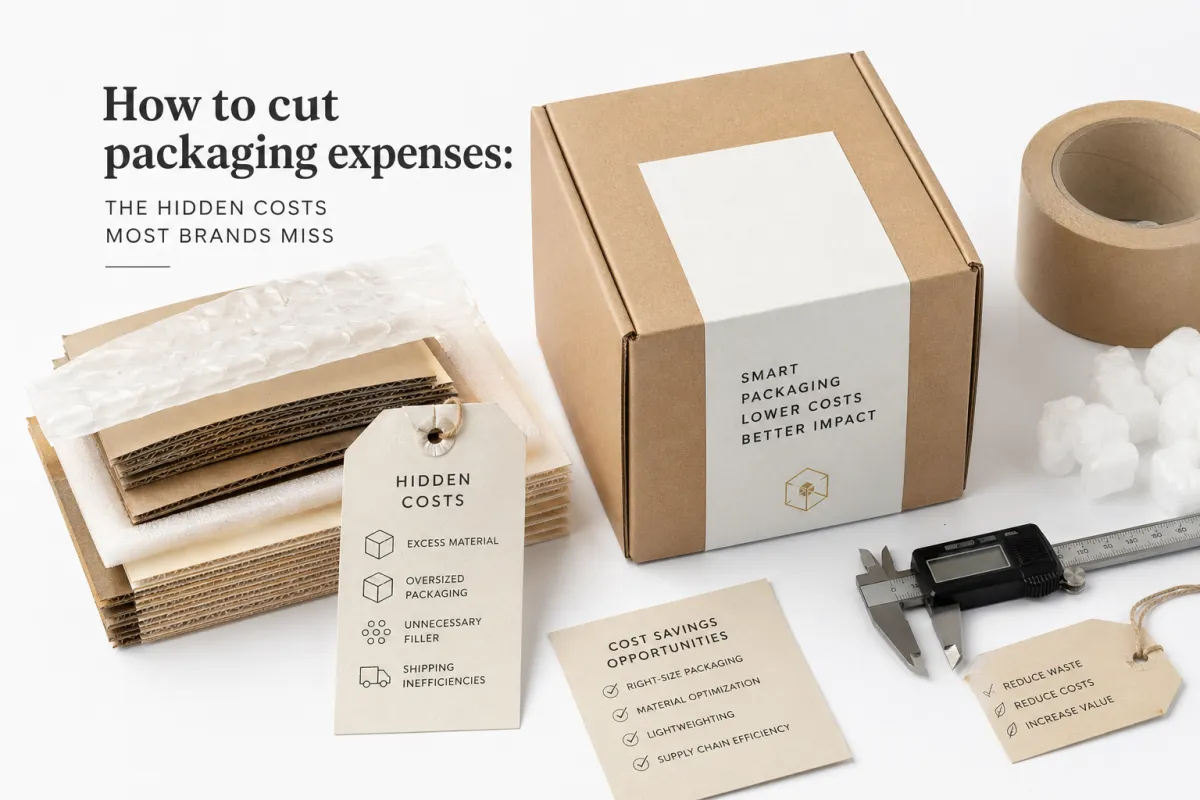
I still remember a client meeting in Columbus where the operations team swore the board grade was the problem. Their packaging looked expensive on paper, but the real leak was a carton that left 2.5 inches of empty space on every side of the product. Once we changed the box size and moved to a right-sized corrugated structure instead of a loose, overbuilt shipper, their parcel rate fell by $0.38 on average, and the void fill usage dropped by 31% in the first 30 days. That is why how to cut packaging expenses starts with the geometry of the package, not the label on the corrugated spec sheet. A crooked fit costs money in a dozen little ways, and those little ways add up faster than people like to admit, especially when the same SKU ships through Chicago one week and Dallas the next.
Packaging costs are broader than board thickness or print finish. Materials matter, yes, but so do labor minutes, warehouse cubic feet, inbound freight, storage, returns, and rework. If a packer needs an extra 18 seconds per order to assemble a complicated tray, that can cost more in a month than moving from a 32 ECT box to a slightly lighter alternative. This is part of how to cut packaging expenses that gets ignored because it is messy, and spreadsheet-friendly teams do not always like messy. I do, because messy usually means the savings are still hiding somewhere, often in plain sight beside a stack of half-used mailers or a pallet sitting in a corner of a 40,000-square-foot warehouse.
The first cuts are usually invisible. Oversized cartons trigger Dimensional Weight Charges, and dimensional weight charges can punish a brand even if the product itself is light. I have seen a 9 oz candle ship in a box that looked harmless on the worktable, only to get billed as if it weighed 6 lb because the carrier used the outer dimensions and a zone 8 rate from Louisville to Phoenix. Add another $0.06 to $0.12 for extra kraft paper or air pillows, and the “cheap” box becomes the expensive one. That is why how to cut packaging expenses should always include the carrier invoice, not just the purchasing invoice. Otherwise, you are comparing half the story to the whole bill, which is a lovely way to fool yourself.
“We thought the $0.04 board downgrade was the win,” one warehouse manager in Newark told me after a 6-week trial. “The real win was deleting 1.5 inches of dead space and cutting the packout time by 22 seconds.”
The goal is simple, even if the path is not: lower spend without weakening protection, slowing fulfillment, or making the unboxing experience look stripped down. For branded packaging and retail packaging, that matters twice. Customers do notice if a package feels flimsy, but they also notice when the process wastes material. Good package branding should feel intentional at 1 oz or 10 lb, and how to cut packaging expenses should preserve that feeling. I have a soft spot for the clean, well-thought-out package that arrives exactly as it should, because it tells me somebody in the building still cares, whether the job ran in Atlanta, Monterrey, or a plant in northern Illinois.
Here is the checklist I use on a first pass when a brand asks how to cut packaging expenses without risking quality:
- Fit first: reduce void space to under 10% whenever the product allows it.
- Measure damage: track the percentage of returns caused by transit breakage, not just total returns.
- Watch labor: time one pack cycle on 10 sample orders and average the result.
- Track freight: compare billed weight to actual weight on 25 shipments.
- Check storage: count how many pallet positions packaging inventory occupies each month.
That list looks simple, but simple is underrated. I have seen teams spend three weeks debating foil finishes while nobody bothered to count the pallet positions. The packaging budget was bleeding out in the back room, and everybody was staring at the label printer like it had committed the crime. In one case, a brand kept 14 months of oversized cartons on hand in a warehouse near Nashville, Tennessee, and paid nearly $900 a month just to store the wrong sizes while waiting for the right ones to run out.
How packaging costs actually work, from unit price to landed cost
Unit price is the headline. Landed cost is the truth. I have seen a procurement team celebrate a $0.29 mailer only to discover it cost $0.62 per order after inbound freight from Shenzhen, hand assembly in a Los Angeles fulfillment center, and 4.7% damage replacement were added. If you want a real answer to how to cut packaging expenses, you need the full stack: per-unit material cost, decoration, setup, freight, storage, and warehouse handling. The invoice is never the full invoice, if you know what I mean, especially once you add a 2% spoilage allowance or a $275 art charge that got buried in the quote.
A simple example makes the point. A stock carton might be $0.34 each at 10,000 units, while a right-sized custom printed box might be $0.31 each at 5,000 units because it ships flatter, packs faster, and uses less void fill. The sticker price looks backward. The landed cost can move in the opposite direction because the better format saves 12 seconds per order and trims dimensional weight by 0.6 lb. That is why how to cut packaging expenses should be judged per shipped order, not just per unit purchased. Otherwise, the cheapest quote turns into the priciest mistake, which is a very annoying little surprise when the accounting team closes the month.
| Packaging option | Example unit price | Warehouse impact | Typical risk | Best use case |
|---|---|---|---|---|
| Stock corrugated mailer, 32 ECT | $0.34 at 10,000 units | Fast to source, moderate pick time | Extra void fill on irregular products | Stable SKUs with similar dimensions |
| Right-sized custom printed box, E-flute | $0.31 at 5,000 units | Faster packout, lower dunnage use | Requires dieline approval and testing | High-volume direct-to-consumer orders |
| Folding carton with insert, 350gsm SBS | $0.58 at 5,000 units | More hand assembly, more touchpoints | Labor creep if line setup is sloppy | Retail packaging and shelf presentation |
That table is where the math gets interesting. A higher unit price can still be the cheaper choice if it saves 20 seconds of labor and cuts freight by 8%. In a supplier negotiation in Shenzhen, I watched a beauty brand move from a glossy two-color structure to a cleaner one-color print on 350gsm C1S artboard. The price dropped from $0.18 per unit to $0.12 per unit at 5,000 pieces, but the bigger gain was easier cartoning and less scuffing during transit to Seattle and Denver. That is the kind of trade-off that defines how to cut packaging expenses without weakening the brand, and honestly, I prefer that kind of practical decision to the “let’s add another finish because it sounds premium” routine.
For transit testing, I lean on the published methods at the International Safe Transit Association, especially when a package change could affect drop performance or compression. I also keep the EPA recycling and waste prevention guidance open when a team is trying to reduce material use and storage waste at the same time. Those references are useful because how to cut packaging expenses should never be based on guesswork alone. Guesswork belongs in a coffee break conversation, not on the packing line in a facility running 7,500 orders a week.
Here is the formula I use with finance teams, and it works better than arguing about carton cost in isolation: landed cost per order = packaging materials + print/setup + inbound freight + storage + pick/pack labor + damage/rework. If any one of those lines is missing, the answer to how to cut packaging expenses will be incomplete by definition. A brand can spend $1,200 less on cartons and still spend $3,500 more on labor if the new design is awkward. I have seen that exact mistake, and it has the same energy as buying a cheaper suitcase that breaks the first time you use the zipper, usually right after a 6 a.m. airport check-in in Dallas.
At this point, the conversation usually shifts from “What is the cheapest box?” to “What is the cheapest box that gets the order out cleanly, in 1 pass, with less than 2% damage?” That is the right question. That is also the question behind how to cut packaging expenses for brands buying Custom Packaging Products on a recurring schedule, whether the run is 3,000 units in Portland or 30,000 units from a facility in the Midwest.
Key factors that drive packaging spend up or down
The biggest driver is product fit. A bottle that is 3.25 inches wide behaves very differently from a 3.25 x 3.25 x 10.5 inch kit, even before you add padding. Weight matters too, because carriers price by actual weight and dimensional weight, and stackability matters because unstable cartons can crush at 4-high in storage. If you are serious about how to cut packaging expenses, you start by measuring product dimensions to the nearest 1/16 inch and confirming which side needs protection, not just which side looks largest. I know that sounds fussy, but so does paying for a broken item to be shipped twice from Memphis to Miami because the box was 3/8 inch too tall.
SKU count is the next pressure point. A brand with 18 packaging formats will pay more in storage, procurement time, and minimum order quantities than a brand that runs 5 smart formats. I have sat in meetings where the finance lead was shocked to learn that 11 low-volume packaging SKUs were consuming 2 full pallet positions and creating $800 a month in carrying cost. How to cut packaging expenses often means trimming format sprawl before trimming material thickness. Fewer formats usually means fewer headaches too, which is not a technical metric, but it absolutely should be. One packaging room in New Jersey had 27 active box sizes and 4 styles of inserts; by quarter’s end, half of them were still wrapped in plastic from the last forecast cycle.
Supplier terms can add or erase savings in one stroke. A 15,000-unit MOQ sounds efficient until the product changes in 90 days and 6,000 printed boxes sit idle. Lead time matters too, because rush orders frequently carry a 12% to 25% premium. If your replenishment plan is weak, how to cut packaging expenses becomes a game of paying more to fix planning mistakes. That is not a packaging problem alone; it is a scheduling problem, a cash-flow problem, and a forecasting problem, which is why I keep telling teams that packaging does not live on an island. A carton produced in Guangzhou or Tijuana still has to arrive on time, and “on time” usually means 12 to 15 business days from proof approval if the spec is already locked.
Branding and compliance add another layer. Some products need package branding that looks premium on a shelf, while others need straightforward product packaging that protects a subscription shipment from a 3-foot drop. The more rigid the branding rules, the narrower the savings window. I have seen brands insist on a metallic finish, spot UV, and embossing for items that sold mostly through e-commerce. The box looked great on a conference table, but it added 14% to total packaging spend. That is why how to cut packaging expenses requires a hard look at what the customer actually values, not just what the creative deck makes everyone nod at. A $0.07 matte varnish can be enough, especially if the box is still 350gsm and the graphics stay clean.
Standards matter here too. If your shipper needs to pass ASTM or ISTA testing, you cannot just shave materials until the box collapses. The same applies to FSC sourcing if you want responsibly sourced paperboard in the mix. A practical way to keep the conversation honest is to link design, protection, and sourcing together. For some teams, that is the moment they revisit custom printed boxes and rework the specification instead of the artwork. I tend to like that moment, because it means people are finally discussing the thing that ships instead of the mockup that looks pretty in a slide deck, usually after a 45-minute meeting in a downtown conference room with bad coffee.
I once worked with a consumer electronics brand that thought the problem was board grade. It turned out the real issue was stack height. Their cartons looked fine at 2-high, but the warehouse stored them 6-high for 18 hours before dispatch. The compression failures were not random. They were predictable. That is a useful reminder that how to cut packaging expenses depends on the whole route, from pallet to porch. Packaging can be perfectly designed and still fail if the real-world handling is ignored, which happens more often than anyone likes to admit in facilities from Indianapolis to San Bernardino.
Step-by-step timeline for reducing packaging expenses
Week 1 is about facts, not opinions. Pull 90 days of data by SKU: packaging type, unit cost, freight profile, damage rate, return rate, and the number of units shipped. If the team cannot answer those numbers cleanly, how to cut packaging expenses is not the first problem; data hygiene is. In one audit I did for a cosmetics brand, the packing line had 3 different carton codes for the same product because the system had never been cleaned up. That little mess was quietly draining money, which is very on-brand for operational chaos. We found one carton code used only 38 times in a quarter, yet it occupied shelf space in a 14-foot rack and confused the line team twice a week.
Week 1 should also include a physical walkthrough. Measure the product, the empty space inside the shipper, and the actual packout steps with a stopwatch. I like to time 10 orders and calculate the average. If packout takes 94 seconds for one SKU and 61 seconds for another, the gap is telling you something. That is often where how to cut packaging expenses becomes obvious enough to act on. You do not need a crystal ball; you need a tape measure and a person willing to watch the process without blinking. A 1/8-inch gap, a dull blade, or a badly placed insert can show up as a 20-second delay by the end of the shift.
Weeks 2 and 3 are for measurement and mapping. Confirm the exact product dimensions, photograph the current packout, and note where waste appears. Is the team pulling 2 sheets of void fill because the insert is too small? Is the mailer opening too wide, forcing a second piece of tape? Does the label peel because the carton surface is rough? Those details sound small, but a 7-second fix repeated 8,000 times a month is a real savings line. That is the practical side of how to cut packaging expenses, and it is usually where the “small” changes start looking very large. One client in Phoenix trimmed a tape application step and saved almost 15 labor hours in 30 days.
Weeks 4 to 6 are for prototyping. Test a smaller carton, a simpler insert, or a standardized mailer format. Run drop tests, vibration tests, and compression checks, then ship a controlled batch of at least 100 units to real addresses. If possible, compare 2 options side by side, because how to cut packaging expenses should be validated with transit data, not only bench testing. Nothing humbles a team faster than a package that passes the lab and then gets wrecked by a routine carrier transfer hub in Indianapolis, especially after a clean 12-foot drop test in the sample room.
Here is the rhythm I recommend in a project plan:
- Audit: build the baseline in 5 business days.
- Measure: verify dimensions and pack time across 10 sample orders.
- Prototype: test 2 to 3 options with real carriers and real packaging tape.
- Launch: switch the winning format on a single SKU or a single channel first.
- Review: check cost, damage, and labor after 30 days and again after 90 days.
After the rollout, month 2 and beyond is about control. Track savings monthly, because the first result is rarely the final result. I visited a fulfillment center in New Jersey where a packaging change saved $0.09 per order in the first month, then another $0.04 once the team removed one extra motion from the line. That is why how to cut packaging expenses is more of a process than a purchase. If you stop watching too soon, the old habits creep right back in, and they do it with the smug confidence of a cat knocking something off a shelf in a 3:00 p.m. shift change.
Common mistakes that erase packaging savings
The biggest mistake is cutting material thickness before testing performance. A switch from 32 ECT to a lighter spec can look wise in purchasing, but one damage spike can wipe out 6 months of savings. I have seen a brand save $0.03 per unit and lose $7,800 in replacements because the new carton failed under a stack load of 60 lb for 10 hours in a humid warehouse near Savannah, Georgia. If you are asking how to cut packaging expenses, do not make the first move a blind downgrade. That kind of move feels smart for about three minutes.
Another mistake is treating box price as the whole story. Freight, void fill, labor, and returns can each exceed the carton price in volume. A box that costs $0.07 less but takes 14 seconds longer to pack is usually not a savings. I have sat with operations teams that thought they had a victory because the invoice dropped by 8%, only to find the warehouse spend went up by 11%. That is the trap behind how to cut packaging expenses without a full cost model. The invoice is cheerful; the actual P&L is not, especially after a month with 1,200 orders and a spike in zone 6 freight.
Over-standardizing can backfire too. A brand with 22 SKUs does not need 22 packaging formats, but forcing everything into 2 formats can create damage on fragile items and a terrible fit on tall or oddly shaped products. The right number is usually somewhere in the middle: enough standardization to reduce complexity, enough variation to protect the product. That balance is central to how to cut packaging expenses while keeping quality intact. There is no prize for making a delicate object rattle around inside a box just because the ops team liked the simplicity of a one-size-fits-all order form.
Hidden transition costs are another leak. Changeovers, artwork updates, old inventory write-offs, and re-labeling can eat the first round of savings if they are not planned. I once watched a company scrap 1,400 printed sleeves because the new logo had already been approved, but the old sleeve stock was still sitting in a warehouse corner. That was a $2,100 mistake tied to one rushed decision. It happens more often than brands admit, and it is a key reason how to cut packaging expenses should be phased, not frantic. Rapid changes can be useful, but sloppy rapid changes are just expensive drama, especially when the old stock lives on two pallets in a back aisle for six months.
“The finance team wanted the lower quote. The warehouse wanted the simpler build. The customer wanted the box to arrive in one piece. We finally solved all three by changing the insert, not the outer carton,” a packaging lead in Austin told me after a 3-week trial.
There is also a branding mistake that deserves attention. A package can be cheap and still feel premium if the typography is clean, the print count is restrained, and the structure is smart. I have seen excellent branded packaging built on a plain kraft shipper with a strong logo and one insert. I have also seen expensive packaging feel generic because the structure was overcomplicated and the message was noisy. If you want how to cut packaging expenses to work, keep the look purposeful and the mechanics simple. The best package is not always the loudest one in the room, and it is definitely not always the one with three finishes and a metallic interior panel.
How to cut packaging expenses without cutting corners
Start with right-sizing. I know that sounds basic, but it is the most reliable answer to how to cut packaging expenses because it can reduce carton volume, void fill, and freight at the same time. In one test I reviewed, trimming 1.25 inches from each side of the shipper saved 14% in cubic volume and lowered carrier charges by $0.27 per parcel. That is not a theory. That is a measurable result. It also means the team spends less time wrestling with packaging foam like it personally insulted them, which is a benefit no spreadsheet fully captures.
Standardize where the math supports it. A small set of packaging formats can reduce purchasing complexity, lower MOQ pressure, and simplify training on the line. For example, a brand might keep 3 core shipper sizes and 2 insert families, then reserve custom structures for products that truly need them. That is a practical way to execute how to cut packaging expenses without flattening the brand into one dull format. The trick is to standardize the boring parts and preserve flexibility for the exceptions, whether those exceptions are fragile glass jars, tall refill pouches, or limited-run holiday kits produced for a 6-week window.
Negotiate against annual volume, not just individual purchase orders. Suppliers can often quote 2 or 3 board grades, 2 print methods, or 2 production schedules if you ask for side-by-side options. In one supplier call, a client saved $1,900 on a 20,000-unit run simply by asking for a second quote on a non-laminated finish. If you are serious about how to cut packaging expenses, ask for choices instead of a single price. A supplier who only offers one path is usually asking you to pay for their convenience, and that is rarely the best deal for a brand shipping from Tennessee, Texas, or coastal California.
Build a scorecard and keep it visible. I like four columns: cost, damage, labor, and customer experience. For some brands, a 2-point rise in NPS matters more than a $0.02 packaging difference. For others, a 0.5% damage drop is the headline. Either way, a scorecard keeps everyone honest. It is hard to manage how to cut packaging expenses if the team only talks about the purchase order. The scorecard also makes it harder for anyone to “forget” the labor side, which happens suspiciously often when the line is busy and someone wants to move the meeting along.
For packaging design, clarity beats decoration when budgets are tight. A crisp one-color logo, a well-placed QR code, and a smart insert can do more for package branding than a heavy coating or a second print pass. I have seen a 350gsm insert with a clean die-line outperform a much fancier sleeve because the customer noticed the structure, not the foil. If you need options, review Custom Packaging Products with a focus on the shipping route, the retail shelf, and the labor step count. That is a much better filter than “what looks fancy in the sample room.” A good sample room can hide a lot of bad math behind nice lighting.
Here is the part people get wrong: cost cuts should not be measured by the invoice alone. If a format saves $0.05 on material but adds 10 seconds of labor and 1 extra touchpoint, it may be losing money. A smart team knows that how to cut packaging expenses is a systems exercise, not a hunt for the lowest quoted carton. That perspective usually separates the brands that save 8% from the ones that save 18%. The bigger savings come from changing the process, not just swapping a supplier, and that usually means documenting the step count before anyone touches the spec.
One more detail from a client meeting in Chicago: a skincare brand was comparing 24pt SBS against 18pt CCNB for a secondary carton. The 24pt version cost $0.09 more per unit, but the thicker board improved print sharpness, reduced corner dings, and kept the unboxing experience premium on a shelf in Seattle and a subscription shipment in Orlando. We kept the higher spec for the hero SKU and standardized the rest. That is a good example of how to cut packaging expenses without flattening the entire brand strategy. Sometimes the right answer is not the cheapest answer; it is the answer that prevents you from having to explain damaged product to a customer service team on Monday morning.
How do you cut packaging expenses in the next 30 days?
If you want action this month, start with 3 high-volume SKUs. Calculate the full packaging cost for each one, not just the carton price, and include freight, labor, void fill, and damage. That single exercise often reveals where how to cut packaging expenses will pay back fastest. In most cases, the highest-volume SKU is the first place to focus because even a $0.04 improvement can become thousands of dollars over 12 weeks. That kind of math is not sexy, but it does make the finance team stop squinting at you across the conference table, especially when the saved amount shows up as $3,840 on the quarterly report.
Next, bring operations, finance, and fulfillment into the same room with the same data. Ask them to agree on 1 savings target and 1 guardrail for protection. For example: cut $0.08 per order, but do not let damage rise above 1.5%. That keeps the project grounded. It also keeps how to cut packaging expenses from turning into a debate about one department’s favorite metric. If everybody is using the same baseline, there is less room for the “my spreadsheet says otherwise” routine, and fewer chances for a Tuesday meeting to become a two-hour argument over a 9-cent insert.
Then test 1 packaging change per SKU. Do not change the carton, tape, insert, and void fill all at once unless you want to hide the source of the savings. Compare freight, damage, labor, and customer feedback after 30 days. I have seen brands rush this step and spend 3 weeks chasing their own tail. The cleaner route is slower by a few days and better by several percentage points. That is the reality of how to cut packaging expenses well. It is not glamorous, but it works, which is more than I can say for a lot of “efficiency” ideas I have heard over the years, especially the ones pitched in a room full of people who have never packed a 40-pound master carton.
Finally, document the new baseline and set a monthly review date. Packaging spend drifts when volume changes, a vendor raises minimums, or a new SKU enters the mix. The brands that keep winning are the ones that recheck the numbers every 30 days, not every 12 months. If you want to keep refining how to cut packaging expenses, the calendar matters almost as much as the carton. I know that sounds boring, but boring is often what keeps budgets from getting weird, and weird budgets are usually the ones that grow a little too fast in Q4.
My blunt advice? Do not wait for a crisis. The best savings come from a controlled 1-SKU test, a clean cost model, and a willingness to change the box size before you change the board grade. That is how I have seen brands protect quality, reduce waste, and keep their packaging looking intentional instead of stripped down. If you want a practical route through how to cut packaging expenses, start with fit, then labor, then freight, and let the data decide the rest. That order has saved me a lot of pointless arguments, and it usually saves a lot of money too, whether the run is coming out of Ontario, California, or a plant near Toronto.
How can I cut packaging expenses without increasing product damage?
Start with right-sizing and product fit before reducing material strength, because a 1-inch fit improvement can matter more than a heavier board. Test the new format in real shipping conditions, not just on a bench, and track damage rate, return rate, and complaints for at least 1 full shipping cycle of 30 to 60 days. If the package survives the carrier sort and still looks decent on the customer’s kitchen table, you are on the right track, whether that table is in Phoenix, Philadelphia, or Portland.
What packaging costs should I measure first?
Measure material cost, labor time, freight impact, and damage or rework together, because those 4 lines usually explain the fastest savings. If you keep more than 5 packaging SKUs in stock, add storage and inventory carrying cost as well, then compare everything by cost per shipped order. I would also keep an eye on changeover time, because that sneaky little number can ruin an otherwise solid plan, especially if the line switches from one carton family to another 14 times in a shift.
Is buying packaging in bulk always the cheapest option?
Not always, because storage, cash flow, and obsolescence can erase a low unit price. Bulk buying works best when volume is steady for 6 to 12 months and packaging changes are rare; otherwise, a smaller order with a better fit can be cheaper in total. I have seen bulk buys turn into expensive shelf decor because the product changed halfway through the year, and 8 pallets of printed cartons were still sitting in a warehouse outside Atlanta.
How long does it take to see savings after changing packaging?
Simple swaps like box resizing can show savings in a few weeks, especially if the carrier charges drop immediately. Structural redesigns or printed packaging changes usually take longer because testing, approval, and rollout often take 4 to 8 weeks before the numbers stabilize. The first week usually looks promising, then reality shows up wearing work boots, usually in the form of a backorder, a carton mispick, or a damaged shipment that needs a second label.
Which change usually saves the most money first?
Right-sizing cartons often produces the biggest early win because it affects materials and freight at the same time. Standardizing 2 or 3 high-use formats can also cut labor and purchasing complexity, while removing unnecessary void fill is often the fastest low-risk win. If I had to pick one place to start, I would almost always start with fit, because fit is where a lot of the wasted money has been hiding, usually under 1.5 inches of dead air and a pile of overqualified dunnage.
The practical takeaway is this: measure fit, labor, freight, and damage together, test one change at a time, and lock the result into a monthly review so savings do not drift away. That is the most reliable way I know for how to cut packaging expenses while keeping the product protected and the brand intact.