Buyer Fit Snapshot
| Best fit | Holiday Packaging Planning for Ecommerce projects where brand print, material claims, artwork control, MOQ, and repeat-order consistency need to be specified before quoting. |
|---|---|
| Quote inputs | Share finished size, material target, print colors, finish, packing count, annual reorder estimate, ship-to region, and any compliance wording. |
| Proofing check | Approve dieline scale, logo placement, barcode or warning zones, color tolerance, closure strength, and carton packing before bulk production. |
| Main risk | Vague material claims, crowded artwork, missing packing details, or unclear freight terms can make a low unit price expensive after revisions. |
Fast answer: Holiday Packaging Planning for Ecommerce: Material, Print, Proofing, and Reorder Risk should be specified like a repeatable production item. The safest quote records material, print method, finish, artwork proof, packing count, and reorder notes in one written spec.
Production checks before approval
Compare the actual filled-product size with the drawing, then confirm tolerance on folds, seals, hang holes, label areas, and retail display edges. Reserve space for logos, QR codes, warning copy, and material claims before decorative graphics fill the panel.
Quote comparison points
Review material grade, print process, finish, sampling route, tooling charges, carton quantity, and freight assumptions side by side. A quote is only useful when the supplier can repeat the same color, closure quality, and packing count on the next order.
Holiday Packaging Planning for ecommerce looks tidy in a spreadsheet, almost too tidy, and then peak season hits like a loading dock at 5:15 p.m. with two late pallets and a carrier driver who already has the door half shut. I still remember a September morning at a corrugated plant outside Atlanta, Georgia, when a candle brand changed the insert depth by 4 mm after proofs were approved. That tiny adjustment meant a new die re-cut, another fit check, and a press schedule shuffle that had three people staring at the floor like it had personally offended them. That was the moment I stopped describing holiday packaging planning for ecommerce as a “packaging task.” It is a timing decision, a labor decision, a freight decision, and a margin decision wrapped around a box, often with a 12 to 15 business day production window counting down from proof approval.
At Custom Logo Things, the strongest holiday packaging planning for ecommerce is never just about pretty Custom Printed Boxes. It is about getting packaging design, print production, warehouse labor, freight windows, and customer experience pointed in the same direction before the order rush begins. I have watched brands save $0.12 per unit on paperboard and then spend $1.40 more per order in rush freight, repacking labor, and breakage claims. Finance teams get real quiet after that kind of math. Holiday packaging planning for ecommerce deserves the same respect as replenishment, freight booking, and holiday forecasting because the package touches all three. It works best when the box is treated like part of the operating system, not a decorative afterthought that gets solved with panic and a rush fee, especially when a Portland, Oregon warehouse is already short two packers on a Monday morning.
What Holiday Packaging Planning for Ecommerce Really Means
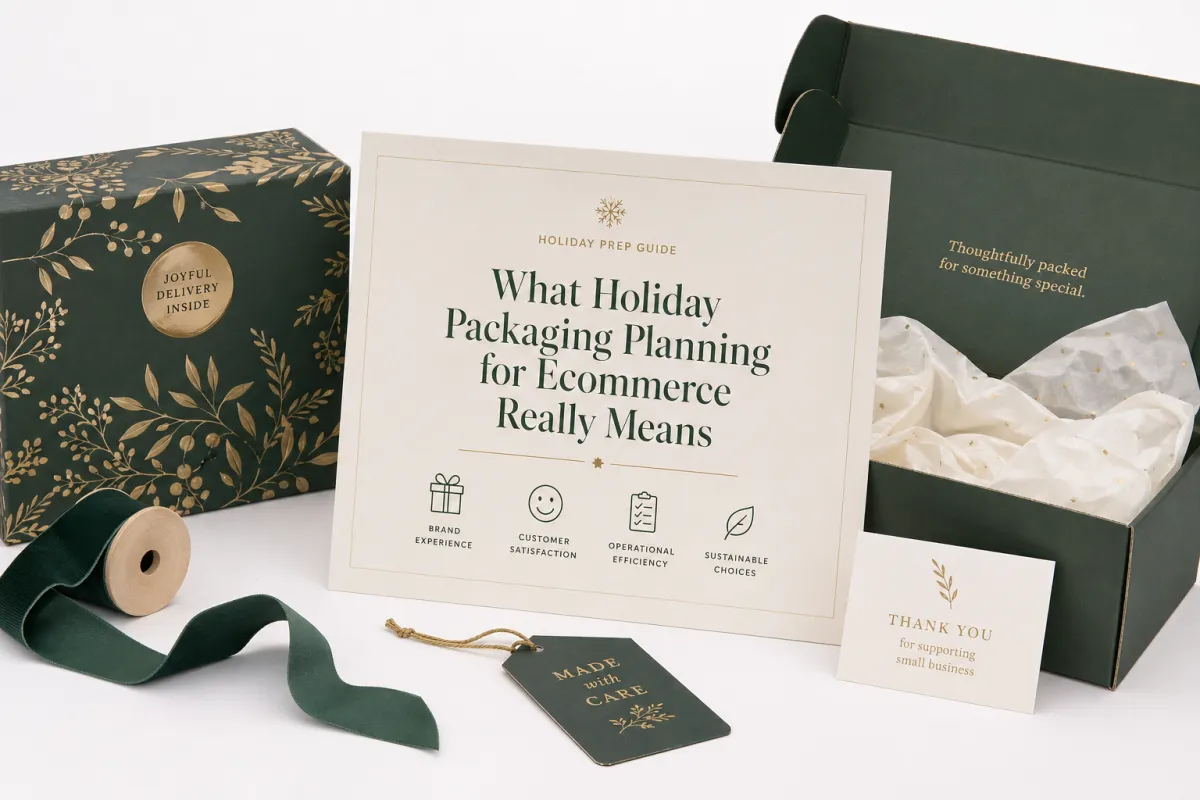
Holiday packaging planning for ecommerce starts with a basic question that teams skip because it sounds obvious: what has to happen before the first box is packed? In my experience, the answer is usually five things moving at once - forecast, structure, print, inventory, and fulfillment timing - and if even one slips, the season starts to feel tighter than it should. I worked with a beauty brand last peak season that had a strong packaging concept, but they underestimated the lead time on foil stamping for a 28-point SBS mailer. The delay pushed them into plain kraft mailers for their highest-volume SKU. The product still shipped, sure, but the brand was not thrilled about swapping “holiday luxury” for “we found this in the back room,” especially after paying a $650 plate fee and waiting 14 business days for the first proof cycle.
For ecommerce, holiday packaging planning for ecommerce means lining up every moving part so order flow stays clean during the busiest weeks of the year. That includes material selection, SKU prioritization, finishing choices, artwork approval, and the way the warehouse actually uses the packaging on the floor. I have stood at enough packing stations in New Jersey and Ohio to know that a beautiful box is not automatically a good box. If it takes 11 extra seconds to assemble, that time compounds across 2,000 orders a day and starts showing up in overtime, fatigue, and missed carrier cutoffs. That is why holiday packaging planning for ecommerce matters so much for direct-to-consumer brands, subscription programs, and gift-heavy catalogs shipping through hubs in Chicago, Dallas, and Louisville.
The stakes are higher during the holidays because carrier networks get crowded, labor gets stretched, and returns rise fast if packaging fails in transit. A fragile ceramic mug, a temperature-sensitive chocolate set, and a rigid gift box all need different structures, different board grades, and different testing assumptions. If the packaging is too thin, you pay in damage. If it is too complicated, you pay in labor. If it is out of stock, you pay in lost sales. Holiday packaging planning for ecommerce has to balance all three, and the best teams start building that balance 8 to 12 weeks before shipping peaks, not 2 weeks before the first Black Friday pallet moves.
"We thought the packaging was the easy part until the warehouse ran out of one insert size on the first Monday of peak season. After that, every order took an extra minute and a half, and our labor plan blew up." - a DTC client I met during a production review in New Jersey
The mistake I see most often is treating packaging like a styling exercise instead of an operations decision. A seasonal sleeve, a satin ribbon, or a matte black mailer might look gorgeous in mockups, but holiday packaging planning for ecommerce only works when those choices fit the line speed, the ship method, and the margin target. The business value is real: lower breakage, better gifting appeal, stronger package branding, fewer rush charges, and a cleaner unboxing moment that can lift repeat orders when it is handled well. I have seen a simple structural change save more than an expensive holiday campaign because the box actually survived the trip from a Dallas fulfillment center to a customer doorstep in Phoenix, Arizona.
If you need a practical place to begin, look at your core packaging SKUs first and compare them against the options in Custom Packaging Products. Holiday packaging planning for ecommerce gets much easier once the team has one master sheet showing dimensions, board grade, print method, target quantity, and required ship date for each item. Not glamorous. Very effective, though, especially when the same sheet includes a target landed cost like $0.38 per unit for 10,000 printed mailers and a backup option at 5,000 units.
How Holiday Packaging Planning for Ecommerce Works
Holiday packaging planning for ecommerce usually begins with a forecast, but not the vague kind that says “we expect growth and vibes.” I mean a SKU-level forecast with actual units, channel splits, and expected promo lifts, because a 15% increase in total orders can hide a 40% jump in one gift set while another item barely moves. From there, the team decides which products need special holiday packaging, which can stay in standard packaging design, and which need extra protection because the pack-out will be slower or the product is more fragile during colder transit windows. That part matters more than it sounds, because winter weather in Minneapolis, Minnesota, and Buffalo, New York, has a way of turning modest risk into expensive inconvenience.
The next step is structural. That means choosing between a folding carton, a mailer, a rigid gift box, a sleeve, or a combination that includes inserts, tissue, labels, and outer shippers. Holiday packaging planning for ecommerce works best when structure follows shipping reality instead of the mockup board. A subscription snack brand I advised moved from a two-piece rigid box to a reinforced E-flute mailer with a 1.5-inch internal insert because the original setup looked premium but failed compression testing after 18 drop cycles in ISTA-style prechecks. The box did not become less attractive, but it became much more survivable, which is the part customers actually feel when a parcel travels from a Chicago sortation hub to a cold porch in Cleveland, Ohio.
Once the structure is chosen, samples matter. Good holiday packaging planning for ecommerce includes a hard sample review, not just a PDF approval that everyone nods at on a conference call. Teams should check print registration, color match, closure fit, product protection, machine compatibility, and how the box behaves under warehouse conditions with gloves, tape guns, and a rushed picker. I still remember a client in a Midwest fulfillment center who approved a sleeve that looked excellent on a table but slid too loosely around the carton once humidity climbed to 72 percent in the building. That one issue created a 9% rework rate during packing until we tightened the tolerances to hold within 1 mm. Humidity is rude like that.
The final handoff is operational. Packaging can arrive on time and still fail if the warehouse does not know how many units are coming, where they are staged, or which SKU gets priority when stock is tight. Holiday packaging planning for ecommerce needs a replenishment plan, a pack instruction sheet, and a count of all components, including inserts, labels, and void fill. I like to see one page that shows the exact packaging sequence and one owner named for every material, because when the phones start ringing in peak season, vague ownership costs time and patience, and nobody has an endless supply of either. If a Los Angeles 3PL is receiving three pallet types in one morning, that one-page guide becomes worth more than a design deck.
In practical terms, the process looks like this:
- Build a demand forecast by SKU and channel.
- Pick the holiday-specific packaging formats.
- Confirm die lines, dimensions, and material specs.
- Approve artwork and finishing, including foil, emboss, or coating.
- Run samples and verify fit in real fulfillment conditions.
- Release production with written delivery windows.
- Receive, inspect, and stage inventory before the peak rush.
That sequence sounds straightforward, but in a busy season it can bend quickly if one supplier slips. Holiday packaging planning for ecommerce works best when each step has a buffer of 3 to 7 business days, because proofs, freight, and receiving rarely move at the exact pace promised in a quote. I have seen a plant in North Carolina sit idle for 36 hours because a pallet of divider inserts was held at the dock waiting for a final count reconciliation, and that kind of delay is expensive when the press and converting line are already reserved. I still remember the look on the production manager’s face; it was the kind of look that says, “I have a headache, and it has a barcode.”
For teams that want cleaner execution, I usually recommend documenting the entire holiday packaging planning for ecommerce process in one sheet that includes vendor contacts, spec versions, lead times, and the final carton count by component. That little discipline keeps package branding consistent and makes the warehouse handoff much less stressful. It also gives you a fighting chance if someone asks, “Which revision did we approve?” at the exact moment no one wants to answer that question, particularly when a Shanghai supplier, a Memphis warehouse, and a Brooklyn marketing team are all looking at different file versions.
Key Factors That Shape Holiday Packaging Decisions
Holiday packaging planning for ecommerce starts with protection, because no customer cares how elegant the box looked if the product arrives cracked, dented, or smeared. Fragile items often need heavier board, molded pulp, foam, corrugated inserts, or a double-wall shipper depending on weight and drop risk. A 14 oz ceramic candle jar may be fine in a 32 ECT mailer with a snug insert, but a 3 lb glass decanter usually needs a stronger outer shipper and a more careful insert design. That is the kind of detail that protects both revenue and brand trust, and it is also the kind of detail that gets ignored until the first broken-item photo lands in support from a customer in Denver, Colorado.
Presentation comes next, especially for holiday gifting. Seasonal print, soft-touch lamination, spot UV, paper belly bands, and coordinated tissue can elevate the experience without forcing a full structural redesign. Holiday packaging planning for ecommerce often succeeds with one visible premium cue instead of five. I once helped a skincare brand switch from a full printed sleeve set to a single embossed closure seal, and the packaging still felt giftable because the unboxing had one thoughtful detail placed exactly where the customer looked first. That change saved them roughly $0.21 per order on a 25,000-unit run, or about $5,250 total, which is hard to ignore in a Q4 margin review.
Sustainability is another factor, but it has to be handled with care. Recycled content, FSC-certified board, water-based coatings, and right-sized cartons can all support better material choices, yet the best spec is not always the greenest sounding one if it creates more breakage or slower packing. Holiday packaging planning for ecommerce should respect both performance and environmental goals. The FSC standard can be a helpful guide for sourcing responsibly managed fiber, and I also keep an eye on the EPA’s sustainable materials guidance because waste reduction, recovery, and right-sizing all matter once volumes rise. For testing and transport durability, I like referencing ISTA test methods early and checking FSC certification requirements when a client needs verified fiber sourcing from mills in Canada, Washington state, or the Midwest.
Fulfillment realities often decide the final spec. A gorgeous rigid box can still be the wrong answer if it nests poorly, takes too long to assemble, or drives Dimensional Weight Charges that wipe out margin. Holiday packaging planning for ecommerce has to account for carton sizes, pallet density, warehouse labor, and carrier rules. A box that saves 0.4 seconds at packing may sound minor, but across 50,000 units it can add up to more than five full labor shifts. That is why I always ask how many seconds a package adds, not just how it photographs. Photos are useful. Labor is where the bills show up, especially in high-cost fulfillment markets like Los Angeles, New Jersey, and Seattle.
There are also channel-specific details worth calling out. DTC buyers may value a premium unboxing moment, while wholesale buyers may care more about shelf appearance and barcode placement. Subscription brands need consistent repeat assembly. Retail packaging may need more hang-tag room or merchandising visibility. Holiday packaging planning for ecommerce does not ignore those distinctions; it uses them to decide whether a product needs a custom printed box, a simple seasonal wrap, or a more protective shipper with clean package branding. A 3-pack gift set in an Austin, Texas warehouse, for example, may need a different insert height than the same set shipped from an Atlanta facility because labor flow and carrier cutoffs are not identical.
One more thing: supplier availability matters more than most teams expect. I have sat through a negotiation in our Shenzhen facility where a buyer wanted 350gsm C1S artboard with a matte aqueous coat, but the lead time changed by four days because a local paper mill had shifted its slot allocation. We solved it by moving one SKU to a stocked kraft board and preserving the premium finish only for the hero item. That kind of tradeoff is common in holiday packaging planning for ecommerce, and the brands that stay flexible usually avoid the worst shortages. Flexibility is not glamorous, but it tends to be profitable, particularly when a supplier can ship from Guangdong in 12 to 15 business days from proof approval instead of missing a holiday launch entirely.
Here is a quick comparison of common holiday formats I have seen used successfully in ecommerce:
| Format | Typical Use | Typical Unit Cost | Main Advantage | Main Tradeoff |
|---|---|---|---|---|
| Printed mailer | Small apparel, accessories, light gifts | $0.18-$0.34 at 10,000 units | Fast pack-out and strong branding | Limited crush protection |
| Folding carton | Cosmetics, candles, compact electronics | $0.22-$0.48 at 10,000 units | Clean presentation and efficient storage | May need an outer shipper |
| Rigid gift box | Premium sets, limited editions, gifting | $0.85-$1.90 at 5,000 units | High perceived value | Higher freight and labor cost |
| Mailer with insert | Fragile DTC orders, bottles, jars | $0.32-$0.72 at 10,000 units | Balances protection and branding | Requires tighter spec control |
That table is not a universal price sheet, because board grade, print coverage, finishing, and freight all move the number, but it gives a practical range. Holiday packaging planning for ecommerce works better when brands compare these options against the cost of damage, returns, and customer complaints rather than just the printed carton price. I have seen a $0.06 cheaper box cost a brand $8,000 in seasonal replacements because the inner fit was loose by only 2 mm. A tiny gap, in packaging terms, can behave like a very expensive personality flaw.
Holiday Packaging Planning for Ecommerce Cost and Pricing
Holiday packaging planning for ecommerce cost analysis should start with landed cost, not unit cost. That means adding the substrate, print method, tooling or plate charges, inserts, finishing, freight, storage, and assembly labor into one view. A carton quote of $0.29 may look attractive until you add $0.08 for inserts, $0.06 for spot UV, $0.05 for higher freight, and $0.04 for extra pack time. Suddenly the real number is $0.42, and that is before any rush fee enters the conversation. I have had more than one buyer say, “Wait, where did the other thirteen cents come from?” and the answer is always the same: the quote was only the beginning.
Quantity changes the economics in a big way. Most converters price around breakpoints, and a jump from 5,000 units to 10,000 units can drop the unit cost by 15% to 28% depending on size and finish. I have seen a client order 6,500 units because they were nervous about overbuying, then scramble to reprint 2,000 more at a higher rate after a promo outperformed expectations. That is exactly the sort of mistake holiday packaging planning for ecommerce is meant to prevent. The right buy is usually the one that balances minimum order quantities, storage space, and post-season risk without forcing a panic reorder, especially if warehousing in Nashville, Tennessee, costs $8.75 per pallet per month.
Rush timing is where budgets often get hurt. Expedite fees, weekend press time, split shipments, and repeated proofs can erase most of the savings from a cheaper initial quote. Holiday packaging planning for ecommerce should build in enough lead time to avoid paying for emergency production. In one negotiation with a paper supplier, a brand saved $1,100 by approving art a week earlier, simply because the material could ship on a standard truck instead of a hot-shot freight run. Those savings are boring on paper and excellent in a budget meeting, which is probably why I like them so much.
I like to break holiday packaging planning for ecommerce into a simple comparison: what does the package cost per order, and what does it save or earn? A stronger insert may add $0.11, but if it reduces breakage by 3% on a $42 item, the math usually favors the insert. A more premium finish may add $0.07, but if it improves giftability and lowers cart abandonment by a small amount, it can justify itself quickly. Packaging should be treated like a profit tool, not just a cost center, even if it never gets the dramatic applause that marketing assets get.
There is a useful middle ground between overbuilding and underbuilding. For example, a brand can use 350gsm C1S artboard for the outer carton, a recycled E-flute mailer for shipping, and a seasonal belly band or label to Create Branded Packaging without redesigning every component. That approach often keeps prices controlled while still improving the customer experience. If you need to browse formats and finishes, the custom packaging products catalog is a practical place to compare options before asking for quotes, especially if you want a 5,000-piece run quoted against a 10,000-piece run to see the breakpoints clearly.
Below is the way I usually explain pricing drivers to a client in a procurement meeting:
- Material - board grade, flute type, recycled content, and coating.
- Print - one-color, four-color process, foil, emboss, or spot UV.
- Construction - mailer, folding carton, rigid box, insert, or sleeve.
- Quantity - MOQ, tiered pricing, and overage for spoilage.
- Timing - standard lead time versus rush production and freight.
Holiday packaging planning for ecommerce also needs a contingency reserve. I usually suggest a 5% to 10% budget buffer for the holiday season because one extra proof round, one delayed ship date, or one freight upgrade can happen without warning. That buffer is easier to defend than a stockout, and it keeps the team from making bad decisions under pressure. Nobody ever complains that the reserve was too calm and reasonable, especially when the backup freight from Ontario, California, costs $320 but saves the launch.
Holiday Packaging Planning for Ecommerce Timeline and Production Process
Holiday packaging planning for ecommerce works best when the timeline is built backward from the first ship date, not from the first marketing campaign. If your first holiday order must leave the warehouse on October 20, then the packaging needs to be approved, produced, shipped, received, and staged well before that date. I usually recommend adding 2 to 4 weeks of cushion for artwork corrections, converting delays, and inbound receiving, because the people who promise perfect timing are usually the ones who have never stood on a dock during peak season. Dock life has a way of introducing humility, especially in Wilmington, North Carolina, when a truck misses a 3 p.m. cutoff by 12 minutes.
The most common delays happen in three places: artwork approval, structural changes, and component shortages. A designer may send a polished file that still needs a dieline correction. A marketing team may decide to add a metallic finish after proofing. A supplier may run short on a particular paper stock or insert board. Holiday packaging planning for ecommerce has to expect those issues and build around them. In one factory visit, I watched a carton line sit idle for 19 hours because a window patch film was one roll short, and that kind of shortage would have been avoidable with a 10% safety stock and a receiving check in advance.
When I talk through holiday packaging planning for ecommerce with a client, I usually lock the specs early and freeze the artwork as soon as the structure is approved. That includes dimensions, board grade, coating, print coverage, and any insert details. Changing the design after production is scheduled almost always costs money, and sometimes it costs the whole season. I have seen a brand lose a press slot because the final dieline came back with a 6 mm panel change that forced a new die and a fresh setup. That sort of surprise always arrives with the confidence of someone saying, “It should be fine.” It usually is not, especially if the scheduled run is only 15 business days from proof approval and the freight carrier needs four days on top of that.
A clean process sequence keeps the season under control:
- Define the packaging brief with dimensions, product weight, and target ship method.
- Request structural and print samples from the supplier.
- Review the sample in real packing conditions, not just on a conference table.
- Approve the final quote, lead time, and delivery terms in writing.
- Release production only after artwork and specs are frozen.
- Inspect inbound goods for count, print quality, and carton damage.
- Stage the inventory by SKU so the warehouse can access it fast.
One of the best habits I learned from an old plant manager in Pennsylvania was to test the packaging in the same hands that will use it. Have the picker, the packer, and the supervisor all try the sample. If the packer needs both thumbs to close the flap, the holiday line will feel that problem within the first hour. Holiday packaging planning for ecommerce should respect real labor patterns, not just lab specs. Human hands, especially tired ones, are excellent at finding design flaws that a conference room misses, particularly when a line is pushing 420 orders per hour in a humid facility outside Philadelphia.
Testing should also match the risk. For heavier ecommerce goods, I like to see compression and drop checks that reflect the actual shipping lane. ASTM D642 can help with compression testing, and ISTA-style testing is useful for transit validation. The point is not to collect standards for a slide deck; it is to make sure a box that looks strong on a pallet also survives a rough route through a fulfillment network. If the packaging is FSC-certified, that is great, but the certification only helps if the box still performs, whether the lane runs from Toronto to Detroit or from Shenzhen to San Diego.
By the time freight is moving, the warehouse should already know where the cartons are going, who signs for them, and how many units should remain as reserve. Holiday packaging planning for ecommerce is much safer when the operations team sees the same calendar the marketing team sees. That simple alignment prevents last-minute repacks and keeps the seasonal launch from turning into a dockside fire drill, which is a phrase I wish I had never had reason to use more than once. It also keeps a 2-pallet shortage from becoming a 200-order delay.
I also recommend a receiving checklist with three items: count, condition, and version. Count checks whether the pallets match the PO. Condition checks for crushed corners, wet edges, or print rub. Version checks whether the correct artwork and exact specification arrived. Holiday packaging planning for ecommerce falls apart when teams receive the wrong revision and do not catch it until the first fulfillment wave starts. I have seen that mistake happen, and it is never a cheerful meeting, especially when the replacement print run would have taken 13 business days and the launch is 9 days away.
Common Mistakes in Holiday Packaging Planning for Ecommerce
The first mistake is waiting too long. Holiday packaging planning for ecommerce is often delayed because teams are still debating the final holiday campaign art, but every week lost in August or September narrows the supplier list and pushes the quote higher. Late starts also shrink the room for sample corrections. I have seen a brand move from four packaging options to one because the others could not meet the schedule, and the remaining option cost 18% more than the original target. Nobody likes paying a premium because a decision sat in a Slack thread for three days, especially if the buyer had already secured a 5,000-piece quote from a plant in Monterrey, Mexico.
The second mistake is designing for appearance only. A package can look polished in a rendering and still perform badly on a line or in transit. If a box takes too many folds, uses a weak closure, or arrives with scuff-prone finishes, it can slow production and create returns. Holiday packaging planning for ecommerce should treat the warehouse as the final design environment. If a packer has to fight the box, the design is not finished. Pretty is not the same as ready, and a matte finish that scuffs after 40 cartons per case is not worth the trouble.
The third mistake is ignoring volume swings. Holiday demand is rarely flat. One gift set may spike after a social campaign, while another item underperforms because inventory landed late or a color variant did not catch on. Holiday packaging planning for ecommerce should separate the fast movers from the slow movers and plan component quantities by SKU. A single blended forecast often causes one packaging item to stock out while another sits untouched in the rack. That is a special kind of inventory sadness, especially when one SKU is selling 1,200 units a week and another barely clears 90.
The fourth mistake is split ownership. Marketing wants the package to look right, operations wants it to move fast, procurement wants the price down, and nobody owns the full timeline. That is how brands end up with a good-looking spec sheet and a missed ship date. Holiday packaging planning for ecommerce needs one owner, one budget, and one source of truth for the latest dieline and production release. If nobody owns the calendar, the calendar ends up owning everybody, usually at 7:30 p.m. on a Thursday when the proof still has a note about changing the barcode.
Another mistake I see in supplier conversations is underestimating how much a small change can affect the line. A 2 mm depth tweak, a different coating, or a slightly tighter tuck flap can force a new setup on converting equipment. During one negotiation with a carton supplier, the buyer wanted to save a few cents by switching to a thinner board, but the packaging line would have needed a slower machine speed and a second pass through the glue station. The savings disappeared before the quote was even signed. That is the sort of thing that sounds like a quick win until someone actually measures the labor, especially in a plant running a 14-hour shift in eastern Tennessee.
If you want a simple rule, use this one: if the package cannot survive a rushed warehouse shift, a noisy conveyor, and a hard parcel route, it is not ready for holiday packaging planning for ecommerce. That rule has saved more money than any fancy presentation deck I have seen. It is not poetic, but it is reliable, and it is a lot cheaper than replacing 600 crushed units in January.
Expert Tips and Next Steps for Holiday Packaging Planning for Ecommerce
Start with the products that matter most. Holiday packaging planning for ecommerce should focus first on the top three SKUs that create the most revenue or the most damage risk, because those are the items that can hurt the season fastest. A premium candle set, a glass skincare kit, and a giftable accessory line may need completely different packaging, and the sooner you isolate them, the easier the rest of the catalog becomes. It is a lot easier to calm a season when the important stuff is already locked down, especially when those SKUs account for 62% of Q4 revenue.
Build a packaging calendar with real milestones. I mean dates for concept approval, sample review, quote sign-off, production release, inbound receipt, and warehouse readiness. Holiday packaging planning for ecommerce becomes far less stressful when each milestone has one named owner and one backup contact. I have used a one-page tracker with six columns and no one has ever complained that it was too simple; they usually say it saved them from a last-minute panic. Simple is underrated, especially when everyone is tired and the freight forwarder in Long Beach, California, has already moved the cut-off by one day.
Test early and test in the real environment. A sample on a desk tells you almost nothing about how the packaging will behave next to a conveyor, a barcode scanner, and a tired packer on hour nine of a shift. Holiday packaging planning for ecommerce should include a pilot run or at least a hands-on mock pack with 25 to 50 units. That small test often reveals whether the insert is too tight, the closure is too weak, or the label placement is slowing the pack-out. I have seen a label position add three seconds per order. Three seconds sounds small until you multiply it by the season and start hearing overtime in the budget, which can be $27 an hour for each extra worker on the floor.
Keep a backup plan ready. I do not mean a vague “if needed” note on a spreadsheet. I mean one alternate material, one alternate freight option, and one alternate pack configuration that the team has already priced. Holiday packaging planning for ecommerce gets much calmer when a paper shortage or truck delay does not force a new decision from scratch. In one case, a client moved from a printed rigid box to a seasonal sleeve over a standard carton because a supplier missed the ship window by four days, and the backup plan saved the launch. That was the kind of crisis that felt dramatic for about six hours and then became everybody’s favorite war story.
Make sure the packaging list matches the warehouse reality. Include exact counts for inserts, cartons, tissue, labels, and any seasonal extras. Holiday packaging planning for ecommerce works better when the warehouse receives a clear count sheet, a pack guide, and a visual of the final look. The floor teams do not need a branding manifesto; they need a fast, accurate way to pack without hunting for missing components. If the team has to go scavenger-hunting for tissue paper, something went wrong upstream, and somebody should be able to fix it before the first 1,000 orders leave the dock.
For brands that want a better holiday presence without overcomplicating the spec, I usually suggest one premium change and one functional improvement. A better finish on the outer box plus a tighter insert can be enough to lift the experience and reduce product movement in transit. That is the kind of practical package branding that keeps costs sane while still feeling special. Honestly, I think restraint usually looks more expensive than overdecorating the box anyway, especially when the base carton is already a crisp 350gsm C1S artboard run with a matte aqueous coat.
Review the numbers after the season. Holiday packaging planning for ecommerce should end with a simple postmortem: what arrived on time, what caused delays, what damaged the margin, and which package format produced the best feedback. A 30-minute review can shape next season’s ordering strategy and save thousands of dollars before the next rush starts. I have seen teams skip this part because everyone wants to move on, and then they repeat the same mistake with a fresher coat of paint. One hour in January can easily prevent a $4,000 mistake in November.
My last piece of advice is straightforward: treat holiday packaging planning for ecommerce like a production project, not a decorative task. If the specs are clear, the samples are tested, the timeline has buffers, and the warehouse knows what is coming, the season is much easier to manage. I have seen that approach work in small Shopify brands with 1,500 orders and in larger programs pushing 80,000 units, and the pattern is always the same - good planning protects margin, protects products, and protects the team. It also protects your sanity, which deserves a line item of its own when the peak season is running through November and December.
Holiday packaging planning for ecommerce is worth the effort because it lets you ship on time, reduce breakage, and create a better unboxing experience without improvising under pressure. If you build the plan around real lead times, real labor, real freight windows, and real customer expectations, the packaging becomes part of the holiday sales strategy instead of a seasonal headache. The practical takeaway is simple: lock the top SKUs, freeze the specs, verify the warehouse counts, and build a small buffer before the first order wave starts. That is the move that keeps December from turning into a scramble, whether the cartons are made in Ohio, Vietnam, or Guangdong.
When should I start holiday packaging planning for ecommerce?
Start as soon as you have a realistic holiday forecast, ideally before supplier calendars fill up and before artwork revisions become a bottleneck. For many brands, that means building the plan 10 to 14 weeks ahead of the first holiday ship date, not waiting for the marketing launch. Holiday packaging planning for ecommerce works best when production, transit, and warehouse setup all have room to breathe. If you wait until everyone is already busy, you are asking a crowded calendar to do a miracle, and calendars are not known for miracles, especially not in September when proof approvals stack up.
How do I estimate packaging quantities for holiday ecommerce demand?
Use last season sales, current growth trends, and any planned promotions to estimate base demand, then add a buffer for forecast error and replenishment delay. Split quantities by SKU and channel so fast movers, gift sets, and fragile items each get the right packaging mix. Holiday packaging planning for ecommerce gets much more accurate when the estimate is specific instead of blended. Blended forecasts are how you end up with too many boxes for the wrong thing and not enough for the product everyone actually bought, which is how one Chicago brand ended up short 1,800 inserts during Cyber Week.
What drives the cost of holiday packaging the most?
Material choice, print method, order quantity, and finishing details usually have the biggest impact on unit price and total landed cost. Rush timing, freight class, and labor needed to assemble or insert components can also add hidden expense even when the quoted carton price looks attractive. Holiday packaging planning for ecommerce should always compare the full landed number, not just the carton quote. The quote is a clue, not the whole story, and a $0.24 mailer can turn into $0.39 once inserts, freight, and pack time are counted.
How can I make holiday packaging more giftable without raising costs too much?
Use one high-impact upgrade, such as a better print finish, a coordinated insert, or a seasonal sleeve, instead of changing every component. Focus on clean structure and correct fit first, because tidy presentation often feels more premium than expensive decorative extras. Holiday packaging planning for ecommerce becomes far more efficient when the premium cue is targeted. One thoughtful detail usually beats a pile of expensive ones that compete for attention, and a $0.07 spot UV accent often looks better than a $0.22 ribbon nobody asked for.
What is the biggest timeline risk in holiday packaging planning for ecommerce?
Late artwork approval is one of the most common risks because it delays proofing, production scheduling, and any chance to fix print or structural issues. The safest approach is to freeze specs early and protect a buffer for transit and receiving so packaging arrives before the warehouse reaches peak volume. Holiday packaging planning for ecommerce depends on that buffer more than most teams expect. The season is much less dramatic when the truck arrives before everyone starts yelling about it, and a 12 to 15 business day press schedule can stay manageable if the proof is signed off on time.


