Buyer Fit Snapshot
| Best fit | to minimalist packaging branding clearly for packaging buyers comparing material specs, print proof, MOQ, unit cost, freight, and repeat-order risk where brand print, material, artwork control, and repeat-order consistency matter. |
|---|---|
| Quote inputs | Share finished size, material target, print colors, finish, packing count, annual reorder estimate, and delivery region. |
| Proofing check | Approve dieline scale, logo placement, barcode or warning zones, color tolerance, and any recyclable or compostable wording before bulk production. |
| Main risk | Vague material claims, crowded artwork, or missing packing details can create delays even when the unit price looks attractive. |
Fast answer: To Minimalist Packaging Branding Clearly: Dieline, Finish, Proof, and Buyer Review should be specified like a repeatable production item. The safest quote includes material, print method, finish, artwork proof, carton packing, and reorder notes in one written spec.
What to confirm before approving the packaging proof
Check the product dimensions against the actual filled item, not only the sales mockup. Ask for tolerance on folds, seals, hang holes, label areas, and retail display edges. If the package carries a logo, QR code, warning copy, or legal claim, reserve that space before decorative graphics fill the panel.
How to compare quotes without losing quality
Compare board or film grade, print process, finish, sampling route, tooling charges, carton quantity, and freight assumptions side by side. A lower quote is only useful if the supplier can repeat the same color, closure quality, and packing count on the next order.
Guide to minimalist packaging branding sounds simple until you watch a quiet package win the shelf. No shouting. No visual gymnastics. Just clear structure, disciplined typography, and materials that carry their weight. Done well, minimal packaging feels calmer, sharper, and more expensive than a crowded box stuffed with badges and claims. That is the whole point of a strong guide to minimalist packaging branding: less noise, more signal.
I have seen this work in categories where shoppers compare five near-identical options in under ten seconds. The pack that earns the second look is rarely the loudest one. It is usually the one that knows what to leave out.
Buyers usually like it for the practical side before they care about the aesthetics. A smart guide to minimalist packaging branding can cut artwork chaos, reduce decision fatigue, and keep a family of products looking like it belongs to the same brand. It also makes life easier across retail packaging, e-commerce shipper boxes, inserts, and secondary cartons. Minimalism is not a mood. It is a system for deciding what earns space and what gets cut.
Empty packaging is just empty packaging. Intentional minimalism feels composed. The strongest packs still tell shoppers what the product is, what category it belongs to, and why it deserves attention, all within a few seconds. In categories where people compare ingredients, scan labels, or judge a product before they touch it, the guide to minimalist packaging branding stops being a style preference and starts acting like a sales tool.
For Custom Logo Things, the cleanest way to think about this is straightforward: clarity first, consistency second, production choices that support both. Minimalism works when it behaves like a framework, not a blank page that everyone stares at and then panics. Shape, coating, finish, spacing, and type all pull weight inside the final brand identity. If one of those pieces is weak, the whole thing feels kinda off.
Guide to Minimalist Packaging Branding: Why Less Can Sell More
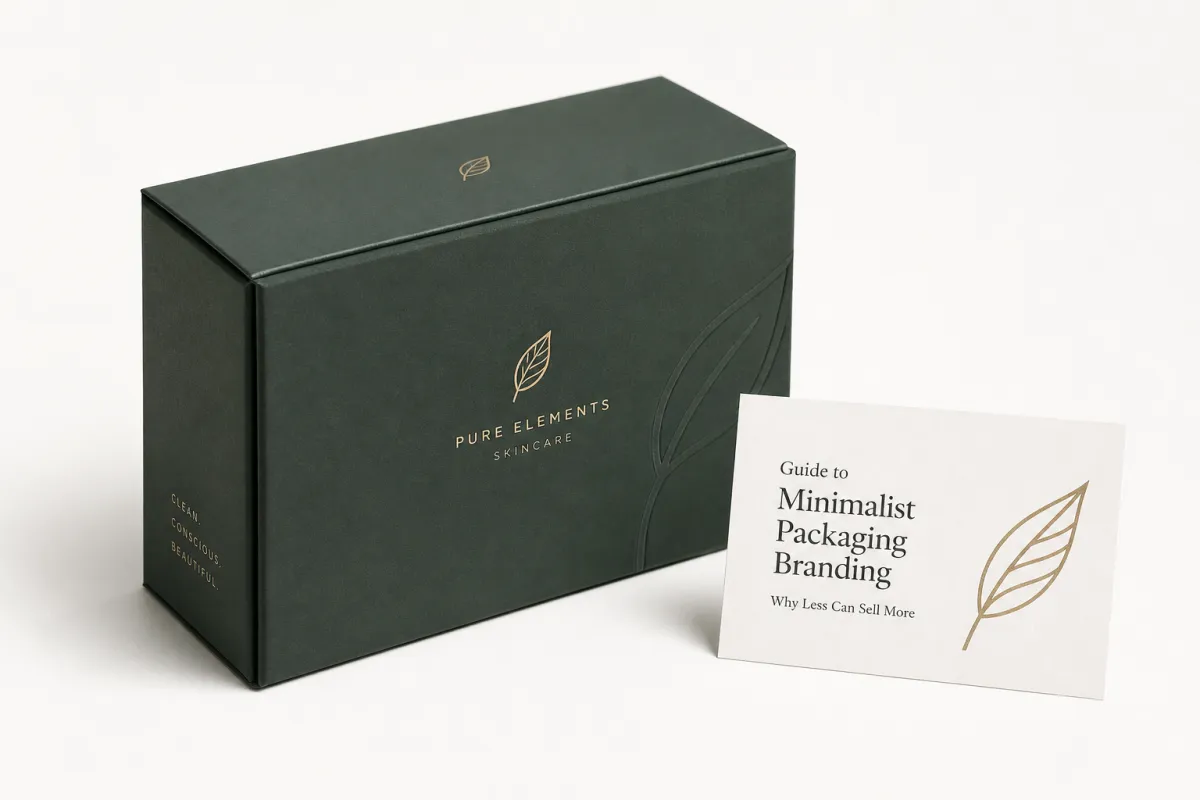
Guide to minimalist packaging branding begins with a retail reality people like to ignore: a package does not need to shout to get noticed. In crowded aisles, restraint often wins because the eye can process the front panel faster when it is not fighting through giant claims, random color explosions, and five different type styles. A cleaner pack tends to read as more expensive because it looks like someone actually made choices.
That shows up fast in premium food, beauty, wellness, and specialty goods. Customers often decide how they feel about quality before they ever open the box. If the product is tactile, ingredient-led, or meant to feel giftable, a sparse layout can raise perceived value instead of lowering it. The guide to minimalist packaging branding works because the material, structure, and message do more than decoration ever could.
Minimalist packaging branding is not the absence of design. It is the deliberate trimming of color, type styles, border treatments, and extra graphics so the important parts rise to the surface. One clear logo placement, one product name, and a disciplined amount of supporting copy are often enough. The package becomes easier to read, easier to remember, and easier to extend across custom printed boxes without losing its personality.
I usually use a simple test: remove the logo and look at the front panel. If it still feels rich, focused, and tied to one product family, the system is probably working. If the package turns blank and lifeless once the artwork is stripped back, the design is not minimalist yet. It is just underbuilt. Minimalist packaging should feel edited, not anxious.
A restrained package should feel edited, not unfinished. Good minimal design still has a point of view; it just refuses to waste space on things the customer does not need.
This approach works best when the product has something worth paying attention to. A tea blend with a real origin story, a skin-care formula with clear actives, a candle with a distinctive scent profile, or a specialty snack with a short ingredient list can all benefit from visual restraint. The guide to minimalist packaging branding gives those products room to breathe without turning the package into a silent wall.
It also helps brands fighting through packed shelves. When every neighboring box is shouting with gradients, badges, and dense claims, the quiet one stands out by contrast. That does not mean it should vanish. It means the package should be recognizable from a few feet away and still worth a second look in the hand, which is exactly where package branding and product experience meet.
There is another upside buyers sometimes miss: minimal systems are easier to extend. A clear grid, one accent color, and a limited type palette make it easier to add new flavors, sizes, or formulas without redesigning the whole thing. The guide to minimalist packaging branding turns into a repeatable framework instead of a one-off visual trick.
One honest caveat: minimalism is not a good fit for every category. If a package has heavy regulatory copy, a long ingredient list, or a product that needs a lot of explanation before it makes sense, going too sparse will hurt clarity. The goal is not less for the sake of less. It is less clutter and more useful information.
Guide to Minimalist Packaging Branding: How the System Works
Guide to minimalist packaging branding only works when the hierarchy is obvious. The front panel should answer three questions in order: what brand is this, what is the product, and what makes it different. That usually means one strong mark, one primary product message, and a small set of support details that guide the eye instead of crowding it.
Negative space does a lot of the heavy lifting. It gives the logo and product name room to register, especially on smaller cartons, labels, and sleeves where every millimeter matters. Enough space can make a package feel premium even when the graphics are limited. It also improves legibility, which matters in retail packaging where shoppers give you about three seconds before moving on.
Material choice is part of the design language, not just a line item on a spec sheet. Uncoated paperboard feels warmer and more natural. Soft-touch lamination lowers contrast and gives the surface a quiet, velvety hand feel. Kraft tones can signal earthiness, while bright white SBS board sharpens type and gives sparse layouts a more precise edge. Clear film and rigid surfaces can also support minimalist packaging branding when the structure itself is doing some of the branding work.
That is why the guide to minimalist packaging branding should never stop at artwork. A simple layout on a flimsy substrate looks cheap fast. The same layout on 18pt or 24pt board, with tight folding tolerances and clean finishing, feels far more considered. Structure, surface, and print discipline all say the same thing: this product was made with care.
Consistency across SKUs is where many systems either hold together or fall apart. If one flavor uses a heavy accent line, another uses a different font weight, and a third shifts the logo to a new position, the whole family starts looking improvised. A strong guide to minimalist packaging branding keeps the layout rules steady so variation feels intentional instead of accidental.
Minimalism is also a production strategy. Fewer inks can simplify setup. Fewer effects can shorten proofing. Fewer decorative elements can lower the chance of misregistration or visual clutter on press. Premium minimalism is not always cheaper, though. It can get more expensive if it leans on specialty board, rigid setup, embossing, foil, or a delicate matte coating that needs careful handling.
From a production floor point of view, the best minimalist packs are the ones that cooperate with the process. Clean dielines, sensible panel sizes, and restrained coverage make the package easier to run and easier to inspect. When the design is disciplined, quality issues stand out faster because nothing is hiding behind noise. That is one reason the guide to minimalist packaging branding matters to both designers and production teams.
For brands comparing formats, it helps to make those decisions early. Some teams need folding cartons, others need mailers, and some need presentation boxes or labels for secondary grouping. Our Custom Packaging Products page is a good place to map those choices against the experience you want, and our Custom Labels & Tags option can handle small identity marks or ingredient callouts without cluttering the main panel.
There is a subtle trust factor here too. People tend to read clean packaging as more deliberate, but only if the details hold up under a close look. Straight folds, accurate color, legible copy, and a real barcode area matter more than decorative restraint. Minimal design makes those flaws easier to spot. That is annoying, but useful.
Key Factors That Shape Minimalist Packaging Branding Costs
Guide to minimalist packaging branding gets talked about like a design problem, but cost matters just as much. Pricing usually depends more on substrate, print method, size, and quantity than on how visually simple the artwork looks. A clean package can still be expensive if it uses premium board, tight finishing tolerances, or custom structural work.
A simple folding carton with one or two colors and aqueous coating may sit in a lower unit-cost range than a rigid presentation box wrapped in specialty paper. A minimalist rigid box can still be the right move if the product needs to feel giftable or premium in transit. The guide to minimalist packaging branding should help brands spend intentionally, not just spend less.
I usually look at pricing through a blunt lens: fewer inks can lower some print complexity, but a premium tactile finish may push the price back up. A plain-looking box with embossing, foil, or soft-touch lamination can cost more than a busier printed carton because the material and finishing stack are doing the work. Cheapest-looking is not the same thing as smartest.
| Packaging approach | Typical visual build | Indicative unit cost at 5,000 pcs | Best use case |
|---|---|---|---|
| Simple folding carton | 1-2 colors, clean type, aqueous coating | $0.18-$0.42 | Retail packaging, light products, high-volume launches |
| Soft-touch premium carton | Minimal graphics, matte finish, tight registration | $0.32-$0.68 | Beauty, wellness, specialty foods, premium gift sets |
| Rigid presentation box | Wrapped board, restrained print, optional emboss | $1.20-$3.50 | Unboxing experience, subscription kits, launch bundles |
| Kraft mailer or shipper | One-color mark, minimal exterior copy | $0.55-$1.80 | E-commerce, subscription orders, direct-to-consumer |
The table is only a reference point, because real pricing shifts with board caliper, print coverage, closure style, inserts, and shipping requirements. A run of 1,000 units usually lands higher per box than a run of 10,000. Custom inserts can add more than people expect. In the guide to minimalist packaging branding, production scale belongs in the design conversation from the beginning.
Dielines and structure changes matter too. If the package needs a new size, a foldover insert, or a special locking feature, tooling and setup charges can rise before printing even starts. That is normal. A careful brand team compares structure changes against inventory efficiency, because a more standard box sometimes saves more money than a fancy custom shape. That is one of the quieter lessons in the guide to minimalist packaging branding.
There is also a sustainability angle. Brands trying to cut waste often choose lighter board, fewer coatings, and paper-based materials that can be easier to recycle where local systems allow it. The U.S. EPA has useful guidance on sustainable materials management at epa.gov, and that view helps packaging teams think beyond the shelf and into disposal and recovery. Minimalism often supports that goal, as long as the structure still protects the product.
For supply chain-minded teams, the right comparison is not just cost per unit. It is cost per sellable unit after damage, returns, repacks, and redesigns. A package that looks cheap but fails in distribution gets expensive in a hurry. No one is gonna care that the render looked elegant if the box arrives crushed. If the pack is shipping through rough handling, transit testing matters, and ISTA protocols are a useful reference point; you can review their standards at ista.org. The guide to minimalist packaging branding should cover protection, not just appearance.
Step-by-Step Process and Timeline for a Minimalist Brand Rollout
Guide to minimalist packaging branding works best when the rollout follows a disciplined sequence. Start with a brand audit. Identify the one logo treatment that must stay visible, the product name hierarchy, the claims that need to stay on-pack, and the regulatory copy that cannot be ignored. That gives the team a real framework instead of a mood board full of nice intentions.
After that, define the system before any artwork gets decorative. Minimalist packaging fails when teams sketch attractive fronts before deciding how the family works. A strong system usually sets the grid, type scale, color logic, and one or two repeatable placements for supporting details. That is the difference between a one-off box and a full brand identity program.
Prototype early if the pack will be handled often or viewed in mixed lighting. Screen comps can hide spacing problems that show up immediately in print. Review hard proofs, sample boards, or digital comps in daylight and under store lighting, because tiny shifts in contrast and alignment matter more in minimalist layouts than in busy ones. The guide to minimalist packaging branding depends on precision.
A realistic timeline usually includes strategy, layout development, revisions, prepress checks, sampling, and production scheduling. A straightforward carton refresh can move in a few weeks once approvals start flowing. A custom structure or a multi-SKU program takes longer because every panel has to agree with the rest of the system. Minimalism does not remove process steps; it just makes each one easier to see.
- Run the brand audit and write the packaging brief.
- Set the visual hierarchy and layout rules.
- Develop one master structure or dieline family.
- Review proofs, finish samples, and shelf mockups.
- Approve prepress and plan the first production run.
Approvals deserve real attention. In a dense package, small issues can hide under texture or graphics; in a minimalist layout, every alignment shift and color mismatch shows up immediately. Prepress checks, bleed review, barcode placement, and copy verification are not clerical tasks. They are part of the design quality. A strong guide to minimalist packaging branding treats them that way from the start.
It also helps to think in terms of packaging families. The retail box, the outer shipper, the insert card, and the label system should all speak the same language, even if they do not look identical. That is where custom printed boxes and shipping materials reinforce the unboxing experience instead of feeling like separate projects. If you need examples, our Case Studies page shows how a coherent packaging system can hold together across different formats.
One more timing note: if the first launch includes new board stock, a new coating, or a new insert style, build in buffer. Those details are small on paper and very real in production. A matte finish that looks perfect in a sample can behave differently under stack pressure, and a tightly fitted insert can slow packing if tolerances drift. The guide to minimalist packaging branding is easier to execute when the schedule respects those realities.
And yes, the timeline gets a little messy if marketing decides to add one more claim the week before release. That is usually the moment where a clean system saves the day, because the structure already knows where that copy belongs. The less improvisation, the better.
Common Mistakes That Undercut Minimalist Packaging Branding
Guide to minimalist packaging branding is not a license to strip away everything visible. The most common mistake is going too bare, so the package loses identity and starts looking like a plain white carton from a generic supplier. That kind of emptiness does not feel premium. It feels unresolved.
The next mistake is removing every cue except the logo. If the front panel only gives you a brand name and almost nothing else, the customer may not know what is inside or why it matters. Minimalism still needs a product story. A good package tells the shopper what category it belongs to and what makes this version different, without stuffing the design with extra graphics just to fill space.
Overusing expensive finishes can also backfire. Foil, heavy embossing, and multiple specialty coatings can fight the quiet message of the package, especially if the layout is already restrained. That creates a mismatch: the design says calm, the surface says look at me. The strongest guide to minimalist packaging branding usually saves premium effects for one intentional moment, not every panel.
Inconsistent typography and spacing across SKUs cause another kind of damage. A family of minimalist packs can fall apart quickly if one variant uses a different weight, another shifts the headline size, and a third changes alignment just to fit extra copy. Those differences may look small in a file, but on shelf they weaken trust. Consistency is what turns simple packaging into a recognizable system.
There are also operational mistakes that have nothing to do with style and everything to do with function. Barcode space still matters. Legal copy still matters. Transport durability still matters. Retail display requirements still matter. A package that fails on those basics may look elegant in a render and become expensive in the real world. The guide to minimalist packaging branding should always make room for the practical stuff.
I also see brands postpone problem-solving until the end, especially on custom printed boxes. They approve the front panel first, then discover the side panels are crowded, the barcode has nowhere decent to live, or the insert does not fit the product securely. That is a costly way to learn. A better move is to review the whole structure early and make sure the simplified design still works from every angle.
Another easy trap: mistaking minimal for generic. A lot of brands shave off too many details and end up with packaging that could belong to anyone. If a shopper can swap your logo for a competitor's and nothing else changes, the system is too thin. Minimalism still needs a point of view.
Expert Tips for Sharper Minimalist Packaging Branding
Guide to minimalist packaging branding gets stronger when each face of the package has one job. A hero logo, a distinct color field, or one structural feature should lead, and everything else should support that choice. That kind of restraint helps the eye settle quickly, which is exactly what you want on a shelf crowded with competing claims.
Build a repeatable layout grid before you start adding variants. A well-planned grid makes it easier to introduce new flavors, sizes, and product types without redesigning the whole system. For multi-SKU families, that is a serious advantage because it keeps production cleaner and the brand language steadier. The guide to minimalist packaging branding is really a guide to repeatable decisions.
Test the pack from a distance and then up close. From three or four feet away, the customer should immediately understand the product type and brand. At hand level, the package should reward touch with board feel, a crisp edge, or a finish that supports the story. That balance is where product packaging becomes memorable without becoming busy.
Finish choice should match the message. Matte and uncoated surfaces usually feel quieter and more grounded. Soft-touch can add a premium hand feel that suits beauty or gifting. Gloss should be used carefully because it changes how light moves across the panel, and foil should be reserved for moments where it genuinely strengthens the brand story. The guide to minimalist packaging branding is strongest when finish acts like part of the language, not decoration slapped on later.
Think about the whole package family, not only the front-facing carton. A retail box, an e-commerce shipper, an insert card, and a seal label should all feel like they belong to the same brand even if each one carries different information. That includes secondary packaging and the outer box used in transit, where the unboxing experience starts before the customer ever sees the product itself.
Another practical habit: ask what can be removed without hurting clarity. That is not the same as asking how little you can get away with. It is a better question. Could a badge disappear? Could a sentence become a line? Could one color do the work of three? The guide to minimalist packaging branding usually improves every time a team is willing to remove one more layer of noise.
For materials, I like to see the packaging spec written as clearly as the design brief. Something like 18pt SBS with matte aqueous, 24pt rigid board with wrapped cover paper, or recycled content board with a clean uncoated face gives the production team a real target. If the brand wants a lower-impact story, FSC-certified paperboard from fsc.org is worth considering, provided the supply chain and budget both support it. The guide to minimalist packaging branding feels more credible when the materials match the message.
Finally, use the package as a communication system, not a poster. The front panel should handle the first glance. The side panels should handle details. The back panel should support trust with ingredients, directions, or claims that can be verified. That is where careful packaging design turns into a better buying experience and a cleaner operating plan.
Put plainly, the strongest guide to minimalist packaging branding turns restraint into a repeatable packaging system. It should help the product feel clearer, help the team make fewer unnecessary artwork decisions, and help the package behave better in print, on shelf, and in transit. That combination separates a quiet design from one that actually performs.
How do I know if minimalist packaging branding fits my product?
It fits best when the product already has a clear category signal, a believable quality story, or ingredients and materials that can stand on their own. A guide to minimalist packaging branding helps most when the product needs faster shelf recognition without visual clutter. If your audience shops quickly, test a simpler layout in shelf mockups or side-by-side lineups before committing to a full rollout.
What makes minimalist packaging branding look premium instead of plain?
Premium minimalism depends on typography, spacing, material feel, and structural precision more than decoration. A crisp dieline, a strong board choice, and one clear focal point usually do more than extra artwork. In a good guide to minimalist packaging branding, the package feels intentional because every element has a reason to be there.
How much does a minimalist packaging branding project usually cost?
Cost depends on the structure, print method, quantity, and finishing choices, so a simple layout can still carry a premium unit price if the materials are elevated. Fewer inks may reduce some setup complexity, but embossing, foil, rigid packaging, or custom inserts can raise the total. The most accurate estimate comes from pairing your guide to minimalist packaging branding direction with exact dielines, quantities, and finish requirements.
How long does a minimalist packaging design timeline usually take?
A straightforward refresh can move faster than a full structural redesign, but approvals, proofing, and sampling still take time. A realistic schedule includes strategy, layout development, revisions, prepress checks, and production planning. Build extra buffer if you are introducing new materials or multiple SKUs, because small spacing or color issues are easier to catch in a guide to minimalist packaging branding workflow than in a rushed final run.
Which materials work best for minimalist packaging branding?
Uncoated board, kraft stock, rigid paperboard, and clean white carton materials are common choices because they support restraint and texture. Soft-touch coatings, matte laminations, and carefully chosen recycled substrates can also reinforce a calm, premium feel. The best material choice in a guide to minimalist packaging branding is the one that fits the product’s handling needs first and the brand story second.
For brands that want a practical next move, start by auditing the current pack, writing down the one message the customer must remember, and listing every element that can be removed without hurting clarity. Then compare two or three directions side by side, not just as pretty mockups but as real packaging systems that can survive print, storage, and shipping. A disciplined guide to minimalist packaging branding should leave you with a cleaner brief, a clearer layout, and fewer surprises in production.
If you are acting on this now, strip the design down to the three things shoppers must see, mock it up on shelf, and check whether the dieline, copy, and finishes still behave in production. If they do, you have a system. If they do not, keep editing until they do. That is the move, and it is usually the difference between a package that looks quiet and one That Actually Sells quietly.
For brands using more than one format, carry the same rules across cartons, labels, inserts, and shipper boxes so the identity holds together wherever it shows up. Consistency is what makes minimalist branding durable, and it is what keeps the packaging from drifting as new sizes and product lines are added. The best guide to minimalist packaging branding helps a product sell clearly, look intentional, and stay practical from the first proof to the last shipped unit.


