Buyer Fit Snapshot
| Best fit | to packaging icon systems branding for packaging buyers comparing material specs, print proof, MOQ, unit cost, freight, and repeat-order risk where brand print, material, artwork control, and repeat-order consistency matter. |
|---|---|
| Quote inputs | Share finished size, material target, print colors, finish, packing count, annual reorder estimate, and delivery region. |
| Proofing check | Approve dieline scale, logo placement, barcode or warning zones, color tolerance, and any recyclable or compostable wording before bulk production. |
| Main risk | Vague material claims, crowded artwork, or missing packing details can create delays even when the unit price looks attractive. |
Fast answer: To Packaging Icon Systems Branding: Dieline, Finish, Proof, and Buyer Review should be specified like a repeatable production item. The safest quote includes material, print method, finish, artwork proof, carton packing, and reorder notes in one written spec.
What to confirm before approving the packaging proof
Check the product dimensions against the actual filled item, not only the sales mockup. Ask for tolerance on folds, seals, hang holes, label areas, and retail display edges. If the package carries a logo, QR code, warning copy, or legal claim, reserve that space before decorative graphics fill the panel.
How to compare quotes without losing quality
Compare board or film grade, print process, finish, sampling route, tooling charges, carton quantity, and freight assumptions side by side. A lower quote is only useful if the supplier can repeat the same color, closure quality, and packing count on the next order.
Guide to Packaging Icon Systems: Branding That Works
A shopper can read a symbol in under a second, and that tiny slice of attention is exactly why the guide to packaging icon systems matters so much on crowded shelves in places like Milwaukee, Minneapolis, and Des Moines. I remember standing in a grocery aisle on South 27th Street in Milwaukee and watching one 6 mm mark on a carton do more work than a 40-word claim block ever could. That was the moment I stopped treating icons as decoration and started treating them like production tools with measurable impact. The guide to packaging icon systems is really about making that speed dependable, repeatable, and easy to print, because once a pack has to carry safety, sustainability, usage, and compliance in the same few square inches, every symbol starts pulling real weight.
That shift changes the entire brief, and it usually nudges the budget a bit too. In packaging design, a symbol system can cut label clutter, support package branding across 6 to 24 SKUs, and make Custom Printed Boxes easier to scan in retail packaging, ecommerce, and retail-ready packaging. I have seen that difference on plant floors in Wisconsin, in buyer meetings at regional chains in Chicago, and in supplier negotiations in Louisville where one weak symbol would trigger a reprint and a week of rushed email threads. The guide to packaging icon systems is about more than appearance; it is about how quickly people understand the pack, how cleanly teams print it, and how consistently it survives from concept board to pallet wrap.
Guide to Packaging Icon Systems: What They Are
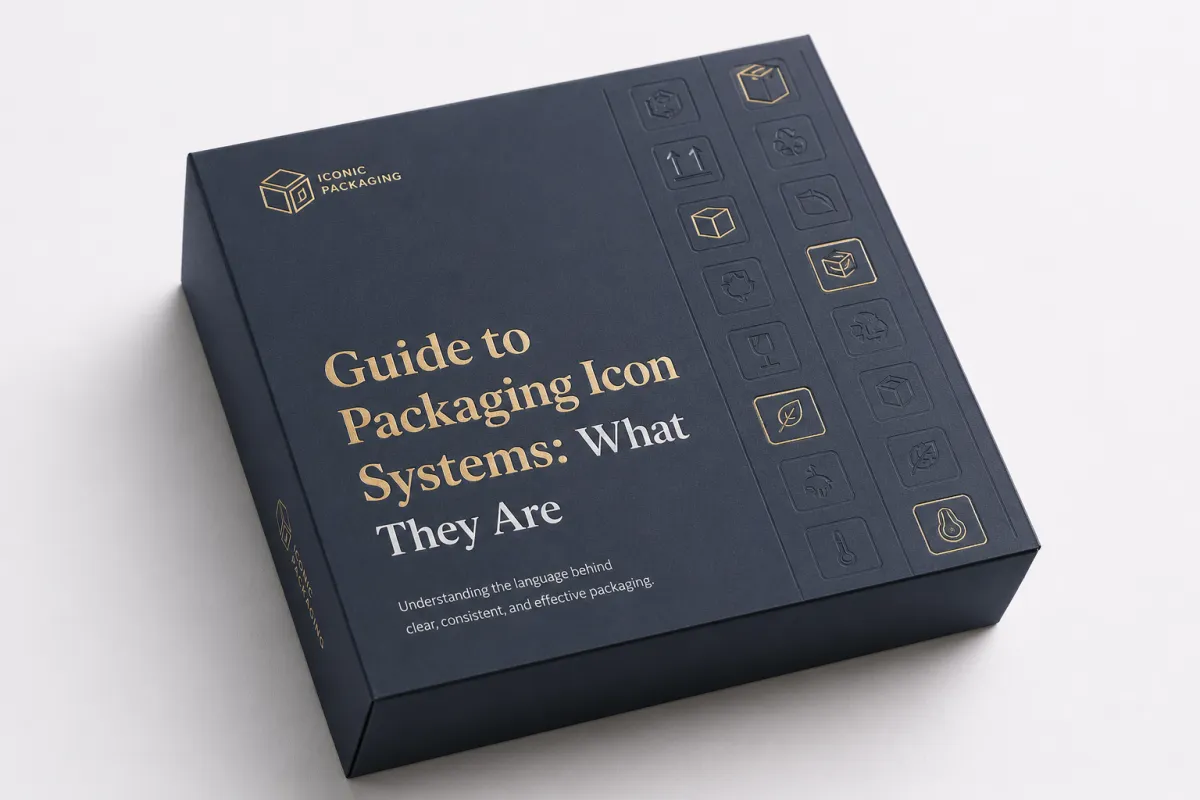
At its core, the guide to packaging icon systems is about using a disciplined set of symbols to communicate product facts without forcing every message into copy. That might mean a droplet for usage, a leaf for material sourcing, a freezer mark for storage, or a tamper indicator for safety, often reduced to a 0.35 mm stroke on a 350gsm C1S artboard carton panel. The strongest systems do not feel scattered or improvised. They feel like they came from the same family, with one line weight, one shape logic, and one visual tone carried through every mark. I like that kind of order because it makes the whole package feel like somebody actually thought through it, which is rarer than it should be.
On a factory floor in Columbus, Ohio, I once saw a carton proof with three icons that looked perfectly clean on screen but failed on press because the thinnest stroke measured only 0.2 mm. Under a flexographic press running at 150 lpi on uncoated board with a heavy ink laydown, that detail filled in fast. The brand was selling a premium kitchen product, so the packaging icon system had to survive both a 300 dpi proof and the real behavior of ink on substrate, not just a polished InDesign file. That is the part people miss: the guide to packaging icon systems is not just about concept sketches, it is about print reality, down to the ugly little details that nobody wants to talk about until the press sheet comes back wrong.
The difference between a one-off icon and a true system is consistency. A one-off symbol may work once. A real packaging icon system has rules for line thickness, corner treatment, spacing, negative space, color use, and placement on different package panels, often documented against a 2 mm clear-space minimum and a 5 mm minimum symbol height. It also has a hierarchy. Primary icons explain the most important thing. Secondary icons support education. Tertiary icons handle edge cases, such as regional claims or special handling notes that belong on the pack but should not dominate it. If the set does not have rules, it is not a system; it is a pile of nice-looking guesses dressed up as strategy.
Here is the practical payoff. A good guide to packaging icon systems helps packaging do more with less, and that usually shows up in faster shelf reads and fewer customer-service calls. It reduces clutter on labels, translates across markets with fewer edits, and gives product packaging a cleaner read at 1 arm's length or 6 feet away. That matters for shelf sets, for warehouse picking, and for ecommerce photos where every square inch counts, especially on a 60 mm front panel or a pouch that only gives you one narrow strip of real estate. It also protects package branding from turning noisy when a product line grows from 4 SKUs to 24 and the team keeps adding messages without pruning old ones.
Many teams start with the wrong question. They ask, "Which icons look nice?" I would rather ask, "Which messages need instant recognition, and which can stay in copy?" That is the core of the guide to packaging icon systems: a selective system beats a decorative pile every time. In my experience, the brands that win are the ones that use symbols with intent, not the ones that collect them like stickers and hope the shelf will sort it out. Shelf space in a Target or Meijer aisle has never been that generous, and the market has no patience for clutter.
How Does a Guide to Packaging Icon Systems Work?
The guide to packaging icon systems works best when it is broken into a few concrete parts. First comes the symbol library, which is the actual set of icons. Then come usage rules, visual hierarchy, line and fill styles, label placement, and file formats for production teams, usually exported as AI, SVG, EPS, and press-ready PDF. If any one of those pieces stays vague, the system starts to drift. A printer in Dongguan sees one version. A marketing manager in Toronto sees another. A retailer in Rotterdam sees a third. That is how inconsistency gets baked into branded packaging before anyone notices the problem, and then everybody acts surprised when the pack starts behaving like three different brands.
In a client meeting in Chicago, a team wanted 14 symbols on a single carton because every department had a favorite message. I asked them to map each symbol to a customer question. What is the product? How is it used? How is it stored? What makes it different? Once we did that, the list dropped to 5 icons, and the package looked smarter immediately. The lesson is plain: the guide to packaging icon systems should answer real questions, not department preferences dressed up as must-have content. I have found that once people see the pack through the customer's eyes, a lot of sacred cows suddenly look like clutter.
A strong hierarchy keeps the pack readable, especially on a 90 mm wide sleeve or a 120 mm carton face. Primary icons carry essential claims, like recyclable material or child-safe handling. Secondary icons might explain fit, care, or assembly. Tertiary icons are for exceptions, regional notes, or less common instructions. If everything is treated as equally important, the eye has nowhere to land. Good packaging design needs contrast, and a packaging icon system is one of the fastest ways to create it without adding visual noise. It is a relief when the pack can breathe a little instead of shouting every message at once.
Consistency across touchpoints matters just as much as the icon itself. The same symbol might appear on a carton, a pouch, an insert card, a pressure-sensitive label, and a product page. If it changes size, stroke, or meaning on each one, the customer loses trust. The guide to packaging icon systems should therefore include digital product pages, because shoppers now compare the web listing with the physical pack in the same buying session and expect the same answers in both places. I have seen people hold a box in one hand and a phone in the other, comparing tiny details like they are checking a witness statement, down to a 12 px mobile icon and a 14 mm print icon.
- Library: the approved icons and what each one means.
- Rules: minimum size, clear space, line weight, and color use.
- Hierarchy: primary, secondary, and tertiary symbols.
- Files: AI, SVG, EPS, and print-ready PDF versions.
- Placement: where icons sit on cartons, pouches, sleeves, and inserts.
Localization is where the guide to packaging icon systems gets more interesting. Some symbols translate cleanly. Others do not. A recycle mark can be understood quickly in many markets, but a symbol for "store upright" or "do not microwave" may need testing because cultural context changes how people decode it, especially in export programs moving through Mexico, Germany, and the Gulf Coast. In one cross-border project, we found that a simple fork-and-knife icon worked in one region but confused shoppers in another because the product was not food at all. The fix was not more art. It was better testing, more observation, and fewer assumptions.
Key Factors That Shape Packaging Icon Systems
Audience is the first filter in the guide to packaging icon systems. A technical B2B buyer does not need the same visual shorthand as a parent shopping in a hurry or a luxury consumer comparing two perfume boxes. The B2B buyer may want structural data and handling notes. The parent may want a fast read on safety and use. The luxury shopper may want the package to feel restrained, almost invisible, while still doing its job. One system rarely serves all three equally well without sharp prioritizing, and pretending otherwise usually creates a muddy pack that satisfies no one.
Product complexity changes the size of the system. A simple candle line might need 4 symbols. A regulated supplement line might need 12 to 18, plus market-specific variants for Canada, the EU, and California Prop 65-related disclosures. I have seen a very lean set work beautifully on a premium soap carton, then fall apart on a multi-ingredient household cleaner because the claim load was too high. The guide to packaging icon systems has to be calibrated to the actual product, not to a mood board with nice lighting. Pretty references are great until the content list shows up and punches a hole through them.
Accessibility is another factor that gets underpriced. Small icons on dark backgrounds can disappear fast. So can icons with thin strokes or overcomplicated internal details. I usually look for at least 4.5:1 contrast when icons sit near text, and I try to keep the minimum symbol height around 5 to 6 mm on small retail packaging, with 7 mm as a safer target for matte black cartons. For textured substrates, I prefer stronger shapes and fewer tiny cutouts. That is not a design fad. It is a legibility requirement, especially once the pack leaves the studio and meets a real store light, a real shopper, and a real chance of being dropped into a cart at speed.
Material and print method can change the entire system. A symbol that looks crisp in offset can blur on low-ink flexo. A symbol that prints fine on white SBS may vanish on kraft. A symbol that works on a flat carton may fail on a curved pouch panel. On a supplier visit in Shenzhen, a converter pushed back on a 0.25 mm detail in reverse-out because the matte varnish kept swallowing the fine edges. We moved the stroke to 0.4 mm, and the whole system printed cleaner on the first run. That kind of adjustment is why the guide to packaging icon systems has to involve production early. If you wait until proofing to find out the icon is too delicate, you just paid tuition to the school of avoidable pain.
Brand voice still matters, even in a functional system. Shape language can feel softer or sharper. Corners can be rounded or squared. Internal spacing can feel friendly or technical. The icons should be neutral enough to serve the product, but they should still reflect the brand's package branding. A pediatric brand will not choose the same geometry as a power tool line, and it should not. The details do the signaling, and the signals travel farther than most teams expect. I am always a little suspicious of icon sets that look so generic they could live on anything from hand soap to frozen peas.
For transit-heavy retail packaging, I also think about test standards before finalizing shipping-related symbols. If an icon hints at durability, stacking, or shock performance, I compare it with real testing logic from ISTA. If the icon is tied to fiber sourcing or sustainable board, I check claim language against documentation from FSC. Those references are not there for show. They keep the design honest and help the team avoid symbols that overpromise. I have had to explain that to more than one enthusiastic marketer, usually with a sample in one hand and a very tired expression on my face.
Process and Timeline for Packaging Icon Systems
The guide to packaging icon systems becomes much easier when the process is broken into stages. I start with a content audit. That means listing every claim, instruction, certification, warning, and differentiator currently appearing on the pack. On one project, the audit found 23 separate statements across a 120 mm panel, and 9 of them were repeated in three different ways. The audit alone saved us from building an overgrown symbol set that would have looked busy and felt even busier. I have never met a brand that truly needed three ways to say the same thing on a cramped carton.
Next comes research and concepting. I group messages into themes, then sketch before I polish. The sketches are rough on purpose. They are supposed to test whether the idea is instantly readable at small scale, not whether it looks beautiful in a presentation deck. In the guide to packaging icon systems, this is where the first useful truths show up. A symbol for "cold storage" may need a snowflake, but maybe not. Sometimes a thermometer tells the story faster. Sometimes a simple box and arrow are clearer than a clever metaphor that takes too long to decode. The clever metaphor usually gets a polite nod and a quiet burial.
After that, the review path matters. Branding, legal, operations, and production should all see the set before it is locked. If legal is brought in too late, the project gets slower, not faster. If production is absent, the files may be beautiful and impossible to print. I have watched a team lose 2 weeks because a low-contrast icon on a recycled board stock was caught only after press proofing. The guide to packaging icon systems should include one review calendar, not four separate tracks that keep crossing each other like drivers refusing to yield at a roundabout.
"The icon is only real when it survives the press room." A printer in Kenosha said that to me during a line review, and I have repeated it ever since because it is brutally accurate. A nice deck is not a package. A print-tested file is.
Testing belongs on actual mockups, not just on screen. A symbol that reads perfectly at 400 percent zoom can disappear on a 30 mm label. A tiny detail that feels elegant on a matte carton might collapse on a glossy sleeve. I like to test the guide to packaging icon systems on at least 2 substrates and 2 sizes before approval. That means a carton proof, a pouch panel, or a sticker label whenever possible, with at least one run on 350gsm C1S artboard and another on 48 lb linerless label stock. It is slower by a day or two, but it prevents expensive surprises and saves everyone from arguing over avoidable defects.
Documentation and rollout are the final piece. A one-page legend helps sales teams, printers, and customer service understand the icons quickly. File naming rules prevent version confusion. A simple governance process keeps future icons aligned. If the brand plans to expand, the guide to packaging icon systems should live like a working library, not a one-time file dump. I tell clients to review it after each major launch, because product lines change and symbols should not linger forever just because someone approved them once. Approval is not immortality, no matter how much a spreadsheet might act like it is.
Timelines vary, and I prefer to be blunt about that. A tight refresh with 6 icons and light review may move in 2 to 4 weeks. A broader system for multilingual product packaging can take 6 to 10 weeks. If the line is regulated, cross-market, or tied to a new structural format, expect more rounds and more proof iterations. The guide to packaging icon systems is faster when scope is narrow and slower when the brand tries to solve everything at once. That is not a flaw. It is normal project physics, especially once production, legal, and marketing all get a seat at the table and everyone suddenly remembers a detail they meant to mention earlier.
Cost and Pricing for Packaging Icon Systems
Cost is where the guide to packaging icon systems becomes very practical. The biggest drivers are simple: number of icons, depth of research, legal review, custom illustration time, and how many package formats need rollout. A 6-icon refresh is not the same job as a 20-icon multilingual system with compliance checks. One is a focused design task. The other is a cross-functional program with real dependencies and a longer tail. The difference is not just budget; it is coordination, patience, and the number of emails nobody wanted to send.
Custom versus adapted systems is the first budget decision. If a brand already has some symbols and only needs them cleaned up, the cost drops. If everything has to be built from zero, the budget rises. A bespoke system often performs better for package branding because it can match the tone of the line and avoid stock-style icons that look generic after the first few SKUs. The guide to packaging icon systems should not push custom work for its own sake, but it should be honest about where originality pays off and where standard forms will do the job. That kind of honesty saves more money than any neat spreadsheet forecast ever could.
Hidden costs usually show up later. Reformatting files for different printers, version control, internal approval rounds, and downstream updates across multiple SKUs all take time. I have seen teams budget for design and forget about implementation, only to spend another 20 percent on production cleanup. The guide to packaging icon systems should include those tasks from the start, especially if the program touches custom printed boxes, inserts, sleeves, and ecommerce-ready assets that need to stay aligned. Nothing stings like discovering the "simple" rollout requires six file exports, three naming conventions, and a fresh round of proof comments.
There is also a false economy in cheap systems. If the icons are vague, they create customer questions, reprint risk, and compliance cleanup. I once reviewed a label set where a "recyclable" symbol was so generic that the legal team asked for a full claim rewrite after print approval. That mistake cost more than a better system would have cost up front. In packaging, ambiguity is expensive, and vague symbols tend to charge interest later. They also have a weird talent for multiplying right after everyone thinks the project is done.
| Approach | Typical Scope | Indicative Budget | Typical Timeline | Best Fit |
|---|---|---|---|---|
| Adapted icon set | 6 to 8 existing symbols refined for one brand | $1,500 to $3,500 | 2 to 3 weeks | Small refreshes, simple product lines |
| Custom starter system | 8 to 12 bespoke icons with usage rules | $3,500 to $8,500 | 4 to 8 weeks | Growing brands, stronger package branding |
| Regulated multi-market library | 15 to 25 icons, legal review, localization, mockups | $8,500 to $20,000+ | 8 to 12 weeks | Complex lines, multiple regions, high compliance load |
Those ranges are not magic numbers. They are the kind of practical figures I have seen in real packaging design scopes, and they move with revision count, file complexity, and stakeholder volume. If a client wants live testing, photography for mockups, or multiple language sets, the budget changes. The guide to packaging icon systems should always include maintenance too. A product line that grows by 8 SKUs next quarter will need updates, even if the first launch was clean. Ignoring maintenance is a bit like polishing the hood of a truck and pretending the engine will service itself.
If the project also includes structural work, I like to connect the symbol system to the package itself. That is where Custom Packaging Products can become part of the planning, because the board, closure, and print method affect how icons read. A well-built symbol on the wrong substrate can still fail. A good budget accounts for the whole package, not just the artwork or the icon list. The board caliper, the coating, the tuck style, and the print route all matter more than people think when they are only looking at a mockup on a monitor.
Common Mistakes in Guide to Packaging Icon Systems
The first mistake is icon overload. When every claim gets a symbol, the package becomes louder, not clearer. I have seen a shelf test where 11 icons on a single pouch made the product feel like a compliance flyer. The guide to packaging icon systems should be selective. Three to five meaningful symbols often outperform ten average ones because they create hierarchy instead of noise and give the eye somewhere to rest. The rest can stay in copy, where they belong, instead of elbowing each other for attention.
The second mistake is mixing visual styles. A line icon from one source, a filled icon from another, and a third symbol with different corner radii can make the whole system feel stitched together. Even if the customer cannot name the issue, they feel it. Package branding loses polish fast when a symbol family lacks one grammar. I have had designers argue that "close enough" is fine. It is not. Close enough is how systems start to fray, and once the drift begins, it spreads into every panel like a tiny but very determined stain.
The third mistake is cleverness without speed. A symbol that looks smart in a presentation can fail on shelf if shoppers cannot decode it quickly. In one retail meeting in St. Louis, a team loved a bespoke icon for "fragrance-free" that looked like an abstract flower in a circle. The buyer paused, frowned, and asked what it meant. That pause is expensive. The guide to packaging icon systems should favor immediate comprehension over inside-joke originality because shoppers rarely have time for interpretation. If an icon needs a speech bubble, it is probably not doing its job.
The fourth mistake is treating compliance as an afterthought. Some symbols imply claims that need substantiation or careful wording. A sustainability mark can trigger questions about sourcing, recycling access, or certification. A child-safe symbol can imply testing obligations. If an icon hints at recyclability, compostability, or FSC sourcing, the claim must match the actual evidence. The guide to packaging icon systems is safer when legal review happens before design is locked, not after print, when the choices are already expensive. I have watched that mistake turn a happy launch into a very quiet room.
The fifth mistake is designing for one package size only. An icon that is elegant on a folding carton may not work on a tiny pouch label or a curved tube. I often ask teams to test the system at the smallest real size first, because that is where failures show up. A symbol that survives 18 mm on a label and still feels clean on a 220 mm carton panel is usually strong. The reverse is not guaranteed, and that detail catches people off guard more often than it should. Small formats have a way of exposing every shortcut, which is rude but useful.
There is one more problem I see a lot: no documentation. A symbol set without a usage guide becomes a collection of guesses. One designer stretches the icon. Another changes the spacing. A third swaps the color. Three months later, the system looks like it came from 3 different brands. The guide to packaging icon systems only works when the rules travel with the files and the team knows where to find them. If nobody can find the source file, the "system" is basically just a rumor with a logo on it.
Expert Tips and Next Steps for Packaging Icon Systems
Start with the 3 to 5 messages that matter most. That is the fastest way to build a useful guide to packaging icon systems without crowding the panel. If the package can already explain usage, storage, safety, and the top differentiator clearly, stop there. Restraint usually improves clarity. I have rarely regretted leaving one more icon out. I have regretted the opposite many times, usually after the first shelf review, when everybody suddenly discovers the design feels a little too eager.
Create a one-page legend for every symbol. Keep the language plain. No marketing poetry. No internal shorthand. A sales rep should be able to glance at it in 20 seconds and understand what to say. So should the printer. So should customer service. In my experience, the best guide to packaging icon systems becomes part of everyday operations because it is easy to use, not because it is cleverly written or buried in a folder no one opens. If the team has to hunt for it, it will not survive the first busy week.
Test the symbols with people outside the brand. Internal teams are too close to the work. They know what every arrow, box, and leaf is supposed to mean, so they overestimate comprehension. I like quick reactions from 5 to 8 outside viewers because even that tiny sample can reveal whether a symbol reads as "store cool" or "serve chilled" or "do not use." The guide to packaging icon systems gets stronger when it is tested against fresh eyes instead of polished assumptions. A little confusion in a test room is much cheaper than confusion on a shelf.
Build a simple governance rule. Every new icon should match the same geometry, the same approval path, and the same documentation standard before it ships. That one rule prevents a surprising amount of drift. If a product line expands to 30 SKUs, governance saves time later. It also protects package branding from fragmenting across teams, seasons, and regions, which is where many systems quietly fall apart. Nobody notices the drift on day one, which is how the drift wins.
I also recommend a small annual audit, even if the system is not tied to a calendar cycle. Review what got used, what got ignored, and what created questions. Remove icons that no longer earn their space. Add only the ones that solve a real problem. The guide to packaging icon systems should behave like a working asset, not a museum exhibit. That mindset keeps the packaging relevant, especially when product packaging changes faster than the design schedule. I have had to retire perfectly good-looking icons because they were solving a question no one asked anymore.
My last piece of advice is to connect the icon set to the physical pack from day one. If the brand is launching new cartons, sleeves, or inserts, align the visual system with the substrate and print method early. That is where branded packaging becomes durable. A great set of symbols on a bad print spec is still a weak result. A practical guide to packaging icon systems respects both the idea and the board, then builds from there. The board does not care how nice the concept deck looks; it only cares whether the ink stays put.
Closing Thoughts
The guide to packaging icon systems is not just about making labels look orderly. It is about helping people understand a product faster, helping teams print it cleaner, and helping a brand stay consistent as it grows across a 250 mm carton face or a 35 mm pouch label. That is why I treat the system as both a branding decision and an operating system for the pack. I have seen it sharpen shelf presence, reduce confusion, and cut revision cycles by 1 or 2 rounds when the rules are clear from the start. Those small gains add up fast, especially when a launch calendar is already crowded.
If you are building or refreshing one, keep the scope tight, test at actual size, and document every symbol before the files leave design. That is the difference between a nice idea and a working toolkit. If your next product line needs custom printed boxes, retail packaging, or a broader package branding update, the guide to packaging icon systems should sit beside the structural brief, not behind it. That is how the system earns its space and keeps earning it as the line grows. And if the icon set still looks elegant after a real press run in Chicago or Louisville, that is the kind of quiet victory I like best.
One practical takeaway: pick the five messages that deserve instant recognition, build those symbols with print reality in mind, and lock the rules before the first proof goes out. Do that, and the system will hold up on shelf, in the plant, and in the hands of the next person who inherits the files.
Frequently Asked Questions
How do I start a packaging icon system without making it too busy?
Begin with the most important customer questions and limit the first set to 3 to 5 symbols that solve those needs best. Use one visual language for all icons, then check each icon at actual package size on a carton, pouch, or label before approval, including a 12 mm version if you expect small-format secondary packs. That is the simplest way I know to keep the guide to packaging icon systems clear instead of crowded, and it keeps the pack from fighting itself. I usually ask teams to remove one more icon than they think they should, because that is often the right move.
What should a packaging icon system include first?
Start with usage, storage, safety, and product-differentiation icons because they usually carry the most value. Add only the symbols that reduce label clutter or answer frequent questions, then document each one in a simple usage guide so internal teams apply the guide to packaging icon systems the same way every time. That keeps the set lean and easier to maintain as the line expands, whether the pack is a 350gsm carton, a PET jar label, or a foil pouch. If a symbol does not help a shopper or a production team, I would leave it out.
How long does a packaging icon system project usually take?
A small refresh can move in 2 to 4 weeks if research and approvals are simple. A larger custom system often takes 6 to 10 weeks because it needs stakeholder review, mockups, and print testing, and production proofs usually add another 3 to 5 business days. Build time for legal or regulatory checks into the schedule so the guide to packaging icon systems does not stall late in the process, when every delay costs more. The schedule always looks calmer on paper than it does once the comments start arriving.
What affects the cost of a packaging icon system the most?
The number of custom icons and the amount of research required usually drive the biggest share of cost. More package formats, more languages, and more review rounds all add time and expense, and a full build can move from $1,500 for a small adapted set to $8,500 or more for a 12-icon custom library with usage rules. Clear scope control is the easiest way to keep the guide to packaging icon systems predictable from budget to rollout, especially when multiple teams want different things from the same panel. I have seen scope creep do more damage than a bad font choice, which is saying something.
How do I know if my packaging icon system is working?
If shoppers understand the package faster, ask fewer questions, and spot key benefits more easily, the system is doing its job. If the icons stay legible across sizes, substrates, and channels, the design is technically strong, especially on 5 mm labels and 220 mm cartons alike. If teams can apply the guide to packaging icon systems without constant reinterpretation, the documentation is doing its job too. That combination tells you the system is pulling its weight. When all three line up, the whole pack feels calmer and more trustworthy.


