Buyer Fit Snapshot
| Best fit | To Recycled Ocean Plastic Mailers for Brands projects where brand print, material claims, artwork control, MOQ, and repeat-order consistency need to be specified before quoting. |
|---|---|
| Quote inputs | Share finished size, material target, print colors, finish, packing count, annual reorder estimate, ship-to region, and any compliance wording. |
| Proofing check | Approve dieline scale, logo placement, barcode or warning zones, color tolerance, closure strength, and carton packing before bulk production. |
| Main risk | Vague material claims, crowded artwork, missing packing details, or unclear freight terms can make a low unit price expensive after revisions. |
Fast answer: To Recycled Ocean Plastic Mailers for Brands: Film, Print, MOQ, and Carton Packing should be specified like a repeatable production item. The safest quote records material, print method, finish, artwork proof, packing count, and reorder notes in one written spec.
Production checks before approval
Compare the actual filled-product size with the drawing, then confirm tolerance on folds, seals, hang holes, label areas, and retail display edges. Reserve space for logos, QR codes, warning copy, and material claims before decorative graphics fill the panel.
Quote comparison points
Review material grade, print process, finish, sampling route, tooling charges, carton quantity, and freight assumptions side by side. A quote is only useful when the supplier can repeat the same color, closure quality, and packing count on the next order.
Guide to Recycled Ocean Plastic Mailers for Brands
A brand can want a cleaner shipping story without giving up the basics: a reliable seal, readable print, and a package that survives the line from warehouse to doorstep. That tension sits at the center of a guide to Recycled Ocean Plastic mailers. The material sounds responsible. Fine. The harder question is whether it performs under pressure, in damp loading bays, through sorting centers, and inside a customer's hands.
The phrase is tidy. The decision is not. A guide to recycled ocean plastic mailers has to dig into resin source, film strength, print behavior, minimum order quantities, and the limits of the material itself. Skip those details and you can end up paying more for a packaging claim that never gets tested by a parcel belt. For brands comparing Sustainable Packaging Options, that difference can be bigger than the mockup suggests.
I have watched teams fall in love with the label before they had tested the sample. They were not careless. They were busy. And the packaging deck looked polished enough to be convincing. Still, a mailer that cannot hold up in transit turns into a return, and returns are where the environmental story gets messy fast. This guide to recycled ocean plastic mailers keeps the focus on how the package behaves once the brand presentation is over and the shipping label is on.
What Are Recycled Ocean Plastic Mailers?
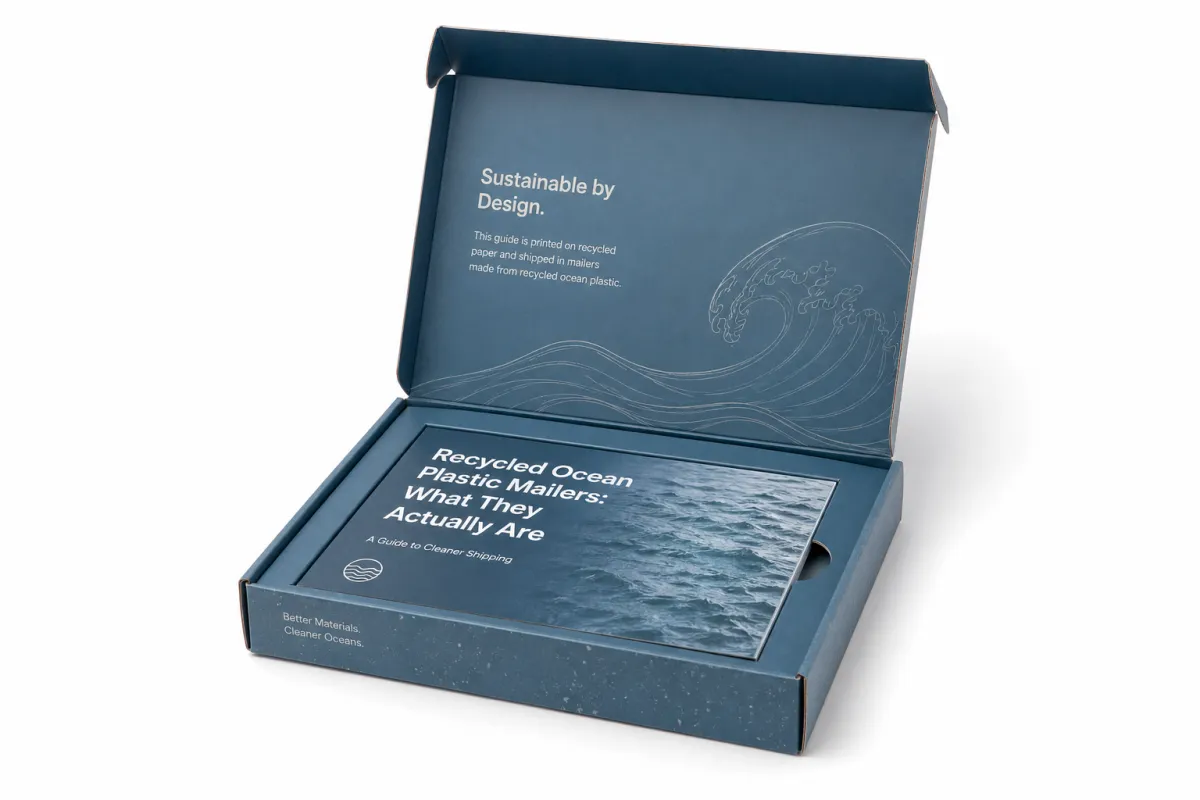
Recycled ocean plastic mailers are flexible shipping mailers made from plastic collected from coastal, shoreline, or ocean-bound waste streams, then processed into new film. That film is cut, sealed, and printed much like standard poly mailer stock. The distinction lives in the feedstock, not the shape. A useful guide to recycled ocean plastic mailers starts there because the package only matters once it leaves the press and enters the shipping system.
A lot of buyers hear "ocean plastic" and expect a material with unusual strength or some kind of environmental bonus point system. That is not how it works. The value comes from verified recovery, usable resin quality, and predictable behavior during transit. A poorly made eco mailer still fails like any other bad mailer. It just fails with better branding. A serious guide to recycled ocean plastic mailers separates the sustainability claim from the transport claim.
The terminology can blur quickly. "Ocean plastic," "ocean-bound plastic," and "marine plastic" are often used interchangeably in marketing, even though they do not always describe the same source stream. Sometimes the material was collected before it reached water. Sometimes it came from land-based waste that was likely to enter waterways. That difference matters. Ask what was recovered, where it came from, and what percentage of the final film is actually recycled content. A strong guide to recycled ocean plastic mailers does not let the label do all the talking.
Compared with paper mailers, recycled ocean plastic mailers usually handle moisture better and offer more forgiveness around sharp product corners. Compared with compostables, they are less dependent on industrial composting infrastructure and are often easier to seal consistently. Compared with virgin plastic, they can reduce demand for new fossil feedstock, though the climate picture changes with transport distance, manufacturing efficiency, and collection method. A guide to recycled ocean plastic mailers should stay practical before it becomes ideological.
The real buying question is not whether the material is green enough for a homepage badge. It is whether the mailer protects the product, prints clearly, and fits the budget without triggering returns. Thickness, closure type, size, and order volume matter before the sustainability story does. A useful guide to recycled ocean plastic mailers keeps the focus on the shipping route, not the mood board.
A mailer that looks responsible but fails in transit is expensive theater with a recycling claim.
Soft goods, apparel, small accessories, and boxed items that do not need a rigid carton are usually a good fit. Jagged, heavy, or high-compression products are a different story unless the film is thick and the seal is reliable. That is why the guide to recycled ocean plastic mailers begins with sustainability and quickly turns into a fit-for-purpose check.
How Recycled Ocean Plastic Mailers Are Made
The production chain usually begins with collection and sorting. Waste is gathered from shorelines, coastal cleanup programs, or waste streams considered at risk of reaching the sea. Contaminants, labels, and mixed materials are removed before the resin stream moves forward. That stage carries a lot of weight in a guide to recycled ocean plastic mailers, because quality is either preserved there or quietly damaged.
Contamination is the weak point. Too much residue, too many mixed polymers, or inconsistent input can produce cloudy film, weaker seals, odd odor, or an unpredictable tear profile. A supplier can say "recycled ocean plastic" all day long, but messy feedstock still behaves like messy feedstock. A careful guide to recycled ocean plastic mailers asks about wash stages, filtration, and how batch variation is handled.
Once the pellets are ready, the material is extruded into film. That film is often blended with other recycled or compatible material to keep flexibility and sealing performance where it needs to be. The sheet is then cut to size, adhesive is applied, and the surface may be printed using flexographic or gravure methods. A grounded guide to recycled ocean plastic mailers treats the package like what it is: a manufactured product with tolerances, not a slogan wrapped in plastic.
Transparency matters here. Ask for chain-of-custody documentation, source information, and any third-party verification tied to recycled content or ocean-bound claims. If the supplier can point to a recognized standard, that is useful. If the paperwork is missing, treat the claim cautiously. The same discipline you would expect from FSC paperwork on paper packaging or from shipping test protocols linked to ISTA test standards belongs here too. A solid guide to recycled ocean plastic mailers treats verification as part of the product.
Appearance gives clues as well. Recycled film can show slight tonal variation, a softer gloss, or a more matte finish than virgin material. That is normal. Strong chemical odor, poor print adhesion, or weak seals are not normal. A sharp guide to recycled ocean plastic mailers tells buyers to judge the sample by shipping behavior and shelf presence, not by whether it looks identical to the cheapest white mailer on the market.
Performance lives in the thickness. Film weight, usually measured in microns or mils, affects puncture resistance and the feel of the package. A 60-70 micron film can work for lightweight apparel and accessories. A heavier 80-100 micron film is a safer bet for products with corners, friction, or return use. The guide to recycled ocean plastic mailers version of that truth is simple: the resin story matters, but thickness and seal strength decide whether the package survives the route.
One more thing that gets missed in marketing copy: ocean plastic content does not automatically mean higher recycled content across the whole mailer. Some products use a blend, and the final package may include only a portion of ocean-bound resin alongside other recycled or virgin-compatible ingredients. That is not automatically bad. It just means the buyer needs the spec sheet, not a vibe.
Guide to Recycled Ocean Plastic Mailers: Cost and Pricing Factors
Price is where buyers either stay disciplined or start chasing a story. A recycled ocean plastic mailer usually costs more than a basic virgin poly mailer, especially at lower quantities, because the feedstock is more specialized and the supply chain is less commoditized. Paper changes the comparison again, since paper mailers can run higher or lower depending on size, seam reinforcement, and print coverage. A practical guide to recycled ocean plastic mailers should compare categories, not just one unit price pulled out of context.
| Mailer Type | Typical Use | Ballpark Unit Cost | What Drives the Price |
|---|---|---|---|
| Stock virgin poly mailer | Basic e-commerce shipping | $0.06-$0.14 | Volume, size, and plain stock availability |
| Custom recycled-content poly mailer | Branded shipments with moderate sustainability goals | $0.10-$0.22 | Print coverage, film thickness, and order quantity |
| Recycled ocean plastic mailer | Brand-led sustainability messaging with shipping durability | $0.18-$0.40 | Resin sourcing, certification, size, and custom print |
| Paper mailer | Dry goods, lighter apparel, short transit windows | $0.14-$0.35 | Paper grade, reinforcement, print, and liner details |
Those ranges are working figures, not a fixed market law. They fit brands ordering in the low thousands rather than giant pallet quantities. On a 5,000-piece custom run, a recycled ocean plastic mailer might land around $0.18 to $0.28 per unit for a simple one-color print and standard size, then drift toward $0.30 to $0.40 when the order adds larger dimensions, heavy ink coverage, or special construction. A serious guide to recycled ocean plastic mailers should say "depends on spec" instead of pretending the factory has one price for every question.
The cost drivers are straightforward and easy to underestimate. Resin availability affects pricing because the feedstock behaves less like a standard commodity. Print coverage matters because full-front branding uses more ink and more setup time. Thickness changes both material cost and protection. Custom dimensions add cutting and tooling. Volume shifts the math because setup costs get spread across more units. The guide to recycled ocean plastic mailers version of pricing is not "how much per bag?" It is "what combination of choices makes the factory do more work?"
Hidden costs can make a quote look better than it is. Artwork proofs, plate or setup fees, sample runs, freight timing, rush production, and storage all show up eventually. If a launch date is fixed and the order ships by air instead of sea, landed cost can jump sharply. A useful guide to recycled ocean plastic mailers keeps the focus on landed cost, not just the number printed on a quote sheet. That is especially true for recycled-content packaging, where verification and lead time can change the final math.
The premium makes sense when packaging is part of the brand presentation, when the product needs moisture protection, or when a customer audience pays attention to the box before they ever open it. Savings usually come from simpler print, more standard sizing, and ordering only what the warehouse can use on schedule. If you need a baseline comparison, reviewing Custom Poly Mailers first is a practical way to separate branding cost from recycled-content cost. That is the unglamorous part of a guide to recycled ocean plastic mailers, and unglamorous is often where the savings live.
Timing carries its own cost. A supplier may need extra time to source a specific resin blend or verify a recycled-content claim. Paying a little more for a dependable run is often cheaper than dealing with stockouts, delayed launches, or replacement shipments. The guide to recycled ocean plastic mailers mindset is blunt: spend more where failure hurts, save where customers will never notice the difference.
From a buyer's point of view, a quote should be read like a contract, not a teaser. Ask what is included, what is not, and which line item is gonna move if you change the size by half an inch. That sounds small. It is not. Half an inch can shift material use, freight carton count, and even the seal area. Packaging math is annoyingly precise like that.
Recycled Ocean Plastic Mailers Process and Timeline
The order process starts with a brief. Send product dimensions, weight, target mailer size, print concept, and expected monthly volume. Good suppliers ask for the product size before they quote because a 6 x 9 mailer and a 10 x 13 mailer are different on material usage, shipping Cost, and Production setup. A practical guide to recycled ocean plastic mailers starts with the item being shipped, not with the artwork.
Sampling comes next. Stock samples can arrive quickly, sometimes in a few days. Custom samples take longer because the film, print, and adhesive all need setup time. Simple projects may take 3-7 business days. Custom print or custom sizing usually needs 7-15 business days. A guide to recycled ocean plastic mailers should not promise a polished same-week turnaround unless the supplier already has usable stock on hand.
After sample approval, production begins. Artwork setup, plate making, color matching, and material procurement happen here. Manufacturing itself may take 10-18 business days depending on volume and complexity. Freight sits on top of that. A domestic or imported order can easily land in the 3-6 week range, sometimes longer if shipping lanes are busy. A plainspoken guide to recycled ocean plastic mailers says it clearly: the film does not usually take forever, but the order cycle can.
Artwork revisions are the common delay. Custom sizing can add more. Lower-volume orders often move slower because factories prioritize larger runs. Certification checks may also slow the schedule, especially when recycled-content or chain-of-custody paperwork needs to be assembled. Freight has its own temperament too. Ocean shipping costs less than air, but speed is not its selling point. A realistic guide to recycled ocean plastic mailers helps buyers plan around the bottlenecks before those bottlenecks turn into excuses.
Timing matters if the packaging supports a seasonal drop, subscription cycle, retail launch, or influencer push. Build in room for one round of sample feedback and one production buffer. Stock items are safer when the deadline is tight. Custom runs are worth the wait when the design is part of the customer experience and the calendar allows space. That is the practical version of a guide to recycled ocean plastic mailers: choose the path that fits the schedule, not the one that makes the spreadsheet look ambitious.
For brands that have never ordered this category before, the biggest surprise is usually not the production time. It is the number of decisions that happen before production starts. One change in size can affect board-feel, artwork fit, carton packing, and shipping cost. The timeline is really a chain of small approvals, and if one link slips, the whole order moves.
Step-by-Step Guide to Choosing the Right Mailer
Start with the product, not the packaging trend. Weight, shape, corner sharpness, fragility, and return risk all belong in the first round of questions. A small box with hard edges behaves differently from soft apparel. Glass, metal, and dense accessories can create puncture points. If customers might return the item, the mailer may need a second adhesive strip or a design that can be reused. A solid guide to recycled ocean plastic mailers begins with those practical checks because they set the spec before the marketing story does.
Next comes size and thickness. Light apparel can often work in a 60-70 micron mailer. Heavier garments, boxed accessories, and products that shift in transit usually need 80-100 micron film. If the item is awkwardly shaped, a slightly larger mailer is better than forcing a tight fit. Overstuffed mailers fail in familiar ways: split seams, poor adhesive contact, and distorted gussets. A practical guide to recycled ocean plastic mailers favors fit and seal over squeezing the cheapest size into the cart.
Print method matters more than many teams expect. Flexographic printing works well for larger runs and clean, simple artwork. Detailed art and full-color effects may require a different approach, and not every recycled film behaves the same with every ink setup. Ask for a printed sample if brand color accuracy matters. A buyer-focused guide to recycled ocean plastic mailers does not accept a mockup as proof that the final package will look right.
Request samples in more than one thickness if the supplier can provide them. Place the actual product inside. Drop the package from waist height. Rub the print with a dry cloth. Check the adhesive twice. Open one and reseal it if the design supports returns. Those are boring tests, and boring tests save money. A real guide to recycled ocean plastic mailers does not stop at a flat sample on a desk.
Supplier claims deserve scrutiny. Ask what percentage of the material is recycled ocean-bound content, what test data is available, and whether a third party verifies the source. Ask for minimum order quantity, lead time, and re-order consistency in writing. If you need a wider packaging comparison, Custom Packaging Products can help you check whether a mailer, box, or insert system fits the shipping flow better. The best guide to recycled ocean plastic mailers gives you a decision path, not a slogan.
Use this checklist to move from shortlist to purchase order:
- Confirm product dimensions, weight, and any sharp edges.
- Select mailer size and thickness based on real transit risk.
- Request samples in at least two film weights if available.
- Review print quality, seal strength, and odor or surface variation.
- Ask for recycled-content documentation and lead time in writing.
- Check minimum order quantity, freight method, and re-order consistency.
Follow that sequence and the guide to recycled ocean plastic mailers stops being abstract. It turns into a spec sheet with a budget attached, which is where packaging decisions belong.
There is also a quieter advantage to this method. It makes cross-functional decisions easier. Operations cares about speed, marketing cares about appearance, and finance cares about landed cost. A test-based selection process gives all three teams something concrete to react to instead of arguing over a rendering.
Common Mistakes When Buying Recycled Ocean Plastic Mailers
The first mistake is assuming every ocean-plastic claim means the same thing. It does not. Some suppliers mean coastal waste, some mean ocean-bound material, and some mean a blend where the recycled portion is smaller than the headline suggests. Without percentages and documentation, you are buying a story rather than a specification. A careful guide to recycled ocean plastic mailers should make that distinction hard to ignore.
The second mistake is choosing the thinnest option to save a few cents. Cheap mailers become expensive when they split, trigger returns, or force replacement shipments. A saving of 0.02 or 0.03 dollars per unit vanishes quickly if even a small percentage of orders arrives damaged. In practice, the guide to recycled ocean plastic mailers answer is often thicker film, not thinner film, because waste costs more than material.
The third mistake is focusing only on the sustainability claim and ignoring the shipping behavior of the package. Seal strength matters. Rub resistance matters. Puncture resistance matters. Odor matters if the product is premium or textile-based. When a mailer arrives scuffed or the seal lifts under pressure, customers do not applaud the sourcing effort. They notice the failure. A realistic guide to recycled ocean plastic mailers puts performance ahead of packaging poetry.
The fourth mistake is ordering too late. A supplier may need 3-6 weeks, including freight, and a rushed order usually costs more. Rushed freight costs even more. The guide to recycled ocean plastic mailers version of this advice is plain: the calendar wins every argument.
Ask for a sample with the actual product inside, not a cotton puff or empty shell. Packaging fails under load, not in theory.
The fifth mistake is testing the wrong thing. A light sample will not tell you how the mailer behaves with a dense product, a boxy edge, or a customer return. Real shipping tests matter. Even a simple in-house drop test and short transit simulation reveals more than a pile of polished mockups. A smarter guide to recycled ocean plastic mailers looks at the whole path: packing, sealing, sorting, and delivery.
The sixth mistake is letting branding override the mechanics. A matte black mailer may look strong on screen and still show scuffs, scratches, or color shift in production. A natural translucent film may be easier to print and still miss the luxury feel a brand needs. Tradeoffs always show up somewhere. The guide to recycled ocean plastic mailers approach is to decide which tradeoff customers will actually notice and which one they never will.
The seventh mistake is assuming sustainability language covers compliance. It does not. If your packaging claims are public, they should be supportable with documentation that can survive a customer question or an internal audit. That part is not glamorous, but it is the difference between a marketing angle and a defensible procurement decision.
Expert Tips and Next Steps
Order two or three samples with different thicknesses if the supplier can support that. Load them with the actual product, rub the print, inspect the seal, and run a short transit test. Twenty minutes of hands-on checking can reveal more than a dozen photos. That is the kind of fieldwork a guide to recycled ocean plastic mailers should recommend because the result is usually obvious and rarely polite.
Ask for exact recycled-content documentation before comparing price alone. A lower quote with vague claims is not a better quote. It may simply be less precise paperwork paired with more shipping risk. Ask for lead times in writing, sample timing, and whether reorders will match the same spec. A disciplined guide to recycled ocean plastic mailers is mostly about avoiding surprises.
Run a small pilot order before committing to a full rollout, especially if the product is fragile, variable in size, or sold in seasonal bursts. A pilot of 500 to 2,000 pieces is often enough to expose seal issues, print inconsistencies, or handling problems. If the pilot passes, scale up. If it does not, adjust the spec while the mistake is still cheap. That is where the guide to recycled ocean plastic mailers becomes useful in the real world: it keeps a rollout from turning into a public lesson.
Build a decision matrix and keep it plain. Price, shipping protection, print quality, recycled-content documentation, and reorder stability can each get a score from 1 to 5. Weight the categories based on what matters most to the brand. A fragile premium product may care more about performance than the sustainability badge. An audience that reads packaging closely may care more about documentation than a small price gap. A practical guide to recycled ocean plastic mailers turns a messy debate into something a team can sign off on.
Compare the mailer against the rest of the packaging stack, not just against another mailer. Sometimes the right move is a stronger insert, a different closure method, or a slightly more rigid package. Packaging should protect the item and support the brand story at the same time. The guide to recycled ocean plastic mailers is not about forcing every shipment into one material; it is about choosing the material that does the job best.
For brands that want to move quickly without buying blind, the next steps are direct: define the product specs, collect two or three quotes, request printed samples, verify recycled-content documentation, and test the mailers in a real shipping flow before scaling. That path is less dramatic than a glossy launch deck. It also tends to work.
If you are making the call internally, keep the decision simple: choose the mailer that meets the product's protection needs first, then verify the sustainability claim, then lock the lead time. That order is not fancy, but it is how the good shipments stay good.
Frequently Asked Questions
Are recycled ocean plastic mailers better than regular poly mailers?
They can be a better choice if a brand wants to reduce demand for virgin plastic and source from recovery-based material streams. Performance still depends on thickness, resin quality, and seal strength. A well-made standard poly mailer can outperform a badly made eco option, which is why a guide to recycled ocean plastic mailers should never treat sustainability as a substitute for testing. The right choice usually comes down to shipping needs, brand positioning, and budget.
How much more do recycled ocean plastic mailers cost?
Expect a premium over basic stock poly mailers, especially for smaller orders or custom print runs. The gap often narrows at higher volume and widens when custom sizing, heavy print coverage, or special documentation enters the quote. A useful guide to recycled ocean plastic mailers compares landed cost, not just unit cost, because freight, proofing, and setup fees can shift the final number quickly.
How long does it take to produce recycled ocean plastic mailers?
Sampling can take a few days to a couple of weeks depending on whether the design is stock or custom. Production timelines are often measured in weeks rather than days, and freight can add more time if the order moves by ocean or consolidated shipping. In a practical guide to recycled ocean plastic mailers, the common bottlenecks are artwork approval and supplier verification, not the film itself.
What should I ask a supplier before ordering recycled ocean plastic mailers?
Ask what portion of the material is recycled ocean-bound content and whether any certifications or documentation are available. Ask for minimum order quantities, lead times, print options, and sample availability before mass production. Ask about puncture resistance, seal performance, and how the mailer behaves under real shipping conditions. If the answers are vague, the guide to recycled ocean plastic mailers answer is simple: keep looking.
Can recycled ocean plastic mailers be customized with branding?
Yes, most can be printed with logos, messaging, and shipping details using standard packaging print methods. The final result depends on film color, print coverage, and how much recycled content affects surface consistency. If branding matters, request a printed sample first so you can check legibility and color accuracy before placing a full order. That last step is where a guide to recycled ocean plastic mailers turns into a purchasing tool instead of a wish list.
Do recycled ocean plastic mailers always contain plastic recovered from the ocean?
Not always. Some use material that was recovered from coastlines or from waste streams that were likely to reach the ocean, which is why the exact source description matters. The claim can be accurate and still incomplete if the supplier does not explain the collection method and recycled-content percentage. A trustworthy guide to recycled ocean plastic mailers treats the label as the starting point, not the proof.


