Buyer Fit Snapshot
| Best fit | Poly Mailers Affordable projects where brand print, material claims, artwork control, MOQ, and repeat-order consistency need to be specified before quoting. |
|---|---|
| Quote inputs | Share finished size, material target, print colors, finish, packing count, annual reorder estimate, ship-to region, and any compliance wording. |
| Proofing check | Approve dieline scale, logo placement, barcode or warning zones, color tolerance, closure strength, and carton packing before bulk production. |
| Main risk | Vague material claims, crowded artwork, missing packing details, or unclear freight terms can make a low unit price expensive after revisions. |
Fast answer: Poly Mailers Affordable: Bulk Pricing, Specs, and Options should be specified like a repeatable production item. The safest quote records material, print method, finish, artwork proof, packing count, and reorder notes in one written spec.
Production checks before approval
Compare the actual filled-product size with the drawing, then confirm tolerance on folds, seals, hang holes, label areas, and retail display edges. Reserve space for logos, QR codes, warning copy, and material claims before decorative graphics fill the panel.
Quote comparison points
Review material grade, print process, finish, sampling route, tooling charges, carton quantity, and freight assumptions side by side. A quote is only useful when the supplier can repeat the same color, closure quality, and packing count on the next order.
I still remember a supplier in Shenzhen sliding a quote across the table: 8 cents a bag for what looked like Poly Mailers Affordable. Twenty minutes later, the real number was 11.6 cents after freight from Yantian port, plate charges, and a 3% defect allowance. I nearly laughed because the spreadsheet had started out looking so tidy, and then it promptly tried to lie to me. That gap is exactly why I start with landed cost and treat "cheap" as a question, not a conclusion.
Anyone who buys packaging for a living has seen the trick. The lowest line item usually hides somewhere else: weak seals, oversized cartons, reorders after a seam split, or a 30-day delay because the artwork file was wrong from the start. I have watched brands save $400 on the quote and spend $1,900 replacing damaged shipments, especially on apparel routes from Dongguan to Los Angeles where cartons get handled three or four times. That is not savings. That is accounting with a bruise on it. Honestly, the bruise is usually bigger than people want to admit.
For poly mailers affordable deals that actually hold up, I look at the product, the shipping route, and the failure rate. A 2.5 mil mailer for a 6-ounce T-shirt is one thing. A 1.8 mil bag for a hoodie with a zipper is another. The target is straightforward: predictable cost per shipment, steady seal strength, and enough tear resistance to survive carrier handling in Guangdong, Southern California, or anywhere a parcel gets tossed around a loading dock. If the parcel can survive being dragged, stacked, and occasionally offended by weather, we are in the right neighborhood.
Custom Logo Things gets a lot of requests from brands that want the headline price to look tiny. Fair enough. I have sat through those meetings too, nodding politely while somebody says, "Can we shave another penny?" as if a penny has never caused a problem in its life. After enough factory visits in Shenzhen, Ningbo, and Wenzhou, and enough freight surprises, one thing becomes obvious: poly mailers affordable is not about finding the thinnest film that can make the trip. It is about paying the right amount for the right spec, then shipping with fewer mistakes.
What Makes Poly Mailers Affordable Without Sacrificing Quality?
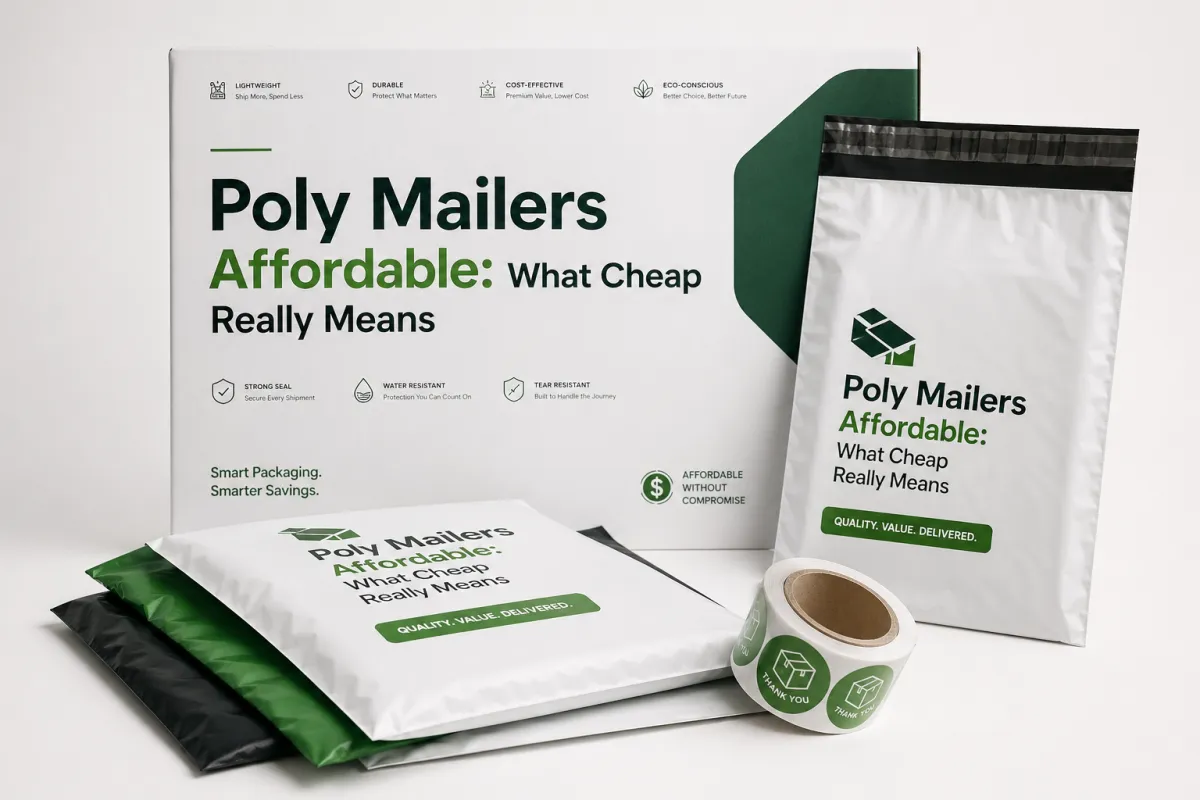
There is a reason I start with landed cost instead of the quote. A bag that looks cheap on paper can become expensive once freight, defects, rework, and labor enter the room. That is the whole point of poly mailers affordable: not the lowest sticker price, but the lowest reliable cost per shipment. If the mailer protects the product, fits the route, and reduces handling headaches, it is affordable in the only sense that matters.
The best price usually comes from three disciplined choices: standard sizing, the right film thickness, and simple artwork. Those are the unglamorous answers. They also work. A 2.5 mil LDPE mailer for light apparel, a standard 10 x 13 inch format, and one-color print can keep the order efficient without undercutting durability. That is how poly mailers affordable stays readable to finance and usable in the warehouse. The bag should do its job quietly. The quote can be the loud part.
Once you start chasing "cheap" in a vacuum, the math gets slippery. A lighter bag may cut a fraction of a cent, but if it slows packing, tears at the seam, or forces re-ships, the savings vanish. I have seen a 1-cent reduction in unit price produce a 14% increase in customer service labor. That is why the most poly mailers affordable option is often the one that looks slightly boring and performs exactly as expected. Boring packaging is underrated. It usually means the warehouse is having a better day.
I still remember one brand insisting that a thinner film would be "good enough" because the items were soft. Soft is not the same as harmless. Buttons, zippers, hems, and corners still punish weak film. If the route includes conveyor belts, cold docks, or rain exposure, the bag needs enough strength to survive real handling. The smartest poly mailers affordable decision is the one that prevents the hidden second invoice: replacements, refunds, and the inevitable apology email no one wants to write.
Poly Mailers Affordable: What Cheap Really Means
On a factory floor, cheap is easy to quote and hard to defend. I once stood beside a blown-film line in Dongguan while the operator checked thickness with a micrometer at six points across the web. The buyer wanted poly mailers affordable at the lowest unit price possible, but the first sample failed a drop test after the seal split near the edge. The second sample, built at 3.0 mil instead of 1.8 mil, added about $0.004 per unit in resin and saved the account from repeat shipments. That tiny adjustment looked boring on paper and heroic in practice.
The gap between unit price and actual landed cost is where most people get burned. A bag at $0.08 each sounds better than $0.11 each until you add ocean freight, a 2% defect allowance, 1,000 reprints, and the labor cost of packing replacements. I have seen the math on a 10,000-piece run from Shenzhen to Chicago: the "cheap" option ended up 17% more expensive because the adhesive strip was weak and the cartons had to be repacked. That is why poly mailers affordable should mean lower total cost, not just a clean-looking quote. If the invoice looks elegant but the warehouse hates it, you did not buy smart. You bought stress with a logo on it.
Shipping math matters too. A lighter mailer can reduce dimensional weight, but only if the size fits the product and the item does not need extra padding. A 10 x 13 inch mailer for a folded tee is efficient. A 14 x 19 inch bag for the same shirt is wasted film, wasted freight, and wasted shelf space. I have watched procurement teams chase a 1-cent savings per unit while paying 6 cents more in unnecessary volume. Finance notices that kind of drift. So does the person stacking cartons at 5:45 p.m. in a warehouse outside Ningbo who really did not want to carry the extra weight.
The mistake I see most often is painfully familiar: buyers choose the thinnest spec because the quote looks tidy, then they pay for replacements later. Straight answer? If a product has hard edges, zippers, buttons, or any chance of snagging, 1.5 mil is not a serious choice. For poly mailers affordable orders, I would rather see a brand spend an extra $120 on stronger film than lose $1,200 handling customer complaints and remails. That is not me being dramatic. That is me having seen the same invoice pattern too many times, especially on direct-to-consumer apparel shipped from Guangdong to California.
Buy for the shipment, not the spreadsheet. If the bag survives conveyor belts, warehouse tossing, and a small rain event on the porch, you win. If it splits at the corner or the adhesive fails in cold weather, the original quote becomes background noise. I learned that during a winter sample run for a Midwest apparel client; the seals were fine in the factory at 26 C, then they went brittle in a 4 C receiving dock in Chicago. The buyer kept saying, "But it passed here." Yes. That is exactly the problem. Packaging does not live in the factory. It lives in trucks, docks, and porches with bad weather and worse timing.
Poly Mailers Affordable in Bulk: Sizes, Thickness, and Materials
For poly mailers affordable bulk buying, the first choice is the base material. White, black, clear, and frosted are the common options, and each one has a job. White hides print variations well and feels clean for apparel. Black gives better opacity for privacy. Clear works for visual presentation, although it is less forgiving if the item inside is uneven. Frosted sits in the middle and usually feels a little more premium without pushing the budget too far. I have a soft spot for frosted film because it looks more deliberate than plain white without acting like it deserves a standing ovation.
Thickness matters more than most first-time buyers expect. Standard choices usually sit around 2.0 mil, 2.5 mil, 3.0 mil, and 4.0 mil, with heavier gauge options available for items that have corners or more weight. For lightweight accessories and folded tees, 2.5 mil is often enough. For hoodies, fleece, or multi-item bundles, I usually push toward 3.0 mil because puncture resistance improves and the seal gets a safer margin. If a buyer tells me they want poly mailers affordable and also wants fewer claims, I already know where the conversation is heading. It is the packaging version of saying, "I want the car to be cheap and also never need tires."
Size selection is where money leaks quietly. A 9 x 12 inch mailer can fit a single tee or a small accessory set. A 10 x 13 inch bag works well for most standard apparel orders. A 12 x 15.5 inch option handles heavier shirts and some light sweatshirts. A 14 x 19 inch mailer is better for bulkier folded garments, but only if the product actually needs it. I have seen brands buy oversized bags because they "wanted room," then spend more on film and freight for the privilege. That is not poly mailers affordable; that is paying rent for empty space. Empty space is expensive. Packaging taught me that long before real estate did.
Write the performance details into the spec sheet. Ask for tear resistance, seal adhesive strength, opacity level, and waterproofing behavior. A poly mailer should resist light rain, protect against dust, and hold its seal from dispatch to doorstep. It should not peel open if the parcel gets dragged across a belt or tossed into a tote. If you need return use, ask for a dual adhesive strip and a tear perforation. If you need more durability, reinforce the seams. These details usually matter more than a fancy print layout for poly mailers affordable bulk orders. Fancy print is nice. A closed seam is nicer.
When I visited a packing line for a subscription brand in Suzhou, the team was using the wrong bag width by just 1 inch. That tiny mistake caused the mailers to curl, slowed packing by about 12 seconds per unit, and added almost two labor hours per 1,000 orders. We switched to a better size and the line moved better. Same product. Same design. Better fit. That is the kind of detail that makes poly mailers affordable without turning the warehouse into a bottleneck. Twelve seconds sounds trivial until you multiply it across a month and suddenly the clock is glaring at everyone.
Common material choices
If you want to compare options quickly, I usually narrow it to five buckets: white LDPE, black LDPE, clear LDPE, frosted LDPE, and custom-printed versions of the same. LDPE is the workhorse because it balances cost, flexibility, and seal performance. For poly mailers affordable buyers, that is the sweet spot. I have had brands try compostable film too early, then discover the cost jump and shelf-life constraints were not worth it for a basic apparel shipper. Sustainability matters, absolutely, but I do not like pretending every product needs a hero arc. For a simple tee shipment, a 50 to 60 micron LDPE film often does the job better than a fancier material that adds 18% to the quote.
| Option | Typical Size | Thickness | MOQ | Approx. Unit Price | Best Use |
|---|---|---|---|---|---|
| Stock white mailer | 10 x 13 in | 2.5 mil | 5,000 | $0.09-$0.13 | Tees, socks, light accessories |
| Stock black mailer | 12 x 15.5 in | 3.0 mil | 5,000 | $0.12-$0.18 | Hoodies, darker branding, privacy shipping |
| Custom printed 1-color | 10 x 13 in | 2.5 mil | 10,000 | $0.15-$0.26 | Branding on a controlled budget |
| Custom printed full coverage | 14 x 19 in | 3.0 mil | 10,000 | $0.22-$0.38 | Premium presentation and stronger visual impact |
| Return-style dual adhesive | 14 x 17 in | 3.0-3.5 mil | 5,000 | $0.18-$0.30 | Brands that need reuse and easy returns |
The table above is not a promise. It is a realistic starting range based on common factory quoting patterns from Guangdong, Zhejiang, and Fujian, and freight can move the final invoice by a few cents depending on carton count and destination. Still, it gives you something better than a vague "contact us for pricing" page. For poly mailers affordable decisions, a clean reference point saves time. It also saves that awkward moment when somebody says, "Wait, I thought we were talking about stock prices," and the room goes quiet.
For teams that need broader packaging support, I often point them to Custom Packaging Products because the mailer is usually one part of the kit, not the whole brand system. If the outer bag is right but the insert card, sticker, or pouch is off by a mile, the customer still feels the mismatch. That is a very expensive kind of inconsistency for poly mailers affordable programs. The customer may not know why the experience feels strange, but they know it feels strange. Humans are annoyingly good at sensing mismatch, especially when the outer bag cost $0.17 and the insert card was printed on 350gsm C1S artboard for a totally different tone.
Poly Mailers Affordable Pricing: MOQ, Tiers, and What Changes Cost
MOQ changes everything. A 2,000-piece request and a 20,000-piece request do not live in the same pricing universe. On poly mailers affordable bulk orders, the first price break usually comes from spreading setup cost, film waste, and printing prep across more units. That is why a small batch can feel stubbornly expensive even when the bag itself is simple. The factory is not being dramatic; it is just math. Unromantic math, but math all the same.
Here is the structure I see most often: stock bags at low MOQ, custom print at medium MOQ, and deeper savings once the run gets large enough to flatten setup costs. A standard unprinted mailer may be available at 5,000 pieces, while a custom one-color run might start at 10,000. Once you move to 30,000 or 50,000 pieces, the unit price usually drops again because the tooling, labor, and ink setup are diluted. That is how poly mailers affordable becomes truly affordable instead of merely "less bad." It is the difference between a coupon and a real reduction.
What actually moves the price? Size, film thickness, ink coverage, number of colors, adhesive type, and any add-ons like perforation or dual sealing. A 1-color logo on a white 2.5 mil bag is far easier to quote than a full-surface print on a black 3.0 mil bag with a return strip and custom warning text. I once negotiated with a supplier in Dongguan who wanted to charge separately for a second ink pass on a 4-inch logo. We cut the design to one color, shifted the placement, and saved $0.018 per unit on a 12,000-piece order. Eighteen thousandths of a dollar. Multiply that by volume and suddenly everybody sits up straighter.
Setup fees also matter. Plates for flexographic printing, artwork preparation, and color matching can add $80 to $250 per color, depending on the factory in Shenzhen or Jiaxing and the complexity. Freight can move the total just as fast, especially if the shipment is air-shipped because somebody needed the bags yesterday and forgot to mention that during quote collection. I have seen a nice-looking rate turn ugly after the client added an urgent airfreight request from Shenzhen to Los Angeles. The bags were still poly mailers affordable on paper, but the shipping line item told a different story. Freight has a talent for turning optimism into paperwork.
For buyers comparing tiers, I usually recommend asking for at least three scenarios: stock, basic custom, and premium custom. That comparison exposes the real break-even point. If stock bags are $0.11, a simple one-color custom run might be $0.17, and a full-coverage premium version may be $0.29. Once you see those numbers side by side, the budget conversation gets much cleaner. The bad habit is choosing a quote without seeing the middle option. That is where people overpay for artwork they do not need or underpay for a spec that will fail in transit. Middle options are boring. They are also where the money usually lives.
There is one more pricing issue most buyers miss: hidden waste. If the bag is 2 inches too long, you might pay more per unit and pack slower. If the print area is too large, ink coverage eats margin. If the adhesive strip is overbuilt for your product, you are paying for extra performance you will never use. Poly mailers affordable does not mean stripping out every useful feature. It means removing waste while keeping the functional parts that protect your order and your brand. That distinction sounds subtle until you are the one paying for 40,000 extra inches of film from a factory in Zhejiang.
I also tell clients to ask for clear payment terms and shipping terms before they approve anything. A quote that assumes EXW can look great until you add local trucking, export docs, and destination handling. A quote with DDP may look higher but can save time and reduce surprises. The same bag can feel 20% cheaper or 20% more expensive depending on who is carrying which leg of the trip. That is why I repeat the phrase poly mailers affordable in the quote call, not just in the headline. If the terms are fuzzy, the savings are probably doing yoga somewhere.
What you can save on
There are smart savings and lazy savings. Smart savings look like choosing a standard size, sticking to one ink color, and using the factory's existing film width. Lazy savings look like cutting thickness below the product's need and hoping the carrier is gentle. It never is. For poly mailers affordable purchasing, I will always choose standard tooling, simple artwork, and the narrowest safe film gauge before I touch seal quality. If the line item gets lower but the claim rate gets higher, you did not save anything. You postponed the bill.
What usually increases cost
Wide print coverage, multiple colors, metallic inks, dual adhesive strips, tear lines, frosted film, and non-standard dimensions all raise the number. So does rush work. So does reproofing artwork because a logo was sent as a low-resolution screenshot. I have seen a buyer lose two days because the file was 600 pixels wide and the factory in Guangzhou could not clean it up without redrawing the mark. That kind of delay is expensive, and for poly mailers affordable jobs, delay can matter more than a penny in resin. I have also seen people send a logo captured from a Slack preview. That was not ideal. The factory, to its credit, was less amused than I was.
How the Order Process Works: Proofs, Sampling, and Timeline
The order process should be boring. Boring is good. For poly mailers affordable production, I want one quote request, one spec sheet, one proof round, one sample if needed, and one approval path. Anything else creates confusion. If three people are emailing changes to the artwork, the size, and the color in different threads, the order is already at risk. Packaging is not a group project with hidden bonus rounds. I have seen more delays caused by "just one more tweak" than by actual production problems, and those delays usually start with the same sentence.
My normal flow starts with the product details: bag size, film thickness, monthly usage, whether the print is single-color or full coverage, and where the order needs to ship. Then we send a proof. A proof is not a decorative PDF. It should show artwork placement, bleed, seal location, and the exact dimensions. For poly mailers affordable orders, I also ask for a plain sample or a physical reference if the brand is switching from another supplier. A 10 x 13 bag that looks fine on-screen can feel wrong in hand if the width is off by 0.5 inch. And yes, half an inch sounds tiny until you try to pack 8,000 units with it.
Sampling is worth the extra day or two. I once had a client approve a frosted mailer proof that looked beautiful, but the sample showed the opacity was too low for the black garment inside. We swapped to a darker base film and avoided a customer-facing issue that would have shown up in every unboxing video. That is why I keep saying poly mailers affordable is really about preventing expensive mistakes before they ship. No one posts a photo saying, "Look at this average bag." They post the failure. Packaging has a cruel way of becoming public only when something goes wrong.
Typical production timing depends on whether the order is stock or custom. Stock bags can move faster if they are already in the right size and color. Custom printed runs usually need a little more room for plate prep, color matching, and inspection. I generally tell clients to expect 12-15 business days from proof approval for a straightforward custom job, plus shipping time based on the route. If a buyer changes artwork after approval, the clock restarts in spirit, and sometimes in fact. That is not cruelty. That is manufacturing. It is also why I keep a small stack of coffee nearby during revisions, especially when the factory is in Ningbo and the client is in Austin.
On the logistics side, domestic shipments are simpler because the freight leg is shorter and tracking is easier. Overseas shipments need carton planning, export docs, and a little patience. If the order is going by sea, add buffer for port movement. If it is going by air, add budget for speed. For poly mailers affordable projects, I tell clients to decide early whether they want the lowest transit cost or the fastest dock date. You rarely get both at once. The ocean is not known for its urgency, and the airfreight invoice from Shenzhen to New York is never shy about reminding you.
"We thought a cheap mailer was fine until a 2% tear rate turned into 400 replacements. The second quote looked higher, but it was the only one that actually stayed cheap."
That line came from a client who moved into Custom Printed Mailers after two rounds of damage claims. I have heard versions of it from apparel brands, cosmetics sellers, and subscription companies in Chicago, Toronto, and London. The lesson is always the same: keep the approval path simple, check the sample before mass production, and keep one contact in charge. That is the cleanest way to get poly mailers affordable without manufacturing drama. It also saves everyone from the special kind of chaos that appears when three managers approve three different versions of the same bag.
Why Poly Mailers Affordable Orders Stay Reliable With Us
I do not like vague packaging promises. They are cheap in the worst way. At Custom Logo Things, the point is to keep poly mailers affordable while still checking the things that matter: seal strength, print clarity, dimension accuracy, and carton consistency. That is not marketing fluff. That is the difference between a product that gets reordered and one that gets quietly replaced after the first complaint. I care about the boring details because the boring details are usually what keep people employed, especially when the account is shipping 15,000 units a month from Guangdong to California.
Factory relationships matter because resin prices move, film suppliers change, and production schedules shift. If you do not have a real relationship with the line, you get the leftover answer. I have sat in supplier meetings where one late raw-material delivery in Dongguan changed three customers' timelines by a week. The teams with stronger relationships got priority because they had volume, history, and clear specs. That is why poly mailers affordable is not just a procurement phrase; it is a supply-chain strategy. It is also a reminder that being pleasant to suppliers is not a soft skill. It is a cost-control tactic.
We inspect practical things, not vanity metrics. Does the adhesive seal cleanly across the full closure line? Does the print hold registration across a 500-piece sample run? Is the width accurate within the tolerance needed to pack a 12-inch folded garment without bulging? Those checks protect your brand from the kind of problems that never show up in a shiny quote. I have seen a bag pass visual inspection and fail when stacked in a shipping carton because the side seams were inconsistent by 2 mm. One tiny mismatch can wreck a whole batch of poly mailers affordable shipments. Two millimeters is not much in life. It is a lot in packaging.
The accountability difference is real. A generic reseller often sits between the buyer and the factory, which means every question takes three emails and two time zones. I prefer a cleaner chain. Fewer handoffs mean fewer misunderstandings. If a client needs a size confirmation, a material spec, or a print revision, the answer should come from someone who has actually talked to production in Shenzhen or Xiamen. That is how we keep poly mailers affordable orders moving without turning them into paperwork theater. No one needs another spreadsheet pretending to be a project manager.
For buyers who want to compare packaging beyond mailers, I usually suggest reviewing the broader supplier options on our Custom Packaging Products page. If the order includes mailers plus inserts, tape, or accessory packaging, the whole system needs to line up. And if you want to look specifically at the base product, our Custom Poly Mailers listing covers the common dimensions and print paths we quote every week. That makes poly mailers affordable planning a lot less guessy. Less guessing, fewer surprises, fewer awkward calls where everybody pretends the missing information is "in transit."
For anyone who likes standards, I am a fan of using clear references instead of hand-waving. The testing language should at least echo practical packaging norms from groups like Packaging Alliance and shipping-performance expectations informed by ISTA. I am not claiming every mailer needs a full lab certification. I am saying the factory should know how to think about seal integrity, compression, and transit abuse. That mindset is what makes poly mailers affordable and dependable at the same time. Cheap film and good process can coexist, which is fortunate, because the alternative is a lot of apologetic emails.
Honestly, I think the best supplier is the one that tells you "no" on a bad spec. If a buyer wants a 1.8 mil film for heavy denim, I would rather lose the sale than ship a weak bag and pretend it is acceptable. That kind of honesty has saved me more accounts than any glossy brochure ever did. Good sourcing is not about saying yes faster. It is about saying yes to the right version of poly mailers affordable. The right answer is not always the cheapest one on the first screen. It is usually the one that survives reality.
Poly Mailers Affordable Use Cases for E-commerce Brands
Apparel is the obvious use case, but it is not the only one. poly mailers affordable packaging works well for T-shirts, leggings, socks, swimwear, small accessories, beauty accessories, and subscription refills that do not need rigid protection. The reason is simple: the bag is light, flexible, and quick to pack. A warehouse in Atlanta or Shenzhen can process hundreds of units an hour without hunting for void fill or waiting on box assembly. That kind of speed is not glamorous, but it pays the bills.
I have seen e-commerce brands cut shipping labor by 20% or more after switching from cartons to mailers for softer items. The savings do not just come from the mailer itself. They come from faster packing, less storage space, and lower freight weight. A well-sized mailer also reduces the chance of the parcel opening in transit because there is less empty air inside. For poly mailers affordable programs, that combination often beats a box all day long. Boxes are great when you need structure. For folded clothes, they can be overkill in a cardboard tuxedo.
Custom print adds branding value without adding much complexity if the design stays disciplined. A one-color logo, a return instruction, and a small brand message can make the package feel intentional without pushing the cost into nonsense territory. I worked with one streetwear label in Los Angeles that switched from plain gray mailers to a black bag with a white logo and a simple return strip. Their customer service team told me the return process got easier and the unboxing videos looked cleaner. That sort of practical brand lift is exactly why poly mailers affordable custom print keeps getting ordered. People like feeling something was designed on purpose. Wild concept, apparently.
Still, not every product belongs in a poly mailer. Glass jars, sharp-edged tools, heavy books, and anything with a real crush risk need more protection. You can make a mailer work for many things, but not every thing. I would never push a thin bag onto a product that needs rigid corner protection just because the unit price looks nice. That is how you create damage claims and angry emails. The right use case for poly mailers affordable is the one where the product fits the film, not the one where the procurement spreadsheet looks clever.
There is also the return-shipping angle. Dual adhesive strips and tear-away perforation are great for brands that expect repeat exchanges or size swaps. I have seen that feature save customer service time because the return path is obvious and fast. If your business has a 10% to 15% exchange rate, this is not a luxury. It is a workflow upgrade. And yes, it still fits within poly mailers affordable if you keep the print simple and the size standard. In fact, it may be cheaper than the pile of replacement emails you avoid.
One more thing people forget: storage. Five thousand mailers take up far less space than five thousand corrugated boxes. I watched a warehouse manager in Dallas reclaim an entire pallet bay after moving to flexible Bags for Small apparel orders. That freed space translated into better picking flow and fewer floor obstructions. Small operational wins like that are why I keep recommending poly mailers affordable packaging to brands that ship light goods at volume. Sometimes the real win is not the package itself. It is the breathing room around it.
Next Steps for Poly Mailers Affordable Orders
If you want a quote that is actually useful, gather four things before you ask for it: the exact bag size, the product weight, the monthly quantity, and the artwork file in a usable format. That sounds basic because it is basic. Yet half the delays I see on poly mailers affordable jobs come from missing dimensions or a logo file that only exists as a screenshot. Good sourcing starts with clean inputs. Bad sourcing starts with "we'll figure it out later," which, in my experience, is not a plan so much as a cry for help.
Then compare at least two scenarios. Ask for standard unprinted stock and custom printed bulk pricing. If you are ordering 5,000 to 10,000 pieces, the difference between the two will show you where the real break-even sits. A simple stock mailer might be fine for one channel, while a custom version makes sense for direct-to-consumer orders. I like to see the numbers side by side before I decide whether poly mailers affordable should mean "plain and simple" or "branded and controlled." Seeing the options next to each other prevents that odd little procurement amnesia where the cheapest quote suddenly feels like the smartest strategy.
Request a sample or a spec sheet before you place volume. Check the thickness with a micrometer if you have one, open and close the adhesive twice, and weigh the mailer if your shipping math is tight. If the bag is supposed to be 2.5 mil and the sample feels flimsy, do not guess. Ask for a correction. I have seen buyers skip that step and regret it after the first 800 orders. A 20-minute sample review is cheaper than a week of complaints, and it keeps poly mailers affordable in the only way that matters: by avoiding waste.
Use this quote checklist so nothing gets left out: MOQ, unit price at each tier, lead time from approval, sample availability, shipping terms, payment terms, and whether the factory includes freight or not. If you are comparing multiple suppliers, insist on the same spec line by line. A 2.5 mil white bag with 1-color print is not the same as a 3.0 mil bag with a return strip, even if both quotes say "poly mailers." That sort of apples-to-oranges comparison is how brands lose money while thinking they saved it. And yes, I have watched a room full of smart people make that exact mistake with impressive confidence.
My advice is blunt because the bills are blunt. Choose the thinnest film that still survives the route, keep the size tight, reduce print complexity, and make the approval path clean. That formula produces poly mailers affordable orders that do their job without draining margin. If you need the lowest possible number on the page, fine. Just make sure it is still the right number once the parcels are in the carrier's hands. A number that collapses later is just an expensive rumor.
If you want the practical version, here it is: use a standard size whenever you can, keep the artwork sharp but simple, and ask for the actual landed cost before you celebrate the quote. That is how I would buy it for my own shelf, and I am not known for letting packaging turn into a surprise expense. The cleanest poly mailers affordable order is the one that ships, protects, and does not create a fresh pile of problems for Monday morning.
The practical takeaway is plain: build the quote around the route, not the headline number. If the size fits, the thickness is honest, the print is restrained, and the freight terms are clear, then poly mailers affordable stops being a slogan and starts behaving like a real procurement decision. That is the version that keeps margins intact and warehouse teams from muttering under their breath.
Frequently Asked Questions
How do I get poly mailers affordable without losing strength?
Choose the lightest thickness that still protects the product, usually 2.5 mil for light apparel and 3.0 mil for heavier pieces. Use standard sizes when possible so you avoid custom tooling and wasted film, and keep the print to one color if the budget is tight. That is the cleanest route to poly mailers affordable without creating damage claims. I would rather spend a little more on the film than spend a week answering customer complaints, and I suspect your team would too.
What MOQ should I expect for affordable poly mailers?
MOQ depends on size, print method, and whether the mailer is stock or custom. Stock items can start around 5,000 pieces, while printed custom mailers often begin near 10,000. Ask for tiered pricing because the break point matters more than the headline number. For poly mailers affordable buying, a tier sheet is more useful than a single quote. It also prevents that classic moment where a low MOQ sounds magical until you notice it costs enough to make finance blink twice.
Which thickness is best for poly mailers affordable shipping?
Light apparel often works with 2.5 mil film, while heavier or sharper items usually need 3.0 mil or more. The best choice is the thinnest option that still survives handling, conveyor friction, and a small impact during transit. That keeps poly mailers affordable while protecting the parcel. If your product is awkward, dense, or prone to poking holes in things, do not bargain with physics. Physics is rude and never negotiates.
How long do custom poly mailers affordable orders take?
Timeline depends on proof approval, production load, and shipping method. Simple stock orders move faster than fully printed custom runs, and a clean file can save several days. Late artwork changes are the most common reason the schedule slips. If you want poly mailers affordable and on time, approve the proof once and keep the revision chain short. The more people who "just want to check one thing," the longer the calendar gets.
Can I order small batches of poly mailers affordable with custom print?
Yes, but small runs usually cost more per unit because setup costs spread across fewer bags. Simple designs and fewer colors help keep the quote under control, and standard sizes help even more. If your goal is the lowest price, bulk ordering is still the smarter move for poly mailers affordable custom work. Small batches are fine for testing, but they rarely win the pricing contest unless you are very lucky or the factory is feeling unusually generous.