Buyer Fit Snapshot
| Best fit | to seasonal up packaging more for packaging buyers comparing material specs, print proof, MOQ, unit cost, freight, and repeat-order risk where brand print, material, artwork control, and repeat-order consistency matter. |
|---|---|
| Quote inputs | Share finished size, material target, print colors, finish, packing count, annual reorder estimate, and delivery region. |
| Proofing check | Approve dieline scale, logo placement, barcode or warning zones, color tolerance, and any recyclable or compostable wording before bulk production. |
| Main risk | Vague material claims, crowded artwork, or missing packing details can create delays even when the unit price looks attractive. |
Fast answer: To Seasonal Up Packaging More: Material, Print, MOQ, and Cost should be specified like a repeatable production item. The safest quote includes material, print method, finish, artwork proof, carton packing, and reorder notes in one written spec.
What to confirm before approving the packaging proof
Check the product dimensions against the actual filled item, not only the sales mockup. Ask for tolerance on folds, seals, hang holes, label areas, and retail display edges. If the package carries a logo, QR code, warning copy, or legal claim, reserve that space before decorative graphics fill the panel.
How to compare quotes without losing quality
Compare board or film grade, print process, finish, sampling route, tooling charges, carton quantity, and freight assumptions side by side. A lower quote is only useful if the supplier can repeat the same color, closure quality, and packing count on the next order.
The guide to seasonal pop up packaging starts with a blunt fact: the campaign has an expiration date, but the product is usually evergreen. I still remember a spring campaign for a skincare brand where the artwork was approved in time, then came three last-minute barcode changes because operations caught a channel mismatch. That is the kind of thing that happens when teams optimize for concept and forget fulfillment. A practical guide to seasonal pop up packaging approach starts with timeline control, then design.
Brands and retail teams reach for seasonal packaging because repetition makes even a solid product look ordinary after enough cycles. A focused refresh lets a familiar item feel timely, giftable, and campaign-aligned without replacing manufacturing foundations. You keep the core cartoning systems, fillers, and shipment workflows steady, then add one visible layer that signals a moment. The upside is real: a small packaging shift can produce a disproportionate shelf effect when the campaign is scheduled with intent.
Most teams I see struggle at the same point: they treat seasonality like a style decision instead of a system decision. A useful guide to seasonal pop up packaging is a sequence of five checkpoints: format choice, in-store and online behavior, cost structure, execution timeline, and avoidable failure modes. If you are comparing Custom Packaging Products or deciding between a sleeve, carton, or rigid box, those five checks usually settle the debate better than creative mood boards ever will.
And yes, if your goal is speed, don’t overbuild the brief. A short campaign is a short shelf-life object in a long supply chain; the only thing that should rush is what is visible and reversible.
What Is the Guide to Seasonal Pop Up Packaging and Why Does It Work?
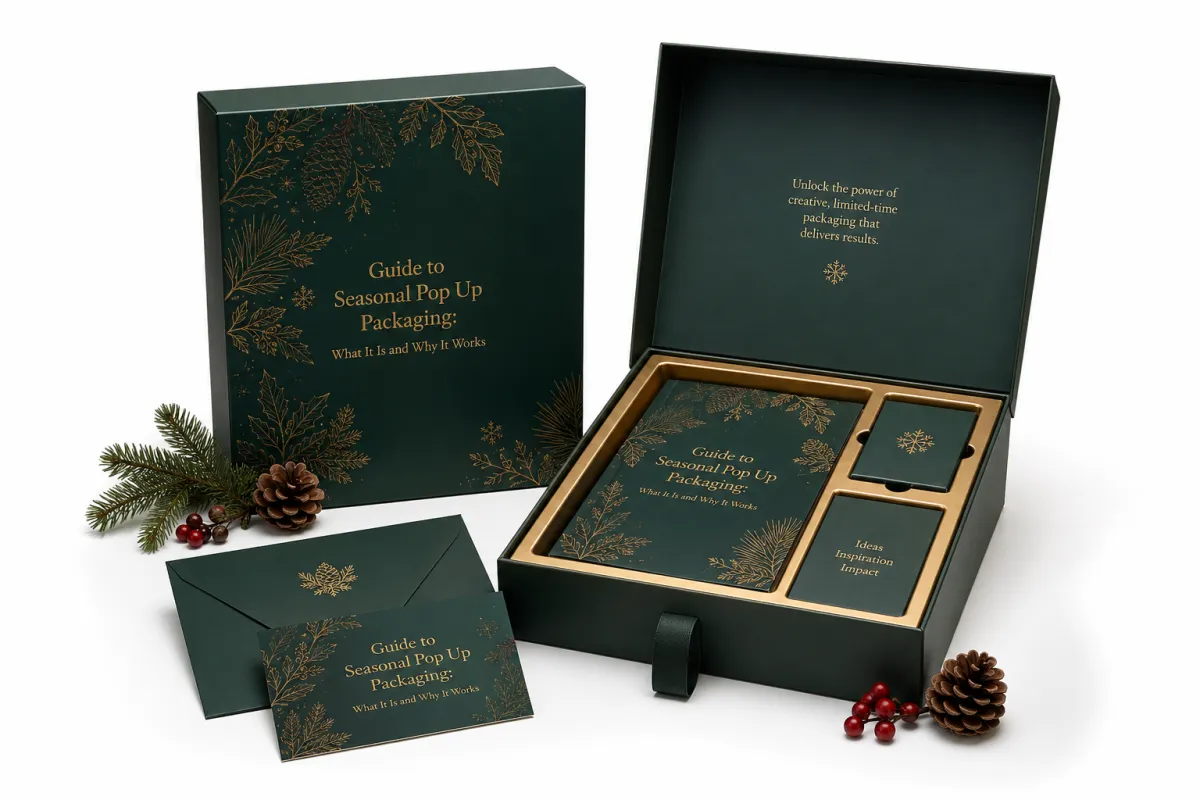
Seasonal pop-up packaging is any finite-period packaging strategy built around a defined window: holidays, launches, pop-culture events, collaborations, or retail moments. It can be a carton, sleeve, shipper, label update, or full gift presentation. The shared element is not the material; it is scarcity of time, and therefore scarcity of attention. A good seasonal package says, “This matters now,” in a way that permanent packaging cannot.
Permanent packaging can tolerate slower persuasion. Seasonal packaging cannot. A shopper in a busy aisle has one look, maybe three seconds, before moving on. That means contrast, hierarchy, and legibility matter more than ornamental complexity. In my own projects, a package that looked “premium” in a design studio often failed in retail because it needed too much close reading.
Seasonal packaging also changes perceived value without changing core formula. You keep the same SKU economics but reframe it around timing. That is why confectionery, cosmetics, beverages, candles, and event kits often run these programs first: the emotional purchase trigger is immediate. The package becomes part of the reason-to-buy, not just a container.
At an operational level, the cleanest teams separate permanent structure from seasonal layer. Reuse a stable carton shape, then add an outer sleeve, insert card, or decorative band. You keep recognition, reduce risk, and avoid re-teaching fulfillment operators how to handle a new system. That same discipline works for secondary packaging too.
The strongest seasonal packs do more than “look festive.” They change movement: in-store pickup flow, online unboxing reaction, and post-sale handling all improve when the packaging remains operationally simple. If a pack can be promoted, stacked, scanned, and shipped without extra exception handling, it usually wins long-term over a prettier design that breaks under real volume.
For durability and handling, ISTA testing standards are not optional polish; they are practical guardrails. Vibrations, compression, and transit stress show up in returns cycles, not mockups. If sustainability messaging is part of the brand positioning, early input on FSC certification frameworks will help avoid claims that cannot be substantiated once sourcing decisions are made.
Seasonal packaging earns trust when it creates urgency, protects the product, and goes through fulfillment like it was designed for a real store and a real shipping lane.
Guide to Seasonal Pop Up Packaging: How It Works in Retail
Retail tests everything that looks good on a screen, especially at arm’s length. Packaging may be designed in a studio, but it earns approval in aisle traffic, on endcaps, at gift displays, and at the customer’s first unboxing moment. The guide to seasonal pop up packaging is useful only if the format maps to each step in that journey.
Common seasonal formats are familiar, but seasonality changes their job:
- Folding cartons for primary product packaging with seasonal artwork, stronger visual hierarchy, or selective window updates.
- Sleeves that preserve existing packaging structure and create a campaign signal with minimal operational disruption.
- Rigid boxes for premium and gift-led kits where opening feels part of the marketing moment.
- Corrugated shippers and display-ready cartons for high-volume retail or pop-up retail moments where both visibility and survivability matter.
- Insert-driven designs that alter in-box narrative without destabilizing outer packaging used by picking and shipping teams.
Graphics and structure are a unit, not two teams in parallel. You can’t out-art a bad structure, and you can’t let a sophisticated mechanism carry cluttered messaging. Type scale, contrast, tactile hierarchy, and print density become campaign infrastructure. In shelf environments, first-read clarity almost always wins over complexity, regardless of how expensive that complexity looked on paper.
Channel behavior changes the rules. Shelf stock demands speed and legibility. Endcaps tolerate stronger statements and slightly deeper storytelling. Gift displays reward tactility and sensory cues like soft-touch, foil accents, embossing, or selective sheen. Ecommerce, meanwhile, changes the sequence: the first interaction can happen in a cardboard outer carton, so outer strength and edge reinforcement become non-negotiable.
Compared with baseline packaging, seasonal packaging usually compresses both revisions and approvals. The dangerous move is changing core specs late: closure, material, or carton size can break costs fast. Most high-performing teams keep formula, compliance language, and logistics numbers unchanged, then execute one visible shift: palette, messaging block, decorative system, or seasonal seal. That single shift usually produces campaign-level differentiation with lower production variance.
Execution details do the heavy lifting when everything else looks aligned. Print method, case counts, nesting behavior, barcode layout, overages, and co-packer instructions all influence final landed cost. A campaign can look flawless in a mood board and still fail at warehouse because of one neglected label orientation or pallet spec. You can fix many issues on paper; you can’t fix missed palletization after freight dispatch.
Guide to Seasonal Pop Up Packaging Costs and Pricing
Seasonal programs have a hard truth: even subtle changes usually cost more per unit than evergreen runs. Setup charges, proofs, and tooling overhead are spread across fewer units, and that arithmetic starts showing up before anyone sees the first full mockup. A guide to seasonal pop up packaging mindset treats this as fixed planning math, not as a surprise discovered in prepress.
Material and process remain the primary levers. Board grade, size, print coverage, finish depth, and component count are usually the biggest cost movers. A label refresh is generally the quickest, lowest-friction option when speed and control are critical. A premium rigid gift system with custom inserts, special adhesives, and higher assembly time increases both unit cost and defect probability. That does not mean “bad” or “good”; it means the strategy has to justify the spend.
Use this directional guide for a 5,000-unit campaign. These ranges vary by region, printer network, finish complexity, and raw-material market swings, but they are useful for planning:
| Format | Best Use | Typical Setup Complexity | Approx. Unit Cost at 5,000 Units |
|---|---|---|---|
| Seasonal label refresh | Fast visual update on existing packaging | Low | $0.04-$0.12 |
| Printed sleeve | Retail refresh with limited structural change | Low to moderate | $0.12-$0.28 |
| Custom folding carton | Primary product packaging with seasonal graphics | Moderate | $0.22-$0.65 |
| Display-ready shipper | Club store, endcap, or ecommerce shipping | Moderate to high | $0.65-$1.80 |
| Rigid gift box | Premium seasonal gifting or limited editions | High | $1.25-$3.50 |
The hidden costs come alive after proof signoff. Multiple prototype rounds add fixed fees and timeline drag. Freight volatility rises when manufacturing and fulfillment are in different countries or far apart within the same region. Production timing mistakes can tie up capital in stock before demand starts. Late edits after dieline lock are one of the largest prepress and schedule risks. The most expensive seasonal package is often the one that keeps getting changed, not the one with the loudest finish.
Modular design protects margin more than redesign purity. Reusing a stable structure and changing one layer keeps tooling, dieline data, and internal process knowledge reusable. A sleeve, belt band, insert, or label usually creates the campaign signal with less operational downside than introducing a new shell every season. That same logic works across Custom Printed Boxes and repeatable branding systems.
Material choice must support both performance and brand claims. A 350gsm C1S art board with an aqueous coat can be a strong baseline for many seasonal cartons. Premium wrapped specialty boards are often worth it when positioning requires it, not as default decoration. If your brand promises recyclability, fewer bonded materials and easier separation can improve both consumer perception and warehouse sorting. For broader environmental references, epa.gov/recycle is a practical starting point.
MOQ planning is where campaign math often breaks. Digital short runs can handle 500 to 1,000 units for pilots, but offset workflows usually smooth out around 3,000 to 5,000 units, when tooling starts to work in your favor. That said, every supplier’s discount curve is different, and all costs are still local to printer capacity, finishing requirements, and lane economics. A campaign that feels simple can quietly become capital-heavy if MOQ is ignored.
Guide to Seasonal Pop Up Packaging: Step-by-Step Process and Timeline
A strong process protects both budget and credibility. Start with strategy, not artwork. Lock campaign window, expected shopper behavior, retail channel mix, SKU count, and one intended emotional outcome. Is the campaign gift-driven, playful, premium, urgent, or collectible? That single call changes typographic rules, material allowances, and production tolerances. No point designing for all moods at once.
After strategy, confirm dieline logic. Collect current product dimensions from operations, define closure constraints, and define what is allowed to move. That single step controls material yield, print placement, case counts, and transportation cost. If a new structure is required, prototype from existing Custom Packaging Products references to prevent late surprises when quotes are already in motion.
Prototyping and proofing are where schedules usually crack. A reliable process includes physical mockups, material checks, color/pattern proofing, and documented internal approvals before press. Digital proofs help with creative consensus, but they are poor predictors of tactile and durability performance under shelf or conveyor stress. If distribution stress is real—and it usually is—include compression and transit-like checks before production release.
Most teams do better with backward planning. A workable seasonal rhythm often looks like this:
- Strategy and brief: 1 to 2 weeks.
- Concept and dieline development: 1 to 3 weeks.
- Sampling and proofing: 1 to 2 weeks, sometimes longer for special finishes.
- Production: often 10 to 20 business days for standard cartons, longer for rigid or specialized finish work.
- Freight and receiving: 3 to 10 business days depending on lane, location, and volume.
- Buffer: at least 1 extra week if the launch window is fixed.
That buffer is not bureaucracy; it is practical insurance. Ink cures, spec updates, compliance edits, and last-minute approvals can all stack when teams are under pressure. Missed launch dates do more than delay momentum. In many campaigns they turn compliant inventory into stranded inventory at full cost.
Cross-functional handoff is the real execution multiplier. Marketing governs message and hierarchy. Operations owns dimensions and carton logic. Retail verifies shelf behavior and planogram impact. Logistics confirms carton strength and pallet math. Compliance locks required claims and language before print starts. When these ownership lines are clear, revisions become controlled changes, not ad hoc rework disguised as creativity.
Teams that run seasonal waves repeatedly keep a recurring checklist for barcode location, net contents, claims language, country-of-origin and nutritional statements, and co-packer instructions. In sourcing cycles, I’ve seen the strongest differentiation from partners who can support this routine, not those with the loudest render library.
Common Seasonal Pop Up Packaging Mistakes to Avoid
Late starts are the first mistake. When teams begin late, approvals compress, revision windows disappear, and shipment decisions happen in panic. A premium-looking concept can become generic in execution when there is no cycle time for testing and correction, especially during crowded seasonal periods.
Second, shelf-life mismatch: the packaging may be beautiful in render form but weak in practical use. Tiny type, low contrast, and finishes that only perform under controlled lighting fail in real shopping moments. A pack that cannot be read from a short distance while shoppers move is unlikely to do much in retail.
Overusing premium finishes is a frequent budget trap. Foil, embossing, special films, and custom inserts can be right choices, but each choice adds setup, handling, and QC burden. In short windows with thin margins, complexity can quietly erase campaign upside. A restrained finish plan usually performs better than “kinda fancy” overbuild.
Durability failures are costly and quiet. A sleeve that scuffs, a lid that shifts under compression, or a brittle insert that tears in transit hurts conversion and brand trust fast. For ecommerce-heavy launches, transit simulations are worth the time and usually prevent returns losses that are expensive to recover after launch.
Creative execution is only one side of the coin. Operations still needs hard clarity:
- Barcode placement that scans through distribution and retail touchpoints.
- Regulatory claims and language aligned with each market and channel.
- Ingredient, claim, and country-of-origin statements finalized before printing.
- Realistic plans for post-season leftover inventory before final quantity is locked.
- Reorder logic written in advance if demand spikes above initial forecast.
Leftover stock is frequently underestimated. A highly specific design can be difficult to reposition once seasonality closes. A neutral base with a re-labelable or reversible surface gives you contingency options and can convert part of the carryover into an off-season offering rather than dead stock. It does not save all risk, but it does reduce damage.
A practical test: if operations cannot describe the seasonal system in one short sentence, the design system is probably overbuilt. Elegant packaging still has to be easy to manufacture, store, and replenish. Otherwise it becomes expensive storytelling with weak commercial value.
Guide to Seasonal Pop Up Packaging: Expert Tips for Better Results
Modular build remains the most repeatable method. Keep structure evergreen and switch seasonal overlays, inserts, and graphic faces. This reduces tooling churn and lets teams compare campaigns with cleaner learning loops. In repeat cycles, that consistency can be a strategic advantage: consumers notice evolution without feeling disconnected.
Use one strong visual cue and execute it well. A dominant seasonal color, a single motif shift, or one concise opening line often outperforms stacked design changes. Shoppers process fewer decisions under time pressure; too many signals can lower recall. In many categories, that clarity is the difference between pause and purchase.
Field test early in the spaces where it will live. Use real store lighting, run carton compression checks, and get feedback from merchandisers and fulfillment managers. They spot practical blockers fast—like shelf height conflict, barcode angle problems, or damage from pallet friction—that design teams often overlook in review meetings.
Select materials for end-to-end outcomes, not just campaign aesthetics. If reuse is likely, choose durability and durability-friendly finishes. If recycling claims are central, avoid mixed-material assemblies that complicate sorting. If premium is the promise, spend only on features that reinforce that exact value statement. A pack gains trust when structure, material, and copy tell the same story.
Copy strategy should create urgency without sounding off-brand. Seasonal language is not a personality reset; it is a tuned extension of existing tone. A sharp line is better than a rewritten manifesto. In categories with loyal buyers, abrupt language shifts can be more damaging than modest visual updates.
The strongest seasonal packs usually do less, not more. One deliberate intervention usually beats five unconnected adjustments made in parallel.
Systematize reusable components. Standardize insert dimensions, sleeve widths, approved board stocks, and an approved finishing matrix. Then next season, you are not starting from scratch; you are tuning a proven system. A disciplined approach to Custom Packaging Products planning is one of the few ways to turn speed into repeatable advantage.
Invest in photography and packaging presentation planning as part of production, not as a post-launch add-on. A seasonal program performs where the audience actually consumes it: shelf, paid social, email cards, and unboxing context. A package that remains clear in all formats has a longer commercial life than one tuned for only one channel.
Next Steps for a Seasonal Pop Up Packaging Launch
Start with a one-page brief and make it explicit: campaign dates, channel plan, exact SKUs, protected brand constants, dimensional constraints, and one non-negotiable seasonal cue. Ambiguity is the first source of scope creep, and scope creep is the first source of missed dates. Keep it simple.
Before approving new tooling, audit existing inventory and packaging systems. Many seasonal goals are reached by sleeve swaps, insert updates, or carton skin changes. A quick stock audit can reveal a lower-cost route with equal shelf impact, especially for established lines with stable production specs.
Build a supplier questionnaire grounded in execution reality. Ask about MOQ, turnaround windows, proofing cadence, finish options, correction thresholds, freight assumptions, and late rework policies. If launch dates are tight, confirm how many revisions are allowed before each cost jump. A reliable supplier should answer marketing goals and transportation durability with equal confidence.
Then plan backwards. Your timeline should run from launch date to final signoff, then include a real buffer for corrections and approvals. “Buffer” is not padding; it is what keeps you from launching into failure on a perfect idea. A seasonal release without contingencies is a bet on external reliability, and reliability is rarely stable during peak cycles.
In practical terms, the guide to seasonal pop up packaging reduces risk by treating speed, margin, and brand expression as one equation. In one campaign, that mindset made a difference between three expensive prototypes and one production-ready design. Decide which one principle you are protecting for each launch, and enforce it across design, procurement, and logistics before you finalize the artwork.
How does seasonal pop up packaging differ from regular packaging?
Seasonal pop up packaging is time-bound: it changes graphics, finishing, messaging, or insert layers to match a campaign window while keeping core structure stable as much as possible. Regular packaging emphasizes consistency across long periods and often prioritizes broad shelf utility. The key difference is intent—seasonal packaging must perform strongly within a narrow period and still stay operationally reliable.
What does seasonal pop up packaging usually cost?
Costs move with format complexity, print type, finish scope, component count, and quantity. Smaller runs usually have higher per-unit costs because setup and prepress are spread across fewer pieces. Reusing a base structure and changing one layer is usually the most budget-efficient path to visible campaign lift.
How long does seasonal pop up packaging take to produce?
Simple campaigns can move quickly, but timing still depends on concept, sampling, approvals, production slots, and freight. A practical schedule starts at the launch date and moves backward by each operational dependency. Special structures and premium finishes increase required lead time, especially for ecommerce distribution.
What materials work best for seasonal pop up packaging?
Paperboard, corrugated board, rigid board, and specialty papers are the most common workhorses because they balance graphics quality, strength, and cost control. Shelf-ready packs, gifting formats, and direct shipping each place different constraints on material and finish. The best choice is the one that matches brand position, channel behavior, and post-season outcomes such as reuse or recycling.
How do I keep seasonal packaging from feeling wasteful?
Use modular systems and choose materials that allow for repurposing, re-labeling, or cleaner recycle streams after the campaign. Plan leftover inventory strategy before the campaign starts, including where overage will go and who owns discount or re-deployment decisions. This is usually where theoretical sustainability becomes actual sustainability.
Actionable takeaway: define one seasonal objective, one core structure, one controlled change, and one realistic timeline before creative lock; if each department signs that package, you will launch on time with less waste, less revision debt, and a clearer path to repeatable seasonal performance.