Buyer Fit Snapshot
| Best fit | Handmade Soap Boxes with Window Wholesale projects where brand print, material claims, artwork control, MOQ, and repeat-order consistency need to be specified before quoting. |
|---|---|
| Quote inputs | Share finished size, material target, print colors, finish, packing count, annual reorder estimate, ship-to region, and any compliance wording. |
| Proofing check | Approve dieline scale, logo placement, barcode or warning zones, color tolerance, closure strength, and carton packing before bulk production. |
| Main risk | Vague material claims, crowded artwork, missing packing details, or unclear freight terms can make a low unit price expensive after revisions. |
Fast answer: Handmade Soap Boxes with Window Wholesale: Pricing should be specified like a repeatable production item. The safest quote records material, print method, finish, artwork proof, packing count, and reorder notes in one written spec.
Production checks before approval
Compare the actual filled-product size with the drawing, then confirm tolerance on folds, seals, hang holes, label areas, and retail display edges. Reserve space for logos, QR codes, warning copy, and material claims before decorative graphics fill the panel.
Quote comparison points
Review material grade, print process, finish, sampling route, tooling charges, carton quantity, and freight assumptions side by side. A quote is only useful when the supplier can repeat the same color, closure quality, and packing count on the next order.
I still remember standing beside a Heidelberg 102 die cutter in a Shenzhen plant while a buyer from Portland, Oregon turned two samples under a bank of 5000K fluorescent tubes: one plain kraft carton, one set of Handmade Soap Boxes with Window wholesale. She did not need a long pitch. The second she saw the lavender swirl through the 0.2 mm clear PET window, the order moved from 1,500 plain boxes to 3,000 windowed ones before the coffee cooled. I have seen that kind of shift at factories in Shenzhen, Dongguan, and Guangzhou, and honestly, it never gets old.
That is the practical case for handmade soap boxes with window wholesale. The packaging starts selling the soap before anyone lifts the lid, and that matters because soap lives in a narrow space between product and feeling. Color, marbling, dried calendula petals, oatmeal flecks, and the surface texture all show through the window, which is exactly what a shopper wants when deciding whether to trust a 100 g handmade bar or keep walking. A carton that shows the bar clearly does real work in a matter of seconds, and if you ask me, that is the kind of work packaging should be doing anyway.
At Custom Logo Things, I have watched brands move with more confidence on retail shelves after switching to handmade soap boxes with window wholesale. A clean window makes a small label feel established, and it keeps the product from looking like a commodity in a random sleeve. If a buyer can see the bar, read the scent note, and understand the ingredient story at a glance, the packaging has already earned its place. That is not marketing poetry; that is retail behavior measured in the first three seconds of shelf contact.
These boxes also travel well across channels. Boutique shops want visibility. Gift sets want a front panel that looks composed. Subscription brands want a carton That Feels Premium in a kraft mailer. Holiday bundles sell with less friction when the customer can see the soap instead of guessing what is hiding inside a closed box. I have seen a buyer hesitate for 10 seconds over a blind box and then grab three windowed cartons the moment they could see the actual bar. Small difference, big effect, especially in stores where a shopper is making choices under a tight time limit.
Why Do Handmade Soap Boxes with Window Wholesale Sell Better?
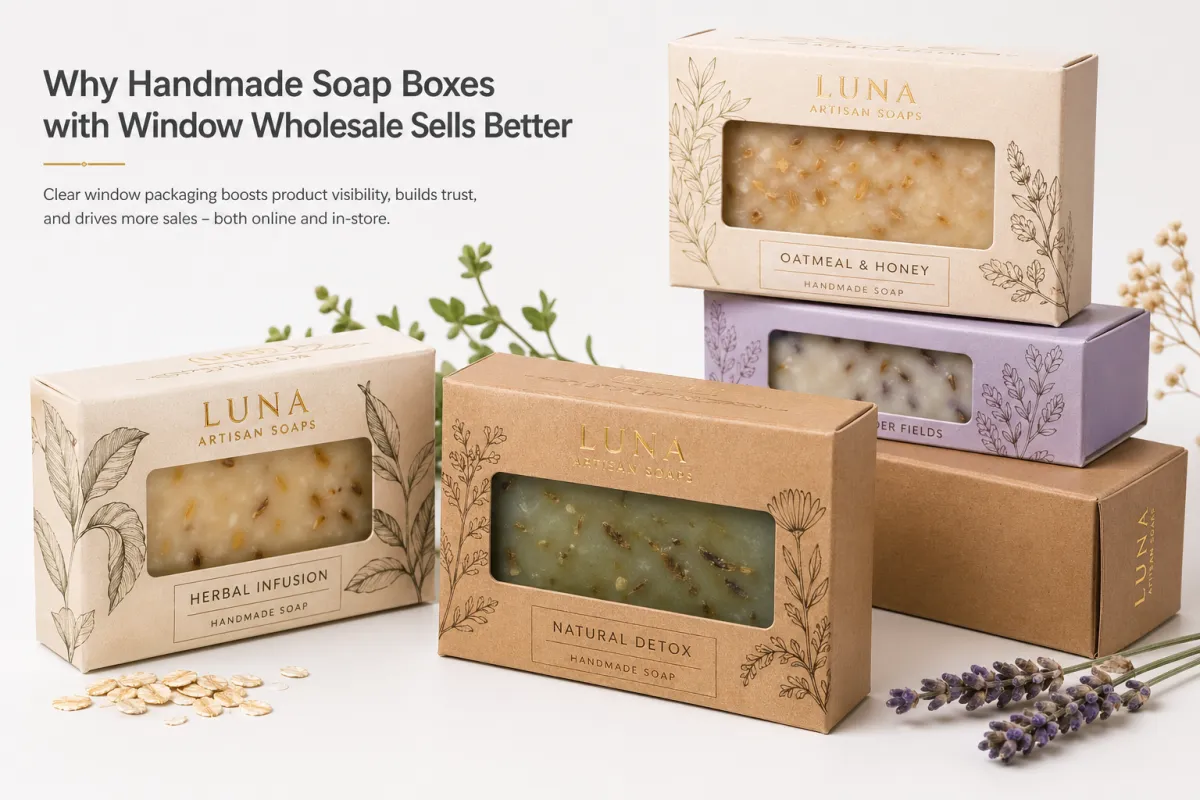
The first reason handmade soap boxes with window wholesale sell better is trust. A clear window removes the uncertainty that slows down a purchase. If the bar is shell-shaped, swirled with botanicals, or dusted with oatmeal, the shopper can inspect it without tearing anything open. That small proof point reduces hesitation, and hesitation is where a lot of sales quietly disappear. I have sat through enough retail reviews in Chicago and Los Angeles to know that most shoppers do not need a lecture; they need a quick visual answer.
I saw that in a retail meeting with a boutique chain in Chicago. Their buying team kept one blunt rule: if a product needed a speech, it was too slow for the shelf. We replaced a closed carton with handmade soap boxes with window wholesale, kept the front panel minimal, and lifted the logo by 8 mm so it cleared the window line. Their merchandiser told me the bar looked "finished" instead of "homemade in the bad sense," which sounds harsh until you have sold enough packaging to know how honest that kind of feedback is. I laughed when she said it, then wrote it down immediately because she was right.
Window packaging also supports premium positioning. A soap bar in a kraft box with a die-cut opening feels more deliberate than the same bar in a plain sleeve. That extra visibility helps with gift sets, seasonal assortments, and natural lines that depend on color and texture to communicate value. If the soap carries lavender buds from Provence, calendula petals, or a layered swirl made in a Portland soap kitchen, the box should show that work instead of hiding it behind ink. The bar took time to make; the box should not act embarrassed about it.
One practical design rule: frame the best face of the soap. I have seen brands center the window only because symmetry looked tidy in a mockup from a design studio in Brooklyn. That is lazy design, and I say that with love but also with a little frustration. If the most attractive side of the bar is an embossed logo or a swirl line near the top edge, move the opening accordingly. Handmade soap boxes with window wholesale should sell the product, not the designer's attachment to a centered rectangle.
There is also a very practical retail benefit. Shelves with windowed cartons create faster recognition, especially in stores where a shopper has 30 seconds and too many choices. Handmade soap boxes with window wholesale work especially well for:
- Artisan soap bars with marbling, herbs, or layered color.
- Botanical bars that need visual proof of ingredients.
- Holiday bundles where gift appeal matters as much as function.
- Scent-led products that benefit from a premium first impression.
One distributor I worked with in Texas had a familiar problem: the soaps were excellent, yet every carton looked nearly identical from 6 feet away. We changed the structure to handmade soap boxes with window wholesale, added a narrow side panel for scent notes, and organized the line by color. Their reorder conversation got shorter the next season because the stores could tell mint from oat milk without opening a stack of samples. I remember the buyer grinning and saying, "Finally, the boxes are doing some of the talking." I could have hugged her, but I settled for a handshake.
"The window paid for itself in one weekend," one buyer told me after a holiday pop-up in Austin. "People picked up the boxes, checked the soap, and put three in the basket instead of one."
That is not magic. That is packaging doing the basic retail work it should have done from the start. And yes, sometimes the simplest move is the one that feels the smartest later.
Product Details: Materials, Window Styles, and Finishes
The board choice changes the whole feel of the pack. For handmade soap boxes with window wholesale, I usually start with kraft, SBS, or CCNB because each one suits a different budget and brand mood. Kraft gives that natural, earthy tone people expect from handmade soap. SBS delivers a smoother surface and sharper print, especially for fine-line logos and small ingredient copy. CCNB keeps the cost lower while still holding up well in a retail setting. I have a soft spot for kraft when the brand story is botanical or farm-made, but I will admit SBS wins every time if the artwork needs crisp little details that refuse to blur. These options also make sense when a brand wants Custom Soap Packaging that still feels grounded and practical.
For most natural soap brands, I recommend 300gsm to 350gsm kraft if the bar is under 150 grams and the box is not carrying extra inserts. If the product is heavier, brittle, or shipped in a multipack, I move up to 400gsm or a rigid-style insert solution. Soap is not as punishing as a candle on the carton, yet a weak corner can still crush if the die line is sloppy or the fold scores are off. I once pulled a sample from a carton that looked fine until I squeezed the side panel and the whole thing folded like it had given up on life. Nobody wants that on a retail shelf in Denver or Dallas.
The window film matters too. Clear PET gives the strongest visibility and works well when the soap itself is the hero. Frosted film softens the look, which helps if the bar has a rougher surface or the brand wants a gentler retail presentation. For handmade soap boxes with window wholesale, I usually see PET around 0.2 mm and frosted film around 0.15 mm, though the exact gauge depends on box size and how much flex the package will take during shipping. Clear film is the straight talker; frosted film is the one that dresses a little better for dinner.
Finishes can get out of hand fast. Matte lamination feels calm and natural. Gloss creates harder contrast and helps color pop from a distance. Soft-touch lamination adds a velvety feel that customers notice in the hand, but it also raises cost by roughly $0.04 to $0.08 per unit on a 5,000-piece run. Foil stamping, embossing, and spot UV each make sense when the logo deserves emphasis, yet I have watched brands pile on every finish in the catalog at once. That does not read as luxury. It reads as a budget that lost the argument. I have been in that meeting, and the quote sheet usually comes back with three red circles and one long silence.
Here is the version I usually recommend for handmade soap boxes with window wholesale when a brand wants a clean retail look without mangling the margin: 350gsm SBS, matte lamination, a clear PET window, and one accent finish such as spot UV on the logo. That combination usually looks sharper than a completely naked kraft box and costs less than stacking foil, emboss, and soft-touch together. On a 5,000-piece order, it can land around $0.15 per unit for the base build before specialty finishing, which is why restraint usually looks more expensive than excess anyway.
There are a few functional add-ons that earn their keep in store. Hanging tabs help if the soaps live on peg walls in chain drugstores or farm stores. Inserts keep the bar from sliding after the carton opens. Sleeve-and-tray formats make gift sets feel more deliberate, especially for holiday assortments packed in December. Straight tuck and reverse tuck structures remain common because they fold cleanly and pack quickly, which matters when the fulfillment line is moving 800 to 1,200 boxes an hour in Dongguan. Nobody thanks the packaging when the line stops, and that is exactly why the structure has to behave itself.
One more lesson came from a supplier negotiation with a converter in Dongguan: custom window shapes can look beautiful, but the die cost has to stay rational. We once moved a client from a fully custom leaf shape to a rounded arch and dropped the one-time tool cost from $310 to $190. The brand kept the premium feel, and the per-box price stayed in a sane place. That is the kind of trade-off I like in handmade soap boxes with window wholesale. Pretty is good. Pretty and sensible is better.
If you are building a broader lineup, our Custom Packaging Products page shows other carton styles that pair well with soap bars, gift sets, and subscription kits.
For paper sourcing, I like to ask for FSC chain-of-custody records from FSC if a brand wants certified fibers. It is a straightforward check that keeps the story honest, and I sleep better when the paper trail actually has a paper trail.
Handmade Soap Boxes with Window Wholesale Specifications
Good quotes begin with good measurements. For handmade soap boxes with window wholesale, I need the soap length, width, height, and finished weight before I can say anything useful about structure. A 90 x 60 x 25 mm bar behaves differently from a 110 x 75 x 35 mm bar, and guessing on carton size is how people end up paying for reprints and awkward fit issues. I have seen boxes that were technically "close enough," which is a phrase that usually means, "we are about to have problems."
The structure should match the packing line, not just the artwork. Straight tuck end works well when the filling team wants a clean opening and closing motion. Reverse tuck end can move faster for hand-pack operations. Sleeve-and-tray gives a premium look but adds material and labor. Custom locking styles make sense for unusual bar shapes, especially if the soap is rounded, beveled, or packed with an insert. I have a bias toward the structure that makes the production team smile, because those are the cartons that tend to behave at the 1,000-piece and 5,000-piece levels. In retail soap packaging, a good structure often matters as much as the print.
For print production, I ask for 300 DPI artwork, 3 mm bleed, and a safe margin of at least 2 mm from the cut edge. If the logo sits too close to the window, it can disappear into trimming or fold lines. I once reviewed a file from a brand in Vermont where the script logo was only 1.5 mm from the die line. The printer caught it, thankfully, because the first batch would have looked like a mistake pulled from a bargain bin. That saved everyone an awkward conversation and a rushed reprint, which is a small miracle in packaging.
Grease resistance deserves a real conversation. Soap bars with heavy oils, butter-rich bases, or botanicals can stain the inside of the carton if the coating is too weak. In those cases, I often suggest an aqueous coating or a protective laminate rather than a naked uncoated board. That choice is not glamorous, but it keeps the box from looking tired after a week on shelf. Nobody wants packaging that looks like it had a rough night after arriving in Minneapolis or Miami.
Window size needs discipline. A window that is too large weakens the board and can cause bowing, especially on lighter stocks below 300gsm. A window that is too small wastes the whole point of handmade soap boxes with window wholesale. I usually like to leave a border of 6 to 10 mm around the cutout so the panel still feels solid in the hand and during transit. I think of it as giving the carton enough shoulders to carry the job without slumping.
Here are the specs I ask for before I quote a serious wholesale run:
- Soap size: exact length, width, height, and weight in grams.
- Box style: straight tuck, reverse tuck, sleeve, tray, or locking structure.
- Board choice: kraft, SBS, CCNB, or coated stock.
- Window style: clear PET, frosted film, or custom die-cut shape.
- Artwork: CMYK files at 300 DPI with bleed and safe zone.
- Performance need: grease resistance, scratch protection, or hanging tab.
For shipping performance, I like to think in testing terms, not wishful thinking. If the cartons are moving through long-distance freight or distribution center handling, I reference ISTA pack testing standards and basic ASTM expectations. That does not mean every soap box needs laboratory abuse. It means the pack should survive a real carton journey without arriving flattened or scuffed into embarrassment. I have seen too many boxes arrive with just enough damage to make a brand owner sigh very slowly, and that sigh tells you everything.
In practical terms, handmade soap boxes with window wholesale should be packed flat, counted in consistent bundles of 50 or 100, and carton-packed with corner protection if the board is thin. I have seen a 10,000-piece order lose margin because someone packed the cartons loosely and the edges curled before filling. A six-dollar shipping-saving can become a six-hundred-dollar quality headache fast. That is one of those "free savings" that turns into a bill you never asked for.
How Much Do Handmade Soap Boxes with Window Wholesale Cost?
Pricing for handmade soap boxes with window wholesale is not random, even if some quotes make it look that way. Size, board type, print coverage, window shape, finish count, and quantity all push the unit cost in different directions. The same box can land at $0.36 or $1.18 depending on how much you ask it to do. I have seen buyers look at two samples and ask why one is nearly twice the price. Usually the answer is, "because one is trying to be six products at once."
Once you move past the first 1,000 units, the price usually drops faster than first-time buyers expect. Setup costs get spread out, die-cutting runs more efficiently, and the print line settles into a better rhythm. Short runs always carry a premium because press setup, proofing, and tooling do not disappear just because the order is small. The factory still has to wake up, and factories in Shenzhen and Dongguan are not known for loving extra wake-up calls before 8:00 a.m.
I once sat through a cost review with a skincare brand that wanted everything in the same carton: matte lamination, foil logo, embossing, frosted window, and a custom arch cut. Beautiful idea. Awful margin. We trimmed it to one premium finish, standard PET, and a cleaner size spec. Their unit cost dropped by 19% at 3,000 pieces, which is the kind of number a buyer can actually take to finance without getting laughed out of the room. I still remember the relief on their face when the math stopped trying to bite them.
For handmade soap boxes with window wholesale, a custom die or unusual window shape may add a one-time tooling charge, usually somewhere in the $120 to $320 range depending on complexity and factory tooling policy. Extra foil stamping, embossing, or soft-touch lamination then raises the per-box cost. That is normal. The real trick is keeping the package attractive without turning every unit into a tiny luxury object that eats the margin alive. A box can be elegant without acting like it is the main character.
| Option | Typical MOQ | Ballpark Unit Price | Best Use | Cost Notes |
|---|---|---|---|---|
| Kraft, clear PET window, 1-color print | 500-1,000 | $0.42-$0.68 | Natural brands, entry-level retail | Lowest setup burden, good for fast reorders |
| SBS, matte finish, spot UV logo | 1,000-3,000 | $0.58-$0.92 | Premium retail and gift sets | Cleaner print surface, stronger shelf presence |
| CCNB, frosted window, full-color print | 1,000-5,000 | $0.36-$0.55 | Budget-conscious wholesale programs | Good value, but print finish is less refined |
| Custom die-cut window, foil, emboss | 3,000+ | $0.84-$1.35 | Flagship lines and seasonal launches | Tooling and finishing costs rise quickly |
That table is not fantasy pricing. It is the same kind of range I see when buyers ask for handmade soap boxes with window wholesale quotes with real specifications instead of "something nice and not too expensive." Nice and cheap are not cousins. They fight each other constantly, and cheap usually wins the argument only if somebody forgets to check the samples.
MOQ usually starts around 500 to 1,000 pieces for simpler boxes, and I would treat that as a practical floor rather than a magic number. Custom shapes, premium finishes, or complex inserts often need 3,000 units or more to stay economical. If a supplier promises a tiny quantity with every finish under the sun, check the quote twice. Something is missing, and it is probably quality or margin. I have never once seen a miracle quote arrive without a hidden tradeoff attached.
The best cost-saving moves are boring, which is exactly why they work. Use a standard size that matches the soap instead of forcing a custom footprint. Keep print coverage tight. Limit finish count to one or two. Choose a window shape that can be die-cut cleanly. That is how handmade soap boxes with window wholesale stay profitable instead of simply looking polished on a sample table. Boring is underrated; boring often pays the bills.
Process and Timeline for Handmade Soap Boxes with Window Wholesale
A clean order process saves more money than a clever sales pitch ever will. For handmade soap boxes with window wholesale, I usually walk buyers through seven steps: inquiry, quote, dieline confirmation, artwork setup, sample approval, production, quality check, and freight booking. Skip one of those and the problem tends to show up later as a reprint, a delay, or a box that does not close properly. Packaging has a way of keeping score whether we like it or not, especially on orders leaving factories in Guangdong.
Sample work usually takes 5 to 7 days once the dieline and artwork are approved. Full production often takes 10 to 15 business days after approval and deposit, though larger runs can stretch longer if the finish list gets complicated. That timeline covers the boxes only. Freight is separate, and it should be quoted separately unless you enjoy confusion. I say that with affection for the industry, but also because I have seen one too many "why is it not here yet?" emails that started with a rushed assumption.
I learned that lesson from a buyer who assumed "production complete" meant "on the dock tomorrow." It did not. The boxes were finished, but the sea freight booking was 5 days out and the destination port had congestion. One misunderstanding nearly turned a normal order into a panic call. Good wholesale packaging work is part manufacturing and part expectation management. I wish there were a cleaner way to say it, but there really is not.
Proofing matters because pre-press is where most expensive mistakes get caught. Window alignment, barcode placement, logo size, and fold direction all need to be checked before the press starts running. A tiny miss on the die line can create a visible shift on the finished box, and a 2 mm shift on a window pack is enough to make the soap look crooked even if the print is technically correct. That is the kind of flaw that makes a brand owner stare at a pallet in silence, which is never a fun moment for anyone.
Here is the practical flow I like for handmade soap boxes with window wholesale:
- Send soap dimensions, desired quantity, and the box style.
- Confirm board choice, finish level, and window type.
- Review a dieline or physical sample.
- Approve artwork after checking bleed and fold areas.
- Start production with a clear deposit and timeline.
- Inspect finished cartons for color, cut quality, and window placement.
- Book freight and keep the cartons flat until filling.
For shipping, air freight can move small urgent runs quickly, but it costs far more per kilogram, often 3x to 5x sea freight rates on a Shenzhen-to-Los Angeles lane. Sea freight takes longer and protects margin on larger wholesale orders. If your launch date is fixed, I tell buyers to work backward from the warehouse receiving date, not the approval date. That is the only reliable way to keep handmade soap boxes with window wholesale from becoming a calendar emergency. I have had to talk people off that ledge before, and I would rather not do it again if we can help it.
Quality control should include a simple panel check: fold accuracy within 1 to 2 mm, window placement where intended, clean print registration, and no film wrinkles or glue smears. If the order is going to chain retail, I also like carton durability checks that echo the spirit of ISTA handling tests. Nothing flashy. Just enough discipline to keep the shipment from arriving tired. Packaging does not need drama; it needs consistency, especially when the cartons are headed to warehouse racks in Dallas, Atlanta, or Toronto.
One of my better factory-floor memories came from a line in Guangzhou where a supervisor caught a weak glue tab before the pallet left the room. The team reworked 600 pieces in under an hour. That saved the client from a slow-motion disaster at the distributor. Good handmade soap boxes with window wholesale depend on that kind of unglamorous detail. No applause, no ribbon, just a lot fewer headaches later.
Why Choose Us for Handmade Soap Boxes with Window Wholesale
I do not sell packaging as if it were theater. I sell it the way a production person thinks about it: dieline accuracy, material availability, consistent color, and a factory that actually knows how to hold tolerance on a die-cut window. That is what buyers need from handmade soap boxes with window wholesale, and that is where we stay focused at Custom Logo Things. Pretty mockups are nice, but they do not ship from Ningbo, Shenzhen, or any other port.
We stay practical because I have seen what happens when a quote sounds cheap but the production details are vague. One supplier promised a lower price on a window pack, then quietly downgraded the film gauge from 0.2 mm to 0.12 mm and changed the board from 350gsm SBS to a lighter sheet. The boxes looked fine on screen and weak in the hand. The buyer noticed immediately, and so did her retail customers. Cheap becomes expensive the second it comes back as a complaint. I still remember her shaking her head and saying, "I knew that price was too cheerful." She was right.
What matters on our side is control. Consistent window placement. Clean folds. Reliable print matching. Less waste during setup. Realistic lead times. I have spent enough time on factory floors to know that if the operator has to fight the die line, the final carton will show it. If the line runs smoothly, the pack looks calm and the customer trusts it without thinking about why. That calmness is part of the product, even if nobody says it out loud.
We also keep the quoting process clearer than most. You Should Know the difference between the base box price, the tooling charge, the finish add-on, and the freight estimate. That is not extra service. That is basic respect. If a quote hides $180 of die work inside a vague line item, the buyer is being played. I have negotiated enough supplier sheets to spot that trick from ten feet away, and I will always call it what it is.
If you are scaling beyond a single product, our Wholesale Programs are built for repeat orders, file storage, and reorder consistency. That matters more than people think. A soap line with four scents and three seasonal variants becomes a mess fast if each reorder starts from zero. I have watched brands lose hours because nobody could find the right dieline, which is a ridiculous way to spend a Tuesday.
There is also flexibility for brands that are still testing the market. We can help with smaller runs, sample-first approvals, and structure recommendations that avoid overbuying. For a lot of clients, the smartest first order is not the fanciest one. It is the one that proves the shelf story, protects the bar, and keeps cash available for the next launch. I think that is just common sense, though packaging people sometimes dress common sense up in a fancy jacket.
And yes, I am saying this from experience, not a spreadsheet fantasy. I once helped a customer in Colorado cut her packaging budget by nearly $900 on a 5,000-piece order by switching from a custom square window to a standard oval and moving one color off the back panel. She still got the premium look. She just stopped paying for avoidable complexity. That is the kind of result I like, because it solves the real problem instead of merely decorating it.
For brands that want the broader packaging ecosystem, our Custom Packaging Products range helps keep soap cartons, mailers, and inserts visually aligned. That keeps the brand story coherent across shelf, shipping, and unboxing. I have always thought coherence was underrated; people notice it even when they cannot name it.
Next Steps for Handmade Soap Boxes with Window Wholesale Orders
If you want accurate handmade soap boxes with window wholesale pricing, send the basics first: soap dimensions, finished weight, quantity, desired box style, and whether the window should be clear, frosted, or custom-cut. Those five details do more for quote accuracy than a long email full of "premium but affordable" language ever will. I promise the factory team would rather have dimensions than adjectives, and the difference between a 90 mm bar and a 110 mm bar matters immediately at the die line.
After that, decide the business details that shape cost most: board type, finish level, shipping destination, and whether you need inserts or hanging tabs. If you do not know the structure yet, ask for a dieline first. A dieline costs far less than a bad guess. I have seen too many brands lose a week because they tried to design around a carton that was never the right shape to begin with. Rework always arrives dressed like a surprise, and it is never a pleasant one.
My preferred order path is simple: approve the dieline, review a sample, lock artwork, confirm the count, and book freight. That sequence keeps handmade soap boxes with window wholesale moving from idea to production without drifting off course. It also gives you room to fix mistakes before you have 3,000 pieces stacked in cartons. The best time to catch a problem is before it becomes palletized.
One last practical tip: if your soap has an unusual shape, order a sample before committing to the full run. A bar with rounded shoulders or a thick base can sit differently inside the box than it looks on a screen mockup. A physical sample is cheap insurance. A reprint is not. I know that sounds blunt, but I would rather be blunt than expensive, especially when a factory in Dongguan can turn a sample in 5 to 7 business days.
So send the specs now, not after the launch date is already breathing down your neck. If you need handmade soap boxes with window wholesale that protect the product, show the bar clearly, and keep the numbers sane, Custom Logo Things can help you get there with fewer surprises and better control over margin.
What is the usual MOQ for handmade soap boxes with window wholesale?
Most handmade soap boxes with window wholesale orders start around 500 to 1,000 boxes, depending on size, print method, and finish. Simple stock structures can sometimes go lower, while custom shapes and premium finishes usually need 3,000 pieces or more before the unit cost behaves. I always ask buyers to compare pricing at 1,000, 3,000, and 5,000 units because that is where the real cost break usually shows up. It is boring math, but boring math saves budgets.
Can handmade soap boxes with window wholesale orders use custom window shapes?
Yes, and that is often a smart move if the brand wants to stand apart. The window can be round, oval, rectangular, leaf-shaped, or fully custom die-cut to match the soap brand. The only rule is structural: the board still needs enough strength around the opening, usually a 6 to 10 mm border, so the box does not collapse or buckle during shipping. A custom shape is fun; a collapsed panel is not.
Which material is best for handmade soap boxes with window wholesale?
Kraft works well for earthy branding and usually keeps the budget under control. SBS gives a smoother print surface if the line needs a cleaner retail look. CCNB is a strong value option for large wholesale programs. If the bars are oily, soft, or packed with botanicals, ask for a grease-resistant coating or laminate so the carton does not stain before it reaches the shelf. I lean toward the board that matches the story and the handling reality, not just the mood board.
How long does handmade soap boxes with window wholesale production take?
Samples usually take 5 to 7 days once the dieline and artwork are confirmed. Production commonly takes 10 to 15 business days after sample approval and deposit, though larger or more detailed jobs can run longer. Freight is separate, so air and sea should be quoted as different timelines instead of blended into one optimistic promise. I have learned the hard way that "soon" is not a shipping method.
What do you need to quote handmade soap boxes with window wholesale accurately?
Send the soap dimensions, quantity, box style, material preference, and target finish. Add artwork files if you have them, plus the shipping address or destination port. If you do not know the structure yet, ask for a dieline first so the quote is based on real measurements, not a guess pulled out of thin air. The more exact the input, the less likely everyone is to end up in a meeting nobody wanted.