If you need a hang tags Supplier Quote for Wine shops, start with the shelf, not the spreadsheet. A hang tag is small, but on a crowded bottle display it does real work: it explains the wine quickly, supports the price point, and gives the shop another surface for branding without touching the label artwork.
Wine shops use hang tags for varietal notes, food pairing suggestions, gift messages, promotional pricing, reserve-line storytelling, and QR codes that point to tasting notes or reorder pages. The best quotes reflect those functions in practical terms: size, stock, print method, finishing, and assembly. If a supplier cannot translate the idea into those specs, the quote is not ready yet.
A tag can look elegant and still fail if it is hard to read, awkward to attach, or oversized for the bottle. A useful quote matches bottle shape, retail lighting, handling habits, and budget pressure at the same time.
Why wine shop hang tags earn their space
Wine shoppers make quick judgments. The bottle label gets only a few seconds of attention. A neck tag gives the store one more chance to communicate value before a customer moves on. In a category where visual cues often stand in for long product explanations, that matters.
For buyers and merchandisers, hang tags do a few jobs especially well:
- They explain the bottle quickly with varietal, region, tasting notes, or serving suggestions.
- They support premium positioning for reserve wines, private label programs, and gift sets.
- They make promotions visible for seasonal bundles, staff picks, and limited releases.
- They create repeatable branding across multiple bottle families without changing the label system.
That repeatability is more valuable than it sounds. A wine shop may carry dozens of SKUs with different origins, margins, and selling seasons. Reprinting a bottle label for every campaign is expensive and slow. A hang tag can absorb changing copy far more easily.
The best use cases are broad. Tasting rooms use tags to guide flights. Wine bars use them to clarify bottle stories on shelf. Gift-oriented shops use them for holidays and corporate baskets. Private label buyers use them to distinguish entry, mid-tier, and reserve lines without rebuilding the whole packaging system.
“If the tag doesn’t help a customer decide, it’s just extra paper hanging off a bottle.”
Styles, shapes, and finishes that fit wine bottles
Wine bottle tags are not one-size-fits-all. Neck diameter, shoulder shape, bottle height, and tag weight all affect the final look. A heavy tag on a narrow neck hangs badly. A tiny tag on a prestige bottle can disappear. The geometry matters before you ever get to the pricing line.
The most common formats are neck hang tags, swing tags, folded tag cards, and double-sided cards with a punched hole. A simple single-card tag works well for pricing and short copy. A folded card is better when the wine shop wants more room for tasting notes, vineyard background, or a pairing message.
Shapes that are practical, not just decorative
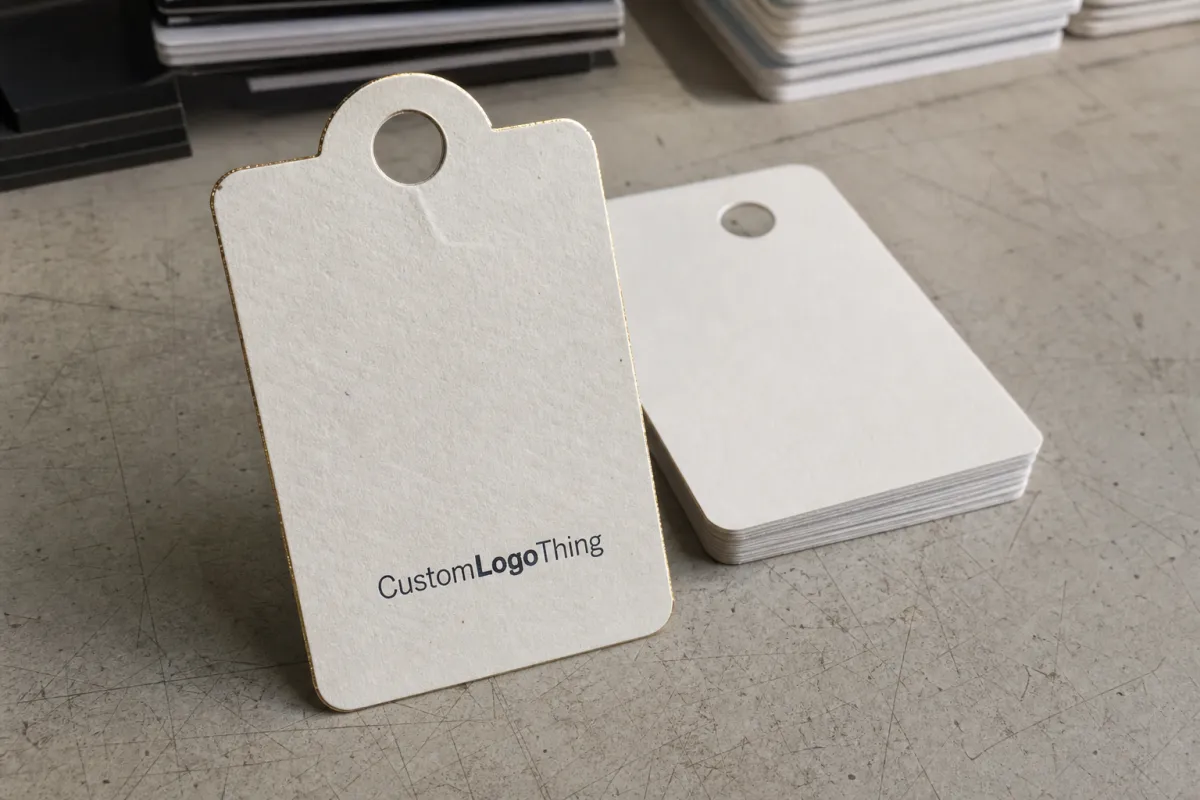
Shape influences both shelf appearance and production cost. Rectangles are the most economical and easiest to quote. Rounded corners make handling easier and reduce edge wear. Arch shapes and bottle silhouettes look more custom, but they require a die-cut and usually add time.
- Rectangle — best for budgets and straightforward copy.
- Rounded corners — cleaner handling, less edge damage.
- Arch — works well for premium or gifting lines.
- Bottle-shaped die-cut — eye-catching, but more expensive.
- Custom die-cut — useful for launches with a strong visual identity.
Print methods and finishes
Most buyers choose digital or offset printing. Digital is practical for short runs and artwork changes. Offset usually makes more sense at higher quantities where color consistency matters more. A two-color design can save money and still look polished.
Finishes should match the bottle tier. Matte lamination reduces glare and works well under retail lighting. Gloss adds punch and can help a tag stand out from a distance. Soft-touch creates a more tactile premium feel. Foil stamping and embossing can elevate reserve or holiday lines, but both add cost and can slow production.
Attachment style matters too. Cotton string is common and dependable. Elastic cord is easier to fit around different neck sizes. Ribbon works for gift sets or limited releases where presentation matters more than speed of assembly. Hole placement should be planned so the tag hangs straight and does not rotate awkwardly on the bottle.
Under bright store lights, matte and soft-touch often read better than shiny coatings.
Material specs, sizes, and print details that shift the price
Material choices are where many buyers get surprised. A tag that looks substantial on a screen may feel flimsy once it is punched, strung, and hung from a bottle neck. For most wine shop applications, 300–400 gsm cardstock is a sensible baseline. Premium gift programs may need heavier board or a coated art paper to hold the right feel in hand.
Coated stock tends to sharpen image detail and deepen color. Uncoated stock feels warmer and more natural, which suits artisan, organic, or minimal branding. Neither is automatically better. A design with small type and dark backgrounds may need a coated surface to stay legible. A rustic wine line may look better on textured uncoated board.
Size affects both readability and cost. A compact 50 x 90 mm tag is tidy and affordable, but copy space is limited. A 70 x 120 mm format allows more room for a tasting note, barcode, QR code, or short brand story. The tradeoff is straightforward: larger tags improve visibility and information space, but they can look oversized on narrow-neck bottles or make lightweight bottles feel top-heavy.
Before signing off on a quote, make sure the following are specified:
- Dimensions in millimeters or inches
- Bleed and safe zone requirements
- Hole diameter and hole placement
- Single- or double-sided printing
- Corner style and die-cut notes
- String type and attachment method
Durability is not optional. Wine shop tags get handled during restocking, moved between shelves, bundled for gift sets, and sometimes exposed to cool-case condensation. The card should resist curling and should not split around the hole after normal handling. If the tag has to survive shipping friction, ask about coating or a board weight that keeps its shape.
Artwork prep can also affect timing and rework. Vector logos are cleaner than low-resolution raster files. Pantone references help if a brand color must stay consistent. CMYK is acceptable for many projects, but if color is sensitive, say so early. If the tag includes a barcode or QR code, leave enough white space around it for reliable scanning.
For buyers who want a broader packaging reference point, standards and sustainability resources from organizations such as the ISTA and the EPA can be useful when durability, recycled content, or material sourcing is part of the brief.
Pricing, MOQ, and real unit cost
Quote pricing depends on more than paper cost. Size, stock weight, print sides, finish, die-cut complexity, and stringing all influence the final number. A simple single-color tag on standard board can be quite affordable. Add foil, soft-touch coating, embossing, or a custom silhouette and the price climbs quickly.
What buyers should watch is the total landed cost. Unit price alone can be misleading if setup fees, die charges, proof charges, packing, and freight are not included. A low per-piece number with expensive prep costs is not really a lower quote.
| Option | Typical MOQ | Approx. Unit Cost | Best For |
|---|---|---|---|
| Simple printed cardstock tag | 250–1,000 pcs | $0.10–$0.28 | Price tags, tasting notes, seasonal promos |
| Double-sided premium tag | 500–2,000 pcs | $0.18–$0.45 | Private label, gifting, reserve lines |
| Foil / soft-touch / custom die-cut | 1,000+ pcs | $0.35–$0.85+ | Luxury retail, holiday programs, specialty launches |
Those ranges are practical, not absolute. Exact pricing changes with artwork coverage, tag size, quantity, and whether assembly is included. Small runs are useful for testing a seasonal design or a new private label line. Larger runs lower the unit cost, but only if the artwork and packaging stay relevant long enough to use the inventory.
Ask any supplier quote to break out these items clearly:
- Setup fee
- Plate or die fee
- Proof fee if applicable
- Sample cost
- Packing method
- Shipping cost
- Taxes or duties if relevant
The cleanest purchase decision comes from comparing the finished cost, not just the print price. A quote that is slightly higher but includes better packing and a reliable schedule can be the smarter buy. Cheap tags that arrive bent or off-register become an immediate re-order problem.
If you are comparing other retail label formats alongside hang tags, Custom Labels & Tags can help narrow down stock, finish, and application choices before artwork is finalized.
Timelines, proofing, and turnaround
The quote process should be predictable. Inquiry, spec confirmation, artwork review, digital proof, production, quality check, packing, then shipping. If a supplier cannot explain those steps in plain language, expect confusion later.
Proofing is where most avoidable errors are caught. For a straightforward tag, one proof round may be enough. For custom shapes, foil, or nonstandard colors, a second round is often worth the time. A dieline can look fine on screen and still place a hole too close to the edge once the piece is printed and cut.
Typical turnaround depends on complexity:
- Simple printed tags: often 7–12 business days after proof approval
- Custom shapes or specialty finishes: often 12–18 business days
- Large quantities or complex assembly: often 15–25 business days
These are common ranges, not promises. A serious supplier should give a spec-based timeline after reviewing the actual quantity, stock, finish, and artwork. If the answer stays vague after those details are shared, the schedule has not been fully thought through.
What slows production down most often? Missing dimensions. Low-resolution files. Color corrections that should have been handled earlier. Late approvals. Changes after proof sign-off. In a wine shop, that can mean missing a promotion window or a holiday display date.
If the hang tags are tied to a fixed launch or tasting event, ask for milestones in writing: proof date, production start date, ship date, and the transit window. Build in cushion time for freight delays and any corrections.
How to judge a supplier before you approve a quote
A reliable supplier saves time before the order even starts. Clear spec sheets, fast answers, and a willingness to explain tradeoffs are the basics. A capable team should be able to tell you whether your requested size is practical, whether the file needs correction, and whether the finishing choice fits the target budget.
Consistency matters because wine shops reorder. A tag that looks good once but shifts from one production run to the next creates avoidable shelf inconsistency. The supplier should keep dielines, trim settings, and finish standards stable.
Quality control should include these checks:
- Clean hole punching without tearing
- Accurate trimming and square edges
- Print registration that keeps text and graphics aligned
- Consistent stringing if assembly is included
- Pack-out protection so tags do not arrive bent
Logistics matter just as much as print quality. Ask how shipping is quoted. Ask whether lead time changes after approval. Ask what happens if a batch has defects or a stock shortage. A supplier who can answer those questions clearly is doing more than selling paper; they are managing risk for the buyer.
If a supplier can’t explain the difference between “cheap” and “fit for shelf,” you are not buying expertise. You are buying a headache in a box.
That distinction is especially relevant for premium wine, where the tag is part of the perceived value. A low-cost tag that wrinkles, curls, or prints unevenly can make a bottle seem less considered than it actually is.
What to send for a quote that works the first time
Before requesting a hang tags Supplier Quote for Wine Shops, gather a short spec list. Keep it practical: quantity, dimensions, stock, print sides, finish, string type, and desired delivery date. Those are the essentials.
Reference images help more than many buyers expect. Even a photo of the bottle on a shelf can improve the sizing decision. That is useful for narrow-neck bottles, imported glass with unusual shoulders, or premium lines where the tag needs to look deliberate rather than oversized and improvised.
It also helps to ask for two versions of the quote:
- Budget version with standard stock and simple finish
- Premium version with heavier board, upgraded finish, or custom die-cut
That comparison makes the tradeoff visible. Sometimes the lower-cost version is the better answer. Sometimes the premium option earns its place because the bottle sits in a high-value section, a gift program, or a seasonal display where the extra finish changes how the line is perceived.
Useful request details to include:
- Final artwork files
- Shipping address and contact person
- Approval deadline
- Target delivery window
- Sample or digital mockup request
Once the proof is approved and the sample checks out, the order should move without drama. That is the buying path that reduces waste and gets the tag onto the bottle where it can do its job.
FAQ
What should I include in a hang tag supplier quote for wine shops?
Include quantity, exact size, stock thickness, print sides, finish, hole position, and string type. Add artwork files, delivery location, and the target date so the quote can be compared on the same basis as other print options.
What is the typical MOQ for custom wine bottle hang tags?
MOQ varies by stock and finish. Simple digitally printed runs can start lower, while foil, embossing, and custom die-cuts usually need higher minimums because the setup cost has to be spread across more units.
How long does production usually take after approval?
Simple tags often move faster than specialty finishes or custom shapes. A spec-based timeline after proof approval is the most reliable answer, since production time depends on quantity, finishing, and assembly.
What finish works best for premium wine shop tags?
Matte and soft-touch finishes usually feel more premium and photograph well under retail lighting. Foil can strengthen reserve and gift lines, but it increases cost and may extend production time.
Can I order a sample before committing to a full hang tags quote?
Yes, and it is a sensible step for premium bottles or seasonal launches. A sample or digital proof helps confirm size, color, hole placement, and how the tag behaves on the bottle before production starts.