Buyer Fit Snapshot
| Best fit | Heavy Duty Corrugated Boxes Supplier projects where brand print, material claims, artwork control, MOQ, and repeat-order consistency need to be specified before quoting. |
|---|---|
| Quote inputs | Share finished size, material target, print colors, finish, packing count, annual reorder estimate, ship-to region, and any compliance wording. |
| Proofing check | Approve dieline scale, logo placement, barcode or warning zones, color tolerance, closure strength, and carton packing before bulk production. |
| Main risk | Vague material claims, crowded artwork, missing packing details, or unclear freight terms can make a low unit price expensive after revisions. |
Fast answer: Heavy Duty Corrugated Boxes Supplier: Board, Finish, Dieline, and Unit Cost should be specified like a repeatable production item. The safest quote records material, print method, finish, artwork proof, packing count, and reorder notes in one written spec.
Production checks before approval
Compare the actual filled-product size with the drawing, then confirm tolerance on folds, seals, hang holes, label areas, and retail display edges. Reserve space for logos, QR codes, warning copy, and material claims before decorative graphics fill the panel.
Quote comparison points
Review material grade, print process, finish, sampling route, tooling charges, carton quantity, and freight assumptions side by side. A quote is only useful when the supplier can repeat the same color, closure quality, and packing count on the next order.
A Heavy Duty Corrugated boxes supplier earns trust for one simple reason: the carton has to survive the way freight actually behaves, not the way it looks sitting neatly on a sample table. Boxes get stacked before they get admired. They sit in warm trailers, damp warehouses, and busy receiving areas where corners get bumped, pallets get compressed, and nobody is especially gentle. I have seen plenty of packages that looked fine in a clean room and then folded under real handling a few days later. A supplier who understands that does more than sell thicker board. It helps you choose a structure that holds shape, protects product, and keeps the shipping line from turning into a damage report.
"Heavy duty" means different things depending on the product, the route, and the storage conditions. A 30 lb retail pack needs a different carton than a palletized load of industrial parts or bottled goods with awkward weight distribution. A serious Heavy Duty Corrugated boxes supplier asks about product weight, stack height, transit length, humidity, dwell time, and whether the cartons move through parcel, freight, or pallet networks. Those questions are not fluff. They are the only way to land on a spec that fits the job instead of a spec that merely sounds tough.
Price can be deceptive in packaging. A light carton often turns out to be the most expensive choice once damage, returns, repacking, and labor show up. A heavy carton can be wasteful too, because extra board adds cost, freight weight, and storage burden without always improving performance. A practical heavy duty corrugated boxes supplier keeps those tradeoffs visible and helps you find the middle ground that protects the product without padding the bill. The rest comes down to how the box is built, quoted, and tested.
Heavy Duty Corrugated Boxes Supplier: What Heavy Duty Really Means
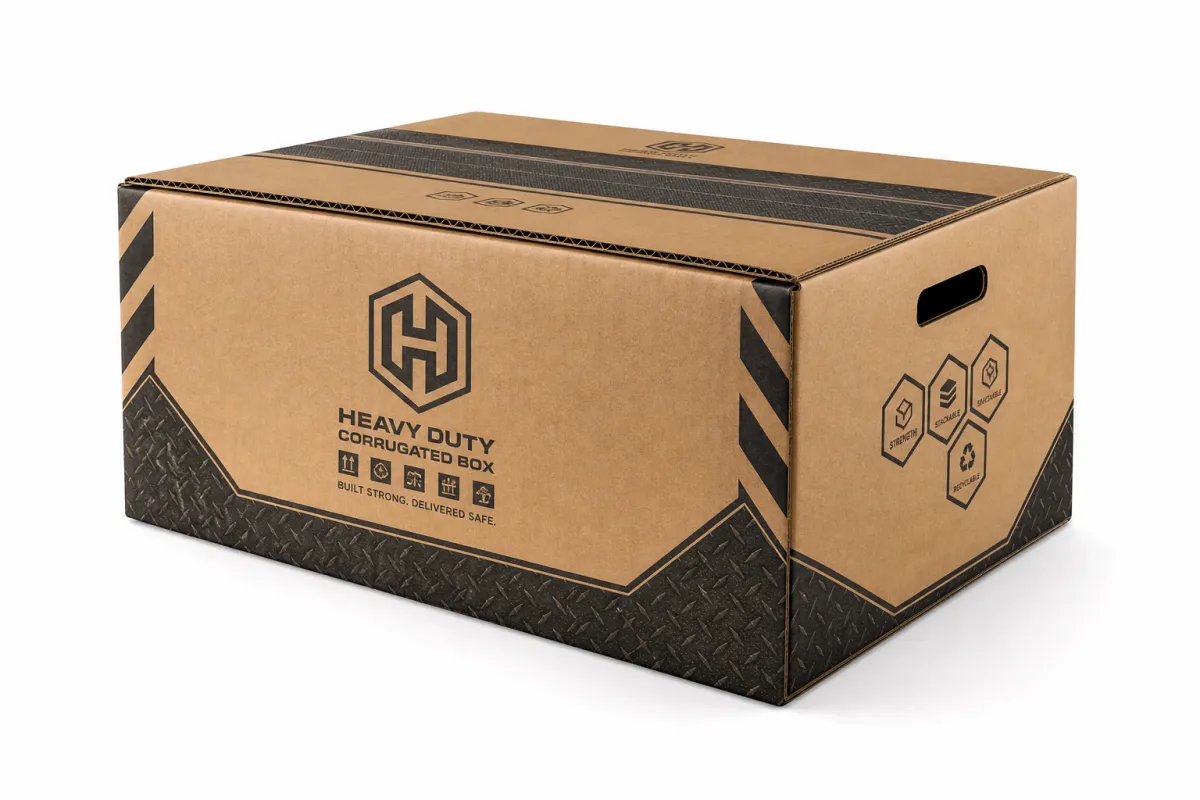
"Heavy duty" is a performance target, not a decorative label. A dependable heavy duty corrugated boxes supplier usually starts with the linerboard, the flute profile, and the carton design that stays square under compression. The goal is not just to make the walls thicker. The carton has to resist edge crush, hold stacking strength, and keep corners from collapsing when the pallet load settles during storage or transit.
Most buyers begin with dimensions and print, then circle back to strength after the quote arrives. That order creates avoidable mistakes. A carton that measures correctly on paper can still fail if the warehouse stacks it six high, if the route crosses into cold storage, or if the load sits in a trailer for two days. A good heavy duty corrugated boxes supplier translates those conditions into board grade, wall structure, and finished carton design. That translation is where real packaging work begins.
No single standard defines "heavy duty." One project may only need a single-wall carton with a strong ECT rating and tight tolerances. Another may call for double-wall or triple-wall construction because the contents are dense, the shipping path is rough, or the cartons are carrying load as part of a pallet system. A heavy duty corrugated boxes supplier that pushes the same answer for every product is not doing the work. Different loads need different structures, and the difference shows up fast once the boxes leave the dock.
Three terms matter early in the conversation: ECT, burst strength, and BCT.
ECT measures edge crush resistance and helps predict how well the carton stacks. Burst strength measures how much pressure the board can take before it ruptures. BCT, or box compression test, measures how the finished carton resists top load. A capable heavy duty corrugated boxes supplier should be able to explain which one matters most for your shipment, because the right metric depends on the route, the stack, and the product inside. Random numbers without context do not help anyone.
Environment matters more than many buyers expect. Corrugated that looks excellent on a desk can lose performance in humidity, during condensation, or after sitting in a warehouse under another pallet. I have watched a carton perform beautifully in a dry sample test, then sag a little after a weekend in a humid receiving area. A heavy duty corrugated boxes supplier should ask about moisture exposure, dwell time, and cold-chain handling before recommending a board. Those details directly affect real-world performance, especially when the shipment needs to stay intact through storage before it ever reaches a carrier.
There is a cost side to heavy-duty design that gets overlooked. Overbuilt cartons move more paper fibers than the application needs, which raises material cost and can reduce pallet density. Underbuilt cartons create damaged goods, returns, and wasted labor. A solid heavy duty corrugated boxes supplier keeps the spec honest and documents why the chosen structure makes sense. If you want a useful starting point for packaging fundamentals, the corrugated resources at Packaging School are a reliable reference.
Practical rule: a box is not truly heavy duty just because the board feels thick in your hands. It has to hold up after stacking, vibration, and moisture exposure. That is the difference between a packaging spec and a hopeful guess.
Before comparing suppliers, define what "heavy duty" means for your load. Weight. Stack height. Route. Storage condition. If a heavy duty corrugated boxes supplier cannot connect those inputs to a board spec and a finished carton design, the conversation is still too vague to trust.
How a Heavy Duty Corrugated Boxes Supplier Builds Strength
Strength starts with board structure. Corrugated board uses linerboard on the outside and fluting in the middle. The liners create smooth surfaces and help resist tearing, while the flutes add stiffness and cushioning. A reliable heavy duty corrugated boxes supplier chooses flute profile and liner weight based on load, stacking pressure, and print requirements instead of treating every brown sheet as interchangeable.
Single-wall corrugated works for plenty of shipping jobs, and it can still qualify as heavy duty when the spec is right. Double-wall adds another flute layer and more linerboard, which improves compression resistance and puncture protection. Triple-wall is reserved for very heavy, industrial, or palletized shipments where carton failure would be costly. A thoughtful heavy duty corrugated boxes supplier will not recommend triple-wall just because it sounds stronger on a quote. The right structure should match the load, not the sales pitch.
Sometimes a well-designed double-wall carton is the smarter choice than a bulky triple-wall option. If the product is moderately heavy but vulnerable to crush, the better answer may be a tighter fit, stronger closure, or cleaner internal support rather than more board everywhere. A skilled heavy duty corrugated boxes supplier looks at the actual stress points in the package and builds around them. That is packaging engineering, not guesswork.
Design matters just as much as board. Regular slotted containers are common because they are efficient and easy to produce, but a die-cut box may be better when the carton needs a precise fit, cleaner presentation, or built-in handholds. Inserts, partitions, and dividers reduce movement inside the carton, which lowers impact and keeps pressure off the walls. A dependable heavy duty corrugated boxes supplier considers the whole system, including closure style, internal support, and how the product is packed. A box that protects a load but lets the product rattle around is kinda missing the point.
Moisture changes the calculation quickly. Corrugated loses strength when exposed to high humidity, condensation, or cold-chain conditions. A carton that tests well in a dry room can disappoint on a damp receiving dock. For products with long storage times or moisture exposure, a heavy duty corrugated boxes supplier may recommend better liners, coatings, or a structural change before print is even discussed. That is not overthinking it. That is preventing the failure that usually costs the most.
Testing standards keep the conversation grounded. ISTA procedures are widely used for transit testing, and compression testing often follows ASTM-style lab methods. If you want a broader look at the testing side, ISTA is a useful place to start. A credible heavy duty corrugated boxes supplier should be comfortable talking about the test method, the result, and what the result means for your load. If they cannot explain why one carton passes and another fails, the spec is not settled yet.
Board ratings matter too. You may hear about 32 ECT, 44 ECT, or burst-tested board. Those numbers are not just catalog language. They help predict carton behavior under pressure, although the finished design still matters just as much. A 44 ECT carton is not automatically better than every 32 ECT carton in every case. A careful heavy duty corrugated boxes supplier will tie the rating back to dimensions, print coverage, closure method, and how the carton will actually be used.
The best supplier acts as a translation layer. It takes the product weight, shipping method, and storage conditions, then turns them into a carton spec that procurement and operations can approve without confusion. That is the real value of a heavy duty corrugated boxes supplier: not just producing cartons, but producing the right carton for the environment in front of it.
Cost, Pricing, and MOQ: What Changes the Quote
Corrugated pricing is straightforward once the inputs are fixed, but it gets messy fast when specs are incomplete. The main cost drivers are board grade, wall construction, size, print coverage, coatings, inserts, and tooling. A heavy duty corrugated boxes supplier will usually price a plain brown carton very differently from a printed die-cut box with custom inserts. That difference makes sense. What does not make sense is comparing quotes that are not built from the same spec.
Minimum order quantity, or MOQ, changes the math quickly. Small runs usually cost more per unit because setup and production overhead get spread across fewer cartons. In many programs, low-volume custom boxes can run 15% to 40% higher per unit than larger runs, depending on complexity, board type, and print. A practical heavy duty corrugated boxes supplier should say that plainly instead of pretending a 500-piece run and a 10,000-piece run cost the same to make.
Small charges can distort a quote if they are left out of the first conversation. Sample fees. Plate or die charges. Color matching. Freight. Rush production. Pallet fees. Those items are easy to overlook until the invoice arrives. If a heavy duty corrugated boxes supplier gives you a suspiciously low number, ask what was excluded. The missing cost usually appears somewhere else.
| Box Type | Typical Use | Relative Strength | Common Price Range per Unit | Notes |
|---|---|---|---|---|
| Single-wall corrugated | Moderate-weight retail and ecommerce shipping | Medium to high, depending on ECT | $0.55-$1.20 | Good value when load and stacking are controlled |
| Double-wall corrugated | Heavier products, longer storage, stronger stacking | High | $0.95-$2.10 | Often the best middle ground for a heavy duty corrugated boxes supplier program |
| Triple-wall corrugated | Industrial loads, palletized shipments, very high compression needs | Very high | $1.80-$4.50+ | Useful only when the load truly needs it; otherwise it is overkill |
The ranges above are intentionally broad. Final pricing depends on dimensions, board market movement, print coverage, quantity, and delivery terms. A heavy duty corrugated boxes supplier should compare quotes using identical dimensions, identical board spec, identical print coverage, and identical freight assumptions. Once those variables change, the comparison stops being useful.
Low MOQ can be the right answer when a product is new or when packaging is still being refined. It is not free, though, and it is not always the best long-term cost. A smaller order can save a program from being locked into the wrong box, which is worth real money in its own way. A good heavy duty corrugated boxes supplier will say that without dressing it up. The numbers usually speak clearly enough on their own.
If you are comparing Branded Shipping Cartons and want to keep the structural side aligned with presentation, the related line of Custom Shipping Boxes gives you a practical way to compare packaging formats without losing sight of the ship-ready spec. If your program also needs mailers, inserts, or other packaging pieces, the broader Custom Packaging Products range can keep the whole system moving in the same direction. A strong heavy duty corrugated boxes supplier should be able to work across those categories without forcing a reset every time the format changes.
Material claims deserve the same attention as price. If a supplier says the board is FSC-certified, ask for chain-of-custody details rather than accepting the label at face value. The FSC site explains how certification works. A responsible heavy duty corrugated boxes supplier will be clear about sourcing, because vague sustainability claims tend to fall apart during audits.
Process and Timeline: From Quote to Delivery
A clean order process saves time before the job starts to slip. A typical heavy duty corrugated boxes supplier workflow begins with an inquiry, moves into spec review, then pricing, sample or prototype approval, production, quality checks, and shipping. If one of those steps is fuzzy, the schedule starts to drift. Packaging rarely gets delayed because of one huge mistake. It usually slips because small changes keep arriving after the job is already in motion.
Reasonable timing is easy to outline. Simple quote requests often return in 1 to 3 business days. Sample or prototype production usually takes 5 to 10 business days. Full production commonly runs 10 to 25 business days after approval, depending on quantity, board availability, and print complexity. Freight time is separate. A good heavy duty corrugated boxes supplier will explain the difference so plant time does not get confused with door-to-door time.
Lead time stretches for predictable reasons. Custom tooling adds setup. Special print can slow finishing. Board shortages can push a date back by several days. Seasonal volume creates congestion. Freight scheduling can become its own bottleneck. A practical heavy duty corrugated boxes supplier builds around those realities instead of promising a ship date that only works in a perfect week.
The fastest way to keep the schedule moving is to send complete specs on day one. Include internal dimensions, product weight, carton orientation, target quantity, artwork, delivery location, and any stacking requirement. If the box will travel on pallets, say so. If it has to survive cold storage, say that too. A capable heavy duty corrugated boxes supplier should not need a long chain of emails to learn the carton must carry 40 lb and stack four high.
Sample approval is often where time disappears. A sample can be visually correct but structurally off, or structurally correct but too loose, too tight, or printed poorly. That is part of the process, not a failure. The purpose is to catch the problem before the production run begins. A disciplined heavy duty corrugated boxes supplier plans for revisions and leaves room for them.
Testing should be treated like production support, not a side task. If the carton is carrying a dense or valuable product, run a fit check, a stack test, and a transit simulation if budget allows. A box that survives controlled testing is far more likely to survive the shipping lane. A trusted heavy duty corrugated boxes supplier will encourage that work, because nobody wants to restart a run after damage starts piling up.
Important shipments deserve buffer time. Add room for approval, freight, and a sample that does not quite land on the first try. A serious heavy duty corrugated boxes supplier keeps the calendar grounded in reality. Packaging emergencies usually come from several small delays that no one wanted to mention until they became one big problem.
Step-by-Step Guide to Choosing the Right Supplier
Start with the product, not the quote. What does it weigh? What shape does it have? Are there sharp corners? Does it scratch easily? Will the carton sit in a warehouse for two weeks, or move the same day it is packed? A strong heavy duty corrugated boxes supplier needs those answers before recommending a structure that actually fits the job.
Capability comes next. Not every supplier can produce the board strength, print quality, or order volume you need. Some do very well on short runs. Some are better on larger repeat programs. Some can build clean structural packaging but struggle with tight print tolerances. A reliable heavy duty corrugated boxes supplier should be direct about where it performs well and where it does not. Honest limits are more useful than polished promises.
Samples should be part of the decision, not an optional extra. If the shipment is heavy, expensive, or sensitive to humidity, skipping samples just pushes the risk into production. A heavy duty corrugated boxes supplier that resists sampling is not saving you time. It is moving the risk somewhere you will have to deal with later.
Use one spec sheet across every vendor before comparing quotes. Keep the internal dimensions, board grade, wall construction, print coverage, quantity, and delivery terms identical. Then score each heavy duty corrugated boxes supplier on communication, sample quality, lead time realism, and production consistency. Price matters, but it only tells part of the story.
A simple scorecard can make the decision much clearer:
- Board match: Did the supplier quote the spec you asked for?
- Communication: Did they answer clearly and without delay?
- Sampling: Did the sample match the approved dimensions and structure?
- Capacity: Can they support repeat orders without scrambling?
- Follow-through: Do they stay responsive after the purchase order is in place?
That last point carries more weight than most people admit. Anyone can sound organized before the order is placed. The better heavy duty corrugated boxes supplier is the one that stays organized after approval, because the second order is usually where weak systems start to show themselves.
A pilot order is often the smartest next step. Keep it small enough to limit risk, but large enough to show handling issues, stacking behavior, and packing speed. If the product is new, if the box is highly custom, or if the load changes often, a pilot makes sense. A good heavy duty corrugated boxes supplier will treat that as normal planning, not as hesitation.
Ask who owns quality checks as well. Does the supplier inspect caliper, print registration, glue performance, and carton dimensions before release? If the answer stays vague, expect surprises. A solid heavy duty corrugated boxes supplier should be able to explain the checks in plain language and tell you what tolerances it holds during production.
Common Mistakes Buyers Make With Heavy Duty Boxes
The first mistake is sizing the carton around the product and ignoring the shipping environment. Void space, pallet pressure, and handling abuse all matter. A product can fit neatly and still fail if the carton does not have enough compression strength. A smart heavy duty corrugated boxes supplier will push back when the dimensions look fine but the structure does not support the route.
The second mistake is chasing the lowest quote without checking the board spec. That is how buyers end up with cartons that look acceptable and perform poorly. A cheaper price often hides a lower ECT, thinner liners, or weaker wall construction. A heavy duty corrugated boxes supplier worth listening to will compare the spec line by line. If that comparison is not possible, the quote is not really comparable.
Skipping sample testing is another expensive habit. A box can look crisp on a screen and still fail in a humid warehouse or on a rough conveyor. A heavy duty corrugated boxes supplier should encourage sample validation because the cost of one bad run is usually much higher than the cost of one good prototype.
Buyers also overlook print and structural details. A carton that protects the product but looks cheap can weaken brand perception, especially when it arrives scuffed, crushed, or misaligned. The best heavy duty corrugated boxes supplier balances protection with presentation so the package does not look like it fought its way to the customer and lost.
Planning mistakes create the last big batch of problems. People forget extras, underestimate seasonal demand, or assume a reorder can happen whenever they want. Then the warehouse runs short and everyone acts surprised. A sensible heavy duty corrugated boxes supplier will ask about reorder points and safety stock because it has seen this cycle many times before.
Heavy duty packaging only works when the spec, test, budget, and timeline all line up. If one of those pieces stays fuzzy, the whole program gets shaky. A heavy duty corrugated boxes supplier is supposed to reduce risk, not decorate it.
Expert Tips and Next Steps Before You Order
Ask for a one-page spec sheet before you request a final quote. Include internal dimensions, board grade, wall construction, ECT or BCT targets, finish, quantity, and approved artwork. That small step saves a lot of back-and-forth with a heavy duty corrugated boxes supplier. It also forces everyone to talk about the same carton, which is more useful than it sounds.
Test the carton the way it will actually live. Stack it. Load it. Move it across the warehouse floor. Leave it in the environment it will face. If the carton fails during a controlled internal check, shipping will not make it better. A good heavy duty corrugated boxes supplier should support that testing rather than treating it like a nuisance.
Build a scorecard for repeat orders. Rate each heavy duty corrugated boxes supplier on price, response time, sample accuracy, production consistency, and after-sales support. A fancy dashboard is not necessary. A simple spreadsheet is enough to show who keeps commitments and who only sounds polished during quoting.
Use a pilot order when the product is new, the packaging is custom, or the product mix changes often. Cheap mistakes scale quickly. One wrong spec on 1,000 boxes is annoying. One wrong spec on 25,000 boxes is a warehouse problem. A thoughtful heavy duty corrugated boxes supplier should understand why testing before scaling is a sensible habit.
Watch the testing language too. If a supplier talks about transit testing, ask whether it uses ISTA-style protocols, compression testing, or both. That question shows whether they understand the difference between surviving a drop and surviving a stack. A heavy duty corrugated boxes supplier with real experience will answer directly.
Freeze the spec once the sample is approved, confirm the quantity, and lock the timeline. If changes are necessary, document them clearly. That is how packaging stays manageable. The best heavy duty corrugated boxes supplier helps keep the process tidy instead of turning a carton order into a guessing game.
If you are collecting options now, request two comparable quotes, ask for samples, and confirm the reorder timeline before signing anything. That is the cleanest way to work with a heavy duty corrugated boxes supplier and avoid the usual mess of vague specs, surprise fees, and cartons that look stronger than they really are. Start with the load, verify the board, and make the supplier prove the carton under the same conditions it will face in the real world.
How do I know if I need a heavy duty corrugated boxes supplier instead of standard cartons?
You usually need a heavy duty corrugated boxes supplier if the product is heavy, stackable, fragile, or moving through a rough warehouse-to-retail chain. If your current cartons fail from crush rather than impact, stronger corrugated construction is probably the fix. Ask for ECT, wall type, and stacking expectations before you choose a supplier. If the carton is only failing after a long sit in storage, humidity may be part of the story too.
What should I send a heavy duty corrugated boxes supplier for an accurate quote?
Send internal dimensions, product weight, quantity, print needs, and shipping destination. Add stacking height, warehouse conditions, and whether you need inserts, coatings, or special die-cuts. The more exact the spec, the less likely the quote is to change later, and a heavy duty corrugated boxes supplier can usually respond faster when the basics are complete. A photo of the product helps too, especially if the shape is awkward or the corners are sharp.
How long does custom heavy duty corrugated box production usually take?
Simple quotes can come back in 1 to 3 business days, while samples often take 5 to 10 business days. Production commonly runs 10 to 25 business days after approval, depending on complexity and capacity. Freight time is separate, so do not treat production lead time as the whole timeline when you work with a heavy duty corrugated boxes supplier. If a run includes special dies or heavy print coverage, build in extra cushion.
Is double-wall corrugated always better for heavy shipping boxes?
No. Double-wall is stronger, but it is not automatically the right choice for every product. The best structure depends on load weight, stacking pressure, moisture exposure, and cost targets. Sometimes a well-designed single-wall box with the right spec performs better than a sloppy double-wall one from a heavy duty corrugated boxes supplier that only sells by thickness. The actual package system matters more than the board count alone.
How can I compare pricing without getting fooled by hidden costs?
Compare quotes with identical dimensions, board specs, print, quantity, and delivery terms. Check for setup fees, sample charges, freight, tooling, and rush costs before you judge the unit price. If one quote is much lower, ask what was removed, downgraded, or left out. That is usually where the real difference hides when you are shopping a heavy duty corrugated boxes supplier. Clear comparisons are boring, but they save money.