Buyer Fit Snapshot
| Best fit | Heavy Duty Corrugated Sleeves Bulk projects where brand print, material claims, artwork control, MOQ, and repeat-order consistency need to be specified before quoting. |
|---|---|
| Quote inputs | Share finished size, material target, print colors, finish, packing count, annual reorder estimate, ship-to region, and any compliance wording. |
| Proofing check | Approve dieline scale, logo placement, barcode or warning zones, color tolerance, closure strength, and carton packing before bulk production. |
| Main risk | Vague material claims, crowded artwork, missing packing details, or unclear freight terms can make a low unit price expensive after revisions. |
Fast answer: Heavy Duty Corrugated Sleeves Bulk: Specs, Pricing, MOQ should be specified like a repeatable production item. The safest quote records material, print method, finish, artwork proof, packing count, and reorder notes in one written spec.
Production checks before approval
Compare the actual filled-product size with the drawing, then confirm tolerance on folds, seals, hang holes, label areas, and retail display edges. Reserve space for logos, QR codes, warning copy, and material claims before decorative graphics fill the panel.
Quote comparison points
Review material grade, print process, finish, sampling route, tooling charges, carton quantity, and freight assumptions side by side. A quote is only useful when the supplier can repeat the same color, closure quality, and packing count on the next order.
For teams protecting repeat shipments without rebuilding the entire pack-out, heavy duty corrugated sleeves bulk orders usually solve the most stubborn failure points: edge crush, corner blowout, and panel flex after a carton leaves the packing bench. I have watched a sleeve miss by just 2 or 3 mm and turn a clean shipment into a pile of crushed corners before the trailer even hit the second stop. That kind of damage is annoying, sure, but it is also expensive in a way that hides inside claims, rework, and lost time. A smarter spec often changes the economics more than one more wrap, another strip of tape, or a heavier outer carton that never needed to be there in the first place.
Buyers compare heavy duty corrugated sleeves bulk options by board grade, flute profile, and inside dimensions before they look at price. That order matters. A sleeve that sits a little too loose can pass a quick bench test and fail in transit. A sleeve that fits too tightly slows the line and invites operators to improvise, which is never a good sign on a busy shift. Packaging buyers tend to learn the same lesson twice: the best bulk purchase is the one That Holds Up across repeated runs, different shifts, and the rough handling that happens between palletization and final delivery.
Bulk buying carries the most weight for repeat SKUs, seasonal spikes, multi-site fulfillment, and products moving through longer freight lanes or mixed distribution networks. It also matters for goods that live under stack pressure: bottled items, boxed components, printed kits, and bundled retail packs. The sections that follow break down the Specs, Pricing, Lead Times, and order-planning decisions that make heavy duty corrugated sleeves bulk sourcing easier to control and easier to replenish.
Why These Orders Cut Damage Risk
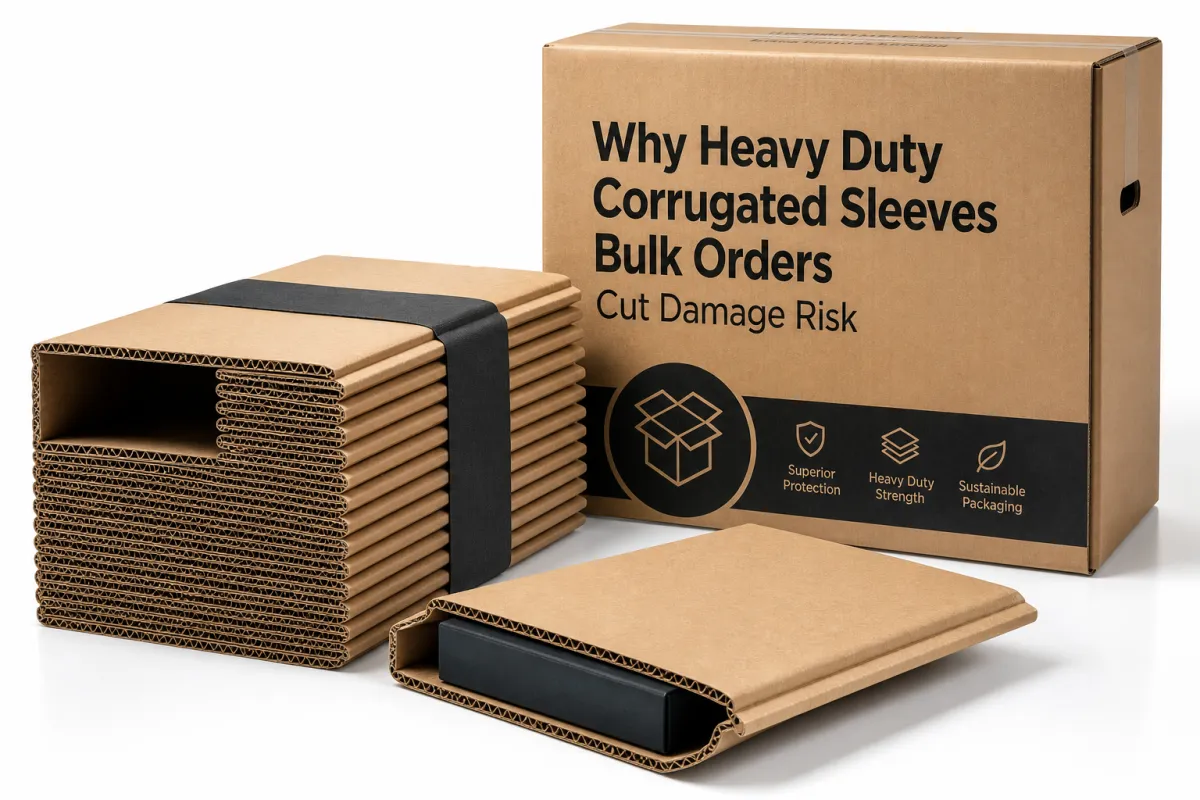
A sleeve is not filler. It reinforces the part of the shipper most likely to fail. That is the practical reason heavy duty corrugated sleeves bulk purchases often beat improvised packaging tweaks. The sleeve helps steady a carton wall, reduces flex at the corners, and keeps product groups from migrating inside the outer container. Those effects matter most when freight lanes run long, transfers pile up, or neighboring loads press sideways into the pallet.
The comparison many buyers miss is simple: damage usually comes from movement and compression, not from a lack of tape. Tape keeps a box closed. A sleeve helps the package keep its shape. That distinction explains why a warehouse can often reduce claims by changing sleeve construction before it adds more wrap or swaps to a heavier carton. In heavy duty corrugated sleeves bulk orders, the economic gain comes from consistency. Every unit behaves the same way, and that steadiness shows up as fewer packing exceptions and fewer operator decisions at the line.
Bulk buying also tightens process control. When a packing team pulls from the same sleeve spec every day, the odds of a wrong-size substitute drop because inventory ran short. Multi-site fulfillment feels that problem first. One distribution center makes do with a similar part, another copies the shortcut, and soon the spec has drifted without anyone signing off on it. A proper bulk program locks the dimension, simplifies replenishment, and gives procurement a reorder point that means something.
The strongest use cases tend to fall into four buckets:
- Repeat SKUs that ship on a predictable schedule and need the same protection every run.
- Seasonal programs where order volume spikes and the packaging line cannot afford trial-and-error changes.
- Multi-site operations that need identical packaging across different warehouses.
- Products moving through rougher channels such as parcel networks, pallet transfers, or regional freight.
From an operational angle, heavy duty corrugated sleeves bulk orders are easiest to justify once the cost of a single damaged shipment outruns the incremental cost of the sleeve upgrade. That happens more often than buyers expect. A 2% damage rate on 50,000 units creates 1,000 problems, not a small rounding error. If the packaging environment includes humidity, long dwell times, or heavy stack loads, the sleeve spec becomes even more important.
In a plant I visited last year, the team had already tried more tape, more stretch wrap, and a heavier master carton. None of it moved the needle. The fix was a double-wall sleeve with tighter scoring. No drama, no glossy story, just fewer claims and less rework. Packaging is kinda like that more often than people admit.
"The cheapest sleeve is rarely the lowest-cost sleeve. The right sleeve protects the product, repeats cleanly on the line, and keeps claims off the freight report."
For broader packaging context, industry groups such as ISTA and the Packaging Machinery Manufacturers Institute offer useful references for transit testing, compression, and packout discipline. Those standards do not replace practical trials, but they help buyers describe performance in terms suppliers can quote without guessing at the outcome.
The value proposition is straightforward: lower unit cost at scale, less variability on the line, stronger product protection, and cleaner replenishment planning. For bulk sleeve programs, the business case usually improves once one sleeve spec can support multiple production runs without a redesign.
Product Details
A corrugated sleeve is a structural wrap that reinforces, separates, or stabilizes a product or carton. In shipping terms, it sits between the product and the outside world. Depending on the design, it can protect edges, prevent panel bowing, or keep bundled items aligned. In heavy duty corrugated sleeves bulk applications, the goal is not decoration. The goal is control.
Common use cases include bottled goods, electronics, industrial parts, printed materials, and multi-pack retail units. A bottled-goods program may use sleeves to prevent crush and maintain spacing. An electronics shipper may use them to limit scuffing and internal movement. Industrial parts often need sleeve reinforcement so cartons survive stacking and conveyor pressure. Printed kits and catalogs benefit because the sleeve can hold a neat bundle without relying on excessive tape or stretch film.
Configuration matters. Buyers usually choose among:
- Open-ended sleeves for quick insertion and removal.
- Wrap-around styles that protect a larger panel area.
- Scored formats for faster folding and better alignment.
- Slotted designs that lock into place during assembly.
- Custom lengths matched to product height, bundle width, or pallet footprint.
Heavy duty versions differ from standard sleeves in board strength, wall construction, and resistance to puncture or compression. A standard sleeve can work for light cartons on short parcel routes. heavy duty corrugated sleeves bulk orders, by contrast, usually target heavier loads, more aggressive handling, or long-haul transit. The structure has to survive not just the warehouse, but the transfer chain after it.
That is why sleeves often beat a full carton redesign. A company may not want to change the primary pack or alter the customer-facing box style. A sleeve can reinforce the current format without retooling the entire package. That keeps launch risk lower and lets procurement focus on a single component instead of rebuilding the whole pack system.
There is a production advantage too. A sleeve can be easier to standardize than a fully custom carton, especially if the packing line already runs a proven carton format. That makes heavy duty corrugated sleeves bulk sourcing attractive for teams that want protection gains without major pack-out disruption.
What Specifications Matter Before Ordering Heavy Duty Corrugated Sleeves Bulk?
Before requesting quotes, buyers should define the specs that determine performance. For heavy duty corrugated sleeves bulk orders, the first questions are usually inside dimensions, board grade, flute profile, wall count, caliper, and print requirements. If those details stay vague, pricing wanders and samples come back wrong. If they are clear, suppliers can quote a usable sleeve instead of guessing at a structure that may never fit.
Single-wall and double-wall construction are the two most common choices. Single-wall can work for moderate loads and shorter routes, especially when the sleeve is about alignment more than compression resistance. Double-wall adds strength and usually performs better under stack pressure, mixed pallet loads, and rough freight handling. For heavy duty corrugated sleeves bulk projects, double-wall is often the safer starting point when the shipment has any real chance of top load or side crush.
Board selection should match shipping risk. A light-to-medium carton on local parcel routes may only need a solid single-wall structure. A heavier industrial load may need a sturdier board with better resistance to puncture and panel flex. Long-distance freight, especially when cartons ride under other pallets, pushes buyers toward stronger construction. If humidity is part of the environment, ask about moisture-resistant options or test the board after exposure, because corrugated performance can fall when fiber absorbs water.
Exact measurement tolerance matters more than many teams expect. A sleeve that is nominally correct but inconsistent by a few millimeters can slow an automated line, create fit issues, or force operators to rework the assembly. That is one reason heavy duty corrugated sleeves bulk buyers should request dimensional tolerances in writing. Repeatability matters. A good sleeve spec is one a packing supervisor can trust on Monday morning and again during peak volume on Friday afternoon.
Optional upgrades can improve performance, but they should be chosen carefully. Moisture resistance can help in humid warehouses or long ocean lanes. Surface treatments may reduce scuffing. Die cuts can make assembly faster. Branding can be added without weakening the structure if the print area is planned correctly and does not force excessive scoring changes. For sustainability programs, buyers may also ask about recycled content or FSC-certified fiber where appropriate. Certification only helps if the structure still survives the actual shipping test.
Some teams also compare sleeve specs against broader packout changes. If the product itself needs a new outer shipper, it may make sense to compare a sleeve program with a full carton redesign or with Custom Shipping Boxes. The right answer depends on the damage mode. Edge crush? Sleeve. Total carton failure? A different structure. No single part solves every problem.
| Option | Typical Construction | Indicative Unit Cost | Common MOQ | Best Fit |
|---|---|---|---|---|
| Standard sleeve | Single-wall, stock size, minimal print | $0.18-$0.28 | 500-1,000 units | Lower-risk shipments and simple reinforcement |
| Custom sleeve | Single-wall or light double-wall, custom cut | $0.24-$0.42 | 1,000-2,500 units | Repeat SKUs with specific fit requirements |
| Heavy duty sleeve | Double-wall, reinforced score, optional moisture treatment | $0.38-$0.68 | 2,500-5,000 units | Stacked pallets, long haul freight, higher claims risk |
| Branded heavy-duty sleeve | Double-wall with print, special finishes, tighter tolerances | $0.52-$0.90 | 5,000+ units | Retail-facing shipments and recurring high-volume programs |
Those figures are directional, not universal, and material markets can move faster than a procurement calendar. They still show why heavy duty corrugated sleeves bulk orders are often priced on more than one variable. Board grade, tooling, print coverage, and dimensional complexity can move the quote faster than many buyers expect. The most expensive sleeve is not always the strongest one, and the cheapest sleeve is not always the one that protects the product.
Pricing, MOQ, and Unit Costs
Pricing for heavy duty corrugated sleeves bulk orders usually starts with five variables: dimensions, board grade, wall construction, print coverage, and order volume. Freight distance matters too. A large, lightweight sleeve can cost more to move than to manufacture if the shipment is poorly palletized or sent across a long lane. That is why a real unit-cost review needs landed cost, not just the sticker price.
The biggest driver of MOQ is setup time. If the job needs a custom die, a new platen setup, or a specific score pattern, the supplier has to recover that prep work across the run. Larger quantities spread that cost out and lower the per-unit price. For buyers comparing heavy duty corrugated sleeves bulk quotes, a small pilot run may look cheaper at the start, but a larger commitment often wins on total cost per protected shipment.
Quote structures usually include a few familiar line items:
- Sample or prototype fees for fit checks and approval runs.
- Plate or die costs if print or custom cutting is involved.
- Material charges tied to board grade, caliper, and wall count.
- Packaging for shipment so sleeves arrive flat, protected, and counted correctly.
- Pallet freight charges based on weight, zone, and delivery requirements.
MOQ is not punishment. It usually reflects how the sleeve is made. When the run is simple and the material yield is high, minimums can stay moderate. When the sleeve is oversized, heavily printed, or built from double-wall board, MOQ can rise because the supplier needs enough volume to keep the process efficient. For bulk work, the real question is whether the MOQ matches annual usage and replenishment cadence.
Total landed cost is the better lens. A sleeve that is 6 cents lower in unit price but arrives with higher freight, more damage, or longer lead time may cost more in the end. Procurement teams should compare the cost of a claim, the cost of a missed ship date, and the cost of excess inventory. Those costs are not abstract. They show up in customer service tickets, labor hours, and rush freight.
For buyers who need a more formal sourcing model, ask suppliers to quote tiered volumes: pilot quantity, mid-run quantity, and full production quantity. That reveals where pricing bends and whether heavy duty corrugated sleeves bulk procurement is worth locking in at a higher annual commitment. If the supplier also supports broader packaging programs, the buyer may combine sleeve sourcing with Wholesale Programs to consolidate planning across multiple SKUs.
A good quote request should include annual usage, forecasted call-off schedule, delivery location, sleeve dimensions, product weight, packaging photos, and any special handling needs. If those details are missing, the quote is likely to be padded. If the details are clear, the supplier can usually offer a sharper price and a more realistic lead time.
One useful rule of thumb: the more the sleeve affects structural protection, the more important it is to validate the spec before ordering in volume. That is especially true for bulk sleeve programs where a small measurement error can create a large pallet-level failure.
Process and Lead Times
The cleanest purchasing process starts with an RFQ, but it should not stop there. A well-run heavy duty corrugated sleeves bulk order moves through sample approval, production, quality check, and shipment. Each step matters because corrugated packaging is only useful if it fits the product and survives the logistics chain. A quote without a sample plan is not enough for a serious launch.
Typical lead times depend on whether the sleeve is stock-sized or fully custom. A stock or near-stock sleeve may move quickly if material is available. A custom sleeve can take longer because artwork, tooling, and board procurement add time before the run starts. In many cases, the production run itself is not the longest part; approval delays are. Missing dimensions, unclear print files, and late changes after sample signoff are the real schedule killers.
A practical planning model looks like this:
- First order: confirm dimensions, board grade, and fit with a sample.
- Pilot run: test the sleeve on a small production batch or one shipping lane.
- Reorder trigger: set the point where remaining inventory covers only lead time plus safety stock.
- Safety stock: keep enough on hand to cover forecast error, spike volume, or freight delays.
For many buyers, the first production run lands somewhere around 12-15 business days after proof approval, though that can stretch if tooling or board supply is tight. Custom print, special scoring, or moisture-resistant treatment can add days. If the job is urgent, ask about phased deliveries or a partial shipment so the launch does not wait for every unit to finish.
Delays usually come from the same four places: missing measurements, unclear structural requirements, late art changes, and freight booking that happens after production instead of before it. The fix is simple, but not always easy: gather complete information before the quote is finalized. That discipline matters even more for heavy duty corrugated sleeves bulk projects because a mistake is more expensive when the order volume is high.
It also helps to understand testing language. If the supplier references compression resistance, burst strength, or transit testing, the buyer should ask how those values were measured and under what conditions. Standards from groups like ISTA help frame that discussion. A sleeve that performs well on paper should also perform in the lane the product actually uses.
One more practical point: plan the reorder cycle around consumption rate, not instinct. If the line burns through 800 sleeves a week and the lead time is three weeks, the reorder point should not be 200 pieces. That is how stockouts happen. For bulk programs, a simple spreadsheet usually beats a hope-based inventory plan.
Why Choose Us for Supply
Custom Logo Things is built for buyers who need packaging that behaves the same way every time. That matters more than flashy claims. In heavy duty corrugated sleeves bulk supply, consistency is the real asset. A sleeve that fits in one production run but shifts in the next does not help procurement, operations, or customer service. The value sits in repeatable structure, predictable lead times, and clear communication from quote to replenishment.
Manufacturing discipline reduces risk. That sounds plain because it is plain. If a supplier verifies dimensions, controls board selection, checks scoring, and confirms print setup before release, the buyer gets a better outcome. If the supplier treats each order like a one-off guess, the buyer absorbs the cost later. For teams that need the same sleeve spec every time, not a near substitute, that difference is decisive.
Direct manufacturer support also matters. Broker-only sourcing can work for simple jobs, but it becomes slower when the buyer needs fast answers on board strength, dimensional tolerance, or print tradeoffs. A direct partner can usually talk through the structural choices faster and give a more useful recommendation based on the actual shipper, not just a price list. That is useful for heavy duty corrugated sleeves bulk orders where the package has to do real work.
Service points that matter in shipping and logistics are not glamorous, yet they save money:
- Spec verification so the sleeve matches the product and pallet profile.
- Sample coordination so the first run is checked before full production.
- Production visibility so procurement can track timing against launch needs.
- Freight coordination so the order arrives flat, counted, and ready to use.
- Reorder support so repeat programs stay stable across seasons and volume swings.
There is also a trust factor buyers appreciate. A supplier who says "this depends on your stack height" is usually more useful than one who pretends every sleeve works for every shipment. Honest guidance is worth more than a polished sales line. For sustainability-sensitive programs, suppliers should also be able to discuss recycled fiber, FSC sourcing, and the tradeoff between lighter board and shipment risk. The answer is not always the greener one on paper; sometimes the lower-damage option is the better environmental result because fewer replacements are needed.
heavy duty corrugated sleeves bulk programs tend to reward vendors who ask better questions. Product weight? Stack pressure? Parcel or freight? Humidity? Assembly speed? Those questions show whether the supplier understands the actual use case. That is the difference between a quote and a packaging plan.
If your team needs a broader packaging refresh alongside sleeves, the same buying logic applies. Compare the sleeve against the shipper, the outer carton, and the broader fulfillment method before committing to changes. A strong sleeve program should fit into the whole pack system instead of fighting it.
Next Steps for Ordering
The fastest way to get a useful quote is to send the right information up front. For heavy duty corrugated sleeves bulk orders, that usually means product dimensions, target quantity, current packaging photos, board preference, delivery location, and the shipping environment the sleeve has to survive. If the product is fragile, heavy, or exposed to moisture, say so early. That saves time and gets the structure right sooner.
Before placing the full order, confirm whether the job needs print, moisture resistance, custom scoring, or a specific compression target. If there is any uncertainty, ask for a sample or a spec sheet. A short approval step is much cheaper than correcting a full production run after the fact. The real cost of packaging mistakes is not just the remanufacture cost. It is the delay, the rework, and the damage that happens while the mistake is being discovered.
Once the sleeve is approved, set a reorder threshold based on weekly usage and supplier lead time. A business that ships 10,000 units a month should not wait until the last pallet is open before ordering again. Build in a buffer for seasonal growth, carrier delays, and demand spikes. That one habit keeps supply from turning into an emergency purchase.
Use the sleeve as a repeatable standard, then lock in the spec and the reorder plan. That is where the savings begin. Not from hunting for the cheapest box on a spreadsheet, but from reducing variability across shipments, operators, and freight routes. For teams that ship the same SKUs every week, heavy duty corrugated sleeves bulk is not just a buying line item. It is a packaging system worth standardizing.
If you are building the program now, start with three things: an actual sample on the real product, a written tolerance range, and a reorder point tied to lead time instead of guesswork. Do those three things well, and the rest tends to follow.
What is the minimum order for heavy duty corrugated sleeves bulk?
MOQ usually depends on board grade, sleeve size, and whether custom printing or tooling is required. Larger runs reduce unit cost because setup time is spread across more pieces. Ask for tiered pricing so you can compare pilot quantities against full production volumes for bulk sleeve planning.
How do I choose the right board strength for bulk sleeves?
Start with product weight, stack height, transit distance, and how much compression the sleeve must handle. Use heavier board or double-wall construction when pallets are stacked, shipments are long-haul, or humidity is a factor. Photos of the current packout help the supplier match the spec to the real failure point.
Can bulk sleeve orders be printed with branding?
Yes, most suppliers can add simple logos, handling instructions, or product identifiers. Keep artwork clean and functional so print does not interfere with structural performance. Confirm whether print affects lead time, setup cost, or minimum quantity before you finalize artwork.
How long do bulk sleeve orders usually take?
Lead time depends on whether the sleeve is stock-sized or fully custom. Artwork approval, sampling, and freight booking are common schedule drivers. If inventory is tight, ask about phased shipments or a pilot run before the full order so production can start while the next steps are being confirmed.
What information speeds up a quote for bulk sleeves?
Provide inside dimensions, quantity, board preference, print needs, delivery location, and target ship date. Add product weight, pallet configuration, and any moisture or compression concerns. Photos of the current packaging help the supplier quote a more accurate replacement for your use case.
For buyers who want fewer claims, less rework, and a cleaner replenishment plan, heavy duty corrugated sleeves bulk is usually a strong place to start. Get the dimensions right, confirm the board strength, validate the sample, and set the reorder point before volume ramps up. That is how packaging stops being a scramble and starts behaving like an operating standard.


