Buyer Fit Snapshot
| Best fit | Heavy Duty Pallet Boxes Supplier projects where brand print, material claims, artwork control, MOQ, and repeat-order consistency need to be specified before quoting. |
|---|---|
| Quote inputs | Share finished size, material target, print colors, finish, packing count, annual reorder estimate, ship-to region, and any compliance wording. |
| Proofing check | Approve dieline scale, logo placement, barcode or warning zones, color tolerance, closure strength, and carton packing before bulk production. |
| Main risk | Vague material claims, crowded artwork, missing packing details, or unclear freight terms can make a low unit price expensive after revisions. |
Fast answer: Heavy Duty Pallet Boxes Supplier: Board, Finish, Dieline, and Unit Cost should be specified like a repeatable production item. The safest quote records material, print method, finish, artwork proof, packing count, and reorder notes in one written spec.
Production checks before approval
Compare the actual filled-product size with the drawing, then confirm tolerance on folds, seals, hang holes, label areas, and retail display edges. Reserve space for logos, QR codes, warning copy, and material claims before decorative graphics fill the panel.
Quote comparison points
Review material grade, print process, finish, sampling route, tooling charges, carton quantity, and freight assumptions side by side. A quote is only useful when the supplier can repeat the same color, closure quality, and packing count on the next order.
Heavy Duty Pallet Boxes Supplier: What Buyers Need
A Heavy Duty Pallet Boxes supplier usually enters the picture after a package has already failed. A crushed load. A split lid. A pallet that wandered during transit like it had somewhere better to be. That is the boring truth, and it costs real money. A heavy duty pallet boxes supplier is not just selling a bigger carton. The job is to build a container that matches the product weight, pallet size, stack pressure, and the actual route the freight takes. For Custom Logo Things, the right supplier acts more like a packaging engineer than a box seller, because "strong enough" is just a hunch until the shipment survives the trip.
Buyers usually need this category when standard cartons stop doing the job. Dense industrial parts, appliance components, auto accessories, export goods, and awkward mixed loads create failure points that regular board cannot handle for long. A heavy duty pallet boxes supplier closes those gaps with large-format corrugated boxes, wood-based pallet boxes, hybrid builds, reinforced sleeves, and better pallet interfaces. The goal is plain: keep the product upright, protected, and presentable after handling, transport, and stacking.
That is why this purchase should be treated like a performance decision, not a shopping errand. Compare only unit price, and you are flying blind. Compare structure, board grade, fit, test evidence, and lead time from the same heavy duty pallet boxes supplier brief, and the quotes start making sense. The numbers stop lying as much when the spec is clear.
What a Heavy Duty Pallet Boxes Supplier Really Means
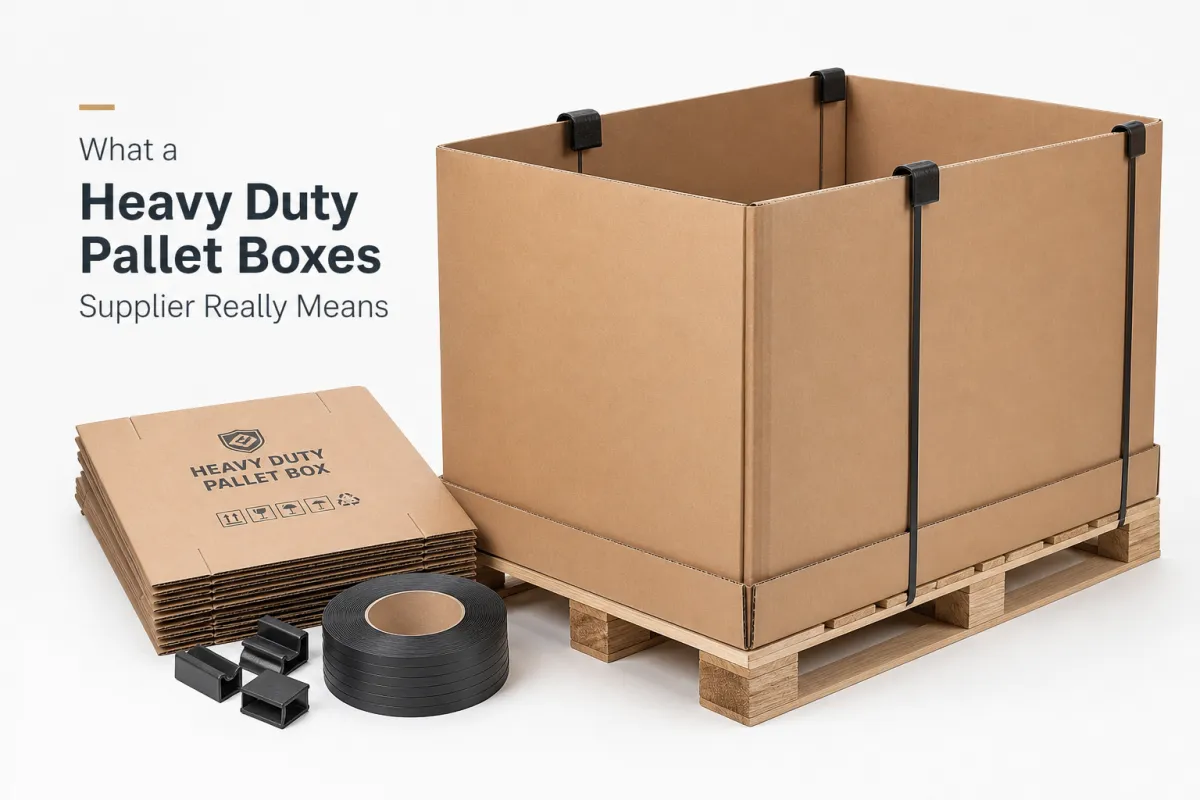
In plain English, a heavy duty pallet boxes supplier builds shipping containers that can take abuse a regular carton would never survive. These boxes are made for heavier contents, palletized handling, and stacking loads far beyond what a standard retail shipper ever sees. A product may be packed once and handled many times. That alone changes the structure you need. A heavy duty pallet boxes supplier works with corrugated board, wood-based panels, or hybrid systems that hold shape under compression instead of sagging after one warehouse stop.
Exporters need this. Industrial parts shippers need this. Appliance brands need this. Auto suppliers need this. Anyone sending dense product that dents, cracks, shifts, or crushes under pressure needs it too. A light cosmetic carton can look fine on a pallet and still fail the moment a forklift clips a corner. A heavy duty pallet boxes supplier thinks about those real handling conditions instead of the marketing photo. The difference shows up fast once freight starts moving.
One mistake buyers make is assuming rigidity equals strength. It does not. A box can feel stiff in your hands and still fail in transit if the flute profile, wall count, joint style, or pallet interface is wrong. A better heavy duty pallet boxes supplier asks about product weight, stacking height, moisture exposure, and whether the shipment is going into a truck, container, or long-term warehouse storage. That conversation matters more than a glossy print finish.
I have seen buyers get fooled by a sample that looked great on a desk and then folded up under real load. Pretty samples are nice. Shipping performance pays the bills. Packaging has a way of being honest when everything else is trying to be polite.
Practical definition: a heavy duty pallet box is usually a large-format corrugated or wood-based container built to support palletized loads, resist sidewall compression, and protect dense or awkward products during shipping and storage.
The supplier choice matters because the box is only one part of the system. A heavy duty pallet boxes supplier may specify double-wall or triple-wall board, reinforced corners, stitched seams, or a pallet sleeve, but if the pallet itself is weak or the load is stacked badly, the package still fails. Packaging is annoying like that. Every part has to pull its weight or the weak link does the talking.
From a buyer's point of view, the right heavy duty pallet boxes supplier also brings judgment. They should know when a design is overbuilt, when a pallet fit is sloppy, and when a cheaper reinforcement pattern would perform just as well. That kind of advice is often worth more than a lower quote. If you want a broader view of structural options, the Custom Packaging Products page is a useful starting point before you ask for samples.
There is also a sourcing angle. A good heavy duty pallet boxes supplier should understand whether your board needs FSC-certified fibers, whether the load will be exposed to humidity, and whether the shipment needs to align with export rules or warehouse practices. For paper sourcing, FSC-certified materials are worth asking about when sustainability claims matter to your brand or your customer. Strong packaging and responsible sourcing do not have to compete.
And yes, some buyers still assume wood means "strong" and corrugated means "cheap." That split is kinda lazy. In reality, the best choice depends on the load, the route, and how many hands touch the shipment before it lands.
How Heavy Duty Pallet Boxes Work in Real Shipping
A heavy duty pallet boxes supplier is really selling a load path. That sounds technical because it is. The pallet takes the bottom impact, the sidewalls carry compression, and the top closure spreads stacking force so one point does not cave in. If the box is built well, the weight moves through the structure instead of punching through it. If the box is built badly, the load finds the weakest corner and starts a demolition job.
Shipping conditions change everything. Warehouse storage is one thing. Truck freight is another. Export lanes add vibration, temperature swings, and humidity that can soften board performance. Mixed stacking weights make the problem worse because a top load can behave fine in one lane and fail badly in another. A heavy duty pallet boxes supplier should know that a box passing in dry indoor storage may act differently after two days in a container crossing a wet route.
Construction choices matter a lot here. Double-wall corrugated works for many industrial loads, especially when the pack is balanced. Triple-wall corrugated steps up compression capacity for heavier or taller stacks. Plywood or hybrid pallet boxes make sense when the product is dense, irregular, or exposed to rougher handling. Reinforced corners, stitched or glued seams, slip sheets, internal dividers, and sleeves all improve stability when used for the right reason. Use them because the load needs them, not because a catalog page made them sound heroic.
Pallet fit is one of the most underrated details. A sloppy footprint lets the box shift, and movement destroys strength faster than most buyers expect. Edge crush starts at the corners, then the whole structure starts to sag. A tight fit can reduce the need for banding or stretch wrap and makes stacking more predictable. This is the sort of detail a serious heavy duty pallet boxes supplier checks before quoting. If they do not ask about pallet footprint, I would ask why they are skipping the basics.
It helps to think of the package as a system:
- Box - carries the product and resists compression.
- Pallet - takes the floor contact and forklift interface.
- Wrap or banding - keeps the load from walking around.
- Internal inserts - stop movement inside the box.
- Handling method - determines how often the load gets stressed.
That system view is where a heavy duty pallet boxes supplier earns trust. Packaging engineering and test methods are not filler. Real suppliers should be able to talk about compression, vibration, and handling in practical terms. If you want to see the kind of standards packaging teams reference, the ISTA test standards are a useful benchmark, especially when product damage has already become too expensive to keep tolerating.
In practice, the box is not trying to be indestructible. It is trying to survive the route with enough margin left to arrive intact. That margin is the whole game. A heavy duty pallet boxes supplier who understands that will ask more questions up front and save you a lot of expensive guessing later.
One more practical reality: drivers and warehouse teams do not treat every load gently. They are moving fast, and the package has to survive the human factor too. That is where a little extra structure can save a lot of grief.
Key Factors That Drive Strength, Price, and Performance
The biggest price driver is usually the material spec. Board grade, wall construction, and custom sizing matter more than decorative print or cosmetic extras. A heavy duty pallet boxes supplier will normally price around the structure first because that is where the performance lives. A box made from heavier linerboard with a better flute profile costs more, and for good reason. The material is doing real work.
Buyers often miss the tradeoff. Thicker board and heavier construction reduce damage risk, but overbuilding adds freight cost, storage cost, and material waste. If the box is too large or too heavy, you pay for it every time the load moves. That is why a good heavy duty pallet boxes supplier should not just agree with your first idea. They should test whether the structure can be smaller, smarter, or lighter without sacrificing protection.
What changes the quote fastest
Size and load profile change the number quickly. A 24 x 24 x 24 box for a 30 lb load is one thing. A 48 x 40 pallet box carrying 350 lb of dense components is another. Product weight, stack height, pallet footprint, and how tightly the product is packed all affect the spec. If the internal fit is loose, you need more reinforcement. If the stack is tall, you need more compression resistance. If the route is humid, you may need moisture protection. A heavy duty pallet boxes supplier should price around those realities, not around optimism.
Performance extras that can be worth it
Some features raise cost but earn their keep. Moisture-resistant treatments help in export or cold-chain-adjacent lanes. Coatings can improve print and surface durability. Reinforced bases reduce floor failure during forklift movement. Die-cut handles help manual handling, though I would not add them just because they look useful. Custom inserts can protect irregular parts from rattling around and beating up the wall. A heavy duty pallet boxes supplier should explain why each add-on exists. If they cannot explain it, you are probably paying for decoration.
Hidden cost traps are the real nuisance. Low minimums sound friendly until the per-unit price jumps. Oversized boxes increase cube and freight charges. Rushed production can reduce inspection time. Vague quotes hide tooling, samples, freight, or setup fees until the invoice shows up and ruins everybody's mood. A decent heavy duty pallet boxes supplier should break those costs out early. If the number looks unusually low, ask what was left out. Usually something was.
Another thing buyers miss is labor. A slightly cheaper box can become the expensive one if it takes two extra minutes per pack line to assemble. That is the kind of math that gets ignored until the warehouse starts complaining.
| Construction type | Typical use case | Common price range per unit | Notes |
|---|---|---|---|
| Double-wall corrugated pallet box | Midweight industrial goods, standard palletized freight | $18-$38 at 500 units | Good balance of cost and compression; often enough when the load is stable. |
| Triple-wall corrugated pallet box | Heavier loads, taller stacks, export lanes | $28-$55 at 500 units | More board, more strength, more freight cost. Not magic, just more material doing real work. |
| Plywood or hybrid pallet box | Very dense parts, rough handling, repeated reuse | $45-$120+ depending on size | Useful where compression and handling abuse are both high, but storage and labor need planning too. |
Those ranges are not a promise. They move with size, print coverage, volume, and shipping terms. Still, they help buyers sanity-check a quote from a heavy duty pallet boxes supplier. If a triple-wall quote lands below a comparable double-wall structure, something is off. Usually the spec changed, the freight is not included, or the supplier quietly trimmed the material.
Another detail worth checking is certification. Some buyers need FSC chain-of-custody documentation. Others care more about compression data, moisture performance, or whether the design aligns with ASTM D642 testing. A heavy duty pallet boxes supplier that can explain these details is usually safer to work with than one that only repeats "it should be fine." Packaging is not a faith-based system.
If you are trying to choose between price and performance, start by asking a blunt question: what failure are we paying to avoid? Once that is clear, the right box spec becomes easier to justify, and a heavy duty pallet boxes supplier can stop quoting guesses and start quoting engineering.
How to Compare Heavy Duty Pallet Boxes Supplier Quotes
Comparing quotes the right way starts with one rule: use the same spec sheet for every heavy duty pallet boxes supplier. Same dimensions. Same board grade. Same pallet footprint. Same print requirement. Same MOQ. Same freight terms. If the inputs differ, the prices are theatre. And nobody needs more theatre in packaging procurement.
Ask each heavy duty pallet boxes supplier for a written spec sheet before you compare the numbers. That sheet should spell out wall construction, flute profile, board grade, joint style, insert details, coating, and delivery terms. If one quote says "double-wall" and another says "industrial board," you do not have a comparison. You have a polite misunderstanding.
The lowest price can be the most expensive option if the supplier is quietly reducing board thickness, removing reinforcement, or charging later for tooling and freight. Cheap packaging is only cheap if it survives the route and arrives on time. Once you add damage claims, repacks, chargebacks, and labor to fix the mess, the bargain quote often turns into a headache with a tracking number.
Here is a simple way to compare a heavy duty pallet boxes supplier quote without fooling yourself:
- Check exact dimensions and tolerance.
- Confirm board grade and wall count.
- Verify whether samples and tooling are included.
- Ask for lead time from proof approval, not from the first email.
- Confirm freight terms, carton count, and delivery method.
- Request performance data or prior test references where possible.
A reliable heavy duty pallet boxes supplier should be able to explain why one construction costs more than another. If they cannot, that is not a pricing strategy; that is a red flag wearing a lanyard. The best suppliers talk about failure modes, not just unit cost. They know that an extra few cents in board can save a lot more in claims and repacking labor.
The right question is not "Which quote is cheapest?" The right question is "Which heavy duty pallet boxes supplier gives me the lowest total risk?"
That total risk view is where custom work starts to make sense. If the box has to fit a tight pallet footprint, hold an odd-shaped load, and survive a humid route, custom structure becomes a practical choice rather than a luxury. This is also where browsing Custom Packaging Products can help buyers see what options exist before they ask for a spec revision.
One more thing. Ask for samples that match the actual load, not a toy version of it. A sample that looks nice on a desk tells you very little about compression or handling. A sample that is close to the real pack tells you whether the box is overbuilt, underbuilt, or simply awkward to use. A serious heavy duty pallet boxes supplier will not mind that request. In fact, they should expect it.
What the Ordering Process and Timeline Usually Look Like
The ordering process is usually more structured than buyers expect. A heavy duty pallet boxes supplier will typically start with a discovery call or spec review, then move into a sample or prototype, then approval, production, quality check, and shipment. That sounds tidy on paper. Real life adds delays where people forget to send dimensions, artwork changes after proofing, or someone decides to "just adjust" the box size after the quote has already been approved. That little habit costs time. A lot of it.
For simple stock-based customization, the timeline can move quickly. Fully custom pallet box projects usually take longer because the supplier needs time for structural review, sample preparation, and production scheduling. In many cases, simple projects may finish in roughly 7 to 12 business days after approval, while more complex runs often sit in the 12 to 20 business day range, depending on volume and material availability. If the job needs special inserts, moisture treatment, or outside freight coordination, the schedule stretches further. A heavy duty pallet boxes supplier should give you a range, not a fantasy.
Where do delays usually happen? Incomplete specs is the big one. Slow artwork approval is another. Changing dimensions mid-project is almost guaranteed to push the ship date. Supplier wait time for test confirmation or deposit clearance can also stall the job. None of this is mysterious. It is just packaging work being packaging work.
Prepare these details early:
- Product weight per unit and per shipper.
- Unit dimensions and packed orientation.
- Pallet footprint, including overhang tolerance if any.
- Maximum stack height in storage and transit.
- Handling method: forklift, hand move, conveyor, or mixed.
- Route type: domestic, export, or warehouse-only.
- Moisture, temperature, or vibration exposure.
- Any internal dividers, inserts, or branding requirements.
When buyers skip this prep, the project drags. When buyers come in with a clean spec, the heavy duty pallet boxes supplier can move faster and usually price more accurately. That is not magic. It is fewer assumptions. Packaging runs on assumptions the way bad recipes run on shortcuts.
There is also a smart way to plan urgency. Build in buffer time for revisions, transit, and reorders. Do not order pallet boxes the week before the shipment leaves unless you enjoy gambling with production schedules. A good heavy duty pallet boxes supplier can move efficiently, but they cannot bend time because the freight forwarder is having a bad Tuesday.
If you have never run a custom pallet project before, the timeline can feel annoyingly slow. It is still faster than fixing a damaged shipment. Trust me on that one.
Common Mistakes Buyers Make With Heavy Duty Pallet Boxes Suppliers
The first mistake is buying by guesswork. Some buyers overspec the box because they are scared of damage, then end up paying for strength they never needed. That is wasteful, and it often makes freight and storage worse. The box is not a trophy. A good heavy duty pallet boxes supplier should size the structure to the load, not to somebody's anxiety.
The second mistake is ignoring the environment. A box that works in dry storage can fail in humid transit, cold storage, or repeated warehouse handling. Board performance changes with moisture and temperature. If the route includes long dwell times or export shipping, the supplier needs to know. A heavy duty pallet boxes supplier that does not ask about those conditions is leaving out a big part of the problem.
The third mistake is forgetting the pallet itself. A weak pallet, bad pallet fit, or poor load distribution can ruin an otherwise strong design. The box and the pallet have to behave like one package. If the footprint slides, the corners take damage. If the pallet bows, the bottom panel loses support. If the wrap is lazy, the load shifts. None of that is mysterious, and all of it is expensive when it goes wrong.
The fourth mistake is skipping sample testing. One dimension error, one weak joint, or one bad insert can turn into crushed product, claims, or returned freight. A heavy duty pallet boxes supplier should encourage practical testing. Compression testing is useful, but so is a real handling check. If the sample cannot survive realistic use, the production run will not improve because everyone hoped harder.
The fifth mistake is forgetting about storage and handling inside the facility. Huge pallet boxes are not useful if they cannot be staged, nested, or moved efficiently. Labor matters. Floor space matters. Forklift access matters. A box that protects beautifully but creates a bottleneck is still a problem, just a more expensive one.
There is a pattern here: most failures come from missing context, not from bad intent. Buyers want to protect the product, and suppliers want to ship a workable box. But a heavy duty pallet boxes supplier can only solve the problem that gets described clearly. Vague instructions produce vague protection. That is packaging law as far as warehouses are concerned.
I would also watch for a quieter problem: teams that keep changing the brief after the sample is approved. That habit is a wrecking ball. It slows everything down and confuses everyone in the chain.
Expert Tips Before You Choose a Heavy Duty Pallet Boxes Supplier
Start with a one-page spec. Keep it simple, but keep it exact. Include product weight, max stack height, pallet size, shipping route, moisture exposure, handling method, and branding needs. That single page helps a heavy duty pallet boxes supplier quote faster and stops everyone from playing email tennis with missing details.
Ask for sample testing that matches reality, not ideal conditions. Compression data is useful, but it is not the whole story. Vibration, stacking, and handling all matter too. If the shipment will move through a rough warehouse or export lane, ask how the box behaves after those stresses. A heavy duty pallet boxes supplier worth your time will not hide from that conversation.
Standardize box sizes where possible. Fewer sizes mean fewer tooling changes, simpler reorders, and better pricing through repeat volume. It also reduces mistakes at the warehouse level, which is one of those boring wins that saves real money. Buyers love complexity until they have to store it.
Use the supplier to solve problems, not just to manufacture a drawing. The best heavy duty pallet boxes supplier can suggest structural tweaks that cut cost without hurting protection. Maybe the wall count can stay the same while the footprint shrinks. Maybe one insert can replace a heavier base. Maybe print coverage can move to one side instead of four. Small changes like that can make the whole job cleaner.
Before you sign off, ask these questions:
- What is the exact board grade and wall construction?
- What testing or performance basis supports the design?
- What is included in the price, and what is not?
- What is the lead time from proof approval?
- How will the box be packed for shipping?
- What happens if a sample needs revision?
Those questions separate a real heavy duty pallet boxes supplier from a quote machine. You want someone who understands tradeoffs: heavier board costs more, but it can reduce damage; a tighter fit helps stability, but it can complicate loading; better testing costs time, but it can save a lot of grief. That is the kind of reasoning buyers should expect.
If you are sorting through options now, shortlist two or three suppliers, send the same brief to each, and compare their answers line by line. Do not just skim the bottom line. Compare structure, timing, included services, and how clearly each heavy duty pallet boxes supplier explains the why behind the quote. The cheapest number is not the winner if it cannot protect the load. That is how people end up paying twice.
In practice, the strongest supplier is not the one that shouts the loudest. It is the one that asks the best questions and gives you clean answers. Quiet competence beats sales noise every time.
How do I compare heavy duty pallet boxes supplier quotes fairly?
Use one spec sheet for every supplier so dimensions, board grade, wall construction, print, and shipping terms are identical. Ask what is included in the price: tooling, samples, freight, and setup fees can change the real cost a lot. Compare performance details, not just the number at the bottom.
What details should I send to a heavy duty pallet boxes supplier first?
Send product weight, unit dimensions, pallet footprint, stack height, and whether the load will be exported, warehoused, or shipped domestically. Include moisture exposure, handling method, and any special inserts or internal dividers. The more exact the brief, the less time you waste on revisions.
How long does it usually take to produce custom pallet boxes?
Simple customizations can move faster, but fully custom projects usually need time for sample approval and production scheduling. Timeline risk comes from design changes, artwork delays, and unclear specs more than the manufacturing itself. Build in buffer time so you are not ordering the boxes after the shipment is already late.
Can a heavy duty pallet boxes supplier help reduce packaging cost?
Yes, if they optimize material usage, right-size the box, and remove unnecessary reinforcement. The cheapest-looking box is not always cheapest overall if it causes damage, freight waste, or storage problems. Good suppliers focus on total cost, not just unit price.
What testing should I ask for before placing an order?
Ask for compression, stacking, and handling test data that matches your real shipping conditions. If the product is sensitive to moisture or vibration, ask how the box performs after exposure to those conditions. A supplier that cannot explain the test basis is guessing, and that is a bad habit in packaging. For that kind of job, a careful heavy duty pallet boxes supplier is worth far more than a bargain quote.